
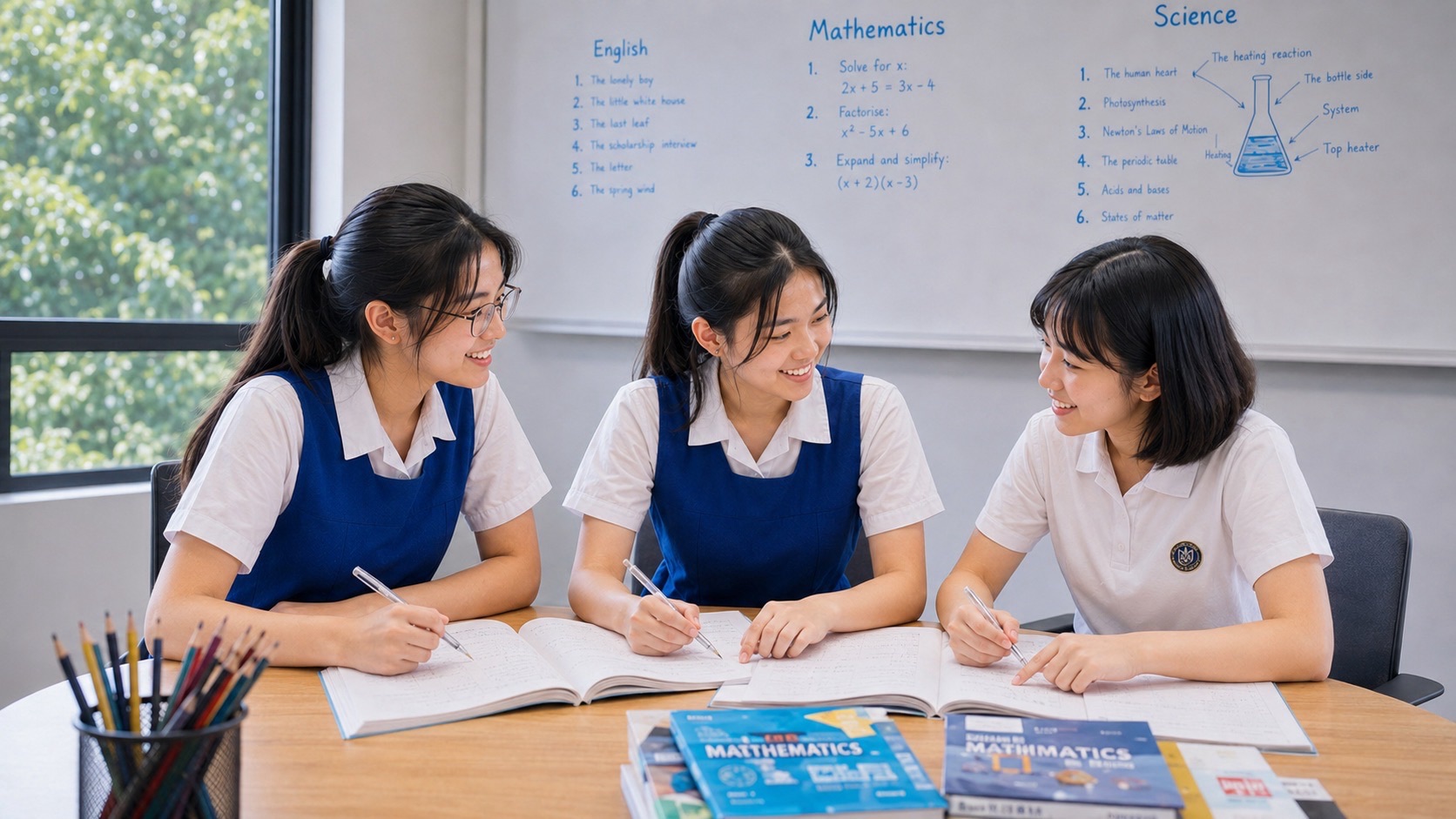
Secondary 2 Chinese small-group tuition for Pasir Ris families can be helpful when the student needs close feedback, purposeful discussion and more opportunities to attempt Chinese independently. A carefully matched three-pupil tutorial can provide these conditions, but class size alone does not improve marks. The first decision is whether the child’s actual weakness fits the proposed teaching and whether the weekly arrangement is sustainable.
For Pasir Ris readers, this guide focuses on oral participation and listening comprehension without rote scripts. It explains what a productive ninety-minute tutorial might do, why students sometimes need school or individual help instead, and how parents can review progress without exaggerated promises. The estate in the title identifies the audience; it does not establish that a suitable Secondary 2 Chinese class exists at a specific local address or has vacancies.
- Potential benefit: individual participation, timely correction and thoughtful peer comparison.
- Possible consequences: mismatch between levels, embarrassment, fatigue, tuition cost and dependence on model answers.
- First action: inspect the child’s school Chinese level and recent independent work before choosing materials.
- Course distinction: G1, G2, G3 Chinese and Higher Chinese must not be confused.
- Review method: test a fresh reading, oral or writing task after several weeks with fewer prompts.
- Availability: verify the actual subject, teaching venue, tutor, group size, fees and vacancies.
This parent guide uses practical illustrative exercises, not promises that all Pasir Ris children share the same learning needs. Parents should judge tuition by its effect on the child’s independent language competence rather than by advertised prestige or the thickness of a workbook.
The Pasir Ris parent guide: oral participation and listening comprehension without rote scripts
Pasir Ris parents: oral Chinese is not one skill
A student may understand a Mandarin question but take a long time to answer. Another speaks rapidly about familiar hobbies yet struggles to explain a judgement. A third can read a prepared paragraph fluently but cannot respond to a follow-up. These are different oral challenges. Parents researching Secondary 2 Chinese small-group tuition for Pasir Ris should ask the tutor how they distinguish comprehension of the prompt, retrieval of vocabulary, organisation of reasoning and the confidence to begin. Treating all hesitation as poor pronunciation or laziness can direct practice toward the wrong problem.
An informative diagnostic asks a familiar question such as whether students should help organise a school event. Give thinking time, note the first independent response and then ask for a reason. The tutor can observe whether the learner understands the task, can find the needed word and connects the example to the opinion. The goal is an attainable first target, not the immediate performance of a long scripted speech. A useful class can give every student repeated, supportive opportunities to make that next step.
Listening and speaking can fail at different points
Parents sometimes assume that listening and oral Chinese improve together automatically. A child may follow an audio message accurately but struggle to produce the language needed to summarise it. Another may speak confidently on a familiar topic yet miss a changed plan in a recording. A tutor should assess these modes separately before designing practice. A short listening clip, an oral summary and one follow-up question can reveal whether the obstacle lies in receiving meaning, keeping it in mind or expressing it.
For example, an announcement might originally place an activity in a classroom but later move it to the hall. A pupil who remembers only the first location needs to listen for correction signals. A pupil who identifies the new location but cannot explain it in Mandarin needs expression practice. In a three-person tutorial, learners can compare the evidence they heard while the teacher checks each child’s own answer. A single correct group response does not demonstrate that all three can understand and speak independently.
Build an oral staircase from short answers
A student who says only “同意” to an opinion question may have a valid starting thought but not yet a complete spoken answer. A useful staircase adds a reason, a concrete example and then a response to a sensible challenge. The tutor can model “我同意,因为……” and help the child select a reason linked to the question rather than a memorised phrase that sounds impressive. The next step can be a practical illustration from school life. A longer answer is helpful only when each sentence contributes something relevant.
A small group can share different ideas for the same prompt, then require each pupil to form an original response. One learner may advocate including classmates in a project, another may focus on fairness and a third on responsibility. The teacher should not impose a single ideal opinion. Instead, check clarity, logical connection and appropriate vocabulary. A fresh topic in the following week reveals whether the staircase became a reusable strategy or remained a rehearsed answer about one specific event.
Give quiet thinking time before asking anyone to speak
Some learners need a short pause to organise their thoughts, especially in a second language. A tutor who always accepts the first raised hand may accidentally teach the others to wait for someone else to answer. In a three-person class, all students can first jot down a keyword or identify a reason privately. The teacher then invites individual answers, allowing different paces while keeping expectations clear. Silence at the beginning of a task is not proof that the child has no ideas.
Parents can ask whether the tutor provides preparation time and how often the quieter learner contributes during the lesson. A good teacher also notices whether the student becomes more able to begin without elaborate scaffolding. The aim is gradual independence, not permanent dependence on a written script. Repeating the same prompt faster is less meaningful than explaining a different situation clearly with a smaller amount of preparation.
Why memorised oral scripts can be misleading
A fluent recitation creates an impression of proficiency, but it may measure memory rather than the ability to communicate. When a follow-up asks for a different example or challenges the student’s first opinion, a rehearsed paragraph can become unusable. A good tutor may teach a response structure and useful expressions, but should then change the scenario. The student needs to understand the idea well enough to respond to a new question in natural Chinese, even with simple vocabulary.
One useful exercise asks the learner to state a position on an issue and then consider what might make the suggestion difficult. For instance, a proposal to reduce waste may involve practical costs or the convenience of different families. Each pupil can offer a different limitation. The tutor should reward a clear, relevant answer rather than an ornate speech that ignores the changed question. Parents can ask to see whether a student now handles unfamiliar prompts, not merely whether a previously memorised performance sounds smoother.
Pronunciation should support understanding rather than interrupt every idea
Pronunciation matters because the listener must understand the speaker. Yet interrupting every minor sound error can make a hesitant learner lose their train of thought. A skilled tutor distinguishes an error that changes meaning from one that can be corrected after the sentence is complete. Feedback might target a tone, an unclear word boundary or a recurring sound pattern, but the speaker should also be encouraged to finish the intended explanation. Correct speech involves both intelligibility and connected thought.
The teacher can keep separate targets for pronunciation and answer quality. A learner who pronounces clearly but provides an irrelevant example needs reasoning feedback, not another set of pronunciation drills. Another who has a sound argument but repeatedly says an important word unclearly can practise that expression briefly. A three-person group gives multiple opportunities to hear accurate models without turning the session into a public ranking of accents. A successful correction helps the child communicate more confidently on a future topic.
Everyday spoken Chinese and school Chinese have different demands
A child may chat comfortably with family yet struggle with the vocabulary needed to express cause, responsibility, comparison or an opinion during school oral tasks. Everyday conversation often relies on shared experience, gestures and partial sentences. More formal answers ask the student to organise ideas for a listener who cannot fill in every gap. The tutor should show how to move from an ordinary description to a complete explanation without treating home speech as inferior.
Begin with a familiar situation, such as planning a class event or helping a friend. Ask what happened, then why someone acted and what result followed. The child can use a simple sentence before extending it with a precise connector and example. A group can compare different formulations and discuss which one fits the intended audience. The learner gains the ability to choose a register and level of detail, not the belief that every natural conversation must sound like a written essay.
Listening for correction rather than the first familiar word
A recording may mention one time or venue and then revise the arrangement. A student who immediately selects the first familiar phrase can answer incorrectly even with adequate vocabulary. The tutor can teach listeners to wait for the complete message and recognise words that signal contrast, exception or change. The objective is understanding the speaker’s final meaning, not transcribing every syllable. Short recordings are often more useful at the diagnostic stage because the exact point of misunderstanding can be identified.
In a three-student listening exercise, one pupil can describe the first plan, another identify the change and a third explain its cause. Roles then rotate on a new recording so that everyone practises the full process. The tutor should note whether the error resulted from unfamiliar vocabulary, loss of attention or ignoring a correction. Parents can support this with short, age-appropriate audio at home rather than insisting on long daily transcripts that may simply exhaust the child.
Answer the follow-up rather than restarting a prepared speech
When someone asks “为什么?” after a pupil states an opinion, the student needs to explain the reason. Repeating the opinion with different vocabulary does not answer the follow-up. A tutor can help learners identify what new information the listener now requires. This is a powerful connection between oral practice and reading comprehension: both begin by recognising the exact demand of a question rather than selecting a familiar-looking answer.
One pupil may say community service is useful; a classmate can ask who benefits and the tutor can ask for a concrete example. The student learns to develop the original point rather than change to an unrelated topic. In a small group, peers can supply genuine questions, while the tutor checks that their questions are respectful and relevant. A new topic tests whether the child can sustain this exchange without a full script. That is closer to real communication.
Group discussion should not become a speed contest
A confident speaker may answer before another student has formed a sentence. If this pattern repeats every week, the slower learner can become a spectator. A three-person tutorial needs explicit turn management. The tutor can set short private preparation, ask everyone to give an initial answer and rotate the roles of speaker, listener and questioner. The teacher should make room for different rates of retrieval without removing the expectation that each child participates.
Parents can ask the tutor how individual learning is recorded. A child may now provide a complete reason rather than a one-word answer; another may offer a more specific example. The standard should be whether each student has improved against their own baseline and school requirements, not whether they finish before a classmate. A healthy group teaches students to listen carefully and change their minds when a peer offers a better argument.
Use familiar situations without inventing local programme claims
For Pasir Ris families, everyday settings can make oral discussion more accessible. A hypothetical conversation about meeting friends at a park, keeping a shared space clean or planning safe travel after an activity gives the learner a topic they can understand. The educational task is to explain reasons and consequences in Chinese. The tutor need not claim that a particular local venue or school programme runs the activity, and this article does not establish that Chinese tutorials operate at any Pasir Ris address.
Students might discuss whether a group should carry reusable bottles on an outing. One pupil explains the environmental reason, another considers convenience and the third suggests a practical compromise. After sharing ideas, each constructs an independent response. These are imaginary teaching prompts, not reports about actual neighbourhood services. Their value lies in the cognitive move from familiar experience to structured explanation, which can transfer to other school oral topics.
A listening task should check gist before detail
A child who tries to remember every spoken word may miss the overall purpose of a message. Listening practice can begin with an accessible question: what is this conversation mainly about? Only after that should the student focus on a particular location, reason or change. This division helps the learner organise attention. A tutor should choose language that is appropriate to the child’s course before increasing speed or complexity.
A short recording about planning a group activity might include several suggestions. The gist could be that students are choosing an arrangement, while a detail concerns the eventual decision. A learner who understands the gist but misses a qualifying detail needs a different lesson from one who cannot identify the topic. The tutor should explain this difference to parents and test the selected skill later with new material. Listening is an active process of making meaning, not a competition to recall every word.
A helpful pause is different from an inability to respond
Teachers and parents may worry when a student hesitates before speaking Chinese. A pause can arise from several sources: choosing among words, organising evidence, avoiding an error or feeling anxious about peers. The tutor can listen to what happens after a little thinking time. Does the learner produce a coherent answer, or remain unable to locate the idea? Does an initial keyword cue help? The diagnosis determines whether the priority is retrieval fluency, conceptual understanding or a safer speaking environment.
A good small-group tutor should not humiliate the pupil for requiring time, yet the end goal is more independent responsiveness. The teacher can gradually reduce written planning and move from familiar to unfamiliar prompts. Parents should look for increasingly relevant answers and less dependence on supplied language. A faster but unsupported response is not necessarily improvement. The student should gain the ability to communicate what they mean, not simply reduce silence at any cost.
Oral vocabulary should be learned for communicative purposes
Vocabulary lists often separate words by school chapter, but an oral learner may need a bank organised around actions: stating a viewpoint, disagreeing politely, giving a reason, providing an example and acknowledging a limitation. The tutor can teach a few natural expressions for each purpose and demonstrate their register. Students should then use the phrases in different contexts, because the same wording may not fit every situation.
For example, a simple causal explanation can use 因为, while a more nuanced comparison may need 虽然 or 然而 in an appropriate sentence. The class can compare meanings and decide when a plainer expression would be better. After practice, the tutor removes the bank and asks for a new answer. A child who chooses language without seeing the list has gained practical access to vocabulary. Parents should favour this flexible outcome over memorising a long collection of impressive phrases.
Pair short listening and writing tasks
Listening practice can produce useful writing when the tutor asks the student to summarise a message rather than transcribe it word for word. The pupil hears a brief scenario, identifies what changed and writes one or two Chinese sentences conveying the relevant meaning. The teacher can now see whether the child understood the audio and whether they can construct the written explanation. These may be separate bottlenecks, and the lesson should distinguish them.
In a group, pupils can first discuss their understanding, then each write independently. One child might know the answer but omit a necessary connector. Another may write accurately but have misunderstood the speaker. The tutor gives the correction that matches each error. A fresh listening-to-writing task later tests transfer. Such cross-mode practice is useful when it strengthens meaning and expression rather than creating an unnecessarily long homework burden.
Parent support without turning every conversation into an oral test
Families may try to improve oral Chinese by insisting that the child answer every home question in perfect Mandarin. Constant correction can make ordinary communication stressful, particularly when the child already feels uncertain. A better routine separates natural family conversation from short planned practice. During everyday interaction the main objective is connection. During a focused practice period, the parent can invite one complete reason or ask the child to explain a story they read, then leave detailed grammar feedback to teachers when necessary.
Parents do not need to be expert Chinese speakers to protect a consistent routine and celebrate a genuine attempt. If the child cannot find a word, the adult can help keep the conversation going rather than treat the hesitation as failure. The tutor can recommend age-appropriate audio or simple speaking prompts matched to the child’s course. A supportive environment builds opportunities to retrieve language and should not require the family to imitate an examination hall every evening.
A Pasir Ris family should check the full timetable
A lesson advertised with a neighbourhood label may be held elsewhere or may not currently exist for the requested subject. Families should verify the tutor, physical venue, G-level suitability, fees, class size and vacancies before making travel arrangements. For a child coming from school and co-curricular activities, the combined journey and lesson may leave little energy for effective oral practice. The cost of the arrangement includes preparation, homework and recovery time, not only the advertised ninety minutes.
Parents can ask when the child is usually most alert and whether the group timetable allows enough rest. A convenient class that has unsuitable material may waste time; a very long journey to an otherwise strong tutor may be unsustainable. Look at the whole week, including independent reading and other subjects. Tuition should support the child’s development, not consume every opportunity to use language in an unstructured, enjoyable setting.
A four-week oral and listening check
Week one can record a short independent spoken opinion and a listening task chosen at the student’s current level. In week two, teach the main bottleneck, such as giving complete reasons or recognising a change in a spoken plan. In week three, practise the same operation on a different topic and reduce prompts. In week four, use a fresh scenario and compare the child’s response with the baseline. The review should include accuracy, relevance and how independently the child responded.
The tutor might report that the pupil now provides a relevant reason but still struggles to retrieve supporting examples. Another may identify the gist of a recording but still miss a critical correction. These observations point to the next lesson and are more honest than a guaranteed examination grade. If the child remains unable to participate comfortably or the group is poorly matched, consider another format. A few weeks can clarify the method’s suitability even when broader language development takes longer.
When small-group speaking practice is not the right format
A child who is distressed by group performance or unable to access the shared language may need individual or school-based intervention first. A small class can offer a safer environment than a large one, but it is not automatically emotionally comfortable. The tutor should notice whether the learner attempts responses, how peers react and whether instruction is pitched appropriately. Forcing repeated public performance may increase avoidance rather than build confidence.
The provider should be willing to discuss alternative arrangements when the group cannot meet the child’s needs. Parents can ask what adaptation will be tried and what evidence will show whether it helped. A respectful learning environment combines clear expectations with protection from ridicule. No family should feel obliged to persist merely because the class has only three pupils. Educational fit is more important than a marketing claim about exclusivity.
The lasting benefit of oral tuition is independence
The desired outcome is a student who can understand a new prompt, organise a position, supply a reason and respond to a follow-up without relying on a memorised script. In listening, they should recognise the main message and important changes. This ability needs to persist on different topics and outside the familiar tutorial. The tutor should increasingly withdraw cues so that the learner performs the necessary thinking.
Once these skills stabilise, the family may reduce tuition and maintain progress through school activities, age-appropriate listening and comfortable everyday conversation. If the child still needs the tutor to dictate every next word, the method should be reconsidered. The benefit of a well-run Pasir Ris-focused small-group programme is competence the student carries away from the class, not attendance that must continue indefinitely.
The teaching method, subject levels and parent decision framework
What the parent should diagnose before paying for tuition
An examination mark is an outcome, not a diagnosis. One Secondary 2 student cannot recognise enough Chinese words to read independently; another understands the passage but answers a different question. A third writes grammatically complete sentences yet loses relevance halfway through a composition. These children do not need the same workbook. Before buying a class, examine recent school feedback, a fresh short passage, an independent writing sample and a short oral response. Ask where the first meaningful error occurs rather than assuming that more repetition is always the cure.
The tutor should be able to describe a clear next step. If the child cannot identify what a question asks, practise task interpretation. If the relevant evidence is located but not explained, practise the connection between evidence and answer. If the pupil has good ideas orally but cannot write them, teach sentence structure and retrieval. Families should keep the initial samples unchanged and compare them with a different task later. This makes the class accountable for actual learning rather than a pleasing folder of corrected worksheets.
Why a three-student class can work
A carefully managed three-pupil tutorial gives the teacher room to watch how each learner thinks and to respond before a misunderstanding becomes a habit. It also allows productive peer comparison: one child offers an explanation, another identifies supporting evidence and a third raises a question that tests it. But each student must attempt the task independently before and after group discussion. Otherwise a confident pupil may do most of the intellectual work and others merely copy the conclusion. A small table is a possibility for better instruction, not proof that better instruction takes place.
A responsible teacher must manage pace, roles and differences in proficiency. Every child should have a meaningful oral turn, written attempt and correction target. When one learner is far behind in character recognition while the others are analysing difficult passages, a shared class may not be efficient. Parents can ask how students are grouped and whether the provider would recommend individual or school-led help when necessary. A tutor willing to say that a particular group is unsuitable is protecting the student’s learning rather than filling every seat.
G1, G2, G3 and Higher Chinese need accurate course matching
Under Singapore’s Full Subject-Based Banding, subjects can be offered at G1, G2 and G3 levels. Posting Group is part of the posting and initial subject placement system; it is not a complete description of every subject a child studies. Parents should confirm the student’s actual Chinese Language level with their school before selecting tuition material. Ordinary Chinese and Higher Chinese must also be distinguished. Using a harder exercise for its prestigious label may reduce understanding when basic reading or sentence foundations remain unstable.
The teacher can occasionally simplify a text to repair a missing prerequisite or stretch a capable student with a deeper question. That is purposeful differentiation, not the replacement of the school’s course with an unrelated programme. If children in the same tuition group take different Chinese courses, ask what can genuinely be shared and which responses receive different feedback. Formal subject-level changes remain a school matter. The tutor should promise careful preparation and diagnostic teaching, not control over a student’s future placement or examination eligibility.
The 2027 SEC is not a Secondary 2 weighted assessment
The Singapore-Cambridge Secondary Education Certificate, or SEC, begins in 2027 for national secondary exit examinations. SEAB lists Chinese Language K120 at G1, K220 at G2 and K320 at G3, as well as Higher Chinese K355 at G3. These codes help families understand the eventual examination pathways; they are not names for ordinary Secondary 2 school papers. The child’s current school determines its lower-secondary assessments and topic sequence. Parents should insist that an external tutor separates the current school task from a future national examination.
Long-term preparation can still guide the foundations taught now. Reading for meaning, producing evidence-based written responses, speaking coherently and following spoken changes of meaning are useful capabilities beyond one assessment. However, an advanced SEC specimen exercise may be the wrong learning material when a pupil cannot yet understand an age-appropriate school passage. Use MOE and SEAB documents to understand the system, and use school-issued materials to decide what is immediately relevant. Clear terminology helps prevent both unnecessary panic and false promises.
A ninety-minute lesson must be a cycle, not a lecture
A useful ninety-minute tutorial can begin with retrieval from the previous session, teach one important principle, provide guided practice and then require every learner to complete something independently. It should end with a concise correction and next-step task. The exact division of minutes can vary with the student’s level and school calendar. What matters is that all three pupils contribute rather than spend most of the time watching a tutor speak or copying an answer key. A high number of completed pages is not, by itself, an indication of strong teaching.
Parents can ask what the student did without help during the final part of a session. Could they explain an unfamiliar reading passage, give an unrehearsed oral reason or revise a sentence meaningfully? The tutor can record one correction target for each child and revisit it after a delay. Homework should reinforce that target without consuming the whole week. A class is demonstrating its value when the learner can transfer the method to a new task, not when the tutor can produce an excellent model answer on the board.
Use the Fence Method as a flexible language tool
A small vocabulary fence groups expressions by purpose. One bank may contain words for explaining causes, another for marking contrast, and another for describing feelings or decisions. This can help students retrieve appropriate language quickly. However, a useful bank is not an instruction to force every idiom and phrase into every composition. Students must understand the expression’s meaning, register and natural context. For example, 因为……所以…… gives a causal relationship, while 虽然……但是…… signals contrast. Choosing the wrong one can distort an otherwise sensible thought.
A tutor can first demonstrate the difference, then ask for original examples on new topics and revisit the expressions in later reading. When the child chooses words without the model in sight, the vocabulary has become more available for communication. When the pupil merely copies the same sentence or memorises an ornate opening, transfer is still unproven. Parents should value precise, flexible expression over large vocabulary counts and ask how vocabulary is applied in comprehension, oral work and writing.
Evidence-based comprehension beats plausible guessing
A student may offer a convincing explanation for why a character acted a certain way, but the passage may not support that explanation. The tutor should distinguish what the text states, what its clues permit the reader to infer and what the reader personally believes. An inference is not permission to invent motives. A careful learner first identifies the relevant action or sentence, connects it to the question and then expresses a conclusion no stronger than the evidence allows. This method also helps with questions requiring comparison, cause and effect or interpretation of tone.
Three students can propose different explanations and defend them by pointing to the passage. The tutor moderates, checks for overstatements and ensures that the discussion stays respectful. Afterward, every pupil needs a new independent question to demonstrate understanding. A shared conversation can expose errors, but it cannot replace individual thinking. The goal is a reliable reading procedure that survives unfamiliar texts, not a memorised list of stock descriptions such as ‘he was kind’ or ‘she felt sad’ applied to any character.
Composition improves when the central idea comes first
Some learners begin a Chinese composition with an elaborate description and then discover they have no clear story or argument to develop. The tutor should ask what the task requires, who the intended reader is and what the piece must establish. A narrative needs a meaningful event, a decision and a consequence. An explanatory paragraph needs a position, related reason and specific example. An ordinary but coherent sentence may be stronger than a showy phrase unrelated to the subject. Planning helps students select what belongs before investing time in surface polish.
In a three-person group, each learner can suggest a distinct outline and explain why it stays on task. The tutor should challenge irrelevant events, missing links and endings that do not follow from the story. Students then draft their own work rather than reproduce a shared model. Revision should target one significant issue at a time: unclear chronology, weak evidence, repetitive description or an unsuitable connector. The proof of improvement is that the learner can plan and edit a new piece without waiting for the tutor to supply its content.
A correction log should change the next lesson
A red-marked question is useful only when the student understands what went wrong. The teacher can record the first unstable step, a brief example and an appropriate future check. ‘Found the wrong speaker’ is different from ‘identified the right sentence but omitted the reason’; ‘knows the word but uses the wrong register’ differs from ‘cannot retrieve the word at all’. The next lesson should deliberately test whether that pattern persists. This keeps correction from becoming a ritual of copying better sentences.
Parents can ask for a brief comparison of independent attempts from two dates. They might learn that evidence selection has improved while written expression remains vague, or that a child now speaks more readily but still loses track of an audio passage. Such distinctions guide teaching more honestly than a blanket progress percentage. A corrected model is only the middle of the process. The endpoint is when the student recognises and repairs a similar problem without prompts.
Time, money, travel and confidence are genuine consequences
Tuition creates a weekly demand beyond the advertised lesson duration. Travelling, eating late, completing extra homework and losing independent reading time can reduce its overall value. A neighbourhood keyword in this guide is not confirmation of an operating class at that location. Parents must verify the exact venue, Chinese subject offered, tutor, grouping, fees and availability. A nearby class may still be unsuitable; a distant one may be educationally good but too tiring to sustain. The correct comparison includes the whole week, not only the classroom fee.
Poorly matched peers and harsh public comparisons can also damage confidence, particularly when a pupil is already anxious about Chinese. Conversely, a real gap that remains unaddressed may encourage avoidance. The appropriate response is neither compulsory tuition for everyone nor automatic rejection of support. Diagnose the need, select the least burdensome effective arrangement and review what the child can do independently. The family should be willing to change the group or stop when the negative consequences outweigh the benefits.
A four-to-eight-week review and an honest exit plan
Choose a small number of observable goals before enrolling. For example, the child might learn to find evidence for a comprehension answer, sustain an oral reason with a relevant example, or write a paragraph with a coherent central point. Keep an independent baseline and use unfamiliar tasks at review. A single school test remains relevant but can be affected by changes in difficulty and other circumstances. A grade guarantee would be misleading; a teacher can responsibly promise a clear process and evidence of what has or has not improved.
The tutor should gradually remove prompts rather than make the child reliant on polished model answers. Once the targeted ability is reliable, school support and independent reading may be enough to maintain it. If no transfer is visible, reassess the diagnosis, work difficulty, group match and home practice. A good provider will sometimes recommend an alternative or a pause. The lasting benefit of small-group teaching is a more capable learner outside the classroom, not a family that feels unable to stop paying for lessons.
Frequently asked questions
Does a 3-pax Chinese tutorial guarantee a better grade?
No. A small class creates opportunities for feedback, but the result depends on the teaching method, student readiness, practice, school assessments and other factors. No responsible provider should guarantee a distinction.
Is Secondary 2 Chinese examined as SEC?
No. Secondary 2 assessments are school-based. The Singapore-Cambridge SEC is the national secondary exit examination beginning in 2027; its subject syllabuses describe a later pathway.
Can a G2 pupil use G3 Chinese or Higher Chinese worksheets?
Occasional selected stretch tasks may help, but the central programme should follow the student’s actual school course and prerequisites. Higher Chinese is a separate subject, not simply a large stack of harder worksheets.
How does a parent know the group is genuinely small?
Ask for the stated maximum class size, actual pupil group, teacher and how speaking or written feedback is distributed. Three chairs alone do not demonstrate a good learning process.
Can parents who are not fluent in Chinese still help?
Yes. They can protect a small, sustainable reading and retrieval routine, encourage the student to explain ideas and let school teachers or tutors handle specialised language correction.
When should the family review the arrangement?
Choose a few learning targets, keep an independent starting sample and compare a new task after several weeks. The review should consider progress, motivation, fatigue and total household cost.
Does the estate name confirm an operating tuition centre?
No. This is an estate-focused parent information guide. Confirm Secondary 2 Chinese, the actual address, subject level, teacher, timetable, fees and vacancies directly.
When should tuition be reduced or ended?
When the student can independently perform the target skills across unfamiliar tasks and sustain them through school and home practice, or when the arrangement is creating disproportionate negative consequences.
A practical Pasir Ris checklist
- Confirm the student’s exact school Chinese course and current assessment tasks.
- Bring one independent reading answer, a writing sample and any relevant oral or listening concerns.
- Ask the tutor to diagnose the first unstable skill rather than label the learner generally weak.
- Check that all three students can participate in appropriate shared work and receive individual feedback.
- Ask how the tutorial uses retrieval, guided practice, independent application and a correction log.
- Verify actual venue, tutor, subject level, timetable, fees, homework and make-up policies.
- Review unfamiliar independent work and the child’s experience after a reasonable period.
- Be willing to reduce, change or end tuition when the evidence suggests another approach.
MOE, SEAB and the correct examination pathway
MOE Full Subject-Based Banding describes how subjects may be taken at G1, G2 or G3 levels. The SEAB 2027 SEC school-candidate syllabus directory provides official national-examination references, including G1 Chinese Language K120, G2 Chinese Language K220 and G3 Chinese K320 and Higher Chinese K355. These are upper-secondary exit-examination references; the learner’s school remains the source for Secondary 2 assessments.
Continue reading
- The SEAB Syllabus | 2027 SEC Chinese Language G1 G2 G3
- How G2 Chinese Language Works | SEC Guide
- How G3 Chinese Language Works | SEC Examination Preparation
- How G3 Higher Chinese Language Works | SEC Examination Preparation
- Secondary 1 Mathematics Tutor Clementi | Small Groups Tutorials — original format reference
The linked Clementi Mathematics tutorial is a structural example of eduKate’s three-pupil teaching format, not confirmation of a Secondary 2 Chinese programme at the same venue. To enquire, contact eduKate Singapore with the child’s school year, exact Chinese course and preferred arrangement; request confirmation of the current subject offering, location, group compatibility, fees and available places.
Updated 5 November 2026. This article is parent education guidance, not a verified local vacancy announcement or a guaranteed grade outcome. Check current school requirements and official MOE/SEAB information, which may change.