
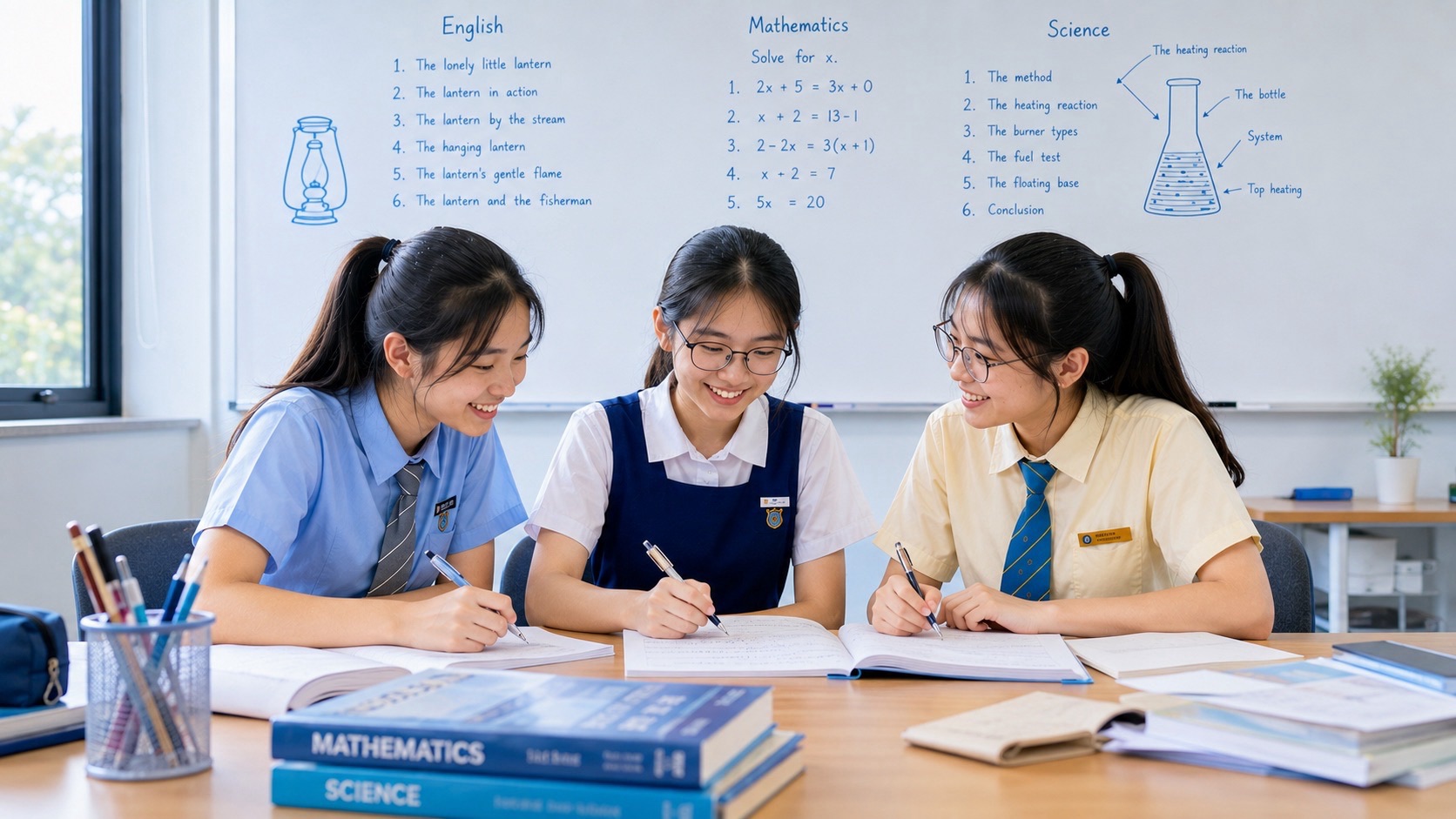
Secondary 2 Chinese small-group tuition for Yew Tee families may help a learner who needs individual correction, more opportunities to explain ideas and structured practice on recurring weaknesses. A class of three can provide these conditions but does not guarantee stronger marks. Teaching quality, course fit and independent progress matter more than the advertised group size.
This guide focuses on comprehension evidence and answering exactly what is asked. Begin with the student’s actual school Chinese or Higher Chinese course, teacher feedback and an independent work sample. The estate name identifies the audience, not confirmation of an available Secondary 2 Chinese class at a physical Yew Tee address. Confirm the programme, tutor, venue, fees and vacancies directly.
- Benefit: individual feedback and peer discussion.
- Risk: mismatched levels, copying, travel fatigue or anxiety.
- First step: diagnose the specific difficulty.
- Course: verify G1, G2, G3 or Higher Chinese.
- Progress: compare fresh independent tasks.
- Decision: adapt or stop if the group is unsuitable.
Yew Tee: comprehension evidence and answering exactly what is asked
Understand the question first
A student may locate a matching keyword but fail to supply the cause or inference required. Ask the learner to paraphrase the task before searching the passage.
A three-person tutor can demonstrate this skill with an appropriate task and ask each child to attempt it before hearing classmates’ answers. The teacher should then identify the first unstable step, explain a focused correction and give a changed question. This last independent attempt is essential: a correct group response does not prove that all three learners understood. Different pupils may need different supports, but the shared activity must remain meaningful for everyone.
Parents can ask for a dated baseline and a new response after several weeks. The tutor should explain how the skill matches the child’s school course and what will be revisited after a delay. Homework should be short enough to complete independently without displacing school assignments, rest or reading. If the child cannot access the material, repair the prerequisite; if it is too easy, deepen the reasoning. The purpose is lasting competence, not an ever-growing workbook.
Read the paragraph as a whole
Identify who acted, what changed and how the event connects to the larger passage. Isolated words are insufficient for meaning.
A three-person tutor can demonstrate this skill with an appropriate task and ask each child to attempt it before hearing classmates’ answers. The teacher should then identify the first unstable step, explain a focused correction and give a changed question. This last independent attempt is essential: a correct group response does not prove that all three learners understood. Different pupils may need different supports, but the shared activity must remain meaningful for everyone.
Parents can ask for a dated baseline and a new response after several weeks. The tutor should explain how the skill matches the child’s school course and what will be revisited after a delay. Homework should be short enough to complete independently without displacing school assignments, rest or reading. If the child cannot access the material, repair the prerequisite; if it is too easy, deepen the reasoning. The purpose is lasting competence, not an ever-growing workbook.
Separate fact from inference
A character’s silence can suggest several feelings. The surrounding dialogue determines what is defensible.
A three-person tutor can demonstrate this skill with an appropriate task and ask each child to attempt it before hearing classmates’ answers. The teacher should then identify the first unstable step, explain a focused correction and give a changed question. This last independent attempt is essential: a correct group response does not prove that all three learners understood. Different pupils may need different supports, but the shared activity must remain meaningful for everyone.
Parents can ask for a dated baseline and a new response after several weeks. The tutor should explain how the skill matches the child’s school course and what will be revisited after a delay. Homework should be short enough to complete independently without displacing school assignments, rest or reading. If the child cannot access the material, repair the prerequisite; if it is too easy, deepen the reasoning. The purpose is lasting competence, not an ever-growing workbook.
Build cause-and-effect answers
A fictional late arrival caused by a bus delay illustrates the need to explain the intermediate link, not simply mention the weather.
A three-person tutor can demonstrate this skill with an appropriate task and ask each child to attempt it before hearing classmates’ answers. The teacher should then identify the first unstable step, explain a focused correction and give a changed question. This last independent attempt is essential: a correct group response does not prove that all three learners understood. Different pupils may need different supports, but the shared activity must remain meaningful for everyone.
Parents can ask for a dated baseline and a new response after several weeks. The tutor should explain how the skill matches the child’s school course and what will be revisited after a delay. Homework should be short enough to complete independently without displacing school assignments, rest or reading. If the child cannot access the material, repair the prerequisite; if it is too easy, deepen the reasoning. The purpose is lasting competence, not an ever-growing workbook.
Track speakers and pronouns
When multiple characters appear, pupils may attribute the wrong action to a person. A temporary actor-action table can clarify the relationships.
A three-person tutor can demonstrate this skill with an appropriate task and ask each child to attempt it before hearing classmates’ answers. The teacher should then identify the first unstable step, explain a focused correction and give a changed question. This last independent attempt is essential: a correct group response does not prove that all three learners understood. Different pupils may need different supports, but the shared activity must remain meaningful for everyone.
Parents can ask for a dated baseline and a new response after several weeks. The tutor should explain how the skill matches the child’s school course and what will be revisited after a delay. Homework should be short enough to complete independently without displacing school assignments, rest or reading. If the child cannot access the material, repair the prerequisite; if it is too easy, deepen the reasoning. The purpose is lasting competence, not an ever-growing workbook.
Use concise evidence
Copying an entire paragraph can hide a weak answer. Select only the relevant detail and explain how it supports the conclusion.
A three-person tutor can demonstrate this skill with an appropriate task and ask each child to attempt it before hearing classmates’ answers. The teacher should then identify the first unstable step, explain a focused correction and give a changed question. This last independent attempt is essential: a correct group response does not prove that all three learners understood. Different pupils may need different supports, but the shared activity must remain meaningful for everyone.
Parents can ask for a dated baseline and a new response after several weeks. The tutor should explain how the skill matches the child’s school course and what will be revisited after a delay. Homework should be short enough to complete independently without displacing school assignments, rest or reading. If the child cannot access the material, repair the prerequisite; if it is too easy, deepen the reasoning. The purpose is lasting competence, not an ever-growing workbook.
Discuss alternative interpretations
A group can compare claims and evidence respectfully, but every child must answer a fresh question independently.
A three-person tutor can demonstrate this skill with an appropriate task and ask each child to attempt it before hearing classmates’ answers. The teacher should then identify the first unstable step, explain a focused correction and give a changed question. This last independent attempt is essential: a correct group response does not prove that all three learners understood. Different pupils may need different supports, but the shared activity must remain meaningful for everyone.
Parents can ask for a dated baseline and a new response after several weeks. The tutor should explain how the skill matches the child’s school course and what will be revisited after a delay. Homework should be short enough to complete independently without displacing school assignments, rest or reading. If the child cannot access the material, repair the prerequisite; if it is too easy, deepen the reasoning. The purpose is lasting competence, not an ever-growing workbook.
Read longer texts progressively
Build from accessible paragraphs toward longer passages while retaining the main idea, rather than overwhelming the learner with difficulty.
A three-person tutor can demonstrate this skill with an appropriate task and ask each child to attempt it before hearing classmates’ answers. The teacher should then identify the first unstable step, explain a focused correction and give a changed question. This last independent attempt is essential: a correct group response does not prove that all three learners understood. Different pupils may need different supports, but the shared activity must remain meaningful for everyone.
Parents can ask for a dated baseline and a new response after several weeks. The tutor should explain how the skill matches the child’s school course and what will be revisited after a delay. Homework should be short enough to complete independently without displacing school assignments, rest or reading. If the child cannot access the material, repair the prerequisite; if it is too easy, deepen the reasoning. The purpose is lasting competence, not an ever-growing workbook.
Time practice after accuracy
Identify whether slow work comes from decoding, rereading or overlong answers. Speed without understanding is not progress.
A three-person tutor can demonstrate this skill with an appropriate task and ask each child to attempt it before hearing classmates’ answers. The teacher should then identify the first unstable step, explain a focused correction and give a changed question. This last independent attempt is essential: a correct group response does not prove that all three learners understood. Different pupils may need different supports, but the shared activity must remain meaningful for everyone.
Parents can ask for a dated baseline and a new response after several weeks. The tutor should explain how the skill matches the child’s school course and what will be revisited after a delay. Homework should be short enough to complete independently without displacing school assignments, rest or reading. If the child cannot access the material, repair the prerequisite; if it is too easy, deepen the reasoning. The purpose is lasting competence, not an ever-growing workbook.
A four-week comprehension audit
Compare new independent passages to track better evidence selection and fewer unsupported guesses.
A three-person tutor can demonstrate this skill with an appropriate task and ask each child to attempt it before hearing classmates’ answers. The teacher should then identify the first unstable step, explain a focused correction and give a changed question. This last independent attempt is essential: a correct group response does not prove that all three learners understood. Different pupils may need different supports, but the shared activity must remain meaningful for everyone.
Parents can ask for a dated baseline and a new response after several weeks. The tutor should explain how the skill matches the child’s school course and what will be revisited after a delay. Homework should be short enough to complete independently without displacing school assignments, rest or reading. If the child cannot access the material, repair the prerequisite; if it is too easy, deepen the reasoning. The purpose is lasting competence, not an ever-growing workbook.
Small-group tuition in Singapore’s education system
What a three-pupil class can do
Three pupils can give a tutor time to inspect individual responses, invite explanations and correct misconceptions. Peer discussion can expose alternative interpretations. But if one student answers everything, the others may simply copy. The teacher should give each child private thinking time and an independent task after discussion.
The group must be reasonably compatible. A child struggling with basic word recognition may not benefit from the same shared passage as one analysing nuanced prose. The tutor should differentiate within sensible limits and be willing to recommend a different group or individual teaching. Class size is an opportunity, not a guarantee of instructional quality.
Full Subject-Based Banding and the actual course
Singapore’s Full Subject-Based Banding provides G1, G2 and G3 subject levels. Posting Group does not completely describe every subject a child takes. The tutor must confirm the student’s current school Chinese course and examine school work before choosing tasks.
A G2 learner may need to repair prerequisites rather than tackle unrelated G3 worksheets. A confident learner may benefit from richer interpretation. Higher Chinese is a separate course. Formal subject-level changes are school matters, not something tuition can guarantee.
The 2027 SEC is a later national examination
The Singapore-Cambridge Secondary Education Certificate begins in 2027 as the national secondary exit examination. SEAB lists Chinese K120 at G1, K220 at G2, K320 at G3 and Higher Chinese K355 at G3. These codes are not Secondary 2 school assessment codes.
School materials determine the immediate learning scope. The national syllabus can guide longer-term preparation in reading, writing, listening and oral skills, but advanced exit-examination papers are not automatically suitable for a lower-secondary learner. Parents should distinguish current school requirements from future examination pathways.
A ninety-minute lesson needs a learning cycle
A productive session can include retrieval of prior learning, a focused explanation, guided practice, an independent task and correction. Every pupil should speak or write meaningfully. The exact time division varies by group and school calendar.
A tutor should be able to explain what the child did without hints and how the same skill will be retested later. A corrected model answer alone is not evidence of mastery. Homework should be manageable and tied to the learning target rather than a large stack of copying.
The correction log and transfer
A weak mark is not a diagnosis. A student may misunderstand a question, select irrelevant evidence, misuse a connector or fail to retrieve a word. These need different teaching responses. Record the original attempt, the specific error and a new question that tests the principle.
After a delay, the tutor should use unfamiliar material and reduce prompts. A learner who can explain and repair an error independently is developing competence. Parents should ask for dated independent samples rather than rely solely on a tutor’s polished corrected worksheets.
Costs, consequences and alternatives
Tuition adds fees, travel, waiting, homework and fatigue. An unsuitable group can create anxiety or dependence on model answers. A neighbourhood-focused guide does not confirm that a Chinese class operates at a local address; parents should verify the actual venue and programme.
School-led help, independent reading or individual teaching may be a better fit. The family should weigh the child’s progress and wellbeing against the total weekly burden. A tutor should not promise guaranteed grades or insist that every child needs permanent external tuition.
Review and exit
Set one or two observable goals before enrolment, such as evidence-based comprehension answers, coherent paragraphs or connected oral explanations. Compare independent work on unfamiliar tasks after four to eight weeks. School marks matter but can vary with assessment difficulty.
A responsible tutor gradually reduces support. If the skill stabilises, the family can reduce tuition; if progress is absent, reassess the method or group. The goal is a student who can work effectively without the tutor beside them.
Frequently asked questions
Does three-pupil tuition guarantee an A1?
No. It can improve opportunities for feedback but cannot guarantee marks.
Is Secondary 2 examined under the 2027 SEC?
No. Secondary 2 assessments are school-based; the SEC is the later national exit examination.
Can G1, G2 and G3 learners share identical worksheets?
Not automatically. The tasks must match each child’s actual school course and readiness.
Is Higher Chinese the same as ordinary Chinese?
No. Higher Chinese is a distinct subject.
Does this page confirm a local class?
No. Verify the real subject, venue, tutor, timetable, fees and vacancies.
How should progress be measured?
Compare independent answers to unfamiliar tasks and the amount of prompting required.
When should tuition end?
When the target skill becomes reliable independently or the arrangement is no longer appropriate.
Parent checklist
- Confirm the exact school Chinese or Higher Chinese course.
- Bring an uncorrected work sample and school feedback.
- Ask how every pupil receives individual feedback and turns.
- Check group compatibility and the correction method.
- Verify the actual venue, tutor, timetable, fees and vacancies.
- Keep homework and travel sustainable.
- Review unfamiliar independent work after four to eight weeks.
- Continue, adapt or stop according to progress and wellbeing.
Official sources and related eduKate reading
MOE Full Subject-Based Banding explains the subject-level system. SEAB’s SEC syllabus directory lists the 2027 national examination references, including G1 Chinese K120, G2 Chinese K220 and G3 Chinese K320 / Higher Chinese K355. The student’s school determines current Secondary 2 assessment requirements.
- Immutable three-pupil format reference: Secondary 1 Mathematics Tutor Clementi
- The SEAB Syllabus | 2027 SEC Chinese Language G1 G2 G3
- How G2 Chinese Language Works | SEC Guide
The Clementi Mathematics reference describes a Mathematics class, not proof of Secondary 2 Chinese at the same address. Contact eduKate Singapore to verify actual Chinese tuition, course fit, location and vacancies. No grade outcome is guaranteed.
Reviewed November 2026. Educational guidance only; verify current school requirements and programme availability.