
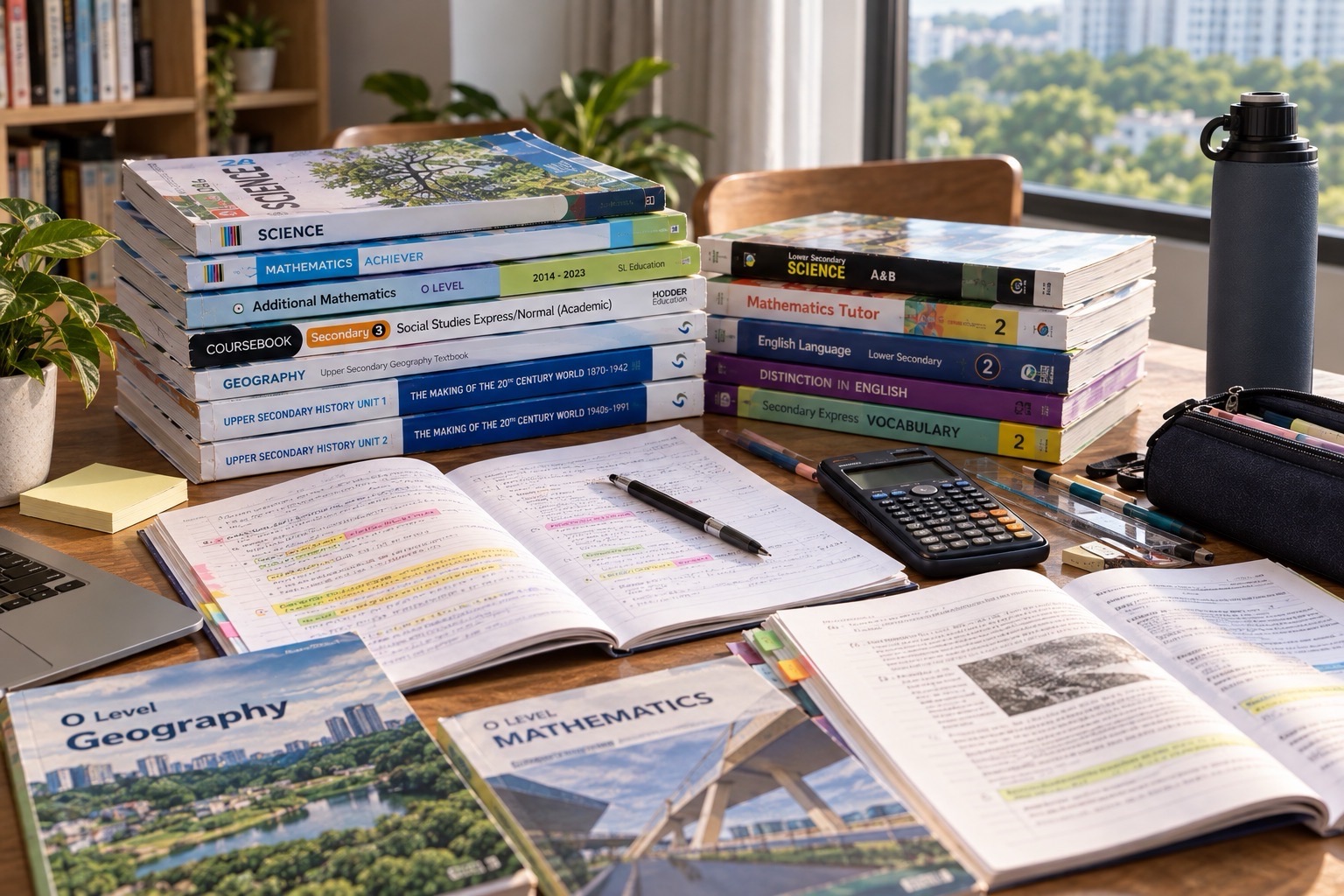
Did you know? Ratio, rate and speed errors in Secondary 2 Mathematics often look like calculator mistakes, but the real issue can be a single unnoticed word: per. ‘Kilometres’ and ‘kilometres per hour’ are not interchangeable. Once a pupil starts asking ‘What is one unit worth?’, many unfamiliar G1 questions become easier to reason through.
Quick answer: what does Secondary 2 G1 ratio, rate and speed need?
A pupil should be able to compare parts in a ratio, find a unit amount, recognise direct and inverse proportion where appropriate, convert units, and work with speed = distance ÷ time. Most importantly, the pupil needs to decide which relationship the words describe. Use a diagram, a ratio-parts table or an explicit unit-rate calculation before reaching for a formula.
This guide is for families looking for a Secondary 2 G1 Mathematics tutor in Bukit Timah. G1 is a Mathematics subject level under Full Subject-Based Banding. It is not a synonym for G2, G3 or the student’s school posting group. Follow the actual school topic order and assessment scope rather than assuming every lower-secondary test includes all examples below.
Find an answer fast
- 50-second check
- Ratio versus rate
- 36 worked clinics
- Correct the earliest error
- What a tutorial can do
- Parent practice
- Common questions
- Official references
A 50-second diagnostic before extra tuition
Ask: ‘A car travels 60 kilometres in two hours. What is its average speed?’ A confident learner answers 30 km/h and explains why dividing distance by time gives kilometres per hour. Then ask: ‘A map has scale 1 cm to 5 km. How far is 3 cm?’ and ‘Split $30 in ratio 2:3.’ If the pupil understands only the first problem, the issue may be ratio parts rather than speed. Choose teaching by the first inconsistent step, not by the final score.
The three questions that solve most comparison problems
1. Are we comparing parts of the same kind?
A ratio such as 2:3 compares two quantities. To share $50 in that ratio, first count five equal parts; then one part represents $10. The quantities are $20 and $30. The relationship stays the same if we scale both parts together. Ratios involving fractions or decimals are simplified in exactly the same spirit: both quantities must change by the same nonzero factor.
Beware of the phrase ‘two out of three’. A ratio of boys to girls 2:3 means five equal parts in the whole group, not three. The fraction of the total represented by boys is 2/5. A student who can distinguish part-to-part from part-to-whole has already avoided one of the most common ratio traps.
2. Are the quantities expressed in different units?
Rate measures one quantity per unit of another: dollars per kilogram, pages per minute, litres per hour. The word per is the hinge. If four kilograms cost $20, the unit price is $5/kg. If the same item costs $5/kg, three kilograms cost $15. Division finds the unit; multiplication extends it. The symbols and units should tell the same story.
Speed is a rate, usually distance per time. If a journey covers 120 km in two hours, average speed is 60 km/h. This does not guarantee the vehicle moved constantly at 60 km/h. For trips with changing speeds, total distance divided by total elapsed time is the correct average across the whole journey.
3. What stays constant?
In direct proportion, quantities increase or decrease together by the same factor. If each notebook has a constant price, doubling the number doubles the price and the cost-per-notebook ratio stays constant. In inverse proportion, the product stays constant under appropriate assumptions. More equally productive workers need fewer days to complete a fixed amount of work. Not every real-world relationship is perfectly proportional: setup fees, discounts, breaks and coordination losses can change the model.
Before calculation, ask the pupil to make a prediction: If we increase the number of items, should cost rise? If more workers share fixed work, should time rise or fall? This simple directional check catches many wrong formula choices that arithmetic practice alone may miss.
Units are an error-detection tool
Write km/h rather than a bare answer of ‘60’. Convert minutes to hours before inserting time into a km/h calculation. Remember 1 hour = 60 minutes, 1 km = 1000 metres, 1 m = 100 cm and 1 L = 1000 mL. A useful habit is to cancel units symbolically: (km/h) × h leaves km, while km ÷ (km/h) leaves h. If your formula leaves an irrelevant unit, the formula probably does not match the question.
36 worked Secondary 2 G1 learning clinics
These are original teaching questions with reasons, characteristic errors and checks. They progress from ratio parts through proportion to rate, unit conversion and speed contexts. Cover the model solution, let the pupil attempt the calculation, then study the first point where their working diverges.
1. Simplify a ratio by a common factor
Try this: Write 12:18 in its simplest form.
Reason and calculate: Divide both parts by their highest common factor, six: 12:18 becomes 2:3. Ratio compares quantities relative to each other; it is not the same as saying two out of three.
Likely error: Dividing only the first part changes the relationship. The pair of parts must be scaled together.
Check and transfer: In the original, 12/18 = 2/3. Now simplify 15:25 and explain why 3:5 is equivalent.
2. Ratios can involve different-looking fractions
Try this: Simplify (1/2):(3/4).
Reason and calculate: Multiply both quantities by four to clear denominators: 2:3. Multiplying both parts by the same nonzero value preserves their comparison. The answer is 2:3.
Likely error: Some pupils write 1:3 or 2:4 by taking numerators or denominators separately. That does not preserve the original fractions.
Check and transfer: Check 0.5/0.75 = 2/3. Repeat with (2/3):(1/6) and find 4:1.
3. Decimals in a ratio do not require decimals in the answer
Try this: Simplify 0.6:1.2.
Reason and calculate: Multiply both parts by ten to get 6:12, then divide both by six: 1:2. Both quantities keep their comparative size.
Likely error: The invalid 6:1.2 happens when only one part is rescaled.
Check and transfer: Use 0.3:0.9 as a check; the simplified form is 1:3.
4. Split a total with parts, not guesses
Try this: Divide $72 in the ratio 5:4.
Reason and calculate: There are nine equal ratio parts. One part is $72 ÷ 9 = $8. The two shares are $40 and $32. Add both shares to check the original total.
Likely error: Dividing 72 by 5 and by 4 independently gives two amounts that do not add to $72.
Check and transfer: Check 40/32 = 5/4. If the total were $90, the shares would be $50 and $40.
5. Recover the total from one ratio share
Try this: Two quantities are in the ratio 3:5. The smaller is 27. Find the larger.
Reason and calculate: Three equal parts represent 27, so one part is nine. Five parts are 45. An optional total is 27 + 45 = 72.
Likely error: Using 27/5 mistakes which quantity corresponds to the known share.
Check and transfer: Check 27:45 reduces to 3:5. Change the smaller amount to 18 and solve again.
6. Ratios with a stated amount identify the unit part
Try this: A:B = 2:5 and A = 14. Find B.
Reason and calculate: Two parts represent 14, so one part is seven. B is five parts, giving 35. Label each part rather than using an unexplained cross-multiplication.
Likely error: Reporting 14 × 5 = 70 forgets to divide by A’s two parts.
Check and transfer: The comparison 14:35 simplifies to 2:5. What if B were 20 instead?
7. Scaling a diagram requires unit care
Try this: A simple plan uses scale 1:500. A wall is 3 cm on the plan. Find its real length.
Reason and calculate: Actual length = 3 × 500 = 1500 cm, which is 15 m. Keep units through the calculation: 100 cm = 1 m.
Likely error: Reporting 1500 m multiplies by the scale but forgets that the initial unit was centimetres.
Check and transfer: Check that 15 m is 1500 cm, and dividing by 500 returns 3 cm.
8. Proportional price begins with one unit
Try this: Four identical pens cost $12. What do seven pens cost at the same unit price?
Reason and calculate: One pen costs $12 ÷ 4 = $3. Seven cost $21. Direct proportion is appropriate if the shop charges a constant price per pen.
Likely error: Multiplying 12 by 7 before dividing by 4 can work if all steps are correct, but a pupil may mistake the known $12 as a unit price.
Check and transfer: Test four pens again: 4 × $3 = $12. Ask how a bundle discount would break the assumption.
9. Direct proportion keeps the quotient constant
Try this: Given y = 3x, find y when x = 8.
Reason and calculate: The constant ratio y/x is three for nonzero x. Substitute eight: y = 3 × 8 = 24. Doubling x doubles y.
Likely error: A pupil may add three rather than multiply by three, confusing constant increase and constant ratio.
Check and transfer: Test x = 2 gives y = 6, then x = 4 gives y = 12. Compare their quotients.
10. A table can support direct proportion
Try this: For pairs (x,y) = (2,6), (5,15), (8,24), is y directly proportional to x?
Reason and calculate: Compute y/x: 6/2 = 3, 15/5 = 3 and 24/8 = 3. The constant is three, so this table is consistent with y = 3x.
Likely error: Equal increases in y are not required when increases in x differ. Focus on the quotient, not just nearby rows.
Check and transfer: Ask whether a table with (2,7) and (4,14) alone is enough to guarantee all future pairs behave this way.
11. Inverse proportion preserves a product
Try this: Four workers need 12 days for a task. Estimate time for six equally productive workers on the same job.
Reason and calculate: With idealised equal rates and no coordination loss, worker-days stay 4 × 12 = 48. Six workers need 48 ÷ 6 = 8 days.
Likely error: A pupil may multiply both six and twelve, increasing the time as the workforce increases.
Check and transfer: Check 6 × 8 = 48 worker-days and state why real teamwork may not scale perfectly.
12. Read inverse proportion from the equation
Try this: If xy = 24 and x = 8, what is y?
Reason and calculate: Divide 24 by eight: y = 3. An inverse relation makes the product constant. It is a different shape of dependence from y = 3x.
Likely error: Writing y = 24 × 8 = 192 confuses multiplication in the equation with the inverse operation used to isolate y.
Check and transfer: With x = 6, y would be 4. Both pairs have product 24.
13. Recognise the direction before calculating
Try this: If the same work is shared among more equally efficient workers, should duration increase or decrease?
Reason and calculate: Duration decreases when the worker count increases under the stated ideal assumptions. This qualitative prediction is a valuable check before calculating the exact time.
Likely error: An equation that predicts twice the workforce needs twice the duration conflicts with the relationship being modelled.
Check and transfer: Use four workers and eight days. Under ideal conditions, eight workers need four days.
14. Rate compares different units
Try this: A machine makes 120 labels in four minutes. Find the rate.
Reason and calculate: Divide output by elapsed time: 120 ÷ 4 = 30 labels per minute. The ‘per minute’ is part of the answer, not decoration.
Likely error: Reporting 30 minutes per label reverses the ratio and changes the meaning.
Check and transfer: Check 30 labels/min × 4 min = 120 labels. Find the output in six minutes at that rate.
15. Unit price is a rate
Try this: Three kilograms of rice cost $9. What is the price per kilogram?
Reason and calculate: $9 ÷ 3 kg = $3/kg. Then five kilograms would cost $15, assuming a constant unit price.
Likely error: Writing 3 kg/$ and calling it dollars per kilogram reverses the dimensions.
Check and transfer: Multiply $3/kg × 3 kg and confirm the dollars remain.
16. Convert kilograms to grams before comparing
Try this: A label gives 1.2 kg. Express this in grams.
Reason and calculate: There are 1000 grams in one kilogram, so 1.2 × 1000 = 1200 g. A conversion factor changes the numeral while keeping the mass unchanged.
Likely error: Dividing by 1000 gives 0.0012 g, an implausibly smaller numerical quantity when moving to a smaller unit.
Check and transfer: Convert 1200 g back by dividing by 1000 to recover 1.2 kg.
17. Convert litres to millilitres
Try this: A jug contains 3.5 L of water. How many millilitres is this?
Reason and calculate: One litre is 1000 millilitres, so 3.5 × 1000 = 3500 mL. The quantity is unchanged; only the measurement unit changed.
Likely error: A learner who writes 350 mL has misplaced one place in the factor of 1000.
Check and transfer: Reconvert 3500 mL to 3.5 L and compare with a 500 mL bottle.
18. Speed is distance divided by time
Try this: A bus travels 180 km in three hours at uniform speed. Find its speed.
Reason and calculate: Speed = 180 km ÷ 3 h = 60 km/h. Under uniform motion, distance = speed × time. Write the unit at every stage.
Likely error: Answering 540 km/h multiplies distance by hours, producing a physically and mathematically inconsistent quantity.
Check and transfer: Check 60 km/h × 3 h = 180 km. Ask what changes if the bus stops during the trip.
19. Minutes must be converted when using km/h
Try this: A vehicle travels 36 km in 45 minutes. Find average speed in km/h.
Reason and calculate: Forty-five minutes is 45/60 = 0.75 hour. Average speed = 36/0.75 = 48 km/h.
Likely error: Using 36/45 produces 0.8 km per minute, not 0.8 km per hour. The number may be correct for the wrong unit.
Check and transfer: Check 48 km/h × 0.75 h = 36 km. Also express the speed as 0.8 km/min.
20. Metres per second is a different speed unit
Try this: A runner travels 120 m in 20 s. Find average speed.
Reason and calculate: Speed = 120/20 = 6 m/s. Do not label the answer km/h because the input distance and time were metres and seconds.
Likely error: Mixing metres with hours or kilometres with seconds silently changes the value.
Check and transfer: Check 6 m/s × 20 s = 120 m. Convert 6 m/s to 21.6 km/h if that has been taught.
21. From km/h to m/s
Try this: Convert 72 km/h to m/s.
Reason and calculate: Seventy-two kilometres are 72,000 metres and one hour is 3600 seconds, so 72,000/3600 = 20 m/s. An efficient rule is divide km/h by 3.6.
Likely error: Multiplying by 3.6 gives 259.2 m/s, reversing the unit conversion.
Check and transfer: Check 20 m/s × 3600 s = 72,000 m = 72 km.
22. From m/s to km/h
Try this: Convert 5 m/s to km/h.
Reason and calculate: Multiply by 3.6: 5 × 3.6 = 18 km/h. The relationship comes from 3600 seconds per hour and 1000 metres per kilometre.
Likely error: Dividing by 3.6 incorrectly makes the km/h value smaller.
Check and transfer: Check 18 km/h ÷ 3.6 = 5 m/s. Explain why the two values describe the same speed.
23. Distance can be recovered from speed and time
Try this: A cyclist maintains 45 km/h for two hours. Find the distance.
Reason and calculate: Distance = speed × time = 45 × 2 = 90 km. The ‘per hour’ cancels with hours, leaving kilometres.
Likely error: Dividing 45 by 2 gives a number with the wrong implied relationship: more time should mean more distance at constant speed.
Check and transfer: Check by dividing 90 km by two hours to recover 45 km/h.
24. Time can be recovered from distance and speed
Try this: A trip covers 150 km at a steady 50 km/h. Find its duration.
Reason and calculate: Time = distance/speed = 150/50 = 3 hours. The units km divided by km per hour leave hours.
Likely error: Multiplying 150 × 50 makes the duration enormous and breaks the relationship.
Check and transfer: Check 50 km/h × 3 h = 150 km. Repeat with 200 km and 40 km/h.
25. A decimal hour is not the same as that many minutes
Try this: Express 1.5 hours in minutes.
Reason and calculate: One hour is 60 minutes. 1.5 × 60 = 90 minutes. The decimal 0.5 denotes half an hour, not five minutes.
Likely error: Writing ‘1 hour 50 minutes’ treats decimal notation as an hours-and-minutes clock format.
Check and transfer: Check that 90 min ÷ 60 = 1.5 h. Convert 1.25 h to 75 min.
26. Average speed needs total distance and total time
Try this: A learner covers 60 km in one hour then another 60 km in two hours. Find average speed.
Reason and calculate: Total distance is 120 km; total time is 3 h. Average speed = 40 km/h. Never average 60 km/h and 30 km/h directly unless the time weighting makes that valid.
Likely error: Taking (60+30)/2 = 45 km/h is the wrong unweighted mean for unequal durations.
Check and transfer: Check 40 km/h × 3 h = 120 km. Explain why the slower two-hour leg matters more.
27. Average rate for unequal periods
Try this: A printer makes 40 pages in 5 minutes then 60 pages in 10 minutes. Find overall pages per minute.
Reason and calculate: Total pages = 100; total time = 15 minutes, so rate = 100/15 = 6⅔ pages/min. A single average rate needs totals.
Likely error: Taking the simple mean of 8 pages/min and 6 pages/min gives 7, which is not the overall rate.
Check and transfer: Check 6⅔ × 15 = 100. Work with the exact fraction before rounding.
28. A recipe scaled by a constant factor
Try this: A recipe uses two cups of flour for five servings. How much for fifteen servings?
Reason and calculate: Fifteen is three times five, so multiply the flour by three: six cups. The proportionality assumes the recipe ratios remain unchanged.
Likely error: Adding ten cups just because the servings increased by ten loses the original relationship.
Check and transfer: Use six cups ÷ fifteen servings = 0.4 cup per serving, matching 2/5.
29. Mix a drink using a part-to-part ratio
Try this: Juice and water are mixed in ratio 3:2. There are 25 cups in total. How many cups of each?
Reason and calculate: Total parts = 5. Each part = 25/5 = 5 cups. Juice is 15 cups; water is 10 cups. Check both the sum and ratio.
Likely error: Treating 3:2 as 3 cups and 2 cups ignores that the mixture totals 25 cups.
Check and transfer: Check 15:10 = 3:2. Decide how quantities change for a 40-cup mixture.
30. Map distance needs a clear scale interpretation
Try this: A simple map key says 1 cm represents 2 km. Two points are 4.5 cm apart. Find represented distance.
Reason and calculate: Multiply 4.5 cm by 2 km/cm to get 9 km. The centimetres cancel, leaving kilometres.
Likely error: Dividing by two incorrectly shortens the real-world distance when the map separation increases.
Check and transfer: Check 9 km / (2 km/cm) = 4.5 cm on the map.
31. Percentage discount is applied to the original price
Try this: A $50 item is reduced by 20%. Find the new price.
Reason and calculate: Twenty percent of 50 is $10. Subtract the reduction: $40. A percentage reduction is not simply $20 off.
Likely error: A student subtracts 20 dollars because the number 20 appears in the percentage.
Check and transfer: Check $10/$50 = 20%. Ask for the final price after a 10% reduction instead.
32. Percentage increase has its own reference value
Try this: A price rises from $40 to $50. Find percentage increase.
Reason and calculate: Change = 50 − 40 = $10. Divide by original 40: 10/40 × 100% = 25%.
Likely error: Dividing by the new price 50 gives 20%, which answers a different comparison.
Check and transfer: Check that 25% of $40 is $10. Discuss why a later decrease of 20% returns $50 to $40.
33. Reverse a speed calculation from the time
Try this: A walker covers 6 km in 1 hour 12 minutes. Find average speed.
Reason and calculate: The time is 1 + 12/60 = 1.2 h. Divide distance by time: 6/1.2 = 5 km/h.
Likely error: Writing 1.12 h treats minutes like decimal hundredths of an hour.
Check and transfer: Check 5 × 1.2 = 6 km. Convert 1 hour 30 minutes to 1.5 h before another example.
34. A bigger speed does not mean a bigger time for fixed distance
Try this: One cyclist rides 24 km at 12 km/h and another at 8 km/h. Compare times.
Reason and calculate: First time = 24/12 = 2 h. Second = 24/8 = 3 h. The faster cyclist needs one hour less for the same distance, assuming steady speeds.
Likely error: A learner may multiply 24 by speed and report that faster cycling takes longer.
Check and transfer: Check by multiplying each speed by its duration to recover the same 24 km.
35. Train the units to reveal an invalid formula
Try this: A student uses ‘speed × distance = time’ to calculate a journey. Which relationship is correct?
Reason and calculate: Speed = distance/time, so time = distance/speed. Units confirm this: km divided by km/h leaves hours. Multiplying gives km²/h, not time.
Likely error: Memorising a triangle diagram without unit meaning can cause multiplication and division to be swapped.
Check and transfer: Write the unit cancellation for distance = speed × time, then time = distance/speed.
36. Detect when direct proportion fails
Try this: A delivery costs $5 booking fee plus $2 per kilometre. Is total price directly proportional to distance?
Reason and calculate: No. Cost = 5 + 2d, so zero distance still incurs a $5 fee. It is linear but not directly proportional because cost/distance is not constant.
Likely error: Calling every straight-line graph direct proportion ignores the fixed initial amount.
Check and transfer: Compare costs at 1 and 2 km: $7 and $9, not a doubling. This contrasts y = 2d, which passes through zero.
37. Explain a rate in words, not just symbols
Try this: Water flows at 4 L/min. What does this mean after seven minutes at constant rate?
Reason and calculate: Four litres enter each minute, so in seven minutes 4 × 7 = 28 L. The unit rate is the meaning of the multiplication.
Likely error: A learner writes 4/7 L, assuming every word problem with two numbers requires division.
Check and transfer: Check 28 L ÷ 7 min = 4 L/min. Change the duration to 2.5 minutes.
38. Find a unit cost from two different packs
Try this: Pack A costs $12 for 3 kg; pack B costs $15 for 5 kg. Which is cheaper per kilogram?
Reason and calculate: Pack A: 12/3 = $4/kg. Pack B: 15/5 = $3/kg. Pack B has the lower unit price if contents are otherwise comparable.
Likely error: Choosing the lower ticket price automatically mistakes total expense for cost efficiency.
Check and transfer: For 3 kg of Pack B-equivalent product, the unit price would imply $9, lower than Pack A’s $12.
39. Test proportional understanding with an impossible answer
Try this: A student says 2 bottles cost $6 so 5 identical bottles cost $11. Is the claim consistent with constant unit price?
Reason and calculate: Unit price is $3. Five cost $15, not $11. The $11 claim could be possible only if a separate discount or different pricing rule was stated.
Likely error: Pupils sometimes add the change in bottle count (three) to the old price (six) or invent their own rate.
Check and transfer: Check $15/5 = $3, which matches $6/2. Ask what discount would make $11 possible.
Five error signatures and the best first repair
The ratio parts do not add to the whole
A learner divides a $90 prize in ratio 2:3 and reports $45 and $60. Both numbers sound reasonable, but they total $105. Ask the student to write five part-boxes, label each as $90 ÷ 5 = $18, then form $36 and $54. The first repair is recognising parts of one whole. Do not begin by drilling unrelated percentage questions.
A rate has been calculated upside-down
A pupil says a 100 km journey taking two hours has speed 2/100 = 0.02 km/h. First point to the words ‘kilometres per hour’. Ask ‘How many kilometres are travelled in one hour?’ A two-hour total must be divided by two. The correct average is 50 km/h. Then reverse the question: at 50 km/h, how far in two hours?
Minutes are read like decimal fractions of an hour
A pupil enters 1 hour 30 minutes as 1.30 hours. Ask for the fractional part: thirty minutes out of sixty is one-half, so the correct duration is 1.5 hours. Check by multiplying 1.5 by 60 minutes/hour and recovering ninety minutes. Have the student convert a few mixed times in both directions before returning to speed.
The answer has no units
A learner writes ‘48’ when a question asks for average speed after covering 36 km in 45 minutes. Even when the number is correct, meaning matters. Ask whether 48 is kilometres, hours, or kilometres per hour. Reconstruct the calculation in hours and label the answer 48 km/h. Then check by reconstructing the 36 km journey.
A straight-line cost is mistaken for direct proportion
A delivery fee is $5 plus $2 per km. One km costs $7 and two km cost $9, not $14. The learner should separate the fixed $5 from the per-kilometre charge and recognise that the relationship does not pass through a zero cost at zero distance. This is a representation problem: a graph, table and verbal explanation together expose the mistake.
Inside a targeted 90-minute three-pupil lesson
The established eduKateSG small-group Mathematics reference describes three-student, 90-minute weekly tutorials near Sixth Avenue MRT. A useful G1 Secondary 2 session builds an explicit chain from the words to a diagram or table, then to calculation, then to a unit-based check. Class availability and matching should be confirmed directly, not inferred from an article.
- First 10 minutes: retrieve ratio parts, fractions and one unit-conversion fact.
- Next 20 minutes: compare a ratio question, a unit-rate question and a speed question, naming their differences.
- Next 25 minutes: each pupil explains several calculations while the tutor checks the earliest invalid line.
- Next 15 minutes: change quantities, units and contexts without changing the underlying mathematical relationship.
- Next 10 minutes: independent mixed work without chapter labels; include one deliberate misleading-data question.
- Final 10 minutes: re-solve a previous error and set a small retrieval task for later in the week.
The first line is often the real teaching target. If a pupil divides by five when there are seven ratio parts, the difficulty is interpreting the whole. If the pupil sets up total distance/time correctly but miscalculates 90/1.5, that is an arithmetic issue. Those pupils need different interventions even if both receive the same mark.
A six-day parent–student plan
Keep the following sessions brief. Prioritise correct reasoning and units before timed speed. Use the school teacher’s scope to decide which items are currently appropriate, and pause if a prerequisite such as fractions or decimal division needs rebuilding.
- Day 1: simplify four ratios, including one with fractions or decimals.
- Day 2: split two totals into unequal shares; check every answer by addition and simplifying the ratio.
- Day 3: compare unit prices from two different package sizes and explain the unit labels.
- Day 4: convert hours and minutes, km/h and m/s; reverse each conversion to check.
- Day 5: solve one distance, one speed and one duration problem with units written at each step.
- Day 6: attempt a mixed real-world question, then explain why direct or inverse proportion is appropriate—or inappropriate.
Rather than asking ‘Did you get them all right?’, ask ‘Which quantity did you divide by which unit, and why?’ Have the student create one plausible wrong answer and disprove it using a total, unit, or common-sense check. This builds independence without turning the parent into an extra examiner.
School tests and what 2027 SEC means
Full Subject-Based Banding differentiates G1, G2 and G3 subject levels. MOE states that the Singapore-Cambridge SEC starts in 2027, and SEAB lists G1 Mathematics K110 for that examination year, referencing earlier 4046. This describes a graduating examination syllabus, not a paper that a Secondary 2 pupil is about to sit. Families should check the child’s eventual examination year and use the current school’s learning sequence now.
For a Bukit Timah Secondary 2 G1 student, the sensible learning outcome is dependable use of ratio and rates in unfamiliar word problems, not a promise of immediate movement to another subject level. A tutor should respect school placements, observed readiness and official procedures rather than making an automatic upgrade claim.
Frequently asked questions
Is rate the same as ratio?
They are related comparisons, but a rate typically compares different units, such as dollars per kilogram or kilometres per hour. Always state what the denominator represents.
Why is average speed not simply the average of two speeds?
If the time intervals differ, each speed contributes differently to the total journey. Use total distance divided by total time, and check units.
Does more of something always mean direct proportion?
No. A fixed charge changes cost without changing the number of items; discounts or thresholds can also change the relationship. Test whether the appropriate ratio remains constant.
Should my child memorise 3.6 for speed conversion?
It is a useful shortcut after the student can derive it from 3600 seconds per hour and 1000 metres per kilometre. Understanding which direction to convert prevents many mistakes.
Will G1 Mathematics K110 be in my child’s Secondary 2 school examination?
No. K110 identifies the 2027 SEC G1 Mathematics syllabus for graduating candidates, while school-level Secondary 2 assessments are set separately. Refer to the teacher-issued topic list.
How can parents identify a useful small-group tutor?
Ask how the tutor diagnoses an incorrect first step, differentiates three learners, checks retention a week later and aligns problems with the student’s actual G1 topic schedule.
Related guides: stay with the earliest missing skill
- Secondary 2 G1 Mathematics Tutor Bukit Timah | Algebra Without Guessing
- Secondary 2 G1 Mathematics Tutor Bukit Timah | Straight-Line Graphs Made Clear
- Secondary 2 G1 Mathematics Tutor Bukit Timah | Ratio, Rate and Speed (this guide)
- Secondary 2 G1 Mathematics Tutor Bukit Timah | Angles and Geometry Explained
For a broad Bukit Timah subject-level route, see how G1, G2 and G3 Mathematics tutoring differs and Bukit Timah tuition and enrichment choices. Programme format comes from the immutable Clementi Mathematics reference, which remains unchanged.
Official sources and limitations
- MOE: G1 Mathematics syllabus and content by level
- MOE: Full SBB and first SEC examinations in 2027
- SEAB: 2027 G1 syllabuses, including Mathematics K110
- eduKateSG: unchanged small-group Mathematics programme reference
Accuracy note: All worked questions are original teaching examples. Speeds, costs, worker productivity and discounts are hypothetical and rely on the assumptions stated; they are not official examination questions, actual transport fares or advertised tuition prices. Do not infer current class vacancies or guaranteed results from this guide.
To discuss tuition near Sixth Avenue MRT, ask eduKate Singapore about a parent–student consultation. Bring one ratio question, one speed question and a school worksheet showing the pupil’s first wrong line. That small sample often helps choose the right starting point.