
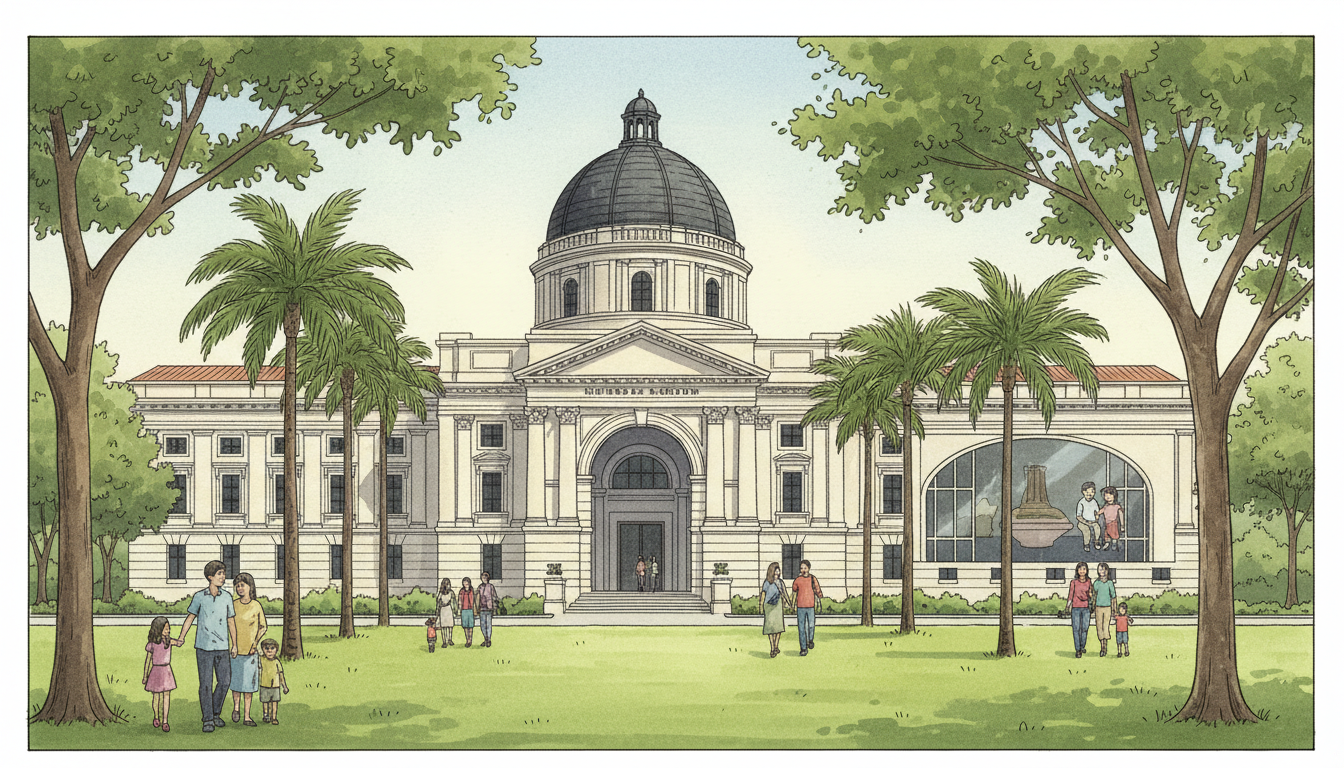
Did you know the Nanyang Academy of Fine Arts was established in 1938, interrupted by war and reopened in 1946—but only moved into Bencoolen Street’s purpose-built campuses in 2005? That difference between an institution’s history and the history of its premises is exactly the kind of careful chronology Secondary 2 G3 History requires.
For families around Bencoolen, Waterloo and Prinsep Streets, eduKateSG provides premium three-student History tutorials for 1.5 hours weekly near Sixth Avenue MRT, not Bencoolen MRT. We use school-marked scripts to strengthen wartime and post-war context, source inference, reliability, usefulness and comparison. Local examples explain the method; the child’s school topics remain the assessed material.
The teaching format follows the immutable Clementi three-student tuition reference. Bencoolen’s wartime and post-war examples draw on NAFA’s official history, National Library’s temple history and NHB’s Bencoolen streetscape record.
A Secondary 2 History tutorial begins with a dated source
A child may understand that Singapore experienced the Japanese Occupation from 1942 to 1945 but treat a 1950s photo of Bencoolen’s hotels as if it shows wartime conditions. Another reads a temple’s post-war rebuilding story and mistakenly concludes the institution was founded then. The first task is therefore to identify the actual event and the date of the document, not to collect more isolated facts.
eduKateSG’s premium three-student 1.5-hour weekly tuition near Sixth Avenue MRT uses each learner’s genuine marked source answer to diagnose such problems. Pupils then practise inference, usefulness, comparison and historical causation on fresh school-relevant material. Bencoolen families should note the class is not located at Bencoolen MRT.
The lower-secondary syllabus takes priority over local heritage
Secondary 2 G3 History increasingly requires pupils to explain Singapore’s wartime and later political experiences, according to the relevant school syllabus. Students need accurate timelines, independent analysis of documents and an understanding that different groups can experience the same policy differently. A local heritage example is useful when it makes that method easier to see.
Yet the official school unit controls the examinable content. A child preparing a History source task on occupation policy must study that policy; memorising an unrelated Bencoolen conservation date would not answer it. The tutor switches from the local teaching analogy to unseen sources from the pupil’s actual chapter.
Before 1942, Bencoolen was already a diverse district
Kampong Bengkulu, early mosques, churches, shophouses and educational institutions were established before the Japanese Occupation. The nearby Waterloo Street area also supported Buddhist, Hindu and Jewish institutions as well as Christian places of worship. These communities had different histories that cannot be collapsed into one label.
A wartime document should be interpreted against an accurate pre-war context. The existence of religious buildings does not prove all worshippers held identical views or experienced occupation in the same way. The tutor teaches pupils to distinguish a physical place from the full experiences of its communities.
Why the origins of Bencoolen Mosque cannot be read from one date
The mosque’s earliest community roots are linked to the 1820s, with substantial rebuilding around 1845, as recorded in MUIS and heritage research. The newer mixed-use complex opened in May 2004. A school pupil may see different dates and presume one source must be false, when the sources may describe different stages.
To compare responsibly, identify the act named: first worship site, rebuilt structure or present complex. A 2004 photograph cannot directly show a wooden prayer house from the 1820s. This is the same chronology discipline needed when studying wartime orders and post-war policy changes.
The Kwan Im Thong Hood Cho Temple provides a genuine wartime clue
The National Library’s temple history states that people sought refuge at the Waterloo Street Kwan Im Thong Hood Cho Temple during the Japanese Occupation. That is an example of a religious site serving a community need amid fear and uncertainty.
A source saying people sought refuge does not automatically provide the number of people at every time, how each felt, or the conditions across all shelters in Singapore. A strong History answer states the supported activity and explains what additional evidence a wider question would require.
An official wartime order is not proof of everyone’s behaviour
The Japanese occupation administration could issue commands regarding movement, trade and daily activities. A surviving official order documents what was required or announced. It does not independently show whether every person complied or how uniformly officers enforced it.
The tutor separates intention, publication, enforcement and lived experience. A dated policy directive is useful for an enquiry about official priorities; a civilian diary or other records may be necessary to investigate effects. Neither kind of evidence should be treated as universally complete.
A refuge story and a government report can both be true
Suppose an institutional report claims a shelter system was provided while an individual’s account recalls danger or disruption. These sources may be addressing different levels: official planning and one person’s experience. Before calling them contradictory, identify the exact issue each describes.
Comparison works when pupils select a common proposition and cite evidence from both sources. One document being official and the other personal is not itself an agreement or disagreement. Source type may help explain perspective, but it does not replace reading the claim.
A heritage account written later is not a wartime eyewitness
A modern National Library or NHB article may be carefully researched and extremely useful for chronology, yet it was not necessarily written by someone present in 1943. A primary diary from the period has a different relationship to the event, and its author may know only what was visible to them.
Students should not assume ‘primary equals trustworthy’ or ‘secondary equals false’. The key is the enquiry: to establish what a particular participant felt, an original diary can be informative; to place an institution’s long-term development in context, a later scholarly synthesis may be more useful.
NAFA’s wartime closure was a separate institutional event
Nanyang Academy of Fine Arts was founded in 1938 in Geylang. The school’s official history records that teaching ceased in the early 1940s as war reached Singapore. That interruption affected an educational institution even though it was not yet located on Bencoolen Street.
A pupil should not mistakenly imagine that a present-day Bencoolen campus was a wartime classroom in 1942. The institution’s continuity and its changing addresses must be separated. This prevents the history of one building from being projected backward onto a school located elsewhere at the time.
1946: NAFA reopens in a new post-war setting
The official NAFA chronology records Lim Hak Tai’s reopening of the school in 1946 at 49 St Thomas Walk after the war. The institution’s work included developing an arts education that drew on Chinese and Western traditions and reflected the lives of people in Southeast Asia.
An opening statement describes an educational ambition. To assess its effects on pupils or artistic production, a historian would study work by students, teachers, exhibitions and independent accounts. A claimed educational philosophy is valuable evidence of aims but not proof of every later outcome.
1940 and 1946 illustrate interruption and continuity
NAFA’s first Western art students graduated in 1940, before wartime interruption. Reopening in 1946 did not mean the entire school, faculty or curriculum remained unchanged. A school can preserve its identity while experiencing major changes in premises and educational priorities.
The tutor asks pupils to name what continued and what changed. This is more precise than saying ‘everything was destroyed’ or ‘everything returned to normal’. Continuity in institutional name is different from an unchanged group of teachers or identical classroom facilities.
Post-war cultural life is different from political sovereignty
Art schools, places of worship and local businesses resumed or evolved after the Occupation, but those developments did not all arise from the same political decision. Singapore’s return to British administration in 1945 and its later internal self-government form another timeline.
Students may set cultural and political changes side by side, but sharing a broad post-war period is not proof of direct causation. If a pupil claims one decision caused another, they must identify the actor, mechanism and relevant evidence, not merely the sequence of dates.
1959: internal self-government is a distinct political milestone
Singapore attained full internal self-government in 1959, a development affecting its institutions and leadership. The exact governmental powers and political context should be explained rather than using ‘independence’ as a label for every constitutional step.
An official 1959 speech can reveal leaders’ stated priorities at that moment. It cannot be read as though the speaker necessarily knew every later outcome. The tutor trains the difference between a contemporary promise and a retrospective assessment.
1963 and 1965 should never become one date
Singapore merged with Malaysia in 1963 and separated in August 1965. These were different constitutional developments involving different decisions and consequences. A source about the merger campaign should be interpreted in its own historical moment.
A student who writes that a 1963 pamphlet was a response to events that did not occur until 1965 has introduced an anachronism. Accurate source reading starts by dating the event before speculating about the author’s motive or audience.
Waterloo Street’s religious institutions continued through change
The Kwan Im Thong Hood Cho Temple, Sri Krishnan Temple and other religious institutions in the wider district existed across different colonial, wartime and post-war periods. Buildings were expanded or reconstructed at particular dates, and their communities’ practices did not all follow one identical path.
A single photo of two neighbouring temples cannot establish that every resident held the same beliefs or that harmony was automatic in every historical episode. Pupils learn to recognise diversity of institutions while seeking evidence for actual relationships.
1982 reconstruction should not be confused with nineteenth-century founding
The National Library records reconstruction work at Kwan Im Thong Hood Cho Temple in 1982. Parts of the earlier complex were preserved or reinterpreted, and changes were made to the building. The institution’s origin was much earlier.
We ask what the 1982 date describes and whether a modern photograph can document the exact original façade. A conservation or rebuilding event is not an institution’s first establishment. This skill transfers to political histories with declaration, implementation and reform dates.
1975: Bencoolen Street as a transport-policy case
The National Archives photograph of Bencoolen Street on 2 June 1975 shows an overhead Restricted Zone sign on the first day of Singapore’s Area Licensing Scheme. This is clear visual evidence of an urban policy measure being implemented at a particular point.
The image does not itself show how traffic volumes changed across the city, what every motorist thought or the scheme’s long-run effectiveness. To assess outcomes, pupils would need independent traffic data, evaluations and accounts of how residents and commuters adapted.
Why road photographs have strong and weak uses
A dated 1975 street photograph can be useful for locating a sign, visible shopfronts and road traffic at that moment. It is much weaker as evidence for average traffic conditions over a whole year or the household income of everyone in the area.
The tutor has pupils write what is directly observable, make one bounded inference and identify a missing source. This exercise makes source usefulness concrete without treating visual evidence as universally reliable or universally limited.
Asia Radio Building and the rise of electronics retail
NHB’s Bencoolen Street history identifies a 14-storey Asia Radio Building opened in 1975, housing an electronics retailer. It was later damaged by fire in 1990 and replaced through redevelopment with budget accommodation.
A 1975 advertisement can reveal retail promotions and technological aspirations. It cannot prove how customers felt in the 1990s or what decisions followed the fire. Source dates and the subject being investigated must remain aligned.
A hotel’s later role cannot explain the pre-war building by itself
During the late 1980s and early 1990s, Bencoolen Street was known for budget hotels and backpackers. A photograph of the Kian Hua Hotel might be authentic evidence of this stage, but it cannot alone establish what a particular shophouse was used for during the Japanese Occupation.
To make a war-related claim about the same physical site, we need a wartime document or independent historical evidence. A place can survive while its occupants and business functions change. We teach pupils to distinguish continuity of location from continuity of use.
A 2004 redevelopment tells a later community story
MUIS reports that a new Bencoolen Mosque complex opened publicly in May 2004 after redevelopment beginning in 2001. It combined religious space with commercial and residential facilities. It continued a much older community institution in a changed built environment.
A learner should not infer that the mosque was first established in 2004. Nor should they assume that the 1845 structure had all the same facilities. A History paragraph should name what changed—building, land use, physical capacity—and what continued, such as community activity.
The 2026 bicentennial is a source about how history is remembered
MUIS’s 2026 bicentennial account places the mosque’s roots in 1825 and emphasises the community’s long service. A modern anniversary narrative is useful for understanding how an institution presents and remembers its past in the present.
It is not a diary written in 1825, and its purpose includes recognition and public outreach. The tutor teaches pupils to use the contemporary statement for what it can establish, then seek older documentary evidence for precise historical details.
The 2005 NAFA campus is not evidence of a 1942 classroom there
NAFA moved to purpose-built Bencoolen Street campuses in 2005. The dates of the school’s 1938 founding, wartime closure, 1946 reopening and 2005 relocation describe separate events in one institution’s history.
A strong continuity-and-change answer compares the school as an ongoing organisation with its changing premises and subjects. It does not treat a 2005 campus photograph as direct evidence of the wartime interruption in another neighbourhood.
Rebuilding can preserve a story without preserving every wall
NHB describes adaptive reuse at 77 Bencoolen Street between 2010 and 2011, connecting older shophouses and a bungalow with modern glass. The heritage award announced in 2012 recognised the treatment of historic structures.
A later photograph is useful for assessing visible restoration but not for reconstructing every original interior. A pupil should distinguish preservation of certain forms from complete physical continuity. The historical enquiry determines which sources are needed.
One street has several post-war histories, not one
The academy’s return after the war, the district’s hotels, the electronics building, the mosque’s redevelopment and 1975 traffic policy are different strands of social change. They can be placed on a timeline but should not automatically be explained by one cause.
Students should identify the institution, its key actors and the particular decision before connecting developments. A source may provide evidence of what happened without demonstrating why every other change occurred nearby.
Reliability is judged against a specific claim
An official statement can be reliable for recording the date a policy was announced but incomplete about whether all people approved. A later participant’s recollection can be useful for personal experience while requiring corroboration for wider statistics.
The tutor expects a sentence that names exactly what the source is being used to prove. ‘Official therefore reliable’ and ‘personal therefore biased’ are not sufficient judgements. The evidence’s scope must match the question.
Comparison requires a common historical question
A 1975 transport notice and a 1946 art-school reopening programme concern very different issues, even though both relate to the general area. They cannot be meaningfully compared on the question of wartime civilian shelter without further relevant content.
When two sources genuinely discuss the same subject, pupils must cite their positions and explain agreement or difference. Formats alone do not make a historical comparison. The tutor trains students to identify the shared claim before selecting quotations.
An achievable investigation into wartime education
A manageable enquiry is: ‘What evidence shows how the war interrupted NAFA’s development between 1941 and 1946?’ Use NAFA’s official chronology as a starting point and look for authenticated contemporary accounts of the closure and reopening.
Avoid claiming the Bencoolen campus was damaged during the war: it did not yet exist there. Identifying the actual school premises and actors prevents the investigation from inventing a dramatic but false local story.
The transfer test belongs to the actual school chapter
After using Bencoolen institutions to practise chronology and source purpose, the learner receives an unfamiliar school-topic document—for example, a wartime public notice or a post-war political source. The child must identify date, maker, audience, inference and limitation without importing irrelevant local facts.
A polished retelling of Bencoolen history cannot replace independent source work. A tutor should be able to show the corrected new paragraph beside the original marked error.
An illustrative 90-minute three-student History lesson
- 10 minutes: retrieve an actual school-topic date, actor and source clue.
- 15 minutes: examine each child’s teacher-marked response for the earliest error.
- 20 minutes: tutor models one purpose, comparison or reliability step.
- 20 minutes: each pupil attempts a fresh school-topic source independently.
- 15 minutes: review the historical context, evidence and limitations.
- 10 minutes: test the correction on a changed question and update the error log.
The exact sequence changes according to need. A child who lacks the wartime timeline needs factual repair before sophisticated comparison. A student with accurate dates but weak source-purpose writing needs a different exercise.
A possible ten-week Secondary 2 improvement cycle
- Week 1: school syllabus and marked-work diagnosis.
- Week 2: establish the pre-war, Occupation and post-war periods.
- Week 3: practise inference from a precise historical clue.
- Week 4: identify maker, audience and purpose.
- Week 5: compare two documents on a shared issue.
- Week 6: distinguish reliability from usefulness.
- Week 7: use independent evidence for corroboration.
- Week 8: write actor–decision–consequence explanations.
- Week 9: plan a focused historical enquiry.
- Week 10: answer unfamiliar school-topic sources independently.
A ten-week plan is not a grade guarantee. Progress is the learner’s independent ability to correct the original error on new evidence.
Twelve original fictional historical source exercises
Every miniature text here is original fictional teaching material, not authentic wartime testimony, a reproduced historical order or an actual SEAB examination question. The exercises isolate reasoning before real sources are used.
Practice 1: A wartime directive
Fictional source: Fictional 1943 order tells residents to follow a restriction.
Question: Does the order prove everyone obeyed? Reasoning: No. Official intention differs from implementation.
Independent task: Find an independent civilian account.
Practice 2: A refuge testimony
Fictional source: Fictional 1943 diary says a family sheltered in a Waterloo Street temple.
Question: Does this cover every household? Reasoning: It is one family’s reported experience.
Independent task: Seek another voice.
Practice 3: A later museum history
Fictional source: Fictional 2026 caption describes the Occupation.
Question: Is it a 1943 eyewitness? Reasoning: No. It is later synthesis of an earlier period.
Independent task: Trace the original evidence.
Practice 4: Art school closure
Fictional source: Fictional 1941 notice says an academy suspends lessons.
Question: Does it establish a Bencoolen campus then? Reasoning: No. Verify the school’s actual address.
Independent task: Check the 1938 and 2005 milestones.
Practice 5: Art school reopening
Fictional source: Fictional 1946 invitation announces classes at another address.
Question: Does reopening undo every effect of war? Reasoning: No. Institutional survival and complete recovery differ.
Independent task: Ask about teacher and student records.
Practice 6: An official speech
Fictional source: Fictional 1959 politician promises improved government.
Question: Does this prove the promised effects? Reasoning: No. A statement of aims needs later evidence.
Independent task: Name an implementation source.
Practice 7: A 1963 pamphlet
Fictional source: Fictional merger campaign makes political promises.
Question: Can it know all 1965 events? Reasoning: Not necessarily. Keep the source in its period.
Independent task: Write the two dates separately.
Practice 8: Traffic zone photograph
Fictional source: Fictional 1975 image shows Restricted Zone signage.
Question: Can it measure yearly congestion? Reasoning: It shows signage on one day.
Independent task: Seek transport statistics.
Practice 9: An electronics advertisement
Fictional source: Fictional 1975 brochure promotes the latest receivers.
Question: Does it reflect every shopper’s tastes? Reasoning: One commercial purpose is not a survey.
Independent task: Identify the intended audience.
Practice 10: A backpacker memoir
Fictional source: Fictional 1989 traveller praises inexpensive hotels.
Question: Does it show the 1840s kampong? Reasoning: It documents a much later experience.
Independent task: Find historic land records.
Practice 11: A mosque redevelopment notice
Fictional source: Fictional 2004 statement advertises new facilities.
Question: Is this the first founding? Reasoning: No. The institution has older roots.
Independent task: Make a multistage chronology.
Practice 12: A new school building
Fictional source: Fictional 2005 press release announces a Bencoolen arts campus.
Question: Does it mean the academy began then? Reasoning: The move is distinct from founding.
Independent task: Write a continuity-and-change paragraph.
Five common Secondary 2 History errors and first repairs
- Assuming the 2005 NAFA campus existed during World War II: verify each location and period.
- Calling an official Occupation order proof that everyone obeyed: distinguish instructions from behaviour.
- Treating a 2026 mosque anniversary statement as an 1825 eyewitness source: identify retrospective accounts.
- Saying 1959, 1963 and 1965 mean the same constitutional change: name each political milestone.
- Claiming a Restricted Zone sign proves the traffic policy’s complete success: ask for outcome data.
Frequently asked questions: Secondary 2 G3 History Bencoolen
Is the Kwan Im temple’s wartime use an entire examined school chapter? It is an authentic local example of source analysis. The actual MOE and school History programme determines the child’s examined scope.
Are later memories useless for wartime History? No. They can reveal personal experiences but require attention to interview date, participant and corroboration.
Why is NAFA included? Its 1938 founding, wartime interruption, 1946 reopening and 2005 move make institutional chronology and continuity easy to understand.
Where is tuition held? The referenced small-group lessons are near Sixth Avenue MRT, not Bencoolen.
Official sources and further History reading
See NAFA’s official historical timeline, National Library’s Kwan Im Thong Hood Cho Temple history, NHB’s Kampong Bengkulu account, MUIS Bencoolen Mosque heritage statement, Singapore government’s Waterloo Street historical article, NHB beMUSE’s Bencoolen conservation study and National Archives’ 1975 Bencoolen Street photo.
The MOE lower-secondary History syllabus guides school learning; the SEAB directory is relevant for later examination choices. The immutable Clementi reference explains the tutorial model. Families may share real marked work with eduKate Singapore.
Continue the Secondary 1–4 G3 History learning sequence in Bencoolen
Secondary 1 G3 History tuition Bencoolen, Secondary 3 G3 History tuition Bencoolen, Secondary 4 G3 History tuition Bencoolen. The earlier guide introduces chronology and evidence; the upper-secondary guides build historical causation, registered subject routing and SEC source synthesis.