
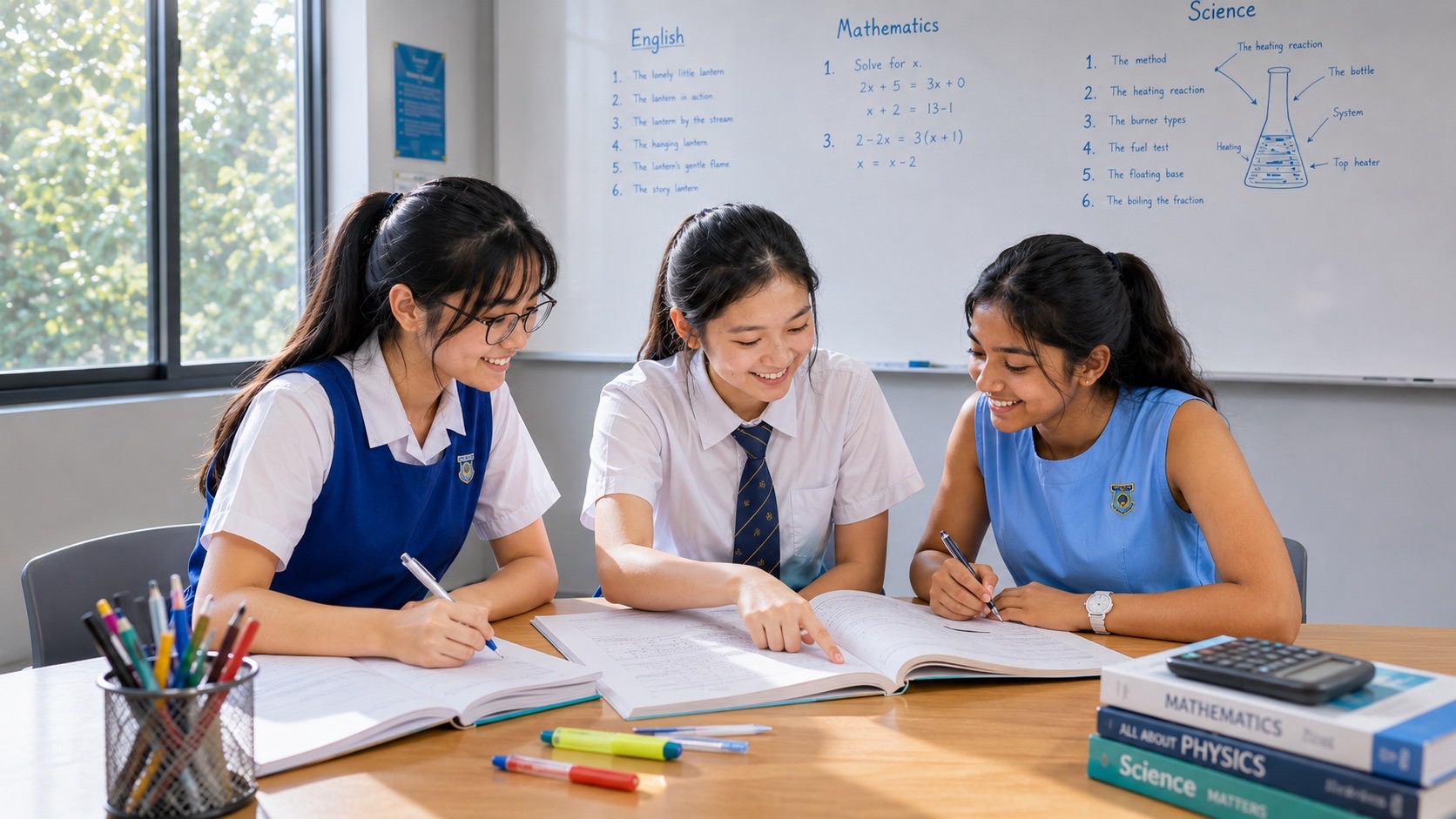
Secondary 2 G3 Principles of Accounts tuition for Jalan Besar students is a useful optional subject-choice preview, not a course for a compulsory national Secondary 2 POA examination. The official 2027 Singapore–Cambridge SEC G3 Principles of Accounts K342 syllabus identifies the subject as an elective offered from Secondary Three. Students should consult the real school’s available combinations, interest and workload rather than assume an early POA class is mandatory.
Imagine an invented Jalan Besar design studio receiving $500 into Bank. If it is an owner’s contribution, Capital rises; if it is a loan, an external repayment liability rises; if it is a fee for a completed service, Revenue rises. The cash amount is identical, but the story and paired account are different. This is the core of accounting reasoning that a Secondary 2 student can sample before choosing an elective.
- POA K342 begins formally at Secondary Three; this Secondary 2 guide offers an elective-choice preview.
- Check the pupil’s own school’s subjects, selection requirements and current academic strengths.
- Explain Assets = Liabilities + Equity using resources and claims in plain language.
- Learn debit-credit from the business event, not a rule equating them with cash arriving or leaving.
- Separate credit purchases, debtor collections, recorded Inventory cost and customer selling price.
- Use source documents, dated timelines and a changed first attempt to test genuine understanding.
- Confirm any actual subject tutor, location and available time before arranging lessons.
This guide provides an evidence-based introduction, twenty original fictional accounting cases, changed independent tests and school-subject advice. It does not describe any real local shop’s financial statements or establish an eduKateSG POA branch in Jalan Besar. The immutable eduKateSG reference documents premium Mathematics lessons for at most three students at 8 Fourth Avenue near Sixth Avenue MRT, not a confirmed lower-secondary POA class.
What an informed Secondary 2 family should do first
The useful objective is to understand the discipline’s style, check that the actual school offers it and make a balanced elective decision. A child who can explain a fresh business event and the related resource or claim has gained more useful insight than one who copies many advanced journals early.
Twelve concepts to preview before choosing POA
Why a school-specific elective choice matters
Principles of Accounts is a national upper-secondary elective, but a national syllabus listing does not guarantee that every school offers the same subject combinations or allocates places in the same way. A Secondary 2 student should review the school’s actual information and discuss academic strengths and interests with teachers. A short preview can clarify what the subject involves, but should never promise admission to a particular combination, a future examination grade or a career.
Test understanding by presenting another event with the same dollar amount but a different source or timing. The pupil should change the paired account for a reason they can explain. If the answer is right only after the tutor provides account names, record that as guided practice and try a different independent version later.
Accounting is a language and information system
A business uses accounting to process transactions and communicate performance, financial position and useful decision information. It does not simply add money from a cash box. Students must decide which resources have changed, whether an outside claim arose, what the proprietor contributed and whether goods or services were earned. Those meanings can be explored in a few original cases before attempting a formal Secondary 3 course.
Test understanding by presenting another event with the same dollar amount but a different source or timing. The pupil should change the paired account for a reason they can explain. If the answer is right only after the tutor provides account names, record that as guided practice and try a different independent version later.
The accounting equation shows position at a point in time
Assets are resources such as Bank, Inventory, Equipment and Trade Receivables. Liabilities can include Trade Payables and a lender’s loan principal. Equity represents the owners’ residual interest after external obligations. Subtracting liabilities from assets yields a snapshot; it does not reveal the year’s earnings. A pupil who thinks Equity is always Bank cash will misinterpret later financial statements even when their subtraction is accurate.
Test understanding by presenting another event with the same dollar amount but a different source or timing. The pupil should change the paired account for a reason they can explain. If the answer is right only after the tutor provides account names, record that as guided practice and try a different independent version later.
Debit and Credit describe directions, not moral labels
Debit is not simply bad, and credit is not good or synonymous with cash received. The account class determines its recording direction. A Bank debit from an owner contribution has a Capital counterpart; the same Bank debit from a lender has Loan Payable; a customer paying an already earned service can affect Revenue or Trade Receivables depending on recognition timing. Ask the child to narrate the event first.
Test understanding by presenting another event with the same dollar amount but a different source or timing. The pupil should change the paired account for a reason they can explain. If the answer is right only after the tutor provides account names, record that as guided practice and try a different independent version later.
The business entity is separate from the owner
A sole proprietor may bring private equipment into the business or take stock for personal use. The first is a capital contribution, and the second may be Drawings. The amount of cash passing through Bank does not determine whether an expenditure is a business expense. Keeping entity and proprietor activities distinct helps stakeholders understand what was actually incurred to earn trading Revenue.
Test understanding by presenting another event with the same dollar amount but a different source or timing. The pupil should change the paired account for a reason they can explain. If the answer is right only after the tutor provides account names, record that as guided practice and try a different independent version later.
A credit purchase and a supplier settlement are different
Goods received on credit create Inventory and an amount owed to a supplier. The Bank transfer that settles an older invoice may occur several weeks later, decreasing both the payable and Bank. Recording Inventory again on settlement would count one shipment twice. A timeline with the delivery note, invoice and remittance advice helps a pupil distinguish acquisition from payment.
Test understanding by presenting another event with the same dollar amount but a different source or timing. The pupil should change the paired account for a reason they can explain. If the answer is right only after the tutor provides account names, record that as guided practice and try a different independent version later.
Trading goods have a selling price and a stock cost
When merchandise is sold, the customer price may differ substantially from what the business recorded as Inventory cost. Under the perpetual method, one journal pair records Revenue and Bank or Trade Receivables at the selling amount, while another moves the stock cost from Inventory to Cost of Sales. A cash sale still removes stock, and an old debtor’s later payment is not a second sale.
Test understanding by presenting another event with the same dollar amount but a different source or timing. The pupil should change the paired account for a reason they can explain. If the answer is right only after the tutor provides account names, record that as guided practice and try a different independent version later.
Returns should follow the source evidence
An accepted supplier credit note can reduce the stock and supplier debt for a credit purchase. A customer returning saleable merchandise may require a reversal of both sales value and stock cost. A mere return request or a damaged item of unknown recoverable value may need additional facts. Students learn accountability when they refrain from inventing a Bank refund or saleable condition to make a journal easy.
Test understanding by presenting another event with the same dollar amount but a different source or timing. The pupil should change the paired account for a reason they can explain. If the answer is right only after the tutor provides account names, record that as guided practice and try a different independent version later.
Financial reporting is period-based, not cash-only
A business can consume electricity before paying for it, use only part of a prepaid insurance contract or receive a fee before all services are provided. A shaded calendar separates current-year Expense, remaining future Prepayment and outstanding service obligation. This preview lets a pupil understand why accounting tracks events over periods without pretending to complete the entire formal subject ahead of school.
Test understanding by presenting another event with the same dollar amount but a different source or timing. The pupil should change the paired account for a reason they can explain. If the answer is right only after the tutor provides account names, record that as guided practice and try a different independent version later.
Source documents can confirm or limit conclusions
An invoice can be photocopied multiple times but still represent one trade purchase. An unpresented cheque can explain why a business ledger differs from a Bank statement. Good source analysis identifies what the original document proves and which facts remain missing. It is not a licence to invent money movements, repeat Revenue or infer dishonesty from a neat numerical discrepancy.
Test understanding by presenting another event with the same dollar amount but a different source or timing. The pupil should change the paired account for a reason they can explain. If the answer is right only after the tutor provides account names, record that as guided practice and try a different independent version later.
A meaningful small group sees every first attempt
The immutable Mathematics reference describes premium up-to-three-pupil instruction near Sixth Avenue MRT with ninety-minute weekly lessons. For an illustrative accounting preview, the tutor should observe each student’s first independent journal before explaining the model. One may confuse owner Capital with borrowing while another simply misreads the invoice. Individualised next steps matter more than a common corrected board answer.
Test understanding by presenting another event with the same dollar amount but a different source or timing. The pupil should change the paired account for a reason they can explain. If the answer is right only after the tutor provides account names, record that as guided practice and try a different independent version later.
The preview can help the student choose another elective
A child might enjoy the methodical event analysis yet decide that another offered subject suits interests or academic plans better. That is an informed outcome, not failure. Assess current Maths, languages, school workload, CCAs, travel and sleep before adding a new session. A geographically named learning guide is not proof that POA is offered at that locality, and no one should promise a grade or subject allocation based on one introductory example.
Test understanding by presenting another event with the same dollar amount but a different source or timing. The pupil should change the paired account for a reason they can explain. If the answer is right only after the tutor provides account names, record that as guided practice and try a different independent version later.
A possible ninety-minute close-feedback class
Minutes 0–10: discuss the actual school’s subject choices and the pupil’s interest in accounting.
Minutes 10–25: distinguish identical Bank deposits from owner Capital, a bank loan and completed service Revenue.
Minutes 25–40: construct the accounting equation from a fictional trader’s resources and outside obligations.
Minutes 40–60: trace goods acquired on credit, sale at a different carrying cost and a later customer collection.
Minutes 60–75: let every pupil attempt different unseen transactions privately before showing complete journal models.
Minutes 75–85: interpret a supplier credit note or uncleared cheque without inventing a Bank movement.
Minutes 85–90: set a short independent altered case and revisit the real subject-choice decision.
This teaching sequence is illustrative, not a published Secondary 2 POA lesson timetable or proof of an active Jalan Besar group.
Twenty original worked transactions and changed first attempts
The fictional cases below show a possible future subject, not an official Secondary 2 examination. They are not real Jalan Besar company accounts or reproduced SEAB questions. Use a suitable selection in a short elective-choice experience rather than forcing all twenty into one class.
Case 1: A complete statement of business position
Original fictional event: An invented microtrader has Bank $4,100, Inventory $1,900, Equipment $2,800 and Trade Receivables $900, with Trade Payables $1,500 and an external Loan Payable $2,700.
Correct accounting explanation: Assets are $9,700; liabilities $4,200; Equity $5,500. This is a residual financial position, not Bank cash or current-year profit.
First misconception to diagnose: Omitting Trade Receivables as an asset or treating the loan as Capital.
Changed independent case and answer: If the lender claim falls to $2,300 with other static balances fixed, Equity becomes $5,900.
Tutor’s conceptual explanation: Classify each amount before using Assets = Liabilities + Equity; an asset may be a customer claim rather than currency.
Question to probe understanding: Why is money owed to the firm a resource?
Before suggesting accounts, ask the learner to narrate who supplied a resource and what claim or service arose. A correct numeric journal without business meaning is fragile.
Close this model and request a new unprompted first line. The student must identify the event, the source record and the relevant account class without being supplied those names. Note whether the reply was independently reasoned, partly hinted or copied; revisit a related case several days later. Good accounting does not invent a transaction where the evidence is silent.
Case 2: Owner funding through cash
Original fictional event: The fictional proprietor introduces $1,850 of personal savings into the business Bank.
Correct accounting explanation: Debit Bank $1,850; Credit Capital $1,850. The business receives owner financing, not customer sales.
First misconception to diagnose: Crediting Sales Revenue for every positive Bank transfer.
Changed independent case and answer: If personal savings contributed rise to $2,400, debit Bank and credit Capital $2,400.
Tutor’s conceptual explanation: The provider of the money is the owner. Its source controls the Capital account, not the arithmetic sign.
Question to probe understanding: Did any client receive a service in this event?
Use separate dates for delivery, invoice, service completion, credit note and Bank settlement. A timeline can reveal where the first wrong assumption entered the working.
Close this model and request a new unprompted first line. The student must identify the event, the source record and the relevant account class without being supplied those names. Note whether the reply was independently reasoned, partly hinted or copied; revisit a related case several days later. Good accounting does not invent a transaction where the evidence is silent.
Case 3: Owner contributes a non-cash printer
Original fictional event: The same sole proprietor introduces personally owned Equipment accepted at $2,100 into the separate business.
Correct accounting explanation: Debit Equipment $2,100; Credit Capital $2,100. A resource and residual owner interest rise without a Bank movement.
First misconception to diagnose: Recording no entry because Bank does not change.
Changed independent case and answer: For accepted Equipment at $2,650, both accounts rise $2,650.
Tutor’s conceptual explanation: Business assets can be contributed in kind. Recognise economic control, not just cash receipts.
Question to probe understanding: Would a supplier credit purchase instead create Capital?
Distinguish the customer’s selling price from stock cost and a lender’s principal from earned Revenue. The same dollar unit does not make different account classes interchangeable.
Close this model and request a new unprompted first line. The student must identify the event, the source record and the relevant account class without being supplied those names. Note whether the reply was independently reasoned, partly hinted or copied; revisit a related case several days later. Good accounting does not invent a transaction where the evidence is silent.
Case 4: Borrowed money from outside a business
Original fictional event: An invented trader takes a repayable $3,400 loan from an external lender, deposited into Bank.
Correct accounting explanation: Debit Bank $3,400; Credit Loan Payable $3,400. Borrowed principal creates an obligation rather than earned income.
First misconception to diagnose: Calling lender funding Service Fee Revenue or Capital.
Changed independent case and answer: At a $2,950 new loan, Bank and Loan Payable each rise $2,950.
Tutor’s conceptual explanation: Identify who can demand repayment; the answer distinguishes borrowing from ownership funding.
Question to probe understanding: Why can Bank rise while owner Equity remains unchanged at that instant?
An original invoice, remittance advice or accepted return document supports a specific event. Unsupported balancing entries make accounting less trustworthy.
Close this model and request a new unprompted first line. The student must identify the event, the source record and the relevant account class without being supplied those names. Note whether the reply was independently reasoned, partly hinted or copied; revisit a related case several days later. Good accounting does not invent a transaction where the evidence is silent.
Case 5: Service completed with immediate settlement
Original fictional event: A fictional design studio finishes a $640 layout service and the customer pays through Bank immediately.
Correct accounting explanation: Debit Bank $640; Credit Service Fee Revenue $640. The fee is earned but complete period profit remains unknown.
First misconception to diagnose: Calling all earned fees final profit or treating customer money as Capital.
Changed independent case and answer: For a $720 completed job on credit, debit Trade Receivables and credit Service Fee Revenue $720.
Tutor’s conceptual explanation: Completed work justifies Revenue; payment terms choose the associated asset.
Question to probe understanding: Which account changes if the client is allowed to pay later?
Collect a separate first journal attempt from each learner before discussion. A copied model can disguise an account-class misconception in one pupil and a simple arithmetic slip in another.
Close this model and request a new unprompted first line. The student must identify the event, the source record and the relevant account class without being supplied those names. Note whether the reply was independently reasoned, partly hinted or copied; revisit a related case several days later. Good accounting does not invent a transaction where the evidence is silent.
Case 6: Service invoiced and collected later
Original fictional event: A fictional studio completes a $1,160 project on credit; the customer pays $430 toward it next month.
Correct accounting explanation: At completion, Debit Trade Receivables $1,160 and Credit Service Fee Revenue $1,160. On payment, Debit Bank $430 and Credit Trade Receivables $430; $730 remains owed.
First misconception to diagnose: Crediting Revenue again when an old debtor is collected.
Changed independent case and answer: If the payment is $600 instead, $560 remains receivable.
Tutor’s conceptual explanation: Use invoice and Bank advice as two dated records of one job, not two separate jobs.
Question to probe understanding: What new service was performed at the collection date?
Try a materially changed transaction days later with the model hidden. Mark whether the correct account was independently selected or needed a leading hint.
Close this model and request a new unprompted first line. The student must identify the event, the source record and the relevant account class without being supplied those names. Note whether the reply was independently reasoned, partly hinted or copied; revisit a related case several days later. Good accounting does not invent a transaction where the evidence is silent.
Case 7: Inventory received on trade credit
Original fictional event: A fictional business receives $1,680 of stock for resale, invoiced for payment in thirty days.
Correct accounting explanation: Debit Inventory $1,680; Credit Trade Payables $1,680. Goods and an external debt arise together.
First misconception to diagnose: Crediting Bank immediately despite the credit arrangement.
Changed independent case and answer: If stock is paid for on delivery, debit Inventory and credit Bank $1,680.
Tutor’s conceptual explanation: Receipt of stock, supplier invoicing and eventual settlement may have different dates.
Question to probe understanding: What evidence proves physical goods arrived?
Before suggesting accounts, ask the learner to narrate who supplied a resource and what claim or service arose. A correct numeric journal without business meaning is fragile.
Close this model and request a new unprompted first line. The student must identify the event, the source record and the relevant account class without being supplied those names. Note whether the reply was independently reasoned, partly hinted or copied; revisit a related case several days later. Good accounting does not invent a transaction where the evidence is silent.
Case 8: Part-payment of the supplier invoice
Original fictional event: The trader transfers $580 to settle part of the earlier $1,680 payable.
Correct accounting explanation: Debit Trade Payables $580; Credit Bank $580. The remaining supplier debt is $1,100.
First misconception to diagnose: Debiting Inventory a second time when paying an already recorded purchase.
Changed independent case and answer: If payment rises to $800, $880 remains payable.
Tutor’s conceptual explanation: Payment decreases the creditor claim; it is not another acquisition.
Question to probe understanding: Did any new merchandise arrive on this date?
Use separate dates for delivery, invoice, service completion, credit note and Bank settlement. A timeline can reveal where the first wrong assumption entered the working.
Close this model and request a new unprompted first line. The student must identify the event, the source record and the relevant account class without being supplied those names. Note whether the reply was independently reasoned, partly hinted or copied; revisit a related case several days later. Good accounting does not invent a transaction where the evidence is silent.
Case 9: Merchandise sold at a price above cost
Original fictional event: Stock carried at $960 is sold on credit for $1,600.
Correct accounting explanation: Debit Trade Receivables $1,600 and Credit Sales Revenue $1,600; separately Debit Cost of Sales $960 and Credit Inventory $960. Gross difference is $640.
First misconception to diagnose: Using the sale price to reduce stock or forgetting the goods-cost pair.
Changed independent case and answer: If carried cost becomes $1,040, gross difference becomes $560.
Tutor’s conceptual explanation: Two monetary values represent the buyer’s claim and the stock leaving the business.
Question to probe understanding: Why is a complete sale more than one journal pair?
Distinguish the customer’s selling price from stock cost and a lender’s principal from earned Revenue. The same dollar unit does not make different account classes interchangeable.
Close this model and request a new unprompted first line. The student must identify the event, the source record and the relevant account class without being supplied those names. Note whether the reply was independently reasoned, partly hinted or copied; revisit a related case several days later. Good accounting does not invent a transaction where the evidence is silent.
Case 10: Merchandise sold with immediate cash
Original fictional event: Goods carried at $380 sell for $640, paid into Bank on delivery.
Correct accounting explanation: Debit Bank $640; Credit Sales Revenue $640; Debit Cost of Sales $380; Credit Inventory $380. Gross difference $260.
First misconception to diagnose: Omitting Cost of Sales because there is no Trade Receivable.
Changed independent case and answer: At $420 carried cost, gross difference becomes $220.
Tutor’s conceptual explanation: Cash versus credit affects the customer-side asset, not the fact that Inventory was sold.
Question to probe understanding: Would the stock-cost entry remain under credit settlement terms?
An original invoice, remittance advice or accepted return document supports a specific event. Unsupported balancing entries make accounting less trustworthy.
Close this model and request a new unprompted first line. The student must identify the event, the source record and the relevant account class without being supplied those names. Note whether the reply was independently reasoned, partly hinted or copied; revisit a related case several days later. Good accounting does not invent a transaction where the evidence is silent.
Case 11: Saleable return from a customer
Original fictional event: A credit customer returns saleable goods previously sold at $290, with recorded Inventory cost $170.
Correct accounting explanation: Debit Sales Returns $290; Credit Trade Receivables $290. Debit Inventory $170; Credit Cost of Sales $170.
First misconception to diagnose: Restoring Inventory at the customer price rather than cost.
Changed independent case and answer: For a $350 sale value and $210 carried cost, reverse the two values separately.
Tutor’s conceptual explanation: The condition saleable supports restoration; if damaged, more facts would be required.
Question to probe understanding: Why does the sale-side amount differ from the stock-side reversal?
Collect a separate first journal attempt from each learner before discussion. A copied model can disguise an account-class misconception in one pupil and a simple arithmetic slip in another.
Close this model and request a new unprompted first line. The student must identify the event, the source record and the relevant account class without being supplied those names. Note whether the reply was independently reasoned, partly hinted or copied; revisit a related case several days later. Good accounting does not invent a transaction where the evidence is silent.
Case 12: Accepted supplier merchandise return
Original fictional event: The supplier accepts $205 of an earlier credit purchase back and issues a credit note, without Bank refund.
Correct accounting explanation: Debit Trade Payables $205; Credit Inventory $205. Both stock and supplier debt decrease.
First misconception to diagnose: Debiting Bank solely because a credit note was issued.
Changed independent case and answer: If accepted return is $155, reduce both accounts $155.
Tutor’s conceptual explanation: The note reduces what is owed on the existing invoice rather than proving cash was received.
Question to probe understanding: Which document establishes the supplier accepted the return?
Try a materially changed transaction days later with the model hidden. Mark whether the correct account was independently selected or needed a leading hint.
Close this model and request a new unprompted first line. The student must identify the event, the source record and the relevant account class without being supplied those names. Note whether the reply was independently reasoned, partly hinted or copied; revisit a related case several days later. Good accounting does not invent a transaction where the evidence is silent.
Case 13: Personal use of company Bank resources
Original fictional event: A sole proprietor takes $125 of business Bank cash for a private celebration.
Correct accounting explanation: Debit Drawings $125; Credit Bank $125. This is private consumption, not a trading Expense.
First misconception to diagnose: Debiting business Entertainment Expense from the event’s label alone.
Changed independent case and answer: If owner takes $90 of Inventory at carrying cost privately, debit Drawings and credit Inventory $90.
Tutor’s conceptual explanation: The business entity remains separate from the proprietor’s personal spending.
Question to probe understanding: Why would recording it as a business expense mislead a reader?
Before suggesting accounts, ask the learner to narrate who supplied a resource and what claim or service arose. A correct numeric journal without business meaning is fragile.
Close this model and request a new unprompted first line. The student must identify the event, the source record and the relevant account class without being supplied those names. Note whether the reply was independently reasoned, partly hinted or copied; revisit a related case several days later. Good accounting does not invent a transaction where the evidence is silent.
Case 14: Rent consumed but still owed
Original fictional event: The fictional trader has used premises worth $480 this period but has not yet paid the landlord.
Correct accounting explanation: Debit Rent Expense $480; Credit Rent Payable $480.
First misconception to diagnose: Ignoring the cost simply because there is no Bank payment.
Changed independent case and answer: If the rent is paid immediately, debit Rent Expense and credit Bank $480.
Tutor’s conceptual explanation: Current performance follows use of the premises, not merely settlement timing.
Question to probe understanding: What liability exists before the eventual cash transfer?
Use separate dates for delivery, invoice, service completion, credit note and Bank settlement. A timeline can reveal where the first wrong assumption entered the working.
Close this model and request a new unprompted first line. The student must identify the event, the source record and the relevant account class without being supplied those names. Note whether the reply was independently reasoned, partly hinted or copied; revisit a related case several days later. Good accounting does not invent a transaction where the evidence is silent.
Case 15: Electricity used and partly paid
Original fictional event: The business consumes $360 of electricity and pays $140 of the bill by reporting date, with no prior arrears.
Correct accounting explanation: Recognise Electricity Expense $360 and Electricity Payable $220.
First misconception to diagnose: Reporting only the paid $140 as the current expense.
Changed independent case and answer: If Bank pays $240, Expense remains $360 while Payable becomes $120.
Tutor’s conceptual explanation: A reporting-period cost can be greater than the cash already transferred.
Question to probe understanding: Why does extra payment not alter electricity already consumed?
Distinguish the customer’s selling price from stock cost and a lender’s principal from earned Revenue. The same dollar unit does not make different account classes interchangeable.
Close this model and request a new unprompted first line. The student must identify the event, the source record and the relevant account class without being supplied those names. Note whether the reply was independently reasoned, partly hinted or copied; revisit a related case several days later. Good accounting does not invent a transaction where the evidence is silent.
Case 16: Prepaid insurance with unused coverage
Original fictional event: The firm pays $1,800 for six equal months of insurance; two months have been used.
Correct accounting explanation: Each month costs $300. Insurance Expense is $600 and Prepaid Insurance $1,200 for future coverage.
First misconception to diagnose: Expensing all the upfront payment.
Changed independent case and answer: After four months used, Expense is $1,200 and Prepayment $600.
Tutor’s conceptual explanation: A calendar makes unused future benefit visible.
Question to probe understanding: How can an asset remain after money leaves Bank?
An original invoice, remittance advice or accepted return document supports a specific event. Unsupported balancing entries make accounting less trustworthy.
Close this model and request a new unprompted first line. The student must identify the event, the source record and the relevant account class without being supplied those names. Note whether the reply was independently reasoned, partly hinted or copied; revisit a related case several days later. Good accounting does not invent a transaction where the evidence is silent.
Case 17: Fees received before work is complete
Original fictional event: A studio receives $1,500 for five equal months of support but completes only two months by year-end.
Correct accounting explanation: Earned Service Fee Revenue is $600; Revenue Received in Advance is $900 for three future months.
First misconception to diagnose: Treating the entire Bank receipt as earned income.
Changed independent case and answer: At four months complete, earned Revenue is $1,200 and advance liability $300.
Tutor’s conceptual explanation: A client retains a claim on promised services not yet delivered.
Question to probe understanding: Does money have to arrive again for another month of service to be earned?
Collect a separate first journal attempt from each learner before discussion. A copied model can disguise an account-class misconception in one pupil and a simple arithmetic slip in another.
Close this model and request a new unprompted first line. The student must identify the event, the source record and the relevant account class without being supplied those names. Note whether the reply was independently reasoned, partly hinted or copied; revisit a related case several days later. Good accounting does not invent a transaction where the evidence is silent.
Case 18: Margin and Mark-up on the same figures
Original fictional event: A fictional trader has Net Sales Revenue $6,000 and Cost of Sales $3,600.
Correct accounting explanation: Gross Profit is $2,400; Gross Profit Margin 40%; Mark-up on Cost about 66.67%.
First misconception to diagnose: Using one denominator for both different measures.
Changed independent case and answer: With Cost of Sales $4,000 and sales fixed, Margin ≈33.33%, Mark-up 50%.
Tutor’s conceptual explanation: The numerator can match while the reference base changes; words in the ratio name matter.
Question to probe understanding: Which of these ratios uses net sales as the denominator?
Try a materially changed transaction days later with the model hidden. Mark whether the correct account was independently selected or needed a leading hint.
Close this model and request a new unprompted first line. The student must identify the event, the source record and the relevant account class without being supplied those names. Note whether the reply was independently reasoned, partly hinted or copied; revisit a related case several days later. Good accounting does not invent a transaction where the evidence is silent.
Case 19: Straight-line Equipment cost allocation
Original fictional event: An invented printer costs $6,000 with estimated scrap value $600 and useful life six complete years.
Correct accounting explanation: Annual straight-line depreciation is ($6,000 − $600)/6 = $900. It is a cost allocation, not a fresh Bank purchase each year.
First misconception to diagnose: Ignoring scrap value or posting yearly machine purchases.
Changed independent case and answer: At five full years useful life the annual figure is $1,080.
Tutor’s conceptual explanation: Separate the one-time acquisition from benefit consumed over later periods.
Question to probe understanding: Does yearly depreciation prove more equipment was bought?
Before suggesting accounts, ask the learner to narrate who supplied a resource and what claim or service arose. A correct numeric journal without business meaning is fragile.
Close this model and request a new unprompted first line. The student must identify the event, the source record and the relevant account class without being supplied those names. Note whether the reply was independently reasoned, partly hinted or copied; revisit a related case several days later. Good accounting does not invent a transaction where the evidence is silent.
Case 20: Bank reconciliation with one uncleared cheque
Original fictional event: The fictional Cash at Bank ledger is $1,870 while the bank statement is $2,130. A recorded issued cheque of $260 is uncleared.
Correct accounting explanation: Statement $2,130 less $260 unpresented cheque equals the ledger’s $1,870. The difference reflects timing.
First misconception to diagnose: Inventing sales to make the columns agree or posting the cheque’s payment twice.
Changed independent case and answer: With a $180 uncleared cheque and unchanged ledger, statement would be $2,050.
Tutor’s conceptual explanation: Reconciliation should follow original cheque and statement records rather than guessing adjustments.
Question to probe understanding: Which evidence would establish the cheque later cleared?
Use separate dates for delivery, invoice, service completion, credit note and Bank settlement. A timeline can reveal where the first wrong assumption entered the working.
Close this model and request a new unprompted first line. The student must identify the event, the source record and the relevant account class without being supplied those names. Note whether the reply was independently reasoned, partly hinted or copied; revisit a related case several days later. Good accounting does not invent a transaction where the evidence is silent.
Frequently asked questions
Is there an official national Secondary 2 G3 POA paper?
No. SEAB’s 2027 K342 is offered as an elective from Secondary Three.
Do debit and credit simply mean money going out and coming in?
No. They are recording directions for account classes, determined by the business event.
Can a loan be treated as Sales Revenue?
No. Principal borrowed creates an external obligation to repay.
Why can a sale of Inventory need two journal pairs?
The amount charged to the customer and the carried cost of goods leaving Inventory are distinct measures.
Does a customer payment toward an old invoice earn another sale?
No. It generally settles an already recognised Trade Receivable.
Does every school offer the same elective combinations?
Consult the pupil’s actual school’s offerings and allocation rules.
Are the Jalan Besar transactions actual shop records?
No. They are original fictional learning cases.
Does this guide verify POA tuition in Jalan Besar?
No. The immutable reference is a Mathematics programme near Sixth Avenue MRT; any POA provision needs separate confirmation.
SEAB and unchanged teaching reference
Official 2027 SEC G3 POA K342 syllabus
SEAB 2027 G3 school-candidate directory
Immutable eduKateSG Mathematics Tutor Clementi reference
Little India Secondary 2 POA companion guide
The complete Jalan Besar Secondary 1–4 G3 POA series
Secondary 1 G3 Principles of Accounts Tuition Jalan Besar
Secondary 2 G3 Principles of Accounts Tuition Jalan Besar
Secondary 3 G3 Principles of Accounts Tuition Jalan Besar
Secondary 4 G3 Principles of Accounts Tuition Jalan Besar
Confirm actual subject, educator and venue
The unchanged eduKateSG reference describes up to three pupils in premium Mathematics tutorials at 8 Fourth Avenue near Sixth Avenue MRT, with ninety-minute weekly teaching for that Mathematics course. Jalan Besar is a readership and fictional example locality, not confirmation of a POA classroom. Compare the actual school elective options with tutor availability, travel, fees, other subjects, CCA and rest before deciding.