
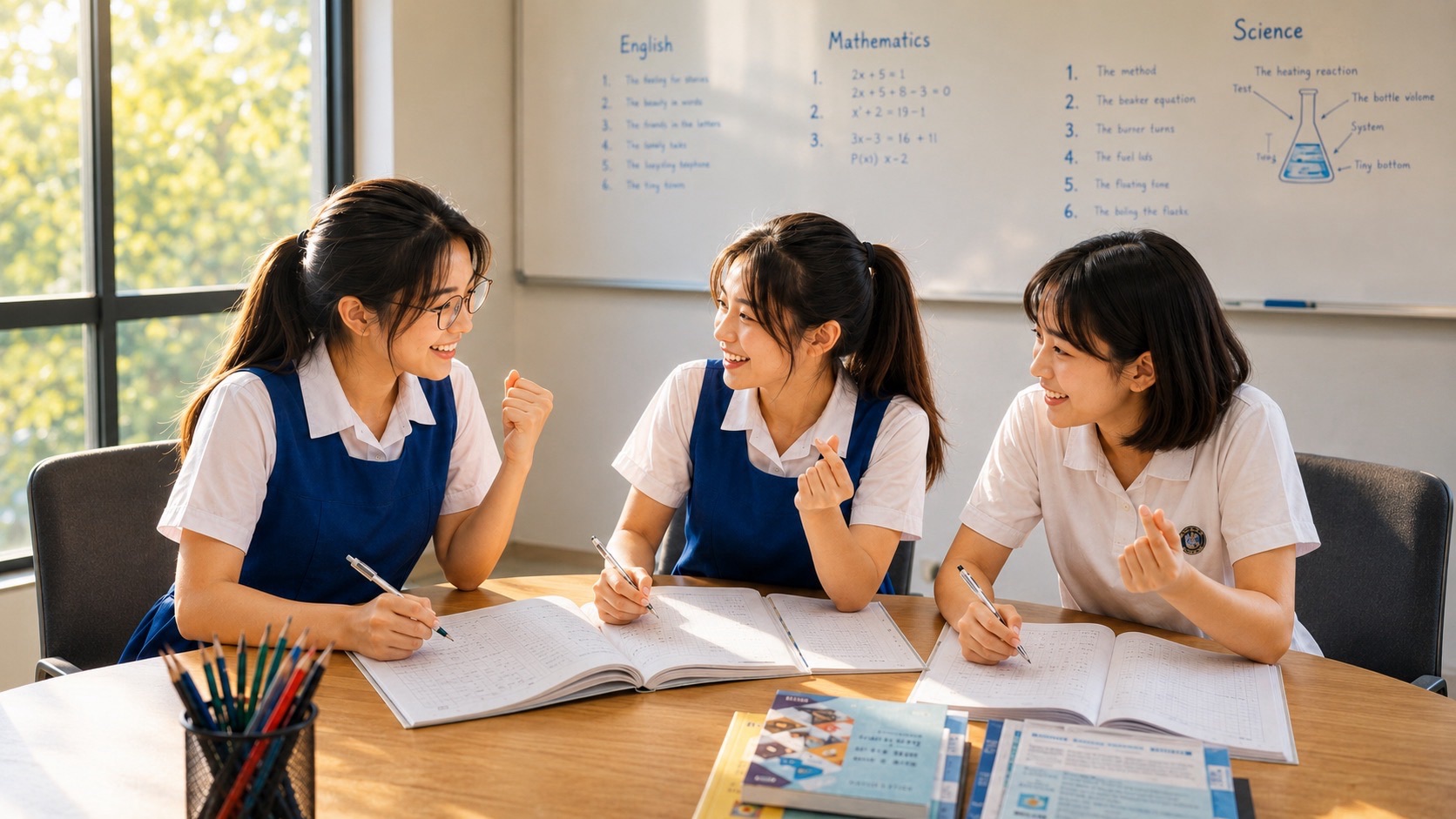
Secondary 2 Mathematics Small Groups Tuition for Choa Chu Kang families should be judged by whether a child can use a corrected mathematical principle in a new question without help. A three-pupil class may offer targeted correction and peer discussion, but it cannot guarantee better marks or replace independent practice. The consequence of tuition without a review process is time, fees and effort spent without a clear picture of what has changed.
For parents in Choa Chu Kang, the most useful first question is not how many more worksheets to buy but what the learner cannot yet do independently. A consultation should begin with marked schoolwork, the current G1, G2 or G3 course and a realistic weekly schedule. This guide concentrates on durable error correction, later retrieval and measuring the difference between assisted answers and independent mastery. It distinguishes the advantages of close feedback from the real costs of tuition, and it makes no claim that an estate-labelled article proves a centre operates in that estate.
Quick information: Three-student, 1.5-hour lessons are potentially valuable when the tutor diagnoses a specific misconception, gives each learner time to reason, and tests a changed problem without help. There is no promise of a grade, examination placement or automatic benefit.
Enquire about Secondary 2 Mathematics tutorials | See the existing Choa Chu Kang Mathematics guide
Real progress is more than an improved correction worksheet
A tutor may help a student complete a correction perfectly, but the same misconception can return a week later. This is why a polished page is not enough evidence. The learner may remember an answer immediately after hearing it without understanding the underlying principle.
Choose a short unseen question before tuition and record the first attempt. After a few lessons, set a comparable problem with different numbers or wording. Ask whether the pupil can choose a method, carry it out and check the result without hints. If the student previously needed three prompts and now needs none, the improvement is meaningful.
For Choa Chu Kang parents, this method of review turns a vague sales claim into observable learning. It also reveals whether the tutor is building dependence by guiding every decision. An effective programme should gradually give the learner control of their own mathematical work.
What Secondary 2 Mathematics small groups tuition should mean
Secondary 2 Mathematics small groups tuition is structured support that addresses particular learning difficulties in a small class. The eduKateSG reference model has no more than three students and a weekly 1.5-hour lesson. Its purpose is to create the opportunity for careful questioning, immediate feedback and checks of individual understanding. Class size alone is not proof that the teaching will work.
A student might solve algebra accurately when told which chapter it comes from but fail to identify the equation hidden in a story. Another might plot coordinates but not understand gradient. A third could correctly recall a formula but apply it to a diagram that does not satisfy its conditions. These are different problems requiring different explanations. The tutor should examine the pupil’s working before deciding what to practise.
The strongest benefit is not an extra set of notes. It is that the learner begins to interpret, select, execute and check methods without someone supplying every hint. The consequence of a poorly matched class can be frustration, travel and expense without much independent improvement. Parents should compare three-pax tuition with school consultations, individual tutoring and suitable self-study rather than assuming every child needs additional lessons.
Why Secondary 2 is the bridge to more independent Mathematics
Secondary 1 introduces new mathematical language and formal procedures; Secondary 2 expects those skills to work together. Pupils must increasingly move between numbers, symbols, diagrams, graphs and written descriptions. A child who knows each operation in isolation may still struggle when several appear within one assessment question.
For example, a linear relationship can be described by a table, expressed as an equation and drawn as a graph. The valuable skill is understanding how the representations fit, not merely copying the format that appeared in the textbook. When the context changes, the student should be able to identify the unknown and choose a sensible approach.
Parents can inspect the child’s earliest working on an unfamiliar question. Was the first step appropriate? Did they define quantities clearly? Did they identify a condition that was not actually given? These observations are more revealing than a simple claim that the pupil is weak or careless. Good tutoring returns to the smallest missing principle and then reconnects it to the current school topic. The outcome should be a stronger foundation for the next year, not just more answers in the current one.
Fictional case: the same error returns in every school paper
Imagine a fictional learner, Ben, who leaves every tutorial with a neatly corrected set of questions. When a school paper presents a similar concept in a different form, he repeats the original error. The tutor realises that the corrected answer has not become durable knowledge.
Ben now has to explain the first invalid step, practise a simpler version and complete a changed example without notes. The same principle returns the following week inside a mixed problem. The tutor records whether Ben identifies it without being told the topic. This follow-up may feel slower than moving straight to the next chapter, but it shows whether the repair is holding.
Parents can ask to see the independent follow-up, not only the teacher’s corrected model. The purpose is to stop the misconception from returning in every new context. The fictional example demonstrates why tuition quality depends on retrieval and transfer, not only the immediate feeling that a lesson has gone well.
Full SBB, G1, G2 and G3: what the tutor must match
Singapore introduced Full Subject-Based Banding for the Secondary 1 cohort in 2024. Students may study subjects at G1, G2 or G3 under the applicable arrangements. The levels broadly correspond to the former N(T), N(A) and Express standards. They describe subject demands rather than fixed intelligence, and a student may take different subjects at different levels.
The same broad mathematical theme can appear across levels, but the required depth, representations and problems can differ. A tutor should ask for the child’s actual Mathematics level, school material and recent marked work before selecting tasks. Teaching every Secondary 2 pupil the same advanced-looking questions is not personalisation.
The Singapore-Cambridge Secondary Education Certificate begins with the graduating cohort in 2027, with candidates sitting subjects at their relevant G-levels. That does not mean a Secondary 2 pupil takes SEC papers in Secondary 2. School assessments and the child’s current subject level determine the immediate lesson plan. Upper-secondary subject offerings and criteria are set by schools under the relevant rules. A tutor may strengthen readiness but cannot promise admission to Additional Mathematics, a G-level change or an examination grade.
Separate mathematical interpretation from algebraic execution
A word problem can be misread even when the student knows the algebra. Conversely, a child may understand the story but be unable to manipulate the resulting equation. The tutor should diagnose where the difficulty begins.
Suppose a ticket costs $6 and the booking charge is a fixed $4. The total for t tickets is 6t+4. If the total is $34, then t=5. Before solving, ask the learner which amount is fixed and which changes with t. If they can build the correct equation but solve it incorrectly, the problem is algebraic. If they cannot create the equation, the problem is interpretation or modelling.
In a three-student group, a table, diagram and equation can be compared. Each pupil then solves a changed situation individually. This keeps peer explanation productive without allowing the confident classmate to do all the interpretation for the others.
What happens inside a purposeful ninety-minute lesson
A useful lesson can open with a short question from an earlier topic that the child solves without notes. That establishes whether prior teaching has been retained. The tutor then explains the current concept, models one example and invites each learner to supply reasons for the steps. The guided explanation should be followed by a quiet individual attempt rather than immediate group copying.
Discussion may then compare different valid methods. One pupil might use a table, another an equation and a third a diagram. The tutor should explain the common principle and where errors arise. The session closes with a new question that each learner attempts independently. The exact timing changes with the topic; a fixed stopwatch is less useful than a clear teaching sequence.
Parents can ask what the pupil knew at the start, what misconception was repaired and what they could do unaided afterward. If the lesson consists entirely of copying a worked solution, the student may become more dependent on the tutor. A smaller group is useful only if the teaching process turns its extra attention into clearer individual understanding.
Find the first invalid line before assigning more exercises
A wrong answer may begin with an incorrect model, a misuse of a theorem, an arithmetic slip or a misunderstanding of notation. A tutor who checks only the final result cannot reliably tell which. The first invalid line often reveals the true learning need.
Consider -2(3x-4)+5x. Correct expansion gives -6x+8+5x, simplifying to -x+8. A pupil who writes -6x-8+5x may not understand why two negative numbers multiply to a positive result. Instead of prescribing twenty expansion questions, the tutor can explain the distributive law, use substitution to expose the difference and set a changed expression for independent practice.
The repair needs to be revisited later. If the student can expand correctly on Tuesday but repeats the sign error inside an equation two weeks later, the understanding has not fully transferred. A short error record—original step, explanation, new example and later retrieval—supports more reliable learning. Parents should look for fewer repeated conceptual mistakes, not only a larger correction booklet.
Make graph understanding survive a change of numbers
A student may recognise the familiar line y=2x+3 but struggle when the rule is written with negative numbers or the axes use a different scale. Good tuition tests understanding after superficial features change.
For y=-3x+9, the intercept is nine and the line reaches y=0 at x=3. The gradient is -3, meaning the y-value falls by three for every one-unit increase in x. Ask the learner to predict points before drawing and to describe why the line slopes downward. Then change the intercept and ask what remains constant.
The group can compare equations, tables and graphs, but the final task must be completed by each child. A new rule with different coefficients is better evidence than another copy of the same diagram. Choa Chu Kang parents can look for explanations that remain correct when the numbers and picture change.
Worked example: interpret the story before solving equations
Suppose two identical notebooks and one pen cost $13, while one notebook and one pen cost $8. Let n be the price of a notebook and p the price of a pen. Then 2n+p=13 and n+p=8. Subtracting gives n=5, so p=3. Both original statements can be checked with those values.
The arithmetic is brief, but there are important choices before it. Which item is counted twice? What do the letters represent? What does equality mean in the context? Some pupils know the elimination procedure but form the wrong equations because they have not translated the story accurately.
A tutor should ask the learner to speak each equation in ordinary language and verify the result in the original problem. Then change the context and ask for an independent new model. Not every example is appropriate to every G-level or school sequence, so the complexity should be adjusted. The transferable skill is connecting real quantities with mathematical relationships rather than memorising the wording of a stationery question.
Worked example: a graph is a relationship, not a picture
For y=3x+2, when x=0 the value of y is two; when x=4 the value is fourteen. The line has gradient three, meaning that y increases by three whenever x increases by one. Its equation, a table and a graph express the same mathematical relationship.
A student can still make two different kinds of error. They might understand the rule but read the wrong scale on an axis. Alternatively, they might plot every point neatly without being able to explain the intercept or gradient. The tutor should diagnose which layer needs attention.
A useful variation changes the rule to y=-3x+2 and asks what remains the same and what changes. The intercept is still two, but the direction of change reverses. In a three-pax group, students can compare the table, sketch and explanation. The final check must be individual and use an unseen rule. A shared, beautifully drawn graph does not prove that all three learners understand the idea.
Spaced retrieval prevents forgotten corrections
A mathematical principle understood during a lesson may be forgotten later, especially when it appears inside a longer question. A tutor should deliberately revisit important ideas rather than considering them permanently mastered after one correct example.
For instance, negative multiplication first appears in bracket expansion, then again in equations and graphs with a negative gradient. Short mixed questions reveal whether the student can recognise that common principle without a chapter label. When the same error returns, the tutor should change the explanation or revisit an earlier prerequisite.
A simple error journal records the initial mistake, why it was wrong and a later independently solved example. Over time the tutor can see which repairs remain stable. Parents can ask when old errors are checked again; the answer should be more informative than ‘we will do revision before exams’.
Ratio, similarity and geometry: identify the mathematical condition
A pupil may memorise a geometry formula without recognising when it applies. A triangle can look right-angled without a right angle being given or proven. Two shapes can look similar without corresponding lengths having been identified correctly. A tutor should insist on the mathematical reason before the numerical calculation.
For a rectangle measuring 2 cm by 4 cm, the area is 8 square centimetres. If both side lengths are tripled, the new area is 72 square centimetres, nine times as large. The length factor is three, but the area factor is squared. The student who merely triples the original area has confused one-dimensional and two-dimensional quantities.
Drawings, tables and short written explanations can repair the confusion. Ask whether the answer should be in centimetres, square centimetres or cubic centimetres. Ask which given fact permits the theorem. The goal is not a long formal speech but a defensible mathematical reason. Group discussion helps when pupils respectfully challenge assumptions, followed by independent justification on a changed diagram.
The difference between guided success and independent mastery
A tutor can make a difficult question feel easy by giving small hints at every important decision. The pupil may leave confident and bring home a correct answer, but the apparent success could depend on the tutor’s guidance. A useful programme must distinguish what the student completed with help from what they can accomplish alone.
After modelling a problem, the tutor should present a fresh example without stating the chapter or first step. Record whether the learner can identify the relevant information, choose a method and check the answer. If a prompt is necessary, note which one. Improvement can mean moving from several prompts to one, and eventually to none on a comparable question.
Parents should avoid judging progress solely by identical worksheets repeated every week. Memory of a model answer can create a misleading increase. Changed numbers, contexts and representations provide stronger evidence of understanding. In the long term, a good tutor should be making their own presence less necessary for basic tasks, even if the family chooses to continue for extension.
Group fit determines whether peer explanations help
Two classmates can offer useful alternative methods, but a three-pupil group can also become unbalanced. If one student always answers first, the others may leave with correct notes but weak independence. If the group contains widely different levels, shared teaching can become confusing.
A tutor should require individual first attempts and choose common concepts with tasks varied for each learner. After discussion, everyone receives a new question to complete alone. Learners should be able to ask questions and make mistakes without being compared publicly by speed.
For Choa Chu Kang families, ask how the group is formed and what happens if the pace is wrong. Sometimes one-to-one teaching or school consultation is a better match. The small number of pupils makes personal attention possible; it does not guarantee it.
What research supports about small-group tuition
The Education Endowment Foundation describes small-group tuition as one teacher or tutor working with roughly two to five learners. Its evidence review reports a positive average effect across the programmes studied, especially where teaching is targeted and connected to classroom learning. Outcomes vary with design, frequency, tutor preparation, subject and learner needs.
A major limitation is that many studied interventions use frequent, concentrated tutoring over several weeks. That does not make a single weekly ninety-minute private tutorial equivalent to the research programme. Nor does the evidence establish a guaranteed grade, percentage-point increase, subject allocation or result for a particular Singapore tuition centre.
The useful conclusion is a quality standard: identify the gap, adapt questions to the child, provide feedback, connect practice with school requirements and check independent transfer. Parents can ask how a provider implements each step. Class size makes those interactions more feasible; it does not guarantee the interactions happen. The research is a reason to examine teaching practice, not a licence to promise an A1.
The benefits and disadvantages parents should compare
A well-managed three-student class offers close questioning, more visible working and opportunities to hear another method. A regular tutorial may also bring structure to revision and make it easier for a hesitant student to ask a question. Compared with a larger class, the tutor has fewer learners to observe at once.
The disadvantages are just as real. Attention is still shared, and a group with incompatible levels can be frustrating. A child may feel exposed in front of two peers. Commuting, fees and homework add to the school week. Repeated tutor prompting can create reliance rather than confidence, while advanced material taught too early can obscure basic weaknesses.
Not every child needs tuition. A pupil who understands school lessons and corrects mistakes independently may benefit more from rest and self-study. A child with large prerequisite gaps may need one-to-one support, and a learner with one narrow misunderstanding may be helped by a school consultation. Choose the format because it addresses a defined problem and fits the child, not because a small class sounds automatically superior.
An eight-week evidence plan for Secondary 2
Weeks one and two can establish baseline skills and identify one or two recurring misconceptions. Weeks three and four focus on repair with changed examples. Weeks five and six mix the concepts with current school topics. Weeks seven and eight revisit them after a delay and repeat an independent diagnostic with comparable difficulty.
The tutor should record first steps, hints, errors and explanations. Parents can then see whether the child is becoming more independent. A higher score on the same repeated questions may reflect memory rather than transfer, so the review must include unfamiliar work.
The sequence is illustrative, not a promise of mastery in eight lessons. If the plan is not working, change the method, group or support format. If the student is ready to continue independently, stopping or reducing tuition may be the best outcome.
How to measure progress without relying on a single grade
At the start of tuition, save a small sample of independent school-style work. Note the first step, the error and whether the pupil needs prompts. Agree on one or two practical targets, such as accurate bracket expansion or independently forming an equation from words. These are more actionable than the instruction to improve Mathematics in general.
After several lessons, set changed but comparable questions. Look for a correct first decision, an understandable explanation, accurate execution and a sensible check. School marks matter, but papers vary in difficulty and topic coverage; the number on a report book should be interpreted alongside evidence of independent learning.
Also review confidence and workload. Is the child willing to attempt unfamiliar problems, or only comfortable when the tutor is beside them? Do the extra lessons leave enough time for schoolwork, family, CCAs, meals and sleep? If the learning target has been met, another goal may be set or tuition reduced. If the same problem persists, the method or support format should change. The aim is competence, not indefinite attendance.
Secondary 3 preparation and Additional Mathematics: honest boundaries
Secondary 2 is a sensible point to think about future subject demands, but school subject combinations, elective availability and eligibility are controlled by the schools under national arrangements. A private tutor cannot guarantee a move from G2 to G3, admission to Additional Mathematics or a particular examination outcome.
Read the child’s school notices and ask which lower-secondary foundations matter most for the preferred pathway. Algebraic fluency, reliable arithmetic, graph interpretation and disciplined reasoning usually support later learning. A pupil with weak basics should not be rushed through advanced chapters for the appearance of acceleration. Another learner with secure foundations may benefit from carefully chosen extensions.
For Secondary 2 students, the immediate work remains school-based assessments and subject-level progress. The SEC begins in 2027 for graduating students; it is not a national Secondary 2 examination. A responsible programme explains this distinction and sets goals within the current learning stage. Better preparation comes from mastering the next useful idea rather than chasing an examination label years too early.
The decision includes the journey and the child’s wider week
An estate-specific article does not establish a classroom in Choa Chu Kang. Confirm the actual teaching venue, session time, subject level and availability. Then account for the full journey, school, CCAs, meals, home practice and sleep.
A strong teaching match can justify a longer journey for some families. For others, the total burden may outweigh the extra attention. No group size can compensate for a chronically exhausted learner. Parents should therefore compare the value of the intervention with the resources it consumes, including time for schoolwork and independent exploration.
An honest tutor should explain what would justify continuing, adjusting or ending the arrangement. Tuition is a means of developing mathematical understanding. Its success is ultimately reflected in how well the learner can reason when the tutor is not present.
Choa Chu Kang family checklist: what to ask before enrolling
- What Mathematics subject level and actual school syllabus does my child follow?
- Which two or three errors repeat in recent marked scripts?
- How will the tutor repair the first wrong step rather than just correct the final answer?
- Will every learner attempt a question independently before group discussion?
- How is the pace adapted when the three pupils have different needs?
- What is the actual venue, travel time and total weekly commitment?
- What independent practice is appropriate alongside CCAs, school and sleep?
- When will progress be reviewed, and what would justify changing or stopping tuition?
Frequently asked questions about Secondary 2 Mathematics tuition for Choa Chu Kang
Does every Secondary 2 student need tuition?
No. Students who understand school lessons, can self-correct and practise independently may not need extra tuition. Start with a specific learning need.
What is a three-pax tutorial?
A class capped at three learners. It offers chances for individual checks and peer explanation, but the tutor’s time is still shared.
Is three-pax better than one-to-one?
Not universally. One-to-one can suit learners needing entirely individual pacing. Small groups can suit pupils who benefit from close feedback and peer discussion.
Can a tutor guarantee A1 or an SEC result?
No. Grades depend on multiple factors, and tuition cannot guarantee examination performance, school subject allocations or future pathways.
What do G1, G2 and G3 mean?
They are subject levels under Full Subject-Based Banding with different mathematical demands. The actual school level should guide tuition.
Does a Secondary 2 student sit the SEC?
No. The SEC begins in 2027 for graduating cohorts. Secondary 2 pupils take their school assessments and prepare for upper-secondary work.
Is early Additional Mathematics essential?
No. Strong current algebraic foundations and school-specific readiness matter more than racing ahead through advanced worksheets.
Does more homework mean better learning?
No. Purposeful, checked practice and independent application are more informative than sheer volume.
How should a tutor check a repeated error?
Identify the first invalid step, explain the missing principle, set a changed example and revisit it later in mixed work.
When should parents review tuition?
After several lessons using independent but unfamiliar questions, plus schoolwork and the child’s experience of the schedule.
What if the group feels uncomfortable?
Ask about the tutor’s participation routines; a different group or individual support may fit a hesitant learner better.
Where should parents verify policy?
Use MOE for Full SBB, SEAB for national examinations and the child’s own school for current coursework and subject choices.
Official policy, educational research and further reading
Official national information is provided by MOE and SEAB. A family’s own school remains the source for current subject offerings, assessments and progression requirements. Research on small-group tuition is useful for understanding general effectiveness but does not guarantee results at any individual centre.
- MOE: Full SBB and SEC transition
- SEAB: Singapore-Cambridge Secondary Education Certificate
- SEAB: 2027 G2 school candidate syllabuses
- SEAB: 2027 G3 school candidate syllabuses
- Education Endowment Foundation: evidence on small-group tuition
- eduKateSG: immutable Clementi small-group teaching reference
- eduKateSG: Secondary 2 Mathematics Choa Chu Kang overview
- eduKateSG: what happens in Secondary 2 Choa Chu Kang Mathematics tuition
The decision for Choa Chu Kang families
A good small-group programme makes the pupil more confident because their thinking is more reliable. It explains difficult concepts, requires independent work and follows up after mistakes. It also allows parents to decide that school support or self-study is sufficient, or that individual tuition is a better fit. Keep the lesson only when its educational benefit justifies the time, energy and cost.
Discuss a suitable Secondary 2 Mathematics tutorial with eduKate Singapore. Verify the location, level, timing, fees and availability directly before planning an enrolment.
A practical follow-up plan for Choa Chu Kang
A simple retention scorecard can prevent a common error in judging tuition: celebrating a correct answer immediately after an explanation as permanent mastery. For each central skill, record the date it was taught, one problem solved with a tutor, one different problem solved without help and a later retrieval check. The later attempt is especially important because forgotten methods often reappear as errors in mixed papers.
The scorecard need not be complicated. Write down whether the learner started unaided, whether the chosen method was valid, whether calculations were accurate and whether the student checked the result. A missed question becomes a prompt for another explanation, not a judgment about ability. If the child repeatedly fails a skill in mixed contexts, revisit the original prerequisite and teach the connection more explicitly.
At a four-to-eight-week review, compare the scorecard with school assessments and the pupil’s experience of the group. Has the same mistake stopped recurring? Does the child explain an answer rather than only repeat a model? Is the weekly journey manageable? These observations help the family decide whether to continue, change the group or reduce support. The purpose of tuition is to make learning durable so that the child can increasingly work independently.