
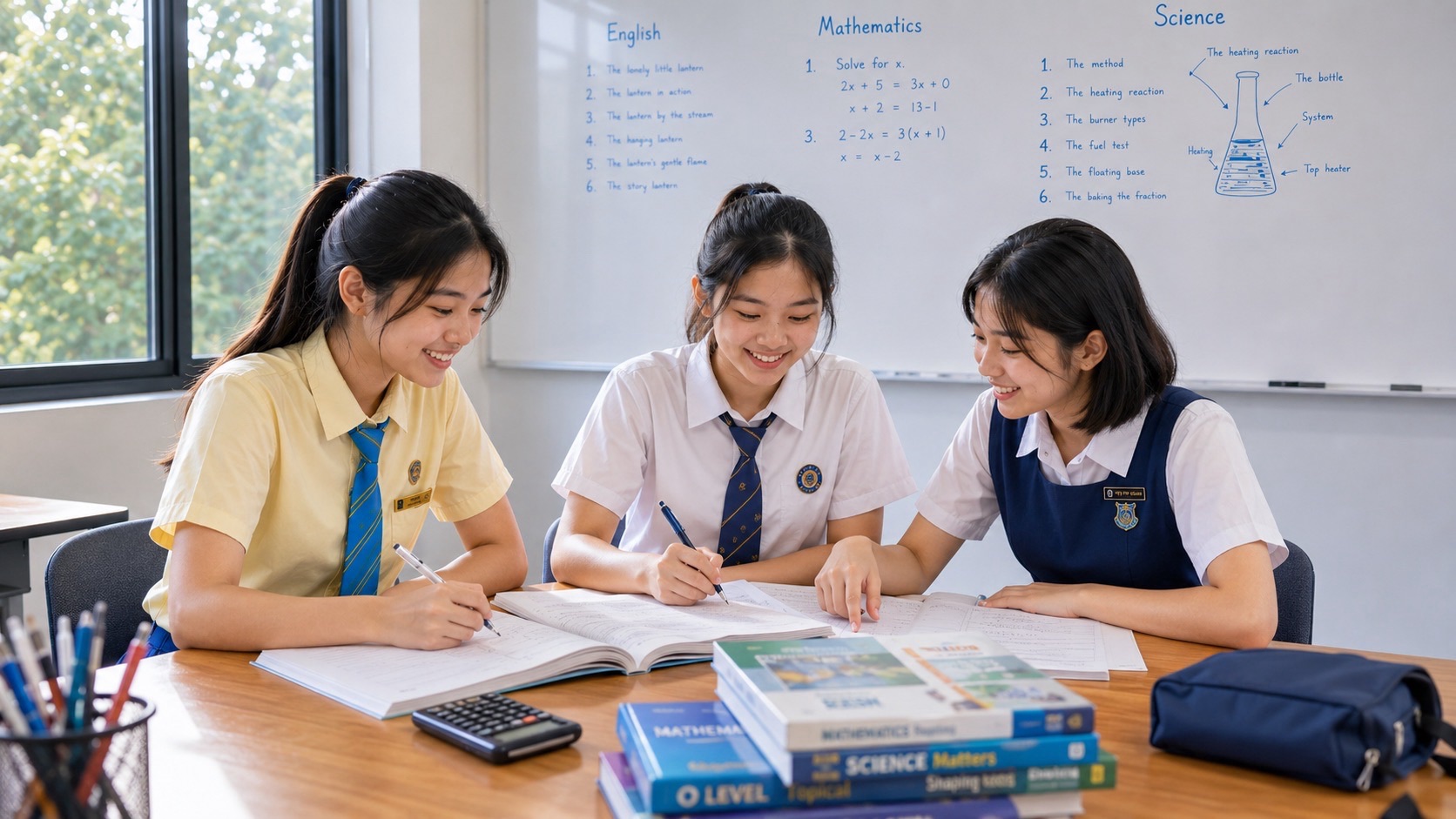
Secondary 2 Mathematics Tuition | Bartley is the consolidation year guide for families searching for Sec 2 Math tuition, lower secondary Mathematics support, Secondary 2 maths tuition or preparation for upper-secondary Mathematics around Bartley. Secondary 2 is often described as a bridge year, but that phrase can sound passive. It is better understood as the year in which lower-secondary ideas must become connected, retrievable and transferable enough to survive the reorganisation of Secondary 3.
For a Bartley Secondary 2 student, the central problem is no longer simply learning algebra for the first time. The student must coordinate algebra, number, ratio and proportion, geometry, graphs, statistics and problem representation while school assessments increasingly mix topics and remove obvious chapter cues. Good Secondary 2 Mathematics tuition should therefore consolidate foundations, improve method selection, repair recurring errors, strengthen cumulative retrieval and test whether knowledge still works when the question changes form.
This page owns only the year+location intent. It preserves the national Secondary 2 Mathematics Tuition owner, the Mathematics Learning Hub, How Mathematics Works, the G1/G2/G3 architecture, and the separate Additional Mathematics Hub. Bartley is used as a family home, school-area and discovery context; eduKateSG is not claiming a physical branch in Bartley.
Secondary 2 is the year to turn chapters into a system
Secondary 1 introduces a new mathematical language. Secondary 2 should make that language operational. A learner who still treats every chapter as a sealed box may score reasonably on a topic test and then struggle on a cumulative paper. The reason is not always forgetting. Often the student cannot decide which idea applies when several are available.
Adrian, one of our fictional resident students, performs well when a worksheet is labelled “algebraic manipulation”. In a mixed set, however, he tries algebra on a ratio problem that would be solved more simply by scaling. He has execution skill but weak selection skill. Secondary 2 tuition must therefore ask an additional question before every method: Why this method here?
That question is the beginning of upper-secondary readiness. At Secondary 3, the number of possible methods grows. If the learner enters that year still dependent on chapter labels, new content increases confusion faster than it increases competence.
The Secondary 2 consolidation audit
A useful Secondary 2 audit asks whether earlier knowledge is available in five forms: recall, can the student reproduce a fact or process; recognition, can the student identify when it applies; execution, can the student carry it out accurately; explanation, can the student say why it works; and transfer, can the student use it when the surface changes? A skill that exists only as recall is not yet ready for a mixed paper.
Jo shows why this matters. She remembers a formula perfectly and substitutes correctly when the diagram matches the classroom example. Rotate the diagram or embed the same relationship inside a word problem and she hesitates. Her formula memory is intact. Her representation-to-method connection is not. We vary the surface deliberately so that the mathematical invariant becomes more visible than the picture.
Algebra in Secondary 2: from rules to control
By Secondary 2, algebra should feel less like a foreign language and more like a working tool. The student should be able to simplify expressions, substitute values, solve equations, use formulae and represent relationships without treating every step as a separate trick. The exact content follows the student’s applicable subject level, but the underlying control principles remain consistent: preserve equality, respect operation order, handle signs carefully and maintain the meaning of each expression.
Ben can simplify routine expressions but becomes unreliable when negatives and brackets interact. Instead of giving him more easy questions, we isolate the dependency: signed operations, distributive structure and line-by-line notation. Once the local weakness stabilises, we reinsert it into mixed algebra. Repair is most efficient when the teacher knows whether the error begins in concept, representation or execution.
Aisha has the reverse problem. Her manipulation is fast, but she does not always know what the algebra represents. We ask her to translate between a verbal relationship, a table, an expression and an equation. The exercise slows her down initially but protects her from a common upper-secondary failure: technically fluent manipulation disconnected from meaning.
Ratio, proportion, percentage and rate should become one family of ideas
Students often store ratio, proportion, percentage and rate as different chapters. Secondary 2 is a good time to connect them as multiplicative relationships. Ratio compares quantities multiplicatively. Percentage uses a base of one hundred. Rate compares quantities with different units. Scale applies a multiplicative relationship between representation and reality. Seeing the family resemblance reduces the number of isolated procedures the learner must remember.
Ryan is accurate with percentage change but weak with speed problems. We do not assume the topics are unrelated. Both require attention to what quantity is the base and how quantities scale. By comparing structures across contexts, Ryan learns to ask, “What is being compared, and by what multiplicative relationship?” That question travels better than a chapter-specific shortcut.
Graphs: reading, creating and reasoning from relationships
Graphs should become more than a plotting exercise. The Secondary 2 learner needs to interpret axes, scale, trend, intercepts or significant features appropriate to the level, and connect graphical information with tables, formulae or real situations. The student should also learn that a graph can be wrong even when every plotted point is placed neatly: unsuitable scale, reversed coordinates or misunderstood variables can invalidate the representation.
Mira’s graph work is visually tidy, but she sometimes reads the vertical axis first because the larger number catches her eye. We train a fixed orientation routine: identify the variables, identify the axes and units, inspect the scale, then interpret the requested relationship. A routine protects attention when the graph becomes more crowded later.
Geometry in Secondary 2: build chains of reasons
Geometry becomes more powerful when students stop treating angle facts as isolated facts. Parallel-line relationships, properties of polygons, congruence or similarity ideas where applicable, and measurement relationships should form chains of reasoning. The goal is not merely to find an angle. The learner should be able to identify which property justifies the result and what information made that property available.
Clara reaches a correct angle quickly but cannot explain the route. We ask her to annotate the diagram and name each reason. The extra discipline may feel unnecessary when the answer is obvious, but it builds the proof-like habits that upper-secondary geometry needs. Mathematical certainty should come from structure, not from a picture that “looks right”.
Statistics and data: calculation is only the beginning
Students can often calculate an average before they can interpret what it means. Secondary 2 should strengthen the distinction between a computation and a conclusion. What does a summary statistic say about the data? What information does it hide? Is a comparison fair? Does a graph exaggerate a difference because of scale? Even when the syllabus-level task is procedural, interpretation trains mathematical judgement.
Ethan calculates two averages correctly and declares the group with the larger average “better”. We ask what the data represent, how spread might matter, and whether the same conclusion would hold under a different measure. The point is not to import advanced statistics prematurely. It is to establish the habit that numbers must be interpreted inside a context.
Mixed-topic practice: the missing bridge to Secondary 3
When every homework page contains one method, the student receives a hidden hint: the page title tells them what to do. Mixed-topic practice removes that hint. Now the first task is diagnosis. Is this a proportional relationship? Is algebra useful? Is the diagram carrying the key information? Is a graph or table easier? Is the problem asking for a calculation, a justification or an interpretation?
Good interleaving does not mean random chaos from the beginning. We first build a method to reasonable fluency. Then we mix it with nearby ideas, later with older topics, and eventually inside school-style sets. The difficulty rises because selection becomes part of the problem, not because every number becomes uglier.
Why fast students can still be fragile
Speed is useful, but speed can hide weak monitoring. Some Secondary 2 students complete routine work very quickly and conclude they are ready for upper secondary. When a question contains an unfamiliar diagram, an awkward wording or two linked topics, confidence falls sharply. The student has learned a fast route through familiar terrain but not how to navigate when the road changes.
For strong students, we therefore add variation, explanation and alternative representations. Aisha might solve a problem algebraically, then explain a numerical method. Adrian might be asked to create a counterexample to a false statement. Clara might compare two valid methods and decide which is more efficient. These tasks strengthen choice and reasoning rather than rewarding speed alone.
Why slow students should not be rushed into imitation
A student who needs more processing time may be tempted to copy the teacher’s method line by line without understanding. That can create short-term completion but long-term dependence. In a small group, we can slow the explanation, reduce simultaneous information, use a simpler example to expose the structure and then rebuild complexity.
Ben may need to verbalise each transformation before writing it. Jo may need one clean worked example followed by an almost-example where one detail changes. The objective is not to make them work slowly forever. It is to give cognition enough time to form a reliable chunk that can later become fluent.
The error taxonomy becomes more useful in Secondary 2
As content accumulates, “careless mistake” becomes increasingly inadequate. We separate errors into representation, knowledge, method selection, execution, communication and checking. We also track recurrence. One sign error is a mistake; eight sign errors across three topics may be a system-level weakness in negative-number control or notation.
An error log should record the question type, the wrong action, the likely cause, the corrected principle and a later retest. Copying the teacher’s correction is not enough. The student should return after a delay and solve an analogous problem independently. That retest tells us whether correction became learning.
Checking should become topic-specific
“Check your work” is too vague. Different questions allow different checks. An equation can often be checked by substitution. A numerical answer can be checked for magnitude. A geometric result can be compared with angle or length constraints. A rate should be checked with units. A graph should be checked against points, scale and expected behaviour. Secondary 2 is a good year to build this library of checks.
Mira used to reread her working from top to bottom and call that checking. Now she checks the vulnerable points: copied values, operation signs, units, final question, and one structural test specific to the method. The routine is shorter and more effective because attention is directed rather than diffuse.
The calculator and estimation must work together
By Secondary 2, students encounter increasingly calculator-suitable arithmetic. The machine should free working memory for reasoning, not remove the need for number sense. Before calculation, estimate the scale. During calculation, enter brackets deliberately. After calculation, inspect sign, magnitude and units. If the result contradicts the estimate, investigate before proceeding.
Ethan once obtains a speed that would require an ordinary cyclist to travel faster than a commercial aircraft. The arithmetic is internally consistent because he entered the wrong time unit. Estimation and real-world plausibility catch what the calculator cannot.
Secondary 2 at G1, G2 or G3: consolidate the actual subject level
Full Subject-Based Banding means the phrase “Secondary 2 Mathematics” does not describe one identical scope for every student. Tuition must align to the learner’s actual G1, G2 or G3 subject level and school sequence. The labels should guide curriculum alignment, not become judgements about ability or potential.
Where movement between subject levels is under consideration, the question is not simply whether the latest score is high enough. We inspect prerequisite security, pace, independence and the student’s ability to transfer. Moving to a more demanding level without enough foundation can create instability; remaining at a level that no longer challenges the learner can also be unhelpful. School guidance remains central to any formal subject-level decision.
The 2027 SEC structure matters as a destination, not as a Secondary 2 worksheet
SEAB’s 2027 SEC listings identify Mathematics as K110 at G1, K210 at G2 and K310 at G3. For a Secondary 2 learner, these codes provide destination accuracy. They help families understand that the current pathway leads into level-specific national assessment. They do not justify replacing a Secondary 2 curriculum with premature Secondary 4 paper drilling.
The better preparation is cumulative competence: reliable algebra, connected number relationships, graphs, geometry, data reasoning, clear working, method selection and self-correction. These capacities survive syllabus transitions because they are mathematical capabilities, not merely familiarity with a paper format.
Upper-secondary readiness: what must be true by the end of Secondary 2?
By year end, the student should be able to retrieve lower-secondary algebra without extensive prompting, work accurately with number and proportion, interpret common graphs and diagrams, use geometry facts as reasons rather than pictures, manage units, select methods in mixed sets, show readable working and correct recurring mistakes. Readiness also includes learning behaviour: bringing questions, completing corrections, spacing practice and tolerating temporary difficulty.
Ryan is “ready” not because every answer is correct. He is ready because when a question goes wrong, he can often locate the failure, explain the correct relationship and solve a variant without the teacher reproducing the entire method. Independence is a more durable readiness indicator than a single perfect worksheet.
The Secondary 3 reorganisation begins before Secondary 3
Upper secondary increases content density and pathway differentiation. Students and parents also begin using search terms such as E-Math, A-Math, G2 Mathematics and G3 Mathematics more frequently. The best preparation is to make Secondary 2 concepts compact and accessible before the new load arrives. A weak algebraic dependency that consumes ten minutes in Secondary 2 may consume forty minutes when embedded inside a more complex Secondary 3 topic.
We therefore use the final part of Secondary 2 to build a prerequisite map. Which concepts are secure? Which are slow? Which fail under mixed conditions? Which need a short repair before the next year? This map is more useful than a vague instruction to “revise everything during the holidays”.
Additional Mathematics: prepare the prerequisites without stealing the subject
Some Secondary 2 families are already thinking about Additional Mathematics. The useful response is not to turn this Bartley Secondary 2 page into an A-Math page. Additional Mathematics remains a separate subject owner. Instead, we strengthen the prerequisites that make later A-Math learning easier: algebraic manipulation, equations, functions-and-graphs thinking, exact notation, geometric reasoning and persistence with multi-step symbolic work.
When A-Math becomes part of the student’s actual programme, route to the Additional Mathematics Hub and the dedicated Additional Mathematics tuition architecture. This separation protects search intent and, more importantly, keeps the educational distinction clear.
A three-student Secondary 2 lesson: one shared concept, three diagnostic paths
In a three-student class, the common lesson might be proportional reasoning. Adrian receives a representation problem because he needs to choose between ratio and percentage. Jo receives a similar relationship with awkward signs and units because execution is her vulnerability. Clara receives an unfamiliar context and must compare two valid solution methods. They can discuss the same mathematical family without pretending their needs are identical.
The teacher can see working at close range. Hesitation before the first line may indicate representation difficulty. A correct first line followed by a sign error points elsewhere. Repeated erasing may show uncertainty even when the final answer is right. These micro-signals are why small-group teaching can become diagnostic rather than merely intimate.
A Secondary 2 lesson cycle
A robust lesson often contains seven moves. First, short cumulative retrieval. Second, clarification of the day’s mathematical relationship. Third, one or two carefully chosen examples. Fourth, guided practice with fading support. Fifth, independent problems that vary representation. Sixth, a mixed retrieval segment that reconnects older topics. Seventh, an exit question that reveals what the student can do without immediate help.
Not every lesson needs equal time in every stage. Before a school test, mixed application and timed work may expand. During foundation repair, explanation and guided practice may take longer. The cycle is a control system, not a script.
A twelve-week Secondary 2 consolidation cycle
Weeks 1–2 establish a diagnostic baseline across algebra, number-proportion, graphs, geometry and data. Weeks 3–4 repair the highest-leverage dependencies. Weeks 5–6 build fluency and topic-specific checks. Weeks 7–8 increase interleaving and representation shifts. Weeks 9–10 introduce longer mixed sets and school-assessment pacing. Weeks 11–12 repeat the diagnostic under less supported conditions and produce an upper-secondary readiness map.
The sequence is deliberately cumulative. A topic is not “finished” when its chapter ends. It reappears in retrieval, mixed practice and later application. That recurrence is what turns temporary performance into accessible knowledge.
When marks fall in Secondary 2
A falling score can result from at least four mechanisms. The content may genuinely be weak. Earlier foundations may be consuming working memory. The learner may know individual methods but fail to select them in a mixed paper. Or examination execution—time, working, checking, skipped parts—may be the main leak. The first intervention should match the mechanism.
For example, Mira’s marks fall from 78 to 61. Topic tests remain strong, but the weighted assessment mixes six areas and she spends too long deciding how to start. Giving her more chapter worksheets would miss the problem. She needs mixed recognition, triage and time-aware practice while keeping conceptual understanding intact.
When marks are high but confidence is low
High-scoring students can still feel fragile if they attribute success to luck or familiar questions. We build confidence through evidence. Can the student solve a delayed retrieval question? Can they explain a step? Can they correct an error independently? Can they handle a new representation? Confidence becomes more stable when the learner can point to capabilities rather than hoping the next paper resembles the previous one.
Aisha learns to keep a “proof of progress” page: not marks, but examples of things she can now do without help. One entry might be “I can check an equation by substitution.” Another might be “I can identify when a graph scale is misleading.” This makes improvement concrete.
What should be memorised?
Mathematics is not anti-memory. Basic facts, definitions, notation, standard relationships and certain formulae need fast retrieval. The question is what the memory is attached to. A formula remembered without conditions can be misused. A procedure remembered without an invariant is fragile. We want compressed memory supported by enough understanding that it can be reconstructed or checked.
Ethan memorises a geometry relationship and can state it instantly. We then show three diagrams: one where it applies, one where a required condition is missing, and one rotated into an unfamiliar orientation. If he identifies the correct case, memory has connected to structure. If he applies it everywhere, the memory remains ungoverned.
What should be practised under time?
Timing should be introduced after enough understanding exists to make the timing meaningful. Early timed work can focus on retrieval or routine execution. Later, students can practise small mixed sets, then longer assessment segments. The objective is not merely to move faster. It is to maintain method selection, working quality and checking while time is limited.
Jo initially gets faster by skipping lines. Her accuracy collapses. We change the target from “finish in eight minutes” to “finish in eight minutes with every sign and unit inspectable”. Speed that destroys reliability is not examination skill.
A weekly Secondary 2 study pattern
A practical week can include three short independent contacts with Mathematics beyond school and tuition. One session retrieves older knowledge. One completes current practice. One revisits errors and solves two mixed problems. During assessment periods, a longer timed segment can replace part of the routine. The pattern is intentionally modest because sustainability matters more than a heroic schedule that lasts two weeks.
Spacing allows forgetting to begin, which makes retrieval effortful enough to strengthen memory. Interleaving forces method selection. Error correction turns failure into revised knowledge. Together, these mechanisms produce more durable preparation than repeatedly rereading worked solutions.
What parents can ask in Secondary 2
Useful questions are process questions: “Which topic is currently easiest, and why?” “Which mistake keeps returning?” “What can you now check by yourself?” “Which old topic appeared in this week’s work?” “What is one thing you should repair before Secondary 3?” These questions invite diagnosis without requiring the parent to become the subject teacher.
Parents can also monitor practical load. Secondary 2 often brings heavier CCA, school responsibilities and social adjustment. If the weekly learning system is so crowded that sleep and recovery collapse, mathematical performance may deteriorate despite more hours of study.
The Bartley resident cast at Secondary 2
Adrian is learning to select methods without chapter cues. Jo is protecting accuracy as speed increases. Ben is repairing brackets and signed algebra. Aisha is reconnecting manipulation to meaning. Ryan is seeing ratio, percentage and rate as a family. Mira is learning mixed-paper recognition. Clara is building explanation and proof-like habits. Ethan is strengthening data and graph interpretation. The eight fictional profiles let us show why consolidation is not one generic revision programme.
Bartley as a search and family context
Bartley is used here as the family’s local search, home or school-area context. The page does not represent a Bartley tuition branch. A practical tuition decision should consider travel, dismissal time, CCA, meals, homework load and the student’s ability to arrive cognitively ready. A sustainable arrangement is part of educational quality because consistency matters.
The existing SEC Examination Mathematics Tuition | Bartley page remains separate. It owns examination-intent discovery rather than this Secondary 2 consolidation job.
How this page routes into the eduKateSG Mathematics system
- Mathematics Learning Hub — broad navigation.
- How Mathematics Works — conceptual root.
- Secondary 2 Mathematics Tuition — national year owner.
- Secondary Mathematics Learning System — stage progression.
- Secondary Mathematics Master Index — Secondary 1–4 route.
- SEC Examination Mathematics Tuition | Bartley — separate exam-intent sibling.
- Additional Mathematics Hub — separate A-Math route.
Frequently asked questions
Why is Secondary 2 important if there is no national examination that year?
Because it is the last full consolidation year before upper-secondary reorganisation. Weak algebra, proportion, graphs, geometry or mixed-topic selection can become much more expensive to repair once Secondary 3 content is added.
Should Secondary 2 tuition teach ahead into Secondary 3?
Only when the current foundations are sufficiently stable. Teaching ahead can reduce future cognitive load, but acceleration should not cover unresolved dependencies. Depth and retrieval usually give a better return than racing through chapters for their own sake.
How much mixed practice should a Secondary 2 student do?
Enough to practise method selection after individual methods are reasonably secure. The amount should rise through the year. A good sequence moves from blocked learning to near-topic mixing, then wider cumulative sets and timed school-style segments.
Does this page cover Additional Mathematics?
No. It prepares prerequisite skills but preserves Additional Mathematics as a separate subject owner. That avoids confusing Secondary 2 consolidation with a future A-Math curriculum.
How should G1, G2 or G3 affect tuition?
The student should be taught the actual level taken in school, with suitable scope, pace and assessment demand. The diagnostic process remains the same, but the content should not be flattened into one generic worksheet for every learner.
The Secondary 2 objective
Secondary 2 should finish with a student who can carry lower-secondary Mathematics as a connected system rather than a stack of completed chapters. The learner retrieves earlier ideas, selects methods with less prompting, works accurately, uses checks deliberately, and knows which dependencies still need repair before the upper-secondary load arrives.
For Bartley families, that is the point of a year-specific Secondary 2 route: consolidation before reorganisation, connection before accumulation, mixed recognition before full-paper pressure, and a clear handoff into Secondary 3 without stealing the job of the national year owner or the separate Additional Mathematics architecture.