
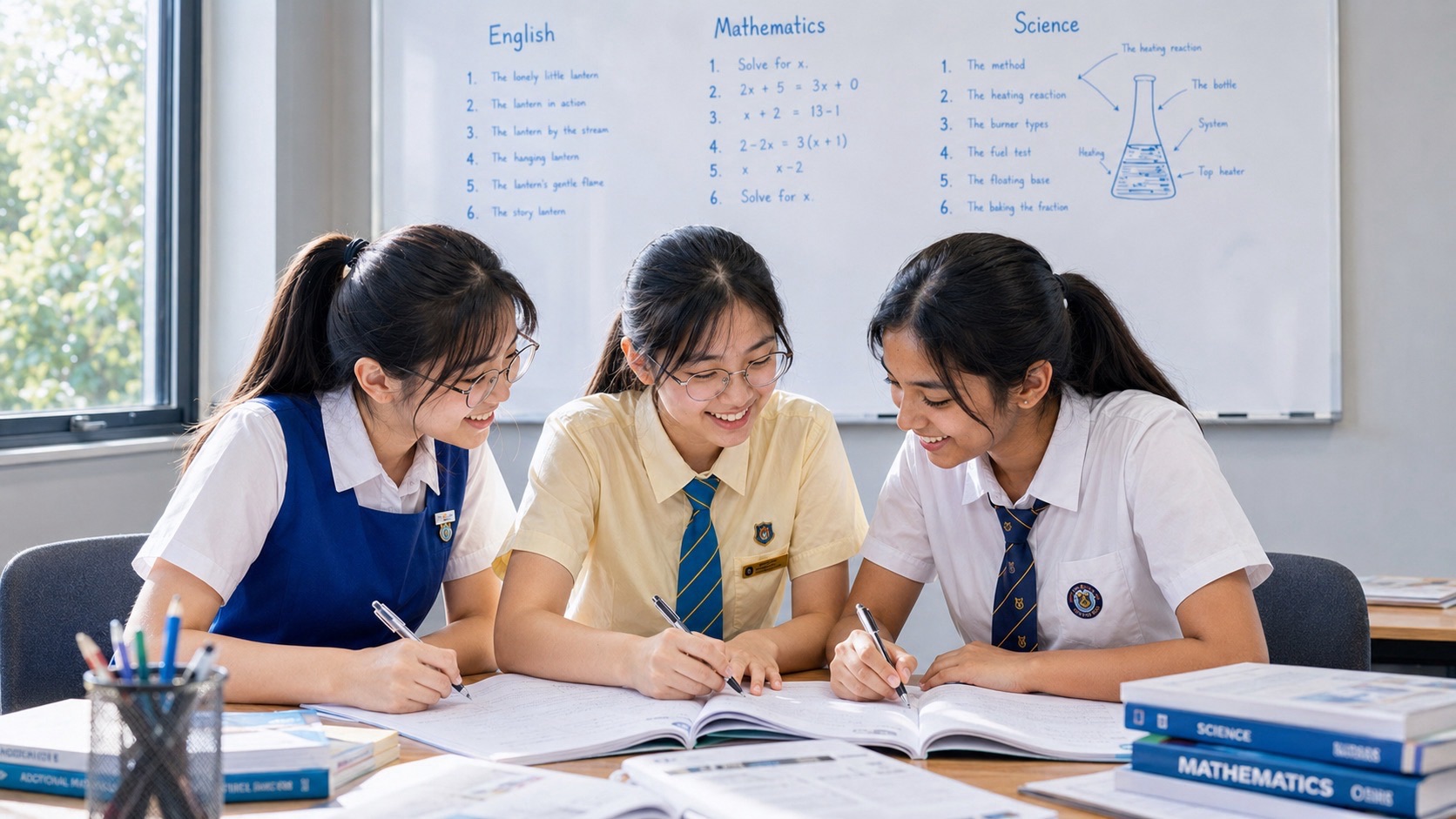
Secondary 2 Mathematics tuition for Crawford students. eduKateSG provides 3-pax tutorials near Sixth Avenue MRT, with focused consolidation, clear teaching and a carefully built transition towards upper-secondary Mathematics.
Secondary 2 is the year to make earlier learning dependable.
The student may already recognise algebra, equations and coordinates. The next challenge is to use them together, choose a method without a chapter heading and remain accurate when a question has several stages.
Our weekly 1.5-hour tutorials combine concept explanation, closely observed practice, independent application and guided correction. Materials and continuation work are selected around the student’s school Mathematics course and actual learning needs.
This guide is for families from Crawford. It does not describe a separate eduKateSG branch there. The teaching venue discussed here is in Bukit Timah, near Sixth Avenue MRT; confirm current placement and arrangements before enrolment.
Arrange a parent–student consultation or ask eduKateSG about Secondary 2 Mathematics on WhatsApp.
A Consolidation Year That Shapes the Next Stage
Secondary 2 can look deceptively familiar. A student has seen letters before, knows several formulas and can complete routine questions. Yet a mixed assessment may reveal that the knowledge works only under favourable conditions.
A worksheet headed simultaneous equations tells the learner what to do. A worded problem about two unknown quantities does not. A geometry diagram with the relevant triangle highlighted provides support that disappears when the student must identify that triangle independently.
The year’s important transition is therefore from recognising a taught procedure to choosing and using it. That requires more than completing additional questions of exactly the same type.
We distinguish three stages. First, the student understands a method while it is explained. Second, the student can repeat it on a similar task. Third, the student can recognise when it is useful after the wording, representation or topic order changes. All three stages matter, but they are not interchangeable.
For Crawford families planning the student’s week, this distinction helps keep tuition purposeful. The extra lesson should provide something that ordinary homework is not already providing: a clearer explanation, a precise repair, more independent selection or an appropriate extension.
It should not become another place where a student appears successful only because an adult supplies every first step.
The strongest preparation for Secondary 3 is a set of skills that remains available when topics become longer and more connected. We build that preparation by checking what the student can explain, retrieve, select and complete without continual prompting.
The Hidden Mathematics Problem: Familiar Methods Must Become Connected
Consider a rectangle whose length is one centimetre more than its width and whose area is twelve square centimetres. The student must first decide what to represent. If the width is w centimetres, the length is w + 1 and the area condition is w(w + 1) = 12.
For a learner whose school programme includes this algebra, expanding and rearranging gives w² + w − 12 = 0. Factorisation gives (w + 4)(w − 3) = 0. The algebraic possibilities are negative four and three, but a physical width must be positive, so the rectangle measures three by four centimetres.
This one question connects reading, representation, expansion, equations, factorisation and interpretation. A learner can know each chapter separately and still struggle with the connection between them.
For a student not yet studying quadratic equations, the same situation can be explored through a table of possible whole-number dimensions. The teaching must fit the course and readiness. We do not use an advanced solution merely to make a simple relationship look impressive.
The important habit is to connect each calculation to the question. Why multiply w by w + 1? Why move twelve to the same side? Why reject a negative width? The student should be able to explain those decisions.
Now change the information from area to perimeter. The equation becomes 2w + 2(w + 1) = P for a stated perimeter P. The dimensions still describe a rectangle, but the relationship has changed. This comparison prevents the student from choosing a method just because the picture looks familiar.
What a Three-Student Group Makes Possible
Mathematics errors often become visible only in the working. A final answer may hide a false cancellation, a copied value or a correct method applied to the wrong quantity. In a 3-pax tutorial, the tutor has room to inspect those intermediate decisions.
Adrian, Jo and Ben are fictional teaching examples. Adrian tends to move quickly; Jo is methodical but may overwork a calculation; Ben often needs help transferring a demonstrated method to a different question. Their examples describe possible lessons, not real results.
Suppose the class simplifies 3(2x − 5) − 2(x + 4). Adrian may lose the minus sign before the second bracket. Jo may reach the correct answer through many small lines. Ben may be unsure whether the two brackets should be multiplied together.
The tutor identifies the structure: two expanded expressions are being subtracted. The result is 6x − 15 − 2x − 8 = 4x − 23. Adrian checks the negative multiplier, Jo looks for a concise but readable layout, and Ben compares the expression with a simpler numerical example.
The class remains centred on one concept while the support differs. Students can then compare a numerical check with a symbolic solution. Substituting x = 0 gives negative twenty-three in both the original and simplified forms.
Discussion has a place, but it should not replace an individual attempt. Each student needs an opportunity to make a decision before hearing someone else’s answer.
Match the Work to the Actual Mathematics Course
SEAB publishes separate 2027 Mathematics syllabuses at G1, G2 and G3. A student’s lesson plan should begin with the subject level and school programme, not an assumption that every Secondary 2 learner needs identical content.
The worked examples here span possible lower-secondary teaching needs. Some are suitable only when the student’s school has introduced the relevant topic. They are not a universal Secondary 2 checklist or a substitute for the school’s syllabus.
Bring recent schoolwork, the topic schedule and details of any school-specific course. A student in an Integrated Programme may have different sequencing and assessment demands. Matching those requirements is more useful than simply adding difficult questions.
We also distinguish readiness from entitlement. Tuition can help a student strengthen Mathematics, but the school determines its subject-offering arrangements and eligibility requirements. We do not promise that attending a class will automatically secure a particular upper-secondary subject combination.
The practical question is what the student needs to do better now. Once the present Mathematics is more stable, discussions about future choices can rest on clearer evidence.
What We Teach in Secondary 2 Mathematics Tutorials
Algebraic accuracy that survives longer expressions
Students need to distinguish terms, factors and operations before manipulating an expression. In 3(2x − 5) − 2(x + 4), every term inside a bracket is affected by its multiplier. The negative two cannot be applied only to x.
We ask students to predict the constant term before finishing the calculation. It should be negative fifteen minus eight, giving negative twenty-three. That separate prediction provides a check on the symbolic working.
Next, change one feature: replace the subtraction before the second bracket with addition. The result becomes 8x − 7. Comparing the two expressions shows why the sign between the brackets matters to both terms.
A student who needs more challenge can construct an expression that simplifies to a given result. This reverses the usual direction and tests whether the relationship is understood rather than merely recognised.
Factorisation as the reverse of expansion
The expression x² − x − 12 factorises as (x − 4)(x + 3). Expanding gives x² + 3x − 4x − 12, which returns to the original expression.
The pair of numbers must satisfy two conditions: their product is negative twelve and their sum is negative one. Checking only the product is not enough. We make both conditions explicit instead of encouraging unstructured guessing.
We also compare common-factor extraction with quadratic factorisation. For 6x² − 9x, first taking out 3x gives 3x(2x − 3). The common factor includes both a number and a variable. Students should check every term after expansion.
Where the topic is part of the school course, recognising x² − 16 as (x − 4)(x + 4) can be explored through expansion. The identity is justified by the cancellation of the middle terms, not by the appearance of two squared values alone.
Algebraic fractions and valid cancellation
Cancellation works on common factors, not on selected pieces of an addition. For example, 6x/9 simplifies to 2x/3 because both numerator and denominator have a factor of three.
By contrast, (x + 3)/x cannot generally be simplified to three. The numerator is a sum, and removing its x would change the value. Substituting x = 3 gives two in the original fraction, which immediately disproves the proposed simplification.
For a student whose course includes the extension, (x² − 9)/(x − 3) becomes (x − 3)(x + 3)/(x − 3), so it simplifies to x + 3 provided x is not three. The restriction remains because the original denominator cannot be zero.
We do not add such restrictions as unexplained decoration. The learner checks the original expression at the excluded value and sees why it was not defined there. The algebra should preserve both value and meaning.
Simultaneous equations and two conditions at once
A fictional stationery purchase gives 2a + 3b = 19 and a + b = 7, where a and b are prices in dollars. Substituting a = 7 − b into the first equation gives 14 − 2b + 3b = 19, so b = 5 and a = 2.
Both equations must be checked. The pair satisfies 2(2) + 3(5) = 19 and 2 + 5 = 7. Checking only one condition can miss a pair that lies on the wrong solution path.
Students also compare substitution with elimination. Doubling a + b = 7 gives 2a + 2b = 14; subtracting that from the first equation gives b = 5 directly.
The point is not to insist on one method for every pair. It is to recognise which route makes the unknowns easier to isolate and to understand that the required pair satisfies both relationships simultaneously.
Graphs as another representation of a relationship
For y = −2x + 7, the points (1, 5) and (3, 1) lie on the line. Moving two units to the right changes y by negative four, giving a gradient of negative two.
A student who counts squares without reading the axes may calculate a different gradient. We use coordinate values, not an assumed visual slope. The units on the axes also determine what the gradient means in an application.
The value of y when x = 0 is seven. That is the vertical intercept in this form. It is not automatically a starting quantity in every real-life situation; interpretation depends on what the variables represent and whether x = 0 is meaningful.
A graph question may ask for a point, a rate of change, an intersection or a comparison. The student should identify the requested feature before deciding which calculation or reading is needed.
Proportion, rate and the assumptions behind a model
If a fictional workshop needs six identical packs of materials for eighteen participants, the model gives one pack for every three participants. Thirty participants would require ten packs under the same assumption.
This is direct proportion: multiplying the number of participants by a factor multiplies the required packs by the same factor. The student should state which quantities are being compared and whether the relationship is justified.
For inverse proportion, imagine a fixed task completed by six equally productive workers in four hours. The simple model predicts two hours for twelve workers. That conclusion depends on assumptions: the work can be shared, each worker has equal productivity, and no additional bottleneck appears.
These are Mathematics models, not claims about an actual business or event in Crawford. Identifying the assumptions is part of understanding why a proportion method fits and when it may fail.
Pythagoras’ theorem and identifying the correct triangle
In a right-angled triangle with hypotenuse thirteen centimetres and one shorter side twelve centimetres, the other side has square 13² − 12² = 25, so its length is five centimetres.
The hypotenuse must be identified from the right angle, not from the way the triangle sits on the page. It is the side opposite the right angle and is the longest side of that triangle.
Students often know the formula but choose measurements from different triangles in a composite figure. We isolate the triangle, label its three sides and mark the right angle before calculating.
After finding the answer, compare its size with the diagram’s stated relationships. A missing shorter side cannot exceed the hypotenuse. This simple check is available even when the diagram is not drawn to scale.
Trigonometry that begins with the reference angle
When right-angle trigonometry appears in the student’s course, we begin by naming the angle and the sides relative to it. Opposite and adjacent are not permanent labels attached to a picture.
For a right-angled triangle with opposite side five and adjacent side twelve relative to angle θ, tan θ = 5/12. Hence θ is approximately 22.6° to one decimal place. The hypotenuse is thirteen, so sine or cosine provides a possible check using the corresponding ratio.
Turn attention to the other acute angle and the opposite and adjacent sides exchange roles. Comparing those two angles makes the meaning of the ratios clearer than memorising a fixed orientation.
Students also check calculator angle settings and round only at the requested stage. An accurate ratio entered in the wrong mode can produce an answer that does not fit the triangle.
Similarity, scale and dimensions
If one figure is enlarged by a length scale factor of three halves, each corresponding length is multiplied by three halves. The area scale factor is nine quarters, because two dimensions are scaled.
A fictional rectangular design measuring eight by twelve centimetres becomes twelve by eighteen centimetres. Its area changes from ninety-six to two hundred and sixteen square centimetres. The ratio is nine quarters, not three halves.
A question inspired by a patterned display in Crawford can use this relationship without pretending that an actual building has been measured. The dimensions in the exercise are supplied data.
Students should establish correspondence before calculating. The longest side of one figure must be matched to the appropriate side of the other, using stated angles or relationships rather than position alone.
Geometry and measurement with explicit reasons
If the sum of a polygon’s interior angles is 1260°, the relationship (n − 2) × 180° = 1260° gives n = 9. This establishes the number of sides; it does not establish that the polygon is regular.
That distinction matters. Equal sides or equal angles require additional information. Students should not infer regularity merely because a diagram appears evenly drawn.
For mensuration, a fictional cylinder with radius three centimetres and height eight centimetres has volume 72π cubic centimetres. An open-top container of those dimensions has one circular base and one curved surface, giving surface area 9π + 48π = 57π square centimetres.
Volume and surface area answer different questions, and the open top changes the required surfaces. We ask the student to identify what is included before selecting a formula.
Statistics and probability as careful interpretation
For the data 4, 6, 7, 7 and 11, the mean and median are both seven, while the range is seven. Equal numerical values here do not make the statistics interchangeable; each was obtained for a different reason.
Frequency tables require weighting. A value that occurs five times contributes five times to the total. Finding the mean of the distinct values alone ignores how often they appear.
For a bag containing four red, three blue and two green counters, the probability of selecting red at random is 4/9. The probability of not selecting blue is 6/9, or two thirds. Students define the sample space and check that the stated selection is random.
Only when the student’s course requires it do we extend to successive selections. Without replacement, two reds have probability (4/9)(3/8) = 1/6. The denominator changes because one counter has been removed.
Our First-Principles Teaching Method
Secondary 2 lessons should make knowledge usable when the question changes. We use a sequence that separates explanation, supported practice and independent performance.
Find the point where the method stops working
We compare a routine example with a changed version. If the student solves an equation on a labelled worksheet but cannot form it from a paragraph, the difficulty is probably not just equation manipulation. If the equation is formed correctly but calculation breaks at a fraction, that is a different need.
The tutor observes the first decision, not only the final answer. A short diagnostic can reveal more than a large collection of undifferentiated practice.
Repair the dependency and reconnect it
A learner struggling with gradients may need to revisit signed subtraction. A learner struggling with similarity may need ratio equivalence. We practise the dependency briefly and then return to the original question.
This return prevents repair from becoming detached from the student’s schoolwork. The student sees that an earlier skill is useful now, not merely something being repeated because a test mark was low.
Use the Fencing Method to vary one difficulty
We initially limit the task so its structure is clear. For simultaneous equations, the first pair might allow immediate elimination. The next pair requires one multiplication. A later pair contains negative coefficients or a worded context.
Changing one feature allows the student to identify what new decision is needed. Once the separate features are secure, we combine them in mixed work. The lesson builds complexity without hiding the source of difficulty.
Connect representations
The same two linear relationships can be represented as equations and as lines whose intersection satisfies both. A similarity ratio can be checked through dimensions and areas. A probability can be represented with a list, a table or a tree when appropriate.
We do not require every representation for every question. The student learns to choose one that clarifies the relationships and then moves towards the most useful form for the task.
Reduce the help deliberately
A student may first need a diagram prompt, then only a question about the unknown, and later no prompt. Recording the amount of help makes progress more visible.
We avoid calling a method independent while the tutor is still naming every operation. Supported success is useful, but the final stage should give the student responsibility for selecting and carrying the route.
Retest after a gap
Corrections return in later mixed sets. A factorisation task may appear beside a percentage problem rather than beneath the same chapter heading. The student must recognise the structure again.
If the knowledge is not retrieved, we adjust the practice rather than assume the student was not listening. The earlier explanation may have been clear while the route to recalling it remains weak.
What Happens During a 90-Minute Lesson
A lesson begins with a short independent check of earlier work. Students might simplify an expression, interpret a graph and revisit one previously corrected question. The tutor sees what remains available without a fresh demonstration.
The central explanation addresses a concept or error with wide relevance. For example, valid cancellation affects fractions, equations and later algebra. Clarifying it carefully is more useful than correcting the same error separately in every chapter.
Guided practice follows. Each learner receives enough support to make a genuine attempt, but the tutor avoids turning practice into dictation. Students should be able to say why a step is useful and what it preserves.
The group then moves to independent application. A question may change its representation or combine an earlier topic with today’s work. The tutor lets the student experience the decision before intervening.
Where readiness permits, a short timed set adds a realistic demand. Timing is not used to conceal uncertainty about the method. We first establish that the student can solve the task and then investigate whether speed or organisation needs attention.
Corrections identify the first incorrect decision. The student tries a related question, and the lesson ends with a small continuation task chosen for a reason.
A week before a school assessment may require a different balance from a normal teaching week. The lesson remains responsive to the current course while retaining a clear expectation of individual working.
Three Secondary 2 Student Pathways
Repair: restore the skills that current work depends on
Ben’s simultaneous-equation work may collapse because he loses meaning when replacing one expression with another. We compare substitution in a simple numerical formula with substitution in an equation, then return to the paired conditions.
His immediate task is not a harder set of word problems. It is a more secure understanding of what one expression can replace and why the original relationship remains valid.
Stabilisation: make correct knowledge available consistently
Adrian may factorise accurately in one sitting but make sign mistakes after a week. His plan includes short delayed retrieval, checking by expansion and mixed questions that distinguish factorisation from solving.
The objective is dependable selection and execution. A single successful lesson does not end the need to revisit a fragile habit.
Extension: deepen judgement without rushing the syllabus
Jo may compare elimination and substitution and explain why one is more economical for a particular pair. She can construct two equations with a chosen solution, then test whether her equations give enough information to determine it uniquely.
For geometry, she might explain why a scale factor affects area differently from length or identify an assumption missing from a proposed proof. The challenge comes from reasoning, not only larger numbers.
A student may move between these pathways within a topic. They are teaching choices, not permanent descriptions of ability.
Why Algebra Still Receives Special Attention
As questions become more connected, algebra acts as a practical language for organising conditions. A rate relationship, a geometric formula and a comparison of two quantities can all become expressions or equations.
The student needs to distinguish simplifying, factorising, evaluating and solving. These commands may involve related techniques but have different outcomes. Factorising x² − x − 12 produces an equivalent product. Solving x² − x − 12 = 0 produces values that satisfy an equation.
Confusing those tasks can lead to a perfectly executed procedure that does not answer the question. We make the target explicit before calculation begins.
Algebra also supports independent checking. Expansion tests a factorisation. Substitution checks a solution. A deliberately chosen numerical value can expose an invalid identity. The learner gains ways to inspect work without immediately consulting an answer key.
How We Reduce Repeated Errors
Method selection
When the student uses a familiar method in the wrong situation, we compare two superficially similar questions. An area problem and a perimeter problem may share a rectangle but require different equations. A direct-proportion model and an inverse-proportion model may both mention two quantities but describe different changes.
The correction asks which relationship makes the method appropriate. Simply practising the method more quickly will not resolve a selection error.
Signs, brackets and fractions
We find the first line where the expression changes incorrectly. If a student subtracts a bracket, every term must be affected. If fractions are combined, the denominator logic must remain valid.
Students write enough intermediate work to inspect the risky operation. This does not mean every question needs excessive lines. It means the line containing the likely error should not be hidden in mental arithmetic.
Diagram reading and units
We mark the relevant triangle, corresponding sides or included surfaces before calculating. Students should be able to say which measurement belongs in each part of the formula.
Units provide another check. A surface area should not finish in cubic centimetres. A gradient’s units come from the vertical quantity divided by the horizontal quantity. These are clues to meaning, not just symbols added at the end.
Calculator use and rounding
Students write the mathematical expression before entering it. They check brackets, the fraction bar and angle mode where relevant. Intermediate values retain enough accuracy for the final stage.
When an answer seems unreasonable, the student compares it with an estimate or geometric limit before accepting the screen. The calculator carries out the entered operation; the learner remains responsible for deciding whether it is the correct operation.
A correction that changes the next attempt
A short correction note should state what went wrong and what to do differently. For example: I used the length scale factor for area; next time I will identify the dimension before applying the factor.
The student then attempts a changed example and revisits the idea later. Copying a model answer may be part of understanding a solution, but it should not be the final evidence of learning.
A Six-Question Check of the Student’s Thinking
This is an illustrative discussion set, not a school examination or a score-based placement test. Use only the questions that match the student’s course.
1. Simplify 2(3x − 4) + 5. The result is 6x − 3. Ask which terms the two multiplies and why the five is added afterwards.
2. Factorise x² + 5x + 6. The result is (x + 2)(x + 3). Ask the student to verify it by expansion rather than repeat a remembered pair of numbers.
3. Solve a + b = 9 and a − b = 3. Adding the equations gives 2a = 12, so a = 6 and b = 3. Ask why addition removes b.
4. Find the gradient through (1, 2) and (4, 11). The vertical change is nine and the horizontal change is three, so the gradient is three. Ask what would change if the points were processed in the opposite order consistently.
5. A similar shape has twice each corresponding length. What happens to area? The area is four times as large. Ask the student to demonstrate this using a rectangle.
6. A bag has three red and five blue counters. What is the probability of red on one random draw? It is three eighths. Ask what the denominator represents.
The explanation matters as much as the answer. Two students who get four answers right may still require very different teaching.
Teaching Ahead and Preparing for Subject Choices
Pre-teaching should follow readiness. A student who controls linear equations may benefit from an introduction to their graphical interpretation. A student whose fraction work remains unstable may need that repaired before more complex algebra.
When Additional Mathematics is being considered, the discussion should include the student’s algebra, persistence with unfamiliar tasks, current workload and the school’s requirements. A tuition programme cannot replace the school’s decision process.
Useful preparation does not require treating every Secondary 2 lesson as an A-Math class. Accurate substitution, valid transformations, factorisation, clear graphs and the ability to learn a new relationship provide a strong base for later study.
We keep the main Mathematics course distinct. Students can read the Additional Mathematics Hub for that separate subject while continuing to consolidate the work required now.
What Progress Should Look Like
A student begins a mixed question by identifying the relevant relationship rather than waiting for the chapter name. Working becomes shorter where it can safely be shorter, and more explicit where an error risk needs attention.
Earlier corrections survive a gap. The learner can explain why a method fits, compare two possible approaches and reject an answer that does not satisfy the original conditions.
For parents, a useful update names the change: simultaneous equations are now independent, but worded modelling still needs a prompt; similarity calculations are accurate, but correspondence needs attention.
A total mark remains important, yet it should be considered alongside the work. No fixed grade or guaranteed improvement timetable is promised. We review the teaching plan when fresh evidence shows that a difficulty remains.
When Should a Crawford Student Begin Secondary 2 Mathematics Tuition?
Support may be useful when a student copes with examples but cannot handle mixed questions, takes an unsustainable amount of time over homework, repeatedly loses marks through the same errors or is entering upper-secondary discussions with unresolved foundations.
A student doing well may instead need a more demanding explanation task or a carefully planned extension. Tuition is not compulsory simply because the year is important. The additional class should address a specific need.
Look at several recent pieces of work before deciding. A low mark in one unfamiliar topic does not prove that the whole subject is weak. Equally, a comfortable overall mark can hide a dependency that will matter more later.
The first consultation should clarify the problem and whether a suitable three-student group is available. It should not rely on a generic promise to cover more material.
Travelling from Crawford to Sixth Avenue
Our Bukit Timah teaching venue is at 8 Fourth Avenue, Singapore 268674, near Sixth Avenue MRT. Confirm the lesson location and appointment through eduKate Singapore.
Families from Crawford should confirm the current public-transport route to Sixth Avenue before travelling. The most practical journey depends on the student’s exact starting point, school location and lesson time.
For a Secondary 2 student, the starting point may be school rather than home. Check both journeys before selecting a weekly slot. Walking to the station, waiting, the final walk and a meal break all affect whether the arrangement is comfortable enough to repeat.
Do not assume that a route suitable on a weekend will fit immediately after a long co-curricular afternoon. A realistic timetable protects the student’s ability to complete both schoolwork and the small amount of continuation practice that makes the lesson useful.
Class Details
Class size: Three students.
Duration: 1.5 hours weekly.
Focus: Secondary 2 Mathematics, with topics and difficulty selected for the student’s school course.
Lesson structure: Retrieval, concept explanation, guided questions, independent application and correction.
Materials: Selected notes, topical practice, mixed revision and continuation work. Bring relevant school assignments and assessment papers.
Enrolment: Subject to compatible placement and availability. Confirm current fees, lesson times and any trial arrangement directly.
A suitable group needs a workable shared pace. Students do not need identical marks, but the lesson should not be so fast that one learner cannot participate or so repetitive that another never encounters a meaningful challenge.
What to Bring to the Parent–Student Consultation
Bring recent marked papers, a few ordinary assignments, the school topic schedule and any teacher comments. Include original attempts and corrections so the tutor can see how the student responds to feedback.
The student should identify a question that was difficult to start, not only the question with the largest number of lost marks. Difficulty at the first decision often reveals the kind of help needed.
Explain the existing weekly workload. A plan that ignores school assignments, other subjects and travel may look thorough but be difficult to follow. We should choose continuation work that the student can attempt properly.
Where upper-secondary subject choices are approaching, bring the school’s actual information. We can discuss mathematical readiness without inventing eligibility rules or promising an outcome that is not ours to decide.
A Sustainable Week of Practice
An illustrative week contains three small kinds of work. First, revisit a recently corrected method without the solution open. Second, practise the current school topic. Third, attempt a short mixture of earlier and current questions.
The sessions need not be equal in length. A student with a fragile fraction skill may need several brief returns to it. Another may need one thoughtful worded problem that requires choosing a representation.
Record the point where help was required. A note such as I could draw the diagram but could not decide which sides correspond is more useful than a general statement that the question was hard.
Parents can ask for one explanation rather than supervise every answer. The aim is a student who becomes more capable of working alone, not a family routine in which each Mathematics session requires an adult to remain beside the desk.
Frequently Asked Questions
Why does my child pass topical tests but struggle in examinations?
Topical practice supplies clues about the method. Mixed assessments require the student to identify the relationship independently and move between topics. We compare those conditions and check whether the difficulty lies in selection, recall, execution or time. More of the same labelled worksheet may not address the actual problem.
Does Secondary 2 tuition repeat Secondary 1?
It may revisit a specific earlier dependency, but it should not repeat everything without a reason. Fractions, signed numbers and equation balance remain important inside newer questions. The tutor should explain how a short repair supports the current task and then return the student to that task.
Will all the topics in this guide be taught in the same term?
No. School sequencing, subject levels and individual readiness differ. The examples explain teaching possibilities, not a universal timetable. Bring the actual course outline so that lessons can match current requirements and distinguish present learning from optional extension.
Can a student receive help with both ordinary Mathematics and future A-Math preparation?
The underlying algebra and reasoning can support both. However, the present Mathematics course must remain clear, and Additional Mathematics is a separate subject. We discuss any extra preparation in relation to school requirements and workload instead of assuming that every learner should immediately study advanced chapters.
What happens when a student cannot remember a method?
We first check whether the relationship was understood. Then we use a limited cue, rebuild the method if necessary and schedule a later attempt without that cue. The objective is to improve retrieval and selection rather than make the student dependent on seeing the same worked example before every question.
Should a student always use the shortest method?
A method should be valid, understandable and suitably efficient. A slightly longer route that the student controls may be preferable to a shortcut used without understanding. As fluency improves, comparing methods helps the learner remove unnecessary steps without concealing important reasoning.
How are errors corrected in a small group?
The tutor inspects the working and identifies the first incorrect decision. Students may share a short explanation when the same idea is relevant, then attempt individual variations. A correction should be checked again later rather than treated as complete because the model solution has been copied neatly.
Can tuition guarantee an upper-secondary subject combination?
No. Schools determine their subject-offering arrangements and requirements. Tuition can support mathematical readiness and provide clearer evidence of learning, but it cannot guarantee a school decision. Families should use the school’s current information when discussing choices.
What should parents look for besides marks?
Look for more independent starts, accurate use of notation, successful delayed attempts and a clearer explanation of errors. The student should increasingly know why a method fits and be able to check whether the result satisfies the original conditions. These observations make a progress discussion more specific.
Is there a Crawford branch?
This article supports families travelling from Crawford. The venue described is the Bukit Timah location near Sixth Avenue MRT. Confirm the actual class, venue, timetable and fees before enrolment rather than inferring a local branch from the area in the title.
Helpful Reading for Crawford Parents
Revisit Secondary 1 Mathematics Tuition | Crawford for the initial algebra transition. Continue to Secondary 3 Mathematics Tuition | Crawford and Secondary 4 Mathematics Tuition | Crawford for the next stages.
The Mathematics Learning Hub and How Mathematics Works provide wider explanations and learning guides.
A Stronger Handover to Upper-Secondary Mathematics
A useful Secondary 2 handover does not simply say that the syllabus has been covered. It identifies which skills are independent, which methods remain fragile and how the student responds when a question is unfamiliar.
The learner should know how to define an unknown, choose a representation, preserve mathematical relationships, organise working and test a conclusion. Those habits give the next year a more dependable starting point.
For students who need repair, we restore the missing connection. For students who need consistency, we make knowledge available after a gap. For students who need challenge, we deepen reasoning and judgement.
Secondary 2 Mathematics tuition for Crawford families should leave the student better prepared to learn the next idea, not merely better rehearsed at the last worksheet.
Arrange a Parent–Student Consultation
Share the student’s Mathematics course, recent work and present difficulties. We will discuss the learning need and whether a suitable three-student group is available.
Contact eduKate Singapore or arrange a Secondary 2 Mathematics consultation on WhatsApp.
eduKateSG, 8 Fourth Avenue, Singapore 268674. Near Sixth Avenue MRT. Consultations by appointment.