
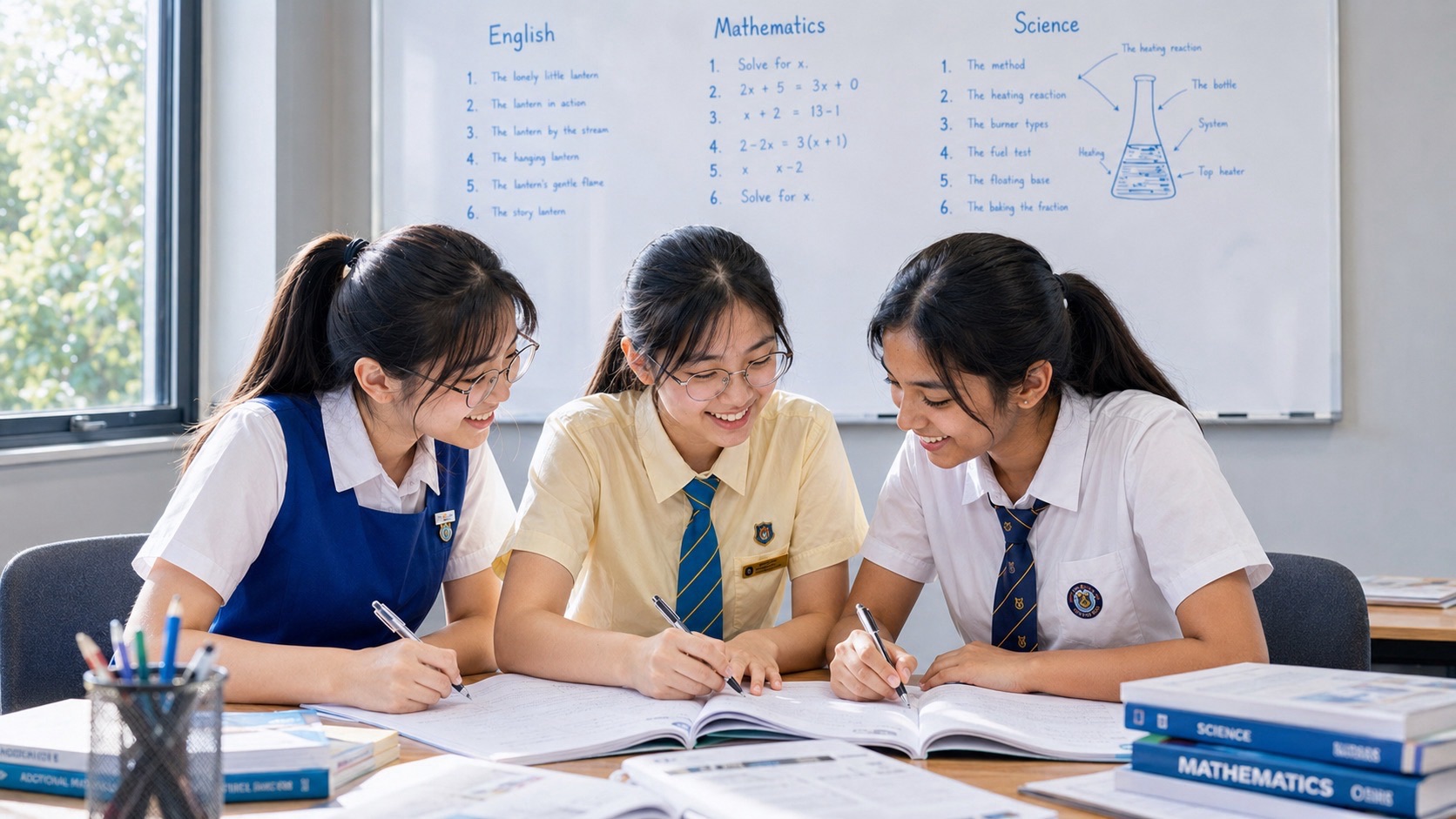
Secondary 2 Mathematics tuition for Kim Seng families should be built around consolidation, transfer and upper-secondary readiness. The second year of secondary school can look deceptively comfortable because students recognise most of the mathematical language: algebra, graphs, ratio, percentage, geometry, statistics and probability are no longer completely new. The real difficulty is that these ideas must now remain available together. A student who succeeds only when each worksheet announces its chapter is not yet ready for the larger mixed demands of Secondary 3.
Parents searching for Secondary 2 Mathematics tuition in Kim Seng, a Secondary 2 mathematics tutor, Sec 2 Math tuition, G2 Mathematics, G3 Mathematics, E-Math preparation or small-group lower-secondary support often want to know whether their child is “ready for upper secondary”. Readiness should not be measured by how far ahead the tuition class has raced. A better test is whether the student can retrieve older methods, recognise structures without chapter labels, explain a correction, manage algebra accurately and combine two or more familiar ideas inside one problem.
This page is the year-specific Kim Seng Secondary 2 route within eduKateSG. Kim Seng is the family’s local search and planning context, not a claim that eduKateSG operates a physical branch there. The article complements the national Secondary 2 Mathematics owners, the Mathematics Learning Hub, How Mathematics Works, and the existing SEC Examination Mathematics Tuition | Kim Seng route. Additional Mathematics remains a separate upper-secondary subject and search intent.
Secondary 2 is the year separate topics must become a connected system
Adrian can simplify an algebraic expression and calculate a percentage when each skill appears alone. His difficulty appears when a word problem requires him to express an unknown algebraically and then apply a percentage change to it. Nothing in the problem is individually beyond him, yet the combination causes hesitation.
This is the central Secondary 2 challenge. The curriculum increasingly reveals whether learning is organised by mathematical relationships or by worksheet headings. Tuition should therefore make connections explicit and then test whether students can retrieve them without hints.
Begin with a mixed diagnostic, not a chapter marathon
Jo completes a twelve-question diagnostic containing algebra, proportion, graphs, geometry, statistics, probability and percentage in mixed order. The tutor records where she starts immediately, where she pauses, where she selects the wrong method and where execution breaks after a correct start.
The pattern matters more than the raw score. A knowledge gap requires teaching. A method-selection gap requires mixed recognition practice. An execution gap may need slower written routines or targeted fluency. One generic revision sheet cannot repair all three.
Algebraic equivalence should become dependable
By Secondary 2, students should understand that expressions can look different while representing the same quantity. For every value of x, 3(x+5) and 3x+15 are equivalent. Expansion, factorisation and simplification are therefore transformations between valid forms.
Ben learns to use substitution as a quick check when appropriate. If he expands 4(2x-3) and is unsure whether the result is 8x-12 or 8x-3, he can substitute x=2 into the original and proposed form. A mismatch reveals the error. The check supports reasoning; it does not replace it.
Factorisation should remain tied to expansion
Aisha sees 12x+18 and asks what common factor every term contains. Taking out 6 gives 6(2x+3). She expands the result to verify it. This two-way relationship makes factorisation easier to reconstruct when memory fails.
Students should also learn why a form might be useful. Expanded form exposes individual terms. Factorised form exposes common structure. Upper-secondary Mathematics repeatedly rewards choosing a useful representation rather than treating one form as permanently “simpler”.
Algebraic fractions reveal old fraction dependencies
Ryan sees x/4+x/6 and tries to add denominators. The problem is not fundamentally algebraic; it is a fraction dependency. The common denominator is twelve, so x/4=3x/12 and x/6=2x/12. The sum is 5x/12.
Good Secondary 2 tuition traces errors backwards. If ordinary fractions are unstable, repair them now. Otherwise the weakness will reappear later inside formulae, equations, probability and algebraic fractions with greater complexity.
Equations now require sequence choice
Clara solves 4(x-3)=2x+10 by expanding first: 4x-12=2x+10, then 2x=22 and x=11. Another valid sequence may exist, but every line must preserve equivalence.
The new skill is not merely executing legal steps; it is selecting a sequence that keeps signs, fractions and brackets easy to audit. Secondary 2 is a good stage to compare methods instead of teaching only one memorised route.
Formula rearrangement should be treated as equation solving
Given P=2l+2w and asked to make w the subject, subtract 2l from both sides and divide by two: w=(P-2l)/2. Ethan narrates the transformations rather than trying to memorise every rearranged formula he may encounter.
This skill has high transfer value. It supports upper-secondary Mathematics, Science and any situation where a relationship must be reorganised around a different quantity.
Simultaneous relationships introduce more than one condition
Suppose two notebooks and one pen cost $13, while one notebook and two pens cost $11. Let n be the notebook price and p the pen price. Then 2n+p=13 and n+2p=11. The pair of equations represents two conditions that must both be true.
Mira checks the model before solving it. This separation between modelling and algebra is important: a perfectly solved wrong equation is still a wrong solution.
Graphs should be read as relationships
If y=2x-1, the equation, table of values and graph describe the same relationship in different forms. Adrian learns to move between them. He also interprets the gradient: as x increases by one, y increases by two.
Graph work should therefore ask more than “plot these points”. What do the axes mean? What does the intercept represent? How does the graph change when a parameter changes? These questions build representational flexibility.
Direct proportion depends on an invariant
If y is directly proportional to x, then y/x is constant for non-zero x. Writing y=kx makes the relationship explicit. If y=18 when x=6, then k=3 and y=3x.
Jo learns to identify the constant of proportionality and interpret it where possible. The constant is not merely a number extracted from a formula; it can represent a rate, unit cost or scale depending on the context.
Inverse proportion needs a model and a condition
For a fixed distance under an idealised model, speed and travel time can be inversely related: increasing speed reduces time so that the product remains constant. But real journeys may contain stops and changing speeds that break the simple relationship.
Ben learns to state the assumption rather than applying y=k/x whenever two quantities move in opposite directions. Mathematical models are strongest when the conditions are understood.
Percentage multipliers organise repeated change
A 15% increase can be represented as multiplication by 1.15. A 15% decrease can be represented as multiplication by 0.85. Starting from $400, an increase and then an equal percentage decrease gives 400×1.15×0.85=$391.
Aisha explains why the amount does not return to $400: the second percentage acts on a different base. Multiplier notation keeps that structure visible and later supports growth, depreciation and reverse-percentage work.
Similarity requires accurate correspondence
If triangle ABC is similar to triangle DEF, the order tells us that A corresponds to D, B to E and C to F. Ryan writes the vertex matching before forming any side ratio.
This small habit prevents one of the most common similarity errors: pairing sides by visual position rather than correspondence. It also prepares the student for area and volume scale factors later.
Pythagoras begins with the right angle
The relation a²+b²=c² applies to a right-angled triangle, with c as the hypotenuse. Clara marks the right angle and identifies the hypotenuse before substituting values.
In a compound diagram, this step matters because several visible lengths may not belong to the relevant right triangle. Formula selection should follow the geometry, not the presence of a triangular picture.
Right-angle trigonometry should begin with side roles
Sine, cosine and tangent describe ratios between sides relative to a chosen angle. Opposite and adjacent therefore change when the target angle changes; the hypotenuse does not.
Ethan labels the sides first, writes the ratio second and uses the calculator third. This sequence prevents calculator fluency from replacing geometric understanding.
Statistics should move from calculation into interpretation
Two data sets can have the same mean but very different spread. An extreme value may pull the mean while leaving the median relatively stable. Mira compares the summaries and asks what each measure reveals and what it hides.
Secondary 2 statistics should teach students to make proportionate claims from the available data rather than treat the calculated statistic as a complete conclusion.
Probability starts with a defined sample space
For two coin tosses, the ordered outcomes HH, HT, TH and TT form a simple equally likely sample space. The probability of exactly one head is therefore 2/4=1/2.
Adrian writes the outcomes before the fraction. This habit makes later compound probability more reliable because the denominator is grounded in an explicit event space rather than chosen by instinct.
Mixed problems are sequences of justified decisions
A rectangular garden has one dimension increased by 20% before a new area is calculated. Jo must identify which dimension changes, calculate the new length, preserve the other dimension and only then use the area formula.
She writes a one-line plan before calculating. This separates structure from arithmetic and reduces the chance that a correct procedure is applied to the wrong quantity.
Upper-secondary readiness should be measured by independence
Parents often ask whether Secondary 2 students should start Secondary 3 topics early. Early exposure can be useful only after foundations are stable. A stronger readiness test is whether the student can start mixed questions independently, retrieve older content, explain why a method fits and repair errors without needing the worked example beside them.
A student who is one chapter ahead but cue-dependent may be less prepared than a student who is on level and mathematically organised.
Additional Mathematics should remain a separate future decision
Some students may take Additional Mathematics in upper secondary, but Secondary 2 main Mathematics should not become premature A-Math drilling. Strong algebra, graphs, proportional reasoning, geometry and checking are the better preparation.
The existing Additional Mathematics Tuition architecture remains separate because the subject has its own syllabus, progression and examination intent.
G1, G2 and G3 support should match the actual subject route
Singapore’s subject-level system means that Mathematics may be taken at G1, G2 or G3. These levels describe subject routes rather than the whole student. For 2027 SEC school candidates, official SEAB listings identify Mathematics as K110 at G1, K210 at G2 and K310 at G3.
Families should use school guidance and current official information to identify the route that applies. Tuition should follow that course rather than treating search labels as interchangeable.
Retrieval should be scheduled every week
If a topic disappears after its chapter test, forgetting is predictable. Ben’s weekly set contains current content, several questions from the previous month and one older dependency. The set is deliberately short so it can survive busy school weeks.
Retrieval keeps methods available before upper secondary increases the number of active topics.
Interleaving should remove cues gradually
Aisha first practises direct proportion in a blocked set. Next, direct and inverse proportion are mixed. Later, proportional reasoning appears among algebra, geometry and statistics. Each stage removes a cue and increases method-selection demand.
Mixing too early can overwhelm a learner who has not yet understood the individual methods. The sequence should move from learning to discrimination to full mixed transfer.
Correction should change the next attempt
Ryan writes specific future controls beside recurring errors: “match corresponding sides first”, “write the percentage base”, “mark the hypotenuse”, or “use a common denominator before adding”. These controls are read before the next relevant set.
A correction is complete only when a fresh problem shows that the future behaviour changed.
A three-student class can share a topic without sharing a diagnosis
Clara may need help with formula rearrangement, Ethan may need method-selection practice and Mira may need more precise written geometry reasons even when all three study the same chapter. The small-group format is useful only if the tutor continues to track individual evidence.
Independent first attempts should be captured before discussion so one learner’s method does not hide another learner’s uncertainty.
School assessments should be classified by mechanism
A low mark can come from different causes: missing knowledge, wrong method, arithmetic execution, incomplete reasoning, question reading, time loss or failure to check. Adrian reviews papers using these categories rather than treating every lost mark as the same kind of weakness.
The classification turns an emotional result into a repair map. It also shows when several errors share one dependency.
Worked example: simultaneous ticket conditions
Adult tickets cost $14 and student tickets cost $9. Forty tickets generate $435. Let a be adult tickets and s be student tickets. Then a+s=40 and 14a+9s=435. Substitute s=40-a into the second equation: 14a+9(40-a)=435, so 5a=75, a=15 and s=25.
Jo checks 15+25=40 and 15×14+25×9=435. Both original conditions are satisfied.
Worked example: compound percentage change
A phone costs $800. Its price rises by 10% and then receives a 15% discount. The final price is 800×1.10×0.85=$748. The result is lower than the original despite the earlier increase.
Ben writes the multipliers first. This protects the changing reference quantity and makes the calculation easier to audit.
Worked example: area scale factor
Two similar rectangles have a length scale factor of 4:3. The corresponding area scale factor is 16:9. If the smaller rectangle has area 45 cm², the larger area is 45×16/9=80 cm².
Aisha draws two dimensions to remind herself why area scales by the square of the length factor.
Worked example: mean from total
The mean of seven scores is 16, so their total is 112. An eighth score of 24 is added, giving a new total of 136 and a new mean of 17.
Ryan translates mean into total before modifying the data set. The method is reliable because the mean is defined by total divided by count.
Worked example: choose the simplest method
A right triangle has legs 8 cm and 15 cm. The hypotenuse is √(8²+15²)=17 cm. No angle information is needed, so Pythagoras is simpler than trigonometry.
Clara learns that method selection should follow the information given. The presence of a triangle does not automatically mean a trigonometric ratio is required.
Formula rearrangement deserves deliberate retrieval
Given v=u+at and asked to make t the subject, subtract u to get v-u=at, then divide by a: t=(v-u)/a, assuming a is non-zero. Ethan writes one transformation per line.
This simple symbolic discipline has high value because formula rearrangement appears across upper-secondary Mathematics and Science.
Calculator fluency should sit behind number sense
Mira estimates before calculating. If 49.7×2.1 appears, she expects a result a little above 100. A display of 10.437 signals an entry problem immediately.
Estimation is not a substitute for exact work. It is an error detector that becomes more valuable as calculator expressions get longer.
Units should travel with quantities
Adrian writes km/h, m², cm³ or dollars per item during working rather than adding units only at the final line. If a speed is 60 km/h and time is 30 minutes, he converts the time before multiplying.
Units can reveal whether an operation makes sense. A perimeter answer in square centimetres is a warning that the wrong quantity has been calculated.
Geometry reasons should become routine
Jo writes “vertically opposite angles”, “angles on a straight line” or “corresponding angles in parallel lines” beside the step that uses the property. The reason converts a visual guess into a mathematical argument.
As upper-secondary geometry becomes more involved, this habit supports longer chains of reasoning.
Graph interpretation should include rate and intercept meaning
Ben does not stop after drawing y=3x+2. He explains that the gradient is three and the y-intercept is two. In a contextual graph, he asks what those quantities represent.
This interpretation makes graphs useful mathematical models rather than exercises in plotting coordinates.
Build a four-week consolidation cycle
Week 1: mixed diagnostic and two high-impact repairs.
Week 2: current school content plus retrieval of repaired skills.
Week 3: mixed-question work with method explanations.
Week 4: fresh independent retest and updated dependency map.
The cycle repeats with new priorities. The point is not to finish every topic in four weeks but to create a rhythm of diagnosis, repair, retrieval and transfer.
A weekly routine should survive real school life
Secondary 2 students juggle many subjects and activities. A plan that requires long daily Mathematics sessions often collapses. A practical routine might include one retrieval session, one mixed-practice session and one correction session outside tuition.
Aisha’s routine is expandable near assessments but small enough to maintain during busy weeks. Consistency prevents old knowledge from disappearing.
Parents can inspect readiness without becoming the tutor
Ask the student to explain one corrected problem. Ask which older topic returned this week. Ask whether an unlabeled mixed question could be started without help. Ask what recurring error is being monitored.
These questions reveal independence and organisation. They are more informative than asking only whether homework was completed.
Method-selection drills deserve their own place
Give ten short prompts and ask the student to name the likely method before solving: percentage multiplier, Pythagoras, factorisation, direct proportion, simultaneous equations, mean-from-total. The drill isolates recognition.
Ryan then solves the three items he found hardest to classify. This targets the bottleneck instead of spending time on arithmetic he already controls.
Use delayed retesting after every important repair
A corrected answer can look easy while the model solution is still fresh. Retest two or three days later with changed numbers and context. If the method still appears independently, the repair is stronger.
Clara’s similarity mistake is only marked stable after a delayed fresh question confirms that she now matches corresponding sides before calculating.
Build an upper-secondary dependency map
Before Secondary 3, list the foundations most likely to support later work: fractions, algebraic manipulation, equations, formula rearrangement, ratio and proportion, graphs, geometry reasons, Pythagoras, trigonometry, percentage, statistics and probability.
Ethan marks each as stable, retrieve or repair. The map is evidence-based and temporary. A skill can move categories after fresh independent work.
Create a compact transition file
The file should contain the dependency map, recurring error controls, several successful mixed questions and a short list of active risks. It should not be a thick archive of every worksheet completed during the year.
Mira’s file tells Secondary 3 exactly where to begin. It prevents the new year from rediscovering weaknesses through avoidable test losses.
How to choose Secondary 2 Mathematics tuition from Kim Seng
Families comparing Secondary 2 Mathematics tuition in Kim Seng should ask whether the programme diagnoses old dependencies, uses mixed retrieval, teaches method selection and judges upper-secondary readiness through independent work. Current Singapore providers commonly use Secondary 1–4 Mathematics, G2/G3, E-Math, A-Math and small-group language in search results, but those labels do not show how learning is repaired.
Ask what happens after a wrong answer. Ask how older topics return. Ask whether the tutor distinguishes main Mathematics consolidation from premature Additional Mathematics work. Ask how individual evidence is preserved inside a small group.
Common Secondary 2 questions
Should my child start Secondary 3 topics early? Only when core foundations are stable. Independence on mixed work is a stronger readiness signal than chapter position.
Is more practice always better? No. Practice should target the mechanism. Repeating familiar questions can increase comfort without improving transfer.
When should A-Math be considered? As a separate upper-secondary subject decision according to the student’s route, school guidance and current requirements.
What if marks fluctuate? Compare the question mix and error mechanisms. A changing mark does not automatically mean underlying learning has reversed.
How do we know consolidation is working? The student starts more questions independently, retrieves older methods faster, makes fewer recurring errors and explains corrections more precisely.
Finish Secondary 2 by removing support conditions
First remove notes. Then remove chapter labels. Then mix old and new topics. Then add a modest time limit. Finally ask the student to explain a solution and correct a deliberate error. Each step reveals whether performance depends on a support condition.
If Adrian remains accurate as scaffolds disappear, the knowledge is becoming independent. If performance collapses, the exact dependency can be repaired before upper secondary begins.
Secondary 2 should hand over an organised learner
Adrian retrieves older methods. Jo recognises structure across contexts. Ben checks algebraic equivalence. Aisha protects fraction dependencies. Ryan uses method-selection drills. Mira interprets data and graphs. Clara justifies geometry relationships. Ethan carries a concise dependency map.
That organisation is the real preparation for Secondary 3. Upper secondary can begin as a planned reorganisation of Mathematics rather than an emergency response to accumulated gaps.
Continue through the Kim Seng Mathematics routes
Use the Mathematics Learning Hub for the complete map, How Mathematics Works for learning mechanisms, and SEC Examination Mathematics Tuition | Kim Seng for the local examination-intent route. Secondary 3 Mathematics Tuition | Kim Seng takes ownership of upper-secondary reorganisation, current G1/G2/G3 accuracy and separate A-Math crosslinks.
A readiness audit should sample dependencies, not only current chapters
At the end of each term, sample the mathematical foundations that upper secondary will reuse. Include an algebraic simplification with brackets, a fraction operation, a rearrangement, a proportional relationship, one graph interpretation, one geometry-reason question, one statistics item and one probability question. Arrange them in mixed order and remove notes.
Adrian may discover that current chapters are strong while an older fraction dependency has weakened. That finding is useful precisely because it appears before the dependency becomes embedded inside harder algebra.
Separate fluency from modelling
Routine algebra, integer work and common fraction transformations should eventually become fluent. Modelling questions should remain slower because the learner must decide what quantities and relationships to represent. Timing both tasks identically can reward haste where thought is needed.
Jo completes brief timed fluency bursts but keeps unfamiliar modelling problems untimed at first. Once the setup is dependable, a moderate time target is introduced. Speed follows correct structure.
Use recurrence, not drama, to prioritise errors
One arithmetic slip in a difficult test may not deserve a full lesson. The same sign error appearing across four weeks probably does. Ben tracks recurring mechanisms rather than every isolated mistake.
If “lost negative sign after expanding a bracket” appears repeatedly, the next repair set deliberately contains negative multipliers. The student then meets a fresh delayed retest to see whether the new control survives.
Worked example: equation with fractions
Solve x/3+2=7. Subtract two to get x/3=5, then multiply by three to get x=15. Aisha checks by substituting: 15/3+2=5+2=7.
The arithmetic is simple, but the example reinforces the principle that equation solving preserves equality. When more complex fractions appear later, the same legal-transformations idea remains.
Worked example: direct proportion with unit meaning
The cost C of identical exercise books is directly proportional to the number n purchased. Eight books cost $20. Then C=kn and 20=8k, so k=2.50. The model is C=2.5n.
Ryan identifies the unit of k as dollars per book. The constant is therefore meaningful: it is the unit price in this model.
Worked example: an inverse model and its limits
A fixed piece of work requires 30 worker-hours under an idealised model. Five equally productive workers would take six hours; ten would take three. Worker number multiplied by time remains thirty.
Clara also states that real jobs can contain coordination costs, unequal productivity and tasks that cannot be divided perfectly. Mathematical modelling includes assumptions.
Worked example: similar figures and area
Two similar figures have a length scale factor of 3:2. Their area scale factor is 9:4. If the smaller area is 28 cm², the corresponding larger area is 28×9/4=63 cm².
Ethan sketches two dimensions and sees why the linear factor is squared. This is more durable than memorising a disconnected “area rule”.
Worked example: statistics and an outlier
The data 4,5,5,6,7 have mean 5.4 and median 5. Replacing 7 with 70 changes the mean dramatically while the median remains 5. Mira sees why different summary measures respond differently to extreme values.
Interpretation follows calculation: the mean is sensitive to every value, while the median depends on ordered position.
Worked example: probability after removal
A bag contains 4 red and 2 blue counters. One counter is drawn without replacement. If the first is red, the bag now contains 3 red and 2 blue counters, so the probability of blue next is 2/5.
Adrian updates both the composition and denominator. This prepares him for later tree diagrams and conditional reasoning.
A student should practise auditing finished solutions
Give Jo a completed solution containing one deliberate mistake. Ask for the first invalid line, the principle violated and the smallest correction needed. She may find that a long wrong solution began with one incorrect percentage base.
Auditing someone else’s work develops the monitoring skill required to review her own paper without the same emotional attachment to the answer.
Reasonableness checks should become automatic
If a right triangle has hypotenuse 10 cm, a calculated leg of 14 cm cannot be correct. If a 5% discount reduces a $200 item to $20, something is wrong. If a probability is 1.4, something is wrong.
Ben learns several impossible-answer boundaries. These checks do not prove correctness, but they catch outputs that violate basic structure.
A transition file should record what no longer needs full support
Upper-secondary planning should not only list weaknesses. Stable skills should be marked for periodic retrieval rather than full reteaching. Aisha may no longer need worked examples for simple equations, while formula rearrangement still deserves practice.
Removing unnecessary scaffolds frees tuition time for the dependencies that genuinely need attention.
Secondary 2 confidence should be evidence-based
Ryan may feel uncertain about mixed work even while fresh-question accuracy improves. Clara may feel confident because a familiar worksheet looks easy but still depend on topic labels. Confidence and performance should be tracked separately.
Evidence-based confidence grows when the student can point to delayed retests, mixed questions and independent explanations that survived without prompts.
One final mixed review should simulate the loss of cues
The year-end set should include familiar mathematical ideas in unfamiliar order, altered contexts and different diagrams. Ask the student to identify the likely method before solving selected items. Add a modest time limit only after setup accuracy is stable.
Ethan’s result becomes the starting evidence for Secondary 3: which skills are ready for ordinary retrieval, which dependencies remain active and which support conditions can now be removed.
Use the last month to practise recovery, not only correctness
Upper secondary will contain questions that do not yield immediately. Secondary 2 is a good time to teach a simple recovery process: reread the target, list what is known, identify the likely mathematical relationship, write one valid first step, and check whether an older dependency is blocking progress. The student learns that hesitation is a diagnostic event rather than a reason to abandon the question.
Mira uses this routine on a mixed geometry-and-algebra problem. She first cannot see the route, but after marking the known lengths and defining an unknown, the equation becomes visible. The recovery sequence is valuable because it can be reused across topics.
End the year with a clear distinction between main Mathematics and A-Math
If Additional Mathematics is part of the student’s next-year pathway, the transition file should note shared prerequisites such as algebraic fluency while still creating separate subject maps. Main Mathematics retains its own geometry, data, probability, percentage and applied-problem demands.
Keeping the subjects distinct prevents the harder-looking A-Math workload from absorbing every revision hour. The student enters Secondary 3 knowing which dependencies support both subjects and which content belongs only to one.
The Kim Seng Secondary 2 route should finish with usable evidence
The final record should contain a fresh mixed score, a short dependency map, recurring error controls, one delayed retest from each major repair and a list of scaffolds that can now be removed. This evidence gives the next year a precise starting point.
Secondary 2 has succeeded when the learner is not merely familiar with more Mathematics, but more capable of selecting, explaining, checking and repairing it independently.
Final handover: make the next teacher able to see the learner quickly
A useful transition record should allow another tutor or the student’s future self to understand the Mathematics profile in minutes. It can state that algebraic simplification is stable, percentage bases need periodic checking, geometry reasons are improving, and mixed-topic method selection still slows under time pressure. Specific evidence is more useful than broad labels.
Adrian, Jo, Ben, Aisha, Ryan, Mira, Clara and Ethan should each finish with a different profile because real learners do not fail in identical ways. The common framework—diagnose, repair, retrieve, mix, retest—stays the same while the active dependencies change.
That is the purpose of the Kim Seng Secondary 2 lane: create a learner who enters upper secondary with an organised Mathematics system, not merely a completed textbook. The next stage can then spend its energy on upper-secondary reorganisation rather than rediscovering foundational weaknesses after they begin costing marks.
The handover should also identify which forms of support can now be withdrawn. If the learner no longer needs worked examples beside routine equations, remove them. If mixed-topic recognition remains dependent on teacher prompts, keep that scaffold temporarily and retest it. Progress is partly measured by the amount of assistance the student no longer requires. A strong Secondary 2 finish therefore creates both a knowledge map and an independence map for the first weeks of Secondary 3.
When this evidence is reviewed at the start of the new year, stable skills can move directly into spaced retrieval while active dependencies receive focused repair. That prevents unnecessary reteaching, protects lesson time and gives the student a clear explanation of what upper-secondary readiness actually means: not knowing everything in advance, but being able to learn new Mathematics from a reliable foundation.
The transition is strongest when the learner can retrieve older skills, choose among methods, explain a correction, and begin new upper-secondary work without rebuilding the foundations from the beginning.