
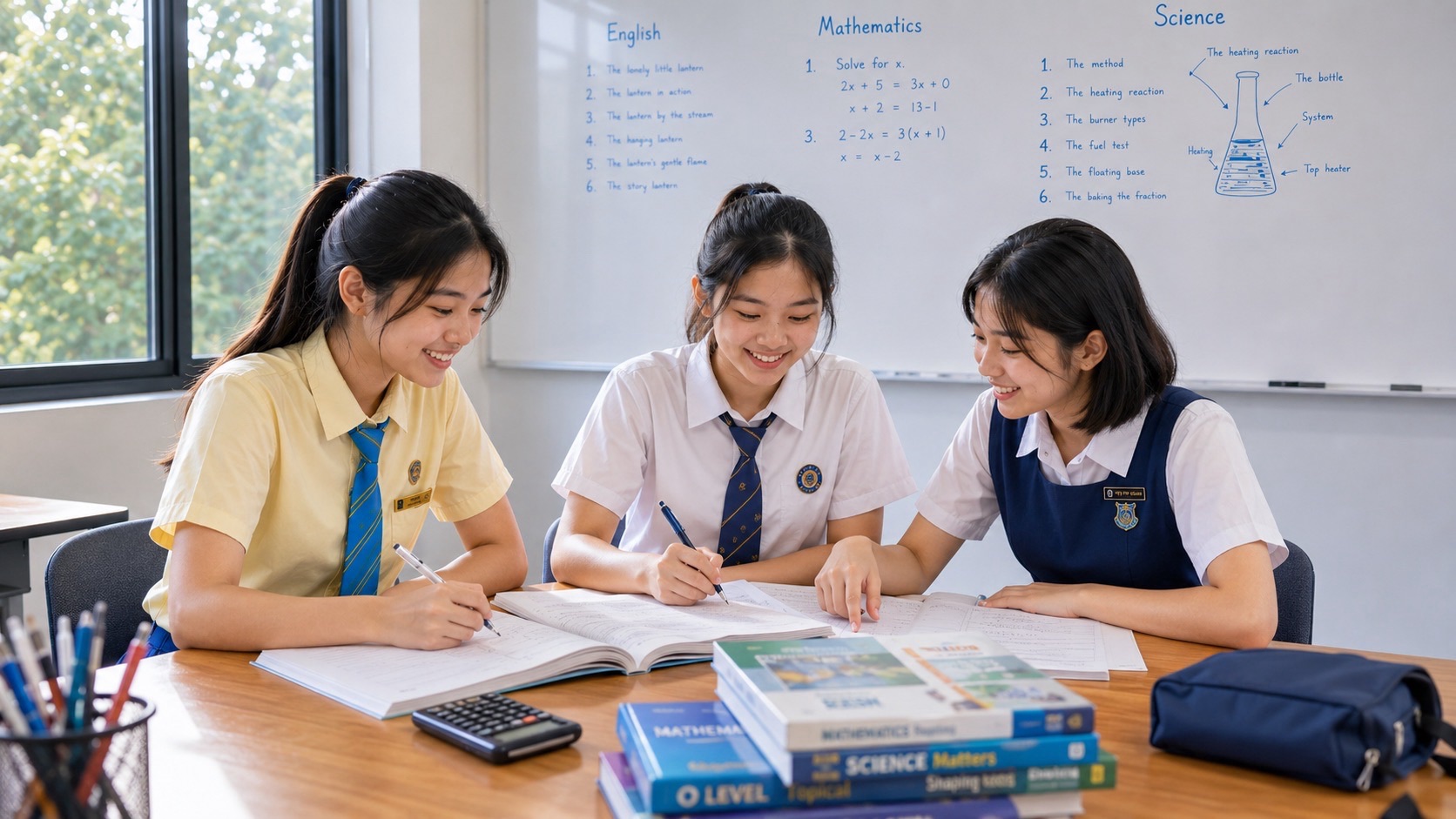
Secondary 3 Additional Mathematics Tuition | Punggol Field is for students who need a strong first year in A-Math: reliable algebra, clearer method selection, disciplined working and close correction before Secondary 4.
For families living around Punggol Field and nearby Punggol East estates, eduKateSG provides three-student Additional Mathematics tutorials at our Punggol teaching location, 83 Punggol Central, Singapore 828761, subject to level, timetable, class fit and availability. Bukit Timah at 8 Fourth Avenue remains an alternative where school location or family movement makes that route more suitable.
The purpose is not simply to give the student more questions. It is to help the learner understand a method, choose it independently, carry it through accurately and recognise it when the next question looks different.
A More Important Transition Than It First Appears
Secondary 3 Additional Mathematics can unsettle a student who has previously felt comfortable with Mathematics. The first examples may look manageable, yet homework becomes slower, the first step becomes less obvious and one algebraic mistake can affect several lines of working.
A learner who previously recognised a question from its appearance must begin reading its structure. A learner who managed several mental steps may need to write more intermediate working. A learner who revised one chapter at a time must keep older knowledge available when it reappears inside a new topic.
Algebra Is the Operating Language of A-Math
In Additional Mathematics, algebra is infrastructure. Weak signs, brackets, fractions, indices, surds or rearrangement can travel into logarithms, coordinate geometry, trigonometry and calculus.
- incorrect expansion and factorisation;
- sign and bracket errors;
- uncertain algebraic fractions;
- weak index or surd manipulation;
- substitution without brackets;
- too many steps compressed into one line; and
- working that cannot be checked easily.
When these mistakes repeat, “be more careful” is not a repair plan. We identify the exact operation that is failing and rebuild it deliberately.
Why Three Students Changes the Teaching
A three-student class keeps each learner visible. The tutor can inspect handwritten working, ask every student to explain a decision, notice when someone is waiting for a hint and vary support within the same lesson.
- frequent individual questioning;
- immediate inspection of working;
- short independent attempts before help is given;
- retrieval of earlier topics during current work;
- faster recognition of repeated error patterns; and
- closer alignment with school assessments.
The Secondary 3 Learning Loop
- Target. Identify the exact problem.
- Retrieve. Bring back the prerequisite knowledge.
- Explain. Build the concept from first principles.
- Model. Make the reasoning visible.
- Attempt. Let the student work independently.
- Vary. Change the surface form.
- Test. Remove prompts.
- Correct. Repair the actual weakness.
- Reconnect. Link the topic to earlier and later Mathematics.
What We Build Across Secondary 3
Schools may sequence topics differently. We follow the student’s school programme while protecting the dependencies beneath it.
Quadratics and polynomial thinking
Students learn to compare factorisation, formulas, roots and graph behaviour instead of memorising one procedure per worksheet.
Functions and graphs
Function notation becomes easier when the student understands inputs, outputs and relationships. Graphs are treated as visual evidence of the same mathematical rule.
Indices, logarithms and trigonometry
Students learn the laws together with the structure those laws preserve, then practise recognising which transformation is useful in a fresh question.
Calculus foundations
When calculus enters the school sequence, it is connected to functions, graphs and algebra so that differentiation and integration do not feel like disconnected procedures.
The First-Step Problem
A common student says, “I understand the solution when I see it, but I do not know how to start.” This usually means recognition has developed further than transfer.
- What information is given?
- What is the target?
- Which relationship connects the two?
- What form is the expression in now?
- What is the first mathematically valid move?
Retrieval, Spacing and Interleaving
A-Math becomes fragile when a student practises one chapter intensively, feels fluent for a few days and then loses it when school moves on. We deliberately bring older topics back and mix them so the learner must choose a method rather than being told by the worksheet heading.
A Weekly Routine for a Punggol Field Student
A practical routine can include a brief reconstruction of the lesson the following day, a small fresh set later in the week and a mixed retrieval task before the next tutorial. The quantity should fit the student’s school workload. The essential feature is an independent attempt without the answer key open.
Getting from Punggol Field to the Punggol Class
Punggol Field is part of the wider Punggol residential area. Families can plan the journey from the student’s actual home or school starting point to 83 Punggol Central. The practical route may involve a short LRT, bus or walking connection depending on the estate and time of day.
This page is a local guide for Punggol Field families and does not imply a separate eduKateSG branch along Punggol Field.
What Progress Should Look Like Before Secondary 4
- less hesitation at the start of questions;
- cleaner algebra;
- better retention of earlier topics;
- less dependence on worked examples;
- fewer repeated error types; and
- stronger ability to handle unfamiliar forms.
Class Details
Format: 3-pax small-group tutorials
Level: Secondary 3 Additional Mathematics
Duration: Generally 1.5 hours weekly
Punggol location: 83 Punggol Central, Singapore 828761
Placement: Subject to school programme, learning needs, timetable, class compatibility and available places
Frequently Asked Questions
Is there a separate eduKateSG branch in Punggol Field?
No. Punggol Field identifies the neighbourhood this guide serves. The Punggol teaching location is at 83 Punggol Central.
Is Secondary 3 too early for A-Math tuition?
Not when there is a clear need. Secondary 3 is often the best time to repair algebra and establish independent problem-starting habits before the examination year becomes urgent.
Do you teach ahead?
Yes, where the student’s foundation is ready. Pre-teaching is used to create orientation and reduce first-exposure overload, not to race through the syllabus.
Arrange a Parent–Student Consultation
Bring recent school work, the current topic sequence and examples of questions that the student cannot start independently. We use that evidence to identify a suitable first target and class placement.