
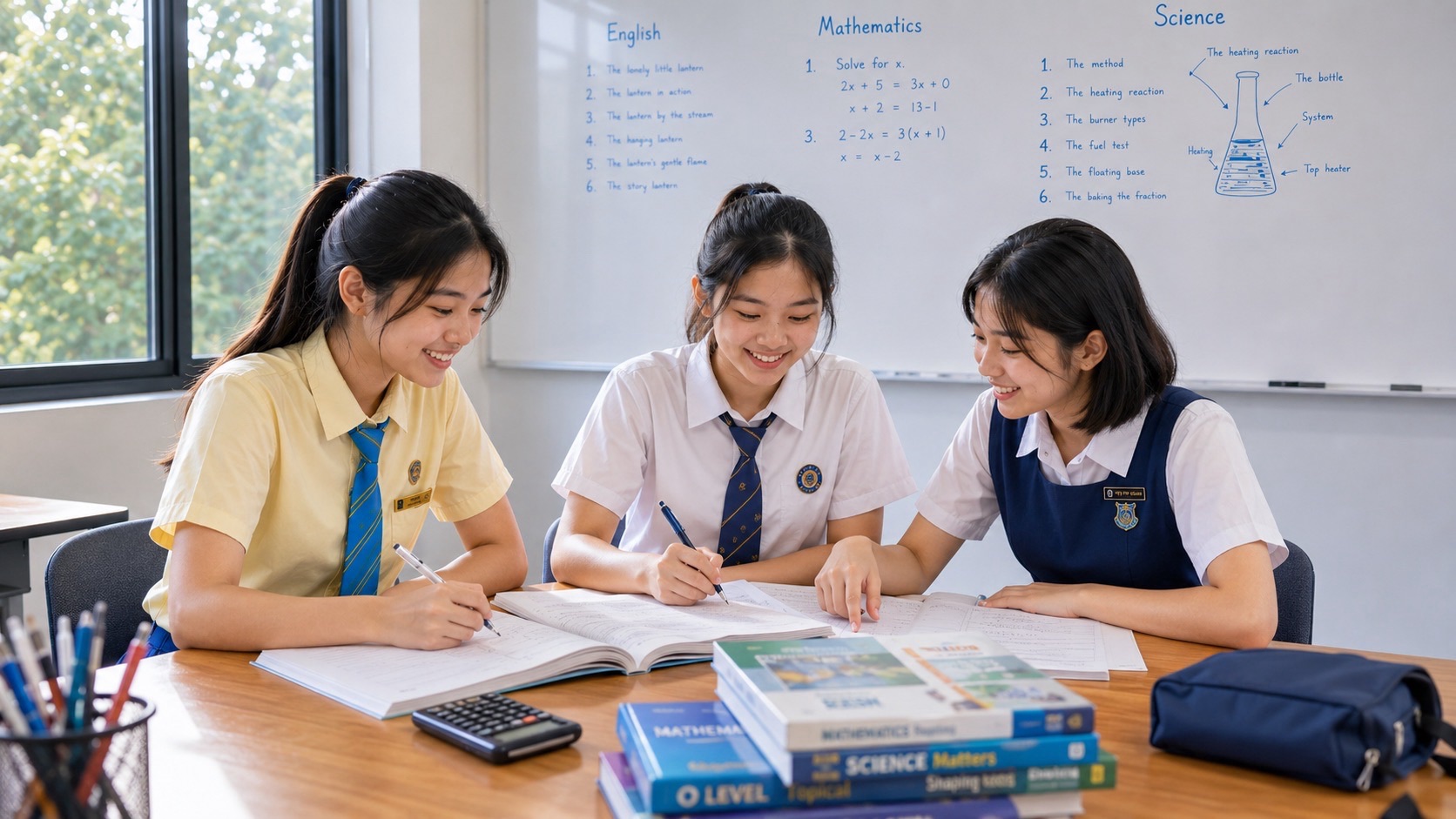
Secondary 3 Additional Mathematics Tuition | Serangoon is for students who need a controlled transition into A-Math: stronger algebra, clearer method selection, more reliable working and enough individual correction to prevent small weaknesses from becoming Secondary 4 problems.
At eduKateSG, Serangoon families can enquire about carefully managed three-student Additional Mathematics classes at our Punggol or Bukit Timah teaching locations, subject to level, timetable, class fit and availability.
The purpose is not simply to add another worksheet session to the week.
It is to help the student understand what Additional Mathematics is asking them to become: a learner who can read symbolic structure, select a route, carry out several connected steps accurately and recover when a question does not look exactly like the example taught in school.
Secondary 3 is the build year. If the algebra engine, function sense, graph reading, trigonometric control and problem-starting habits are established here, Secondary 4 becomes a year of consolidation and performance rather than emergency repair.
Our Secondary 3 Additional Mathematics support is suitable for students who need to:
- repair lower-secondary algebra before it begins affecting every A-Math chapter;
- understand why Additional Mathematics feels different from E-Math;
- stop depending on worked examples before starting a question;
- keep pace with a fast school sequence without memorising blindly;
- improve symbolic accuracy, signs, brackets and working presentation;
- recover after a weak weighted assessment or common test;
- learn slightly ahead where the foundation is ready;
- prepare for G2 or G3 Additional Mathematics according to the student’s school programme; or
- build a reliable runway into Secondary 4.
Classes are limited to three students. Lessons are generally 1.5 hours weekly, with curated materials, guided correction, focused continuation work and support around important school assessments according to the class arrangement.
Immediate Concerns of a Secondary 3 Additional Mathematics Parent and Student in Serangoon—and How eduKateSG Can Help
Secondary 3 often begins with a quiet surprise.
A student may have been comfortable with lower-secondary Mathematics. Homework was manageable. Test questions were recognisable. Algebra appeared to be under control.
Then Additional Mathematics begins and the same student suddenly needs much longer to finish questions. Familiar rules seem to arrive in unfamiliar combinations. A single sign error can ruin several lines of correct reasoning. A question that looked simple at first becomes difficult because the student cannot decide how to begin.
This does not automatically mean that the student is weak in Mathematics.
It usually means the mathematical operating environment has changed.
Secondary 3 Is a Change in Mathematical Operating Language
Lower-secondary Mathematics contains algebra, graphs, geometry, trigonometry and problem solving, but many questions still allow the student to work within relatively clear chapter boundaries.
Additional Mathematics compresses the subject.
Algebra is no longer one chapter. It becomes the language used inside many chapters. Functions are not only definitions; they control graphs, equations and later calculus. Trigonometry becomes an algebraic transformation system. Coordinate geometry depends on equation control. Differentiation and integration eventually require earlier ideas to remain available at the same time.
The student is therefore not simply learning more content.
The student is learning how a connected mathematical system behaves.
Why Students Who Were Good at Mathematics Can Still Struggle
A strong lower-secondary result can hide several weaknesses because simpler questions may not yet have placed enough load on them.
A student may be able to solve a linear equation but still be uncertain with algebraic fractions. The student may know expansion but make sign errors when a negative expression is involved. The student may recognise a quadratic form but not understand when factorisation, completing the square or a formula is the better route.
Additional Mathematics exposes these differences quickly.
The correct response is not to label the student as “careless” or “not an A-Math person”. The useful response is to identify the exact mathematical operation that is failing.
At eduKateSG, we look at the student’s working, not only the final score.
We ask:
- What did the student think the question was asking?
- Which idea did the student retrieve first?
- Was that idea appropriate?
- At which line did the reasoning change direction?
- Was the error conceptual, algebraic, procedural or presentational?
- Could the student repeat the method without the example?
- Could the same idea be recognised after the surface form changed?
These questions turn a disappointing mark into a diagnosis.
The Hidden Engine: Algebra Must Become Reliable
In Secondary 3 Additional Mathematics, algebra is infrastructure.
If the infrastructure is unstable, every later chapter becomes more expensive to learn.
Common weaknesses include:
- incorrect expansion and factorisation;
- sign errors when terms move or expressions are rearranged;
- poor control of algebraic fractions;
- weak index manipulation;
- confusion with surds;
- difficulty changing the subject of a formula;
- inconsistent equation balancing;
- unclear substitution;
- premature calculator use; and
- working that is too compressed to check.
These are not small cosmetic issues. They determine whether the student can handle quadratics, logarithms, coordinate geometry, trigonometry and calculus with confidence later.
We therefore repair algebra when it is needed, even if the school has already moved to another chapter. The repair is not a detour. It is the shortest route back to the current topic.
Additional Mathematics Is a Connected System
Students often revise A-Math as separate folders: quadratics, logarithms, graphs, trigonometry, differentiation, integration.
That organisation is useful for learning a chapter, but it is not enough for long-term performance.
The subject behaves more like a network.
Quadratic structure can reappear inside coordinate geometry. Exponential and logarithmic relationships still depend on algebraic manipulation. Graph interpretation depends on function sense. Trigonometric equations require both identity knowledge and equation control. Differentiation questions can fail because the student cannot simplify an expression before differentiating it.
We teach the chapter and the connection.
The student should gradually be able to answer two questions:
- What topic am I seeing?
- What earlier mathematical tools are hidden inside it?
That second question is where transfer begins.
Early Warning Signs That Should Not Be Ignored
Parents do not need to wait for a severe failure before seeking help. Earlier signals are often more informative.
- The student says, “I understand when the teacher explains, but I cannot do it alone.”
- Homework takes far longer than expected.
- The answer key is checked after almost every line.
- The student can solve questions only when the chapter is obvious.
- Algebra errors appear in many different topics.
- Test marks fluctuate widely from one paper to the next.
- Easy questions are lost through signs, brackets or incomplete working.
- The student avoids unfamiliar questions and waits for a model solution.
- Revision means rereading notes rather than solving from memory.
- The student is already worrying about Secondary 4 before Secondary 3 foundations are secure.
One of these signs may be temporary. Several appearing together usually indicate that the learning system needs attention.
Why Three Students Changes the Teaching
A small class is not useful merely because it is small.
It is useful because the tutor can observe enough of each student’s mathematical process to intervene at the right point.
In a three-student lesson, the tutor can ask one learner to explain why a factorisation works, another to compare two methods, and a third to identify where a sign changed incorrectly. Each student remains visible.
The format creates room for:
- frequent questioning;
- inspection of written working;
- immediate correction;
- different levels of scaffolding within one lesson;
- short independent attempts before hints are given;
- peer comparison without large-class noise;
- repeated retrieval of earlier material; and
- faster detection of recurring error patterns.
The student cannot easily remain silent and appear to understand.
That matters in A-Math because apparent understanding during explanation can disappear as soon as the learner has to begin independently.
Diagnosis Before Volume
When a student is struggling, the first instinct is often to increase practice volume.
More practice is useful only when the student is practising the correct thing.
We separate common breakdowns into three broad layers.
Concept breakdown
The student does not yet understand the mathematical idea. A rule has been memorised but its conditions or meaning are unclear.
Execution breakdown
The student understands the idea but cannot carry the algebra, notation, signs, arithmetic or working sequence accurately enough.
Transfer breakdown
The student can solve a familiar example but does not recognise the same idea when the question changes shape or combines with another topic.
Each breakdown needs a different repair.
Concept weakness requires explanation. Execution weakness requires carefully controlled repetition and error correction. Transfer weakness requires variation, mixed questions and deliberate comparison between forms.
Giving all three students the same extra worksheet may therefore be less effective than giving each learner the right mathematical task.
What We Teach in Secondary 3 Additional Mathematics
Schools may sequence topics differently. We coordinate with the student’s school while protecting the prerequisite structure beneath the syllabus.
Algebraic control
Students strengthen manipulation, expansion, factorisation, algebraic fractions, equations, inequalities, indices and surds. The aim is not speed first. The aim is valid transformations that can later become fast.
Quadratics and polynomial thinking
Students learn to see structure rather than treat every quadratic as an isolated trick. They compare routes, check roots and connect symbolic forms to graphs where appropriate.
Functions and graphs
Function notation can feel abstract at first. We slow it down enough for the student to understand inputs, outputs, relationships, domains, graph behaviour and the way algebra and visual form support each other.
Logarithms and exponentials
Students need more than laws written on a formula sheet. They must recognise when a law is useful, preserve equivalence and solve equations without losing control of restrictions or algebra.
Coordinate geometry
Gradient, line equations, intersections and geometric relationships become a useful meeting point between algebra and diagrams. Students learn to extract structure from coordinates rather than mechanically substitute values.
Trigonometry
Trigonometry requires both identity knowledge and controlled manipulation. Students practise seeing equivalence, selecting transformations and avoiding the common error of treating identities as formulas to insert blindly.
Calculus foundations
When differentiation or integration enters the school sequence, we connect the new ideas to graphs, rates of change, algebraic form and the student’s existing function knowledge. Calculus should not feel like a disconnected final chapter added on top of everything else.
How a Typical Lesson Is Built
The exact lesson changes with the students, but the learning architecture remains deliberate.
- Orient. Identify the current school topic, recent errors and the most important learning target.
- Retrieve. Bring back prerequisite knowledge before new work begins.
- Explain. Build the idea from first principles rather than only demonstrating a procedure.
- Model. Show one or two carefully chosen examples with explicit reasoning.
- Vary. Change the surface form so the student must recognise the structure rather than copy a pattern.
- Release. Remove prompts and require independent attempts.
- Inspect. Analyse errors line by line.
- Reconnect. Link the lesson to earlier chapters and likely future use.
- Continue. Assign focused work that reinforces the exact weakness or new capability.
This sequence protects the difference between seeing Mathematics and being able to do Mathematics.
Teaching Ahead—But Only When It Helps
Pre-teaching can be valuable in Secondary 3 because it changes the student’s first encounter with a difficult topic.
Instead of meeting logarithms, trigonometric identities or calculus for the first time in a fast school lesson, the learner can enter school with some orientation already built.
However, teaching ahead is not a race to finish the syllabus.
We move ahead only when the current foundation can carry the next idea. A student with unstable algebra does not benefit from being rushed into more advanced content simply to claim syllabus coverage.
Depth first. Then speed.
School Alignment Without Becoming a Homework Service
School work matters because it reveals the student’s current environment.
We consider school topic order, weighted assessments, teacher feedback and recurring mistakes. We can help clarify difficult school questions when they reveal a genuine learning gap.
But tuition should not become a system where the tutor simply completes the student’s homework.
The long-term target is independence.
The student should leave with better orientation, stronger methods and a clearer ability to continue alone.
The 2026–2027 Examination Transition
Singapore is moving from the existing GCE examination structure to the Singapore-Cambridge Secondary Education Certificate from 2027 under Full Subject-Based Banding.
For 2026 school candidates, SEAB continues to list Additional Mathematics under the existing GCE routes, including O-Level Additional Mathematics syllabus 4049 and N(A)-Level Additional Mathematics syllabus 4051.
For 2027 school candidates, SEAB lists Additional Mathematics at G2 as K232 and at G3 as K341.
The administrative labels change, but the central teaching requirement remains familiar: students need secure algebra, accurate manipulation, strong function understanding, reliable trigonometry, clear calculus foundations and the ability to apply knowledge under assessment conditions.
We therefore place the student according to the school programme actually being taken rather than forcing every learner into one generic worksheet stream.
Serangoon Families Have Two eduKateSG Routes
Serangoon is unusually well connected to both of eduKateSG’s established Mathematics teaching locations.
Serangoon to eduKate Punggol
Serangoon and Punggol sit on the North East Line, giving families around Serangoon Central, Upper Serangoon, Kovan and nearby areas a direct rail route towards Punggol without changing lines.
eduKate Punggol is located at 83 Punggol Central, Singapore 828761.
Serangoon to eduKate Bukit Timah
Students travelling towards Bukit Timah can take the Circle Line from Serangoon towards Botanic Gardens, transfer to the Downtown Line and continue towards Sixth Avenue.
eduKate Bukit Timah is located at 8 Fourth Avenue, Singapore 268674, near Sixth Avenue MRT.
The better class is not automatically determined by map distance.
Families should consider the student’s level, tutor fit, timetable, journey after school, compatible classmates and current class availability. The objective is to place the learner where the weekly Mathematics routine is sustainable and the teaching fit is correct.
eduKateSG does not present these articles as proof of a separate Serangoon branch. They are local guides for Serangoon families considering the established Punggol or Bukit Timah learning routes.
Three Common Secondary 3 Starting Points
Student A: The algebra debt is spreading
This student understands explanations but loses marks because signs, fractions, factorisation and equation handling are unreliable.
The priority is not more advanced questions. It is to repair the algebraic operations that are contaminating many chapters at once.
Student B: The examples make sense, but the first step is missing
This student can reproduce a method immediately after seeing it but becomes stuck when the question changes form.
The priority is route recognition: identifying knowns, unknowns, mathematical relationships and the first valid move without waiting for a model solution.
Student C: The foundation is strong, but distinction habits are not yet stable
This student is already performing well but loses marks through rushed algebra, incomplete checking or weaker unfamiliar-question handling.
The priority is precision, controlled variation, mixed-topic transfer and disciplined presentation.
These students may sit in the same three-student class while receiving different correction because their mathematical bottlenecks are different.
What Progress Should Look Like
Improvement is not measured only by the next test score.
Useful early indicators include:
- the student begins questions with less hesitation;
- working becomes easier to read and check;
- repeated sign and bracket errors decline;
- the student can explain why a method works;
- older topics remain available after new chapters begin;
- homework requires less dependence on answer keys;
- the student can recognise a familiar idea in an unfamiliar form;
- test performance becomes less volatile; and
- the learner enters Secondary 4 with fewer unresolved foundations.
A grade improvement is valuable. A repeatable mathematical process is what makes the grade more likely to remain.
Class Details
Format: Carefully managed 3-pax small-group tutorials
Level: Secondary 3
Subject: Additional Mathematics
Programme fit: Current GCE routes where applicable and G2/G3 SEC pathways according to the student’s cohort and school programme
Duration: Generally 1.5 hours weekly
Teaching locations: eduKate Punggol, 83 Punggol Central, and eduKate Bukit Timah, 8 Fourth Avenue near Sixth Avenue MRT
Placement: Subject to level, timetable, class compatibility, tutor assessment and available places
Teaching may include first-principles explanation, algebra diagnosis, school-topic coordination, retrieval, interleaving, controlled variation, error analysis, timed micro-sets, carefully paced pre-teaching and Secondary 4 runway planning.
What Parents Can Bring to the First Conversation
The most useful material is evidence of how the student currently works.
- recent weighted-assessment papers;
- marked school assignments;
- topical worksheets showing repeated mistakes;
- the school’s current topic sequence;
- teacher comments;
- examples of unfinished questions;
- the student’s own notes; and
- a short description of what happens during homework at home.
We are looking for patterns, not only percentages.
Frequently Asked Questions
Is there an eduKateSG tuition centre in Serangoon?
eduKateSG’s established teaching locations are in Punggol Central and Fourth Avenue in Bukit Timah. This page is a local guide for Serangoon families considering those routes; it does not imply a separate Serangoon branch.
Should a Serangoon student choose Punggol or Bukit Timah?
The route should be chosen by class fit rather than geography alone. Punggol offers the direct North East Line connection from Serangoon. Bukit Timah can be reached via the Circle Line to Botanic Gardens and the Downtown Line towards Sixth Avenue. Timetable, level, tutor fit and availability matter as much as the journey.
My child has just started Secondary 3. Is it too early for tuition?
Not if there is a clear reason. Early support is useful when algebra is weak, the student is already unable to begin questions independently, school pace is difficult or the family wants a stronger structured start. A student who is coping confidently may not need extra tuition.
Do you teach G2 and G3 Additional Mathematics?
Support is aligned to the student’s actual school programme and readiness. From 2027, SEAB lists Additional Mathematics at G2 and G3 under the SEC framework.
Do you teach ahead of school?
Yes, where the student’s foundation is ready. Pre-teaching is used to create orientation and reduce overload, not to race through the syllabus.
My child understands the teacher but cannot do questions alone. What is missing?
The likely issue is not exposure but transfer. The student may recognise a demonstrated method without being able to select it independently. We address this through controlled variation, first-step training, retrieval and gradually reduced prompting.
Will more worksheets fix weak A-Math?
Only if the student is practising the correct capability. Concept gaps, execution errors and transfer problems require different repairs. Volume without diagnosis can repeat the same mistake more efficiently.
Can a strong student use the class for A1 preparation?
Yes. For a student already performing well, the work shifts towards unfamiliar questions, mixed-topic transfer, precision, efficient methods, checking discipline and reducing small repeated losses.
Helpful Reading for Serangoon Parents
- Additional Mathematics Tuition at eduKateSG
- How eduKateSG Additional Mathematics Tutorials Work
- Mathematics Tuition Serangoon | eduKateSG Punggol & Bukit Timah
- Secondary 3 Mathematics Tuition | Serangoon
- Secondary 4 Additional Mathematics Tuition | Serangoon
- MOE Secondary School Curriculum and Syllabuses
- SEAB 2026 GCE O-Level Syllabuses
- SEAB 2027 G2 SEC Syllabuses
- SEAB 2027 G3 SEC Syllabuses
Secondary 3 Additional Mathematics Tuition for Serangoon Families
Secondary 3 is the best time to make the A-Math system coherent.
Algebra becomes the engine.
Functions become relationships rather than notation to memorise.
Graphs become evidence.
Trigonometry becomes structured transformation.
Calculus eventually becomes a natural extension of functions and change.
The student should not need to wait until Secondary 4 to discover that an early weakness has been travelling through the subject for a year.
For students who need repair, we rebuild the missing foundation.
For students who need stability, we make the methods repeatable.
For students who are already strong, we increase transfer, precision and independence.
The objective is not simply a student who has seen the syllabus.
It is a student who can operate it.
Arrange a Parent–Student Consultation
Speak with us about the student’s school programme, present results, recurring errors, current topic sequence and suitable Punggol or Bukit Timah class route.
eduKate Punggol
83 Punggol Central
Singapore 828761
eduKate Bukit Timah
8 Fourth Avenue
Singapore 268674
Near Sixth Avenue MRT
Three-student small-group tuition. By consultation and suitable class placement.