
Did you know? A ratio of 2:3 does not mean that one person gets two-thirds of the whole. It means there are five equal parts altogether. That small distinction can turn a difficult-looking question into a very ordinary calculation.
This guide helps parents and Secondary 3 G1 Mathematics students in Bukit Timah make sense of ratio, proportion and map scales with short worked examples. No magic tricks: just read the units, name the parts, and check that the answer fits the situation.
The Singapore Examinations and Assessment Board (SEAB) 2027 G1 syllabus directory identifies Mathematics as subject code K110 (previous reference code 4046). Its official K110 syllabus PDF lists ratio and proportion, percentages, rates, algebra, geometry and data skills as part of the whole G1 course. These guides are for Secondary 3 learners; your child’s school determines which topics are being taught or assessed this term.
The quick answer: ratio compares, proportion connects
A ratio compares quantities in a stated order. When we write A:B = 2:3, the first quantity has two equal shares for every three shares of the second. A proportion describes a consistent relationship between quantities. Keeping these ideas separate matters when a problem switches from sharing money to using a map scale or comparing a recipe.
When a tutor hears a student say ‘I divided by three because the ratio has a three’, the first question should be: three out of how many total parts? Ask the student to draw a bar model before reaching for a calculator.
Worked example 1: sharing an amount fairly
Question. Two school club teams receive a hypothetical total of $45 for materials, shared in the ratio 2:3. How much does each team receive?
- Find the parts: 2 + 3 = 5 equal parts in all.
- Find one part: $45 ÷ 5 = $9.
- Find Team A’s share: 2 × $9 = $18.
- Find Team B’s share: 3 × $9 = $27.
- Check: $18 + $27 = $45 and $18:$27 simplifies to 2:3.
The complete answer names the recipients. The calculation ‘$18 and $27’ may be right, but the order is still important: Team A gets $18 and Team B gets $27. In a class, ask the student to explain why $45 ÷ 3 would not work.
Worked example 2: reading a scale on a map
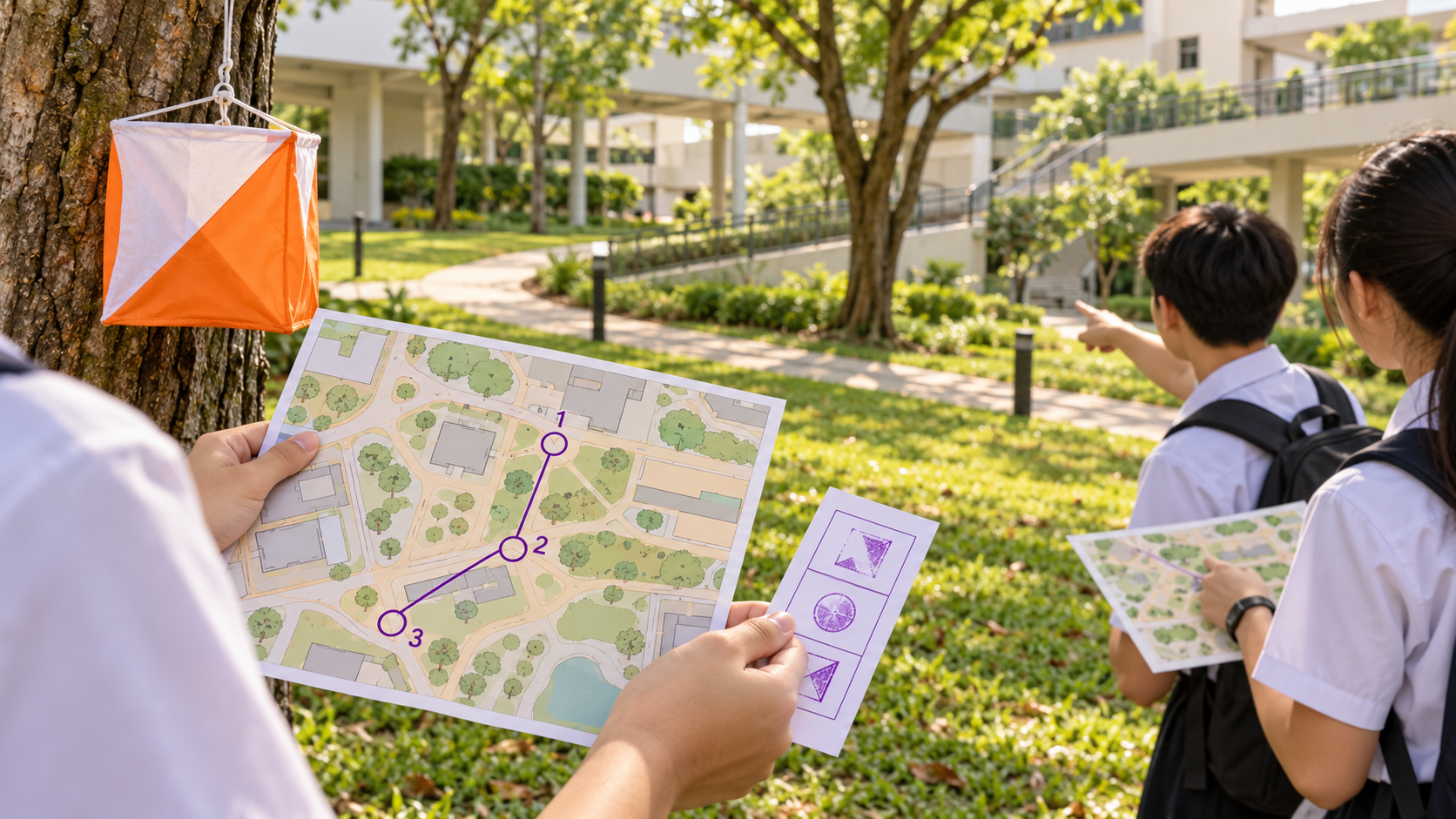
Imagine a practice map with a scale of 1:25,000. The straight-line distance between two marked points measures 4 cm on the paper.
- Interpret the ratio: 1 cm on this map represents 25,000 cm in reality.
- Convert the unit: 25,000 cm = 250 m, since 100 cm = 1 m.
- Calculate the real distance: 4 × 250 m = 1,000 m = 1 km.
- State the limitation: that is the straight-line distance represented by the drawing, not necessarily the distance along an actual road.
Notice how the answer becomes easy to interpret only after the units are converted. Many map-scale errors are not arithmetic errors; they are unit errors. Keep the ruler, the stated scale and the intended real-world unit visible throughout.
What about area scales?
Area does not change by the same factor as length. If each real-world length is multiplied by 25,000, an area is multiplied by 25,000², because area has two length dimensions. A learner who uses only 25,000 to convert square centimetres has mixed up distance and area. A helpful tutor asks the student to explain why both the width and height become larger.
Direct and inverse proportion are not interchangeable
Direct proportion: more of one means more of the other
If five identical notebooks cost $20, then one costs $4 and eight cost $32, assuming a constant unit price. Both the quantity and total price increase in the same proportion. Ask: ‘Is there a fixed delivery fee or bulk discount?’ If there is, this simple relationship may not apply.
Inverse proportion: the same task shared by more workers
Suppose four identical machines complete a fixed task in six hours. Under an ideal assumption that every machine works at the same constant rate, eight machines would take three hours. The product ‘number of machines × time’ remains 24 machine-hours. This is a mathematical model; real projects may have coordination delays and cannot always be doubled this neatly.
Three mistakes to catch before the next worksheet
- Part versus whole: dividing by the second number of the ratio instead of the sum of all ratio parts.
- Inconsistent units: treating 2 m:50 cm as 2:50 instead of converting 2 m to 200 cm before simplifying to 4:1.
- Wrong proportional model: assuming that doubling a quantity always doubles its result, even when there is a fixed fee or a fixed amount of work.
Ten minutes of useful ratio practice
Start with a bar model for a 2:3 sharing question. Next, convert one map distance from centimetres to metres. Finish by comparing a direct-proportion question with an inverse-proportion question, saying out loud why each model fits. Only three questions are needed if the student can explain every step.
Questions parents ask
Should we memorise more ratio formulas?
Master the meaning of the parts first. Draw, label and check the sum. The formulas become more useful when the comparison is understood.
Does map scale include area in G1 Mathematics?
Yes. The 2027 K110 whole-course syllabus lists map scales for distance and area. Check the school’s teaching sequence before assuming both are in the next Secondary 3 test.
How can a small-group tutor diagnose a ratio problem?
Ask each student to describe the whole, draw the shares, and say whether more of one quantity should make the other increase or decrease. These spoken explanations locate the misunderstanding earlier than a final mark does.
More Mathematics help for Bukit Timah families
Ratio confidence comes from noticing the structure of a question, not from doing the longest set of repetitive exercises. A learner who checks the whole and the units is already building a transferable habit.
The eduKateSG small-group Mathematics tutorial reference describes a Secondary 1 programme near Sixth Avenue MRT and its approach to close attention and worked corrections. It is background on the teaching approach, not a claim that a particular Secondary 3 G1 group or timetable is available. Families can ask eduKate Singapore about current Secondary 3 G1 support.
Keep reading in this Secondary 3 G1 series
- Percentages, Discounts and Household Bills
- Speed, Rates and Unit Conversion
- Rounding, Estimation and Significant Figures
For the neighbouring skills, see algebra word-problem practice.