
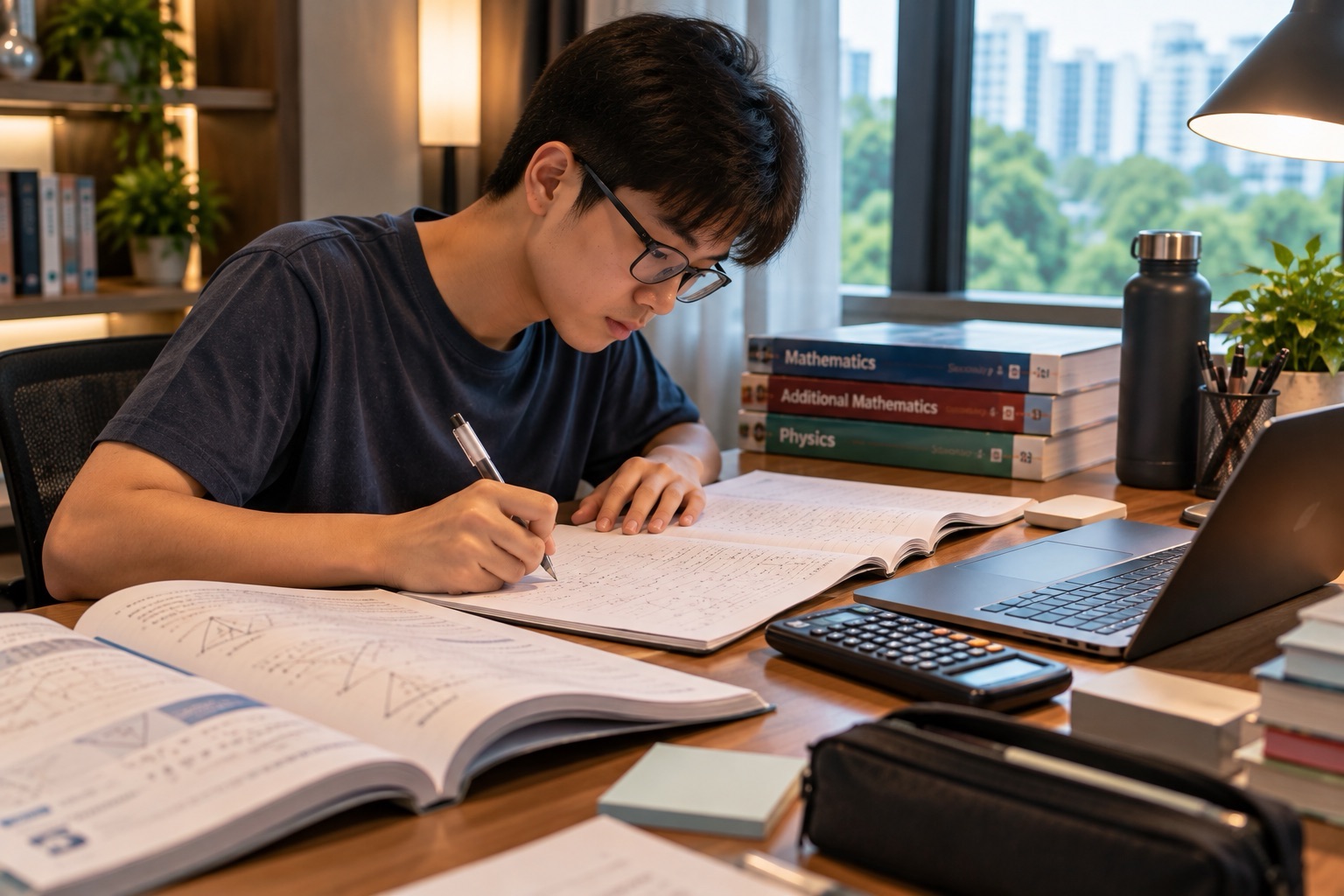
Secondary 3 G3 Biology tuition in Yew Tee should begin with the student’s actual subject combination, not a random paper labelled Biology. Did you know that two students may both say they take G3 Biology but study different national examination entries? One may be on a standalone Biology route; the other may take Biology within Combined Science. The required course depth and assessment components are not interchangeable. A useful tutor verifies the route before assigning revision work.
The 2027 Singapore-Cambridge Secondary Education Certificate (SEC) lists standalone Biology K325, Science (Physics, Biology) K327 and Science (Chemistry, Biology) K328 separately. A student in Secondary 3 in 2026 should confirm the school’s eventual national examination registration and latest applicable syllabus, rather than assume a paper from an older examination year has the right specifications.
Biology tuition should then focus on the decisions behind a correct scientific answer. Does the pupil know which substance moves, which gradient is relevant, what an experiment measured and which conclusion is supported? Memorising the definition of osmosis will not repair an answer that treats water movement as movement of salt. Understanding requires selecting and using the right principle when the conditions change.
The correct examination course is the first teaching decision
According to SEAB’s 2027 school-candidate G3 syllabus directory, Biology K325 is a standalone entry, whereas K327 and K328 are Science combinations. A Combined Science student also has a companion science, and Biology practice should not consume time required for the other component. The detailed syllabus outcomes and school sequence must guide how much depth each subject receives.
Parents can bring the child’s school combination, current timetable, last marked test and the actual year of national assessment. The tutor should first inspect a genuine answer before announcing that the pupil is “weak in Biology”. A missed mark may result from an incorrect definition, wrong scientific mechanism, numerical calculation, unread graph axis, inaccurate command-word response or unsupported inference. These require different teaching interventions.
The transition from integrated lower-secondary Science to upper-secondary disciplinary work also calls for more precise scientific language. A good tutor should teach a pupil to separate observations from explanations, proportional changes from raw changes, and expected probabilities from actual outcomes. These ideas are more powerful than learning one fixed paragraph for every familiar topic.
Eight worked Biology situations, with answers that transfer
1. Osmosis: mass change is evidence of water movement
A fictional potato-strip test gives a strip initial mass 4.8 g and final mass 5.4 g. Its percentage mass change is (5.4 − 4.8) ÷ 4.8 × 100 = +12.5%. A second strip changes from 5.0 g to 4.6 g, giving −8%. Both numbers are changes relative to the initial mass and can be compared more fairly than raw differences when samples start at different sizes.
Osmosis involves net movement of water across a partially permeable membrane from higher water potential to lower water potential. Under suitable conditions, gaining mass is consistent with net water uptake; losing mass is consistent with net water loss. A child who says “the solution’s salt entered the potato because it became heavier” has identified the wrong process. Ask the student what the measurement actually shows.
Now change the data: 6.4 g falls to 5.6 g. The correct percentage change is −12.5%. The student should explain the sign, the implied net movement of water and why the exact surrounding solute concentration cannot be inferred from mass change alone. This must be answered without the first solution visible.
The tutor can ask why a controlled exposure time, comparable tissue preparation, blotting method and repeated readings matter. A single mass change does not establish every microscopic mechanism or the behaviour of all cells. Accurate claims should match the method’s resolution.
2. Diffusion, osmosis and active transport: a membrane alone is not enough
A diagram showing a substance crossing a cell membrane does not identify its transport mechanism unless the moving substance and relevant conditions are provided. Diffusion describes net particle movement down a concentration gradient. Osmosis involves water crossing a partially permeable membrane down a water-potential gradient. Active transport can move substances against a gradient with cellular energy and suitable proteins.
Suppose a question describes mineral ions entering a root hair cell against their concentration gradient. Active transport is appropriate. Another question shows oxygen moving from a region of higher concentration to lower concentration; diffusion is consistent with that movement. Water crossing a selectively permeable membrane down a water-potential gradient invokes osmosis.
The tutor should make students ask four things before answering: which substance is moving, in what direction relative to its gradient, what role the membrane plays, and whether cellular energy is involved. A memorised phrase such as “membrane means osmosis” is an unreliable shortcut.
In the independent challenge, change the direction and labels of an unfamiliar diagram. A pupil who can justify the process and reject a tempting incorrect option has learned more than someone who copies “osmosis” beside every arrow.
3. Enzyme rate: reciprocal time works only for a specific method
Two fictional enzyme experiments reach the same defined endpoint. One takes 180 seconds and the other 120 seconds. If the endpoint represents the same amount of reaction, reciprocal time can provide a useful proxy for relative average rate. The 120-second trial has a rate proxy 1.5 times that of the 180-second trial.
Do not generalise this to every enzyme dataset. If the method instead records 24 mL of product gas in eight minutes, the measured mean collection rate is 3 mL per minute. The pupil should name the measured outcome, identify the time interval and choose the calculation that describes the apparatus. Taking a reciprocal of gas volume would be inappropriate.
If one reaction is faster at 30°C than at 20°C, those two readings cannot locate the exact optimal temperature. Unmeasured temperatures may produce greater or lower activity. At a suitable syllabus depth, explanations can discuss changes in reaction conditions and enzyme active-site function without promising that activity rises indefinitely with temperature.
For transfer, show a pH experiment where enzyme concentration accidentally changes between trials. Ask the learner to explain how that confounds the interpretation and propose a concrete correction. The answer should name the factor and its consequence, not merely say “make it fair”.
4. Genetics: separate genotype, phenotype and probability
In a deliberately simplified complete-dominance model, a dominant allele A and recessive allele a give the cross Aa × Aa. The expected genotype probabilities are ¼ AA, ½ Aa and ¼ aa. Under that model, the dominant phenotype has probability ¾ and the recessive phenotype ¼. These are theoretical probabilities, not guaranteed counts for a family of four.
A student can draw a correct Punnett square and still report genotype ratio when the question asks for phenotype ratio. The tutor should check which outcome is requested and ask why the parental gametes produce the possible combinations. The model explains probabilities, not fixed allocations of future offspring.
For a changed problem, Aa × aa produces expected genotypes ½ Aa and ½ aa; AA × aa produces all Aa under the simplified assumptions. The child should draw the appropriate combinations from the parental genotypes with the first square hidden rather than copy an attractive 2 × 2 grid.
Real traits can involve additional genes, different inheritance patterns and environmental influences. The simplified model should be labelled as a model and used at the depth required for the student’s actual standalone or Combined Science course.
5. Starch tests: qualitative observations are not measured rates
A correctly conducted leaf-starch test with a positive iodine reaction supports starch being present in the tested leaf tissue. It does not directly measure the rate of photosynthesis in units per minute. A pupil who writes “the darker leaf photosynthesised twice as fast” from a simple colour observation has assigned numerical precision that the method does not provide.
Compare an invented gas-collection experiment measuring 30 mL in ten minutes. Its mean gas-collection rate is 3 mL min⁻¹. Whether this observation represents a valid proxy for photosynthesis depends on the apparatus, identity of the gas, environmental conditions and other limitations. The student must state what was directly measured before explaining what it might mean biologically.
Ask for three answers to the same stimulus: describe the visible or recorded observation, explain a biological process where supported, and evaluate whether the method establishes a rate. The same worksheet now teaches how command words change the scientific claim.
The transfer exercise uses another plant experiment with a numerical outcome. A learner who can calculate a rate and then identify what the measurement does not prove is better prepared for unfamiliar practical work than someone who repeatedly writes one sentence about starch.
6. What is a fair biological investigation?
Suppose a fictional enzyme study changes pH but also doubles enzyme concentration in the treatment with highest pH. Reaction outcomes may differ because of pH, enzyme amount or both. The student cannot isolate a cause simply by recording precise numbers. A weak answer says “be more careful”.
An improved response identifies the confounder, explains how it can affect the measured activity independently and proposes keeping enzyme concentration and volume comparable. Other controls might include substrate quantity, temperature, reaction endpoint and measurement time depending on the actual procedure. Each proposed control needs a reason connected to the test.
A useful answer structure is specific flaw → effect on inference → measurable improvement. A student might write: “The enzyme concentration differs, so the observed rate difference may not be due only to pH; use the same concentration and volume across treatments.” That is much stronger than “make the experiment fair”.
For an unseen question, change the topic to the effects of water supply on plant height. If groups also receive different amounts of sunlight, the student should identify a new confounder and propose an appropriate design. Practical experiments must follow appropriate school supervision and safety arrangements.
7. A graph’s highest recorded point is not necessarily its exact optimum
Imagine enzyme activity readings of 12, 20, 27, 24 and 15 units across five tested pH conditions. The third condition is highest among those measured. The data show an increase followed by a decrease over the sampled range. They do not prove a global optimum at precisely the third pH, because unmeasured intermediate values might produce an even greater rate.
For a “describe” question, report the pattern and values. For an “explain” question, connect conditions to a relevant biological mechanism. For an “evaluate” question, examine whether the experimental controls, repeats and spacing of observations justify the conclusion.
The student may propose testing at closer intervals around the observed peak, keeping other conditions comparable. More detailed data could refine the estimate, but the answer should still avoid claiming to have surveyed every possible condition.
Change the stimulus to a seedling-growth graph and remove the topic label. The pupil should still separate a directly recorded value, an inferred mechanism and an uncertainty. This is a useful general scientific skill rather than an enzyme-specific script.
8. The answer should fit the question, not the remembered chapter
A student who knows a long definition of an enzyme may write it whenever a problem mentions enzymes. But the task could ask for the percentage change in an experimental result or a limitation of the method. An accurate but irrelevant paragraph can fail to earn the required mark. The command word determines whether the answer needs a fact, a trend, a causal explanation or an evaluation.
A useful writing sequence is: identify the exact change or condition, select the relevant scientific principle, explain how it produces the observed effect, and use numerical evidence when requested. Short “state” items should not be inflated into long essays; multi-mark “explain” items may require several connected steps.
One practice task gives a single graph and three prompts: describe the trend, explain a possible mechanism consistent with the evidence, and evaluate one limitation. The pupil should write three different responses, then compare them with the marking expectations.
A more realistic final exercise removes all chapter headings and mixes cell transport, inheritance, enzyme rates and experimental design. If the student now chooses the relevant process unaided, the tutorial has built examination-useful thinking rather than recognition of familiar worksheet layouts.
How the premium three-student teaching method applies
The immutable eduKate Secondary 1 Mathematics Tutor Clementi | Small Groups Tutorials documents a premium three-pupil Mathematics programme near Sixth Avenue MRT, including a 1.5-hour weekly lesson and feedback-focused practice. Its instructional ideas—identify the first unstable link, explain accurately, increase difficulty deliberately and demand independent transfer—can inform this Biology series without changing the reference.
A possible 90-minute Biology tutorial can begin with 10 minutes of spaced recall, 15 minutes inspecting genuine marked questions, 20 minutes rebuilding a mechanism, 20 minutes of guided and independently written work, 15 minutes of changed-context questions and 10 minutes of feedback. This is an illustration of method, not a confirmed Yew Tee class schedule.
In a group of three, one student may know osmosis but use a wrong mass denominator, another may select an inappropriate transport mechanism, and a third may report an exact optimum from sparse readings. Each needs a different correction. The tutor should hear everyone’s initial answer and give every pupil an independent final task.
Yew Tee decisions: real local context, no invented service
LTA’s public station dataset identifies Yew Tee as NS5 on the North-South Line. YewTee Point’s directions page confirms access via Yew Tee MRT. These are useful landmarks for residents but not proof of a Biology class in the area. The experimental figures above are fictional, not measurements from nearby parks, homes or schools.
Parents should verify the actual syllabus supported, tutor, teaching venue, group size, class duration, fees and timetable. The immutable Clementi reference documents Mathematics near Sixth Avenue MRT, not a confirmed Biology class in Yew Tee. Consider whether the full journey after school and CCA leaves sufficient time for meals, independent practice and sleep.
A four-week review can preserve a baseline wrong answer, teach the correct principle, test a new application and revisit it after a delay. What matters is the pupil’s independently demonstrated improvement, not promises of a particular examination grade or increasing numbers of photocopied papers.
Frequently asked questions
How does K325 differ from K327 and K328?
The 2027 SEC lists K325 as standalone G3 Biology and K327/K328 as Combined Science including Biology with Physics or Chemistry. Course details and paper requirements must follow the student’s actual examination entry.
Can a Combined Science pupil attempt standalone Biology questions?
Selected overlapping concepts may be useful, but not every standalone question necessarily matches the scope and assessment of the student’s Combined Science entry.
Why can an apparently correct graph description still be weak?
It may claim a precise optimum without measurements at sufficient conditions, ignore the axes or answer an explanation question with only a description.
How can a parent tell whether Biology tuition is working?
Compare one authentic marked response with a different unseen question answered without hints after several days, including correct mechanisms and appropriately limited conclusions.
Complete the Yew Tee Secondary 1–4 G3 Biology series
Secondary 1 G3 Biology Tuition Yew Tee · Secondary 2 G3 Biology Tuition Yew Tee · Secondary 3 G3 Biology Tuition Yew Tee · Secondary 4 G3 Biology Tuition Yew Tee
Also see Secondary 3 G3 Biology Tuition Canberra from the preceding locality. Consult SEAB’s current G3 SEC listing for subject codes, MOE lower-secondary Science for prerequisites and the immutable Clementi Mathematics tutorial for the teaching method. Actual Biology-class availability should be confirmed directly.