
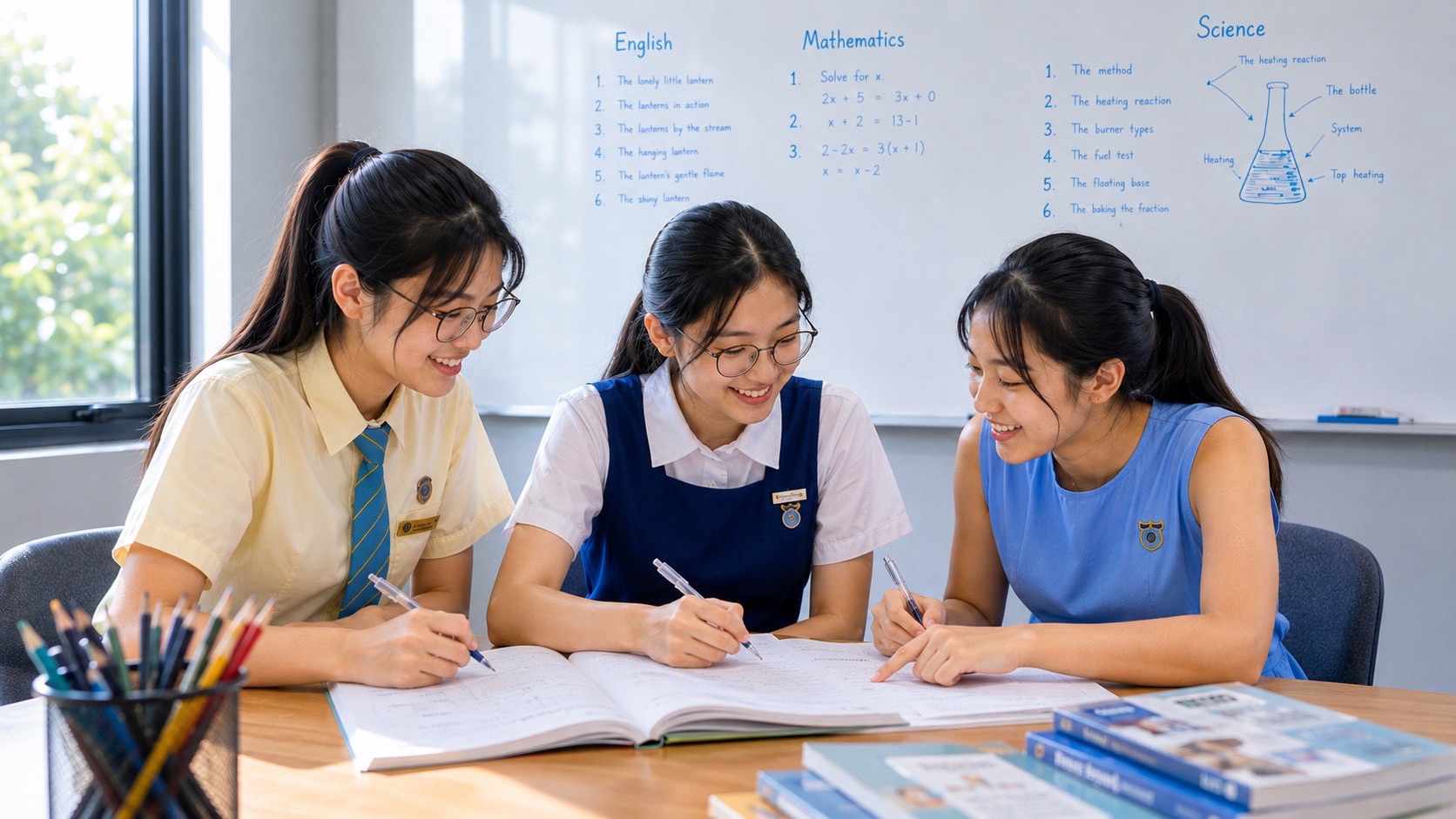
Secondary 3 Mathematics small groups tuition for Boon Keng families can help when a teenager understands algebra demonstrations but makes recurring sign, bracket, equation-modelling or inequality errors when working alone. A skilled tutor teaching three learners can inspect each student’s original decision, repair the specific misconception and assess a changed problem without hints.
eduKateSG’s published small-group model has up to three learners in a typical 1.5-hour tutorial. Its immutable Mathematics reference describes tuition near Sixth Avenue MRT in Bukit Timah. This Boon Keng parent guide does not confirm a current local teaching room or vacancy; families should verify the actual teacher, venue, subject level, fee and full journey.
The guide explains G1/G2/G3 under the 2027 SEC and Full Subject-Based Banding, then works through algebraic transformations, equations, inequalities and quadratics. It evaluates the benefits of targeted feedback against homework, fatigue, group mismatch and dependency on tutor prompting, with an objective review framework.
- Best fit: repeated algebraic errors or inability to choose the first step in a word problem.
- Syllabus: match the actual G1, G2 or G3 Mathematics level; A-Math is a separate subject.
- Potential benefit: precise feedback, alternative methods and solo changed-question practice.
- Risks: group mismatch, peer comparison, travel and excessive homework or hints.
- Progress: fewer signs and model-selection errors on unfamiliar work after a delay.
- Decision: choose tuition only when it offers genuine help beyond school and self-study.
1. Why a teenager can understand the demonstration and still fail alone
Some Secondary 3 students solve every equation in tuition because the tutor tells them what to isolate, which line to expand and which factorisation to use. During a school paper, the first hint is missing. The teenager may sit staring at an unfamiliar situation despite having completed many practice questions.
For Boon Keng families, an early diagnostic should distinguish whether the student can choose a valid first step alone. Give an equation, a word story and a question combining older skills. Record the child’s initial choice before offering any prompt. Correct working under constant guidance is not the same as independent mastery.
A small group of three may create more opportunities to observe that decision and give precise feedback. However, group size does not automatically make anyone independent; the teacher must deliberately reduce prompts and revisit skills after a delay.
2. Full Subject-Based Banding requires an exact subject match
In Singapore’s Full Subject-Based Banding, secondary pupils take individual subjects at G1, G2 or G3. A student’s Mathematics level does not determine all other subject levels or describe the teenager’s whole potential. It is a curriculum and assessment detail that should inform tutoring.
The 2027 Singapore-Cambridge Secondary Education Certificate replaces the former separate N- and O-Level examinations for graduating school candidates. The Mathematics codes in the official 2027 syllabus lists are G1 K110, G2 K210 and G3 K310. Although the certificate name is shared, these are distinct subject-level requirements.
Parents should consult SEAB SEC examination overview, 2027 G1 school-candidate syllabus list, 2027 G2 school-candidate syllabus list, 2027 G3 school-candidate syllabus list and MOE Full Subject-Based Banding and SEC information before choosing examination-oriented materials. The school remains the source for the actual level, topic sequence and expected examination year. The worked examples here illustrate concepts, not a single curriculum compulsory for every G-level.
3. Additional Mathematics is a separate educational decision
Some Secondary 3 students offer Additional Mathematics as well as Mathematics; others do not. SEAB’s 2027 G3 Mathematics K310 and Additional Mathematics K341 are listed separately, and the G2 list includes Additional Mathematics K232. A tutor should therefore confirm the pupil’s subject combination before assigning advanced work.
A child may need help with ordinary Mathematics percentages and inequalities but be ready for abstract A-Math tasks. Another may be strong in contextual problems but weak at A-Math algebraic transformations. These need separate progress targets, not one vague statement that the child is weak in Maths.
Ask whether the class teaches Mathematics, Additional Mathematics or both, and how members are matched by subjects and prerequisites. In a three-person tutorial, one learner should not spend most of the lesson waiting through a course they do not take.
4. Worked example: an equation describes a balance
Take 6x − 5 = 31. Add five to both sides to obtain 6x = 36, then divide by six: x = 6. The value can be checked by substitution because 6(6) − 5 = 31. Each step is a transformation that preserves equality.
Students sometimes remember that a number ‘moves across the equals sign and changes sign’ without understanding why. This shortcut can fail when a negative multiplier, a fraction or a bracket is involved. The actual principle is applying an equivalent operation to both sides.
Ask the learner to explain every transformation in ordinary words. Then change the equation to 5x − 7 = 18, producing x = 5. A correct independent solution is more persuasive than the tutor’s original worked page.
5. Expanding brackets is an equality problem
The expression 3(2x − 4) must be expanded as 6x − 12. A child who writes 6x − 4 has multiplied the first term but not the second. Even if later operations are accurate, the resulting expression is no longer equivalent to the original.
Substitute x = 3 to see why: the original equals 3(6 − 4) = 6, whereas the incorrect expression equals 18 − 4 = 14. A numerical counterexample reveals the false equality more clearly than the phrase ‘be careful’.
After the explanation, set 4(3x − 2) and ask for 12x − 8 with a justification. Then include a bracket inside a longer equation so the learner must retrieve the rule outside a worksheet headed ‘Expansion’.
6. Choosing to divide before expanding can reduce errors
Consider 5(x − 2) = 20. Dividing both sides by five first gives x − 2 = 4, then x = 6. An equally valid route expands to 5x − 10 = 20, then 5x = 30 and x = 6.
A teenager who thinks there is exactly one correct arrangement of lines may become confused when classmates use a different method. Comparing valid approaches helps pupils recognise that Mathematics is governed by equivalence rather than rituals.
The tutor can ask which route creates fewer opportunities for a sign error, then assign a new equation where the student chooses a method. The final check should substitute the answer into the original expression, not merely compare with the answer key.
7. A sign error might be a missing earlier concept
For 7 − 2x = 15, subtract seven to obtain −2x = 8 and divide by negative two to get x = −4. The check is 7 − 2(−4) = 15. A learner who writes positive four may be uncertain about signed division, not about solving equations generally.
Such a recurring error may appear in coordinate gradients, linear equations, bracket expansion and substitution. A precise tutor can repair the foundational signed-number principle and then revisit its applications in upper-secondary work.
Give a changed equation, 9 − 3x = 21, which also gives x = −4, and ask the student to justify the sign unaided. The learning objective is to recognise negative arithmetic in a new setting after the original explanation.
8. Fraction equations reveal the state of prerequisite knowledge
Consider x/3 + x/4 = 7. Converting to a common denominator gives 4x/12 + 3x/12 = 7, so 7x/12 = 7 and x = 12. Substitute to check 12/3 + 12/4 = 4 + 3 = 7.
A learner who combines the left side as 2x/7 may not understand the meaning of a common denominator. Adding unlike fractions directly is an older conceptual gap that becomes more disruptive when embedded in algebra.
A tutor should briefly return to a visual fraction example and then repeat a changed algebraic task. Racing ahead of school while a basic prerequisite remains insecure may create frustration instead of academic progress.
9. Inequality symbols represent a range, not one value
Suppose a club needs at least $180. It has already raised $36 and receives $12 for each ticket. With n as the number of tickets, the condition is 36 + 12n ≥ 180, giving n ≥ 12. Twelve or any larger integer count meets the goal.
A student may write equality and obtain twelve but fail to represent the full set of acceptable results. Another may confuse ‘more than’ with ‘at least’, changing whether the boundary value is allowed.
Ask pupils to create statements using ‘at most’, ‘at least’ and ‘strictly greater than’. They should choose the appropriate comparison symbol before performing arithmetic. This is mathematical literacy, not a memory trick.
10. Dividing inequalities by negative numbers reverses order
For −3x + 4 ≥ 16, subtract four to obtain −3x ≥ 12. Dividing by negative three reverses the inequality, giving x ≤ −4. A student who writes x ≥ −4 has applied a familiar equation procedure without recognising the change in ordered quantities.
Try x = −5. In the original, −3(−5) + 4 = 19, which satisfies the condition. The correct solution includes this test value; the incorrect range does not.
A tutor should use a number line and concrete substitutions to explain the reversal, then give a new inequality with different coefficients. The child should verify the sign direction independently before accepting the final answer.
11. Whole-number restrictions change applied inequality answers
A budget of $50 is available for tickets costing $8 each. The mathematical relationship is 8n ≤ 50, giving n ≤ 6.25. But because tickets come as whole items, the maximum number that can be purchased is six, not 6.25.
Rounding up to seven would violate the budget, so an ordinary decimal-rounding habit is wrong here. The story’s meaning determines how to interpret the boundary. A tutor should teach the student to identify restrictions before calculating.
Then change the situation to the minimum number of twelve-seat vehicles needed for fifty people. The calculation 50/12 is about 4.17, but a minimum of five whole vehicles is required. The two questions illustrate why rounding direction depends on context.
12. A word problem needs its unknown defined first
A delivery service charges $5 to begin a booking and $3 per parcel. The total bill is $26. Let p be the number of parcels. The equation is 5 + 3p = 26, giving p = 7.
A student who writes 3p = 26 may understand division while failing to model the fixed charge. Another may define p as the total bill and become confused when interpreting the answer. The first line is therefore the most informative diagnostic.
For further examples see forming equations from word problems. A tutor should ask the pupil to identify the unknown and map each number in the story to a term, then present a different fixed-charge story without announcing the relevant equation.
13. Two prices can be represented with simultaneous equations
Two notebooks and one pen cost $17. One notebook and one pen cost $10. Let n be the notebook price and p the pen price. The conditions are 2n + p = 17 and n + p = 10. Subtracting gives n = $7 and p = $3.
The elimination is straightforward once both equations are correct. But a student may write the wrong coefficients because the number of items was misread. The tutor should diagnose whether the weakness is translating the story or calculating the algebra.
Ask the learner to check both original purchase sentences, then change the quantities and prices. A new pair of equations formed unaided demonstrates that the model-building skill has transferred.
14. Algebraic factorisation should follow the full equation
Consider x² − 5x + 6 = 0. Factorising gives (x − 2)(x − 3) = 0, so x = 2 or x = 3. The zero-product property requires at least one factor to be zero.
If the right side becomes two, x² − 5x + 6 = 2, the original roots no longer solve the problem. Subtracting two first gives x² − 5x + 4 = 0, which factors as (x − 1)(x − 4) = 0. The roots are one and four.
A tutor should make pupils read the entire equation before applying a remembered method. Substitution into the exact original statement is a useful independent check that can prevent an error caused by familiar-looking numbers.
15. Quadratics can have more than one solution
The equation x² − 7x + 12 = 0 factors as (x − 3)(x − 4) = 0. Both three and four are valid roots. A pupil who reports only the first may have forgotten that either factor can equal zero or may assume every problem produces one answer.
A tutor should explain the zero-product property rather than merely remind the child to give two numbers. Then change the coefficients to x² − 6x + 8 = 0 and ask for both roots, two and four.
The why a second quadratic root is missed discusses this mistake. Problems must be chosen according to the student’s actual Mathematics or Additional Mathematics syllabus, rather than forcing all Secondary 3 pupils to cover the same algebraic content.
16. Factorised and completed-square forms highlight different facts
The quadratic function y = x² − 6x + 8 can be written y = (x − 2)(x − 4), showing roots at two and four. It can also be written y = (x − 3)² − 1, showing a minimum value of minus one when x = 3.
The learner should see that both forms describe one curve, not two unrelated techniques. If the question asks for x-intercepts, the factorised form is useful. If it asks for a minimum, the completed-square form makes the result easier to identify.
A tutor can present an unfamiliar quadratic and ask which representation serves the requested goal before doing any algebra. Only students whose actual subject course includes the technique should receive this as formal examination practice.
17. An algebraic solution is not automatically a practical answer
A quadratic equation can give one positive root and one negative root. If the variable is an ordinary physical width, the negative result is unsuitable in the given model even though it satisfies the symbolic equation.
Negative values are meaningful in other stories, such as signed displacement and temperature changes. The tutor should not teach ‘discard every negative root’ as a universal shortcut. The correct check is what the unknown represents and what values the question permits.
Ask pupils to finish a model with a sentence explaining the chosen result, its unit and any restrictions. This links algebra to the original situation and helps distinguish mathematically valid values from admissible contextual answers.
18. Form a quadratic from a rectangle before solving it
A rectangular plot has area 35 m² and length two metres more than its width. Let w be the width. The relationship is w(w + 2) = 35, so w² + 2w − 35 = 0.
Factorising gives (w + 7)(w − 5) = 0, producing w = −7 or w = 5. Only the positive width is appropriate in this physical context; the plot is five metres by seven metres, which checks the area.
Some teenagers can factorise once the equation is printed but fail to create it from a story. The tutor should diagnose that distinction and give a new plot or rectangular garden question with different conditions for independent modelling.
19. Graph interpretation provides an alternative check
A simplified model c = 5 + 3n describes total cost in dollars for n items with a fixed fee of five dollars and a variable charge of three dollars per item. The table for n = 0, 1, 2 and 3 gives $5, $8, $11 and $14.
On a graph, five is the intercept and three is the slope in dollars per item. A student who writes c = 3n has overlooked the starting fee; one who writes c = 8n has combined unlike quantities.
A tutor can ask the pupil to translate words to table to graph and back into an equation. That flexibility helps when an examination presents a familiar mathematical relationship in a new form.
20. Direct proportion is not the same as any linear rule
If each notebook costs $4 without an extra charge, c = 4n is direct proportion. Zero notebooks cost zero and doubling n doubles c. Add a fixed $6 delivery fee and the rule becomes c = 6 + 4n.
This second equation still forms a straight line, but doubling n does not double c. One notebook costs $10 while two cost $14. A learner who uses a direct-proportion method for every linear-looking table is missing the fixed term.
A tutor can ask the teenager to compare both models at n = 0 and n = 2 and explain what changes. Then a new table should be interpreted without the heading telling the pupil which model is involved.
21. Gradient subtraction needs consistent point order
Take points (1, 4) and (5, 12). The gradient is (12 − 4)/(5 − 1) = 8/4 = 2. Reversing both subtraction orders yields (4 − 12)/(1 − 5) = −8/−4 = 2, so the result is unchanged.
A child who reverses only the numerator may obtain minus two for a rising line. The mistake is inconsistent ordering of coordinates, not a lack of multiplication skill. A quick graph sketch can reveal the expected sign.
Ask the learner to predict the gradient sign and identify axis units before calculating. This approach builds a self-check that the pupil can use without the tutor’s supervision.
22. One assessment may combine algebra, graphs and a story
A practical pricing question might give two services in tables, then ask where their costs become equal and which one is cheaper after that point. The learner must infer line equations, equate them and interpret the intersection.
A student who performs elimination or substitution flawlessly but never identifies the first relationship may fail the combined task. A tutor should teach the sequence of decisions and allow the teenager to choose a representation that makes the comparison clear.
Changed mixed questions are valuable once foundational fluency is established. The aim is transfer across topics, not doing unfamiliar difficulty before the necessary prerequisites are secure.
23. A three-pupil group can support different valid methods
One student may divide both sides before expanding, another expand first and a third verify the solution through substitution. Comparing sound approaches can make algebra flexible rather than a single memorised line order.
However, the quickest learner should not speak for the other two. A productive tutorial protects individual first attempts, checks peer explanations for mathematical correctness and ends with a changed solo task for every student.
Parents can ask for their own child’s original work and later independent answer. A polished group worksheet may conceal how much reasoning the child actually performed.
24. Group placement must include the child’s prerequisites
Three teenagers in Secondary 3 may take different Mathematics subject levels and have different foundations. One might still struggle with fractions and signs, another can manipulate equations but not translate words, and a third is ready for more challenging functions.
A tutor can sometimes share a common concept while assigning differentiated tasks. But a pupil who spends most of the session waiting or unable to participate may need another group or individual teaching instead.
Ask how placement is assessed and whether the group will be changed when the teaching pace stops being suitable. Three seats do not guarantee three compatible learning needs.
25. Ninety minutes should include practice without hints
eduKateSG’s published model uses up to three pupils in a typical 1.5-hour tutorial. A good session can begin with retrieval, explain a priority misconception, give individual practice and finish with a changed problem attempted independently.
- 10 minutes: retrieve signed arithmetic or earlier algebra without notes.
- 20 minutes: teach one central misunderstanding and a tempting invalid shortcut.
- 25 minutes: level-appropriate independent tasks with tutor observation.
- 20 minutes: mixed algebra questions where method cues are removed.
- 10 minutes: check signs, valid roots and contextual interpretations.
- 5 minutes: choose a short follow-up and a delayed retention check.
The allocation is illustrative, not a promise about a currently operating Boon Keng class. The decisive part is the independent exit task, which reveals whether the student still requires the tutor’s first-step cue.
26. Too many prompts can make tutoring appear more successful than it is
A tutor who writes the opening equation, names the factorisation or fixes every sign immediately can make a child’s work look almost perfect. Back in school, the teenager may remain unable to begin because those cues are absent.
Good teaching withdraws assistance in stages. The first example is demonstrated, the next receives a neutral question and the final task is solved alone. The teacher can record the number of prompts required and aim to reduce it over several sessions.
Parents should inspect a changed question completed after a delay. Correctness immediately after an explanation is weaker evidence of stable understanding than independent problem solving a week later.
27. Peer pressure and matching can both become drawbacks
Some teenagers learn comfortably from a peer’s alternative method. Others hide confusion when a classmate finishes quickly and the room feels competitive. A small group can make individual performance more visible in ways that are not always beneficial.
A skilled tutor gives quiet time to think and discuss mistakes respectfully, without treating answer speed as ability. Individual feedback should never be replaced by public ranking among three learners.
If the child repeatedly becomes silent or anxious, a different group or one-to-one teaching may provide better support. A smaller class is not automatically the emotionally safest environment for every adolescent.
28. The Boon Keng journey adds a real education cost
This article addresses families in Boon Keng. It does not establish that eduKateSG currently operates a Secondary 3 Mathematics class at a Boon Keng address. The immutable reference describes tuition near Sixth Avenue MRT in Bukit Timah. Confirm actual venue, tutor, subject level and vacancy before planning attendance.
Boon Keng MRT is on the North East Line. A teenager may travel from school or CCA elsewhere rather than from home; the actual commitment includes walking, waiting, transfers, meals and returning home after the lesson.
A ninety-minute tutorial can occupy much of an evening once travel is included. If the child is exhausted, the attention needed for careful algebraic reasoning may be limited. The whole schedule should be assessed, not only the lesson’s advertised duration.
29. Heavy tuition homework may displace better practice
A long worksheet pack is not inherently more effective than a small one. A sheet titled ‘Quadratic Factorisation’ has already told the pupil which technique to use, whereas mixed school assessments may require selecting the method independently.
An efficient follow-up set might contain a direct example, a changed word story, an error-filled worked answer and an older concept to retrieve after several days. These varied tasks expose more than repetitive pages rushed after CCA.
Parents should ask what the added homework is intended to diagnose and which school exercises or unproductive repetition it can replace. Extra work should fit the learner’s other subjects and rest.
30. What independent research says about small groups
The EEF small-group tutoring evidence reviews targeted small-group tuition with roughly two to five learners and reports positive effects on average. It also highlights the importance of teaching quality, diagnosing needs and matching the group; the evidence for secondary schools is less extensive than for primary schools.
Those studies vary by age, subject, teaching frequency and programme design. They do not guarantee that any particular commercial weekly ninety-minute class in Singapore will produce a specified SEC Mathematics grade or mark improvement.
Use the research to ask how a tutor chooses tasks and monitors independent learning. The student’s actual work before and after instruction remains the most relevant evidence for the family.
31. A six-week review should test transfer to new algebra
Week one can preserve the student’s original expansion, inequality, quadratic and word-equation attempts appropriate to the school course. Record the first incorrect decision and any prompting. Weeks two and three repair the priority misconception.
Weeks four and five introduce changed coefficients, mixed stories and old topics after a delay. In week six, ask for comparable new tasks completed without hints. Look for correct signs, valid equation setup, both required roots and appropriate final interpretation.
School marks may be included but vary with paper difficulty. If the learner still cannot begin without a prompt, discuss changing the diagnosis or group rather than signing up for more identical lessons automatically.
32. When one-to-one help or no tuition may be better
A student with several earlier number gaps may need a short period of individual foundation repair before joining a shared upper-secondary group. One-to-one teaching can suit that need, although it can also become too guiding if every step is supplied.
A teenager progressing effectively through school, teacher consultation and independent revision may not require paid weekly lessons. Sometimes an overcrowded timetable and poor sleep are bigger obstacles than a lack of Maths tuition.
The one-to-one and small-group Mathematics comparison compares support formats. A responsible educator should recommend the least burdensome intervention that meets the actual need, including a pause or exit when the child becomes independent.
33. Questions Boon Keng parents should ask before paying
- Which G1, G2 or G3 Mathematics course and examination year apply?
- Does the teenager also take Additional Mathematics and how are its needs separated?
- What is the first incorrect step in a recent school algebra script?
- How do all three learners make independent first and final attempts?
- How are pupils grouped when their foundations or subject levels differ?
- What are the current classroom venue, teacher, fees, timetable and available places?
- How much tuition homework fits other school subjects, CCA and sleep?
- What changed tasks will be compared after six weeks, and when might stopping be sensible?
34. Frequently asked questions
Does Secondary 3 Mathematics require private tuition?
No. Students can progress effectively with school teaching and independent revision. Private lessons should respond to a specific skill gap.
Are all G1, G2 and G3 Mathematics syllabuses identical?
No. The different subject levels have distinct requirements and assessment expectations.
Does every Secondary 3 pupil take A-Math?
No. Additional Mathematics is a separate subject offered to some students.
Does a group of three guarantee better grades?
No. It creates opportunities for individual feedback but cannot guarantee an SEC score.
Is an eduKateSG Boon Keng classroom confirmed?
No. This is a parent guide, not verification of an active local teaching room or current vacancy.
Why does an inequality symbol sometimes reverse?
Multiplication or division by a negative reverses the order of real numbers, so the comparison direction changes.
How should parents test quadratic understanding?
Change the equation and ask the child to find and verify every relevant solution without hints.
When should tuition stop?
When the original error pattern is repaired and the teenager maintains school progress independently, reassess the need for paid weekly lessons.
35. National sources and further learning
Check SEAB SEC examination overview, 2027 G1 school-candidate syllabus list, 2027 G2 school-candidate syllabus list, 2027 G3 school-candidate syllabus list and MOE Full Subject-Based Banding and SEC information for official SEC and Full SBB information. The school confirms the teenager’s current course and sequence.
The EEF small-group tutoring evidence offers wider research evidence; it cannot guarantee an individual private-tuition outcome.
Related eduKateSG resources include eduKateSG’s immutable Clementi Mathematics tutorial reference, the Potong Pasir Mathematics parents’ guide, the Kallang Mathematics parents’ guide, the forming equations from word problems, the why a second quadratic root is missed and the one-to-one and small-group Mathematics comparison.
The long-term value of small-group tutoring is a student who can select, justify and check algebraic transformations on new questions, becoming progressively less reliant on a teacher’s hints.