
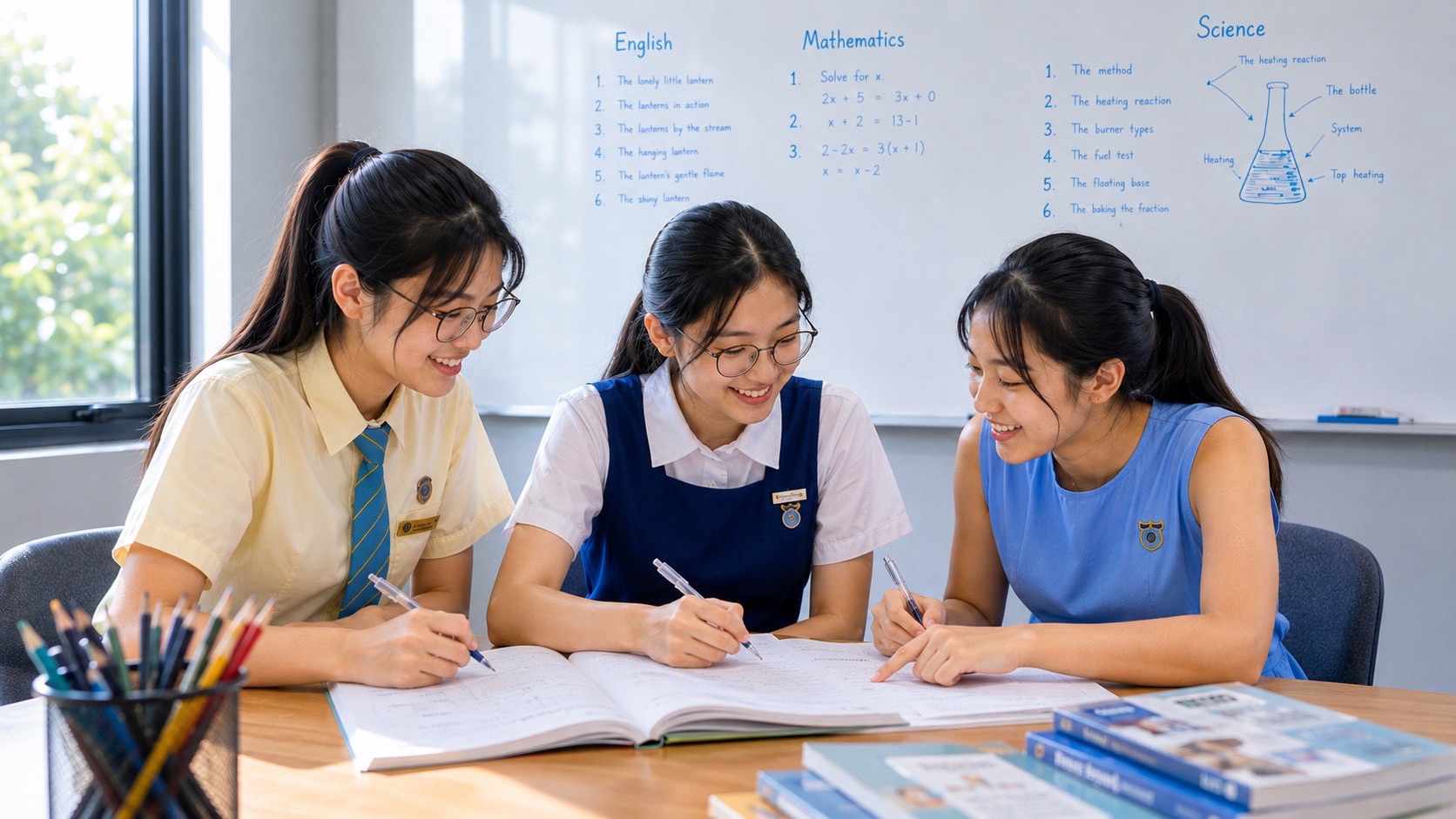
Secondary 3 Mathematics small groups tuition for Chinatown families can help when a teenager calculates accurately but cannot reliably interpret statistics, data displays or probability conditions in unfamiliar questions. A tutor working with three pupils can observe the student’s first choice of method, correct the misconception and check a new question without hints.
eduKateSG’s established 3-pax teaching model is a typical 1.5-hour tutorial. Its immutable Mathematics reference concerns a Bukit Timah arrangement near Sixth Avenue MRT; this Chinatown parents’ guide does not verify a currently operating classroom, timetable or vacancy within Chinatown. Confirm actual venue, teacher, course level, fees and travel before enrolment.
This guide explains the 2027 SEC and Full Subject-Based Banding, then works through mean, median, weighted results, probability, graphs and practical interpretation. It evaluates benefits and consequences honestly, including group suitability, homework burden, peer comparison and the distinction between correct calculations and independent reasoning.
- Best-fit need: persistent errors choosing statistical measures or reading probability conditions.
- Syllabus: confirm G1/G2/G3 Mathematics; Additional Mathematics is a separate subject.
- Potential benefit: individual diagnostic feedback and changed-question checks.
- Possible consequences: fees, travel, group mismatch, overwork and prompting dependence.
- Measure of progress: an appropriate method chosen and justified without hints after a delay.
- Decision: tuition is optional and should address a real gap beyond school support.
1. Chinatown parents: why interpretation matters as much as calculation
Secondary 3 pupils may compute a mean without difficulty yet draw the wrong conclusion about which result is typical. Another might multiply two probability fractions correctly while ignoring that a counter was removed between draws. A third correctly reads values from a graph but makes a dramatic claim about a small numerical change.
These are not the same as being unable to add or divide. The mistake usually starts when the student decides what the question means. A tutor should examine the original school script and ask why the pupil chose a certain statistic, sample space or comparison.
In a class of three, each learner can attempt a question before anyone suggests a method. The tutor can then correct the precise interpretation and test it again in an unfamiliar context. The small group is a tool for close diagnosis, not a reason to promise grades.
2. Start with the student’s G1, G2 or G3 subject level
Under Singapore’s Full Subject-Based Banding, students may offer individual secondary subjects at G1, G2 or G3. These are subject-level designations rather than permanent labels for the child. A teenager could take Mathematics at one level and other subjects at different levels, depending on school arrangements.
Starting with the 2027 graduating cohort, the Singapore-Cambridge Secondary Education Certificate replaces the former separate N- and O-Level qualifications. SEAB identifies Mathematics for 2027 school candidates as G1 K110, G2 K210 and G3 K310. The content and assessment demands remain level-specific.
Families should check official SEC overview, SEAB 2027 G1 syllabus list, SEAB 2027 G2 syllabus list, SEAB 2027 G3 syllabus list and the MOE Full SBB and SEC explanation. The school determines the actual current course and teaching sequence. Examples used to teach interpretation here do not imply that every such topic is examinable at every G-level.
3. Mathematics and Additional Mathematics require different plans
Mathematics is a separate subject from Additional Mathematics for pupils who offer both. The 2027 G3 syllabus listings identify Mathematics K310 and Additional Mathematics K341 separately, while G2 Additional Mathematics has a distinct listing, K232. Not every Secondary 3 student takes the additional subject.
A learner might work confidently with E-Math statistics but struggle with A-Math algebraic functions. Another may enjoy abstract algebra but misread everyday data applications. These are different deficits and should not be merged into one description of ‘weak in Maths’.
Ask which subject and G-level the group teaches and how pupils studying different combinations are handled. A child who does not offer A-Math should not spend a large portion of a lesson watching material that is irrelevant to their school course.
4. Worked example: mean and median answer different questions
Consider five values: 2, 3, 3, 4 and 18. Their sum is 30, so the mean is six. The median is three, the middle value after ordering. Both results are correct, but they describe different features of the set.
The unusually high observation eighteen raises the mean above most values. If the task asks what is typical, the median may be more useful; if it asks for the total divided equally, the mean directly answers that. A pupil who automatically computes the mean whenever they see ‘average’ may not be reading the specific question.
Change eighteen to five. The new mean is 3.4, while the median remains three. Ask the teenager what changed in the interpretation, not merely whether the arithmetic was correct.
5. Worked example: a range does not explain how data are spread
Set A consists of 2, 5, 6, 7 and 10; Set B is 2, 2, 2, 10 and 10. Both have range eight because ten minus two equals eight. But A has median six, while B has median two. Identical ranges do not imply identical typical values or distributions.
A student can apply the range formula perfectly and then overstate what the result proves. The misconception is treating one summary as a complete description of the data.
A tutor can ask students to create two new distributions with the same minimum and maximum but different middle values. Having the learner invent an example demonstrates understanding more deeply than copying another range calculation.
6. Weighted scores depend on the stated contributions
Suppose a hypothetical course gives a quiz 30% weight and a test 70% weight. Scores of 60 and 80 yield a weighted result of 0.30 × 60 + 0.70 × 80 = 74. An ordinary mean of 70 assumes equal weights and therefore describes a different assessment model.
The key question is not whether the teenager can multiply decimals. It is whether the child recognises that 30% and 70% are proportions of the total, and that their combined weights add to 100%.
This is an illustrative mathematical example, not a statement about a particular school’s grading policy. A tutor should ask what happens when the weights reverse, and require the student to select the appropriate model before doing arithmetic.
7. The average can hide an equation
Five observations have a mean of 12. Their total must therefore be 5 × 12 = 60. Four observations are 8, 10, 11 and 13, adding to 42. The unknown fifth observation is 18.
An algebraic expression of the same relationship is (42 + x)/5 = 12. A pupil who knows how to find a mean but cannot rearrange this equation may feel the new question is unfamiliar, even though the underlying idea has not changed.
Ask the student to derive the total from the given mean before writing an equation. Then change the number of values and the target mean, removing all hints. That tests whether statistics and algebra have become connected.
8. Averages across groups cannot always be averaged equally
Suppose one small group of four students has mean score 60, and another group of six has mean 80. The combined total is 4 × 60 + 6 × 80 = 720 for ten students, so the combined mean is 72.
Simply averaging 60 and 80 to obtain 70 gives both groups equal weight despite their different sizes. The arithmetic is valid for an unrelated two-number mean but not for the actual combined cohort.
A tutor should ask the pupil to explain what each group contributes to the total. A changed example with different group sizes can verify that the student is not following a memorised shortcut.
9. Why a median can remain unchanged when the mean changes
Take observations 1, 2, 3, 4 and 10. Their median is three and their mean is four. If the last observation becomes 30, the median remains three while the mean increases to eight.
The median depends on position in the ordered list; the mean uses every numerical value. An extreme value can therefore change the mean substantially without changing the middle position.
Have the teenager predict the direction of the mean change before calculating. Understanding how a statistic behaves is more useful than recomputing numbers without recognising the principle.
10. Read the context before declaring one statistic better
If a question asks about typical spending, an outlier may make the median useful. If it asks for the total revenue per person when sharing a combined amount, the mean is the necessary calculation. Neither statistic is universally the right answer.
Students sometimes memorise the phrase ‘use the median when there are outliers’, then repeat it even where the question asks for totals or an average contribution. The tutor should require an explanation tied to what is being measured.
A short discussion comparing two interpretations of one data set can reveal whether the child knows the role of each measure. The next task should be an unfamiliar story, not a nearly identical calculation.
11. Probability begins with the complete sample space
A bag contains four red and three blue counters, each equally likely to be drawn. The probability of red on one random draw is 4/7, because four of seven counters satisfy the event.
A learner who writes 4/3 is comparing red to blue rather than red to all possible counters. Such a fraction exceeds one, which is already a warning that it cannot be an ordinary event probability.
A good tutor asks the teenager to describe what counts as a possible outcome before forming a fraction. The same reasoning can be tested with a new mixture of colours and different quantities, without first telling the child to use a probability formula.
12. Worked example: without replacement changes the bag
Two counters are drawn from the four-red, three-blue bag without replacement. The probability of both being red is (4/7) × (3/6) = 12/42 = 2/7. After the first red is removed, only three red remain among six counters.
A pupil who writes (4/7) × (4/7) has treated the second draw as though the bag were restored. The arithmetic multiplication may be correct for a different experiment, but the method contradicts the phrase ‘without replacement’.
Ask the student to physically or visually remove one red counter before describing the second probability. Then change the wording to ‘with replacement’, in which the probability of two red becomes (4/7)² = 16/49.
13. An event may happen in more than one order
If the question asks for one red and one blue in either order without replacement, red then blue has probability (4/7) × (3/6) = 2/7. Blue then red has probability (3/7) × (4/6) = 2/7.
Both ordered paths satisfy the requested event, and they are mutually exclusive, so the combined probability is 4/7. A learner who reports just 2/7 has answered only one order, even if that individual computation is correct.
Ask students to list successful sequences in words before multiplying. This prevents an apparently straightforward calculation from overlooking part of the sample space. Specific methods should still be matched to the child’s syllabus.
14. When probability and odds are confused
A bag has three green and two yellow counters. The probability of green is 3/5, whereas the ratio of green to yellow is 3:2. Those statements are not numerically interchangeable. A pupil who reports probability as 3/2 is using the wrong denominator.
The tutor should ask ‘favourable out of all possible, or one group compared to another?’ This choice matters in statistics, ratios, and everyday numerical claims.
After explaining, change the bag composition and ask the learner to write both the probability and the ratio with labels. Clear meaning can prevent a misconception from appearing across several seemingly unrelated topics.
15. Expected frequency is a model, not certainty
If an event has probability 0.25 on each of eighty comparable trials, its expected frequency is 80 × 0.25 = 20. This does not require exactly twenty successes in a real sequence; outcomes can fluctuate.
A student may perform the multiplication correctly but state that twenty results must happen. That is a misconception about the meaning of an expectation rather than a problem with multiplication.
A tutor can ask what two separate experiments might produce and why their counts may differ. The objective is interpretation at an appropriate school level, not an assertion that advanced probability theory is compulsory for every G-level.
16. An unfair or unknown sample space changes the model
Probability calculations often rely on an assumption that the considered outcomes have equal chances. Drawing one physical counter uniformly from a well-mixed bag fits this simplified model. Choosing a person from a biased selection process may not.
An accurate numerator and denominator do not by themselves establish a valid probability if the sample space or selection method is different from the assumption. A tutor can ask what the question explicitly states about randomness and replacement.
Students should learn to identify the conditions that make a formula appropriate. This habit applies beyond probability whenever a real-life story is translated into a simplified mathematical model.
17. Graphs can exaggerate small absolute differences
Suppose three reported values are 96, 99 and 102. A vertical axis starting at 94 can make the bars look dramatically different, while a graph beginning at zero makes them appear closer. The data themselves are unchanged.
A teenager who declares that a value doubled because its bar looks twice as tall has failed to read the axis labels. The correct comparison comes from actual values, differences and percentages, not visual impression alone.
Ask the child to draw two versions and state which numerical claims remain true. This is a useful mathematical literacy skill for school work and for interpreting public information.
18. Graph slopes need the units of the axes
A straight line through points (1, 4) and (5, 12) has gradient (12 − 4)/(5 − 1) = 2. If the vertical axis is cost in dollars and the horizontal axis counts items, the gradient represents $2 per item.
If instead the axes record kilometres and hours, the same numerical slope means 2 km/h. A pupil who calculates two correctly but attaches the wrong unit has not fully interpreted the graph.
Ask the teenager to predict whether the line rises or falls before calculating and to label the units after the quotient. These simple checks support independent error detection.
19. A flat line can represent different real conditions
On a distance-time graph, a horizontal segment indicates no change in recorded distance during that interval. On a speed-time graph, a horizontal line above zero represents a constant speed. Identical-looking segments can describe different situations.
A student who always says ‘flat means stopped’ is using a visual shortcut without checking the vertical quantity. The tutor should require the child to name both axes first.
Give two graphs with matching shapes but different labels, and ask for separate verbal interpretations. Then present a fresh graph without hints. A good tutorial teaches the student to read the information rather than memorise a picture.
20. A fixed-fee table is not a direct proportion
A simplified service costs $5 before use and $3 per item. For quantities 0, 1, 2 and 3, the prices are $5, $8, $11 and $14. The model is c = 5 + 3n, with an intercept of five and a slope of three dollars per item.
A student who writes c = 3n has ignored the fixed part, while c = 8n adds two different kinds of quantity. Both models fail when tested against multiple rows of the table.
Ask the teenager to explain why doubling the number of items does not double the bill. A new table with different starting and variable amounts tests the connection between data and equations.
21. Comparing two linear plans requires interpretation
Service A charges $5 plus $3 per item, while Service B charges $9 plus $2 per item. Equating them gives 5 + 3n = 9 + 2n, so n = 4. Both cost $17 at four items.
At two items, A costs $11 and B $13, while at six items, A costs $23 and B $21. The intersection is a threshold: A is cheaper at smaller usage, B at larger usage in this simplified scenario.
A tutor should not accept only n = 4 if the question asks for a comparison. The student must explain the meaning of the result and demonstrate the conclusion using a table or graph.
22. Correct arithmetic may still fail the final request
A question may ask for a numerical result and a reason, or for the maximum whole-number amount under a restriction. A teenager who writes 6.25 tickets from a budget calculation has not supplied an appropriate count, even if the inequality arithmetic was correct.
Before finalising the answer, the learner should reread what quantity was requested, what its unit is and whether any whole-number or positivity conditions apply. This is the last stage of modelling rather than an optional extra.
A tutor can set altered contexts that use similar operations but permit different final values. The student should make the contextual decision independently rather than wait for the teacher to reject an answer.
23. Three learners need independent work before discussion
One pupil might choose the wrong summary statistic, another misunderstand replacement, and the third calculate correctly but misinterpret a graph. They may share a topic on paper but have different causes of error.
A teacher supervising three students can inspect original attempts and assign targeted corrections. But if the quickest pupil explains everything before others begin, the group may create imitation rather than learning.
A sound routine involves a private first attempt, a brief exchange of methods and a changed individual problem afterward. Parents can ask to see these stages in their child’s actual work.
24. Peer explanations can be valuable but require checking
A peer might express why the median differs from the mean in language another teenager understands. Another may suggest a better way to list probability outcomes. These discussions can make mathematical relationships easier to retain.
Yet confidence is not proof of correctness. A student might passionately explain the wrong sample space and unintentionally mislead classmates. The tutor must validate methods and show why tempting alternatives fail.
After a discussion, the child should independently attempt a different example. If the learner still selects a wrong method, another targeted explanation is needed regardless of how lively the group sounded.
25. A ninety-minute tutorial should include an unaided exit problem
eduKateSG’s established small-group model uses up to three learners in a typical 1.5-hour session. A useful lesson moves from retrieval of earlier learning to explanation, individual practice, feedback, changed contexts and an exit check.
- 10 minutes: retrieve an older fraction or data interpretation idea.
- 20 minutes: explain the priority misconception using a valid and invalid example.
- 25 minutes: differentiated work while the tutor inspects the first choices.
- 20 minutes: unfamiliar mixed problems without topic labels.
- 10 minutes: verify interpretations, units and reasoning.
- 5 minutes: set a manageable follow-up and a delayed review question.
The exact timing is illustrative rather than a statement about any currently operating class. The important step is a new question solved without the tutor identifying the first method.
26. Group placement cannot rely on Secondary 3 age alone
Three teenagers can take Mathematics at different G-levels and have different foundations. One may need fraction repair before probability, another understands fractions but misreads events, and a third is ready for complex statistical comparisons.
A tutor can differentiate within a shared concept if prerequisites overlap, but not every combination is suitable. A learner who waits for much of the session or cannot follow the tasks may need another group or individual support.
Ask how the provider selects classmates and what happens if one teenager’s subject level is a poor fit. A vacant seat is a logistical fact, not an educational reason to enrol.
27. Student confidence should come from genuine progress
A teenager may be encouraged by seeing a classmate explain a difficult concept, but some pupils are reluctant to show their mistakes in a group. The small room can make comparison more visible, especially when one person answers quickly.
A respectful tutor gives quiet thinking time, treats the original wrong answer as useful information and does not rank pupils by response speed. Confidence is more durable when the child sees a formerly difficult question becoming independently solvable.
If a student repeatedly hides questions or leaves feeling embarrassed, consider a different class. Group size alone cannot guarantee a supportive atmosphere.
28. Little homework with useful feedback may beat a large pack
School homework, corrections, CCA and other subjects already occupy Secondary 3 evenings. Extra assessment sheets can crowd out the time needed to understand an original error, particularly when a new pack merely repeats one named technique.
An effective follow-up set may contain one routine calculation, a changed condition, one misleading worked answer to critique and a delayed question from the preceding chapter. Each task reveals a distinct part of understanding.
Ask the tutor why each assignment is necessary and which repetitive activity it replaces. The purpose is to build independent mathematical reasoning, not to maximise the number of sheets completed.
29. The journey from Chinatown is part of the learning cost
This guide is for Chinatown families. It does not verify that eduKateSG runs a current Secondary 3 Mathematics classroom at a Chinatown address. Its immutable Mathematics reference concerns tuition near Sixth Avenue MRT in Bukit Timah. Confirm the real venue, subject, teacher, timetable and vacancy before planning travel.
Chinatown MRT is an interchange on the Downtown and North East lines, but the teenager’s journey may begin at school or CCA elsewhere. Walking, waiting, transfers, meals and returning home can greatly extend a nominal 90-minute lesson.
A long commute after a demanding school day can reduce concentration on statistics and word problems. Families should calculate the complete time and wellbeing cost, not assume that a central station means the class is convenient.
30. Why too many tutor hints can make the child dependent
During tuition, a teacher may immediately say ‘use the median’ or ‘the bag has six counters left’, allowing the student to finish accurately. In school, the first hint is absent and the child may still be unable to make the decision.
A tutor should withdraw support deliberately: one fully explained example, a guided variation with fewer prompts and a new task attempted alone. The number of hints required can be recorded as an individual progress measure.
Parents should ask for work completed after a delay. A correct unseen solution without hints is stronger evidence than a perfect worksheet completed while an adult repeatedly selects the method.
31. Educational research is context, not a guarantee
The Education Endowment Foundation small-group tuition review describes targeted small-group tuition, generally involving two to five pupils, and reports positive average educational effects. The findings vary across student ages, subjects and teaching designs, with a smaller average effect in secondary than primary settings.
These averages cannot guarantee that a commercial weekly 90-minute three-person class will raise an individual Singapore student’s SEC grade by any particular amount. Some programmes studied are more intensive or structured differently.
Use the evidence to ask about diagnostics, differentiation and independent follow-up. Parents should then evaluate the actual learner’s work rather than accept a marketing promise based on the number three.
32. A six-week review should test learning after the lesson
Week one can preserve original work on an average, a probability condition and a graph interpretation, with the first wrong step and hints recorded. Weeks two and three repair the main misconception. Weeks four and five introduce changed contexts and retrieval after a delay.
At week six, the child should attempt comparable unfamiliar questions alone. Look for correct choice of a statistical measure, a sound probability denominator, accurate conditional interpretation and a graph claim supported by values.
School results can contribute to the review but vary with assessment difficulty. If independence is not improving, the tutor should change the plan, recommend another group or consider whether extra tuition is necessary at all.
33. One-to-one, a group or independent revision?
One-to-one tuition can suit a pupil with large foundation gaps or one who cannot reveal mistakes comfortably among peers. It allows more individual pace but can also create dependence when an adult supplies every next line.
A larger revision group may be useful for a student who already works independently, while a teenager progressing effectively through school may need no paid tuition. A short revision routine and school teacher feedback can sometimes solve the problem.
The comparison of individual and small-group Maths tuition compares formats. The best option is the smallest necessary intervention that improves actual independent work without excessive fees, travel or emotional burden.
34. What families should ask before enrolment
- Which G1, G2 or G3 Mathematics syllabus and examination year apply to the pupil?
- Does the teenager also offer Additional Mathematics, and is it taught separately?
- What first error is visible in an actual school probability or statistics problem?
- Will every member of the group make an unaided first attempt and final changed attempt?
- How are learners matched by prerequisite knowledge and subject level?
- What are the confirmed venue, teacher, lesson duration, fee and available seats?
- How does the homework fit with CCA, school corrections and travel?
- What independent work will be compared after six weeks, and when might a pause be advised?
35. Frequently asked questions
Must every Secondary 3 student attend private Mathematics tuition?
No. School teaching, teacher feedback and independent revision may be entirely sufficient. Extra tutoring should address an identifiable problem.
Do G1, G2 and G3 Mathematics follow the same syllabus?
No. They are different subject levels with distinct requirements. Teaching should match the actual course.
Does every pupil take Additional Mathematics?
No. A-Math is separately offered and should be confirmed from the school combination.
Does this article confirm a Chinatown tuition classroom?
No. It provides parent information, not a verified current classroom or vacancy listing.
Will a group of three guarantee an SEC grade improvement?
No. It may permit closer feedback, but grades depend on the student, teacher, practice and group match.
How do we assess progress in statistics?
Use new data with a changed outlier and ask the student to choose and justify a suitable summary independently.
How can we test probability understanding?
Change a condition from with replacement to without replacement and ask for an explanation of the altered sample space.
When is it reasonable to stop tuition?
When the original skill gap is repaired and independent school progress remains secure, consider reducing or ending the paid class.
36. Official sources and next reading
The national SEC framework appears at official SEC overview, SEAB 2027 G1 syllabus list, SEAB 2027 G2 syllabus list and SEAB 2027 G3 syllabus list, with additional context at MOE Full SBB and SEC explanation. The child’s school remains responsible for subject level and current assessment sequencing.
The Education Endowment Foundation small-group tuition review provides wider research evidence about small groups; those average findings should not be converted into personalised grade guarantees.
Read immutable Clementi Mathematics three-pupil teaching reference, the Outram Mathematics parents’ guide, the Redhill Mathematics guide and the comparison of individual and small-group Maths tuition for further educational and tuition-format decisions.
The long-term objective is a student who understands what numerical information represents, selects a justified method and checks new answers independently. Good teaching should reduce—not create—the need for permanent tutoring.