
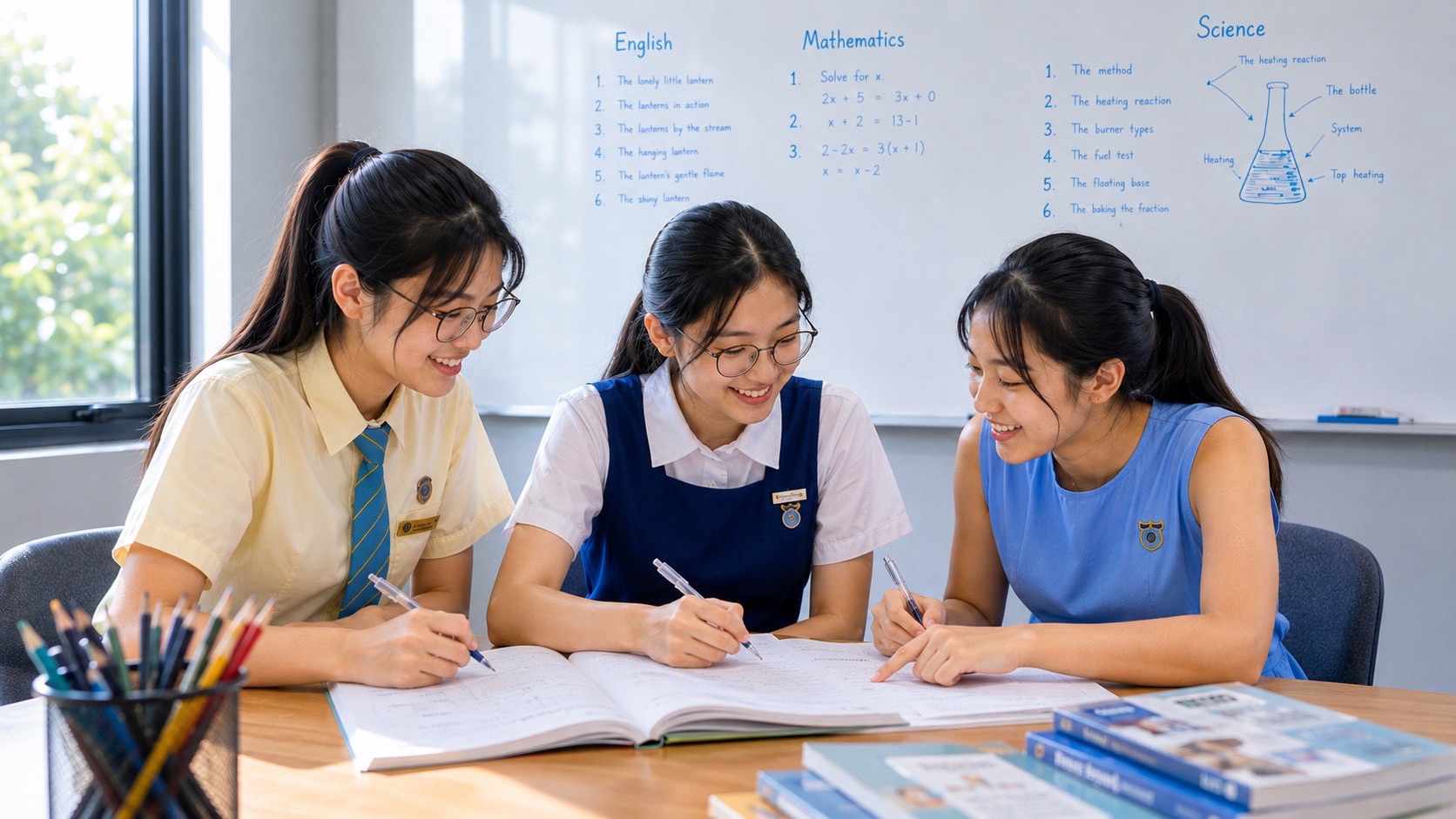
Secondary 3 Mathematics small groups tuition for Jurong East families can help when a student knows how to calculate an average, probability or algebraic expression but cannot interpret which calculation a new question requires. The educational advantage of a three-pupil tutorial is the opportunity to inspect each learner’s first decision, correct an underlying misconception and test it again using unfamiliar data or wording.
eduKateSG’s published model involves up to three students in a typical 1.5-hour tutorial. The immutable small-group Mathematics reference describes teaching near Sixth Avenue MRT in Bukit Timah; this article is intended for Jurong East parents and is not confirmation of a current class at a Jurong East address. Parents should verify location, availability, subject level, fees and transport before committing.
This parent guide explains G1, G2 and G3 Mathematics under Full SBB and the 2027 SEC, then shows worked examples in averages, probability, algebra and graph interpretation. It weighs the benefits of feedback and peer reasoning against fatigue, costs, group mismatch and excess homework, and ends with a practical six-week review.
- Best learning need: repeated errors interpreting data or choosing the method in unfamiliar problems.
- Curriculum check: G1, G2 and G3 Mathematics, with Additional Mathematics separately where offered.
- Benefit: frequent individual checks plus structured discussion of alternative methods.
- Consequences: time, fees, stress, mismatched level and dependence on hints.
- Progress: correct explanation and method choice on new problems without prompts.
- Decision: tuition is optional and should add something the child is not already receiving.
1. The main issue is not how many examples a student has seen
A Secondary 3 student might calculate an average, probability or percentage accurately when the type of question is printed at the top of a worksheet, yet struggle to decide which information matters in an assessment. Upper-secondary Mathematics increasingly rewards interpretation of unfamiliar conditions as well as mechanical fluency.
Parents in Jurong East can use three recent pieces of school work to ask where the first decision failed. Did the child assume two events were independent? Did the learner choose the mean when an extreme value distorted it? Was an inequality sign misread? Answers to those questions are more useful than the generic statement that a teenager is weak at Mathematics.
A three-pupil tutorial can help when the tutor examines each student’s reasoning and teaches the missing concept. If the lesson only supplies more questions without a specific diagnosis, the small advertised class size may produce little additional value.
2. Know the subject level under Full SBB
Under Singapore’s Full Subject-Based Banding, G1, G2 and G3 refer to levels of individual subjects rather than permanent labels for the whole learner. Mathematics at these levels involves different content and assessment demands. A useful tutoring plan must start from the child’s real school course.
For the 2027 Singapore-Cambridge Secondary Education Certificate, Mathematics has codes G1 K110, G2 K210 and G3 K310. The SEC replaces the former separate N- and O-Level examination certificates for graduating candidates from 2027. The examination year matters because the official specifications may change.
Refer to SEAB’s SEC overview2027 G1 syllabus list2027 G2 syllabus list2027 G3 syllabus list
Many families use ‘Maths’ broadly, but Additional Mathematics is a separate subject for pupils who offer it. In the 2027 SEC the G3 Mathematics syllabus is K310, while Additional Mathematics is K341; a distinct G2 Additional Mathematics syllabus is K232. A student who takes only Mathematics should not be assumed to take A-Math. This distinction is important when selecting a small group. A teenager who is secure in Mathematics data interpretation but needs extensive algebraic work in Additional Mathematics may need different tasks, revision records and assessment targets. A pupil who takes only Mathematics may find a heavily A-Math-focused lesson irrelevant. The tutor should state the subjects taught, the relevant levels and how each member of the group is supported. Matching all three by school year alone is not an adequate teaching plan. Suppose a small set of daily sales values is 3, 4, 4, 5 and 24. Their total is 40, so the mean is 40 ÷ 5 = 8. The median, after ordering the data, is 4. Both are correct calculations but communicate different information about the observations. The value 24 pulls the mean above most of the daily results. If the question asks for a typical day, the median may describe the central experience better. But a question asking for average sales revenue over the full period may have a different reason to use the mean. A good tutor asks which measure answers the stated question and why. Then change the data to 3, 4, 4, 5 and 6. The new mean is 4.4, much closer to the median of 4, showing how an unusual value affects the interpretation. Two groups of results both have a minimum of 2 and a maximum of 10, so both have a range of 8. Yet one group may have almost every value near 6 while the other has many values close to the extremes. The same range does not imply the same overall distribution. Ask the student to sort the data, draw an appropriate display and explain what the chosen measure captures. A pupil who memorises ‘range equals largest minus smallest’ can compute it but may not understand what the result fails to communicate. At different subject levels, more detailed measures of spread may or may not be required. The tutor should use the school’s actual syllabus to select the next step rather than teach an advanced formula just because it exists. A bag contains four red and three blue counters. Two counters are drawn at random without replacement. The probability that both are red is (4/7) × (3/6) = 12/42 = 2/7. After one red counter is taken, only three red remain among six counters. A common incorrect answer is (4/7) × (4/7) = 16/49. That calculation assumes the bag returns to its original composition before the second draw, which contradicts ‘without replacement’. The student may be excellent at multiplying fractions yet poor at reading the condition. Ask the child to describe what is physically in the bag after the first draw. This concrete reasoning is often more memorable than an unexplained probability tree. Then switch the words to ‘with replacement’ and let the learner calculate 16/49 for the revised question. A student may draw a neat tree diagram after watching one demonstration but still label the second branches incorrectly. The tutor should inspect why the denominators change, where the branch probabilities originate and which outcomes are being requested. Give a changed problem with three green and two yellow counters, requiring one green followed by one yellow without replacement. The probability is (3/5) × (2/4) = 3/10. The learner should explain that after a green is removed, there are four counters and two yellow remain. Whether a probability tree is part of the student’s current syllabus must be checked. The transferable principle is interpreting sequential conditions accurately and checking that the sample space changes when objects are not replaced. Suppose the probability of a certain outcome on each trial is 0.3. Over 100 comparable trials, the expected frequency is 0.3 × 100 = 30. A student might incorrectly claim that exactly thirty outcomes must occur. Probability does not generally fix the realised count in a finite series of trials. The tutor can ask for a plausible simulation or a discussion of why real outcomes fluctuate. The distinction between an expected value and a guaranteed observation is important when students interpret statistical questions outside a textbook. Teaching should remain appropriate to the learner’s level. A simple calculation can open a discussion about meaning without requiring advanced probability theory that the student has not yet studied. A vertical graph beginning at 98 rather than zero can make values 99, 100 and 101 look dramatically different. The numerical change is still two units from the first to the last value. The graph’s scale affects how steep the visual pattern appears, not the underlying recorded values. Ask the pupil to inspect axis labels, intervals and units before describing a trend. A student who says the quantity ‘doubled’ based solely on visual height should compare the actual figures. A thoughtful tutor can display the same data on two different scales and ask what changed. This is an educationally useful habit beyond examinations. Statistical claims in news, advertising and daily decisions often depend on interpreting how information is presented. An applied question may require the student to find a missing observation from a mean. Suppose five numbers have mean 12, so their total is 60. If four values are 8, 10, 11 and 13, their sum is 42, and the missing fifth value must be 18. A learner who knows the average formula but cannot work backwards may treat the problem as entirely new. The underlying equation is (42 + x)/5 = 12, giving 42 + x = 60, so x = 18. The problem joins a statistical idea with basic algebra. Ask for a changed number of observations or a different mean. A student who can set up the equation without being told the first step is becoming more flexible, which is a key goal of Secondary 3 Mathematics preparation. Before a detailed calculation, a student can often predict whether the result should be positive or negative, larger or smaller than a known value, or between two reasonable boundaries. This habit helps catch the wrong percentage base, swapped coordinates and improbable units. For instance, if an item marked $80 receives a discount, the final price must be below $80 and above zero. A student who calculates $96 has probably used an increase, a reversed operation or an incorrect starting amount. Recognising that before submitting the answer is part of mathematical literacy. A tutor should require a short plausibility check after selected application questions. Not every problem needs a long written explanation, but students should learn to notice when the answer contradicts the story. In a small group, students can first work silently, then compare three approaches. One learner may create a table, another a diagram and a third an equation. The tutor can identify which methods are valid, what assumptions they need and why two different procedures reach the same result. However, a group can perform badly when the fastest child always answers before the others have begun. That pattern can make a confident pupil more confident while leaving the others dependent. An effective teacher should protect individual attempts before discussion and give everyone a new problem afterwards. Parents can ask how the tutor checks each page and records each learner’s misconceptions. Class size by itself does not answer those questions. eduKateSG’s published model is a typical 1.5-hour session with up to three students. A useful lesson begins with a brief retrieval check, explains a governing principle, provides guided individual practice and ends with an independent transfer question. The teaching rhythm should vary according to the topic and the learners. The essential requirement is enough time for each student to attempt work without receiving the next step from the tutor. A group might include a student who is rebuilding fractions, another who is accurate at calculations but misinterprets data and a third who needs demanding multi-step problems. Their school year can match while their required scaffolding differs. A sensible tutor can begin with a shared idea, then differentiate tasks. One learner uses a small table, another writes an equation, and a third examines a more complicated context. All should have an individual exit check that tests their actual objective. If the spread is too wide for meaningful teaching, the provider should be willing to rearrange groups or recommend individual support. Fitting three children into a room is not the same as arranging an effective learning group. A teenager who is worried about answering incorrectly may conceal the very misconception the tutor needs to observe. The small group should establish that an incorrect first attempt is useful evidence, not a public failure. Some students enjoy explaining to peers, while others need private thinking time before speaking. Good tuition accommodates both. A clear routine can require students to write first, then discuss approaches, then try a new question on their own. If comparison with classmates routinely creates stress or silence, the family should reconsider the group even if the teaching content is sound. Progress may first appear as reading all conditions, writing the sample space correctly, calculating a mean with the right number of observations and checking whether a number is plausible. These habits are less dramatic than a sudden grade jump but can reduce repeat mistakes. Later, a student should be able to move between a table, graph, equation and written explanation. That is a stronger form of understanding than memorising a procedure under a chapter heading. It can also support independence in school homework. Parents can ask for an original attempt and a comparable changed problem completed after a week. A tutor who shows this evidence is demonstrating teaching rather than merely attendance. This guide serves Jurong East families; it does not establish a particular active eduKateSG Secondary 3 Mathematics classroom inside Jurong East. The immutable Mathematics reference describes a Bukit Timah arrangement near Sixth Avenue MRT. Confirm the real teaching venue and availability before making travel plans. Jurong East is an MRT interchange on the East–West and North–South lines. A child’s trip to a proposed tutorial may begin from school or CCA rather than home. Include walking, transfers, waiting, food and the return journey in the real cost. Even a well-run class may be ineffective when the student arrives after a draining day and struggles to focus. Transport convenience is not merely a family preference; it is part of the conditions in which learning happens. Teachers may assign extra work to make a tuition programme look rigorous. But a teenager who already has unfinished school corrections can become overwhelmed by another full paper every week. Fast mechanical completion may replace careful thinking. A better task set targets the diagnosed error. Three well-chosen questions—a direct case, a changed context and a delayed old concept—may provide the tutor with more useful evidence than dozens of nearly identical calculations. Parents should ask what work can be reduced or replaced. The objective is better use of the student’s time, not the largest possible total of questions completed across school and tuition. The EEF review of small-group tuition
The general evidence suggests that focused attention and feedback can matter. It does not prove any particular teacher is effective, nor does it guarantee a specific SEC grade or number of marks for a child. Families should examine the actual teaching process, class composition and independent progress. A research average should improve the questions parents ask, not replace evidence from their own teenager. One-to-one tuition can be more suitable where a learner needs intensive repairs to earlier number skills, cannot follow the proposed group pace or finds peer discussion very uncomfortable. It also risks over-prompting if the tutor supplies every first step. A larger class can help students who mainly need organised revision, while self-study and school consultations may be enough for independent pupils who correct mistakes successfully. Three-person tuition is one option among several rather than the automatic best choice. For more comparison, see the individual versus small-group tuition guide
Choose a small set of starting tasks: for example, interpret a data distribution, solve a probability question and form an algebraic equation from a mean. Save the student’s original working and note how many prompts were needed. Over several weeks, teach the underlying principles, revisit them after a delay and introduce changed problems. By week six, compare independent attempts of reasonably similar complexity. Look for fewer mistakes in the sample space, clearer explanations of mean versus median and more accurate algebraic setups. School marks remain useful supporting information, but one paper may test a different chapter or be much harder than another. If the core learning behaviours have not improved, ask for a revised plan or a different support format. A student making steady progress through school lessons and corrections may need no paid weekly support. Structured independent revision can be enough, especially where the main problem is consistency rather than a misunderstanding that needs close tutoring. Other students may require individual foundational work or a reduction in commitments before another class is sensible. Sleep, CCA and family routines are legitimate parts of an educational decision. A responsible tutor should be able to explain when a group is not the right place, and when the initial gap has been repaired enough for the learner to continue independently. No. School-based teaching and thoughtful independent practice may be sufficient. Tuition is an optional way to address a specific need. Only if the tutor can protect each learner’s actual syllabus and readiness. A shared school year does not justify identical worksheets. No. It is a separate subject where offered and requires its own teaching plan. Students may misread a graph, fail to consider an extreme observation or choose an inappropriate interpretation. A tutor should diagnose the conceptual choice. No. Confirm current lesson locations and vacancies directly; an estate title identifies the family audience rather than a guaranteed classroom. No responsible provider can guarantee a fixed SEC grade. Independent reasoning and school performance should be reviewed over time. Review whether extra paid tuition still adds a unique benefit. Increasing independence is a good reason to reduce unnecessary support. The formal examination framework is published in SEAB’s SEC overview2027 G1 syllabus list2027 G2 syllabus list2027 G3 syllabus list
The general small-group research is summarised by EEF review of small-group tuition
3. Mathematics and Additional Mathematics must be separated
4. Worked example: mean and median need interpretation
5. Worked example: a range is not the whole story
6. Worked example: probability without replacement
7. Independence matters more than a perfectly drawn probability tree
8. Worked example: expected frequency is not a guaranteed count
9. Data can be presented to create misleading impressions
10. Algebra sits beneath many data questions
11. Estimation can expose a calculation error early
12. What a three-student group can actually do
13. A ninety-minute tutorial should contain a real learning cycle
14. Why three learners may still require different questions
15. Group discussion should not embarrass the uncertain learner
16. The immediate benefits are often procedural habits
17. The consequence of travelling from Jurong East
18. The consequence of more worksheets than the child can process
19. Evidence for small-group support is positive but conditional
20. Small-group versus one-to-one and self-study
21. A six-week progress review using real evidence
22. When a Jurong East family should not add tuition
23. Questions to ask before enrolment
24. Frequently asked questions
Does every Secondary 3 student need Mathematics tuition?
Can G1, G2 and G3 students share one class?
Is Additional Mathematics the same as E-Math?
Why do data questions create mistakes even when calculations are correct?
Is a Jurong East tuition classroom confirmed by this guide?
Can the tutor promise a grade improvement?
Should we stop when the child can work independently?
25. Official sources and continuing reading