
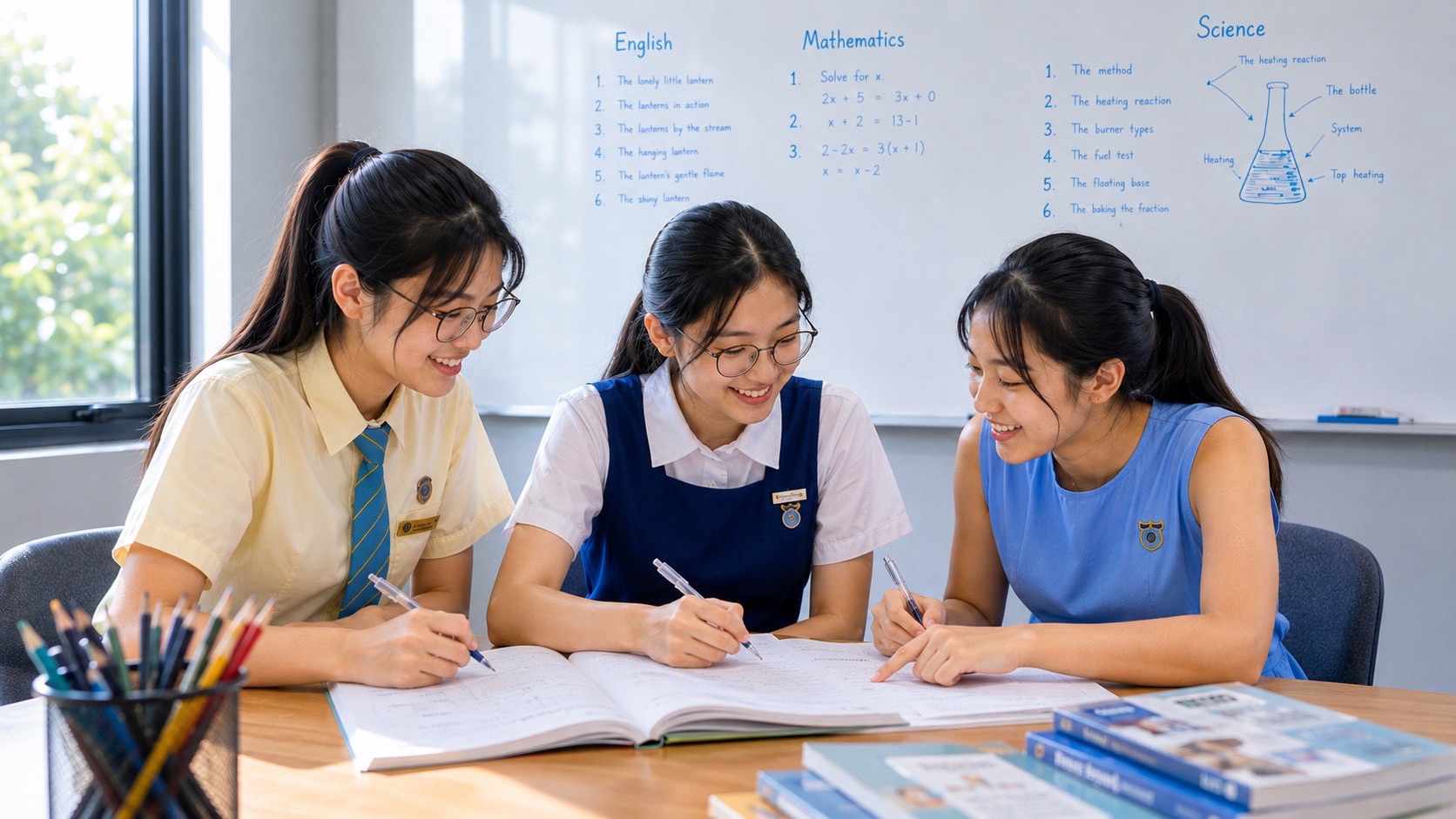
Secondary 3 Mathematics small groups tuition for Paya Lebar families can help when a teenager calculates accurately but has trouble deciding what a graph, price table or percentage story means. A tutor with three pupils may be able to inspect each learner’s first decision, clarify a mistaken relationship and test an unfamiliar variation without providing the next step.
eduKateSG’s published three-pupil teaching approach uses a typical 1.5-hour tutorial. The immutable Mathematics reference concerns a Bukit Timah arrangement near Sixth Avenue MRT; this page is for parents in Paya Lebar and is not confirmation of a current teaching location there. Confirm the real venue, subject level, group composition and timetable before joining.
This guide explains Singapore’s Full Subject-Based Banding and the 2027 SEC Mathematics syllabuses, then shows how a good tutorial teaches linear models, gradients, percentages and interpretation. It weighs the benefits of individual feedback against commuting, fees, peer mismatch and excessive homework.
- Best learning need: understanding what real quantities and graphs represent.
- Curriculum: G1, G2 and G3 Mathematics require appropriate level matching; A-Math is separate.
- Small-group benefit: feedback on each student’s reasoning and method selection.
- Consequences: extra costs, fatigue, group pacing and dependence on hints.
- Review: independent performance on changed equations and graphs.
- Parent decision: enrol only where the class adds support school and independent practice do not.
1. Why a secondary Mathematics mistake may not be a calculation error
A pupil may be comfortable adding numbers yet fail to decide how a cost changes when both a fixed fee and a charge per unit are present. Another remembers the gradient formula but calculates a negative answer for a line that visibly rises. A third knows what an equation looks like but cannot build it from a story.
In upper-secondary Mathematics, interpretation and method selection become essential. A lower mark is not enough to establish what went wrong. Parents should look at the first unsupported decision and ask what evidence of understanding is missing.
In a three-pupil tutorial, the teacher can inspect each learner’s initial working instead of simply distributing more worksheets. That is the potential advantage worth evaluating.
2. Paya Lebar parents should check G1, G2 and G3 before enrolling
Full Subject-Based Banding allows secondary students to take individual subjects at G1, G2 or G3. These levels do not define the whole child’s ability. A student might take Mathematics at one level and other subjects at different levels, which a tutor needs to understand before deciding what to teach.
The 2027 Singapore-Cambridge Secondary Education Certificate replaces the separate N- and O-Level examinations. Its Mathematics syllabuses for school candidates are G1 K110, G2 K210 and G3 K310. Each is a different subject-level specification; the examination year and school’s actual teaching sequence must be checked.
The authoritative references are SEAB’s 2027 SEC explanation, SEAB’s 2027 G1 syllabus list, SEAB’s 2027 G2 syllabus list and SEAB’s 2027 G3 syllabus list. Private tuition can use them to align content but must not imply official endorsement or guarantee that all students study the same chapter in one particular week.
3. Mathematics and Additional Mathematics are separate subjects
Some students offer Additional Mathematics as a separate subject, and some do not. In the 2027 SEC, G3 Mathematics K310 and G3 Additional Mathematics K341 are listed separately. The G2 list also contains a distinct Additional Mathematics syllabus K232.
An A-Math student may struggle with symbolic algebra while finding everyday rates and graphs easier; a different learner may need help interpreting a Mathematics story but have no difficulty with algebraic techniques. The learning target should identify which subject is affected.
Before enrolling, ask whether the class teaches the child’s exact Mathematics level and how A-Math support, if relevant, is scheduled. A mixed group should not spend the majority of a shared session on tasks unrelated to one member’s school course.
4. Worked example: a fixed charge creates a graph intercept
Suppose a delivery service charges $4 for booking plus $3 for each kilometre. If d is the distance and c the cost in dollars, the relationship is c = 4 + 3d. At zero kilometres, the cost is $4, so the graph has a vertical intercept of four.
A student who writes c = 3d may have treated the situation as direct proportion and ignored the fixed fee. The formula can look plausible, but it fails when d = 0. This simple substitution is a useful sense check.
Ask the learner to build a table of values for d = 0, 1, 2, 3. The corresponding costs are $4, $7, $10 and $13. Then ask for the graph and a verbal interpretation of the intercept and gradient.
5. The gradient is a relationship with units
Using the delivery-cost table, two points are (1, 7) and (3, 13). The gradient is (13 − 7)/(3 − 1) = 6/2 = 3. The vertical variable is dollars and the horizontal variable is kilometres, so the gradient means three dollars per kilometre.
A student may calculate three correctly yet call it three kilometres per dollar, which reverses the ratio’s meaning. Another pupil may use a negative gradient by subtracting the points in different orders in numerator and denominator.
Ask what the line’s direction should be before using the formula. A delivery cost that rises with distance should have a positive slope in this simplified model. The ${U.gradient} explores the subtraction-order misconception.
6. A changed graph can reveal whether understanding transfers
The tutor can change the fixed fee to $6 and the variable rate to $2 per kilometre. Now c = 6 + 2d. The graph begins higher on the vertical axis but rises less steeply with each extra kilometre.
Compare the two services at d = 2. The first costs $10 and the second also costs $10. At shorter distances the higher fixed fee may make the second service dearer; at longer distances its lower kilometre rate can make it cheaper.
Ask the student to find where costs are equal by writing 4 + 3d = 6 + 2d, which gives d = 2. This task joins graph meaning, equations and practical interpretation rather than keeping each in a separate exercise book chapter.
7. Why a table is not just a list of values
A table is a compact description of a relationship. When a pupil sees quantities one, two, three and four paired with prices six, twelve, eighteen and twenty-four dollars, they should recognise a rate of six dollars per unit.
Now change the table to eight, fourteen, twenty and twenty-six dollars. The difference between successive values is still six, but the cost at zero units would be two dollars. The correct linear model is c = 6n + 2.
A tutor can ask which part of a table represents the fixed amount and which represents a rate. This helps students see why a line is not automatically through the origin simply because it slopes upwards.
8. Direct proportion and a linear relationship are not identical
In direct proportion, y = kx, so when x doubles, y doubles and the graph passes through the origin. A relationship of the form y = kx + c with non-zero c is linear but not directly proportional.
The delivery example has a non-zero fixed fee, so doubling the distance does not double the entire cost. At one kilometre c = $7; at two kilometres c = $10, not $14. A student who tries to use a direct-proportion rule will give an incorrect price.
Teach the difference through a table, an equation and a graph, then remove the hints. A teenager who explains the role of the fixed term has learned a principle that transfers to many practical situations.
9. Percentage changes also have a reference quantity
A jacket costs $90 after a 25% discount. The sale price represents 75% of the original, so original price × 0.75 = 90. The original price is $120. Substitution confirms that a quarter of $120 is $30 and $120 − $30 = $90.
A common error is adding 25% of ninety to ninety. That uses the sale price as the reference rather than the original price. The multiplication or addition may be accurate, but the model answers the wrong question.
Before calculating, ask the student to state which amount is 100%. Give a changed problem involving an increase instead of a discount to check whether the rule is understood independently.
10. Successive percentage changes use different bases
A price rises from $100 by 10% to $110 and then falls by 10% of the new price, which is $11. The final amount is $99, not $100. The same percentages do not cancel because they apply to different starting values.
A tutor can teach this using multipliers: 100 × 1.10 × 0.90 = 99. A child who simply adds the percentage changes may not understand why the second base has changed.
Ask for a fresh +20% then −20% example and a verbal prediction before calculating. The final multiplier is 1.20 × 0.80 = 0.96, meaning a 4% overall decrease. The child should be able to explain the result without a slogan.
11. Word problems are a test of modelling
Three notebooks and two pens cost $19; one notebook and two pens cost $9. Let n be the notebook price and p the pen price. The relationships are 3n + 2p = 19 and n + 2p = 9. Subtracting gives 2n = 10, so n = 5 and p = 2.
Someone may solve simultaneous equations correctly when they are printed but form the wrong coefficients from the story. A good tutor should observe the translation and ask the learner to explain where every symbol came from.
Check both bills in words, not merely in symbols. Then give a new purchase story and see if the student forms two equations without being prompted to use elimination.
12. Choosing the correct level is more important than rushing ahead
The exact graph and algebra demands vary by G-level and subject combination. A learner with insecure fractions should not have to leap into unfamiliar advanced applications simply because other pupils in the group are ready.
Equally, a student with strong foundations may need deeper questions about interpretation, comparing models or detecting invalid assumptions rather than another page of introductory calculations.
A teacher should use a diagnostic to choose the amount of support and extension. The right challenge is the next step the child can productively learn, not the most impressive-looking worksheet available.
13. Why a three-pupil class may be helpful
Three students can hear alternative ways of representing a problem: a table, a sketch and an equation. The teacher can compare these methods and identify whether each produces the same result for the right reason.
That opportunity disappears if the fastest student always answers aloud and the other two copy. The tutor should require quiet individual first attempts, brief discussion and a new private question.
Parents should ask for evidence of individual attention: what error was observed in their child’s work, what principle was taught and whether the child later solved a changed question without hints.
14. A useful ninety-minute tutorial has a learning cycle
eduKateSG’s published approach involves up to three learners in a typical 1.5-hour session. A ninety-minute class can be structured to test recall, teach a principle, observe individual attempts and check transfer.
- 10 minutes: retrieve a prior equation or graph idea from memory.
- 20 minutes: teach one major misconception with a clear counterexample.
- 25 minutes: level-appropriate individual tasks and corrective feedback.
- 20 minutes: mixed questions without labels identifying the method.
- 10 minutes: check graph interpretation, units and working.
- 5 minutes: set a manageable follow-up and next retrieval target.
The exact schedule should adapt to the child and topic. The essential feature is protected independent work after explanation rather than ninety minutes of continuous demonstration.
15. The risk of a tutor supplying too many hints
A teenager may finish every tutorial question because the teacher points to the correct formula, identifies the first step and corrects errors immediately. The same student can still fail a school assessment where no one supplies that assistance.
A good lesson deliberately withdraws prompts. The learner sees a full example, attempts a changed problem with minimal support and then begins another problem independently. The tutor can record the number of hints required.
Parents should not confuse a full notebook with stable understanding. Independent problem solving after several days is a more meaningful indicator of teaching quality.
16. The risk of mixed-level groups
Three pupils may be in Secondary 3 yet take Mathematics at different G-levels or have very different foundations. One may need introductory rate problems, another may need graph interpretation and a third may be ready for unfamiliar multi-stage models.
A tutor can share a core idea while differentiating tasks, but not every combination is workable. If one learner spends much of the lesson waiting or unable to participate, the group may not be a good fit.
Ask what criteria determine placement and what happens if a mismatch becomes clear after two or three sessions. An honest provider should be willing to suggest another group or format.
17. The risk of peer comparison
Some adolescents are comfortable sharing mistakes with peers; others feel exposed when one classmate finishes more quickly. A good tutor treats incorrect attempts as information for teaching, not as a public ranking.
Quiet thinking time before discussion can protect a slower learner from the pressure to answer immediately. The tutor should ensure that every student has a chance to explain a decision and learn from feedback.
If the child consistently avoids questions due to the group atmosphere, consider another arrangement. A three-seat classroom is not automatically a supportive one.
18. Paya Lebar families should account for travel, not just lesson duration
This is a Paya Lebar-focused parent guide, not confirmation that eduKateSG operates a current Secondary 3 Mathematics classroom inside Paya Lebar. Its immutable Mathematics reference describes teaching near Sixth Avenue MRT in Bukit Timah. Confirm the actual venue, teacher, subject, fees and vacancy before travelling.
Paya Lebar MRT is an interchange for the East–West and Circle lines, but a teenager may begin the journey from school or CCA rather than the station. The true commitment includes transfers, waiting, walking, meals and the trip home.
A distant lesson may reduce time for school homework and sleep, particularly after a tiring school day. Compare the instructional benefit with the complete weekly cost, not simply the advertised ninety minutes.
19. More worksheets can create false confidence
A worksheet titled ‘Linear Graphs’ gives away the method before the student reads the question. Such targeted drills help build initial fluency but do not establish that the learner can recognise a graph relationship when presented in a story.
A useful follow-up mixes equations, percentages and graphs and asks the student to explain why one method fits. A few varied questions may be more informative than fifty identical calculations completed quickly.
Parents should ask what new learning an assigned worksheet is intended to test. If the child already has school practice material that can be corrected and reviewed effectively, another full pack may be unnecessary.
20. Evidence about small groups is encouraging, but limited
The research review of small-group tuition summarises research into teaching groups of approximately two to five pupils and reports positive average educational effects. It supports considering focused tutoring, but does not guarantee that any commercial three-pupil class will reproduce the results.
Study programmes, student ages and frequencies vary. A weekly ninety-minute tutorial is not automatically equivalent to each intervention in a research review, and the evidence should not be converted into a promise of a fixed SEC Mathematics grade.
Parents should combine the general research with evidence from their own child’s original work, independent checks and school feedback.
21. When a larger class or one-to-one support is better
A student who already studies independently may benefit from a larger revision class or no paid tuition at all. A teenager with deep prerequisite gaps may need one-to-one repair before joining a small shared group.
One-to-one instruction offers individual pacing but may still over-prompt. A three-pupil group allows discussion but may be mismatched. The educational advantage depends on lesson design rather than a universally superior class size.
The individual versus small-group Mathematics comparison discusses these choices further. Parents should select the least burdensome intervention that improves the student’s actual work.
22. A practical six-week review
In week one, save the student’s original solutions to a price-equation question, a table-to-graph task and a reverse-percentage problem appropriate to their syllabus. Record the first error and number of hints needed.
Weeks two and three can teach the highest-impact principle; weeks four and five should revisit it in changed contexts and mix older ideas. By week six, the student attempts comparable unfamiliar questions alone.
Look for correct interpretation of a fixed fee, consistent gradient working and the ability to identify the percentage base. If these skills do not improve, reassess the diagnosis, group or timetable before purchasing another term.
23. Parent checklist before enrolment
- Confirm the exact G1, G2 or G3 Mathematics syllabus and expected examination year.
- Ask whether Additional Mathematics is separately taught when needed.
- Bring actual work and request a diagnosis of the first wrong step.
- Ask how all three pupils receive independent practice and tailored feedback.
- Check that group members have compatible prerequisites and learning objectives.
- Confirm the actual active classroom, tutor, lesson fee, timetable and vacancy.
- Calculate the journey from school or CCA and the cost to other subjects and sleep.
- Agree on an independent-work review and an exit condition when tuition stops adding value.
24. Frequently asked questions
Is Secondary 3 Mathematics tuition compulsory?
No. Many students progress through school lessons, teacher feedback and independent revision. Tuition is an optional intervention.
Does every Secondary 3 student study A-Math?
No. Additional Mathematics is a separate subject offered according to the student’s combination.
Can a G2 pupil follow a G3 tutorial?
Only where the child’s G2 learning needs are protected with appropriate level-specific teaching. G3 worksheets are not automatically a substitute.
Does a three-pupil group guarantee better marks?
No. Group size may improve opportunities for observation, but results depend on teaching quality, readiness and practice.
Is a Paya Lebar classroom confirmed?
No. This guide is written for Paya Lebar families. Confirm active venues and vacancies directly.
How can progress be measured?
Ask for new problems solved unaided with correct method selection, units and explanation, alongside school feedback.
What if the child is already coping well?
An extra class may provide little benefit. Protecting time for independent study and rest can be the more responsible choice.
25. Official sources and further reading
The SEC examination framework is set out in SEAB’s 2027 SEC explanation, SEAB’s 2027 G1 syllabus list, SEAB’s 2027 G2 syllabus list and SEAB’s 2027 G3 syllabus list. The child’s school remains the source for the actual subject level and teaching sequence.
General research is reviewed by research review of small-group tuition. Its average findings are not a guarantee for an individual private lesson.
Read the immutable Clementi three-pupil Mathematics reference, the Paya Lebar small-group Mathematics teaching overview, the guide to reversing the gradient, the individual versus small-group Mathematics comparison and the nearby Bedok Secondary 3 Mathematics guide for related decisions and examples.
A good small-group tutorial should teach the child to choose, justify and check a mathematical relationship when the example has changed. The greatest benefit is a student who eventually needs fewer hints.