
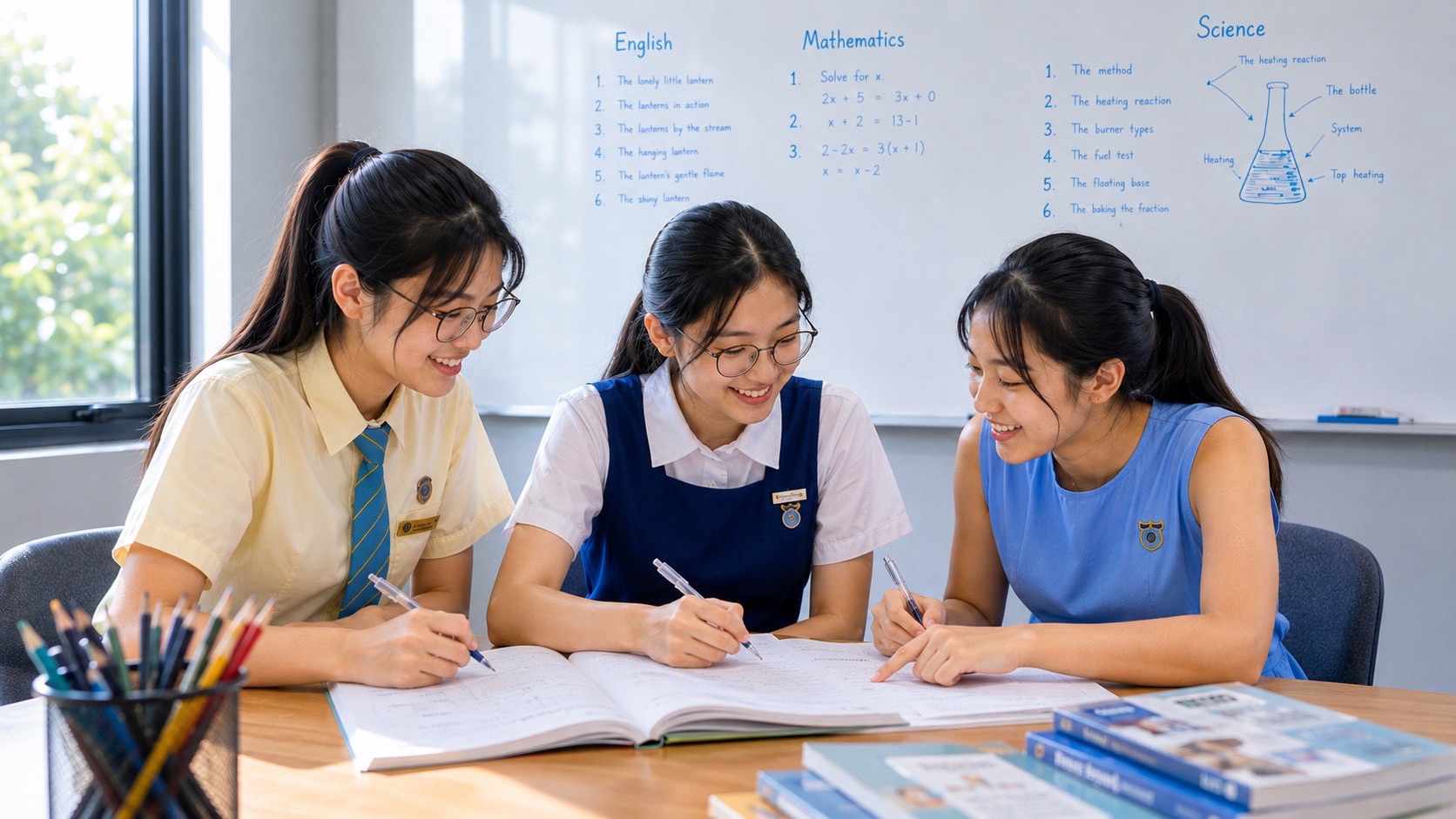
Secondary 3 Mathematics small groups tuition for Simei families may help when a teenager understands individual methods but loses confidence on mixed questions involving data interpretation, probability and practical reasoning. A three-learner tutorial can make the first mistaken decision visible and allow a tutor to test whether the correction works without hints.
eduKateSG’s published model uses a maximum of three pupils in a typical 1.5-hour session. Its immutable Mathematics reference describes teaching near Sixth Avenue MRT in Bukit Timah; this Simei guide is a parent’s information resource, not confirmation of an active Simei tuition venue or vacancy. The actual classroom, subject level, group and travel should be checked before enrolment.
This guide explains the 2027 SEC and G1/G2/G3 Mathematics framework, then uses examples of averages, probability and graphs to show how tuition can teach better decisions. It also examines the costs of added homework, travel, mismatched groups and dependence on tutoring, and sets out a review process.
- Best fit: students whose recurring errors involve interpreting data or conditions.
- Curriculum: G1, G2 and G3 Mathematics differ; Additional Mathematics is separate.
- Potential benefit: targeted feedback, independent practice and peer reasoning.
- Potential risks: fatigue, travel, group mismatch and excessive hints.
- Measure of progress: correct, independent explanation on changed questions.
- Decision: only add tuition when the benefit outweighs the full family cost.
1. The first question is why performance changes in unfamiliar tasks
A Secondary 3 teenager might complete routine schoolwork confidently but panic during an assessment that mixes algebra, data and practical questions. The child has learned some procedures, yet cannot reliably identify when each one should be used.
A Simei parent should begin with the student’s marked work and look for recurring choices: did the student mistake a probability condition, select the wrong average, misread a graph or simply run out of time? These causes differ, and the teaching response should differ too.
A three-pupil lesson can offer time to observe the student’s first decision before a tutor explains the solution. That is the potential benefit worth judging, rather than the existence of another class on the weekly schedule.
2. Full SBB means the actual Mathematics level comes first
Full Subject-Based Banding allows secondary pupils to study subjects at G1, G2 or G3 levels. These describe individual subjects, not the child’s entire intelligence or academic identity. A useful tuition plan must follow the student’s actual Mathematics course.
In the 2027 Singapore-Cambridge Secondary Education Certificate, Mathematics appears at G1 K110, G2 K210 and G3 K310. The SEC combines what were formerly separate N- and O-Level examinations for the graduating cohort from 2027 while maintaining different subject-level demands.
Use SEAB’s SEC overview, 2027 G1 syllabuses, 2027 G2 syllabuses and 2027 G3 syllabuses to verify the formal syllabuses. The student’s school determines the current teaching sequence, so parents should not expect every example in this general guide to be required at all levels.
3. Additional Mathematics is a distinct course
Some Secondary 3 pupils take Mathematics and Additional Mathematics; others study Mathematics alone. SEAB’s 2027 G3 lists Mathematics K310 and Additional Mathematics K341 separately, and its G2 list includes a separate Additional Mathematics syllabus K232.
A teenager can be strong at statistical interpretation in Mathematics but uncertain at algebraic procedures in A-Math. Another may manage algebra but become stuck on multi-step applied contexts. The tutor should diagnose each subject separately.
Ask whether the group actually teaches E-Math, A-Math or both, and how separate goals are kept visible. A learner should not spend half a tutorial on an unrelated subject simply because other members have a different combination.
4. A strong diagnostic observes the first decision
Present a short problem without a chapter label. Give the student a few minutes to identify the unknown, list the facts and describe a possible relationship. The tutor should observe whether the learner makes a thoughtful initial attempt or waits for the first hint.
Then compare with an example that looks different but uses the same principle. This distinguishes recognition of a familiar worksheet from the ability to transfer a method.
Recording only the final mark loses important information. An original attempt, the missing idea, the correction and a later independent attempt together provide a better teaching plan.
5. Worked example: mean and median tell different stories
Consider the five values 2, 3, 3, 4 and 18. Their sum is 30, so the mean is six. The middle value is three, so the median is three. Both are mathematically correct summaries of the data.
The unusually high value of eighteen pulls the mean upwards. A pupil who always uses the mean for the word ‘average’ may overlook that the question seeks a typical central observation. The correct choice depends on the context, not a slogan that the median is always better.
A tutor can alter the final observation from eighteen to five and ask for the new mean and median. The change reveals how the distribution affects the summaries. The student should explain why the interpretation may differ.
6. What the range can and cannot tell us
A data set with minimum two and maximum ten has range eight. Another data set can also have minimum two and maximum ten but contain most observations near an endpoint rather than the middle.
The same range therefore does not prove the two distributions are similar. A learner who calculates the range correctly but draws an unsupported conclusion needs interpretation work, not more subtraction drills.
A tutor can present two short tables with identical extrema and ask the child what else must be known. This develops evidence-based reasoning at the complexity appropriate to the student’s syllabus.
7. A probability depends on what is in the sample space
A bag contains four red counters and two blue counters. The probability of drawing a red counter on one random draw is 4/6, or 2/3. The denominator represents all equally likely counters, not an arbitrary number chosen for convenience.
A learner may write 4/2 because there are four red and two blue counters, confusing a ratio with a probability. The answer would exceed one, which is a useful warning sign. Probabilities for ordinary events must lie between zero and one.
An effective tutor asks the pupil to describe the possible outcomes and why the denominator is six. After feedback, a changed bag composition tests whether the principle is understood.
8. Without replacement, the sample space changes
Draw two counters from the same bag without replacement. The probability of drawing two red counters is (4/6) × (3/5) = 12/30 = 2/5. After the first red is removed, only three red counters remain among five.
A common wrong approach uses 4/6 for both draws, ignoring that the bag changes. The multiplication is not the main difficulty; interpreting ‘without replacement’ is.
Compare with a new experiment in which the first counter is put back. Then the probability is (4/6) × (4/6) = 4/9. The tutor should let the student explain why the two contexts require different second fractions.
9. Two orders may contribute to the same event
Suppose the question asks for one red and one blue counter from the four-red, two-blue bag, without replacement, in either order. Red then blue has probability (4/6) × (2/5) = 4/15. Blue then red has probability (2/6) × (4/5) = 4/15.
Because the two orders are mutually exclusive paths to the requested event, their probabilities add to 8/15. A student reporting only one path may have carried out a perfectly correct calculation for an incomplete event.
A tutor should ask the child to list which outcomes satisfy the words ‘in either order’ before multiplying. A diagram or tree can help, where appropriate to the student’s syllabus.
10. A correct probability result needs a sense check
A calculated probability of 1.2 is an immediate signal that the solution is invalid for an ordinary event. The student should check whether they have confused favourable-to-unfavourable odds with favourable-to-total probability, or counted cases incorrectly.
Probability questions also require interpreting the sample space and whether outcomes have equal chances. A formula used without checking assumptions can give an attractive-looking but wrong result.
Good tuition teaches a short checking routine: describe the event, establish the total possible outcomes, compute the value and decide whether its size makes sense. This can reduce repeat errors without dependence on the tutor.
11. Interpreting a chart is not simply reading bar height
A vertical axis that begins at ninety rather than zero can make values 96 and 101 appear much farther apart than their five-unit difference suggests. The actual numbers have not changed.
A student who judges the graph solely by the picture may claim a dramatic increase without considering the scale. The tutor should ask the pupil to read tick intervals, axis units and the original values before describing a trend.
Present two displays of the same figures with different vertical-axis ranges. The child should identify what changed in the representation and what remained true about the data.
12. Algebra can be hidden inside a question about averages
Five numbers have mean twelve, so their total is sixty. Four observations are 8, 10, 11 and 13, which add to forty-two. The missing fifth observation is therefore eighteen.
The equation (42 + x)/5 = 12 expresses the same reasoning. A student who can calculate a mean but cannot reverse the formula may treat the problem as unfamiliar.
Ask the learner to write the relationship in words, then symbols, before solving. This joins data interpretation with algebra and can be retested using a changed number of observations.
13. Time management begins with knowing what the question requests
Some teenagers spend too long on a familiar calculation because they fail to read that the question requests an explanation rather than a numerical answer. Others use a calculator immediately where a rough estimate would expose an impossible result.
A tutor can teach a routine of marking the unknown, choosing the method and checking whether every part was answered. This should become quicker with practice instead of remaining a slow written checklist forever.
Timed work has value once the method is stable. Starting with high time pressure can merely teach a worried learner to guess faster, rather than improving mathematical understanding.
14. A tutor needs to distinguish error types
One student calculates the mean incorrectly because the sum is wrong. Another computes the correct mean but gives an unsupported interpretation. A third chooses the wrong number of observations in the denominator. These are three distinct difficulties.
With a three-pupil group, the tutor may be able to inspect each first attempt and prescribe a different correction. A generic worksheet on averages is less useful when the actual problems are not the same.
Parents can ask for an example of the child’s original mistake and how the teacher checked the correction in a new problem. The quality of that response matters more than how many pages were marked.
15. A ninety-minute lesson needs purposeful phases
eduKateSG’s published small-group approach uses a typical 1.5-hour tutorial for up to three students. A good session should include retrieval of old knowledge, diagnosis, explicit instruction, individual practice and an independent transfer check.
- 10 minutes: retrieve an earlier idea from memory.
- 20 minutes: teach the most consequential misconception with a counterexample.
- 25 minutes: differentiated student work and observation of errors.
- 20 minutes: changed or mixed problems without chapter cues.
- 10 minutes: check interpretation, working and plausibility.
- 5 minutes: a manageable follow-up exercise and next review target.
This is an illustrative schedule, not a guarantee about a particular class. The important point is that every student eventually handles a new question alone rather than only follow the tutor.
16. Peer discussion should strengthen independent reasoning
A student may learn from a classmate who explains why probabilities change after a counter is removed. Another peer might challenge an incorrect interpretation of a graph’s scale. These exchanges can deepen understanding.
But lively discussion is not proof of mastery. The teacher should protect silent first attempts and require independent changed questions after conversation. No learner should pass through a lesson by copying the fastest classmate.
The tutor must also correct inaccurate peer explanations and maintain a respectful atmosphere in which teenagers can reveal confusion without embarrassment.
17. Students with different prerequisites may need different groups
Three Secondary 3 learners may have different mathematical foundations and may study at different G-levels. One needs fraction concepts, another appropriate probability questions and a third advanced mixed data applications.
A tutor can share a core concept and adapt tasks, but a large mismatch creates delays and frustration. Group placement should consider actual school courses and diagnostic readiness, not merely age.
Parents should ask what happens when one student is repeatedly unable to follow. Moving to another group or individual help may be more responsible than continuing an ineffective match.
18. Benefit: students can gain confidence based on evidence
A teenager who correctly identifies a sample space, chooses the appropriate average and explains a graph’s scale is gaining transferable skills. Those decisions matter even if a school paper has not yet produced a dramatic grade change.
Confidence is most valuable when linked to successful independent application. A good tutor shows the learner an earlier error and a later changed question solved without hints.
A school score is still relevant, but papers vary in difficulty and topic selection. Look for a pattern of stronger decisions across several work samples and assessments.
19. Consequence: travel from Simei can reduce the benefit
This page serves Simei families; it is not confirmation of a currently available eduKateSG Secondary 3 Mathematics classroom in Simei. The immutable reference describes tuition near Sixth Avenue MRT in Bukit Timah. Confirm the actual venue, tutor, timetable, subject and vacancy before making travel arrangements.
Simei MRT is on the East–West Line, but a teenager may start from a school or CCA location elsewhere. The journey may involve walking, waiting, transfers, meals and the trip home, all of which count toward the weekly burden.
A student who arrives exhausted may struggle to interpret unfamiliar data. Compare the expected teaching gain with the time and wellbeing cost of attending it.
20. Consequence: more tuition may create dependency
A tutor who immediately identifies the formula and corrects every step can make a learner appear very productive during tuition. During a school assessment, the child may still be unable to choose a method without a hint.
A good teaching plan withdraws prompts gradually. The tutor begins with a demonstration, then asks a neutral question, then gives an unfamiliar task for independent completion.
Parents should ask whether the child needs fewer hints after several weeks. The intended outcome is greater self-direction, not indefinite reliance on a paid lesson.
21. Consequence: a second curriculum can crowd out rest
Extra worksheets can duplicate school assignments and prevent the student from revisiting the mistakes that matter. A teenager with CCA and multiple subjects may lack time for focused independent study if every evening is scheduled.
Targeted tuition can assign a few varied problems instead: one direct question, one changed condition, one incorrect solution to critique and one delayed retrieval task.
The child should have time to think, check and rest. Quantity of homework is not a reliable measure of tutoring quality.
22. The limits of small-group research
The EEF evidence review of small-group tuition reviews small-group tutoring with roughly two to five learners and finds positive average effects. The studies vary by subject, age, frequency and delivery, and those averages do not guarantee that a weekly private three-pupil class in Singapore will yield the same result.
Research supports evaluating targeted instruction with care. It does not justify promising an SEC grade or treating any class size as a universal solution.
Parents should combine that context with evidence of the student’s own progress, group fit, school learning and the family’s practical constraints.
23. Choosing the appropriate format
One-to-one tuition may be preferable where a teenager needs intensive repair of earlier foundations or finds a group environment difficult. A larger revision class may suit a student who works independently and wants structure.
Some pupils need no paid tuition: regular school feedback and planned self-study may already meet the need. A three-pupil tutorial is useful only when its individual observation and peer discussion add something meaningful.
The one-to-one versus small groups compares these options. The right approach changes with the learner and need not be a permanent commitment.
24. A six-week independent-progress review
Week one can save short original tasks on a mean, a graph and a probability condition appropriate to the student’s level. Weeks two and three address the most repeated misconceptions. Weeks four and five revisit them after a delay and introduce altered contexts.
At week six, ask the learner to complete similar but unseen problems without hints. Observe correct identification of a mean’s denominator, interpretation of a graph scale and reading of replacement conditions.
School scores can support the evaluation but should not be used alone. If independent reasoning is not improving, change the teaching plan, class or support format.
25. Questions parents should ask before paying
- What G1, G2 or G3 Mathematics course and examination year apply to this pupil?
- Is Additional Mathematics taught separately where the child takes it?
- Which exact error can the tutor identify in an original school script?
- How do all three learners make independent first attempts?
- What happens if students have substantially different prerequisite gaps?
- What are the real teaching address, tutor, fee, timetable and current vacancies?
- How much homework fits alongside CCA and school requirements?
- Which unseen questions will demonstrate progress after several weeks?
26. Frequently asked questions
Does every Secondary 3 pupil need tuition?
No. Tuition is optional. Many students progress with school teaching, feedback and independent practice.
Does every Secondary 3 student take A-Math?
No. It is a separately offered subject, and the school combination must be checked.
Are all the probability examples compulsory at every G level?
No. They illustrate reasoning, and tutors must select actual examination practice according to the student’s subject level and syllabus.
Does three-pupil tuition guarantee better SEC grades?
No. It can provide closer feedback, but outcomes depend on how the class is taught and whether it suits the learner.
Is a Simei classroom confirmed?
This guide does not establish a current Simei venue. Confirm lesson locations and vacancies with the provider.
How do I measure improvement?
Compare unseen independent attempts and recurring errors over several weeks, alongside school feedback.
When should tuition be reduced or stopped?
When the identified gap is addressed and the learner progresses independently, reassess whether a weekly paid session still adds useful support.
27. Official sources and continuing reading
Consult SEAB’s SEC overview, 2027 G1 syllabuses, 2027 G2 syllabuses and 2027 G3 syllabuses for the official SEC framework and check the student’s school programme. These sources, not private lesson advertisements, determine national assessment requirements.
Read EEF evidence review of small-group tuition for general evidence about focused small-group teaching. Its average effects do not guarantee individual outcomes.
Continue with unchanged Clementi small-group Mathematics teaching reference, the Simei three-pupil Mathematics overview, E-Math and A-Math stress guide, the one-to-one versus small groups and the nearby Tampines Mathematics parents’ guide.
An effective tutoring choice identifies a real problem, uses an appropriate subject-level class, respects the family’s time and measures whether the child can solve new questions without help.