
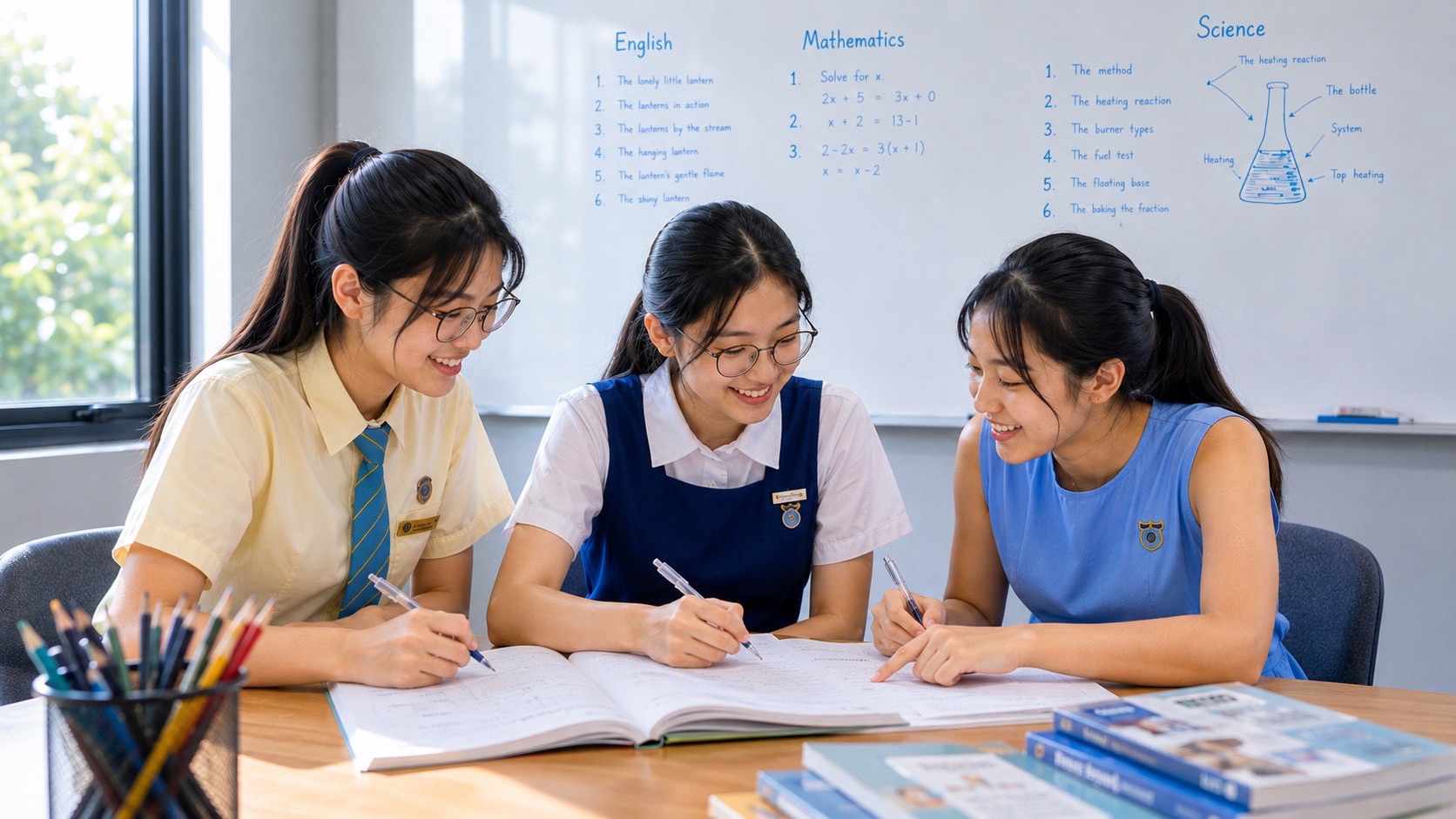
Secondary 3 Mathematics small groups tuition for Tanglin families can help when a student remembers geometric formulas but struggles to recognise valid theorem conditions, scale factors and trigonometric relationships in unfamiliar diagrams. A tutor working with three pupils can inspect each learner’s first assumption, correct it and check whether the principle survives a new figure without hints.
eduKateSG’s published small-group teaching approach uses up to three learners in a typical 1.5-hour tutorial. The immutable Mathematics reference concerns tuition near Sixth Avenue MRT in Bukit Timah; this Tanglin guide does not confirm an active classroom, timetable or seat in Tanglin. Families should verify the actual teaching venue, subject level, teacher and full travel cost before enrolling.
This guide explains Full Subject-Based Banding and the 2027 SEC Mathematics levels, then gives worked examples in geometry, trigonometry, similarity, scale, measurement and proof. It assesses both the learning benefits and practical consequences of three-person tuition, with a framework for measuring real independent improvement.
- Best-fit learning need: misreading geometry diagrams or applying theorems without their conditions.
- Curriculum: select the correct G1, G2 or G3 Mathematics course; Additional Mathematics is separate.
- Potential benefit: individual reasoning checks and changed-diagram practice.
- Possible consequences: commute, group mismatch, emotional comparison, worksheet burden and tutor dependence.
- Evidence: unfamiliar diagrams solved with justified properties and correct units, without hints.
- Decision: add tuition only when it supplies a demonstrable educational gain beyond school and independent study.
1. Why drawing-based Mathematics needs genuine reasoning
A Secondary 3 student can remember a formula yet fail because the diagram has been rotated, an angle is drawn in an unfamiliar position or the conditions of a theorem are missing. An attractive-looking diagram is not a statement of equal lengths, parallel lines or right angles. The learner must distinguish facts given from properties merely suggested by appearance.
For Tanglin families, start with a marked school geometry question and the child’s original labels. Ask which information was actually provided and which relationship the student used. If the pupil cannot justify the first geometric step, the problem is not simply a lack of calculator fluency.
A tutor working with three pupils can listen to each learner’s first explanation and correct the specific misconception. That feedback must lead to a changed independent attempt. A small class is useful only when it teaches students to reason from valid conditions, not to memorise one drawing.
2. Match the actual G1, G2 or G3 Mathematics syllabus
Under Full Subject-Based Banding, Singapore secondary pupils can study individual subjects at G1, G2 and G3 levels. These labels refer to subject requirements, not to the whole teenager’s intelligence or permanent potential. A tutoring plan should follow the Mathematics level and school programme the child actually takes.
For the first 2027 Singapore-Cambridge Secondary Education Certificate, SEAB lists Mathematics as K110 at G1, K210 at G2 and K310 at G3. The SEC replaces the former separate N- and O-Level qualifications for the graduating cohort, but the subject-level examination expectations remain distinct.
Use official SEAB SEC overview, 2027 SEC G1 syllabus list, 2027 SEC G2 syllabus list, 2027 SEC G3 syllabus list and MOE’s Full SBB and SEC policy. The student’s school is the appropriate source for its current chapter order and subject allocation. Not every example below is required in every course; the tutor must choose content according to the actual syllabus and assessment year.
3. Mathematics is not the same subject as Additional Mathematics
In 2027, G3 Mathematics K310 and G3 Additional Mathematics K341 appear as separate courses in SEAB’s school-candidate list. G2 Additional Mathematics is also separately listed under K232. Many Secondary 3 pupils offer Mathematics alone, while others study both subjects.
A learner may understand E-Math geometry but struggle with more abstract algebraic transformations in A-Math. Another may manipulate algebra confidently yet misread ordinary Mathematics diagrams or measurement units. Such needs require different lesson priorities and may benefit from different group matching.
Ask whether the proposed three-person class teaches E-Math, A-Math or both and how pupils studying different combinations are accommodated. The label ‘Secondary 3 Maths’ alone is not enough to demonstrate syllabus fit.
4. First diagnostic: what did the diagram actually state?
Imagine two sides on a printed triangle that appear nearly equal in length. Unless equality is specified or can be proved from the given conditions, the pupil cannot simply assume the triangle is isosceles. Likewise, two lines drawn almost parallel are not necessarily parallel.
A tutor should ask the student to mark all explicitly given relationships in one colour and all conclusions that require proof in another. Then compare the student’s claimed theorem against the known facts.
Changing the drawing’s shape without changing the given properties can be particularly revealing. A learner who understands the theorem will preserve the valid conclusion; one who relies on visual appearance may change their answer incorrectly.
5. Worked example: recognise a right-angled triangle from side lengths
A triangle with sides 6 cm, 8 cm and 10 cm satisfies 6² + 8² = 10². Since 36 + 64 = 100, it is a right-angled triangle with the 10 cm side opposite the right angle. The conclusion follows from the side relationship.
Contrast a triangle with sides 6, 8 and 9 cm. It is not right-angled because 6² + 8² = 100, whereas 9² = 81. A student who assumes that any diagram with three numbers invites Pythagoras has selected a formula without checking its condition.
Ask each pupil to decide whether another set of lengths represents a right angle and explain why. This prevents the familiar formula from becoming a shortcut applied regardless of the problem’s geometry.
6. Pythagoras changes direction when the hypotenuse is known
A right-angled triangle has two perpendicular legs measuring 5 and 12 cm. The hypotenuse is √(5² + 12²) = 13 cm. If the hypotenuse is 13 cm and one leg is 5 cm, the other leg is instead √(13² − 5²) = 12 cm.
A learner who adds the squares in the second situation has copied the procedure from the first without considering which side is missing. A result larger than the stated hypotenuse should trigger a basic sense check.
Rotate the triangle and label different unknown sides. The student should identify the right angle and the hypotenuse before calculating, then solve a changed diagram alone without an opening hint.
7. The hypotenuse is not defined by the picture’s orientation
Some teenagers call a slanted line the hypotenuse, yet a right triangle can be drawn so that the hypotenuse is vertical or horizontal on the page. Its defining property is being opposite the right angle and being the triangle’s longest side.
A tutor should ask learners to locate the ninety-degree mark first, then identify the opposite side. This relationship remains true when a figure is reflected, rotated or enlarged.
A useful independent task redraws a familiar 5–12–13 triangle at a different orientation, removing the usual visual cue. If the pupil labels and solves correctly, the learning is becoming independent of one textbook image.
8. Trigonometric sides depend on the chosen reference angle
In a right-angled triangle, the hypotenuse is fixed by the right angle. The opposite and adjacent sides are defined relative to whichever acute angle the question names. Choosing the other acute angle exchanges those roles.
If an acute angle θ has opposite side 5 and adjacent side 12, then tan θ = 5/12. Writing 12/5 uses the other angle’s ratio rather than the requested one. Memorising a mnemonic does not correct a mistaken side label.
The rotated trigonometry diagram guide examines rotated-diagram errors. A good tutor requires students to mark the chosen angle, identify each side and justify the ratio before using a calculator. A changed drawing then tests the skill without hints.
9. Worked example: the ladder against a wall
An illustrative ladder is 5 m long, resting against a perpendicular wall with its base 3 m from the wall. The ladder is the hypotenuse of a right triangle. The height reached is √(5² − 3²) = 4 m.
A student who treats the ladder as a shorter leg may produce a vertical height longer than the ladder itself. Even before detailed marking, that should be rejected as geometrically implausible.
Have the learner sketch the wall and ground, mark the assumed right angle, label the sides and only then calculate. A changed ramp problem should be solved independently to show that the structure, not the specific 3–4–5 numbers, is understood.
10. Parallel-line relationships require actual parallel lines
When two lines are parallel and a transversal crosses them, corresponding angles are equal, alternate interior angles are equal, and co-interior angles sum to 180 degrees. Each conclusion depends on the stated or proved parallel relationship.
A pupil may spot a familiar Z-shape or F-shape and use an angle rule despite no evidence that the two lines are parallel. The remembered diagram mnemonic has then replaced reasoning about the conditions.
A tutor should ask where parallelism was given or justified. Then use a similar drawing without a parallel marking and ask what cannot be concluded. Learning when a theorem does not apply is as valuable as using it when it does.
11. Triangle angle sums cannot justify every missing angle
The interior angles of an ordinary plane triangle total 180 degrees. If two angles are 55 and 65 degrees, the third is 180 − 55 − 65 = 60 degrees. The arithmetic is simple because the triangle relationship is known.
Some geometry questions contain overlapping triangles or an exterior angle. Students may choose the wrong three angles and apply the sum correctly to an invalid set. The first question is which triangle the chosen angles belong to.
Ask the learner to highlight one triangle and label its three interior angles before calculating. Then introduce a more complex diagram where a new angle must be found in stages, with each inference justified in writing.
12. Circle-theorem answers need a named relationship
A circle question can become a guessing game if a student selects a theorem because a drawing looks familiar. For angles subtended by the same chord on the same segment, the relevant circumference angles are equal, but the student must identify the shared chord and the correct segment.
A different arrangement of points may invalidate a shortcut that looked right in a previous exercise. A teacher should therefore ask the pupil to state the necessary conditions rather than recite an angle equality without explanation.
The circle-theorem mistake guide gives additional examples. A useful tutorial alternates valid and misleading diagrams and asks the learner to identify which theorem, if any, can actually support a conclusion.
13. Tangents and radii need a geometrical reason
A tangent to a circle is perpendicular to the radius drawn to the point of contact. This is a powerful property, but the line must really be a tangent and the radius must connect the centre to that point.
A student might see a line touching the circle’s outline in a sketch and assume a ninety-degree angle without the required information being stated. The tutor should ask which labels or conditions establish tangency.
Ask the child to annotate a valid diagram and then a near-example with missing information. The exercise develops proof and interpretation rather than visual memorisation, where the topic belongs to the student’s actual school syllabus.
14. Congruence requires sufficient corresponding information
Congruent triangles have the same size and shape. Criteria such as side-side-side and side-angle-side can justify congruence when the corresponding information fits the criterion. Similar-looking triangles on a page are not automatically congruent.
A pupil may claim congruence after seeing only two pairs of equal sides and an angle not included between them. The side-side-angle arrangement does not in general guarantee triangle congruence. This is a condition error, not a calculation problem.
A tutor can show two diagrams with similar markings and ask which one supplies a valid criterion. The pupil should name the relevant corresponding parts and justify the decision in a changed question.
15. Similarity and congruence lead to different calculations
Similar shapes preserve angles and proportional corresponding side lengths, but may differ in size. Congruent shapes have equal corresponding side lengths and the same shape. A student who treats similarity as congruence may assume the scale factor is one when it is not.
If similar triangles have corresponding sides in ratio 2:3, their areas are in ratio 4:9. The length factor applies to two dimensions when calculating area, which explains the squared ratio.
The similarity and congruence mistakes guide explains this distinction in more depth. A changed pair of similar squares with different side lengths can test whether the child understands why area and length have different scale multipliers.
16. Worked example: drawing scale and physical length
At scale 1:200, one centimetre on a plan represents 200 cm, or two metres, in reality. A 4 cm plan distance therefore represents 8 m. A pupil should be able to explain the direction of the conversion before multiplying.
An answer of 800 m after a correct multiplication of 4 × 200 shows a unit error, not a failure to understand multiplication. Another student may divide by 200 because the scale direction was not understood.
A tutor can ask the child to say ‘one centimetre on paper represents two metres in reality’, then change the scale to 1:250. A 3 cm plan distance represents 7.5 m; the teenager should calculate that alone.
17. Scale area grows by the square of a length multiplier
A 4 cm by 3 cm rectangle on a 1:200 plan represents 8 m by 6 m in reality, so its area is 48 m². Multiplying the 12 cm² plan area by 200 only once is wrong because both length dimensions change.
An equivalent calculation is 12 × 200² = 480,000 cm², which equals 48 m² after conversion. The methods agree and demonstrate that an area factor is the square of the length factor.
Ask the student to explain the difference without only reciting ‘square the scale’. A new plan size should be solved by both routes, helping the learner choose a method and verify its result.
18. Volume needs one more scaling dimension
Two similar cubes have side lengths of 2 cm and 6 cm. The linear multiplier is three, the face-area multiplier is nine and the volume multiplier is 27. Their volumes are 8 cm³ and 216 cm³.
A child who applies a factor of three to volume has thought in only one dimension; a factor of nine uses two dimensions. The actual cubic multiplier follows because length, breadth and height are each tripled.
The tutor can draw layers of cubes or explicitly multiply the dimensions, then ask what happens when all sides double. Appropriate depth must still follow the student’s subject level and school programme.
19. Perimeter, area and volume need different units
A rectangle measuring 8 m by 6 m has perimeter 2(8 + 6) = 28 m and area 8 × 6 = 48 m². The results represent boundary length and surface area, respectively. A three-dimensional box would additionally have a volume measured in cubic units.
Students sometimes choose the correct formula but attach the wrong unit, or use an area rate for a boundary-price question. The tutor should ask what the practical story is measuring and what unit the fee uses before calculation.
Set one fencing-cost question priced per metre and one flooring-cost question priced per square metre. The student should select the relevant measurement unaided, with no chapter label announcing the choice.
20. Mixed centimetres and metres can ruin an otherwise correct area
A rectangle measures 250 cm by 1.8 m. Convert the first side to 2.5 m before calculating. Its area is 2.5 × 1.8 = 4.5 m². Alternatively, convert 1.8 m to 180 cm, giving 45,000 cm², also 4.5 m².
A pupil who multiplies 250 by 1.8 and reports 450 m² has combined inconsistent units. The arithmetic multiplication is correct for the raw numbers but not for the stated physical measurements.
A tutor should require unit labels at each useful stage and compare the two methods. A changed mixed-unit question should then be completed without a hint about which measurement to convert.
21. Rounding at the wrong time changes the final answer
If an intermediate length is exactly √50 cm, the area of a square with that side is exactly 50 cm². Rounding the side to 7.1 cm before squaring gives 50.41 cm². The difference comes from premature rounding, not the area formula.
A tutor can show how keeping an exact expression or sufficient calculator digits until the final step preserves accuracy. Students must also follow the question’s stated rounding instructions rather than assume that every answer should be presented in the same format.
Use a changed diagonal problem and ask the pupil to compare an exact calculation with an unnecessarily rounded intermediate one. The principle can transfer to trigonometry and mensuration tasks.
22. A rounded measurement represents an interval
A recorded length of 12.4 cm to the nearest 0.1 cm corresponds, under usual rounding, to an underlying length from 12.35 cm inclusive to below 12.45 cm. The given measurement is an approximation rather than an infinitely precise fact.
A student may treat 12.4 as exact in a possible-maximum-value problem. A number line can make the boundary conditions and the meaning of nearest 0.1 visible.
Formal upper- and lower-bound calculations should only be assigned where the actual syllabus requires them. The general lesson about measurement precision nevertheless supports sound mathematical interpretation beyond that specific topic.
23. A valid algebraic root may fail a geometric interpretation
A geometric model can produce both a negative and positive root. If the variable denotes a physical side length, the negative result is unsuitable in the given context even when it solves the symbolic equation.
This is not a reason to reject all negative answers in Mathematics. Negative quantities can describe changes, positions or temperatures. The final judgement follows the definition of the variable and the restrictions in the question.
A tutor should ask for a final sentence explaining the acceptable length and its unit. A teenager who checks the context independently is less likely to lose marks by stopping at the algebra.
24. The most valuable geometry habit: name the reason
Students can sometimes obtain a correct angle through guesswork or visual measurement. But a robust solution should state why a particular equality or angle sum is valid, using the actual given properties.
A tutor may ask learners to annotate which conclusion depends on parallel lines, triangle angle sum, a circle theorem or similarity. This exposes unsupported steps before the final result is reached.
Then use a diagram that looks similar but lacks one condition. Ask what is no longer provable. This helps the pupil distinguish genuine reasoning from recognition of a familiar picture.
25. Three pupils need three individual diagnostic records
One student may select the wrong theorem, another may apply the right one but fail at algebra and the third may calculate accurately but forget to convert area units. The same final mark could conceal all three causes.
A class of three allows a tutor to inspect those pathways in detail and give tailored follow-up questions. However, if the fastest student answers aloud while others copy, the potential advantage is lost.
Parents should ask for evidence of the child’s original attempt, the teacher’s feedback and a later independent task. An immaculate notebook alone does not show whether understanding has become durable.
26. Ninety minutes should not mean a ninety-minute lecture
eduKateSG’s published small-group model involves up to three learners in a typical 1.5-hour tutorial. A purposeful session can begin with retrieval, explain a misconception, allow independent work and close with a changed diagram.
- 10 minutes: retrieve a previous geometry or unit-conversion rule.
- 20 minutes: explain one major misconception and a near-example where a theorem fails.
- 25 minutes: differentiated student questions with tutor observation.
- 20 minutes: mixed, unfamiliar or rotated diagrams without hints.
- 10 minutes: correct theorem reasons, units and mathematical working.
- 5 minutes: agree on a short follow-up and a delayed retention task.
The minute allocations are illustrative rather than a guaranteed live-class timetable. The essential feature is an individual exit task that reveals what the pupil can do after the teacher stops choosing the method.
27. Matching three pupils requires more than a common school year
Three teenagers may all be in Secondary 3 while taking different G-levels or having different foundations. One needs help with basic fractions, another is learning right-angle trigonometry and a third wants complex geometric proof. The same timetable label cannot make their prerequisites compatible.
A tutor can sometimes share a central idea and differentiate tasks. But where the gaps are too wide, one child may spend the lesson waiting or unable to participate meaningfully. A different group or individual teaching could provide better support.
Ask what diagnostic is used before placement, how actual school subjects are protected and when a group change would be recommended. Class size alone is not an educationally sound placement policy.
28. Peer comparison can make a small room uncomfortable
Some teenagers are encouraged by hearing classmates explain a difficult theorem. Others feel exposed when one peer answers quickly and may stop asking questions. With only three learners, those social effects can be especially visible.
A skilled tutor protects private thinking time before discussion, validates mathematical reasons rather than response speed and treats an incorrect attempt as useful information about what to teach.
If a learner repeatedly conceals confusion or becomes anxious, the group may not be appropriate. Individual teaching or a different set of classmates should be considered rather than forcing attendance because the class is small.
29. Tanglin parents should check the whole journey
This article serves families living or schooling in Tanglin, Singapore. It does not verify that eduKateSG currently operates a Secondary 3 Mathematics classroom at a Tanglin address. The immutable reference concerns Mathematics tuition near Sixth Avenue MRT in Bukit Timah. Ask for actual active venue, teacher, subject level and availability before planning travel.
Tanglin is a broad area; places such as Napier MRT on the Thomson–East Coast Line may be relevant to some families, but a teenager may begin the trip from school or CCA elsewhere. Walking, buses, transfers, meals and the return home affect the true duration.
A ninety-minute lesson that consumes most of an evening may displace school corrections and rest. A tired pupil may struggle to reason through unfamiliar geometry, reducing the value of close tutoring.
30. Repetitive homework can mask a failure to transfer
A worksheet titled ‘Pythagoras’ tells the student which theorem to use before the problem is read. Such targeted practice may build initial fluency but does not prove readiness for a mixed school paper where several geometric relationships might apply.
After explaining a principle, the tutor should present altered diagrams, misleading near-examples, mixed-unit questions and later retrieval tasks. A smaller, varied set with purposeful feedback may be more useful than a long pack of near-identical exercises.
Parents should ask what each tuition assignment is intended to reveal and what school practice it replaces. More pages are not automatically more learning, particularly when teenagers have other subjects and CCA commitments.
31. Too much tutor prompting may create dependence
A teacher who immediately circles the right angle, labels the opposite side and selects the formula can produce perfect-looking answers while the student remains unable to begin at school. This is guided completion rather than fully independent mastery.
An effective progression starts with demonstration, moves to one neutral question on a changed example and finally presents an unseen diagram with no method hint. The number and type of prompts needed should decrease over several lessons.
Parents can ask for the pupil’s original working and an independent attempt completed days later. A new, accurate solution without hints is stronger evidence of learning than an identical worksheet corrected in class.
32. What independent research says about small groups
The EEF research on small-group tutoring reviews targeted small-group tuition broadly involving two to five students and finds positive educational effects on average. The review indicates that outcomes vary with age, subject, session intensity and implementation, and average secondary-school gains are smaller than those in primary settings.
These results support considering a well-designed three-pupil tutorial, but they do not guarantee a particular Singapore SEC Mathematics grade from a commercial weekly ninety-minute programme. Research averages are not individual predictions.
Parents should ask about teacher skill, group placement, diagnostic feedback and changed-question checks. The student’s own unaided work and wellbeing are the most relevant measures for deciding whether this particular class helps.
33. A practical six-week review of geometrical understanding
At week one, save the child’s original right-angle question, a similar-shapes task and a unit-conversion exercise appropriate to the school syllabus. Note the first incorrect assumption and how much help was given. Weeks two and three focus on the most damaging conceptual gap.
Weeks four and five use rotated diagrams, altered conditions and delayed retrieval. By week six, ask for comparable unfamiliar problems independently. Look for correct theorem choice, valid justifications, squared area factors where needed and consistent units.
School marks provide supporting evidence but differ across assessments in topic and difficulty. If independent reasoning remains unchanged, revise the teaching strategy or group rather than automatically continuing the same lessons indefinitely.
34. Cases where another format or no tuition makes more sense
A teenager who understands school explanations, completes corrections independently and progresses steadily may not need another weekly class. School consultation and short home practice can already supply enough support.
A pupil with deep prerequisite gaps may first need one-to-one teaching. Another who cannot comfortably reveal mistakes in a group may benefit from individual attention or different peers. A student whose schedule is already exhausting may need rest more than another journey.
The small group versus one-to-one Mathematics guide explores these alternatives. The sensible decision is the least burdensome support that addresses a real learning need, with a clear reason to reduce or stop once the child becomes independent.
35. Questions for Tanglin parents before enrolling
- Which G1, G2 or G3 Mathematics course and examination year are relevant to my child?
- Does the teenager take Additional Mathematics, and how are those learning goals separated?
- What is the first unjustified assumption in an original school diagram?
- How does each learner complete an independent first and final attempt?
- How are the three students matched by prerequisite knowledge and subject level?
- What are the actual active teaching address, tutor, timetable, fees and vacancies?
- How will homework and commuting fit school, CCA, meals and rest?
- Which changed diagrams will be used for a progress review, and when might stopping be advised?
36. Frequently asked questions
Does every Secondary 3 pupil need private Mathematics tuition?
No. Many students progress with school teaching, teacher feedback and independent revision. Private tutoring is optional and should meet a specific need.
Are G1, G2 and G3 Mathematics identical?
No. They are separate subject levels with different syllabus expectations. Tuition should follow the student’s actual course.
Is A-Math compulsory for all Secondary 3 students?
No. Additional Mathematics is a separately offered subject, and the actual combination must be confirmed.
Are all these geometry examples part of every G-level examination?
No. They illustrate reasoning. Tutors should select formal examination practice based on the correct syllabus.
Does this guide confirm a Tanglin classroom?
No. The estate identifies the family audience, not a verified live classroom or vacancy.
Does a group of three guarantee better grades?
No. It may make individual feedback easier, but cannot guarantee an SEC score or grade.
How can a parent test real trigonometry understanding?
Rotate a right triangle and ask the student to identify the angle, hypotenuse, opposite and adjacent sides without prompts.
When should tuition stop?
When the earlier misconception is corrected and the teenager maintains progress independently, review whether additional paid teaching remains necessary.
37. National references and related guides
The official SEC framework is documented in official SEAB SEC overview, 2027 SEC G1 syllabus list, 2027 SEC G2 syllabus list and 2027 SEC G3 syllabus list, with policy context in MOE’s Full SBB and SEC policy. Families should use the school’s current course and examination year.
Research background appears in EEF research on small-group tutoring. Its average findings should not be represented as a guarantee for a particular private tuition class.
Related eduKateSG reading includes immutable Clementi 3-pax Mathematics teaching reference, circle-theorem mistake guide, similarity and congruence mistakes guide, rotated trigonometry diagram guide, the Newton Mathematics parents’ guide, the River Valley Mathematics parents’ guide and the small group versus one-to-one Mathematics guide.
Effective small-group Mathematics tuition should help a teenager read an unfamiliar diagram, identify a justified property, calculate accurately with units and check the answer without waiting for the next hint. That growing independence is the most important long-term benefit.