
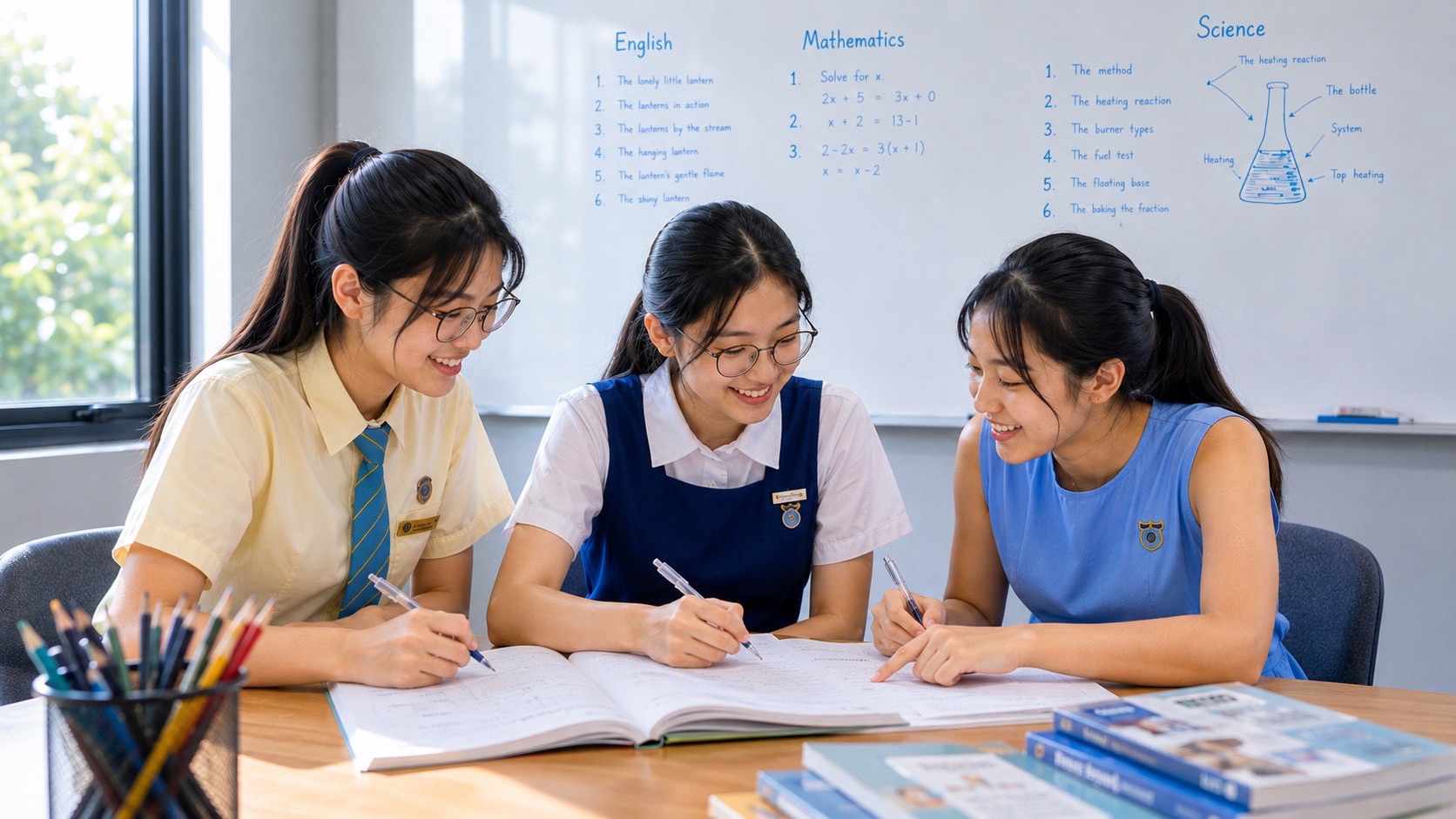
Secondary 3 Mathematics small groups tuition for Tiong Bahru families can be worthwhile when a teenager remembers geometric formulas but cannot determine which relationship a new diagram justifies. In a three-learner tutorial, a tutor may be able to observe whether each student identifies a right angle, selects a scale factor correctly and explains why an angle theorem applies.
eduKateSG’s published model uses up to three learners in a typical 1.5-hour session. Its immutable Mathematics reference concerns teaching near Sixth Avenue MRT in Bukit Timah; this Tiong Bahru guide does not confirm an active local classroom, tutor or vacancy. Parents should check actual course levels, address, schedule and full travel commitment before enrolment.
This guide explains how the 2027 SEC and G1/G2/G3 Mathematics subject levels affect tuition choices, then teaches through geometry, measurement, similarity and proof examples. It balances possible improvements in reasoning with the risks of poor grouping, fatigue and dependence on the tutor.
- Best-fit need: repeated geometry and measurement errors caused by misreading diagrams.
- Curriculum: match G1, G2 or G3; Additional Mathematics is a separate subject.
- Value: the tutor examines each child’s first reasoning step and checks a changed problem.
- Consequences: costs, travel, group pace, social comparison and excess homework.
- Progress measure: unfamiliar diagrams solved and explained independently.
- Parent decision: choose lessons only when they provide support beyond school and self-study.
1. Geometry is not solved by trusting a picture
A Secondary 3 student may look at a triangle and decide that two lengths are equal simply because the drawing looks symmetrical. Another may apply Pythagoras without checking whether the triangle is right-angled. A third may remember a circle theorem but be unable to state why it applies to the marked points. These are interpretation and reasoning problems, not simply slow calculation.
For Tiong Bahru families, the first tuition diagnostic can be a school geometry question with the child’s original working preserved. Ask the teenager to show what information was explicitly given, what was assumed from the appearance and what theorem justifies a written equality.
A small tutorial is worthwhile when a teacher can recognise those assumptions, explain a valid mathematical property and ask the learner to handle a redrawn example without hints. Three pupils may create room for this, but the class must use that time deliberately.
2. Match the correct G1/G2/G3 Mathematics programme
Under Full Subject-Based Banding, Singapore students may study individual subjects at G1, G2 or G3 levels. The labels refer to the subject’s level, not the teenager as a whole. A tuition plan therefore needs the actual Mathematics level and current school sequence.
From 2027, the Singapore-Cambridge Secondary Education Certificate replaces the former separate N- and O-Level examinations for graduating students. SEAB lists 2027 Mathematics as G1 K110, G2 K210 and G3 K310. These are distinct subject syllabuses with different demands, not one common worksheet at three speeds.
Parents can read MOE Full SBB and 2027 SEC announcement, 2027 G1 subject syllabuses, 2027 G2 subject syllabuses and 2027 G3 subject syllabuses. A student taking an examination in a different year should check that year’s official materials; the school remains the authority for current topic teaching and subject choices.
3. Don’t confuse general Mathematics with Additional Mathematics
Additional Mathematics, where offered, is a separate upper-secondary subject. The 2027 G3 syllabus list identifies Mathematics K310 separately from Additional Mathematics K341; the G2 list also includes Additional Mathematics. A pupil who does not offer the additional subject should not be placed in a class dominated by A-Math questions.
A student may perform well with practical geometry and measurement but struggle with algebraic abstraction in A-Math. Another may manipulate equations accurately while failing to interpret a physical diagram. Those needs require separate diagnoses.
At an enrolment discussion, ask which subject the proposed three-student lesson teaches, whether group members have compatible prerequisites and how individual progress is documented. A shared school year is not enough to establish curriculum fit.
4. Worked example: Pythagoras first requires a right angle
A right-angled triangle has perpendicular sides of 9 cm and 12 cm. Its hypotenuse is found from 9² + 12² = 225, so the hypotenuse is 15 cm. The relationship works because the sides are opposite and adjacent to the established right angle.
A student can complete the arithmetic but mistakenly apply the formula to a triangle with no right angle indicated. A tutor should ask which fact justifies Pythagoras before any substitution.
Rotate the same triangle. If the child still identifies the right angle and opposite longest side, the learning has transferred beyond a standard picture. A new diagram that looks very different is often more informative than a page of identical upright triangles.
5. A shorter side requires subtraction, not automatic addition
Now suppose the hypotenuse of a right triangle is 15 cm and one shorter side is 9 cm. The missing side satisfies x² = 15² − 9² = 225 − 81 = 144, giving x = 12 cm.
A pupil who calculates √(15² + 9²) has copied the previous addition pattern without noticing which side is unknown. The tutor should ask the learner to predict whether the missing shorter side must be less than the hypotenuse. The wrong answer fails that plausibility check.
Provide a fresh 5–12–13 triangle with a missing shorter side. The child should mark the hypotenuse, form the equation and explain the subtraction without relying on tutor hints.
6. Similarity is not the same as congruence
Congruent shapes match in size and shape. Similar shapes have corresponding angles equal and side lengths related by a common factor, but they may have different overall sizes. A learner who remembers the words may still confuse their implications during a calculation.
If similar figures have corresponding side lengths in the ratio 2:3, their areas are in the ratio 4:9. The linear scale factor must apply to both dimensions contributing to area. Simply using 2:3 for the areas is a conceptual mistake, not a multiplication error.
A tutor can draw two squares with sides 2 and 3. Their areas, 4 and 9, show the relationship immediately. Ask the child to explain why the square of the factor appears before learning a shortcut. For related diagnostic examples, see ${U.similar}.
7. A volume changes by three dimensions
Two similar cubes have side lengths 2 cm and 6 cm. The side ratio is 1:3, the surface-area factor is 9 and the volume factor is 27. The volumes are 8 cm³ and 216 cm³ respectively.
Students may apply the squared factor to volume because they remember that ‘you have to square the scale’. The correct explanation is that volume multiplies length, breadth and height. Each dimension scales by three, so the volume scales by 3 × 3 × 3.
Ask the learner to compare length, area and volume in a small table. At the appropriate syllabus level this becomes a general concept rather than three unrelated formulas.
8. Scale drawings: first decide the direction of the conversion
A floor plan has a scale of 1:250. A segment of 4 cm on the plan represents 4 × 250 = 1,000 cm, or 10 m, in reality. A common wrong answer is 4 ÷ 250 because the student sees the ratio but does not interpret which quantity is smaller.
A clear sentence helps: one centimetre on the plan corresponds to 250 centimetres in reality. The real object is therefore larger than its drawing. Estimating the direction before calculating gives the pupil a useful check.
Use a new scale, perhaps 1:200, and ask the student for a real dimension. The child should decide whether to multiply or divide without being told the operation.
9. Area and perimeter measure different properties
A rectangular garden is 8 m long and 6 m wide. Its perimeter is 2(8 + 6) = 28 m, while its area is 8 × 6 = 48 m². Both numbers describe the same object but answer different questions.
A teenager can memorise the formulas and still choose perimeter when the question asks how much flooring is needed. The tutor should ask what the measurement is meant to cover: the boundary or the surface.
An altered story about a fence or covering a floor can test the concept. A student who chooses the correct measurement and writes the appropriate unit has moved beyond memorised arithmetic.
10. Circle theorems require the exact conditions
Some circle questions appear to reward guessing which angles are equal. An effective approach begins by identifying the relevant chord, tangent, radius or segment and checking the conditions of a specific theorem.
For instance, angles in the same segment subtended by the same chord are equal. But two angles that merely look similar on a diagram are not necessarily justified by that property. The learner should name the chord and the positions of the angles, not point to a visual resemblance.
Redraw the points or remove a stated relationship and ask whether the previous conclusion still follows. This teaches the student to use proofs rather than image recognition. For a more focused explanation see ${U.circle}.
11. An angle solution must show why each step is true
Suppose two parallel lines are cut by a transversal. Depending on the configuration, corresponding angles can be equal, alternate angles can be equal and co-interior angles can sum to 180°. The relevant relationship must be identified from the positions of the angles.
A student may write a correct number with no reason or use a theorem that does not apply to those marked angles. A tutor should require a short line explaining which property justifies the calculation.
Written reasoning serves two purposes. It communicates the solution and helps the student discover where a false assumption entered the process. That makes the learner less dependent on an adult correcting the last answer.
12. Trigonometry begins with the angle being considered
In a right-angled triangle, the side opposite an acute angle is determined by that angle. The adjacent side changes when the reference angle changes, while the hypotenuse remains opposite the right angle.
If the opposite side is 5 and the adjacent side 12, tan θ = 5/12. A pupil who writes 12/5 may remember the mnemonic but have labelled the sides relative to the wrong angle.
Instead of beginning with calculator buttons, the tutor should ask the student to mark the right angle and reference angle, name the sides and justify the selected ratio. A redrawn or rotated diagram tests whether the explanation is robust.
13. Mixed geometry questions reveal whether knowledge connects
A school task might describe a scaled rectangular floor with a diagonal. A student has to interpret the scale, determine real side lengths and perhaps use Pythagoras to calculate a diagonal. A learner who knows each component may still struggle to decide the order.
An effective tutor asks for a plan before calculation. For example: first convert the plan dimensions to real lengths; second establish the right angle; third calculate the diagonal; fourth interpret the answer in metres.
The tutor can give three learners different parts to explain, but each must later solve an entire changed problem independently. That final check prevents a lively group discussion from being mistaken for full personal mastery.
14. Why exactly three learners can be useful
With only three pupils, the tutor can inspect each diagram while the solution is unfolding. One teenager may mark the wrong hypotenuse, another apply a linear scale to area, and the third ignore a unit conversion.
Those errors need different feedback even if all appear under ‘geometry’. A good teacher supplies a precise correction and checks it through a new question rather than writing ‘revise geometry’ on three worksheets.
Parents can ask for a sample of the student’s original attempt and another independent attempt completed after the correction. The opportunity for close observation is the benefit worth assessing, not the number of seats by itself.
15. A ninety-minute tutorial must end with an unaided task
eduKateSG’s small-group teaching model involves up to three learners for a typical 1.5-hour session. A productive structure includes retrieval of older skills, one central misconception, individual work, group explanation and independent transfer.
- 10 minutes: retrieve a previously taught angle, scale or algebra concept.
- 20 minutes: explain one principle and demonstrate an appealing incorrect shortcut.
- 25 minutes: individual questions differentiated by readiness, with tutor observations.
- 20 minutes: a changed diagram or mixed problem without hints.
- 10 minutes: inspect the first wrong step, mathematical notation and units.
- 5 minutes: set a brief continuation task and the next retention check.
This is a sample teaching rhythm, not confirmation of an active class schedule. The final independent question matters because a perfect answer immediately after the tutor’s demonstration may not show retained understanding.
16. Group matching matters more than the school year
One Secondary 3 student may still struggle with basic area units, another may handle scales but not similarity, and a third may be ready for more demanding proof. The tutor must know whether those needs can productively share the same lesson.
A common concept can be taught at different levels, but the fastest student should not spend the session waiting and the least prepared student should not spend it merely watching. Appropriate differentiated work is essential.
If the gap is too large, a different group or individual instruction may be the more responsible choice. Three learners with incompatible goals do not become a good class solely through the number three.
17. A good discussion allows students to be wrong
One teenager may explain a theorem incorrectly while another notices a missing condition. That can be a valuable learning moment if the tutor checks the reasoning carefully and no pupil is ridiculed.
But a shy learner may hide confusion when two peers answer quickly. The teacher should give quiet individual thinking time before asking for explanations and avoid treating speed as evidence of depth.
The group must help the teenager become comfortable correcting mistakes, not dependent on classmates’ answers. Every student should leave with work they can repeat independently.
18. The benefits that should transfer to school
Useful progress may appear as a child labelling the correct angle, identifying the hypotenuse on a rotated diagram, choosing the right scale factor or writing units clearly. These habits often emerge before a major change in a school grade.
After several weeks, the student should also solve mixed geometry problems without being told which chapter they resemble. A tutor can check this using changed diagrams and delayed retrieval of older ideas.
Parents should ask for the original error, the principle taught and the later independent performance. That comparison is more informative than simply counting how many pages the child finished during tuition.
19. Tiong Bahru travel is part of the education decision
This guide is written for Tiong Bahru families and does not establish an active eduKateSG Secondary 3 Mathematics classroom at a Tiong Bahru address. The immutable Mathematics reference describes teaching near Sixth Avenue MRT in Bukit Timah. Confirm the actual active location, tutor and available class time.
Tiong Bahru MRT is on the East–West Line, but a teenager may leave from school or CCA elsewhere. Door-to-door planning must include walking, transfers, waiting, the journey home and meals.
A ninety-minute tutorial can occupy much more than ninety minutes of the family’s evening. If the teenager is exhausted or school revision is displaced, the net learning gain may be smaller than the teaching looks on paper.
20. The risk of too many extra worksheets
A long sheet labelled ‘Pythagoras’ may make the next procedure obvious even to a student who cannot recognise that relationship in a mixed school question. Such worksheets can establish initial fluency but do not fully assess method selection.
Later practice should mix geometry, measurement and proportional reasoning. Include a diagram whose orientation has changed and an error-filled solution for the child to critique. These exercises teach recognition without chapter cues.
Tuition homework should complement school material, not create another complete workload that leaves no time for careful correction or rest.
21. The risk of dependency on tutor cues
An attentive tutor may label every triangle, point out the theorem and supply the first equation. The learner’s notebook looks correct but the student remains unable to start independently during a test.
Support should be reduced deliberately: demonstrate a method, guide a variation with a neutral question and then present an unfamiliar problem with no hint. Count whether the child needs fewer prompts over the following weeks.
A tuition class that makes the learner more dependent has missed its longer-term purpose, even if the immediate marks on practice worksheets look impressive.
22. Research is a reason to inspect the teaching, not a guarantee
The EEF small-group tuition evidence reviews small-group tuition for roughly two to five pupils and reports positive average results. It highlights the importance of targeted support and implementation; the evidence in secondary schools is less extensive than that for primary learners.
The reviewed interventions do not automatically match a weekly commercial ninety-minute lesson. No parent should be promised a fixed SEC grade from general research evidence or from class size.
Use research to ask how pupils are grouped, how errors are diagnosed and how learning is monitored. Then use the child’s own independent work to decide whether the programme deserves continuation.
23. Three-person, one-to-one, larger class or no tuition?
One-to-one tutoring may be appropriate where a teenager needs intensive foundation repair or is uncomfortable revealing confusion among peers. But one-to-one can also over-prompt unless independent tasks are protected.
A larger revision class can be suitable for an independent student who mainly needs organised practice. Some pupils are making steady progress with school teachers and self-study and do not need additional paid lessons at all.
The one-to-one versus small-group tuition comparison offers a fuller comparison. The correct format is the one that addresses an identified gap at a reasonable cost in time, money and wellbeing.
24. Six weeks to evaluate genuine progress
Begin with a short baseline that includes a right-angled triangle, a scale diagram and a question requiring a theorem reason. Preserve the teenager’s first attempts and note which hints were supplied.
Teach the missing principle, then change the diagrams and combine it with older skills. By week six, ask the pupil to solve comparable unfamiliar examples without hints. Check whether the right condition is identified, units are coherent and an answer is plausible.
School marks should inform the review, but one assessment can differ greatly in difficulty. If the independent work remains unchanged, the tutor should revise the plan or recommend a different arrangement instead of continuing automatically.
25. When tuition should not be added
A student who learns effectively in school, corrects errors independently and shows steady progress may gain little from another weekly class. A short home revision routine and asking school teachers focused questions may be sufficient.
A teenager who is exhausted by travel and school duties may benefit more from a lighter timetable. Another with deep prerequisite gaps may need individual foundational work before joining a shared group.
Choosing no tuition can be a sound educational decision. A responsible provider should be willing to recommend stopping when the original learning need has been addressed.
26. Questions Tiong Bahru parents should ask
- Which exact G1, G2 or G3 Mathematics syllabus and examination cohort applies?
- Does the child take Additional Mathematics, and is it taught separately?
- Can the tutor identify the first unjustified statement in the student’s geometry working?
- Will every pupil attempt a changed diagram without hints?
- How are three learners with different foundation levels matched?
- What is the confirmed current venue, lesson time, tutor, fee and vacancy?
- How much homework will be added alongside school and CCA?
- When will independent work be reviewed and what would justify stopping tuition?
27. Frequently asked questions
Do all Secondary 3 students need small-group Mathematics tuition?
No. It is an optional intervention for an identified need, not a compulsory part of Singapore education.
Are G1, G2 and G3 Mathematics identical?
No. They have distinct subject requirements. The tutor must match the student’s actual course and examination year.
Does every teenager take A-Math?
No. Additional Mathematics is a separate subject offered according to school combinations.
Does the three-person format guarantee a better SEC grade?
No. It permits closer feedback, but outcomes depend on teaching and the learner’s circumstances.
Does this guide confirm a Tiong Bahru classroom?
No. Parents must confirm the current active venue and available lessons directly.
How do we test understanding of geometry?
Change the diagram’s orientation and ask the learner to justify the relationship before calculating.
What happens if the child is already improving at school?
Consider whether tuition adds enough unique value to justify its time and cost; self-study may already be sufficient.
28. Official references and next reading
For the education framework see MOE Full SBB and 2027 SEC announcement, 2027 G1 subject syllabuses, 2027 G2 subject syllabuses and 2027 G3 subject syllabuses. Check the student’s actual school course and examination year.
For research evidence see EEF small-group tuition evidence. Its average results do not guarantee the performance of an individual commercial tutorial.
Read the immutable Clementi small-group Mathematics tutorial reference, Tiong Bahru three-pupil mathematics explainer, the similarity and congruence mistakes guide, the circle theorem reasoning guide, the one-to-one versus small-group tuition comparison and the related Queenstown Secondary 3 Mathematics guide.
Strong tuition should enable the learner to identify mathematical conditions, reason through unfamiliar diagrams and check the result without needing an adult to name the next step. This independence is the most meaningful long-term benefit.