
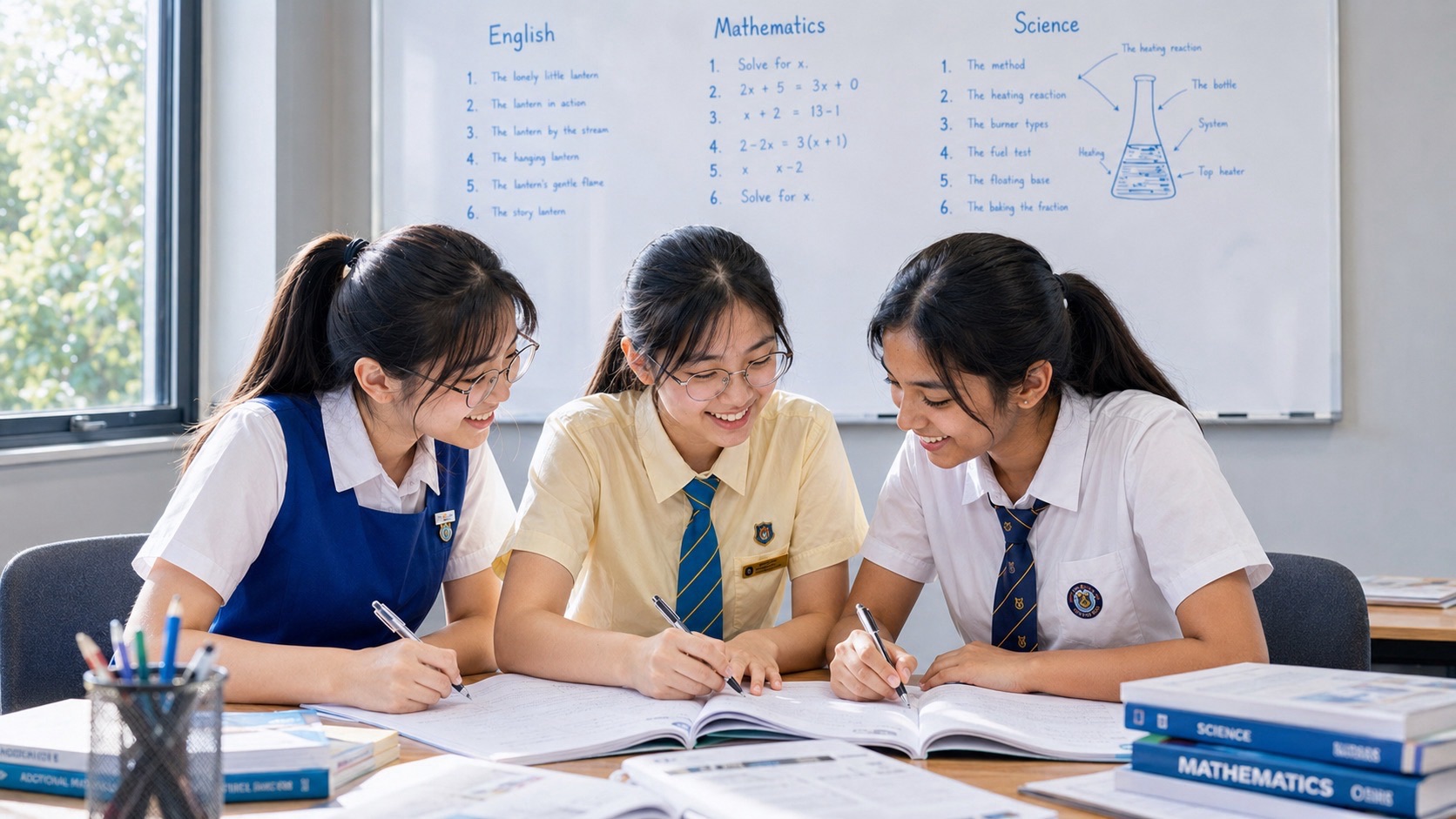
Secondary 3 Mathematics tuition for Zion Road families should be organised around the upper-secondary phase shift. The student now has to manage a wider syllabus, longer dependency chains, mixed questions and, where applicable, a separate Additional Mathematics subject. Main Mathematics must remain coherent on its own: algebra, graphs, geometry, trigonometry, mensuration, statistics, probability and applied problem solving all have to remain retrievable while new content continues to arrive.
Parents searching for Secondary 3 Mathematics tuition in Zion Road, Sec 3 E-Math tuition, G2 Mathematics, G3 Mathematics, SEC Mathematics support or small-group upper-secondary Math tutoring usually need two things at once: accurate course routing and a practical repair system. Current Singapore search results use familiar terms such as Secondary 1–4, E-Math, A-Math and G2/G3; the teaching plan must still follow the student’s actual subject level and examination year.
This page is the year-specific Zion Road Secondary 3 route within eduKateSG. Zion Road is the family’s local discovery context and does not imply a physical eduKateSG branch there. It complements the national Mathematics owners, the Mathematics Learning Hub, How Mathematics Works, the separate Additional Mathematics Tuition architecture and the existing SEC Examination Mathematics Tuition | Zion Road route.
Upper-secondary reorganisation
Adrian works on a coordinate-geometry lesson that exposes a weak gradient dependency. The central principle is that current learning, prerequisite repair and retention must run together. The tutor watches for treating the current chapter as the only active mathematics, because an apparently small decision can distort every later line of working. The practical control is to keep a three-lane weekly plan. After guided practice, Adrian meets a fresh variant without the original example beside them and explains why the method fits. The repair is considered stable only when the reasoning survives changed numbers, wording or diagrams. This matters in Secondary 3 because the syllabus is no longer a set of sealed chapters: each new topic reuses earlier algebra, number sense, representation and checking habits. A precise control therefore protects more than one worksheet; it strengthens the learner’s upper-secondary operating system.
Dependency mapping
Jo works on an algebraic-fraction question that fails because common denominators are unstable. The central principle is that later topics depend on earlier algebra, fractions, graphs and geometry. The tutor watches for calling the entire upper-secondary topic weak, because an apparently small decision can distort every later line of working. The practical control is to trace the error back to the smallest unstable prerequisite. After guided practice, Jo meets a fresh variant without the original example beside them and explains why the method fits. The repair is considered stable only when the reasoning survives changed numbers, wording or diagrams. This matters in Secondary 3 because the syllabus is no longer a set of sealed chapters: each new topic reuses earlier algebra, number sense, representation and checking habits. A precise control therefore protects more than one worksheet; it strengthens the learner’s upper-secondary operating system.
Algebraic fractions
Ben works on factoring a numerator before simplifying a rational expression. The central principle is that cancellation works on common factors, not on similar-looking terms. The tutor watches for cancelling across addition, because an apparently small decision can distort every later line of working. The practical control is to factor first and note excluded values where relevant. After guided practice, Ben meets a fresh variant without the original example beside them and explains why the method fits. The repair is considered stable only when the reasoning survives changed numbers, wording or diagrams. This matters in Secondary 3 because the syllabus is no longer a set of sealed chapters: each new topic reuses earlier algebra, number sense, representation and checking habits. A precise control therefore protects more than one worksheet; it strengthens the learner’s upper-secondary operating system.
Quadratic structure
Aisha works on solving a factorisable quadratic and expanding the factors to check. The central principle is that factorisation, roots and the zero-product principle belong to one system. The tutor watches for memorising factor pairs without seeing the structure, because an apparently small decision can distort every later line of working. The practical control is to check the factorised form by expansion. After guided practice, Aisha meets a fresh variant without the original example beside them and explains why the method fits. The repair is considered stable only when the reasoning survives changed numbers, wording or diagrams. This matters in Secondary 3 because the syllabus is no longer a set of sealed chapters: each new topic reuses earlier algebra, number sense, representation and checking habits. A precise control therefore protects more than one worksheet; it strengthens the learner’s upper-secondary operating system.
Contextual roots
Ryan works on a rectangle problem that produces one positive and one negative root. The central principle is that a mathematically valid root may be unsuitable for the model. The tutor watches for discarding negative roots automatically, because an apparently small decision can distort every later line of working. The practical control is to state why the context accepts or rejects each root. After guided practice, Ryan meets a fresh variant without the original example beside them and explains why the method fits. The repair is considered stable only when the reasoning survives changed numbers, wording or diagrams. This matters in Secondary 3 because the syllabus is no longer a set of sealed chapters: each new topic reuses earlier algebra, number sense, representation and checking habits. A precise control therefore protects more than one worksheet; it strengthens the learner’s upper-secondary operating system.
Indices
Mira works on combining powers with the same base. The central principle is that index laws should remain reconstructable from repeated multiplication. The tutor watches for mixing addition with multiplication rules, because an apparently small decision can distort every later line of working. The practical control is to rebuild the law from factors when memory is uncertain. After guided practice, Mira meets a fresh variant without the original example beside them and explains why the method fits. The repair is considered stable only when the reasoning survives changed numbers, wording or diagrams. This matters in Secondary 3 because the syllabus is no longer a set of sealed chapters: each new topic reuses earlier algebra, number sense, representation and checking habits. A precise control therefore protects more than one worksheet; it strengthens the learner’s upper-secondary operating system.
Formula rearrangement
Clara works on making one variable the subject of a multi-term formula. The central principle is that changing the subject is ordinary equation solving with symbols. The tutor watches for moving symbols without preserving equality, because an apparently small decision can distort every later line of working. The practical control is to use one legal transformation per line. After guided practice, Clara meets a fresh variant without the original example beside them and explains why the method fits. The repair is considered stable only when the reasoning survives changed numbers, wording or diagrams. This matters in Secondary 3 because the syllabus is no longer a set of sealed chapters: each new topic reuses earlier algebra, number sense, representation and checking habits. A precise control therefore protects more than one worksheet; it strengthens the learner’s upper-secondary operating system.
Coordinate gradient
Ethan works on finding the gradient between two given points. The central principle is that gradient measures vertical change relative to horizontal change. The tutor watches for reversing one difference but not the other, because an apparently small decision can distort every later line of working. The practical control is to keep subtraction order consistent. After guided practice, Ethan meets a fresh variant without the original example beside them and explains why the method fits. The repair is considered stable only when the reasoning survives changed numbers, wording or diagrams. This matters in Secondary 3 because the syllabus is no longer a set of sealed chapters: each new topic reuses earlier algebra, number sense, representation and checking habits. A precise control therefore protects more than one worksheet; it strengthens the learner’s upper-secondary operating system.
Line equations
Adrian works on building the equation of a line from two points. The central principle is that a point, gradient and intercept are linked representations. The tutor watches for substituting into the wrong line form, because an apparently small decision can distort every later line of working. The practical control is to check the final equation with the second point. After guided practice, Adrian meets a fresh variant without the original example beside them and explains why the method fits. The repair is considered stable only when the reasoning survives changed numbers, wording or diagrams. This matters in Secondary 3 because the syllabus is no longer a set of sealed chapters: each new topic reuses earlier algebra, number sense, representation and checking habits. A precise control therefore protects more than one worksheet; it strengthens the learner’s upper-secondary operating system.
Graph interpretation
Jo works on reading an intercept and rate from a straight-line graph. The central principle is that graphs encode relationships rather than decorative pictures. The tutor watches for plotting accurately without interpreting meaning, because an apparently small decision can distort every later line of working. The practical control is to state what the axes, gradient and intercept represent. After guided practice, Jo meets a fresh variant without the original example beside them and explains why the method fits. The repair is considered stable only when the reasoning survives changed numbers, wording or diagrams. This matters in Secondary 3 because the syllabus is no longer a set of sealed chapters: each new topic reuses earlier algebra, number sense, representation and checking habits. A precise control therefore protects more than one worksheet; it strengthens the learner’s upper-secondary operating system.
Right-triangle trigonometry
Ben works on finding an unknown side from one angle and one side. The central principle is that side roles depend on the chosen angle. The tutor watches for choosing a ratio before identifying opposite and adjacent, because an apparently small decision can distort every later line of working. The practical control is to label the triangle before using the calculator. After guided practice, Ben meets a fresh variant without the original example beside them and explains why the method fits. The repair is considered stable only when the reasoning survives changed numbers, wording or diagrams. This matters in Secondary 3 because the syllabus is no longer a set of sealed chapters: each new topic reuses earlier algebra, number sense, representation and checking habits. A precise control therefore protects more than one worksheet; it strengthens the learner’s upper-secondary operating system.
Non-right-angle trigonometry
Aisha works on selecting an appropriate relationship for a non-right triangle where included in the course. The central principle is that formula choice follows the information actually given. The tutor watches for choosing a formula by visual resemblance, because an apparently small decision can distort every later line of working. The practical control is to inventory known sides and angles first. After guided practice, Aisha meets a fresh variant without the original example beside them and explains why the method fits. The repair is considered stable only when the reasoning survives changed numbers, wording or diagrams. This matters in Secondary 3 because the syllabus is no longer a set of sealed chapters: each new topic reuses earlier algebra, number sense, representation and checking habits. A precise control therefore protects more than one worksheet; it strengthens the learner’s upper-secondary operating system.
Mensuration inventory
Ryan works on decomposing a composite figure into familiar parts. The central principle is that length, area, surface area and volume are different target quantities. The tutor watches for using a familiar formula for the wrong quantity, because an apparently small decision can distort every later line of working. The practical control is to write the target quantity and unit before calculating. After guided practice, Ryan meets a fresh variant without the original example beside them and explains why the method fits. The repair is considered stable only when the reasoning survives changed numbers, wording or diagrams. This matters in Secondary 3 because the syllabus is no longer a set of sealed chapters: each new topic reuses earlier algebra, number sense, representation and checking habits. A precise control therefore protects more than one worksheet; it strengthens the learner’s upper-secondary operating system.
Radius versus diameter
Mira works on a circle or cylinder question where diameter is given. The central principle is that measurement language controls the formula input. The tutor watches for substituting diameter as radius, because an apparently small decision can distort every later line of working. The practical control is to mark r and d explicitly on the diagram. After guided practice, Mira meets a fresh variant without the original example beside them and explains why the method fits. The repair is considered stable only when the reasoning survives changed numbers, wording or diagrams. This matters in Secondary 3 because the syllabus is no longer a set of sealed chapters: each new topic reuses earlier algebra, number sense, representation and checking habits. A precise control therefore protects more than one worksheet; it strengthens the learner’s upper-secondary operating system.
Compound percentage change
Clara works on applying an increase followed by a decrease. The central principle is that repeated percentage changes are multiplicative. The tutor watches for subtracting percentages as though they share a base, because an apparently small decision can distort every later line of working. The practical control is to write the multiplier chain. After guided practice, Clara meets a fresh variant without the original example beside them and explains why the method fits. The repair is considered stable only when the reasoning survives changed numbers, wording or diagrams. This matters in Secondary 3 because the syllabus is no longer a set of sealed chapters: each new topic reuses earlier algebra, number sense, representation and checking habits. A precise control therefore protects more than one worksheet; it strengthens the learner’s upper-secondary operating system.
Reverse percentage
Ethan works on reconstructing a pre-discount price. The central principle is that the given amount represents a known fraction of the original. The tutor watches for adding the discount percentage to the final amount, because an apparently small decision can distort every later line of working. The practical control is to write what percentage of the original remains. After guided practice, Ethan meets a fresh variant without the original example beside them and explains why the method fits. The repair is considered stable only when the reasoning survives changed numbers, wording or diagrams. This matters in Secondary 3 because the syllabus is no longer a set of sealed chapters: each new topic reuses earlier algebra, number sense, representation and checking habits. A precise control therefore protects more than one worksheet; it strengthens the learner’s upper-secondary operating system.
Percentage comparison
Adrian works on comparing two group sizes in both directions. The central principle is that the reference quantity determines the percentage statement. The tutor watches for dividing by the wrong base, because an apparently small decision can distort every later line of working. The practical control is to name the reference group before forming the fraction. After guided practice, Adrian meets a fresh variant without the original example beside them and explains why the method fits. The repair is considered stable only when the reasoning survives changed numbers, wording or diagrams. This matters in Secondary 3 because the syllabus is no longer a set of sealed chapters: each new topic reuses earlier algebra, number sense, representation and checking habits. A precise control therefore protects more than one worksheet; it strengthens the learner’s upper-secondary operating system.
Average speed
Jo works on combining two journey segments with different speeds. The central principle is that average speed is total distance divided by total time. The tutor watches for taking the simple mean of speeds, because an apparently small decision can distort every later line of working. The practical control is to calculate each segment time before averaging. After guided practice, Jo meets a fresh variant without the original example beside them and explains why the method fits. The repair is considered stable only when the reasoning survives changed numbers, wording or diagrams. This matters in Secondary 3 because the syllabus is no longer a set of sealed chapters: each new topic reuses earlier algebra, number sense, representation and checking habits. A precise control therefore protects more than one worksheet; it strengthens the learner’s upper-secondary operating system.
Rate and units
Ben works on converting a production rate into time required. The central principle is that units can reveal the correct operation. The tutor watches for dropping units during multi-step calculations, because an apparently small decision can distort every later line of working. The practical control is to carry compound units until the final line. After guided practice, Ben meets a fresh variant without the original example beside them and explains why the method fits. The repair is considered stable only when the reasoning survives changed numbers, wording or diagrams. This matters in Secondary 3 because the syllabus is no longer a set of sealed chapters: each new topic reuses earlier algebra, number sense, representation and checking habits. A precise control therefore protects more than one worksheet; it strengthens the learner’s upper-secondary operating system.
Statistics from totals
Aisha works on adding a new observation to a group with known mean. The central principle is that means can be manipulated safely through totals and counts. The tutor watches for averaging averages directly, because an apparently small decision can distort every later line of working. The practical control is to convert mean to total before changing the data. After guided practice, Aisha meets a fresh variant without the original example beside them and explains why the method fits. The repair is considered stable only when the reasoning survives changed numbers, wording or diagrams. This matters in Secondary 3 because the syllabus is no longer a set of sealed chapters: each new topic reuses earlier algebra, number sense, representation and checking habits. A precise control therefore protects more than one worksheet; it strengthens the learner’s upper-secondary operating system.
Weighted mean
Ryan works on combining class averages of different sizes. The central principle is that group size or percentage weight changes each contribution. The tutor watches for giving unequal groups equal influence, because an apparently small decision can distort every later line of working. The practical control is to multiply each mean by its weight or count first. After guided practice, Ryan meets a fresh variant without the original example beside them and explains why the method fits. The repair is considered stable only when the reasoning survives changed numbers, wording or diagrams. This matters in Secondary 3 because the syllabus is no longer a set of sealed chapters: each new topic reuses earlier algebra, number sense, representation and checking habits. A precise control therefore protects more than one worksheet; it strengthens the learner’s upper-secondary operating system.
Median and outliers
Mira works on replacing one data value with a large outlier. The central principle is that different summary measures react differently to extreme values. The tutor watches for assuming one average describes the whole distribution, because an apparently small decision can distort every later line of working. The practical control is to compare centre and spread before making a claim. After guided practice, Mira meets a fresh variant without the original example beside them and explains why the method fits. The repair is considered stable only when the reasoning survives changed numbers, wording or diagrams. This matters in Secondary 3 because the syllabus is no longer a set of sealed chapters: each new topic reuses earlier algebra, number sense, representation and checking habits. A precise control therefore protects more than one worksheet; it strengthens the learner’s upper-secondary operating system.
Probability sample space
Clara works on listing outcomes for a simple two-stage event. The central principle is that the denominator must come from defined possible outcomes. The tutor watches for choosing a denominator by instinct, because an apparently small decision can distort every later line of working. The practical control is to define the event space before calculating. After guided practice, Clara meets a fresh variant without the original example beside them and explains why the method fits. The repair is considered stable only when the reasoning survives changed numbers, wording or diagrams. This matters in Secondary 3 because the syllabus is no longer a set of sealed chapters: each new topic reuses earlier algebra, number sense, representation and checking habits. A precise control therefore protects more than one worksheet; it strengthens the learner’s upper-secondary operating system.
Without replacement
Ethan works on drawing two counters from a bag without replacement. The central principle is that the first selection changes later probabilities. The tutor watches for reusing the first fraction on the second branch, because an apparently small decision can distort every later line of working. The practical control is to update the remaining composition after each draw. After guided practice, Ethan meets a fresh variant without the original example beside them and explains why the method fits. The repair is considered stable only when the reasoning survives changed numbers, wording or diagrams. This matters in Secondary 3 because the syllabus is no longer a set of sealed chapters: each new topic reuses earlier algebra, number sense, representation and checking habits. A precise control therefore protects more than one worksheet; it strengthens the learner’s upper-secondary operating system.
Probability complements
Adrian works on finding the probability of at least one event through its complement. The central principle is that complements are useful only when the event pair is exhaustive. The tutor watches for subtracting from one without defining the complement, because an apparently small decision can distort every later line of working. The practical control is to state the complementary event in words. After guided practice, Adrian meets a fresh variant without the original example beside them and explains why the method fits. The repair is considered stable only when the reasoning survives changed numbers, wording or diagrams. This matters in Secondary 3 because the syllabus is no longer a set of sealed chapters: each new topic reuses earlier algebra, number sense, representation and checking habits. A precise control therefore protects more than one worksheet; it strengthens the learner’s upper-secondary operating system.
Applied modelling
Jo works on turning a word problem into an equation or diagram. The central principle is that long contexts must be translated into mathematical objects. The tutor watches for starting calculator work before defining quantities, because an apparently small decision can distort every later line of working. The practical control is to underline quantities, constraints and the target first. After guided practice, Jo meets a fresh variant without the original example beside them and explains why the method fits. The repair is considered stable only when the reasoning survives changed numbers, wording or diagrams. This matters in Secondary 3 because the syllabus is no longer a set of sealed chapters: each new topic reuses earlier algebra, number sense, representation and checking habits. A precise control therefore protects more than one worksheet; it strengthens the learner’s upper-secondary operating system.
First-move practice
Ben works on writing only the first valid mathematical move on a mixed question. The central principle is that starting is a separate skill from finishing. The tutor watches for waiting for a tutor to supply the entry, because an apparently small decision can distort every later line of working. The practical control is to practise definitions, sketches and setup steps separately. After guided practice, Ben meets a fresh variant without the original example beside them and explains why the method fits. The repair is considered stable only when the reasoning survives changed numbers, wording or diagrams. This matters in Secondary 3 because the syllabus is no longer a set of sealed chapters: each new topic reuses earlier algebra, number sense, representation and checking habits. A precise control therefore protects more than one worksheet; it strengthens the learner’s upper-secondary operating system.
Method selection
Aisha works on choosing between factorisation, graphs, trigonometry and percentage methods. The central principle is that recognition should be trained apart from arithmetic. The tutor watches for using the most recently taught method by default, because an apparently small decision can distort every later line of working. The practical control is to name the structure before solving. After guided practice, Aisha meets a fresh variant without the original example beside them and explains why the method fits. The repair is considered stable only when the reasoning survives changed numbers, wording or diagrams. This matters in Secondary 3 because the syllabus is no longer a set of sealed chapters: each new topic reuses earlier algebra, number sense, representation and checking habits. A precise control therefore protects more than one worksheet; it strengthens the learner’s upper-secondary operating system.
Why-not comparisons
Ryan works on comparing a Pythagoras question with a trigonometry question. The central principle is that method boundaries become clearer when alternatives are rejected explicitly. The tutor watches for selecting formulas by topic appearance, because an apparently small decision can distort every later line of working. The practical control is to explain why the unused method is unnecessary or invalid. After guided practice, Ryan meets a fresh variant without the original example beside them and explains why the method fits. The repair is considered stable only when the reasoning survives changed numbers, wording or diagrams. This matters in Secondary 3 because the syllabus is no longer a set of sealed chapters: each new topic reuses earlier algebra, number sense, representation and checking habits. A precise control therefore protects more than one worksheet; it strengthens the learner’s upper-secondary operating system.
Retrieval
Mira works on bringing back graph and percentage work during a new algebra unit. The central principle is that older methods need scheduled reactivation. The tutor watches for waiting until exams to revisit old topics, because an apparently small decision can distort every later line of working. The practical control is to include short older questions every week. After guided practice, Mira meets a fresh variant without the original example beside them and explains why the method fits. The repair is considered stable only when the reasoning survives changed numbers, wording or diagrams. This matters in Secondary 3 because the syllabus is no longer a set of sealed chapters: each new topic reuses earlier algebra, number sense, representation and checking habits. A precise control therefore protects more than one worksheet; it strengthens the learner’s upper-secondary operating system.
Interleaving
Clara works on combining current, repaired and older questions in one set. The central principle is that mixed practice develops method discrimination. The tutor watches for mixing before individual methods are stable, because an apparently small decision can distort every later line of working. The practical control is to increase mixture gradually after blocked learning. After guided practice, Clara meets a fresh variant without the original example beside them and explains why the method fits. The repair is considered stable only when the reasoning survives changed numbers, wording or diagrams. This matters in Secondary 3 because the syllabus is no longer a set of sealed chapters: each new topic reuses earlier algebra, number sense, representation and checking habits. A precise control therefore protects more than one worksheet; it strengthens the learner’s upper-secondary operating system.
Error classification
Ethan works on reviewing a school assessment by knowledge, method, execution and reading. The central principle is that wrong answers should be sorted by mechanism. The tutor watches for calling every loss careless, because an apparently small decision can distort every later line of working. The practical control is to name the first failure category before assigning practice. After guided practice, Ethan meets a fresh variant without the original example beside them and explains why the method fits. The repair is considered stable only when the reasoning survives changed numbers, wording or diagrams. This matters in Secondary 3 because the syllabus is no longer a set of sealed chapters: each new topic reuses earlier algebra, number sense, representation and checking habits. A precise control therefore protects more than one worksheet; it strengthens the learner’s upper-secondary operating system.
First-failure analysis
Adrian works on reviewing a long solution whose first error is the wrong radius. The central principle is that later mistakes may all descend from one early decision. The tutor watches for correcting every downstream line as a separate issue, because an apparently small decision can distort every later line of working. The practical control is to repair the earliest invalid decision. After guided practice, Adrian meets a fresh variant without the original example beside them and explains why the method fits. The repair is considered stable only when the reasoning survives changed numbers, wording or diagrams. This matters in Secondary 3 because the syllabus is no longer a set of sealed chapters: each new topic reuses earlier algebra, number sense, representation and checking habits. A precise control therefore protects more than one worksheet; it strengthens the learner’s upper-secondary operating system.
Delayed retesting
Jo works on retesting a repaired algebra skill several days later. The central principle is that a correction is not stable until it survives time and variation. The tutor watches for declaring mastery immediately after seeing the solution, because an apparently small decision can distort every later line of working. The practical control is to use a fresh variant without notes. After guided practice, Jo meets a fresh variant without the original example beside them and explains why the method fits. The repair is considered stable only when the reasoning survives changed numbers, wording or diagrams. This matters in Secondary 3 because the syllabus is no longer a set of sealed chapters: each new topic reuses earlier algebra, number sense, representation and checking habits. A precise control therefore protects more than one worksheet; it strengthens the learner’s upper-secondary operating system.
Written visibility
Ben works on solving a multi-line equation with signs and fractions. The central principle is that enough working should remain inspectable. The tutor watches for compressing several risky transformations into one line, because an apparently small decision can distort every later line of working. The practical control is to show one meaningful transformation per line when risk is high. After guided practice, Ben meets a fresh variant without the original example beside them and explains why the method fits. The repair is considered stable only when the reasoning survives changed numbers, wording or diagrams. This matters in Secondary 3 because the syllabus is no longer a set of sealed chapters: each new topic reuses earlier algebra, number sense, representation and checking habits. A precise control therefore protects more than one worksheet; it strengthens the learner’s upper-secondary operating system.
Calculator discipline
Aisha works on entering a trigonometric expression after the ratio is written. The central principle is that the calculator should execute a model, not choose it. The tutor watches for pressing buttons before the relationship is clear, because an apparently small decision can distort every later line of working. The practical control is to estimate magnitude and check angle mode where relevant. After guided practice, Aisha meets a fresh variant without the original example beside them and explains why the method fits. The repair is considered stable only when the reasoning survives changed numbers, wording or diagrams. This matters in Secondary 3 because the syllabus is no longer a set of sealed chapters: each new topic reuses earlier algebra, number sense, representation and checking habits. A precise control therefore protects more than one worksheet; it strengthens the learner’s upper-secondary operating system.
Reasonableness checks
Ryan works on rejecting a triangle leg longer than its hypotenuse. The central principle is that structural limits can expose impossible answers. The tutor watches for trusting every calculator display, because an apparently small decision can distort every later line of working. The practical control is to ask whether the answer fits geometry, units and scale. After guided practice, Ryan meets a fresh variant without the original example beside them and explains why the method fits. The repair is considered stable only when the reasoning survives changed numbers, wording or diagrams. This matters in Secondary 3 because the syllabus is no longer a set of sealed chapters: each new topic reuses earlier algebra, number sense, representation and checking habits. A precise control therefore protects more than one worksheet; it strengthens the learner’s upper-secondary operating system.
Unit checks
Mira works on checking whether an area answer carries square units. The central principle is that dimensions act as an additional error detector. The tutor watches for adding units only at the final line, because an apparently small decision can distort every later line of working. The practical control is to keep units attached through rate and measurement work. After guided practice, Mira meets a fresh variant without the original example beside them and explains why the method fits. The repair is considered stable only when the reasoning survives changed numbers, wording or diagrams. This matters in Secondary 3 because the syllabus is no longer a set of sealed chapters: each new topic reuses earlier algebra, number sense, representation and checking habits. A precise control therefore protects more than one worksheet; it strengthens the learner’s upper-secondary operating system.
Three-student independence
Clara works on having three learners write first moves before discussion. The central principle is that small-group discussion should not hide individual recognition. The tutor watches for letting one confident student supply the method for everyone, because an apparently small decision can distort every later line of working. The practical control is to capture independent evidence first. After guided practice, Clara meets a fresh variant without the original example beside them and explains why the method fits. The repair is considered stable only when the reasoning survives changed numbers, wording or diagrams. This matters in Secondary 3 because the syllabus is no longer a set of sealed chapters: each new topic reuses earlier algebra, number sense, representation and checking habits. A precise control therefore protects more than one worksheet; it strengthens the learner’s upper-secondary operating system.
Two-Mathematics scheduling
Ethan works on planning weekly work for a student taking both subjects. The central principle is that main Mathematics and Additional Mathematics need separate ownership. The tutor watches for letting A-Math consume all mathematics revision time, because an apparently small decision can distort every later line of working. The practical control is to keep separate maps and repair logs. After guided practice, Ethan meets a fresh variant without the original example beside them and explains why the method fits. The repair is considered stable only when the reasoning survives changed numbers, wording or diagrams. This matters in Secondary 3 because the syllabus is no longer a set of sealed chapters: each new topic reuses earlier algebra, number sense, representation and checking habits. A precise control therefore protects more than one worksheet; it strengthens the learner’s upper-secondary operating system.
Shared prerequisites
Adrian works on repairing formula manipulation used in both main Math and A-Math. The central principle is that some algebraic repairs can support both Mathematics subjects. The tutor watches for merging the entire subjects because they share algebra, because an apparently small decision can distort every later line of working. The practical control is to repair shared dependencies once but track subject-specific content separately. After guided practice, Adrian meets a fresh variant without the original example beside them and explains why the method fits. The repair is considered stable only when the reasoning survives changed numbers, wording or diagrams. This matters in Secondary 3 because the syllabus is no longer a set of sealed chapters: each new topic reuses earlier algebra, number sense, representation and checking habits. A precise control therefore protects more than one worksheet; it strengthens the learner’s upper-secondary operating system.
G1/G2/G3 routing
Jo works on checking the student’s current Mathematics level before choosing materials. The central principle is that subject-level planning must match the actual course. The tutor watches for using familiar search labels as if they were the syllabus, because an apparently small decision can distort every later line of working. The practical control is to record the exact subject level and examination year. After guided practice, Jo meets a fresh variant without the original example beside them and explains why the method fits. The repair is considered stable only when the reasoning survives changed numbers, wording or diagrams. This matters in Secondary 3 because the syllabus is no longer a set of sealed chapters: each new topic reuses earlier algebra, number sense, representation and checking habits. A precise control therefore protects more than one worksheet; it strengthens the learner’s upper-secondary operating system.
2027 SEC transition
Ben works on selecting current SEC syllabus and specimen information for final-year planning. The central principle is that 2026 Secondary 3 students may enter a new certificate framework in 2027. The tutor watches for treating old O-Level architecture as automatically current, because an apparently small decision can distort every later line of working. The practical control is to verify official SEAB information before full-paper simulation. After guided practice, Ben meets a fresh variant without the original example beside them and explains why the method fits. The repair is considered stable only when the reasoning survives changed numbers, wording or diagrams. This matters in Secondary 3 because the syllabus is no longer a set of sealed chapters: each new topic reuses earlier algebra, number sense, representation and checking habits. A precise control therefore protects more than one worksheet; it strengthens the learner’s upper-secondary operating system.
Past-paper use
Aisha works on using selected legacy questions where content overlaps. The central principle is that older questions can train mathematics without being current paper blueprints. The tutor watches for assuming every old paper matches the current scheme, because an apparently small decision can distort every later line of working. The practical control is to separate skill practice from current examination simulation. After guided practice, Aisha meets a fresh variant without the original example beside them and explains why the method fits. The repair is considered stable only when the reasoning survives changed numbers, wording or diagrams. This matters in Secondary 3 because the syllabus is no longer a set of sealed chapters: each new topic reuses earlier algebra, number sense, representation and checking habits. A precise control therefore protects more than one worksheet; it strengthens the learner’s upper-secondary operating system.
Timed clusters
Ryan works on timing a short algebra or data cluster. The central principle is that speed should be added after method stability. The tutor watches for timing a weak method until the wrong process becomes faster, because an apparently small decision can distort every later line of working. The practical control is to stabilise setup first, then add modest time pressure. After guided practice, Ryan meets a fresh variant without the original example beside them and explains why the method fits. The repair is considered stable only when the reasoning survives changed numbers, wording or diagrams. This matters in Secondary 3 because the syllabus is no longer a set of sealed chapters: each new topic reuses earlier algebra, number sense, representation and checking habits. A precise control therefore protects more than one worksheet; it strengthens the learner’s upper-secondary operating system.
Section timing
Mira works on noting where a mixed set begins to overrun. The central principle is that overall completion time can hide local pacing problems. The tutor watches for measuring only the final finish time, because an apparently small decision can distort every later line of working. The practical control is to use a few checkpoints instead of timing every question. After guided practice, Mira meets a fresh variant without the original example beside them and explains why the method fits. The repair is considered stable only when the reasoning survives changed numbers, wording or diagrams. This matters in Secondary 3 because the syllabus is no longer a set of sealed chapters: each new topic reuses earlier algebra, number sense, representation and checking habits. A precise control therefore protects more than one worksheet; it strengthens the learner’s upper-secondary operating system.
Command words
Clara works on distinguishing calculate, show, state and explain. The central principle is that question language affects the response expected. The tutor watches for treating every command as a request for the same kind of answer, because an apparently small decision can distort every later line of working. The practical control is to identify what evidence the command word requires. After guided practice, Clara meets a fresh variant without the original example beside them and explains why the method fits. The repair is considered stable only when the reasoning survives changed numbers, wording or diagrams. This matters in Secondary 3 because the syllabus is no longer a set of sealed chapters: each new topic reuses earlier algebra, number sense, representation and checking habits. A precise control therefore protects more than one worksheet; it strengthens the learner’s upper-secondary operating system.
Confidence versus evidence
Ethan works on comparing confidence after a familiar worksheet with a fresh mixed retest. The central principle is that feeling confident and performing independently are different variables. The tutor watches for using self-confidence as the only readiness measure, because an apparently small decision can distort every later line of working. The practical control is to track independent accuracy separately. After guided practice, Ethan meets a fresh variant without the original example beside them and explains why the method fits. The repair is considered stable only when the reasoning survives changed numbers, wording or diagrams. This matters in Secondary 3 because the syllabus is no longer a set of sealed chapters: each new topic reuses earlier algebra, number sense, representation and checking habits. A precise control therefore protects more than one worksheet; it strengthens the learner’s upper-secondary operating system.
Recovery process
Adrian works on responding to a weak test by classifying and repairing one high-impact dependency. The central principle is that setbacks should trigger a repeatable repair cycle. The tutor watches for revising the entire syllabus in panic, because an apparently small decision can distort every later line of working. The practical control is to diagnose, repair, retest and return to current learning. After guided practice, Adrian meets a fresh variant without the original example beside them and explains why the method fits. The repair is considered stable only when the reasoning survives changed numbers, wording or diagrams. This matters in Secondary 3 because the syllabus is no longer a set of sealed chapters: each new topic reuses earlier algebra, number sense, representation and checking habits. A precise control therefore protects more than one worksheet; it strengthens the learner’s upper-secondary operating system.
Transition file
Jo works on recording subject level, active dependencies and proven checks. The central principle is that the final-year handover should be compact and usable. The tutor watches for carrying an unfiltered archive of worksheets, because an apparently small decision can distort every later line of working. The practical control is to keep only evidence that changes future decisions. After guided practice, Jo meets a fresh variant without the original example beside them and explains why the method fits. The repair is considered stable only when the reasoning survives changed numbers, wording or diagrams. This matters in Secondary 3 because the syllabus is no longer a set of sealed chapters: each new topic reuses earlier algebra, number sense, representation and checking habits. A precise control therefore protects more than one worksheet; it strengthens the learner’s upper-secondary operating system.
S4 readiness audit
Ben works on completing a mixed audit with algebra, geometry, data and modelling. The central principle is that the final Secondary 3 review should remove chapter cues. The tutor watches for testing only the most recent chapters, because an apparently small decision can distort every later line of working. The practical control is to sample the network and record what remains active. After guided practice, Ben meets a fresh variant without the original example beside them and explains why the method fits. The repair is considered stable only when the reasoning survives changed numbers, wording or diagrams. This matters in Secondary 3 because the syllabus is no longer a set of sealed chapters: each new topic reuses earlier algebra, number sense, representation and checking habits. A precise control therefore protects more than one worksheet; it strengthens the learner’s upper-secondary operating system.
Local discovery architecture
Aisha works on linking the local year page back to national owners. The central principle is that Zion Road should route year-specific intent without creating a competing broad root. The tutor watches for duplicating the Mathematics Learning Hub at a location level, because an apparently small decision can distort every later line of working. The practical control is to keep local scope narrow and crosslink outward. After guided practice, Aisha meets a fresh variant without the original example beside them and explains why the method fits. The repair is considered stable only when the reasoning survives changed numbers, wording or diagrams. This matters in Secondary 3 because the syllabus is no longer a set of sealed chapters: each new topic reuses earlier algebra, number sense, representation and checking habits. A precise control therefore protects more than one worksheet; it strengthens the learner’s upper-secondary operating system.
Secondary 3 should finish with a known operating system
By year end, Adrian, Jo, Ben, Aisha, Ryan, Mira, Clara and Ethan should not simply have completed more chapters. They should know the target examination year, the actual Mathematics subject level, the separate A-Math route where relevant, the dependencies that remain fragile and the checking routines that repeatedly protect marks. Stable skills move into spaced retrieval; active weaknesses carry a named repair and a delayed retest into Secondary 4. The final year can then focus on mixed-paper reliability rather than rediscovering the learner from scratch.
Continue through the Zion Road Mathematics routes
Use Secondary 1 Mathematics Tuition | Zion Road for the transition year, the emerging Secondary 2 year route for consolidation, the Mathematics Learning Hub for the wider estate, and the specialist Additional Mathematics Tuition architecture for A-Math. Secondary 4 Mathematics Tuition | Zion Road then takes ownership of examination reliability, timing, checking and cohort-accurate final-year preparation.