
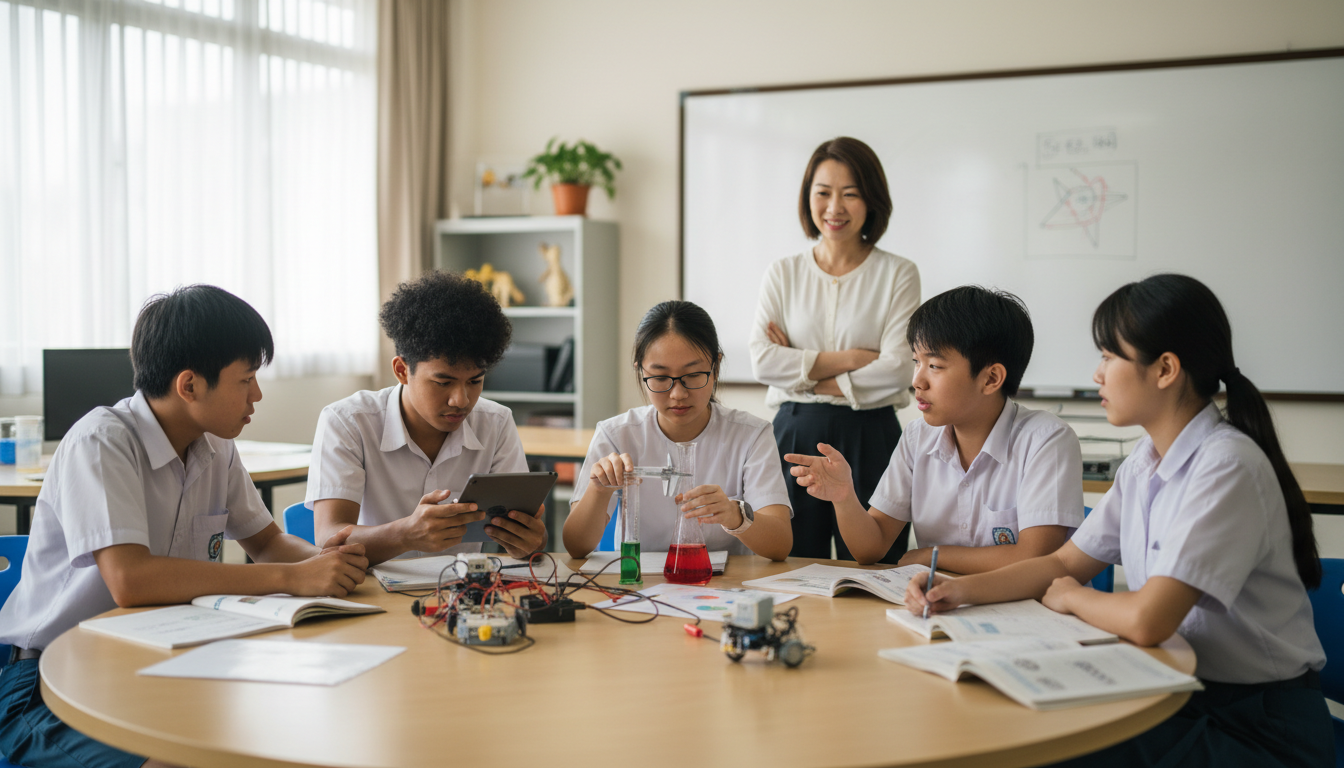
Secondary 3 Science small groups tuition for Bartley families can help when a student recognises hydrocarbon names and combustion equations but cannot explain what distinguishes a saturated molecule from an unsaturated one, or why complete combustion differs from incomplete combustion. A well-matched tutorial of three students can make each learner inspect a molecular formula, predict a suitable reaction, balance atoms and justify a conclusion on a fresh task independently. The benefit is an accurate carbon-chemistry model rather than memorising names of fuels.
There are real consequences to consider. Detailed organic Chemistry does not belong to every G1, G2 and G3 Science course at identical depth, and some combinations exclude Chemistry. A small group that teaches unassessed content may consume fees, commute time and sleep without improving school results. Parents should begin with the child’s subject-option form and one marked school question, then ask the tutor how the original misconception would be repaired.
- Best learning need: carbon compounds, combustion, molecular formulas, alkanes, alkenes and material implications where the syllabus includes them.
- Three-pupil advantage: independent first attempts followed by discussion and precise corrections.
- Subject safeguard: verify the G-level, Science combination and eventual SEC examination year.
- Benefits: better equation balancing, molecular reasoning and evidence-based explanations.
- Consequences: unrelated advanced content, rote formulas, cost, fatigue and peer dependence.
- Progress check: a new molecule and reaction explained accurately without the tutor selecting the equation.
- Availability: the Bartley guide does not establish a current classroom or available three-pupil place there.
Why organic Chemistry is a test of principles, not just memory
The word organic can suggest an enormous collection of names and structural formulas. At the school level, however, many questions are built around a few core ideas: carbon can form covalent bonds, structures influence properties, combustion involves reaction with oxygen and related molecules may share patterns. A child who recognises a familiar formula may still fail when the carbon chain is longer or the question asks for a different product.
A student might write that every carbon-containing material is a fuel, that every compound with carbon and hydrogen has a carbon–carbon double bond, or that a blue flame proves a process produces no greenhouse gases. These are not small presentation errors. They show a misunderstanding of molecular composition, combustion or how observations support conclusions.
A useful tutor starts with a specific erroneous statement. Which atoms are present? How are they bonded? Which substances enter the reaction? What is the balanced equation under the stated conditions? What can the resulting measurements prove? These questions reveal the first weak model before introducing more complex reactions.
Correct MOE/SEAB pathways under Full SBB
Full Subject-Based Banding allows secondary students to study individual subjects at G1, G2 or G3, sometimes at different levels across subjects. The student’s initial Posting Group need not define every later subject. At upper secondary, Science can mean G1 Science, G2 or G3 paired Science, or separate G3 Physics, Chemistry and Biology, according to school options and allocation.
The SEAB SEC overview states that the Singapore–Cambridge Secondary Education Certificate begins with the 2027 examination cohort, replacing separate N(T), N(A) and O-Level certificates while identifying subject levels. A child who is Secondary 3 in 2027 generally sits the SEC in a subsequent year, so their final-year syllabus should be checked once issued.
For 2027 school candidates, the G1 list includes Science K123; the G2 list includes Physics–Chemistry K223, Physics–Biology K224 and Chemistry–Biology K225; and the G3 list includes paired Sciences K326–K328 and separate Physics K323, Chemistry K324 and Biology K325. These codes apply to 2027, not automatically to later examination cohorts.
A student taking Physics–Biology may not need a hydrocarbons lesson, while a separate G3 Chemistry student can require greater treatment of organic reactions than another course. The tutor should inspect actual syllabuses and school assessments before offering a group. The examples below illustrate useful concepts; they are not a universal checklist of topics required of every Secondary 3 student.
The first-principles questions behind an organic molecule
- Elements: what atoms are present in the molecular formula?
- Bonding: how is carbon connected to the neighbouring atoms?
- Class: does the molecule match an alkane, alkene or another functional group, where taught?
- Conditions: which reactants, catalysts or energy conditions are specified for the reaction?
- Conservation: can each element’s atoms be counted before and after the reaction?
- Evidence: what observation actually supports the proposed product or chemical class?
- Transfer: does the same principle work with a changed carbon chain or reactant?
These questions guide thinking rather than constitute a compulsory answer template. An item asking for a molecular formula needs that formula. A combustion calculation may require a balanced equation. An explanation of a reaction’s effect on the environment needs evidence and a valid mechanism. A tutor should adjust the written response to the actual command word.
Worked example 1: hydrocarbon means carbon and hydrogen
A hydrocarbon is a compound containing carbon and hydrogen only. Methane, CH₄, and ethane, C₂H₆, are hydrocarbons. Ethanol, C₂H₅OH, is not a hydrocarbon, because it contains oxygen as well as carbon and hydrogen. A student may notice the carbon chain in ethanol and classify it as a hydrocarbon without reading every element in the formula.
A tutor can give a short independent classification with three formulas and ask pupils to justify each answer. The aim is not memorising that methane is a gas or ethanol a liquid; it is checking the composition criterion stated in the definition.
For a changed task, compare C₃H₈ with C₂H₄O. The former contains only carbon and hydrogen, whereas the latter also contains oxygen. The exact structural identity of C₂H₄O cannot be determined uniquely from its molecular formula alone, another useful reminder that composition is not the complete structure.
Worked example 2: simple saturated alkanes
In the standard school model, open-chain saturated alkanes contain only single carbon–carbon bonds and have general formula CₙH₂ₙ₊₂ for positive integer n. Methane is CH₄, ethane is C₂H₆ and propane is C₃H₈. The general formula applies to the stated class of acyclic alkanes, not to every carbon compound.
A pupil might use CₙH₂ₙ₊₂ for an alkene or a cyclic hydrocarbon, producing an incorrect hydrogen count. The tutor should ask which bonds and structural conditions make the formula appropriate. A carbon-chain model can help explain the number of hydrogen atoms needed to satisfy the normal valency of carbon.
A fresh problem asks for a four-carbon open-chain alkane. Substituting n = 4 gives C₄H₁₀. The learner should justify the formula under the stated model and distinguish molecular formula from the possible structures of isomers.
Worked example 3: an alkene has a carbon–carbon double bond
An alkene contains a carbon–carbon double bond. For a simple acyclic alkene with one such double bond, the familiar general formula is CₙH₂ₙ for n at least 2. Ethene is C₂H₄ and propene is C₃H₆. The formula alone does not automatically prove a particular molecular structure in all possible compounds.
A student might say every CₙH₂ₙ compound must be an alkene. Some cyclic saturated hydrocarbons can share that molecular formula, so the structure or other evidence matters. A tutor should show how general formulas describe a family within a defined structural scope, not provide unique identification for every unknown.
A changed task gives a correctly drawn structure with one carbon–carbon double bond. The pupil should classify it using the bond, then count carbon and hydrogen atoms. If the learner can do this without relying solely on the formula pattern, the concept is more secure.
Worked example 4: saturated and unsaturated are structural descriptions
A saturated open-chain hydrocarbon contains the maximum hydrogen content for that kind of chain because its carbon–carbon bonds are single in the standard model. An unsaturated hydrocarbon has a carbon–carbon multiple bond. These terms do not describe whether a liquid is “full” or whether its solution has high concentration.
A pupil may describe ethene as saturated because there are four hydrogen atoms around two carbon atoms. The tutor should focus on the double bond and its relationship to the hydrogen count. A molecule with a carbon–carbon double bond can undergo reactions characteristic of that group under suitable conditions.
A fresh diagram can alter chain length without removing the double bond. The student should still recognise the relevant unsaturation. If the structure instead has only single bonds and is an open-chain alkane, the classification changes.
Worked example 5: complete combustion of methane
With sufficient oxygen and appropriate conditions, methane undergoes complete combustion represented by CH₄ + 2O₂ → CO₂ + 2H₂O. One carbon atom appears in one carbon dioxide molecule, four hydrogen atoms in two water molecules and four oxygen atoms from two O₂ molecules appear across the products.
A student may balance the equation by changing a subscript in CO₂ or H₂O, accidentally changing the chemical identity of a product. The tutor should ask the learner to preserve correct formulas and adjust coefficients to conserve every element.
A changed question uses propane rather than methane. The learner should identify the correct products under complete combustion and balance a new equation, rather than copy the methane coefficients from memory.
Worked example 6: complete combustion of propane
In the idealised complete-combustion model, propane reacts according to C₃H₈ + 5O₂ → 3CO₂ + 4H₂O. Three carbon atoms become three carbon dioxide molecules, eight hydrogen atoms become four water molecules and the oxygen atoms balance with five O₂ molecules.
A pupil may immediately write five carbon dioxide molecules because there is a coefficient five before oxygen. The tutor should count carbon atoms first, then hydrogen and finally oxygen. Using atom conservation makes balancing a reasoning task rather than a numerical guessing game.
For independent transfer, choose ethane: 2C₂H₆ + 7O₂ → 4CO₂ + 6H₂O under complete combustion. The child should verify the carbon, hydrogen and oxygen totals on both sides and explain why a coefficient of two before ethane is convenient for whole-number balancing.
Worked example 7: incomplete combustion changes possible products
If oxygen supply is inadequate under suitable combustion conditions, incomplete combustion can produce carbon monoxide, carbonaceous particulates and other products, with their proportions depending on the process. A pupil should not assume that all combustion always yields only carbon dioxide and water regardless of oxygen availability.
A simplified balanced example for incomplete combustion forming carbon monoxide is 2CH₄ + 3O₂ → 2CO + 4H₂O. The equation illustrates one possible product combination; it does not claim that every oxygen-limited methane flame produces precisely those products. Carbon monoxide is a hazardous gas and should never be intentionally produced for an unsupervised demonstration.
A new question may describe soot formation instead. The learner should distinguish solid carbon-containing particles from carbon monoxide gas and identify that the actual products depend on conditions. The tutor should use supervised written or simulated examples, not home experiments with flames.
Worked example 8: a blue flame is not proof of zero emissions
A clear, well-aerated flame may indicate more complete combustion under some conditions, but colour alone does not demonstrate that no carbon dioxide is produced. Complete combustion of a carbon-containing hydrocarbon can generate carbon dioxide as a chemical product. A student who writes that a blue flame is “carbon-free” has confused combustion completeness with carbon content.
The tutor should ask the learner to balance the combustion equation and identify where its carbon atoms end up. A familiar colour description may support a limited inference about combustion conditions but is not a complete emissions test.
A changed question might compare a fuel’s stated carbon content with a measured exhaust composition. The student should use the given chemical data rather than rely on flame colour alone. Real combustion systems are affected by many factors, so claims should remain proportionate to the evidence.
Worked example 9: mass conservation during combustion
In complete combustion of methane, carbon and hydrogen from the fuel combine with oxygen from the surroundings. If the mass of a closed or fully accounted-for system is considered, the total mass of reactants equals the total mass of products under ordinary chemical conservation. The products may weigh more than the original fuel alone because they include oxygen that was not in the fuel.
A pupil may say mass was created if a measured solid oxidation product gains mass. The tutor should ask which material entered the weighed portion of the system. Conversely, an open reaction with escaping gaseous products may show a lower balance reading without matter being destroyed.
A new problem can change the system boundary, asking for the mass of fuel alone, fuel plus oxygen or all products. The student should first define which substances are being counted before choosing an equation.
Worked example 10: combustion energy and power
A fuel releases a specified amount of energy during an appropriate reaction. A learner may confuse the total energy with the rate at which it is released. If an idealised device transfers 90,000 J over 30 seconds, its average power is 90,000 ÷ 30 = 3,000 W. The unit watts represents joules per second, not the total amount.
A changed device transfers the same energy in sixty seconds, giving 1,500 W. The total amount is unchanged while the average transfer rate is smaller. A tutor should ask what changed and what stayed fixed.
Actual fuel energy transfer and useful device output may differ due to incomplete combustion and other pathways. A numerical school problem may define assumptions so that a clear calculation is possible; the tutor should make those conditions explicit.
Worked example 11: efficiency is not the same as energy produced
Imagine a device receives 1,000 J of chemical energy and delivers 350 J as useful mechanical output for its defined task. Efficiency is 350 ÷ 1,000 × 100 = 35%. The remaining 650 J has been transferred in other ways, rather than disappearing.
A student may claim that a device with 50% efficiency must always provide more useful output than one with 35% efficiency. That depends on the input amounts. A 50%-efficient device receiving 200 J yields 100 J useful output, less than 350 J from the larger-input example.
A fresh problem can provide input and useful output power rather than energies. When values refer to comparable operating conditions, the same ratio structure can be used. The learner must distinguish a dimensionless percentage from watts or joules.
Worked example 12: an alkene’s addition reaction
An alkene’s carbon–carbon double bond can participate in suitable addition reactions. In an introductory model, ethene can react with bromine to form a saturated dibromo compound under appropriate conditions, represented as C₂H₄ + Br₂ → C₂H₄Br₂. The example shows addition across a multiple bond, not a change in the number of carbon atoms.
A tutor should ask students to identify which bond changes and which atoms are added. A learner may incorrectly say the double-bonded carbon atoms disappear during reaction. Their identities remain carbon; the bonding arrangement changes under the chemical transformation.
A changed task can involve addition of hydrogen to an appropriate alkene under suitable catalytic conditions. For ethene the simplified equation is C₂H₄ + H₂ → C₂H₆. The child should recognise the transformation from a double bond to a single bond in the standard model.
Worked example 13: bromine-water testing and limits
Bromine-water decolourisation under appropriate conditions is often taught as evidence consistent with an unsaturated carbon–carbon multiple bond. But test results and other chemical contexts matter; bromine can undergo other reactions, and a colour change alone does not uniquely identify a specific alkene.
A student may see decolourisation and immediately claim the unknown must be ethene. The tutor should ask what the test establishes about a relevant chemical feature and what additional evidence would be needed for an exact identity. This is another example of proportional scientific inference.
The lesson should remain theoretical or appropriately supervised. Bromine reagents are hazardous and are not suitable for unsupervised student experiments at home or in a normal tuition room lacking relevant laboratory facilities.
Worked example 14: polymers and repeating units
Under the suitable addition-polymerisation model, many ethene molecules can join to form poly(ethene), whose repeating unit is commonly represented as –CH₂–CH₂–. The process changes the pattern of bonds in the monomer units while conserving their atoms across the idealised polymerisation.
A pupil may draw the repeating unit with a carbon–carbon double bond remaining, copying the monomer’s structure. The tutor should ask what happens to the double bond during addition and how the polymer chain’s single-bond backbone is represented. The number of repeating units can vary across polymer molecules.
A changed task uses propene as a monomer, if relevant to the syllabus. The learner should determine the corresponding repeating-unit connectivity rather than apply the ethene structure to every polymer. A single type of polymerisation should not be presented as the origin of all plastics.
Worked example 15: polymer properties are not one universal rule
Different polymers can have different chain structures, molecular masses, additives and processing histories. Their strength, flexibility, melting behaviour and degradation vary. A student who says all plastics are identical chemically or that every polymer can be recycled by the same method has overgeneralised from a common material label.
A tutor can present a hypothetical table with different softening temperatures and tensile strengths. The pupil should choose a material for a stated application using the actual measured properties, not automatically select the sample with the greatest number in every column.
A changed application may prioritise flexibility instead of stiffness. The conclusion can change even if the data stay the same. This builds scientific decision-making without inventing real-world certifications or environmental performance claims.
Worked example 16: ethanol is not a hydrocarbon
Ethanol has formula C₂H₅OH, containing carbon, hydrogen and oxygen. It is an alcohol, not a hydrocarbon. In the suitable complete-combustion model, C₂H₅OH + 3O₂ → 2CO₂ + 3H₂O. The oxygen already present in the ethanol molecule must be counted when balancing.
A student may apply an alkane general formula to ethanol because it contains two carbon atoms. A tutor should ask which functional group and atoms are actually present before selecting a chemical-family rule. An alcohol formula cannot simply be treated as the same thing as a hydrocarbon with an extra decorative O.
A fresh task compares ethanol and ethane. Both have two carbon atoms, but their oxygen content and structure differ, affecting their chemical behaviour. The lesson is not a recommendation to use or consume alcohol; the compound is discussed strictly as a Chemistry example.
Worked example 17: carbon dioxide and scientific claims
Carbon dioxide is a product of complete combustion of carbon-containing fuels under the appropriate model. It is also a greenhouse gas that contributes to climate change through its infrared-radiative effects. A student may think complete combustion is environmentally impact-free merely because fewer carbonaceous particulates form than under some oxygen-poor conditions.
A tutor should distinguish local combustion pollutants, carbon dioxide emissions and the wider lifecycle of a fuel. Whether a fuel system has lower overall emissions requires suitable measurements, definitions and boundaries. A school reaction equation identifies products but does not alone provide a full lifecycle assessment.
A new task may ask for the carbon dioxide molecules formed from one mole of propane in the idealised complete reaction. The stoichiometric equation gives a three-to-one mole ratio. The pupil should calculate from atom conservation rather than treat one fuel molecule as always yielding one carbon dioxide molecule.
Worked example 18: stoichiometric carbon dioxide prediction
For a student whose Chemistry syllabus includes moles, the equation C₃H₈ + 5O₂ → 3CO₂ + 4H₂O indicates that one mole of propane can form three moles of carbon dioxide under complete combustion and sufficient oxygen. If 0.50 mol propane reacts completely, the theoretical carbon dioxide amount is 1.50 mol.
A pupil may incorrectly write 0.50 mol CO₂ simply because the propane amount was 0.50. The tutor should ask how many carbon atoms are in each propane molecule and where they go. The three-to-one coefficient relationship then has a physical meaning.
A changed problem uses methane, where one mole of CH₄ can form one mole of CO₂ in the idealised complete reaction. The student should not carry the propane ratio into a different fuel. Such quantitative extensions must be aligned with the pupil’s actual course.
Worked example 19: comparative mass of carbon dioxide
Using relative atomic masses C = 12 and O = 16, one mole of CO₂ has molar mass 12 + 2 × 16 = 44 g/mol. Under the previous simplified propane example, 1.50 mol CO₂ corresponds to 1.50 × 44 = 66 g of carbon dioxide. This includes oxygen mass supplied by the combustion process, not carbon alone.
A student may multiply carbon moles by 12 and call the result the mass of carbon dioxide. That calculates carbon mass only. The tutor should ask which compound’s molar mass is required and whether the atom totals match the balanced equation.
A fresh task can give a different fuel amount and ask for theoretical product mass. The learner should identify the proper balanced ratio and molar mass rather than recall an isolated 66 g answer.
Worked example 20: a fuel comparison is not just a headline number
A hypothetical table might show two fuels with different energy per gram and different combustion emissions per gram. The fuel with greater energy per gram need not have lower emissions per unit useful output if the device efficiency and chemical composition differ. The criteria must be defined before deciding which is preferable for a stated application.
A tutor can ask what is being compared: total energy, energy per mass, useful energy per mass, product amount or an environmental measure. Mixing denominators leads to misleading conclusions. A useful answer states the chosen quantity and the assumptions explicitly.
A changed application may place greater importance on low particulate emissions rather than energy density. The child should adapt the recommendation to the evidence, not assume “higher energy” is universally the best criterion.
Scientific inquiry: testing combustion conditions fairly
A school-level written investigation may compare the effects of oxygen availability on a combustion model. To isolate the intended factor, the investigator must consider fuel amount, apparatus, temperature and measuring methods. If one trial uses more fuel and a different burner as well as different oxygen availability, the causal interpretation becomes uncertain.
A tutor should teach the design and data analysis through safe diagrams or simulations. Burning fuels, generating carbon monoxide or using hazardous reagents should not be improvised in a tuition room or home. Supervised laboratory facilities and safety controls are essential for appropriate practical work.
A changed task may compare different fuel identities while holding other conditions appropriately comparable. The student must revise which variable is manipulated and avoid blindly repeating the first experiment’s control list.
What a flame observation can and cannot prove
A school question may describe a yellow luminous flame or soot deposits. These can provide evidence about combustion conditions in a particular setup, but they do not uniquely measure all products or the fuel’s identity. A visible colour cannot replace a chemical analysis or balanced reaction interpretation.
A student may write that a smokeless flame produces no greenhouse gases, which is incorrect for complete combustion of carbon-containing fuel. The tutor should help the child separate an observed particulate effect from carbon dioxide formation. Different forms of pollution and greenhouse-gas impact require different evidence.
An unfamiliar question can provide measured products rather than a flame photo. The learner should base the explanation on the given data instead of a colour-based shortcut.
Why three pupils can improve organic Chemistry reasoning
One learner may balance methane combustion correctly but classify ethanol as a hydrocarbon. Another may identify an alkene but carry the double bond into a polymer repeating unit. A third may interpret flame colour as proof of zero carbon dioxide. Each needs a different explanation even though the lesson concerns carbon compounds.
A tutor should preserve independent first work, then use group discussion to compare the relevant atoms, bonds and evidence. The fastest student must not provide every formula before others attempt the question. A changed molecule at the end provides a better test of personal understanding than a shared corrected worksheet.
Subject matching remains essential. An advanced organic Chemistry class should not be sold to a student whose selected Science course does not include the topic. A responsible provider recommends regrouping or another support format when the academic requirements do not align.
Research on small-group tuition
The Education Endowment Foundation review defines small-group tuition as one tutor working with two to five pupils. It reports an overall average of roughly four additional months of progress, with a smaller secondary-school subset averaging about two months. These are research averages across different interventions, not guarantees of an individual Singapore SEC grade.
The review emphasises targeted gaps, subject relevance and high-quality feedback. Some effective programmes meet more often than a single weekly ninety-minute session. Parents should evaluate the tutor’s actual methods and the child’s independent new responses rather than treat three pupils as a magic number.
Benefits that Bartley parents can inspect
- The learner distinguishes carbon compounds and hydrocarbons using composition.
- Organic structural features are identified without relying only on memorised formulas.
- Combustion equations are balanced through atom conservation.
- The tutor detects whether the student confuses rate, energy, product amount or emissions.
- New molecules and reaction conditions test independent transfer.
- Peer comparison is constructive and every child supplies an original answer.
- Old mistakes are retested after a delay, with fewer prompts needed.
Consequences of the wrong tuition choice
Wrong syllabus depth: detailed organic Chemistry, mole ratios and polymerisation may not belong to every G1/G2/G3 Science course. The tutor must use the school’s actual subject allocation and scope.
Memorised formulas: a pupil can recite CₙH₂ₙ₊₂ while applying it to the wrong molecular family. The structure and assumptions should be explained before using the formula.
Unsafe practical shortcuts: fuel combustion and chemical reagents need supervision and appropriate facilities. The tutorial should use written or simulated exercises when it cannot provide safe laboratory work.
Overstated environmental claims: a reaction equation alone is not a full emissions or lifecycle assessment. Tutors should distinguish chemical products, measured pollution and wider effects.
Time and fatigue: extra tuition competes with schoolwork, CCAs, homework and sleep. The family should review the entire journey and workload.
Peer pressure and expense: a fast pupil can dominate and class size does not guarantee marks. The tutor should demonstrate individual feedback and independent progress.
Choose three-pupil tuition, one-to-one help or home revision
A small group can be effective for learners who need precise corrections and benefit from compatible peer discussion. One-to-one tutoring may suit severe foundational gaps, unusual combinations or substantially different pacing. A larger class may be sufficient for an independent student seeking structured syllabus review.
School consultation and home revision may also be enough when the learner understands the Chemistry but needs more consistent practice. A manageable task is to balance one unfamiliar combustion equation, identify its assumptions and explain a changed molecule without notes. The least burdensome effective support should be chosen.
An illustrative ninety-minute carbon-chemistry lesson
- 10 minutes: retrieve hydrocarbon terminology and basic atom conservation.
- 15 minutes: diagnose one marked molecular-formula or combustion question.
- 20 minutes: rebuild the structural or reaction model through clear examples.
- 15 minutes: compare each of three independent explanations with precise feedback.
- 20 minutes: unseen molecular and reaction questions solved without tutor prompts.
- 10 minutes: record corrections and set brief delayed practice.
The timings illustrate an instructional design, not a verified Bartley class schedule. The advantage comes from each learner demonstrating thinking before and after teaching. A lecture delivered to three passive pupils does not necessarily offer meaningful personalised tutoring.
A six-week evidence checkpoint
Week 1 uses marked schoolwork and an unseen carbon-compound question as baseline. Week 2 repairs the main formula or combustion misconception. Week 3 retests with a different molecule after a delay. Week 4 mixes reaction equations, structural features and evidence interpretation. Week 5 adds a short independent set without chapter cues. Week 6 compares similarly demanding new work with the baseline.
Parents should look for correct molecular composition, balanced equations, precise units and fewer tutor hints. One higher school mark on easier material is not decisive. The review should also examine workload, travel and the child’s confidence in Science.
Six weeks is a decision checkpoint, not a guaranteed grade-improvement deadline. The family may continue with a narrower focus, change group or pause when the learner can handle unfamiliar questions independently.
Bartley travel and actual class availability
Bartley families should compare travel from school, CCA schedules, nearby transport connections and time left for home revision. A conveniently located group has limited benefit if it teaches a different Science subject. Include the full door-to-door time and homework burden in the decision.
This guide is written for Bartley families. It does not establish that eduKateSG has a Secondary 3 Science classroom or an available three-pupil place in Bartley. Confirm actual tutor, subjects, level, teaching venue, fee and timetable directly.
Questions parents should ask
- Does the child actually study hydrocarbons and organic Chemistry at this subject level?
- Can the tutor explain the first structural or reaction mistake in a marked school answer?
- Will every pupil balance a fresh equation before the tutor supplies coefficients?
- Are practical claims limited to facilities and supervision actually available?
- How do changed molecules test independent transfer?
- What are the confirmed teacher, venue, group size, fees, homework and absence arrangements?
- What evidence would justify continuation or a pause after several weeks?
Frequently asked questions
Does every Secondary 3 pupil need detailed organic Chemistry?
No. Content depends on the actual G-level, Science combination and school sequence. Some learners do not study Chemistry within their selected pair.
When does SEC begin?
The first SEC examination cohort is in 2027. Later candidates should consult their own examination-year syllabuses and subject codes.
Are ethanol and methane both hydrocarbons?
No. Methane contains carbon and hydrogen only, while ethanol also contains oxygen.
Does complete combustion of a hydrocarbon produce no carbon dioxide?
No. In the standard complete-combustion model, carbon from the fuel forms carbon dioxide, while hydrogen forms water.
Does a blue flame guarantee zero emissions?
No. Flame appearance alone does not establish an absence of carbon dioxide or other emissions.
Does all plastic have the same chemical structure?
No. Polymers vary in molecular structure and properties, and not all form through the same process.
Does three-pupil tuition guarantee higher marks?
No. It permits closer diagnosis and feedback, but syllabus matching and independent practice determine the actual outcome.
Can written tuition replace supervised Chemistry practicals?
No. Printed questions complement learning; hazardous substances, flames and apparatus require suitable supervised facilities.
Official sources and related eduKateSG guides
See SEAB’s SEC overview, 2027 G1 Science, 2027 G2 paired Science, 2027 G3 Science, MOE secondary education guidance and the EEF evidence review. Related eduKateSG guides include Joo Chiat metals and oxidation, Boon Keng reaction rates and Marsiling chemical structures.
Arrange a subject-matched parent discussion
Bring the child’s actual subject-option notice, one marked Chemistry answer and a sustainable weekly timetable. Ask the tutor to identify the first wrong model and test it on a new molecule. Contact eduKate Singapore for the actual tutor, classroom, subject coverage, fees and current availability.