
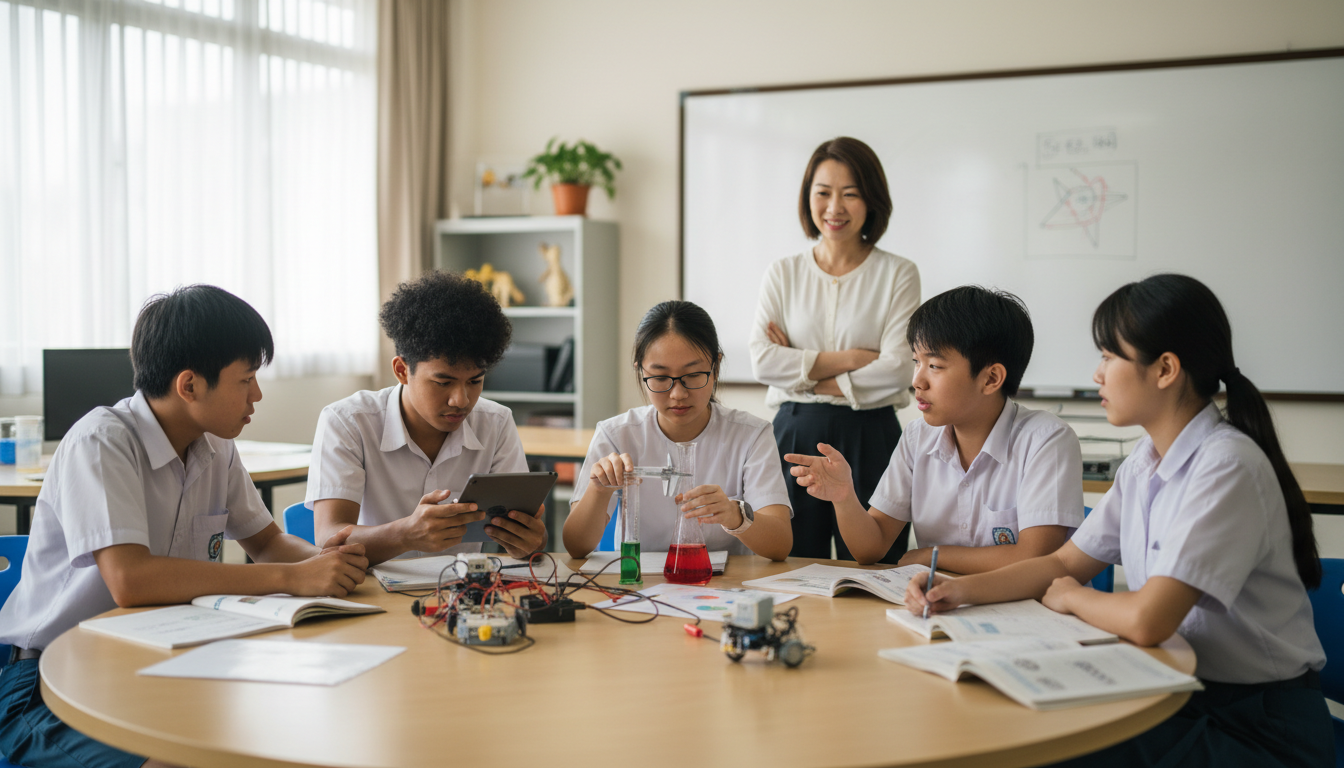
Secondary 3 Science small groups tuition for Yew Tee families can help when students understand an experiment in the textbook but become uncertain when a school paper changes the apparatus, results or variables. A good three-pupil tutorial makes each child identify what was deliberately changed, what was measured, and what the conclusion can genuinely establish. The aim is not to memorise more standard practical answers; it is to become able to plan, interpret and evaluate unfamiliar investigations independently.
The consequences of tuition matter too. Three pupils can still form an unsuitable group if they study different G1, G2 or G3 Science subjects, and a tutor who supplies every variable or equation may hide weak independent thinking. Weekly lessons add travel, homework, fees and fatigue. Parents should first diagnose the child’s actual error, match the syllabus, then compare small-group teaching with school consultation or an organised home-study plan.
- Immediate parent decision: bring a marked practical-style Science question, not just the total score.
- Correct curriculum: identify the precise G-level and Science pairing or separate subject.
- Three-pupil advantage: individual discussion of experiment design, data and explanation.
- Important drawbacks: subject mismatch, passive copying, misleading practical claims, transport and fees.
- Progress standard: fresh unseen experiments interpreted without tutor prompts.
- Availability: check the real tutor, venue and schedule; the title does not establish a tuition branch in Yew Tee.
Why Secondary 3 Science investigations feel more difficult
Science experiments are not merely procedures to follow. The method attempts to answer a defined question, and a good conclusion must follow from the evidence collected. At lower secondary, many pupils meet investigations in familiar chapters. By Secondary 3, a Physics, Chemistry or Biology assessment may use a new diagram, unfamiliar measurements or a changed set of conditions. The student must decide how the design works before interpreting the result.
A pupil may write that a plant grew more because of fertiliser, forgetting that it was also placed in stronger light. Another may calculate gas production correctly but call a lower rate a decrease in the total collected gas. A third may decide that a material is the best insulator in all settings based on a single ten-minute comparison. These mistakes share a theme: the final claim goes beyond the exact evidence.
A small-group tutorial should reveal the first false assumption. The learner explains what the experiment intended to test, which measurements matter, what variables were controlled and where the conclusion becomes uncertain. Only after that diagnosis should the tutor show a better method. A changed unseen task checks whether the student has learned to reason instead of simply reproduce the correction.
Full SBB, G1/G2/G3 and the first SEC examinations in 2027
Singapore’s Full Subject-Based Banding allows different secondary subjects to be taken at G1, G2 and G3; a student’s initial Posting Group is not necessarily the level of every subject studied. Upper-secondary Science can include G1 Science, G2 or G3 paired Science, and separate G3 Physics, Chemistry or Biology. Subject options and allocated courses depend on the school.
The official SEAB SEC overview explains that the Singapore–Cambridge Secondary Education Certificate begins with the 2027 examination cohort, replacing the former separate N(T), N(A) and O-Level certificates while retaining the appropriate subject levels. A student who is in Secondary 3 in 2027 would normally sit examinations in a later year, so the eventual candidate-year syllabus should be checked.
For 2027 school candidates, the G1 list identifies Science K123. The G2 list includes paired Physics–Chemistry K223, Physics–Biology K224 and Chemistry–Biology K225. The G3 list includes paired Science K326–K328 and separate Physics K323, Chemistry K324 and Biology K325. These identifiers are specifically from 2027, not guaranteed codes for later years.
Parents should therefore bring the school subject-option notice and a recent marked paper. An investigation designed for separate G3 Chemistry may be at the wrong depth for a paired G2 learner, and a Physics–Biology pupil does not necessarily need the Chemistry questions taught to a different group. A class of three only works when there is sufficient syllabus overlap and teaching is differentiated appropriately.
The investigation thinking sequence
- Purpose: state the exact relationship or effect being investigated.
- Change: name the factor deliberately varied between trials.
- Measure: identify the recorded response, instrument and units.
- Control: keep other relevant factors comparable so the effect can be isolated.
- Analyse: compare the measurements with an appropriate calculation or graph.
- Conclude: use the actual evidence, avoiding claims that the design cannot establish.
- Evaluate: identify how a genuine limitation could be addressed.
These are steps in thought, not seven paragraphs to write into every examination answer. If the question asks for one controlled variable, name it and explain it only as required. If it asks for a graph’s trend, use the readings. An evaluation may require a flaw and an appropriate remedy. A tutor should teach the child to recognise the command word rather than force every question into a long generic response.
Worked Physics investigation: comparing cooling rates
Imagine two identical containers each holding 200 mL of water initially at 70°C. Different coverings are being tested. After ten minutes, A reads 54°C and B reads 61°C. The observed temperature decreases are 16°C for A and 9°C for B. B has the smaller temperature drop during this specific experiment.
The student should not jump to “B is always the best insulator.” Only two arrangements were compared. Covering thickness, container materials, lid conditions and the surrounding environment can influence a result. If one cup had a lid but the other did not, the experiment might not isolate the coverings fairly. The tutor can ask the learner which feature the investigator intended to change and which others should remain comparable.
The average magnitudes of temperature decrease across the ten minutes are 1.6°C/min and 0.9°C/min respectively. These are interval averages; they do not prove that cooling rate was constant at every moment. A new question with unequal intervals forces the student to distinguish total temperature change from rate and check whether the trials are comparable.
Worked Chemistry investigation: reaction rate from cumulative gas
A hypothetical gas-producing reaction gives readings of 0 cm³ at 0 s, 12 cm³ at 20 s and 20 cm³ at 60 s. Average rate over the first twenty seconds is 12 ÷ 20 = 0.6 cm³/s. Over the following forty seconds, 8 additional cubic centimetres are collected, giving 0.2 cm³/s. The later interval has a smaller average rate, yet the cumulative gas volume keeps rising.
A learner who says “less gas was produced overall” has confused accumulated quantity with rate. Another may divide 20 by 40 for the second interval without subtracting the 12 cm³ already present at its start. The tutor should teach the pupil to circle the start and end readings of the requested interval and state what their difference represents.
The independent task can change the observation times or show two trials with different early rates that reach the same final recorded volume. A student must not infer a larger final yield from a steeper early slope without evidence of the completed reaction. This distinction between rate and total is a transferable Science skill.
Worked Biology experiment: plant growth and confounding variables
Suppose Seedling A is fertilised and placed beside a bright window, while Seedling B receives no fertiliser and remains in dimmer light. If A grows more, the result cannot isolate fertiliser as the cause because light conditions also changed. More than one relevant factor differs between the trials.
A better design attempts to hold plant type, starting size, water, light and other important factors comparable while deliberately varying fertiliser treatment. Several similar seedlings may help reveal natural biological variation. Repeating an unfair design many times does not necessarily remove its systematic bias, so the tutor should explain what each proposed improvement actually fixes.
In a changed question, light becomes the manipulated variable while fertiliser is kept comparable. The pupil must choose new controls rather than repeat the original list. This checks whether the learner understands the experiment’s logic or merely memorises which variable was named first.
Worked Biology calculation: absolute and percentage growth
Plant A grows from 8 cm to 13 cm, while B grows from 11 cm to 15 cm during the same interval. A has an absolute increase of 5 cm, while B increases by 4 cm. B is taller at the final reading, but A grew by a larger amount during the recorded period.
Relative to starting heights, A increased by 5 ÷ 8 × 100 = 62.5% and B by 4 ÷ 11 × 100 ≈ 36.4%. The correct comparison depends on whether the question asks for final height, increase in centimetres or percentage growth. A tutor can ask the child to name the required quantity before calculating.
The data alone do not establish why the differences occurred. Initial health, water, light, species and other conditions may matter. A changed table with different starting values checks whether the learner can choose the appropriate measure and separate observation from causal explanation.
Worked Chemistry evidence: bubbles are not unique identification
Suppose an unknown mixture releases a colourless gas. A student writes “It must be hydrogen because hydrogen is colourless.” This inference is too specific: several gases are colourless. Observing bubbles supports gas production, but does not establish one chemical identity without the necessary reaction information or an appropriate test.
The tutor can ask the student what is directly observed, what might reasonably be inferred and which additional evidence could distinguish the gas. A course-appropriate gas test may justify a particular answer when its result is described. The goal is not guessing the most familiar product but selecting a conclusion supported by actual experimental details.
A changed exercise describes a precipitate rather than bubbles. Again, seeing a solid appear does not automatically identify its formula. The pupil should practise a scientific claim proportionate to the observations and the information supplied.
Worked measurement problem: one anomalous reading
Suppose a student records three close readings of 12.2, 12.3 and 12.2 units followed by 17.0 units. The fourth differs substantially. The correct response is not automatically to delete it because it spoils the trend. It may reflect an error in recording, a measurement problem, a procedural change or a real unusual event.
A tutor should ask what further evidence could identify the cause. Repeating under comparable conditions may help reveal whether the difference recurs. Checking the instrument’s calibration and the original procedure can reveal other issues. A systematic error can persist even when measurements are repeated, so “repeat three times” does not fix every limitation.
A fresh data set may have consistent readings but an unfair experiment. The learner then needs to distinguish reliable measurement from a valid causal comparison. The common skill is accurately matching a proposed improvement to the particular weakness.
Experimental vocabulary and command words
Words such as independent variable, dependent variable, controlled variable, reliability, accuracy and precision describe different aspects of investigation. A pupil can memorise each definition without applying it. A tutor should ask what was deliberately changed, what was measured and what could otherwise influence the outcome in each new question.
The command word matters just as much. “State” may ask for a single fact, “Describe” for a pattern, “Explain” for a mechanism and “Evaluate” for a judgement about data or method. A pupil who writes a causal theory in a pure description question can waste time, while one who gives only a trend when asked for a reason may leave out an essential link.
The tutor should show a student how to prepare a concise answer plan before writing. An accurate response with the required relationship is preferable to a paragraph padded with irrelevant textbook facts. The plan should be used flexibly, not as an artificial template for every mark.
What research says about a group of three
The Education Endowment Foundation review defines small-group tuition as teaching two to five pupils. It reports an overall average impact of about four additional months of learning progress, and an average around two months in its smaller secondary-school evidence subset. These are research averages across different subjects and programmes, not promises of grades for a Singapore SEC candidate.
The review highlights targeted support, diagnostic assessment and high-quality feedback. Some effective interventions involve several short sessions per week, unlike a single weekly ninety-minute class. The value of three pupils therefore depends on whether the tutor actually observes original responses, corrects misconceptions and tests independent transfer.
Why three students can learn from different investigations
A group of three can make different errors visible. One pupil may calculate an average rate correctly but claim that a final yield is known without evidence. Another might identify the independent variable but forget an important control. The third might interpret measurements accurately but write an incomplete scientific explanation. The tutor can provide a different follow-up to each learner.
Everyone should attempt the question before the discussion. If one pupil announces every answer, the others may never practise the initial reasoning. A useful routine is quiet individual work, comparing explanations with tutor guidance, correction and a new independent task. This allows peer learning without hiding who understands what.
A small class can also be unsuitable if the three pupils’ Science subjects or levels diverge too far. Differentiated practice can help within a shared theme, but the tutor should be honest when grouping is not academically sensible.
Benefits parents can observe
- The learner can identify experimental variables without a prompt.
- The tutor distinguishes a measurement error from an unsupported conclusion.
- Data and graphs are interpreted with correct units and intervals.
- Peers question scientific claims respectfully and use the evidence rather than competing by speed.
- Each pupil completes new problems independently after teaching.
- Old mistakes are revisited after a delay to check retention.
- Parents can compare fewer repeated errors on similarly demanding tasks.
Consequences of choosing an unsuitable Science class
Wrong subject content. A practical-style group may mix learners studying different combinations and depths. Parents should verify the actual course, not assume every Secondary 3 Science lesson is interchangeable.
Misleading practical preparation. Written experiment questions can teach inquiry, but they cannot fully replace supervised laboratory apparatus, technique and safety when required by the subject. A provider should describe practical support accurately.
Prompt dependence. If the tutor supplies the variable name, calculation method and final conclusion each time, the child may appear capable in class without achieving independent mastery. Changed tasks with hints withdrawn are necessary.
Time and health costs. Tuition adds travel and homework to schoolwork, CCAs and sleep. More academic hours are not always useful if the learner becomes tired or stressed.
Peer and financial pressure. A fast pupil may dominate discussion, and a small-group fee does not guarantee a grade. Good tutors allow thinking time and report progress honestly.
When individual or home support is more appropriate
Three-pupil tuition suits some students who need frequent feedback and compatible peer discussion. One-to-one teaching can be better for severe foundational gaps, an unusual subject combination or much slower progress. Larger classes may suit independent learners who need structured content coverage.
Home study and school consultations may suffice for a child who understands concepts but needs more consistent checking of experimental variables. A manageable routine of correcting one marked investigation and answering one unseen changed experiment can be a sensible first step before adding fees and travel.
Illustrative ninety-minute teaching plan
- 10 minutes: retrieve an earlier experimental concept without notes.
- 15 minutes: diagnose one marked school investigation and its first false inference.
- 20 minutes: rebuild the relevant experimental or scientific model.
- 15 minutes: compare all three students’ individual answers and give targeted feedback.
- 20 minutes: complete unseen investigations independently with changed variables.
- 10 minutes: log the correction and plan manageable delayed practice.
The times illustrate an instructional approach, not confirmed hours of an actual Yew Tee class. The essential quality is each learner’s independent response before and after tuition. A small group in which children copy one model answer throughout the lesson does not deliver the same benefit.
Six weeks: a progress and well-being checkpoint
In Week 1, establish a baseline with a marked experiment and a new question. Week 2 repairs the main variable or inference error. Week 3 retests it after a delay using changed apparatus. Week 4 mixes the topic with a rate calculation. Week 5 uses an unseen investigation under reasonable time pressure. Week 6 compares fresh work of similar difficulty with the baseline.
Look for accurate variable identification, correct use of measurements, justified conclusions and fewer hints. One improved school paper may have been easier; compare several tasks. The child’s sleep, CCAs and confidence should also be part of the review.
Six weeks is a decision point, not a promised timeline for a grade rise. If the same errors persist, change the strategy or group. If the learner can analyse unfamiliar investigations independently, reducing tuition may be a successful outcome.
Yew Tee travel and real availability
Yew Tee families should consider the door-to-door journey from school, CCA commitments and home-study time. A nearby class may reduce fatigue but cannot compensate for an incompatible Science syllabus. Compare the full weekly commitment, including practice assignments, with the identified academic benefit.
This article is for Yew Tee families. It does not establish that eduKateSG operates a Secondary 3 Science classroom or offers an available three-pupil place in Yew Tee. Confirm the real teacher, venue, subject combination, timetable, fees and vacancy directly before arranging enrolment.
Questions for a parent–tutor consultation
- What exact Science subjects and G-level is the pupil taking, and in which year will they sit the SEC?
- Can the tutor identify the first incorrect experimental decision in this marked answer?
- Will the class teach fair testing and scientific inference at the relevant subject depth?
- Does each pupil attempt an unseen investigation before another student supplies the method?
- How is independent progress measured after the lesson and after a delay?
- What practical work remains the responsibility of supervised school laboratories?
- What are the actual tutor, group size, venue, fees, homework and missed-lesson arrangements?
Frequently asked questions
Do all Secondary 3 pupils take the same Science examination?
No. Under Full SBB, different G-levels and paired or separate Science subjects are available according to school allocation. Tutors should teach the actual syllabus.
Does the SEC begin in 2027?
Yes. The first SEC examination cohort is 2027. Later candidates should check the specific syllabus and codes for their own year.
What is the biggest benefit of three-pupil experimental tuition?
The tutor may have more opportunity to inspect each learner’s thinking and target errors. But that benefit requires active individual tasks and accurate teaching.
Can a fair test still contain inaccurate measurements?
Yes. Keeping relevant conditions comparable supports causal comparison, while instrument and procedural accuracy require additional attention.
Should unusual readings simply be discarded?
No. Record them faithfully and investigate whether the measurement or procedure differed.
Can a tutor replace school practical lessons?
No. Written inquiry tasks complement but do not fully replace safe supervised hands-on laboratory work.
Are exam grades guaranteed?
No. Group size, research averages and tutoring fees cannot guarantee an individual pupil’s results.
When should the family pause tuition?
When the learner can analyse unfamiliar evidence and revise independently, or when the available group is unsuitable or exhausting, a pause can be sensible.
Official sources and connected Science guides
Consult SEAB’s SEC overview, the 2027 G1 list, the G2 list, the G3 list, MOE’s Full SBB information and EEF’s evidence review. Related eduKateSG reading includes the Choa Chu Kang investigation guide, the Lavender fair-test guide and the immutable Clementi tuition reference.
Ask about a syllabus-matched group
Bring the school subject-option notice, a marked experiment question and the family’s available times. Ask which scientific error the tutor would correct and how a fresh task would demonstrate progress. Contact eduKate Singapore or enquire about Secondary 3 Science for Yew Tee students. Confirm the actual tutor, venue, timetable, fees and opening before enrolment.