
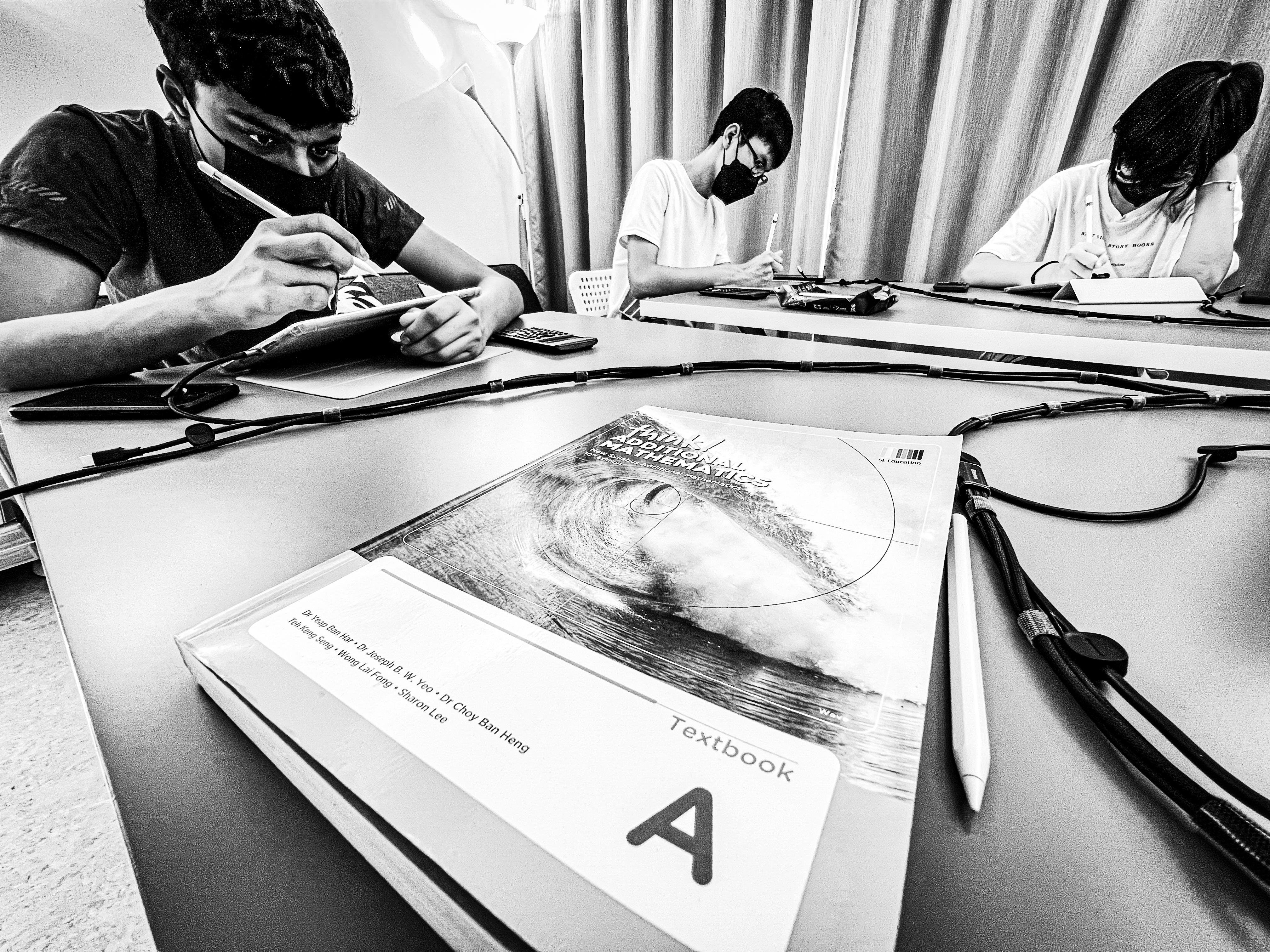
Parent’s quick answer: For a Hougang Secondary 4 learner, small-group Additional Mathematics tuition can make the biggest difference when the student knows individual formulas but cannot use them in an unfamiliar trigonometry, algebra or calculus question. With three pupils, a skilled tutor can compare reasoning, check each student’s first step and correct a misunderstanding before it becomes a rehearsed mistake.
The consequence is that a badly matched group may replace thinking with copying. The fastest child answers first; others imitate without understanding, and tuition seems productive until a school paper removes all the hints. Hougang families should inspect how the tutor protects independent attempts and assess the full journey to a verified teaching venue; the reference Mathematics tutorial is near Sixth Avenue MRT, not a confirmed Hougang A-Math class.
In brief: Confirm G2 or G3 and examination year, diagnose whether difficulty is with method selection, exact values or mathematical working, demand an unseen-question retest and balance fees with sleep and independent revision. A useful tutorial should make the student less dependent on the tutor over time.
- Format: 3-pupil teaching can improve observation and feedback, but only when tasks are individualised.
- Curriculum: verify 2026 O-Level versus 2027 SEC, then check 2027 G3 K341 or G2 K232.
- Evidence: no class size, tutor or amount of homework guarantees an A1 or predetermined grade.
- Location: the immutable Mathematics reference describes a teaching venue near Sixth Avenue MRT; confirm the actual A-Math class.
- Decision: look for durable independent solutions and balance that benefit against time, expense and well-being.
Contents: the parent’s decision in one place
- Hougang student: what Secondary 4 A-Math involves
- The 2026–2027 examination transition and official papers
- How small-group learning works, and where it fails
- Hougang worked examples and family decisions
- Six-week reviews, practical choices and further reading
- Frequently asked questions
Secondary 4 Additional Mathematics for Hougang: a practical definition
Additional Mathematics is not merely a faster version of ordinary Mathematics. Its core work asks learners to manipulate symbolic relationships, recognise mathematical structures and communicate why a technique applies. The 2027 G3 syllabus organises material into algebra, geometry and trigonometry, and calculus; the 2027 G2 syllabus has the same broad strands with a different assessed scope. For a student who struggles, the most important step is often to identify where the mathematics first ceased to make sense.
A parent reading this article may want to know whether a private class in Hougang is necessary. The estate itself cannot answer that question. The class needs to match a specific student, a correct syllabus, a sustainable timetable and a problem that other available support has not already resolved. eduKateSG’s immutable Clementi Mathematics small-group reference describes three learners and a ninety-minute teaching model near Sixth Avenue MRT. Its design supplies a useful educational example, not automatic proof of a current Secondary 4 A-Math vacancy in Hougang.
The assessment requirements parents must get right
| 2027 requirement | G3 Additional Mathematics K341 | G2 Additional Mathematics K232 |
| Earlier reference code | 4049 | 4051 |
| Paper 1 | 2 h 15 min, 90 marks, 50% | 1 h 45 min, 70 marks, 50% |
| Paper 2 | 2 h 15 min, 90 marks, 50% | 1 h 45 min, 70 marks, 50% |
| Assessment objectives (technique / problem-solving / reasoning) | about 35% / 50% / 15% | about 50% / 40% / 10% |
| Working and calculator | Essential working; approved calculator | Essential working; approved calculator |
These figures come from SEAB’s published K341 G3 and K232 G2 2027 syllabuses. The official documents, not a commercial class outline, determine what is examined. The percentages for assessment objectives are approximate paper-level distributions, not targets that a tutor can guarantee. Schools determine their own teaching sequence and internal assessments. A tuition plan should connect to the school’s actual stage and use current official material.
Why smaller classes sometimes help
Why small groups are a teaching choice, not a guarantee
A tutorial with three pupils creates a particular opportunity: the tutor can ask everyone to begin a problem independently, listen to three different explanations and check who can complete the next question without help. This is useful when errors are specific and varied. It is not proof that a small class is always more effective than excellent school teaching, an individual consultation or self-directed practice. A three-student class with weak diagnosis may simply deliver the same worksheet three times.
The distinction matters because parents are choosing an intervention, not a seat count. A learner who cannot begin a logarithmic problem needs a different response from one who understands logarithms but loses accuracy under time pressure. Good tutoring makes that difference visible, teaches the missing step and checks again after a delay. If the arrangement cannot offer that feedback, class size alone does not justify the fees or the time taken from the rest of the week.
What research about small-group tuition can and cannot establish
The Education Endowment Foundation’s small-group tuition evidence review defines small-group tuition as teaching two to five pupils together. Across the research it reviews, the average reported impact is around four additional months of progress compared with similar pupils without the intervention. This is a research average drawn from varying settings and programmes, not a prediction about any Singapore tuition centre or a promise of four months of progress for an individual Secondary 4 learner.
The review also reports smaller average effects in secondary settings than in primary settings, and evidence in Mathematics that is more modest than in reading. The separate class-size review stresses that smaller numbers help only when teachers change what they do. Neither review proves that three is a magic number, that a ninety-minute weekly session is an optimum research dosage or that a particular subject score will rise. The useful lesson is to target known needs, use high-quality feedback and measure independent improvement.
2026 O-Level candidates and 2027 SEC candidates are not the same cohort
A Secondary 4 student sitting national examinations in 2026 follows the final O-Level arrangements. The first Singapore-Cambridge Secondary Education Certificate (SEC) G3 subject examinations are from 2027 under Full Subject-Based Banding. Before selecting a practice paper, parents and tutors should establish the student’s actual examination year and subject level. A familiar A-Math chapter name does not guarantee that the correct paper, timing or syllabus has been selected.
For 2027, SEAB lists G3 Additional Mathematics as K341 (earlier code 4049) and G2 Additional Mathematics as K232 (earlier code 4051). Those are separate qualifications with different specifications. They are not a single ‘SEC A-Math’ workbook for everyone. The family’s first administrative task is to check the school’s subject entry, compare it with the official syllabus, then plan tuition around the content actually assessed.
G3 and G2 Additional Mathematics: the paper facts
The published 2027 G3 K341 examination has two compulsory written papers. Paper 1 runs for 2 hours 15 minutes, contains 12–14 questions and is worth 90 marks; Paper 2 runs for 2 hours 15 minutes, has 9–11 questions and is also worth 90 marks. The weighting is 50 percent for each paper. Essential working must be shown, and an approved calculator may be used. The related G2 K232 assessment also has two compulsory papers, but each is 1 hour 45 minutes and carries 70 marks.
The G2 paper format comprises 13–15 questions in Paper 1 and 8–10 in Paper 2, each worth 50 percent. Assessment objectives also have different weightings: in G3 K341, standard techniques account for roughly 35 percent, problem solving 50 percent and reasoning/communication 15 percent; G2 K232 uses 50, 40 and 10 percent respectively. These are approximate assessment-objective weightings, not a mark forecast for individual questions. Showing steps and explaining results are important at both levels.
Syllabus matching matters more than the age on the class list
Both 2027 subject levels include a structured set of algebra, geometry and trigonometry, and calculus. They are not identical. In the published G3 specifications, topics include binomial expansion, exponential and logarithmic functions, and proofs in plane geometry; these are not listed as assessed topics in the G2 syllabus. G2 still requires serious mathematical work, including trigonometric identities and calculus. A tutor should never assume that because three students are in Secondary 4, they should all receive the same material.
Mixed-level grouping is possible only with deliberate differentiation. The tutor can discuss a common algebraic principle and then assign level-appropriate applications. If one pupil is left coping with unassessed topics while another is never asked to reason beyond routine manipulations, the grouping has failed. Families should request the intended syllabus code, a sample question for their child’s level and an explanation of how the tutor handles differences in pace and readiness.
How to distinguish concept, technique, route and communication errors
A concept error means the pupil does not understand the idea: for example, a derivative as a gradient or why a logarithm has a domain. A technique error means the idea is understood but the calculation is faulty, such as mishandling indices or the sign of a bracket. A route-selection error appears when the student can complete a chapter-labelled exercise but cannot decide what to do in a mixed paper. A communication error appears when the reasoning is sound but the final solution omits a necessary step, unit, answer or justification.
These categories are useful because the remedies differ. A long explanation may help with a concept gap; it will not repair a student’s repeated expansion mistake unless that error is practised and checked. Timed papers may reveal route-selection difficulty but can also reinforce panic if the foundations are missing. Parents can sort three marked questions into these categories before meeting the tutor. Ask for an example of how the tutor would change the next week’s teaching after seeing those exact lines.
Hougang: what the tutor needs to notice
Hougang parent’s first task: find out why trigonometry feels impossible
A pupil may be able to recite sine and cosine values and still find upper-secondary trigonometry intimidating. The challenge changes when angles extend beyond one quadrant, units switch between degrees and radians, graphs become periodic and identities require legal transformations. Rather than treating all ‘trigonometry mistakes’ alike, ask whether the pupil misread the interval, chose the wrong quadrant, confused a function with an inverse or mishandled algebra during simplification.
This distinction should shape the first tutorial. A student struggling with exact values may need triangle and unit-circle reasoning. Another who knows the graph but writes only one valid angle needs interval practice. A third may solve equations accurately while making unjustified steps in an identity. Putting these learners through the same revision notes may be convenient, but it is not sufficiently diagnostic. The value of three pupils is the chance to notice the differences.
Worked example: finding all valid solutions
Consider sin(2θ) = √3/2 for 0° ≤ θ < 180°. The angle 2θ therefore lies in the interval from 0° up to but not including 360°. Sine equals √3/2 at 60° and 120° in that interval, so 2θ = 60° or 120°. Dividing by 2 gives θ = 30° or 60°. A pupil who finds only 30° has recognised one reference angle but not considered the full interval. A pupil who lists 120° as θ has forgotten that the original unknown is half the angle being solved.
The tutor should ask the pupil to draw the sine curve, mark the interval for 2θ and translate the answers back to θ. Then alter the coefficient and interval so the child must reason again. It is more important that the student can justify the full solution set than that they memorise two numbers from this particular example.
When a trigonometric identity is not an equation to solve
Suppose a student is asked to simplify (1 − cos²x)/sin x wherever sin x is non-zero. Since 1 − cos²x = sin²x, the expression simplifies to sin x on that domain. A risky shortcut is to cancel terms before using a valid identity, or to forget the restriction on the denominator. An identity shows equivalent expressions where defined; an equation asks for particular solutions. Those are different mathematical tasks even though the same symbols appear.
A strong group lesson can show a valid and an invalid line side by side. Ask each pupil to explain the restriction and justify the replacement. The tutor can use a contrasting example where cancellation would divide by zero. The lesson should not end when everyone nods at the teacher’s result. It ends when each student can write an independent explanation with the correct domain condition.
The graph provides a second route to check an answer
Trigonometric equations often become easier to check by imagining or drawing the curve. If sin θ = 1/2 on an interval from 0° to 360°, a graph indicates two intersections with the horizontal line at 1/2. A learner who writes only 30° can see the missing second solution at 150°. The graph is not a replacement for accurate algebra; it supplies a different way of verifying that the answer set is complete.
A small group can compare an algebraic solution, a unit-circle argument and a graph. Each pupil should evaluate which route is most efficient for the particular problem. This discussion is especially useful for students who mistake knowing a special angle for understanding a periodic function. A subsequent solo problem reveals whether they can select and apply a checking strategy without the group supplying it.
The difference between a strong student and a fast student
In three-pupil settings, the student who answers first can dominate. But speed is not always depth. A student who reaches an answer quickly may have overlooked a valid second angle, lost a domain restriction or failed to justify a transformation. Another who takes longer may be reasoning carefully. A responsible tutor should ask for an independent first step from all three learners before allowing anyone to explain their route.
This creates a fairer learning environment. The confident pupil can be challenged to defend every step and offer an alternative proof; the quieter pupil gets time to write an initial idea. The tutor then selects examples to correct rather than praising speed alone. Parents should ask whether the child speaks because they understand, or remains silent because someone else always starts. Small groups require active facilitation to prevent copying.
When an apparent trigonometry weakness is really algebra
Many upper-secondary identities are algebraic statements in disguise. A pupil may know sin²x + cos²x = 1 but expand a square incorrectly, factor a denominator carelessly or cancel terms across a sum. Repetition of trigonometric formulas will not necessarily solve the underlying algebra issue. Try a short expression with letters a and b rather than sine and cosine. If the same incorrect move appears, the tutor should repair the operation before returning to the trig question.
An efficient lesson makes that connection visible. First correct one algebraic principle, then use it inside a trigonometric identity, then apply it inside a different-looking function. The student should be able to state what is unchanged across the problems. This helps mathematical transfer because upper-secondary subjects repeatedly reuse earlier skills under unfamiliar notation.
The first independent line reveals more than the final answer
Many students appear fluent when a tutor demonstrates the approach and the class copies the subsequent algebra. To discover whether the learner can act alone, place a new problem in front of the pupil with the chapter heading removed. Ask what is known, what is required and which mathematical relationship is promising. Require one written step before anyone offers a hint. The choice can reveal a stronger understanding or a specific misunderstanding that the final mark conceals.
This practice also creates fair participation in a group of three. A confident classmate should not give away the first move while a quieter child silently agrees. Once all pupils have recorded an independent start, compare the different approaches. The tutor can show why two methods may be valid, which is efficient and where a condition could be lost. Afterwards everyone completes a fresh task alone. That last step, not the eloquence of the group discussion, is the evidence that counts.
Algebra remains the hidden language of calculus
Differentiation and integration require algebraic fluency. A pupil may know the chain rule yet simplify a negative expression incorrectly, copy a power with the wrong sign or cancel terms across addition. When the teacher sees a wrong derivative, the natural temptation is to repeat calculus. The more useful diagnosis asks whether the derivative rule was applied correctly before the algebra went wrong. If the underlying issue is algebra, it may need a short repair exercise unrelated to calculus.
A practical intervention is to put two solutions side by side. One contains an incorrect mathematical rule; the other uses the right rule but goes wrong in expansion. Ask which line is invalid and why. Then have the learner correct a simpler example, return to the original question and attempt a changed problem the next day. This checks whether the repaired skill survives a different context, which is particularly important when Secondary 4 questions combine several earlier chapters.
Why examination working is part of mathematical thinking
SEAB’s G3 Additional Mathematics syllabus states that omission of essential working will result in loss of marks; the G2 syllabus makes the same point. A calculator display, an unexplained jump to an answer or a complicated expression written without supporting reasons may prevent the examiner from following the method. Essential working is not decorative. It helps the candidate verify that each transformation is valid and recover from an error without restarting an entire question.
A well-run small group should practise writing concise, complete mathematics. For an equation, show the formation, transformations, solution candidates and relevant restrictions. For a calculus application, identify what a derivative means before stating the final rate or maximum. For an area question, distinguish a signed integral from geometric area. A tutor who accepts only the final numerical answer may inadvertently train a habit that costs marks in the official examination.
A workable 90-minute small-group design
The reference eduKate Mathematics model describes a 1.5-hour tutorial with three pupils. A possible—not fixed—division of that time is ten minutes for independent retrieval, fifteen for diagnosis, twenty for explanation and questioning, twenty-five for differentiated attempts, ten for a fresh transfer question and ten for correction plus next steps. A lesson can change the proportions if a student has a serious gap. The key is that every pupil spends meaningful time trying mathematics rather than watching the tutor perform it.
Parents can ask a simple question after each class: what did my child do independently that they could not do last week? A clear answer may identify a corrected error, a better method choice or stronger reasoning. An answer consisting only of a list of pages completed is weaker evidence. A three-person group earns its value when the tutor uses those limited minutes to change the student’s independent behaviour, not merely increase the quantity of exposure.
Benefits and consequences require the same honesty
Plausible benefits include more observed attempts, timelier feedback, stronger engagement and opportunities to hear alternative methods. Potential consequences include poor peer matching, domination by one pupil, embarrassment around mistakes, additional homework, expense and less rest. A very strong student may be made to repeat familiar work; a student with severe gaps may be overwhelmed by the class pace. Neither learner benefits from the format merely because only three chairs are occupied.
Parents should treat the tutorial as an experiment with defined aims. Decide what evidence would show that a class is helping, then review it after several weeks. If the student becomes more accurate but increasingly dependent on prompts, the method needs changing. If the student is progressing independently, weekly tuition might be reduced or stopped. The outcome to seek is durable mathematical capability with an acceptable burden on the child’s whole life.
Hougang: making the family decision
What a good tutor does with a partly correct answer
A learner may write the correct first equation and then lose an angle at the final step. Another may have the full correct solution set but present it without referring to the stated interval. The tutor’s feedback should recognise what was valid and isolate what failed. Replacing the entire answer with a finished model obscures where the learner’s own reasoning was strong.
Ask the student to rewrite only the faulty passage in context, explain the condition that was missed and then attempt a new question. In a group of three, different partial solutions can be compared as examples of reasoning, provided no pupil is shamed or labelled as ‘the weak one’. The best teaching turns mistakes into precise decisions that can be improved, not into a performance in front of classmates.
Hougang scheduling: measure the full learning day
A Hougang family should verify the actual Secondary 4 A-Math teaching venue before planning a journey. The immutable Mathematics reference discusses a tutor near Sixth Avenue MRT. There is no basis for assuming that the same A-Math lesson is held inside Hougang merely because Hougang appears in a search title. Ask about current group availability, teaching level and journey requirements rather than relying on a generic estate description.
The relevant burden includes leaving school or home, transit, the ninety-minute lesson, meals, return travel and any homework the tutor adds. If tuition reduces the time available for sleep or other examinable subjects, its benefits must be carefully weighed. Some students may thrive with a specialist and longer journey; others will learn more by taking a nearby school consultation and protecting time for independent revision. There is no universal answer.
A six-week plan for trigonometry without endless drills
Week one uses a few unseen questions to separate angle knowledge, intervals, identities and equation-solving errors. Week two teaches the weakest category with a graphical or geometric explanation. Week three uses a contrast pair: one identity to justify and one equation to solve. Week four includes mixed algebra and trigonometry. Week five adds a short timed set that requires complete answers and checking. Week six asks for a fresh question on an unfamiliar interval solved alone.
This plan is deliberately limited. Six weeks should reveal whether the specific error is improving, not produce a promise of perfect marks. Compare the number of missing solutions, illegal cancellations and incomplete explanations before and after. If the student still cannot choose a starting method, change the teaching approach rather than increasing page counts. Durable understanding is visible in new questions, not only in a polished exercise book.
G2 and G3 trigonometry: similar ideas, distinct expectations
Both 2027 G2 K232 and G3 K341 Additional Mathematics require important trigonometric reasoning, but they are separate syllabuses with different overall scopes and assessment weightings. A mixed-level tutor may teach the shared meaning of radians, exact values and identities in a common discussion, then differentiate tasks according to each candidate’s official specification. Parents should never infer that a student’s assessment level from the general phrase ‘Secondary 4 A-Math’.
Other G3 topics such as binomial expansion and logarithmic functions cannot simply be assigned to G2 students as though they are compulsory current-paper material. Conversely a G3 learner needs suitable practice of these assessed topics. Clarity on that difference avoids needless confusion and allows the limited weekly tuition time to be used for the learner’s real requirements.
Should parents intervene when confidence drops?
Repeatedly missing a second trigonometric solution can make a pupil feel incapable, especially if classmates answer faster. The most helpful response is a repair that the child can recognise. Ask them to draw the interval, mark one correct reference angle, then identify the other valid quadrant. Once the pupil solves a fresh variation independently, the success is concrete. Empty reassurance is less useful than a corrected method that works again.
Parents can protect the learning relationship by asking what the tutor helped the child understand, not which classmate obtained the highest mark. If the student is genuinely distressed by a very small group, consider a different grouping or temporary individual support. The teaching format should create room for effortful thinking without making the learner hide mistakes.
When no tuition may be the best option
A learner who can already identify why each trig solution is complete, check graphs and correct older mistakes may not need another weekly class. They could use occasional school consultations for challenging questions and direct independent practice toward fresh applications. A busy timetable may make this the better option, even for a high-stakes examination year.
If the pupil struggles consistently but the proposed group moves too quickly, that is also a reason not to enrol in that particular session. The correct decision is a better-matched support arrangement, not necessarily a more expensive one. The value lies in what the student can do later without prompts. A small group that cannot deliver this independence is not a sound investment.
How the correction notebook should work
A useful error record contains the original problem, the student’s own first attempt, the exact line where validity was lost, a plain-language statement of the rule, a corrected solution and a later independent retest. Labels such as ‘careless mistake’ are insufficient on their own. Reversing an inequality when multiplying by a negative quantity, applying a logarithm law outside its conditions and forgetting a chain-rule multiplier are different mathematical mistakes and require different reminders.
A small group can share a quick discussion of related mistakes, but each learner needs an individual record because their difficulties may differ. The notebook should also reveal patterns across topics. If the same expansion error appears in trigonometry, calculus and quadratics, the tutor has found a productive repair target. Parents do not need a complex app to monitor this. A dated exercise book with a few complete examples can be enough, provided the student actually revisits those examples independently.
What to measure at the six-week review
Begin with a small baseline set of unseen questions chosen for the student’s syllabus and major weak areas. Record correctness, the first invalid line, whether a method was selected without hints and the time taken. Repeat with new but comparable tasks in later weeks. A rising raw score can be encouraging, but it may reflect easier or more familiar questions. A more trustworthy improvement is that the learner makes fewer repeated errors and can explain the method on work they have not previously seen.
The family should also check the hidden costs: is the student sleeping enough, keeping up with school, doing independent revision and still participating in other important activities? A three-pupil tutorial that improves one topic but destroys the rest of the week’s study routine may be a poor overall choice. Record both mathematical changes and the practical cost. If progress is not visible, revise the teaching plan rather than simply buying more of the same lesson.
When a different support format would be better
School consultations can be excellent for a student with several well-defined questions. Independent practice is often the most efficient option for someone who can recognise and repair mistakes alone. One-to-one help may be preferable for an anxious learner or someone requiring sustained prerequisite teaching at a pace very different from peers. Larger groups can work for routine coverage if the child is already independent. A three-pupil class is one option among several; it is not a compulsory stage of preparing for A-Math.
Try to match the teaching format to the obstacle. If the pupil knows what is wrong and needs only a quick explanation, start with school support. If they repeatedly select unsuitable methods in mixed problems, close observation and structured discussion may be valuable. If they cannot solve foundational equations independently, they may need a period of individual repair before any shared pacing becomes sensible. Ask what success looks like and when the pupil might no longer need the intervention.
The student should own the answer after the tutor leaves
The purpose of a tutorial is transfer: using a learned idea in a new situation without the original helper present. A useful home test one or two days later is to solve a new question with the same underlying structure. The child should explain why that method fits and check the result independently. This is different from copying a model, recognising an answer or being guided through every line by a parent. The more help is supplied during the test, the less it reveals.
Parents can support the process by asking questions rather than giving the next step. ‘What does the question require?’, ‘Which restriction applies?’ and ‘How could you check this result?’ leave responsibility with the learner. If the child gets stuck, keep the incomplete attempt for the tutor. A productive mistake is evidence. A neat page assembled through constant prompting may hide the same weakness until examination day.
A Hougang parent’s decision table
| Option | Most appropriate when | Risk or limitation |
| School teacher consultation | The child has precise questions about recent taught material | Limited time; requires prepared questions |
| Independent study | The child can recognise, correct and check errors | A persistent misconception may go unnoticed |
| Three-pupil tutorial | Individual feedback and peer reasoning would address a diagnosed gap | Poor grouping can reduce individual gains |
| One-to-one tuition | Major foundation repair or highly individual pace is necessary | Cost and the risk of excessive prompting |
| Larger group revision | The learner is mostly independent and needs routine coverage | Less opportunity to inspect detailed workings |
This comparison is a prompt for discussion rather than a ranking. Different arrangements suit different obstacles, and a learner’s needs may change. Many students benefit from a limited period of targeted tuition and then return to self-study. Parents should ask whether the proposed tutor can explain the mechanism of improvement and the conditions under which the arrangement should end.
Frequently asked questions for Hougang parents
What if my child remembers sine and cosine formulas but still gets questions wrong?
Check angle range, quadrant signs, whether the task is an identity or equation, and algebraic transformations.
Why do trigonometric equations have multiple answers?
Periodic functions can take the same value at multiple angles within the specified interval.
How can a group of three prevent copying?
Require everyone to write an independent starting step before any student presents a solution.
Are trigonometric proofs part of G2 A-Math?
Yes, the G2 K232 syllabus includes proofs of simple trigonometric identities; do not confuse this with separate G3 plane-geometry proof requirements.
Is a Hougang teaching venue confirmed?
No. The reference Mathematics tutorial is near Sixth Avenue MRT; confirm the current Secondary 4 A-Math arrangement.
Should we use only topical worksheets?
Topical repair is useful at first, but an examination-ready student also needs mixed problems and independent method selection.
Is one-to-one always better?
No. The right format depends on the learning needs, teaching quality, group fit and costs.
When should we evaluate the class?
Set a short baseline, then review comparable unseen work and the practical burden after several weeks.
A five-step parent action plan
- Confirm whether the pupil is sitting the 2026 O-Level or 2027 SEC, and obtain the correct A-Math subject level.
- Collect three independent attempted questions and identify the first recurring invalid steps.
- Ask the proposed tutor how those errors will be explained, differentiated and independently retested.
- Calculate actual door-to-door travel and the effect on homework, sleep and other examinations.
- Agree on a review after several weeks using new unseen questions; continue only if the learning and life balance justify it.
If the student becomes more capable without help, the intervention has served its educational purpose. If they cannot begin an unfamiliar problem without the teacher’s first line, the programme needs adjustment regardless of how polished the class materials look. The most useful measure is what the learner can do independently at school, at home and eventually in the examination room.
Official references, research and related eduKateSG guides
- SEAB — 2027 SEC G3 subjects, including Additional Mathematics K341
- SEAB — 2027 SEC G2 subjects, including Additional Mathematics K232
- Official G3 K341 Additional Mathematics syllabus PDF
- Official G2 K232 Additional Mathematics syllabus PDF
- EEF — small-group tuition evidence review (interpret averages cautiously)
- EEF — reducing class size evidence review
- The Gold Standard of Secondary 4 Additional Mathematics Tuition
- Secondary 4 A-Math: past-year papers or topical revision first?
- Secondary 4 A-Math: school consultation or tuition before SEC?
- Chain rule or product rule: why pupils mix them up
- How much working should my child show in A-Math?
For enquiries about the specific subject, current tutorial availability and teaching venue, use eduKate Singapore’s parent contact page. A reader from Hougang should confirm transport and arrangements directly before attending. This independent educational guide does not imply that any particular Singapore school endorses the private tuition service or that a named estate has a verified tutorial branch.
The conclusion: assess the student, not the advertisement
A carefully organised three-student Secondary 4 Additional Mathematics tutorial may repair errors, strengthen explanation and improve independent handling of difficult questions. It may also be unnecessary, overly demanding or unsuitable for a particular learner. The best Hougang decision begins with the student’s actual mathematical work, the correct SEAB syllabus and a realistic timetable. A parent’s goal is not more weekly lessons. It is better mathematical judgement that lasts when no tutor is present.