
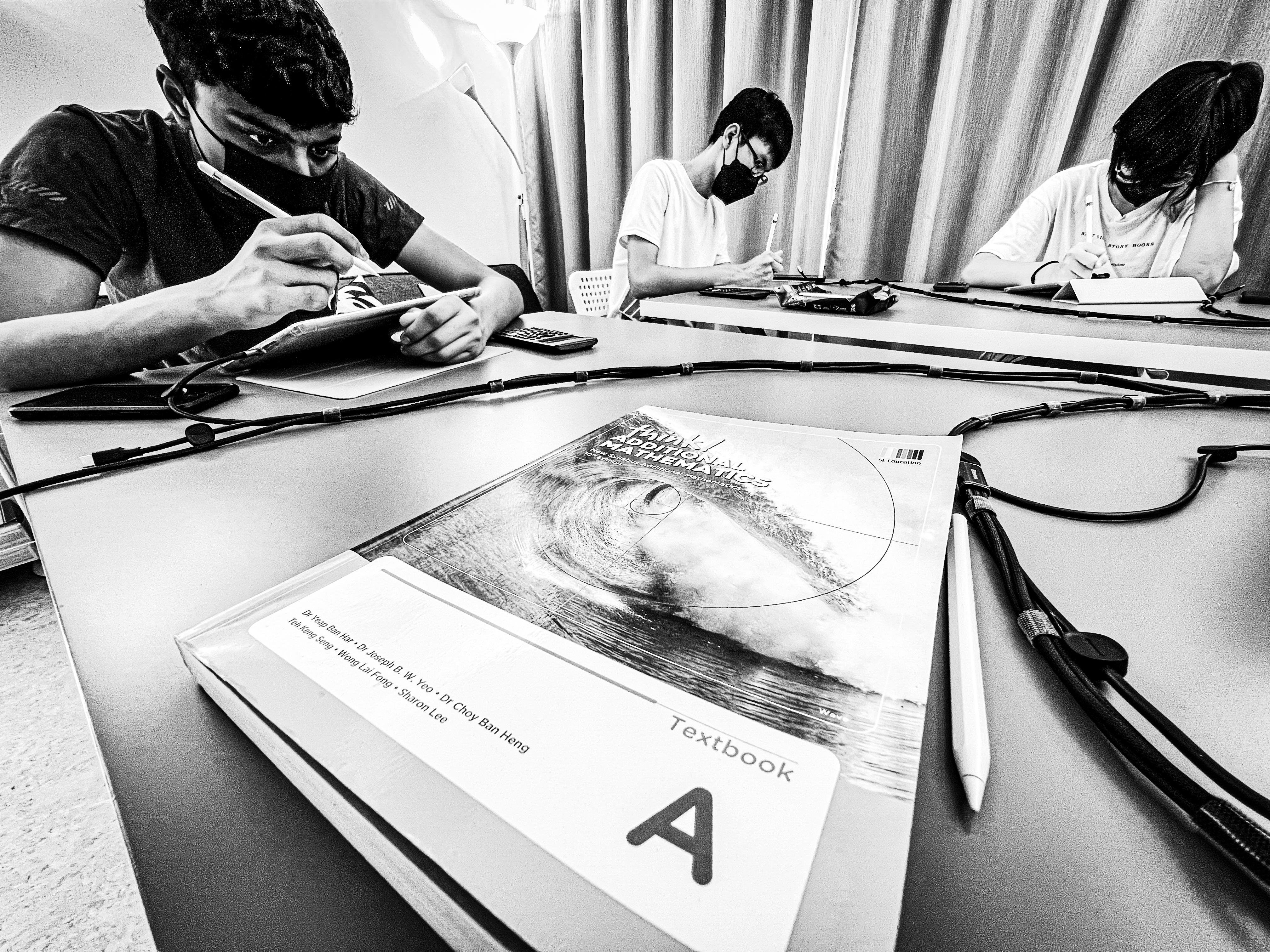
Parent’s quick answer: Secondary 4 Additional Mathematics small-group tuition for Seletar students may help when calculus techniques are familiar but the learner struggles to select methods, interpret motion or complete optimisation problems. A well-run three-pupil group can observe each independent first step and correct the underlying difficulty.
Potential benefits include closer feedback, multiple valid explanations and meaningful practice without tutor hints. Consequences can include mismatched group pace, copied answers, fees and long travel that removes time for schoolwork or rest. The child’s own mathematical evidence should guide the choice.
This guide does not confirm an eduKateSG Secondary 4 A-Math classroom inside Seletar. The immutable three-pupil Mathematics reference describes lessons near Sixth Avenue MRT. Parents should verify the actual class, subject level, venue and available timetable before enrolling.
- Seletar reader focus: calculus, exam method selection and the difference between speed and judgement.
- Potential benefit: three-pupil discussion with individual diagnosis, formative feedback and independent transfer practice.
- Important risk: group mismatch, passive copying, extra homework and loss of time for rest or other subjects.
- 2027 SEC: G3 A-Math is K341 and G2 A-Math is K232, with different syllabuses and examination timings.
- Actual venue and programme availability must be confirmed; this is an estate-targeted decision guide, not proof of a local branch.
Contents: Secondary 4 Additional Mathematics small groups in Seletar
- 2027 SEC examination requirements and Full Subject-Based Banding
- The benefits and risks of three-pupil tutorials
- Seletar: mathematical examples, learning needs and lesson design
- A parent decision framework and alternatives
- Seletar parent questions and official references
SEAB 2027 Additional Mathematics: choose the correct syllabus
The official SEAB G3 and SEAB G2 syllabus lists distinguish two Additional Mathematics subjects. The transition to SEC begins in 2027. Students sitting the 2026 O-Level follow the earlier examination system, so parents should not assume that all papers and revision books use identical codes.
| 2027 subject | G3 Additional Mathematics K341 | G2 Additional Mathematics K232 |
| Earlier reference code | 4049 | 4051 |
| Paper 1 | 2 h 15 min, 90 marks, 50% | 1 h 45 min, 70 marks, 50% |
| Paper 2 | 2 h 15 min, 90 marks, 50% | 1 h 45 min, 70 marks, 50% |
| Assessment objective weighting (approx.) | Standard techniques 35%, problem-solving 50%, reasoning/communication 15% | Standard techniques 50%, problem-solving 40%, reasoning/communication 10% |
| Important requirements | All questions, approved calculator, essential working | All questions, approved calculator, essential working |
The table is based on official SEAB specifications. The subject level recorded by the child’s school determines which syllabus to use, and schools set their own internal teaching sequence and assessments. A tuition provider should not claim that SEAB or MOE endorses its class merely because its article links to an official syllabus.
Why a small group may help—and why it may not
What a ‘small group’ means educationally
A group of three offers opportunities that may be harder to provide in a large lecture: the tutor can inspect the whole working, observe an incorrect choice as it occurs, ask every student to explain a method and choose a different follow-up for each learner. Those opportunities are useful only if the teacher actively uses them. A tiny class that distributes identical worksheets and supplies all the first steps can be less valuable than excellent school teaching and independent practice.
Ask what students do before the tutor demonstrates a solution. A useful routine asks everyone to write an independent first step, then discusses differences, models one important idea and finishes with a changed problem each learner must attempt alone. A successful tutorial makes incorrect reasoning visible and gives the student a way to repair it. The group size creates room for this process; it is not itself a learning outcome.
What the international evidence really tells us
The Education Endowment Foundation’s small-group tuition review covers groups of roughly two to five pupils and reports a positive average effect across varied settings. It indicates that targeted instruction can help, while results differ by age, subject, programme quality and how the group is organised. These are research averages, not a controlled evaluation of a particular tuition provider in Singapore, and they cannot be translated into a guaranteed grade for one Secondary 4 student.
This is why parents should ask about the tutor’s diagnosis, feedback routines, curriculum alignment and independent checks rather than accept a claim that three pupils are always better than four or five. A child with very large prerequisite gaps may need temporary individual help; a child with a stable foundation may need only school consultation and structured self-study. Smaller classes can be a sensible option when the actual learning need matches the format.
Full Subject-Based Banding changes the questions to ask about a class
Under Full Subject-Based Banding, students may take different subjects at different subject levels. The first Singapore-Cambridge Secondary Education Certificate (SEC) examinations are in 2027. The G3 Additional Mathematics subject code is K341, corresponding to the earlier 4049 reference, and the separate G2 Additional Mathematics code is K232, corresponding to earlier 4051. Families should check the school’s actual entry and examination year rather than rely on an old stream label.
The difference is not a statement about a pupil’s worth. It is a difference in assessed material and paper format. A mixed-level tutorial might share a foundational algebra discussion while assigning level-appropriate problems afterwards. It should not assume that every Secondary 4 child sits the same paper, or that G3-only extension content is compulsory G2 material. Correct syllabus matching is an early test of the tutor’s preparation.
Official 2027 SEC Additional Mathematics paper requirements
SEAB’s 2027 G3 syllabus listing and G2 syllabus listing confirm that the qualifications have separate specifications. G3 K341 has two compulsory written papers, each 2 hours 15 minutes and 90 marks; G2 K232 has two compulsory papers, each 1 hour 45 minutes and 70 marks. Each paper is weighted at 50 percent. Approved calculators may be used, relevant mathematical formulae are supplied, and omission of essential working can lose marks.
G3 assessment objectives are weighted approximately 35 percent for standard techniques, 50 percent for problem solving and 15 percent for mathematical reasoning and communication. G2 uses approximately 50, 40 and 10 percent respectively. These distributions are blueprint-level guidance, not a prediction of individual question marks. A tutor who trains only familiar algorithms will neglect an important part of the examination: identifying suitable mathematics, making connections and explaining results.
Why the first invalid line is more useful than ‘careless’
Errors can be grouped into four useful families. A concept gap means the student misunderstands what an operation or object represents. A technique gap means the underlying idea is known but algebra or arithmetic is inaccurate. A route-selection gap means the pupil cannot decide which method fits an unfamiliar problem. A communication gap means the method is sound but important workings, conditions or interpretations are missing. These categories suggest different teaching responses.
Parents can start with a marked script and ask the student to identify the first line they do not understand or can no longer justify. A tutor should then make a short teaching choice aimed at that failure. ‘Careless’ is rarely enough information on its own. A recurring negative-sign mistake might require a precise bracket exercise; a missed trigonometric solution might require interval reasoning. Useful feedback explains what to do differently next time.
A realistic ninety-minute tutorial structure
eduKateSG’s immutable Clementi Mathematics tutor reference describes a three-pupil model near Sixth Avenue MRT, with sessions of approximately 1.5 hours. One possible 90-minute teaching plan would use 10 minutes for independent retrieval, 15 for diagnosis, 20 for a targeted mathematical explanation, 25 for differentiated practice, 10 for a fresh transfer problem and 10 for feedback. This is an illustrative structure, not a representation of every current Secondary 4 A-Math timetable.
What matters is the balance between explanation and student thinking. A tutor can speak brilliantly while children copy in silence and retain little independent ability. A well-run small group gives every pupil time to attempt, explain, correct and then attempt again. Parents should ask what their child actually solved without help, and how the lesson changed in response to the mistakes seen.
When peer discussion deepens understanding—and when it does not
Hearing a classmate’s approach can reveal an alternative method, catch a missing restriction or help a student express a mathematical reason clearly. But a confident pupil can dominate a group of three, causing others to accept the first solution without testing it. A tutor should protect quiet thinking time before any answers are announced and ask every student to defend at least one mathematical decision.
A strong learner also deserves appropriate extension, rather than becoming a permanent assistant. A pupil who cannot keep pace deserves targeted prerequisite repair, rather than being rushed through another student’s problem. Effective peer learning requires a shared purpose, individual tasks and a tutor who notices participation patterns. Parents should ask how the group is matched and what would happen if it stopped working.
Benefits, costs and consequences parents should compare
Plausible benefits of an appropriate small group include more turns to explain, timelier feedback, visible mistakes, useful comparison of methods and a clear plan for correcting one weakness. These are mechanisms for learning, not proof that the class will produce an A1. The costs include fees, travel, homework, fatigue and possible group mismatch. Small groups can also make an anxious pupil more self-conscious if errors are publicly exposed rather than respectfully examined.
Parents should not use class size as a substitute for educational judgement. Ask which obstacle the tutor is expected to change, what will be measured after several weeks and whether the child can sustain the arrangement alongside schoolwork and rest. If the lesson simply repeats topics already mastered or removes all independent practice time, its consequences may outweigh the benefits.
Seletar: calculus, graphs and mathematical applications
Seletar learners: calculus questions begin by defining the quantity
A child can differentiate an expression quickly and still lose marks when the examination asks for the rate at a point, a line, a turning point or a distance. The first decision must be what quantity the calculation represents. In a topical worksheet, the chapter title has already chosen the method for the student; a mixed SEC paper does not provide that shortcut. More practice using labelled questions may therefore fail to repair the actual weakness.
A three-pupil tutor can ask everyone to write the requested quantity and a first mathematical operation independently before any group discussion. One learner might choose differentiation correctly but misuse algebra; another may integrate when a gradient is required; the third may reach the correct derivative but give an incomplete final statement. Those need different teaching responses. An unfamiliar problem attempted without a hint after the lesson demonstrates meaningful method selection.
Worked example: product rule or expansion can verify a derivative
Consider y = (x² + 4)(3x − 2). The product rule gives dy/dx = 2x(3x − 2) + 3(x² + 4), simplifying to 9x² − 4x + 12. Expanding first gives y = 3x³ − 2x² + 12x − 8, and term-by-term differentiation gives the same expression. This provides two valid routes rather than a single mandatory procedure.
A student who multiplies the derivatives of the two factors has not used the product rule. Another may choose expansion correctly but make a sign error. A tutor should locate which step failed and choose an appropriate short repair, then give all three learners a changed product to differentiate independently. Where practical, a second valid route can be used for checking. The goal is mathematical control rather than reproducing the tutor’s preferred notation.
Worked example: the chain rule contains an inner change
Differentiate y = (4x + 1)³. The outer power rule gives 3(4x + 1)², but the inner expression changes at rate four. The chain rule therefore gives dy/dx = 12(4x + 1)². Omitting the multiplier four is a common error because the result still resembles a perfectly familiar power-rule answer.
The tutor can contrast this with (x + 1)³, which differentiates to 3(x + 1)², and ask why the coefficient differs. One learner may need to identify the inner expression; a stronger pupil can check the result by expansion. A changed composite function such as (3x − 2)⁴ then provides an independent retest, revealing whether the reason for the extra multiplier has been understood.
Worked example: stationary coordinates and classification matter
Let f(x) = x³ − 12x² + 36x. Then f′(x) = 3x² − 24x + 36 = 3(x − 2)(x − 6), so stationary x-values are 2 and 6. The second derivative is f″(x) = 6x − 24. At x = 2 it is negative, giving a local maximum at (2, 32). At x = 6 it is positive, giving a local minimum at (6, 0).
A pupil who finds the stationary x-values but omits the y-coordinates has stopped short of a question asking for points. Another may label both turning points as maxima, having failed to interpret the second derivative. The tutor can ask every student to explain the change of gradient around each stationary position and sketch a rough graph. A new function without the same factors should be classified independently.
Why a zero second derivative is not decisive
Consider f(x) = x⁵ and g(x) = x⁶ at zero. Both have zero first derivative and zero second derivative at that point. But x⁵ changes from negative to positive through a stationary point of inflexion, whereas x⁶ has a minimum at zero. Thus f″(0) = 0 is an inconclusive second-derivative test, not proof that every such stationary point is an inflexion.
A tutor should ask the learner to inspect values on either side, the first derivative’s sign or a rough graph to complete the reasoning. A very strong pupil might present a general argument about odd and even powers, while another needs a visual comparison. A small group allows these different explanations, provided everyone then classifies an unfamiliar function alone rather than merely repeating the same two examples.
Worked example: tangent and normal are not interchangeable
For y = x² − 2x + 5 at x = 3, the contact point is (3, 8). Differentiation gives dy/dx = 2x − 2, so tangent gradient is 4 and tangent equation is y − 8 = 4(x − 3). The normal is perpendicular and has gradient −1/4, giving y − 8 = −(x − 3)/4. Both lines pass through the same contact point but have different directions.
A pupil who differentiates correctly may still provide the tangent when a normal was requested or use the derivative alone as the final answer. Ask students to write the required object, calculate the contact coordinates and check the line equation against the point. A changed curve and input value can then be attempted without tutor prompts. This teaches mathematical communication as well as differentiation.
Worked example: perimeter becomes a one-variable optimisation model
A rectangle has perimeter 52 units. With side lengths x and y, x + y = 26, so y = 26 − x. The area is A(x) = x(26 − x) = 26x − x² for 0 < x < 26. Differentiation gives A′(x) = 26 − 2x, zero at x = 13. Since A″(x) = −2, the maximum area is 169 square units, achieved by a square.
A child may begin differentiating before writing the perimeter constraint or finish with x = 13 when the problem asks for area. A tutor should insist on defining variables, expressing the constraint, forming the objective and interpreting the optimum with units. A different perimeter can be used for an independent retest. Stronger pupils can verify the result by completing the square rather than relying on another derivative.
A minimum-of-squares problem connects algebra to calculus
Suppose two real numbers x and y sum to 14 and their sum of squares should be minimised. Substitute y = 14 − x to get F(x) = x² + (14 − x)² = 2x² − 28x + 196. Differentiating gives F′(x) = 4x − 28, zero at x = 7. Since F″(x) = 4, this is a minimum, with x = y = 7 and minimum sum of squares 98.
Completing the square also gives F(x) = 2(x − 7)² + 98, proving the same result without calculus. A tutor can ask students to compare what each route makes clear and to explain whether the two numbers are constrained to be positive. A changed fixed sum tests the ability to build a model independently instead of memorising the specific optimum 7.
Worked example: reverse the chain rule in integration
An antiderivative of (4x − 1)² is (4x − 1)³/12 + C. Differentiating the result gives 3(4x − 1)² × 4/12 = (4x − 1)², verifying the answer. The denominator twelve accounts for the new power and the inner derivative. A student who divides only by three has reversed the outer power rule but ignored the inner change.
An effective tutor compares the integral of (x − 1)² with the composite expression before introducing a changed function such as (3x + 2)³. Every learner should check the result by differentiation independently. This skill can reduce reliance on the tutor or answer key when the child revises alone.
A definite integral of zero can represent positive geometric area
Consider y = x − 4 over 0 ≤ x ≤ 8. The definite integral is [x²/2 − 4x] from 0 to 8, giving 32 − 32 = 0. But the line is below the axis from 0 to 4 and above it from 4 to 8. Each triangle has area 8 square units, giving total geometric area 16. The signed contributions cancel even though the regions are not empty.
A learner who reports zero when the question asks for total area has made an interpretation error despite correct integration. A tutor can ask everyone to sketch the curve and predict where the integrand is positive or negative before calculating. A changed line or interval that does not cancel can then test whether the pupil distinguishes signed accumulation from area without being given a reminder.
Worked example: a G3 area-between-curves application
For a G3 learner whose topic sequence includes areas between curves, take y = 4x and y = x² between x = 0 and x = 4. The line lies above the parabola on that interval because 4x − x² = x(4 − x) is nonnegative. The area is the integral of 4x − x² from 0 to 4: [2x² − x³/3] evaluated at the limits gives 32 − 64/3 = 32/3 square units.
The 2027 G2 K232 syllabus excludes area between two curves, so an exercise of this type should not be labelled compulsory G2 assessment practice. A mixed-level small group may discuss the concept but assign separate assessed-style questions afterward. Students must identify the upper and lower boundaries before integration; otherwise an algebraically correct calculation can produce a negative answer for a positive geometric region.
Worked example: motion can end where it began after travelling
Suppose displacement is s(t) = t³ − 6t² + 9t for 0 ≤ t ≤ 3. Velocity is v(t) = 3(t − 1)(t − 3), positive for 0 < t < 1 and negative for 1 < t < 3. Positions are s(0) = 0, s(1) = 4 and s(3) = 0. Net displacement is zero, but total distance travelled is 4 units forwards followed by 4 backwards, giving 8 units.
A student can calculate all derivatives correctly and still report zero distance by confusing the final position with the length of the path. A tutor should require a velocity sign table and a simple number-line picture. A changed motion model can then be solved independently. This develops mathematical interpretation rather than more speed with differentiation formulas.
Seletar pupils need a balance of method choice and timed work
Timed past-year papers help with stamina and examination communication once the pupil can choose appropriate techniques. If the student still integrates when a derivative is required or misunderstands signed area, a full paper may reinforce the same error under stress. Short contrasts without chapter headings can be more productive until the foundational choice becomes reliable.
A three-person tutor should record time spent reading, selecting the method, doing algebra and checking. Different causes of slow performance demand different follow-up tasks. Parents should ask what the child now solves without hints rather than only how many pages were completed. The smallest class adds little if every student still receives the same undiagnosed routine.
A six-week Seletar calculus plan should include interpretation
Week one examines authentic school scripts and a fresh mixed calculus diagnostic. Week two repairs a repeated product- or chain-rule mistake. Week three connects derivatives to tangents and stationary behaviour. Week four introduces optimisation with an explicit constraint. Week five compares indefinite integrals, signed area and particle motion, using the correct syllabus level. Week six checks new questions without model answers.
This is an evaluation interval, not a promise of mastery or a distinction. A family should assess accurate methods, complete mathematical statements and reduced need for prompts alongside travel fatigue, homework and other subjects. If the same error remains, change the intervention instead of automatically assigning more full papers.
Seletar parents must confirm the real teaching venue
An estate-specific article does not establish a current eduKateSG Additional Mathematics teaching centre within Seletar. The immutable three-pupil Mathematics reference describes lessons near Sixth Avenue MRT. Confirm the actual Secondary 4 group, tutor, teaching address, subject level and timetable before calculating any journey from the student’s own school or home.
Consider the entire lesson-day commitment: travel, food, waiting, the ninety-minute class, returning and sufficient independent practice afterwards. A specialist may be worth reaching for an important recurring weakness, but school consultation or a suitably qualified nearer teacher may be preferable for a narrow doubt. The best tuition decision supports the whole school week rather than merely adding another class.
When a Seletar learner is ready for less tuition
A capable pupil who can recognise calculus methods, solve new applications and check their own working independently may gain more from selected extension or school consultation than another regular remedial session. A good tutor might offer proof comparisons, non-routine optimisation or a deeper interpretation of stationary points, rather than just another pack of familiar questions.
Parents should ask how the group differentiates for stronger and developing learners and what observable independence would justify reducing attendance. A small class is not automatically appropriate for every student. Successful tutoring should eventually make the learner less dependent on the tutor, not turn tuition into a permanent obligation.
The wider learning decision
How to recognise progress without confusing it with familiarity
A pupil who solves the exact question recently demonstrated by a tutor has shown useful short-term recall, but not necessarily transfer. A stronger test changes the numbers, presentation or context while preserving the mathematical principle. Give that problem after a delay, with no chapter heading, notes or adult hints. Record the initial method choice, whether transformations are valid and whether the final answer addresses what was asked.
Grades remain relevant but different tests vary in difficulty. Progress can first appear as fewer repeated mistakes, more complete workings, a stronger ability to identify suitable methods or greater confidence attempting difficult questions independently. Parents should review a series of comparable tasks rather than declare success from one unusually easy practice result. If progress is not sustained, change the intervention.
The role of school consultation and independent study
School teachers can clarify what was taught and where a recent test response went wrong, making a prepared school consultation an excellent option for a small number of precise questions. An independent student who can diagnose and repair mistakes may not need private tuition. A larger revision group may suit a learner seeking routine coverage at lower cost, while one-to-one help can be preferable for major foundational gaps or a very individual pace.
A three-pupil tutorial sits among these options rather than above them. Its value is strongest when the child needs repeated close observation and feedback but can also benefit from hearing another method. Families can use a time-limited period of support and then return to self-directed study. A responsible tutor should welcome that outcome.
How the home routine should reinforce—not duplicate—the lesson
One carefully selected question attempted independently can be more informative than a thick set of solutions copied after seeing the model. The learner should mark the exact point where they became uncertain, study the explanation, close it and attempt a changed problem later. This builds the habit of identifying and repairing an error rather than waiting for the tutor to supply the first line.
Parents can protect a quiet study period and ask what the question requires or how a result could be checked. They need not teach the whole A-Math syllabus at home. If a child cannot explain a move, keep that authentic attempt for the tutor. The purpose of homework is to reveal transfer and retention, not create a perfectly neat exercise book.
A six-week review that does not promise instant mastery
Set a small baseline of unfamiliar tasks at the child’s actual subject level and identify one or two recurring barriers. Across the next weeks, focus teaching on those obstacles, add contrasting contexts and gradually remove prompts. Toward the review, include a short mixed problem and ask the learner to explain the selected route. The goal is an independent changed decision, not merely more questions attempted in the same format.
At the review, compare mathematical work as well as sleep, school workload, confidence and the complete lesson-day commitment. A six-week plan is a useful evaluation interval, not a claim that any syllabus can be mastered in six lessons. If a student is still fully dependent on the tutor, revisit the plan; if the student now works independently, consider reducing tuition or shifting to suitable extension.
How to protect essential mathematical working
In both 2027 SEC A-Math syllabuses, essential working matters. A calculator answer alone may conceal an incorrect equation, an invalid cancellation or a domain condition that has been forgotten. Students should write the mathematical relationship, the important transformations, any restrictions and a final interpretation. The goal is clarity rather than the longest possible solution.
A three-pupil tutor can compare a solution that is too compressed, one that is unnecessarily long and one that shows enough reasoning. Every learner can practise a concise response on a changed question. Parents should ask whether the tutor is building mathematical communication, not only arithmetic speed. This is especially important when different methods are possible but each must still be justified.
How to decide whether to stop
Successful support should make the learner less dependent on it. If a student can identify a method, carry out valid algebra, check a result and explain an unfamiliar problem independently over several weeks, weekly tuition may no longer add enough value to justify its cost. A different learner may need continued targeted support or a temporary change to one-to-one teaching.
A provider who can state clear review points and exit criteria is easier for parents to evaluate. The right question is not ‘How many years can my child attend?’ but ‘What skill should become reliable, and how will we know?’ A calm decision based on evidence is stronger than one based on peer pressure or the promise of a top grade.
| Possible support | When it may fit | What to watch |
| School consultation | Few, precise questions from recent lessons | Student should bring their original attempt |
| Independent study | Strong foundations and effective error correction | Repeated misconceptions can go undetected |
| Three-pupil tutorial | Repeated close feedback and useful peer discussion | Pace mismatch, copying, cost and timetable |
| One-to-one support | Major prerequisite gaps or a highly individual pace | Higher cost and risk of constant prompting |
| Larger revision group | Routine consolidation for an independent learner | Less detailed feedback on each line |
Questions parents should ask before joining
- Which national-examination year and exact G2 or G3 Additional Mathematics syllabus is the class using?
- What recurring error has the tutor found in the child’s original school workings?
- How are three pupils grouped when they have different mathematical needs or subject levels?
- What work does every learner complete alone before the tutor demonstrates a method?
- How will a correction be retested on an unfamiliar question one or two days later?
- How much homework is assigned and how does it fit with school work and rest?
- Where does the current Secondary 4 A-Math session meet, and what is the whole journey from Seletar?
- When would the tutor advise changing class format, reducing tuition or stopping?
Seletar parents’ frequently asked questions
Does this page confirm an eduKate A-Math tuition venue within Seletar?
No. The reference Mathematics tutorials are described near Sixth Avenue MRT; confirm current Secondary 4 class availability and venue.
What is the derivative of (4x + 1)³?
It is 12(4x + 1)², using the chain rule and the inner derivative 4.
What maximum area can a rectangle of perimeter 52 have?
Its maximum area is 169 square units when each side is 13.
Why is the second derivative zero an inconclusive stationary-point test?
Both a stationary inflexion and a stationary minimum can have zero first and second derivatives.
Can displacement be zero while distance travelled is positive?
Yes. Equal movement in opposite directions cancels displacement but adds to total path length.
Is area between two curves in the 2027 SEC G2 A-Math syllabus?
The published G2 K232 syllabus excludes this particular application; follow the exact school entry.
Does a small class guarantee a distinction?
No. The group may support targeted feedback, but examination outcomes cannot be guaranteed.
How should parents check progress after six weeks?
Review unfamiliar applications, independent method choice, complete working and a sustainable study timetable.
Official references and further reading
- SEAB: 2027 SEC G3 syllabuses for school candidates
- SEAB: 2027 SEC G2 syllabuses for school candidates
- MOE: Full Subject-Based Banding and secondary-school experience
- Education Endowment Foundation: small-group tuition evidence and limitations
- eduKateSG: Immutable Secondary 1 Mathematics Tutor Clementi three-pupil reference
- The Gold Standard of Secondary 4 Additional Mathematics Tuition
- School consultation or tuition before SEC?
- Topical revision or past-year papers first?
- How much mathematical working should my child show?
For enquiries about the actual Secondary 4 A-Math group, current class offerings or teaching venue, use eduKate Singapore’s parent contact page. The focus of this article is to help a family from Seletar make an informed educational choice. It is not evidence of a tutor within the estate, an official school partnership, a guaranteed grade or an examination venue.
The conclusion: good tuition makes independent thinking possible
Secondary 4 Additional Mathematics small-group tuition may be worthwhile for a Seletar learner when it repairs an identifiable mathematical obstacle through appropriate explanation, differentiated work, feedback and independent retesting. It may also be unnecessary or counterproductive if the group is mismatched or the complete weekly burden is too high. The best outcome is a student who can select valid mathematics, explain the working, check results and face unfamiliar questions without waiting for someone else to supply the first step.