
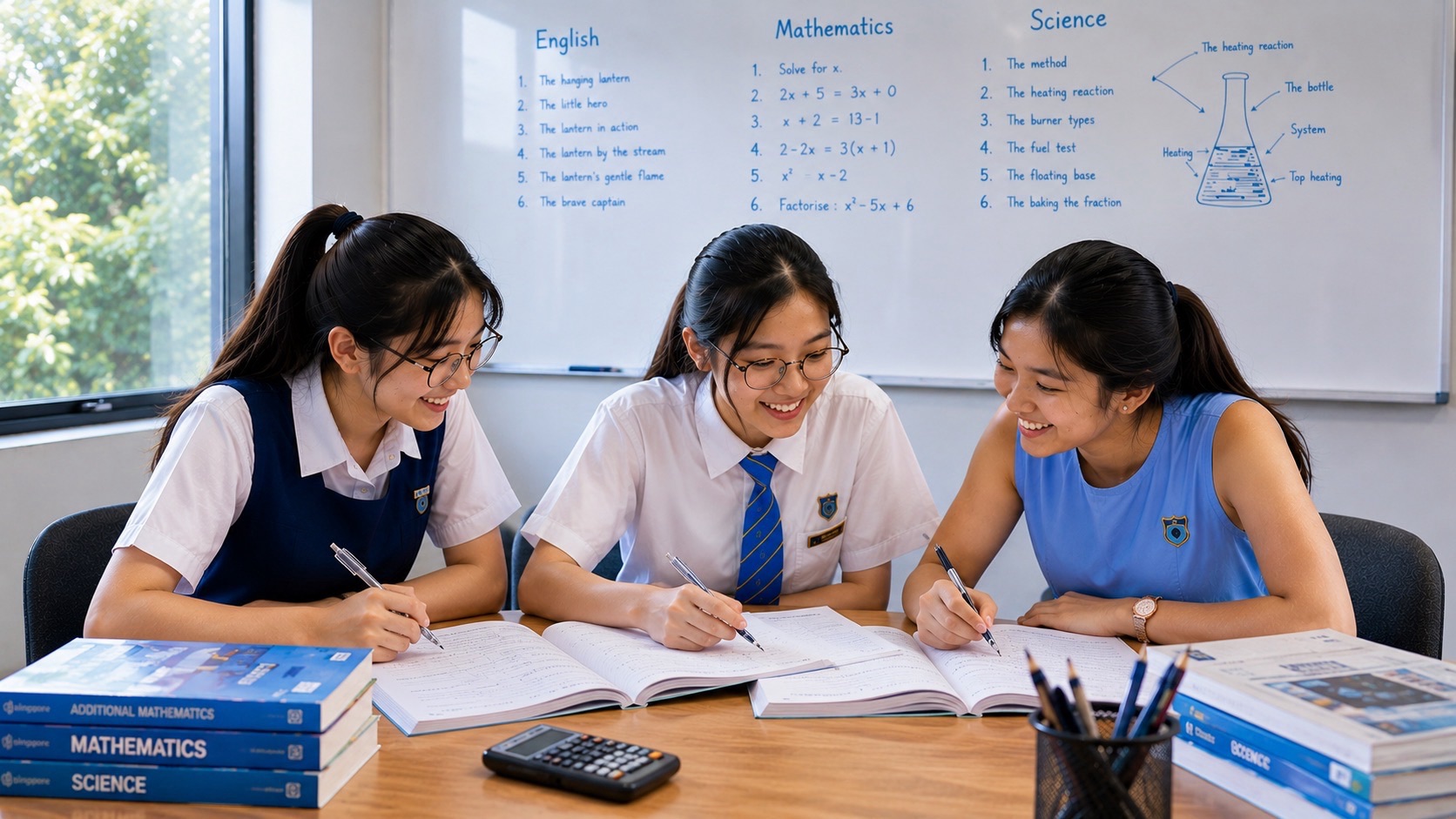
Secondary 4 Additional Mathematics Tuition | Jalan Kayu is for students who now need the entire A-Math system to become dependable under examination conditions.
For Jalan Kayu families, eduKateSG provides carefully managed three-student Additional Mathematics classes through our established Punggol and Bukit Timah teaching locations, subject to level, timetable, class fit and availability. Jalan Kayu sits on the north-western edge of Sengkang beside Seletar, giving many families a practical route towards Punggol while retaining the Bukit Timah option where school location, timetable or class fit makes that more suitable.
Secondary 4 changes the learning task.
The question is no longer only whether the student has learned a chapter.
The student must now retrieve, select, execute, connect and check under time pressure.
That means Secondary 4 A-Math tuition should focus on four jobs at once:
- repairing high-impact foundations left unstable from Secondary 3;
- completing and consolidating remaining syllabus content;
- integrating topics so the student can recognise methods in mixed questions; and
- converting knowledge into stable paper performance.
Classes are limited to three students. Lessons are generally 1.5 hours weekly, with targeted repair, mixed-topic work, timed micro-sets, full-paper practice, error analysis and mark-protection routines.
Immediate Concerns of a Secondary 4 Additional Mathematics Parent and Student in Jalan Kayu—and How eduKateSG Can Help
Secondary 4 is where the entire Additional Mathematics system has to come together.
A student may know many individual chapters and still perform inconsistently because examination performance requires several abilities at the same time.
The learner must recognise the topic, retrieve the right method, choose a route, preserve algebraic accuracy, manage time, notice when a solution is failing and recover without losing control of the rest of the paper.
This is why Secondary 4 often exposes weaknesses that were less visible when topics were practised separately.
A student may look strong in topical revision but become uncertain in a full paper because the chapter label has disappeared.
The difficulty is no longer only knowledge.
It is integrated execution.
The Three Jobs of Secondary 4 A-Math
1. Repair what Secondary 3 left unstable
Weak algebra, uncertain functions, incomplete trigonometry or poor graph interpretation cannot simply be carried forward.
These gaps may have been manageable when chapters were taught separately. In full-paper conditions, they begin to affect several questions at once.
2. Complete and connect the remaining syllabus
New content must still be learned, but earlier content must remain retrievable at the same time.
The student cannot finish the latest chapter while allowing the first half of the syllabus to disappear.
3. Convert knowledge into examination performance
The student must practise mixed recognition, time control, solution presentation, checking, route selection and recovery from unfamiliar questions.
These jobs compete for time.
A strong Secondary 4 plan therefore needs priorities.
The Wrong Strategy: Treat Every Weakness as Equal
When a student is behind, the instinct is often to restart everything from the beginning.
That is rarely the most efficient response in an examination year.
Some weaknesses create far more downstream damage than others.
Algebra is the clearest example.
If algebraic manipulation is unstable, the same weakness can affect logarithms, coordinate geometry, trigonometry, functions and calculus.
Repairing one high-leverage skill can therefore improve several parts of the paper simultaneously.
- Which error type is costing the most marks?
- Which prerequisite appears inside the largest number of current topics?
- Which topic can be secured quickly to create reliable marks?
- Which weakness is slowing the entire paper?
- Which correction will have the greatest downstream effect?
This keeps revision selective and purposeful.
A-Math Execution Debt
Small unrepaired weaknesses can accumulate quietly across Secondary 3 and early Secondary 4.
A sign error is corrected once but the habit remains. A function idea is understood just well enough to pass one test but not well enough to transfer. A trigonometric identity is memorised without the student understanding when it becomes useful.
Each weakness appears small in isolation.
Under full-paper load, they begin interacting.
The result can look like sudden collapse:
- the student starts confidently but slows badly in the middle;
- several questions are left incomplete;
- answers are lost through algebra even when the concept is known;
- mixed-topic questions feel much harder than topical exercises;
- the learner repeatedly checks the answer key instead of committing to a route;
- one difficult question affects the rest of the paper; and
- test results fluctuate more than the student’s actual understanding suggests.
The purpose of Secondary 4 tuition is to reduce that execution debt before the final examination environment exposes it fully.
The First Diagnostic: Is the Problem Knowledge, Execution or Transfer?
A 55% paper and another 55% paper can represent completely different students.
One learner may have major concept gaps. Another may understand most of the syllabus but lose marks through algebra, time control and incomplete working.
We separate the causes.
Knowledge gap
The student does not know or understand the relevant concept. The repair is explanation and rebuilding.
Execution gap
The concept is understood but algebra, notation, accuracy or sequencing breaks down. The repair is disciplined practice and line-level correction.
Transfer gap
The student can solve familiar exercises but cannot recognise the same idea in a new form. The repair is controlled variation and mixed-topic work.
Time-control gap
The student can solve the questions but not efficiently enough. The repair is route selection, pacing, stop-loss rules and timed practice.
Checking gap
The student finishes but gives away marks through avoidable errors. The repair is targeted checking rather than vague advice to “be careful”.
Once the failure mode is identified, practice becomes more efficient.
Why Full-Paper Practice Alone Is Not Enough
Full papers are essential in Secondary 4, but they are diagnostic instruments as much as practice instruments.
If a student completes paper after paper without analysing the pattern of lost marks, the same failure can repeat at higher volume.
- Attempt. Complete the paper or selected section under an appropriate time condition.
- Mark. Identify where marks were actually lost.
- Classify. Separate concept, algebra, reading, time and checking errors.
- Repair. Return to the smallest skill causing the loss.
- Retest. Use a fresh question with the same underlying structure.
- Transfer. Mix the repaired idea with other chapters.
- Re-run. Return to timed work and see whether the improvement survives load.
This turns a paper into feedback rather than a score sheet.
Why Three Students Matters More in an Examination Year
Secondary 4 students may all be revising the same syllabus, but their bottlenecks can be completely different.
One learner may require algebra repair. Another may need faster route recognition. A third may already be near distinction level but lose marks through small execution errors.
A three-student format allows the tutor to keep the common lesson structure while varying the correction.
- working can be inspected frequently;
- questions can be directed to individual students rather than the room;
- one student can receive a foundation repair while another attempts an extension;
- timed micro-sets can be calibrated by current performance;
- error patterns can be tracked across weeks;
- full-paper strategy can be discussed from actual student evidence; and
- the tutor can notice when a learner is becoming dependent on prompts.
The class remains a group, but the learner remains visible.
The Secondary 4 A-Math Flight Plan
Phase 1: Recover
Repair the high-impact weaknesses blocking current work. This may include algebraic fractions, indices, logarithms, trigonometric manipulation, functions or graph interpretation.
The objective is not to revisit every Secondary 3 worksheet. It is to restore the mathematical systems the student still needs.
Phase 2: Integrate
Move from chapter-by-chapter comfort to mixed recognition. Questions are chosen so the learner must decide which method applies.
The objective is transfer.
Phase 3: Perform
Increase timed work, paper sections and full papers. Improve pacing, question triage, stop-loss decisions, working presentation and checking.
The objective is stable output under examination load.
Phase 4: Protect
For students already performing strongly, the remaining improvement often comes from preventing small losses such as signs, restrictions, incomplete conclusions, premature rounding, miscopied values and unforced algebra errors.
The objective is not to become more dramatic.
It is to become more reliable.
Topic Integration: The Subject Must Stop Feeling Like Separate Folders
Algebra supports everything
Expansion, factorisation, fractions, indices, surds and equation manipulation are not background skills. They are infrastructure.
Functions connect equations and graphs
A function is not merely notation. It is a relationship that can be represented symbolically and visually. Strong function sense supports graph interpretation and later calculus.
Trigonometry is both identity and equation
Students need to recognise equivalent forms, manipulate identities and solve equations without losing algebraic control.
Coordinate geometry combines diagram and algebra
Gradient, lines, intersections and geometric conditions become easier when the learner can translate confidently between visual relationships and equations.
Calculus depends on earlier fluency
Differentiation and integration may be new tools, but many errors occur outside the calculus itself. Weak simplification, function understanding or algebra can still ruin a valid calculus method.
This is why late-stage A-Math revision should not become isolated drilling.
The First-Step Problem in a Full Paper
One of the clearest signs of weak transfer is a student who says, “I know this chapter, but I do not know how to start.”
The first step is often the highest-value decision in the question.
- What information has been given?
- What is the target?
- Which relationships connect the given information to the target?
- What form is the expression currently in?
- Can it be transformed into a more useful form?
- Is there a restriction or condition that changes the available method?
- What would a sensible first line look like?
This slows the student down for a few seconds so the rest of the solution can become faster.
Timed Micro-Sets Before Full Papers
A student who is weak under time pressure may not benefit from jumping immediately into endless full papers.
Timed micro-sets provide a smaller training unit.
- three algebra-heavy questions;
- a mixed functions-and-graphs sequence;
- trigonometric equations under a strict time window;
- calculus questions requiring clean manipulation;
- first-step recognition across several topics; or
- checking discipline after a short paper section.
The student learns to operate under pressure without the noise of a full paper.
Once the process stabilises, the load increases.
Paper Strategy: Not Every Question Deserves Unlimited Time
A common Secondary 4 failure is allowing one difficult question to consume the time needed for several accessible questions later.
Students need a stop-loss rule.
- Read the target again.
- Check whether a condition has been missed.
- Write any valid intermediate result already obtained.
- Attempt one alternate route if it is genuinely plausible.
- Mark the question for return.
- Move on before one block becomes a paper-wide failure.
This is not giving up.
It is managing examination resources.
Mark Protection for Students Already Near Distinction
A student moving from failure to pass needs different work from a student moving from A2 to A1.
At the higher end, the syllabus may already be understood. The remaining marks are often lost through precision failures.
- read every condition before beginning;
- choose efficient methods rather than merely valid ones;
- maintain exact forms where required;
- carry signs and brackets carefully;
- avoid premature decimal approximation;
- write enough working to preserve method marks;
- check high-risk algebraic transitions;
- confirm that the final answer addresses the actual target; and
- use remaining time on the highest-value checks.
Distinction preparation is often quieter than rescue work.
The gains come from reducing variance.
When a Student Is Failing in Secondary 4
A failing grade does not tell us whether recovery is possible or how recovery should be attempted.
We need to know what remains intact.
A student may still have several strong islands of knowledge. The fastest route to stability is often to secure those areas, repair a few high-leverage dependencies and then widen the reliable territory.
- if algebraic fractions are destroying several later topics, repair them first;
- if the student can do topical work but not mixed work, prioritise recognition and interleaving;
- if the student knows the content but leaves many questions unfinished, prioritise time control and first-step decisions;
- if one or two chapters are missing but the rest is sound, contain the gap rather than restarting everything; and
- if confidence has collapsed, rebuild it through evidence from successful, progressively harder work.
The plan must match the student’s remaining time and actual starting point.
When a Student Is Passing but Unstable
This is one of the most common Secondary 4 profiles.
The student may score well on one paper and poorly on the next.
Instability often comes from:
- topic dependence;
- unrepaired algebra;
- weak transfer to unfamiliar forms;
- inconsistent checking;
- overreliance on recent revision;
- uneven pacing; or
- a small number of error patterns that recur unpredictably.
The goal is score stability.
That means the student should perform within a narrower, stronger range even when the paper mix changes.
When a Student Is Already Strong
A strong student does not need harder questions for the sake of difficulty.
The learner needs questions that expose the edge of current capability.
- unfamiliar combinations of familiar concepts;
- questions where several valid routes exist;
- tasks requiring explanation rather than only computation;
- timed work with limited opportunity to restart;
- mixed papers that force rapid classification; and
- post-paper reviews focused on the last few preventable losses.
The aim is to convert high potential into repeatable performance.
Why Jalan Kayu Families Often Consider the Punggol Route
Jalan Kayu sits between Sengkang West and Seletar, with neighbourhood travel feeding towards the wider Sengkang–Punggol corridor.
For many families around Jalan Kayu Road, Sengkang West and the nearby Seletar residential area, the Punggol route can fit naturally into the student’s weekly movement after school.
eduKate Punggol: 83 Punggol Central, Singapore 828761.
The most suitable placement still depends on timetable, tutor fit, student level, compatible classmates and current availability.
The Bukit Timah Alternative
Some Jalan Kayu families may prefer the Bukit Timah route because of school location, family movement, timetable or class fit.
eduKate Bukit Timah: 8 Fourth Avenue, Singapore 268674, near Sixth Avenue MRT.
The correct class is not determined by map distance alone.
Families should consider the student’s level, school schedule, tutor fit, compatible classmates, journey after school and current availability.
This page is a local guide for Jalan Kayu families and does not imply a separate eduKateSG branch in Jalan Kayu.
What Progress Should Look Like in Secondary 4
- fewer questions are left blank;
- the student starts unfamiliar questions more calmly;
- algebraic working becomes cleaner;
- older topics remain retrievable;
- the learner switches methods more intelligently when a route fails;
- timed sections become more complete;
- error categories repeat less often;
- full-paper scores become less volatile;
- checking becomes targeted; and
- the student can explain where lost marks came from after a paper.
A student who can diagnose their own paper is becoming less dependent on the tutor.
Class Details
Format: 3-pax small-group tutorials
Level: Secondary 4
Subject: Additional Mathematics
Duration: Generally 1.5 hours weekly
Teaching locations: eduKate Punggol, 83 Punggol Central; and eduKate Bukit Timah, 8 Fourth Avenue near Sixth Avenue MRT
Placement: Subject to school programme, learning needs, timetable, class compatibility and available places
Lessons may include prerequisite repair, first-principles explanation, mixed-topic retrieval, interleaving, timed micro-sets, full-paper practice, error analysis, route-selection training, school assessment preparation and distinction-level mark protection.
What Parents Can Bring to the First Conversation
- recent school test papers;
- preliminary examination papers when available;
- marked assignments;
- the school’s revision schedule;
- a list of completed topics;
- teacher comments;
- examples of questions left incomplete;
- papers showing repeated errors; and
- the student’s own view of which topics feel unstable.
We are looking for patterns behind the score so that the remaining time is spent where it has the highest value.
Frequently Asked Questions
Is there an eduKateSG branch in Jalan Kayu?
eduKateSG’s established teaching locations are in Punggol Central and Fourth Avenue in Bukit Timah. This article is a local guide for Jalan Kayu families considering those classes.
Why might Punggol be convenient from Jalan Kayu?
Jalan Kayu connects into the Sengkang–Punggol transport corridor, making Punggol a practical option for many families in the area. The final class choice should still consider timetable, tutor fit, class compatibility and available places.
My child is already failing A-Math. Is Secondary 4 too late?
Not necessarily, but the plan must be selective. We identify which foundations are still recoverable, which topics already provide reliable marks and which high-impact weaknesses are causing repeated losses.
My child is passing. Why are results inconsistent?
Fluctuation often comes from weak transfer, uneven algebra, topic dependence, time pressure or repeated checking failures. Mixed and timed practice helps reveal which factor is driving the variance.
Do you only practise full papers?
No. Full papers are combined with targeted repair, topical refreshers, mixed sets, timed micro-sets and detailed error review. The purpose is to stop the same failure from repeating through many papers.
How do you help with careless mistakes?
We identify the actual error type and build a specific countermeasure. Sign errors, misread conditions, premature rounding and time-pressure errors have different causes and should not all be treated with the instruction “be more careful”.
Can an A2 or B3 student work towards A1?
Yes, where the underlying foundation is sufficiently strong. The work typically shifts towards unfamiliar-question handling, efficient route selection, precision, time control and systematic mark protection.
Should my child keep doing topical revision or move to papers?
Both may be needed. Topical work repairs specific weaknesses. Mixed and paper work tests whether those repairs survive without chapter labels and under time pressure. The balance changes as the student becomes more stable.
Helpful Reading for Jalan Kayu Parents
- Additional Mathematics Tuition at eduKateSG
- How eduKateSG Additional Mathematics Tutorials Work
- Mathematics Tuition Sengkang
- Secondary 4 Additional Mathematics Tuition | Sengkang
- Secondary 3 Additional Mathematics Tuition | Jalan Kayu
- Secondary 4 Additional Mathematics Tuition | Fernvale
Secondary 4 Additional Mathematics Tuition for Jalan Kayu Families
Secondary 4 is where Additional Mathematics has to become operational.
Knowing a formula is not enough.
The student must recognise when it belongs.
Understanding a method is not enough.
The student must execute it accurately under load.
Finishing a chapter is not enough.
The student must still retrieve that chapter when it reappears weeks later inside a mixed paper.
For students who are behind, we repair the highest-impact weaknesses.
For students who are passing but unstable, we integrate and stabilise.
For students approaching distinction, we sharpen route selection and protect marks.
The final objective is not a student who merely recognises A-Math.
It is a student who can perform it.
Arrange a Parent–Student Consultation
Speak with us about the student’s current results, completed topics, repeated errors, school assessment calendar and suitable Punggol or Bukit Timah class route.
eduKate Punggol
83 Punggol Central
Singapore 828761
eduKate Bukit Timah
8 Fourth Avenue
Singapore 268674
Near Sixth Avenue MRT
Three-student small-group tuition. By consultation and suitable class placement.