
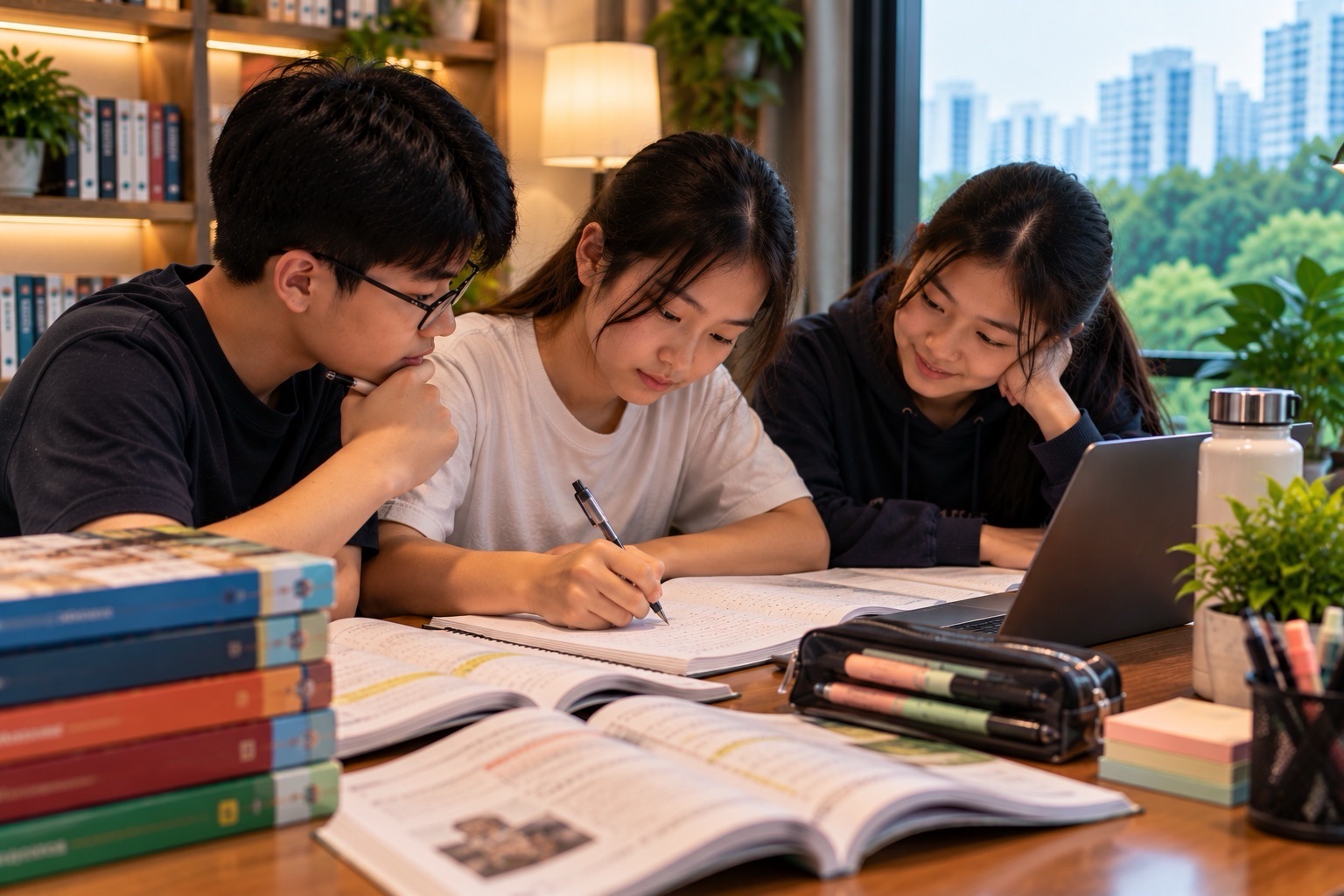

Choosing weekday or weekend Secondary 4 Biology tuition in Toa Payoh is about where useful revision fits. A weekday can repair one recent paper error quickly. A weekend can give space for a fuller attempt and detailed feedback. Choose the day that leaves the student able to think and use the correction afterwards.
Confirm standalone Biology or the Biology component of Combined Science, the actual subject level and the examination year. Relevant 2026 candidates still use their O-Level syllabus; the Singapore-Cambridge Secondary Education Certificate begins in 2027. Revision materials must match the student’s own course and cohort.
Bring an original marked script with working intact. Select the highest-value repair, compare the full lesson journey and plan a brief independent return. A calmer revision routine starts when the family knows exactly what the next session is meant to improve.
Find a learning rhythm that fits
Match the course, the current need and the complete family day.
Match the course · Compare weekdays · Compare weekends · Worked example · Parent questions · Full contents · Science Learning Hub
Article contents
Course and timetable
Biology learning and teaching
A revision session should begin with evidence from the student’s own work. A missing biological mechanism needs a different response from an overlooked instruction or an incomplete comparison.
Inspect a recent script and group the errors by what caused them. A broad score can identify concern, but the answers show where help may be useful.
Choose one priority with the tutor. For example, the learner may need to explain a change rather than describe the graph again.
Keep the original response and compare it with a later fresh answer.
This gives the family a reason for the session and a way to judge whether the chosen timetable is helping.
Confirm the exact subject and syllabus before selecting papers. Standalone Biology and Biology within Combined Science require materials that fit their own scope and assessment.
Relevant 2026 school candidates taking O-Level Biology should use the 2026 syllabus. SEAB introduces the Singapore-Cambridge Secondary Education Certificate from 2027.
For a SEC cohort, select the actual subject level and syllabus. A Posting Group is insufficient to identify every examination subject.
School guidance should establish the student’s own course and examination arrangements.
Ask how the provider checks material relevance. A paper labelled Biology may still belong to a different syllabus, cohort or assessment context.
A weekday can suit a student who wants to repair a specific issue from a recent attempt while the reasoning is still easy to recall.
The tutor can inspect the answer, ask how the student reached it and clarify the necessary connection.
A fresh short question then checks the repair. That may be more useful on a school evening than attempting a full paper after several demanding lessons.
Allow food and travel time before tuition and leave a manageable evening afterwards.
Plan a later independent return. Prompt feedback becomes valuable when the student can use it beyond the corrected script.
A weekend can provide room for an appropriate timed section or a longer examination task, followed by careful feedback.
Begin with a clear target. Decide whether the session concerns concept repair, application, answer organisation or pacing.
A full paper is useful when the resulting feedback can be acted on. Repeated papers without reviewing the underlying errors can consume time without clarifying the next step.
Protect recovery and avoid filling every remaining gap with another revision appointment.
Confirm actual class arrangements. The planning question is how the lesson supports the student’s revision, rather than whether weekend sounds more intensive.
Imagine a supplied enzyme-reaction graph that rises to a peak and then falls as temperature increases. Read the axes first: the explanation depends on what is actually measured.
In an appropriate initial range, higher temperature increases particle kinetic energy and can increase the frequency of effective collisions.
At sufficiently high temperatures, denaturation alters the enzyme’s active-site shape, reducing the formation of enzyme-substrate complexes.
The student must connect each part of the pattern with the relevant mechanism. “It gets faster and then slower” describes the graph but does not explain why.
Use the actual conditions and syllabus depth. Do not assume a fixed numerical optimum for every enzyme.
A changed graph or investigation checks whether the learner can select the explanation independently.
Read the instruction before assembling the answer. A question asking for a pattern needs accurate description; an explanation needs a biological reason connected to that pattern.
Use values when the question requires quantitative support. Then make the causal connection explicit where appropriate.
A tutor can ask the student to mark which sentence supplies evidence and which supplies the mechanism.
Remove unnecessary material that does not answer the instruction. A longer answer is not automatically a clearer one.
On the next question, let the student organise the response alone. That makes the revision skill visible.
eduKate’s three-student model can provide opportunities to discuss competing explanations and inspect why an answer meets the task.
Ask how the actual class protects time for each learner’s priority. Students sharing a year level may have different syllabuses or error patterns.
After a shared example, each should attempt another task independently. Group agreement cannot establish individual readiness.
Feedback should name the missing link and propose a suitable next task.
Confirm course compatibility and the process for handling different needs. The teaching and review process gives the small group its value.
Map the lesson as a complete day. Include school or another activity, meals, waiting, tuition and the return.
Confirm the actual teaching address and current provision. A local search title does not establish a specific nearby timetable.
If an adult accompanies the student, include their work and the rest of the family’s arrangements.
Consider how the journey affects the evening after tuition. The student still needs space for other subjects and appropriate recovery.
Choose the option that can support a prepared arrival and useful follow-up during an ordinary busy week.
Check the practical or investigation requirements in the student’s own syllabus and school guidance.
Where relevant, revision can involve identifying variables, interpreting observations, choosing suitable measurements and considering how an investigation supports a conclusion.
A written discussion of practical reasoning is different from carrying out laboratory work. Confirm what facilities and activities are actually available before assuming a provider offers them.
Ask the learner to justify a proposed method and explain what the resulting evidence could establish.
Keep the task course-specific and safe. A clear reasoning target helps the tutor choose appropriate practice without inventing laboratory provision.
Use a simple sequence: attempt, inspect the error, repair the connection and try a fresh question later.
A weekday pattern may focus on one recent script issue. A weekend pattern may begin with a fuller attempt and return to one priority during the school week.
These are planning examples rather than prescribed durations or advertised schedules.
The follow-up should be short enough to happen and specific enough to reveal learning.
Record whether the student needed a hint and what kind. That information guides the next lesson more precisely than a pile of completed papers.
Compare similar tasks before judging the arrangement by one broad score. Look for clearer selection of evidence, more complete mechanisms or better control of the instruction.
If the student remains dependent on prompts, adjust the teaching target and practice. If arrival is consistently exhausted, review the lesson timing.
The two problems call for different changes.
Ask the student what part of the session they can now use independently. Their explanation should align with the fresh work.
A revision timetable earns its place when it supports a useful attempt, clear feedback and application on another day.
Should we add a weekend lesson near an examination? Begin with an identifiable need, available attention and a realistic follow-up rather than add time automatically.
Will more full papers help? They can reveal performance when they fit the syllabus and their feedback is used.
What should we bring? Exact course and exam year, marked scripts, original working and the current timetable.
What should we confirm? Provision, address, lesson duration, fees, absence arrangements, syllabus fit and any practical facilities being offered.
Book a consultation to clarify the starting position. Choose the day that supports the next useful repair and keeps the revision routine manageable.
Check the examination cohort and Biology subject code before revising
Final-year Biology revision must match the student’s actual examination route. For the 2026 GCE O-Level, standalone Biology is listed as 6093, while Science (Physics, Biology) is 5087 and Science (Chemistry, Biology) is 5088. They are separate entries. Students may also be following other appropriate school routes, so never assume a worksheet labelled ‘O-Level Biology’ is suitable for every Secondary 4 learner.
The 2027 SEC G3 directory lists Biology K325 and the two Biology-containing G3 Science combinations K327 and K328. The G2 directory has Science (Physics, Biology) K224 and Science (Chemistry, Biology) K225. An Integrated Programme student may follow school-specific assessments instead of a particular SEC paper.
Before spending money on tutoring, parents should write down the examination year, actual registered course, paper structure, school assessment dates and two recurring errors from marked scripts. A tutor’s materials must fit that information. This is more important than a marketing promise to teach ‘every chapter’.
Toa Payoh is used as the family’s planning context; it does not confirm class availability in that neighbourhood. Verify the teaching venue, qualified tutor, course coverage, group size and timetable directly.
Choose two repair targets from a genuine marked Biology paper
A total grade tells the parent how the whole paper went, but not why. Separate lost marks by knowledge gaps, misunderstanding of the command word, graph interpretation, wrong numerical operations, incomplete causal chains and poor timing. Then select no more than two first priorities for a four-week cycle.
A student who describes enzyme activity accurately but miscalculates a change per minute needs rate practice. Another who performs the calculation yet asserts an unsupported cause needs a method or evidence lesson. Giving both the same lengthy notes is unlikely to address their first mistakes.
Ask the learner to replay the original answer without seeing the marking scheme. What exactly did the resource establish? Where did the reasoning stop? What would an acceptable answer need to include? A tutoring session becomes useful when these questions reveal a teachable missing link.
Keep a dated original and corrected answer, and add a different independent question two days later. If the pupil still needs prompts to select the method, the repair remains incomplete regardless of how fluent the tutor’s explanation sounded.
Biology command words ask for different kinds of reasoning
‘State’ can require a short accurate fact. ‘Describe’ needs visible features, stages or a pattern. ‘Explain’ requires a reason or mechanism; ‘compare’ requires consistent criteria on both sides; ‘predict’ needs an outcome grounded in the stated conditions; and ‘suggest’ may require a plausible scientific answer with appropriate limits. Different examination papers use their exact own command-word conventions, so confirm the current syllabus and school’s marking guidance.
For a fictional graph of an enzyme reaction, ‘describe the change’ means identifying what rises, plateaus or falls over a measured interval. ‘Explain the change’ calls for a relevant mechanistic reason supported by the conditions. A list of values is not an explanation of enzyme–substrate interactions.
Teach students to underline the command word and circle the substance, organism or variable to which it refers. Ask them to draft one sentence mapping the evidence to the process before writing a complete paragraph. This reduces generic answers that contain topic vocabulary but miss the question.
Give the student a different command word about the same hypothetical dataset and require them to adapt. A learner who can distinguish description from explanation gains an efficiency advantage without memorising longer prose.
Worked example: water loss as a measured rate
Invented plant-physiology practice table: a fictional potometer activity reports apparent water uptake corresponding to 2.4 cm³ over 4 minutes. The task asks for the average uptake rate. The arithmetic is 2.4 ÷ 4 = 0.60 cm³/min. This is not automatically the exact transpiration rate: in real experimental settings, water uptake can be a proxy, and some water may be used in other processes.
Now the pupil sees a second fictional reading of 3.6 cm³ over 9 minutes. Its average rate is 3.6 ÷ 9 = 0.40 cm³/min. The first measured uptake rate is greater by 0.20 cm³/min in these artificial conditions. The answer should not infer that the first plant is healthier without suitable information about the specimens and environment.
Why can a rate comparison be better than raw amounts? Because different durations make total uptake misleading. The second reading has a larger total amount but a smaller amount per minute. The tutor should teach the pupil to identify the time denominator before choosing the larger number.
Transfer: change the second duration to 6 minutes, leaving the uptake at 3.6 cm³. Its new rate is 0.60 cm³/min, equal to the first. The learner must revise the conclusion as the denominator changes. This is a portable data-reasoning skill, not one memorised result.
| Fictional uptake | Duration | Average water uptake rate |
|---|---|---|
| 2.4 cm³ | 4 min | 0.60 cm³/min |
| 3.6 cm³ | 9 min | 0.40 cm³/min |
| 3.6 cm³ | 6 min | 0.60 cm³/min |
Distinguish water transport from food transport in plants
In vascular plants, xylem and phloem are involved in different transport functions. Xylem conducts water and dissolved mineral ions from roots through the plant and also provides structural support; phloem transports products of photosynthesis, including sugars such as sucrose, between sources and sinks. The directions and mechanisms involved should be explained according to the student’s actual syllabus.
A weak answer says ‘food goes up xylem and water goes down phloem’ because it memorises a picture as two arrows without considering what is transported. Begin by naming the substance, source tissue, destination or physiological need and correct transport tissue. Do not simply swap the arrow colours in the diagram.
Ask a changed problem about a leaf using light energy to synthesise organic molecules while growing roots also require supplies. The student should recognise that photosynthetic products can move to non-photosynthetic growing tissues. A localised movement model cannot be turned into a universal statement that phloem always works in one fixed direction.
Connect the lesson to the water-loss rate example. Measuring apparent water uptake is about the water transport and loss system; it is not directly a measurement of sugar export. A tutor who makes this distinction clear prevents an entire chain of later errors.
Photosynthesis and respiration: what a net reading actually measures
Photosynthesis and respiration are not alternative labels for the same process. Photosynthesis uses light energy to synthesise organic molecules from carbon dioxide and water and releases oxygen under appropriate conditions. Aerobic respiration releases usable energy from organic material and consumes oxygen. Plant cells can carry out respiration even while photosynthesis is occurring.
Fictional balance example: under a simplified light condition, photosynthesis produces 14 arbitrary units of oxygen per minute while respiration consumes 5 units per minute. The net oxygen release is 14 − 5 = 9 units/min. The net release does not equal the total oxygen produced through photosynthesis.
Change the scenario so the photosynthetic rate is 3 units/min and respiration consumes 5. Net oxygen exchange is then 3 − 5 = −2 units/min, representing a net uptake of oxygen under the invented model. The negative sign is meaningful; it is not simply a calculation mistake.
A Biology tutor should then ask what could affect the individual processes and whether the measuring method could distinguish them. Do not infer the condition of a real plant or prescribe experiments from the invented units. The target skill is interpreting the difference between a measured net outcome and underlying processes.
Biological regulation is a feedback process, not a command to memorise
Biology explanations of homeostasis should identify the controlled variable, detection of change, coordinating response and relevant effector activity where required. The goal is to show how a biological system responds to deviation within its operating context. A sentence such as ‘the body fixes the problem’ is not enough.
Use a school-style fictional diagram of temperature regulation rather than advice about anyone’s personal health. If body temperature increases, a suitable response may involve increased heat loss through mechanisms taught in the actual syllabus. The learner should identify the trigger, the response and how it tends to oppose the initial change.
Do not claim that every response is instantaneous or identical in all circumstances. Biological regulation has limits and involves interacting processes. Precise wording matters; a mechanism that reduces the original change differs from a process that amplifies it.
Give a changed question describing a drop rather than a rise in the controlled variable. The student should explain the adjusted sequence instead of copying the previous list of responses. This tests understanding of negative feedback rather than memory for a single direction.
Original inheritance exercise: calculated probability is not certainty
Under a fictional single-gene model of complete dominance, suppose allele A is dominant to a and two heterozygous parents have genotype Aa. Their cross yields combinations AA, Aa, Aa and aa. The predicted genotype ratio is 1:2:1 and the phenotypic ratio is 3:1 under the stated assumptions.
These proportions represent possible outcomes in a simplified model. They do not guarantee that exactly three children in a four-child family will show one trait and the fourth another. Real characteristics, including many human traits, may be influenced by multiple genes and environmental factors. The pupil must recognise when a classroom model simplifies reality.
Transfer: change the cross to Aa × aa. The predicted offspring genotypes are Aa and aa in equal theoretical proportions, a 1:1 phenotype ratio under the specified dominance model. A child who repeats 3:1 without drawing the new cross has memorised an outcome rather than the method.
Use the changed example to teach the distinction between probability and observation. If a small sample’s actual outcomes differ from the theoretical ratio, it does not automatically mean the mathematics of the model is incorrect.
A food web requires conditional reasoning about effects
An ecological web contains overlapping feeding relationships. If one prey population changes, the effect on a predator may depend on other food sources, habitat, competition and time. A diagram showing a feeding arrow alone cannot guarantee one exact future population count.
Start with an invented web containing grass, insects, small birds and larger predators. Ask which arrows show energy transfer and which organisms may have alternative food pathways. Then remove one insect population in the hypothetical scenario and ask for a supported possible consequence, along with one reason that consequence may be smaller or different than expected.
Students should avoid universal answers such as ‘the bird will always die’ or ‘the predator population must double’. These statements exaggerate the predictive power of a simplified food web. A conditional prediction is stronger when it identifies the stated assumptions.
For a changed resource, provide two bird species that differ in diet breadth. Ask how alternative prey could affect their responses. The tutor should listen for mechanisms rather than rewarding a collection of ecosystem buzzwords.
Practical preparation should produce authentic experimental thinking
Practical Science includes identifying variables, taking suitable measurements, analysing results, improving methods and working safely under school supervision. An outside tutor may explain principles with fictional graphs, but should not provide fabricated data or perform assessed work on the student’s behalf.
A learner evaluating a rate measurement should ask whether the instrument was read consistently, the measurement interval was defined and relevant conditions were controlled. If temperature, light and plant material differed between comparisons, one factor cannot be isolated without further design and evidence.
An appropriate paper repair involves writing a better method plan: state the question, independent variable, dependent measurement, relevant controls, number of repeats and one limitation. Avoid unapproved experiments using chemicals, cultures or biological specimens.
The pupil should then evaluate an unfamiliar proposed method and identify one concrete improvement. ‘Make it more accurate’ is too vague; ‘use the same measurement interval across groups’ identifies an observable change.
Use timed practice only after identifying the first error
Near examinations, repeating full papers without reviewing the cause of lost marks can exhaust the student while producing little improvement. Start with a short representative question from the correct syllabus and analyse the task reading, method choice, calculation, explanation and final check. Then target the first failure.
Timing becomes useful when the learner already knows the method but cannot retrieve it efficiently. Track how long they spend identifying a graph’s axes, planning a mechanism or checking units. A single slow task may be caused by uncertainty rather than simply a lack of speed.
Do not invent one universal time allocation for every Biology paper. Standalone Biology and Science combinations may have different paper structures, and official exam instructions govern the actual duration. A tutor should support time management using the student’s genuine current paper.
After correction, use a changed question under comparable conditions. Look for improved accuracy, independent explanation and a better balance between completing and checking. Another completed paper is not proof of improvement by itself.
Three learners need distinct feedback even when sharing one source
Consider a small group reviewing the fictional transpiration table. Student A divides by the wrong number of minutes; Student B finds the rate but calls water uptake ‘exact transpiration’ without considering the measurement; Student C interprets the numbers correctly but cannot explain water movement through plants. A single model answer would hide those different needs.
A strong tutor gives A a changed interval, B a question about proxy measurements and limitations, and C an unfamiliar transport diagram requiring a causal explanation. Each learner should complete a fresh response individually after discussion.
Check that class materials distinguish standalone Biology from the relevant Science combinations and the student’s subject level. A group of three remains poorly matched if everyone is forced to work through a syllabus they are not actually taking.
Parents should ask to see a before-and-after sample that shows the student thinking independently. Confidence matters, but it should accompany more accurate reasoning on unfamiliar work.
Weekday or weekend: preserve the entire revision system
A weekday class can address a recently returned paper while the student still remembers the original decision. It might be a good choice when it leaves time for homework and a short independent retry before the next school assessment. After CCA, a long journey and a late meal, however, the child may be too tired for another cognitively demanding session.
A weekend class can provide a calmer block for mechanism explanation and selective timed practice. It is not automatically better because it is longer; a student still needs rest, exercise, time with family and attention for every other examination subject.
Compare exact travel routes and possible venues instead of assuming the Toa Payoh search title means a nearby class exists. Use a three-week trial to record whether the child completes a changed independent task one to two days after instruction.
The best schedule is one the student can maintain while repairing specific errors. If the child attends faithfully but reproduces the same misconceptions, alter the teaching target or format before adding more hours.
A four-week final-year Biology repair programme
Week 1 — confirm and diagnose: identify the actual course code, exam cohort and school revision plan. Choose two recurring errors from marked work, such as incorrect rate units or an incomplete explanation of photosynthesis and respiration. Record the baseline answers.
Week 2 — model and transfer: explain one mechanism clearly and solve one numerical example in stages. Change the numbers or conditions and ask the child to solve the next question with the original answer closed. Check whether the first wrong step has disappeared.
Week 3 — mixed independent practice: bring an unfamiliar diagram or data source from the correct syllabus and combine a calculation with an explanation. Note whether the learner identifies the required process, units and source limitations without prompting.
Week 4 — evaluate and decide: repeat a similar task after a delay. Compare accuracy, completion, self-correction and the sustainability of the schedule with Week 1. Continue only where additional support has a clear remaining purpose. No tutor can guarantee a specific examination grade.
Parent checklist for choosing Secondary 4 Biology support
- Confirm the student’s registered 2026 GCE or 2027 SEC course, subject level and examination paper.
- Distinguish standalone Biology from the Biology section of Combined Science.
- Bring a marked school paper and identify two actual recurring errors.
- Check whether rates include the correct units, intervals and denominators.
- Ask for process explanations rather than memorised labels alone.
- Require a changed independent question after each guided correction.
- Compare realistic weekday or weekend travel, rest and other subjects.
- Verify the exact class provision, teacher, venue, fee, group size and absence policies.
A useful tutoring arrangement should reduce the learner’s dependence on prompts. Where school teaching and planned independent practice already repair the error, further private lessons may not be required. Families should judge the decision from fresh work, not attendance alone.
Ten quick questions about Secondary 4 Biology tuition
Which Biology code applies to 2026 O-Level?
SEAB lists standalone Biology 6093; Combined Science combinations containing Biology include 5087 and 5088.
Which G3 codes apply for 2027 SEC?
Biology K325, Science (Physics, Biology) K327 and Science (Chemistry, Biology) K328 are separate entries.
Does a water-uptake instrument always measure exactly the amount transpired?
Not necessarily. Apparent uptake is used as a proxy and other water uses or experimental conditions may affect the relationship.
How do I calculate average rate?
Divide the change in the relevant measured quantity by the elapsed time, using correct units.
Do plants respire when photosynthesis occurs?
Yes. Net gas exchange depends on the balance between the underlying processes.
Is a dominant genetic trait always more common?
No. Dominance in a simplified inheritance model does not establish population frequency.
Will a four-week plan guarantee an examination grade?
No. It provides a way to diagnose, teach and evaluate specific learning targets.
Can a tuition provider conduct my child’s assessed Biology practical?
Assessed work must follow the school’s rules for student authenticity and supervised practice.
Is weekend tuition automatically better close to exams?
No. Choose a sustainable time that leaves adequate recovery and independent revision.
How can parents recognise a useful correction?
The child gives a more accurate, independently reasoned answer to an unfamiliar course-matched question.
Official syllabuses and connected eduKate guidance
- SEAB 2026 GCE O-Level syllabus directory
- SEAB 2027 SEC G3 Biology and Science subjects
- SEAB 2027 SEC G2 Science subjects
- Secondary 4 Science tuition in Toa Payoh: O-Level and SEC revision
- Secondary 3 Biology Toa Payoh: preceding level
- eduKate Science Learning Hub
Independent educational commentary, October 2026. All uptake readings, fictional genetic crosses, gas-exchange balances and teaching scenarios are illustrative rather than real experiment data or official examination tasks. Confirm subject entries and the student’s school requirements before using a revision paper.
Continue with suitable support
What Happens in Secondary 4 Toa Payoh Science Tuition | O-Level and SEC Exam Revision provides context for the same school stage. To discuss current work and a suitable next step, book a consultation and confirm course provision and arrangements.
MOE secondary curriculum and syllabuses · SEAB SEC syllabuses for school candidates · SEAB 2026 O-Level syllabuses. Use the official information and school guidance relevant to the student’s actual course and examination year.