
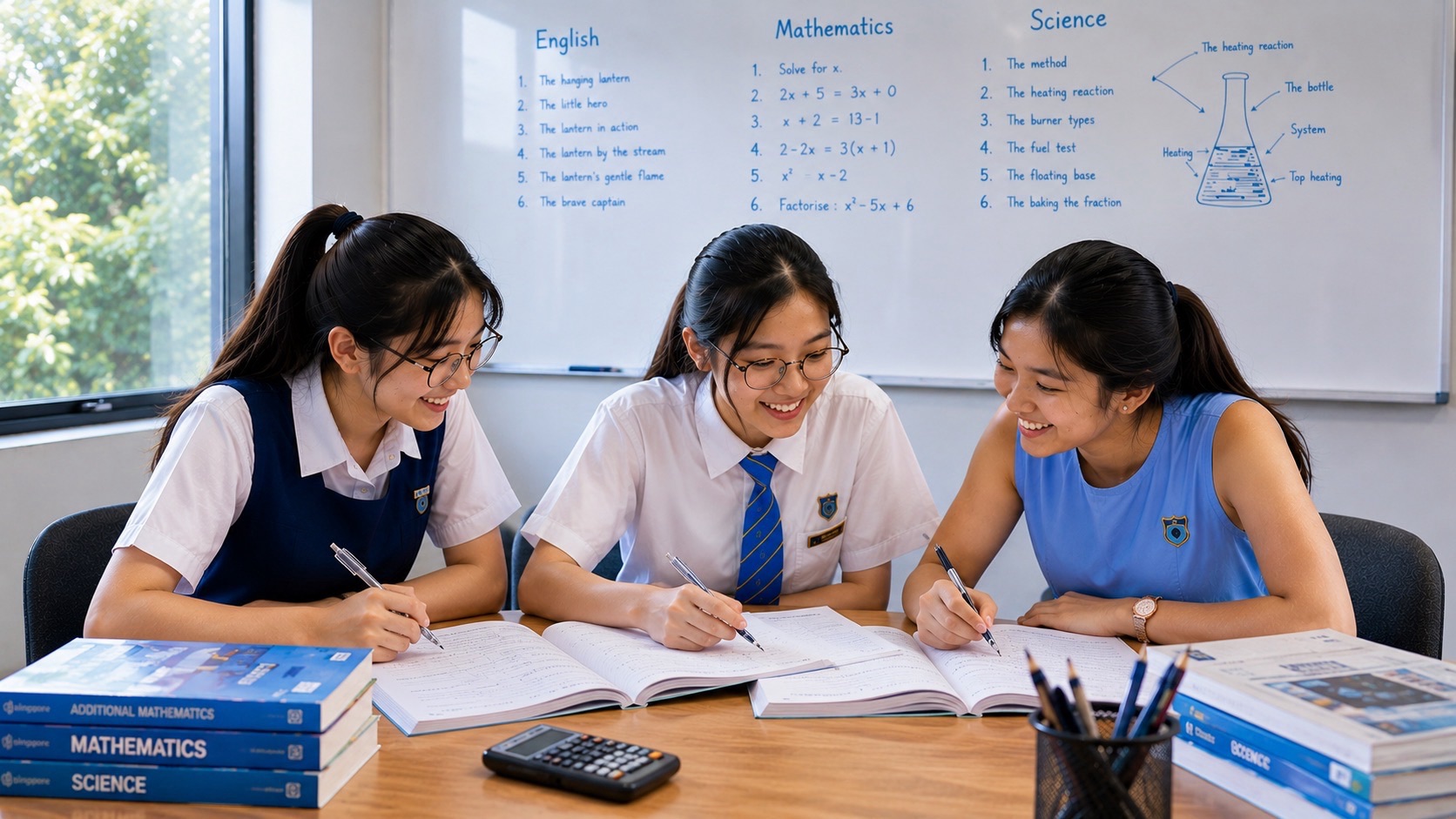
Secondary 4 Mathematics tuition for Hougang families should convert knowledge into reliable examination performance. By the final secondary year, a student may recognise nearly every chapter in a revision book and still lose marks through a misread condition, an unsuitable first method, a sign error halfway through the working, an incomplete final interpretation or poor allocation of time across the paper. The useful Sec 4 Math tuition question is therefore not simply “How many papers should the student complete?” but “Which failure patterns still remain when the student is working independently under the correct examination conditions?”
Parents searching for Secondary 4 Mathematics tuition in Hougang, Sec 4 Math tuition, E-Math revision, G1/G2/G3 Mathematics support, prelim preparation or small-group examination tuition need a programme matched to the student’s actual examination year and syllabus. In 2026, school candidates may still be sitting the existing GCE structure; from 2027, the Singapore-Cambridge Secondary Education Certificate applies. The final-year plan must therefore verify the right subject code and paper structure before using old labels, old papers or generic “O-Level Math” advice.
This Hougang page is the Secondary 4 year-specific child of the existing Mathematics Tuition Hougang umbrella. Hougang is the family and local search context; the broad parent routes Hougang students to eduKateSG’s Punggol teaching location. This page preserves the separate Hougang Additional Mathematics guide, national year owners, G1/G2/G3 owners, the Mathematics Learning Hub and How Mathematics Works.
First identify the examination the student will actually sit
For 2026 school candidates, SEAB lists Mathematics 4052 at O-Level, Mathematics Syllabus A 4045 at N(A) and Mathematics Syllabus T 4046 at N(T). Additional Mathematics remains separate: 4049 at O-Level and 4051 at N(A). A student’s registered paper should be confirmed through school and the current SEAB information rather than inferred from the title of a tuition worksheet.
SEAB states that the Singapore-Cambridge Secondary Education Certificate begins in 2027 and combines the previous N(T), N(A) and O-Level certificates. Subjects are examined at G1, G2 or G3. For the published 2027 structure, Mathematics appears as K110 at G1, K210 at G2 and K310 at G3; Additional Mathematics remains separate as K232 at G2 and K341 at G3.
This distinction matters because a revision resource can be mathematically useful without being a complete match for the current examination specification. Older questions may still teach valuable algebra, geometry or statistics, but a tutor should check scope, instructions, calculator rules and paper demands rather than assume that every historical paper reproduces the student’s current examination.
A prelim mark is a starting point for diagnosis, not a complete verdict
Adrian, a fictional student, forms the correct simultaneous equations but loses signs during elimination. Jo solves the difficult algebra questions but overlooks two short interpretation parts. Ben spends too long on one unfamiliar question and leaves several accessible marks untouched. Aisha reaches correct numerical values but omits units and final statements. Similar totals can therefore conceal very different final-year problems.
Ryan, Mira, Clara and Ethan appear elsewhere in the guide. All eight names are fictional recurring residents used to demonstrate mathematical decisions, not real student records or testimonials. Their examples show why the first failed decision matters more than the broad label “careless”.
After a prelim, preserve the original paper and working long enough to inspect what happened under actual conditions. Mark which questions were not attempted, which were abandoned, which were completed only after the exam and which required a hint during correction. A question solved calmly at home after seeing the method is useful learning evidence, but it is not the same as independent examination performance.
Classify lost marks by the first failure mechanism
A practical review can separate five broad categories. A content gap means the required idea is not yet available. An interpretation error means the student misread the quantity, condition or requested form. A method-selection failure occurs when knowledge exists but the student chooses an unsuitable route. An execution error appears after a valid plan. A paper-management failure concerns time, question coverage and recovery across the assessment.
These categories can overlap. Ben may run out of time because his algebraic manipulation is slow, not because he lacks a paper strategy. Aisha may omit units because she never identified the measured quantity clearly, not because she forgot to check at the end. Find the earliest change that would make the solution valid.
Do not assume every lost mark is immediately recoverable. Some require substantial learning. Others depend on examination demand. “Recoverable” should mean there is a plausible teaching action and a way to test whether the failure becomes less frequent in fresh independent work. It is not a promise that every marked error will convert into a mark on the next paper.
Prioritise by impact, dependency and remaining runway
A repeated fraction or sign error that affects algebra, graphs and geometry may deserve attention before one rare advanced question type. A reading habit that causes students to answer an intermediate quantity rather than the final request can also have broad impact. Final-year prioritisation should consider frequency, reach and the time available for a realistic repair.
Keep a short current priority list. Adrian might focus on sign control in multi-line algebra, substitution checks and moving on when a question stalls. Jo might focus on complete paper coverage and final-answer interpretation. Three precise targets are more useful than a list saying “revise all topics”.
Review the list after new evidence. A skill that becomes dependable should move into maintenance. A skill that fails only under time pressure may need timed micro-practice rather than full reteaching. A skill that remains conceptually unclear needs direct instruction before more paper volume is added.
Read the requested quantity before calculating
A question may supply a radius, height, price and percentage but ask for only one particular output. Before calculation begins, state what the final answer must represent. This short habit keeps the target visible while intermediate numbers accumulate.
Consider an invented cylindrical container with diameter eight centimetres and height fifteen centimetres. A question asking for capacity requires radius four and a volume calculation of 240π cubic centimetres. A question asking for material used in an open-top container requires a different inventory of surfaces. The data can be identical while the mathematics needed is different.
Ethan’s practice places several questions with similar data side by side but changes the requested quantity. He identifies the target and first relationship before touching the calculator. Aisha checks whether the final unit matches that target. These are small habits, but they can recover marks across many chapters.
Use time as a decision tool, not an inflexible formula
The official paper instructions determine the actual duration and mark structure. In practice, students can estimate a time budget so that one difficult question does not absorb a disproportionate share of the paper. A simple average of minutes per mark can provide orientation, but it should not become a mechanical rule applied to every part.
Some questions require a longer setup and then several quick marks. Others are short but conceptually demanding. The useful habit is to notice when no new mathematical progress is occurring. If repeated attempts are simply rewriting the same idea, mark the question for return and move to accessible work when the paper structure permits.
Ben practises leaving a clear intermediate line before moving on. That makes the later return easier. The objective is not to abandon difficult questions quickly. It is to distinguish productive struggle from repeated unproductive effort while preserving paper coverage.
A first pass should protect accessible marks without becoming a rush
During a mixed practice paper, the first pass should aim to complete accessible work accurately and identify questions that need a return. It should not become a frantic skim. Students still need to read instructions, identify the task and establish a justified route.
Jo’s problem is the opposite of Ben’s. She enjoys difficult algebra and may spend too much time polishing one complex question while a short data interpretation part remains unseen. Her closing routine includes checking every question number and subpart before returning to the hardest item.
Where all questions are compulsory, moving on is a temporary allocation choice, not permission to omit the question permanently. Practice should show whether the strategy improves coverage without causing new errors in questions the student already knows how to solve.
Percentage reliability begins with the correct base
An invented price rises from eighty dollars to ninety-two. The increase is twelve dollars, so the percentage increase is 12/80 × 100 = 15 percent. If the price later falls from ninety-two to eighty, the percentage decrease is 12/92 × 100, approximately 13.0 percent. Equal dollar changes do not mean equal percentage changes because the reference bases differ.
A useful check is to apply the proposed multiplier to the stated starting quantity. Eighty times 1.15 gives ninety-two. Ninety-two times 0.85 gives 78.20, not eighty, so a fifteen-percent reverse decrease is immediately exposed as wrong.
Mira’s correction routine names the base before choosing the multiplier. Her later mixed set combines ordinary percentage change, reverse percentage and successive change without chapter labels. The goal is independent selection rather than memorisation of three isolated procedures.
Simultaneous equations require both modelling and execution
In a constructed stationery example, two pens and three notebooks cost twenty-one dollars while three pens and two notebooks cost nineteen dollars. Let p and n represent the respective prices. The equations are 2p + 3n = 21 and 3p + 2n = 19.
Multiplying the first equation by three and the second by two gives 6p + 9n = 63 and 6p + 4n = 38. Subtracting gives 5n = 25, so n = 5 and p = 3. Both original equations should be checked: six plus fifteen is twenty-one, and nine plus ten is nineteen.
Adrian’s repair focuses on sign control when whole equations are subtracted. Ethan’s focuses on defining the variables and forming two independent conditions. A student can therefore need “simultaneous equations revision” for entirely different reasons. The tutor should diagnose before prescribing volume.
Quadratic solutions must still fit the context
A rectangle has length two centimetres more than its width and area thirty-five square centimetres. Let the width be x. Then x(x + 2) = 35, giving x² + 2x − 35 = 0 and (x + 7)(x − 5) = 0. The algebraic solutions are x = −7 and x = 5.
Only x = 5 is meaningful as the width in this stated geometric context. The dimensions are five and seven centimetres. The negative value is rejected because the model describes a physical length, not because negative roots are generally invalid in algebra.
Clara compares this with a purely algebraic quadratic where both roots may be valid and with an algebraic fraction where a value is excluded because it makes the original denominator zero. Final-year reliability includes knowing why a candidate solution is accepted or rejected.
Average speed is total distance divided by total time
A traveller covers sixty kilometres at forty kilometres per hour and returns over the same distance at sixty kilometres per hour. The first journey takes one and a half hours; the return takes one hour. Total distance is one hundred and twenty kilometres over two and a half hours, giving an average speed of forty-eight kilometres per hour.
The arithmetic mean of forty and sixty is fifty, but it does not represent the journey because the traveller spends different amounts of time at the two speeds. A useful plausibility check is that more time was spent at the slower speed, so the overall average should be closer to forty than sixty.
Ryan’s follow-up changes the distances or includes a stationary period, with the question specifying whether that time belongs in the average. The method should be reconstructed from total distance and total time rather than remembered from the familiar equal-distance example.
Geometry must establish the condition before the formula
A five-metre ladder is modelled as a straight segment leaning against a vertical wall, with its foot three metres from the wall on horizontal ground. The model creates a right triangle, so the height is four metres by Pythagoras’ theorem.
The five-metre ladder is the hypotenuse because it lies opposite the right angle. A student who automatically adds 5² and 3² has failed to identify the geometric roles. The result should also be checked against the situation: the vertical height must be shorter than the ladder.
Where trigonometry is in scope, the angle with the ground satisfies cos θ = 3/5, giving about 53.1°. The reference angle matters. A calculator can execute the inverse cosine, but it cannot decide which angle the question asked for.
Probability changes when the sample space changes
A bag contains four red and three blue counters. Two are drawn without replacement. The probability of two reds is (4/7)(3/6) = 2/7. The second fraction changes because the first draw altered both the number of red counters and the total number remaining.
The probability of one red and one blue in either order is (4/7)(3/6) + (3/7)(4/6) = 4/7. The probability of two blues is (3/7)(2/6) = 1/7. These disjoint cases sum to one, providing a useful check.
Aisha states the event and replacement condition before drawing a tree or multiplying fractions. A probability tree is only useful when each branch represents the correct conditional situation. Neat presentation cannot rescue a wrongly defined event.
Statistics questions can be lost through weighting, not arithmetic
An invented group of twelve students has a mean score of sixty-five, while eighteen students have a mean of seventy-five. Their totals are 780 and 1350, giving 2130 over thirty students, so the combined mean is seventy-one.
The simple average of sixty-five and seventy-five is seventy, but that treats the groups as if they were equal in size. The larger group carries more weight. A useful qualitative check is that the combined mean should lie closer to seventy-five than sixty-five.
Jo practises reconstructing totals before combining groups. Ben checks that a mean lies within a plausible range. Clara writes a conclusion that names the statistic and population. Correct calculation should be followed by a claim no stronger than the data support.
Calculator discipline should make the expression visible first
Students should use a calculator permitted for their actual examination and check current school and SEAB requirements. Do not assume that a familiar device used at home is automatically approved for every national examination year. Equipment preparation belongs to the examination plan.
Write the mathematical expression before entering it. Brackets, powers, negative values and fractional denominators need to be represented accurately. For angle work, confirm the appropriate calculator mode. Keep enough intermediate precision to avoid creating rounding error that propagates into a later answer.
Ethan often enters a denominator without the necessary brackets. Aisha rounds early and changes the final value. Their mathematical knowledge may be sound, but the tool use is not yet reliable. The tutor should distinguish the expression, calculator entry and reported answer as three separate stages that can each fail.
Checking should use a different route when possible
Substitute a solution into the original equation. Test an intersection in both line equations. Compare units. Estimate magnitude. Check whether disjoint probabilities sum to one. Reconstruct a percentage result from the proposed original value. These checks can expose errors that repeated execution of the same method may not.
Not every check proves correctness. Agreement at one substituted value does not prove an algebraic identity. A plausible magnitude does not prove the model was valid. A neat diagram does not prove a line is parallel. Students should understand what each check can and cannot detect.
Clara’s final scan prioritises unattempted parts, requested form, units, restrictions and her known high-risk sign errors. Adrian has a slightly different routine. A universal checklist containing every possible issue can become too long to use under pressure. Build a common base and personalise the highest-value checks.
Written working should make the reasoning inspectable
Clear working does not mean writing every trivial arithmetic step. It means preserving the relationships and transformations that justify the answer. Define variables where needed, state the relevant relationship, substitute accurately and show the critical intermediate stages.
Do not promise a fixed number of “method marks” for an arbitrary line unless an applicable official marking scheme establishes it. The educational reason for showing working is already strong: it lets the student inspect the solution, recover after an error and communicate mathematical reasoning clearly.
Ryan practises shortening a correct solution without removing the logic. Ben adds the missing relationship that made his earlier jump impossible to follow. Jo compares two valid methods and selects the cleaner one. Efficiency is not the absence of working; it is the removal of unnecessary work while preserving meaning.
A practice paper should produce a repair plan
After a full paper, do not automatically start another one. Review selected questions, locate the first failed decision and design the next activity to answer that diagnostic question. If percentage bases are the issue, use a small contrast set. If method selection is weak, use unlabelled mixed questions. If coverage and stamina are the problem, another timed mixed section may be appropriate.
Keep independent attempts, supported corrections and delayed retests separate in the record. A corrected question completed with help is valuable learning work but is not evidence that the student can yet reproduce the method independently.
Mira may gain more from two targeted sessions and one shorter mixed check than from immediately completing another full paper. Ethan may need paper-navigation rehearsal rather than more topic teaching. The next practice should follow from the evidence, not from a quota of papers.
Additional Mathematics preparation should remain separate
A student taking Additional Mathematics needs a distinct record of its syllabus, assignments and examination preparation. Shared algebra can be repaired efficiently, but main Mathematics is not automatically covered by A-Math homework. Nor should this Hougang main-Math page absorb the existing A-Math owner.
Use the separate Hougang Additional Mathematics tuition guide for that subject. Confirm each subject’s current code and paper requirements separately. The 2026 GCE structure and 2027 SEC transition both keep Additional Mathematics distinct from Mathematics.
At a weekly review, inspect both subjects. A learner may overinvest in A-Math because it feels harder and let routine main-Math errors accumulate. Another may avoid A-Math by spending time on comfortable main-Math practice. Allocate work according to evidence, upcoming assessments and the student’s total load.
G1, G2 and G3 final-year preparation must match the actual course
The student’s Mathematics subject level determines the relevant syllabus and examination demand. G1, G2 and G3 are not a single ladder of identical worksheets at different speeds. Each should be prepared accurately. A learner can need more concrete explanation, more fluency or more demanding transfer without being judged by an unrelated course.
The 2027 SEC transition makes precise naming especially important. Mathematics K110, K210 and K310 are distinct subject-level routes. Families should check the school’s guidance and the official SEAB specification for the applicable year before interpreting an old practice resource.
The existing G1, G2 and G3 Mathematics guide carries the wider explanation. This Hougang S4 page concentrates on the final-year process that turns course knowledge into reliable paper performance.
A three-student final-year lesson can be highly specific
A ninety-minute lesson can begin with a short mixed independent set that exposes the week’s target. Each student writes a first method before discussion. Adrian may show a sign-control problem while Jo’s issue is paper coverage. The lesson can share a central question and then branch into different follow-up work.
The central teaching segment compares wrong and correct routes, repairs the selected mechanism and places it back into a changed question. Every student should still produce their own working. A quick student’s spoken answer cannot substitute for the others’ decisions.
The lesson ends with a fresh task and a clear statement of what was independent, prompted or still unstable. A parent update can be short but specific: “the model is now correct; elimination signs still fail under timing.” That is more useful than “needs more confidence”.
The final fortnight should not become uncontrolled overload
When examinations are near, every new task should have a reason. Maintain secure topics with a modest mixed set, repair a small number of repeated failures and rehearse appropriate paper conditions. Avoid filling every remaining evening with a full paper followed by extensive correction when there is no time left to understand the correction.
Distinguish learning sessions from assessment sessions. During learning, notes, explanation and limited hints are appropriate. During assessment, the student works independently under stated conditions. Do not merge those results into one mastery count.
Confirm examination logistics early through the school and official instructions: reporting details, equipment, permitted calculator and any approved arrangements. Final preparation should make established systems dependable rather than introduce a collection of unfamiliar last-minute tricks.
Recover after a difficult paper without inventing a result
A difficult first paper does not provide enough information to calculate a final grade from memory. Students often remember only the disputed or painful questions. Reconstructing the entire paper emotionally between examinations can consume time needed for the next task.
After an appropriate break, identify only information that can improve the next preparation. Did the student lose time? Was there an equipment issue? Is one known topic relevant to the next paper? Keep the review factual and bounded.
Ben may need to move on earlier when no new progress is being made. Jo may need to check every subpart before the final review. Aisha may need units and requested accuracy written beside her final line. The aim is recovery of a working process, not a promise about the result of a paper that is already finished.
A family decision about tuition close to the examination
Bring the latest marked paper, the actual examination information and a realistic remaining timetable. Ask which failures appear most actionable and how a short intervention will be evaluated. A responsible tutor should distinguish immediate repairs from deeper gaps that cannot honestly be compressed into a few lessons.
Confirm the teaching location, class fit, timetable and current fees through the Hougang Mathematics umbrella. The established route is to eduKateSG’s Punggol teaching location. Judge the real journey from the student’s home or school rather than assuming a universal travel time.
Sometimes the most useful support is a focused diagnosis and narrower plan rather than more lesson hours. Sometimes a substantial gap genuinely requires sustained teaching. The family should know which situation it is facing before adding workload during an already demanding year.
Frequently asked examination-reliability questions
Should students memorise model answers? Worked examples can teach useful structure, but the student should then close the solution and attempt a changed problem. The important memory is when and why the method applies.
Is speed the main problem when a paper is unfinished? Sometimes. But slow algebra, uncertain method selection, repeated restarting and poor paper navigation can all produce the same unfinished paper. Diagnose the mechanism before increasing pressure.
Should every old paper be used as a full mock? No. Check examination year, subject level and scope. Older individual questions can remain mathematically useful even when the complete paper no longer matches current requirements.
What shows that revision is working? Look for fewer repeated failures in fresh independent work, better mixed-task coverage, stronger method selection and effective checking without constant prompts. A rising score can support that picture when the papers are reasonably comparable.
The final objective is dependable mathematical behaviour
A strong final-year routine begins by confirming the right syllabus and reading the target. It continues through justified method selection, clear working and proportionate time allocation. It finishes by checking the result against the original condition and ensuring every required part has been addressed.
For Hougang families, useful tuition strengthens those behaviours inside a sustainable week. The student should understand why each assignment was selected and what independent evidence will be reviewed next. The parent should be able to understand the priorities without becoming the tutor for every question.
Secondary 4 Mathematics tuition cannot remove uncertainty from an examination or guarantee a particular grade. It can make preparation more exact: correct target, high-impact repair, appropriate practice, honest checking and a calmer recovery process when something goes wrong.
Continue through the Hougang Mathematics route
Use Mathematics Tuition Hougang for the broad local programme. Revisit Secondary 1, Secondary 2 and Secondary 3 Mathematics Tuition | Hougang. Keep Additional Mathematics in the separate Hougang A-Math route. The Mathematics Learning Hub and How Mathematics Works retain the broader subject architecture.