
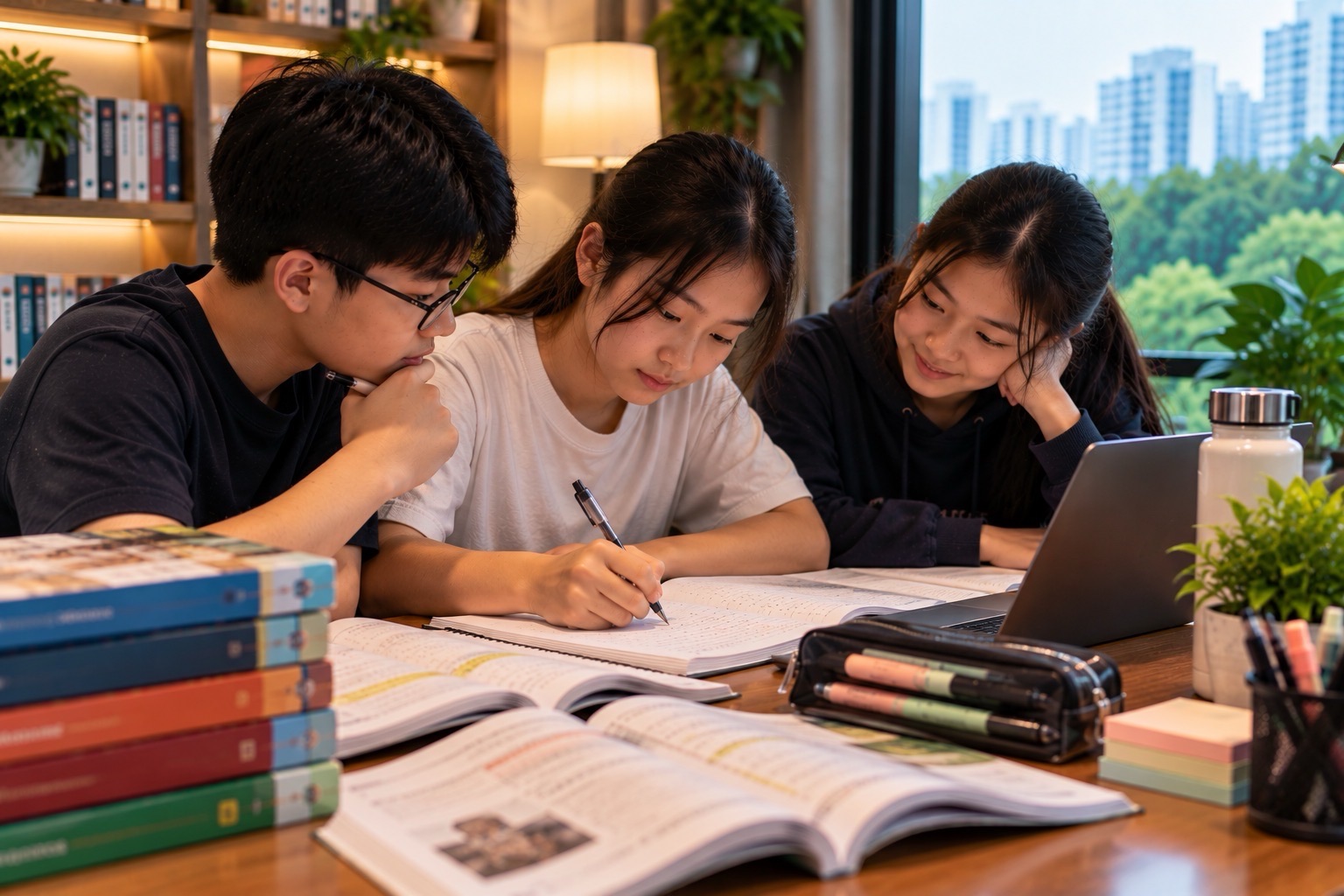
Secondary 4 Science Small Groups Tuition Pioneer | Benefits and Consequences. Secondary 4 Science small groups tuition for Pioneer families can be helpful when a teenager is working hard but repeatedly losing marks for the same Science misconception. Instead of adding another pile of timed papers, a suitably matched three-person tutorial can identify the earliest important error, rebuild the model, check delayed retrieval and gradually return to examination-speed application.
Extra tuition can also become part of the problem when the child is already overloaded. Travel, fees, homework and lack of sleep may reduce the independent work required for real improvement. A Pioneer-focused guide is not a claim that eduKateSG currently runs an available physical Science classroom in Pioneer. Parents should verify the tutor, subject, venue and timetable before enrolment.
Quick parent information: Quick parent decision: preserve two original wrong answers, classify whether the problem is knowledge, application, representation or timing, confirm 2026 GCE or 2027 SEC subject and level, ask for a four-lesson repair plan, then judge an unfamiliar answer alongside the total weekly workload.
- The first priority is repairing one recurring misconception rather than covering every chapter at once.
- A class should match the student’s Science combination and G1/G2/G3 level.
- Good teaching moves from clear models to contrasting applications and delayed retrieval.
- Time pressure comes after independent accuracy, not in place of scientific understanding.
- A group of three is helpful only if all learners have genuine opportunities to reason.
- Verify the actual Pioneer-area teaching venue and availability; none is presumed.
A four-stage recovery plan that respects Science foundations and student energy
A poor test result is diagnostic information, not a request for unlimited worksheets
A Secondary 4 result may make a family anxious, particularly when national examinations are approaching. The immediate instinct is to buy more papers and add another tuition session. Such practice may help a pupil whose scientific concepts are secure but who needs time management or endurance. It is less likely to help a student who repeatedly chooses the wrong model and has not understood why the earlier answers were incorrect.
The first step is to preserve the actual school scripts and classify the mistakes. Was a necessary term forgotten? Was a true rule applied under the wrong conditions? Did the child misread the graph or give an unsupported conclusion? Was the method accurate but the time allocation poor? An effective tutor studies the first decision rather than only the final mark. Different errors lead to different interventions.
A useful diagnostic might identify that most Physics losses begin with selecting values for the wrong circuit component. Another learner may lose Chemistry marks by naming a gas from insufficient observations, while a third knows Biology definitions but fails to apply them to unfamiliar cell diagrams. Each child needs a specific repair rather than an identical fifty-page Science revision pack.
Parents can ask the prospective tutor to give a one-sentence educational target for the first month. ‘Recognise the requested physical quantity before choosing a formula’ is measurable. ‘Improve Science’ is too vague to tell the family whether tuition is working. A narrow starting goal also helps prevent an overloaded teenager from feeling they must relearn every chapter simultaneously.
Stage one: rebuild the earliest unstable principle
Foundational rebuilding means teaching the minimum scientific idea needed to understand a question. For a Physics circuit, this might involve what current, potential difference and resistance mean in the arrangement rather than only their symbols. The tutor can show how measurements relate to named components, ask the child to label the system and then explain why a relationship applies.
In Biology, the pupil might accurately recite osmosis but predict the wrong movement of water because the surrounding conditions were not analysed. The tutor can use contrasting cell diagrams and ask what changes the direction of net movement. The process is then understood as a model operating under conditions rather than a sentence to reproduce from a marking guide.
In Chemistry, a student may claim that the presence of ions makes every ionic substance conduct electricity in any physical state. The tutor can return to mobility of the charge carriers and compare relevant arrangements. A changed example requires the child to explain the property rather than quote a familiar line. The precise content should follow the registered syllabus.
Within a three-person class, each pupil may need a different starting scaffold. A tutor should allow private thinking time, ask for the original reason and correct the misconception respectfully. If a teenager lacks several earlier prerequisites and cannot follow the group’s pace, one-to-one bridging or a slower matched group may be more effective than forcing enrolment in the next available session.
Stage two: make the correction survive until next week
Understanding a worked solution immediately after a tutor explains it is an important beginning, but not proof that it will be accessible a week later. Recognition and retrieval are different activities. A pupil may nod throughout the lesson and still fail the same concept on an unfamiliar school paper because the scientific idea cannot be produced without the original cues.
A useful tutor begins a later session with a short closed-book question from an earlier weakness. The problem should use the same underlying principle but change the surface details. A rearranged circuit, altered biological condition or different chemical observation reveals whether the model has become flexible. If the student can explain why the method fits without hints, the correction is more durable.
An error log should capture the original mistaken assumption, the accurate principle and a date for the next check. It should not become a long notebook filled only with copied model answers. A note such as ‘I described the first part of the graph but ignored its plateau’ points to a specific action for the next question. The teenager can gradually learn to choose retrieval tasks independently.
Parents can support retrieval with neutral prompts. Ask what the problem measures, which condition changed and why the proposed principle applies. Avoid announcing the formula immediately. A reasonable first attempt tells the student and tutor where uncertainty remains. The goal is to make the child increasingly able to start unfamiliar questions without another person’s opening cue.
Stage three: transfer to altered Science contexts
Examination questions often present known ideas through unfamiliar diagrams, apparatus, organisms or wording. A student who has only practised near-identical examples may believe a topic is secure while remaining unable to recognise it elsewhere. Transfer means choosing the scientific relationship because of the actual evidence, not because the picture resembles the last worksheet.
The tutor can present contrasting problems. One circuit may require a relationship used in a familiar component; another arrangement changes which measurements apply. A Chemistry practical may show bubbles but lack sufficient information for unique gas identification. A Biology graph may reach a plateau despite a familiar principle suggesting an initial increase. In each case the student should state what condition changes the reasoning.
Group discussion can be helpful here because different pupils may spot different assumptions. However, the tutor should not let the most confident student answer first every time. Private initial attempts and unassisted post-discussion tasks show whether all three learners have developed the skill. Completing the original example after hearing the teacher is not sufficient proof of transfer.
A Pioneer parent can ask to see one new problem with no topic heading and a record of how much assistance the student needed. If the teenager now selects and explains a relevant principle, the lesson has developed a more useful skill than simply memorising another model answer. If the error returns, the tutor should revisit the prerequisite instead of immediately moving to another chapter.
Stage four: add examination timing only after accuracy stabilises
Timed paper practice matters for fluency, stamina and presentation, but it should not be used to disguise an unresolved misunderstanding. A student who repeatedly applies an equation to the wrong circuit component may simply become faster at making that error. A pupil who writes a definition instead of a causal Biology explanation may learn to produce the same incomplete response more quickly.
Once independent accuracy is reasonably stable, the tutor can introduce short time limits on relevant question types. The pupil practises reading the demand, selecting a principle, completing the response and checking units or evidence. This compact routine can become automatic through purposeful work. The goal is to keep a sound scientific method under pressure, not to rush through a worksheet by skipping interpretation.
Different learners may require different timing support. One has a slow but accurate numerical method; another writes long paragraphs of irrelevant Science facts; another rushes and misreads graph axes. The tutor should diagnose these patterns separately and provide targeted practice rather than demand that all three complete an identical number of questions within the same time.
Parents should distinguish improved speed from improved learning. A quicker wrong answer is not an achievement. A correct unfamiliar response produced independently within a manageable time limit is stronger evidence. The family can assess this through a four-lesson cycle without expecting the tutor to predict an exact national-examination grade.
Combined Science recovery must protect both components
Combined Science contains two named disciplines, and one overall grade can conceal very different levels of understanding. A student may be strong at Physics and weak at Chemistry practicals; another may understand Biology yet struggle with physical graphs. A blanket plan to revise more Science does not establish which component or error type deserves the next available hour.
One sensible approach gives a brief retrieval check to the stronger component while spending deeper teaching time on the more persistent misconception. If a Chemistry inference error is being repaired, it may require several contrasting practical descriptions before the weekly balance shifts. The allocation should be explained to parents and adjusted as school assessments reveal new information.
A three-person class can become difficult when pupils have different Science combinations. A Physics/Chemistry student should not be forced through Biology-specific work because another learner takes Chemistry/Biology. Some scientific inquiry skills overlap, but the core individual tasks need to match the registered course and level. Honest differentiation or a different placement is preferable to irrelevant worksheets.
Parents can ask for separate evidence in the two components after four lessons. Has the weaker discipline become more accurate while the stronger one remains stable? Narrow improvement in the real bottleneck may be valuable even if the total percentage has not changed much. The tutor should report the result candidly and avoid treating all pupils’ Science profiles as identical.
The full Pioneer household schedule determines whether tuition is sustainable
A ninety-minute tuition session is rarely a ninety-minute commitment. Travel, waiting, meals, preparation and follow-up work can occupy a much larger part of a weekday or weekend. Secondary 4 students also need time for school practicals, Mathematics, languages, other assessed subjects and sleep. A well-taught lesson may still have poor overall value if it creates chronic fatigue and leaves no opportunity for independent consolidation.
Pioneer families should first confirm the actual classroom, tutor, subject and timetable. This guide does not announce a physical eduKateSG Secondary 4 Science centre or available group in Pioneer. A convenient-sounding estate title cannot substitute for operational confirmation, and a nearby class is not educationally suitable if it follows the wrong Science syllabus.
The family should calculate what the new commitment replaces. If it displaces a valuable self-study period, the tutor might assign only a few targeted unfamiliar questions rather than a thick repetitive pack. If the teenager is already learning effectively through school consultations and an error log, another weekly class may be unnecessary. The least burdensome effective intervention should be preferred.
A small-group provider should be comfortable recommending against enrolment when the available class is too fast, the group lacks subject compatibility or the pupil needs more basic individual teaching. Parents should welcome such candour. The goal is not to maximise attendance but to help the student use limited preparation time more intelligently.
The final objective is a self-correcting teenager
A strong revision habit begins with diagnosing what went wrong. Instead of saying ‘I am bad at Science’, the learner identifies a missing concept, a wrong model, misread data or an examination execution issue. Each classification suggests a next action. A student who knows why an answer failed can choose purposeful practice instead of repeating the whole chapter reflexively.
The tutor can initially model this process using the child’s original school responses. Over several meetings, the teenager becomes responsible for maintaining an error log and selecting one relevant unfamiliar question. This gradually transfers planning from adult to learner. A three-person tutorial may support that process through peer comparison, provided individual work remains central.
Parents can look for independence outside the lesson: the child explains a diagram without notes, checks a calculation’s units, qualifies an experimental conclusion and uses school-teacher feedback to revise. These are stronger signs of growth than the number of practice papers stored on a shelf. They can also reduce anxiety because the student has a method for recovering from uncertainty.
When those habits are secure, the family may reduce or stop paid supplementary teaching. The best outcome is not permanent dependence on a tutor. It is a teenager who can learn from mistakes, interpret unfamiliar evidence and prepare responsibly for the remaining subjects while maintaining a sustainable school week.
Four worked Science mistakes for Pioneer students
Physics equation used for wrong component
Original error: The pupil knows the formula but misreads where measurements apply.
Targeted correction: Rebuild the diagram model before any timed practice.
Unassisted check: Solve a changed circuit correctly without prompts.
Biology definition recited but not applied
Original error: The relevant membrane or conditions were overlooked.
Targeted correction: Use contrasting examples and delayed retrieval.
Unassisted check: Explain a new cell situation independently.
Chemistry practical makes unsupported gas claim
Original error: A familiar observation triggers automatic identification.
Targeted correction: Separate evidence, plausible mechanism and confirmation.
Unassisted check: Give a justified conclusion in an unfamiliar experiment.
Timed paper repeats earlier misconception
Original error: Speed practice reinforces a wrong process.
Targeted correction: Repair first principles, test transfer, then add timing.
Unassisted check: Answer a changed task accurately at a manageable pace.
Frequently asked questions from Pioneer families
Does Pioneer have a verified eduKateSG Science class?
This guide does not confirm a physical local centre, tutor or vacancy. Check arrangements directly.
Should a weak student immediately complete more full practice papers?
Not if the same misconception persists. Diagnose and repair the principle before emphasising time pressure.
Can a three-pupil class suit a student with major gaps?
Sometimes, but substantial earlier gaps or pace differences may require individual bridging.
Does one overall Combined Science grade reveal which component needs help?
No. Inspect original responses and error categories in each discipline separately.
Can tuition guarantee an A grade?
No. Teaching can target improvement but examination outcomes depend on multiple factors.
When should tuition be reduced?
When the student independently retrieves, applies and corrects Science with school and home resources.
A recovery programme should make the student an active planner
At the start of a recovery period, the tutor may need to choose the error category and next practice task. But over several lessons, the student should become able to name the misconception and suggest how to test it. A pupil who can say ‘I used a formula for the wrong circuit component, so I need a new circuit with altered connections’ has gained a practical self-correction strategy.
An error log should be short and actionable, not a permanent punishment. Each entry can include the original wrong interpretation, the scientific principle that repairs it, and a new question attempted after a delay. The log helps the learner distinguish a knowledge gap from a representation error or timing issue. That classification makes later revision more purposeful and less overwhelming.
The tutor can also ask the teenager to explain which tasks no longer need intensive teaching. If Physics units are now stable, they may be maintained with a quick retrieval question while effort shifts to Chemistry evidence or Biology application. This protects the student from repeatedly spending time on familiar strengths merely because those tasks feel comfortable.
Parents can look for a change in the quality of questions the child asks: from ‘I cannot do Science’ to ‘I do not know whether this graph permits that conclusion’. A more precise uncertainty can be addressed through school-teacher feedback, a focused tutorial or independent revision. The long-term aim is to rely less on the tutor’s weekly instructions.
When an exam-year schedule needs subtraction, not addition
A Secondary 4 household may try to solve every weak result by adding a new class. This can create a timetable in which the pupil has no free evening to retrieve a corrected concept or attempt unfamiliar work alone. Sleep and other examined subjects are not optional costs. An overloaded teenager may appear industrious while having insufficient cognitive space to consolidate learning.
A tutor should therefore estimate the complete weekly commitment, including the journey to the confirmed location, meals, a ninety-minute session and realistic home tasks. If the class repairs a recurring misconception, that may justify the time. If the teaching largely repeats school explanations or sets low-value worksheets, reducing the commitment may improve the overall study plan.
Some learners benefit from a short period of individual bridging before joining a group; others are already capable of self-study and need only occasional school consultation. A responsible provider should be comfortable recommending these alternatives. No class-size label can guarantee a good placement for a child whose prior knowledge or timetable differs greatly from other group members.
A Pioneer parent can review a four-lesson trial using an independent question and a weekly energy check. Has the student’s first scientific decision improved, and is the child still able to sleep, study other subjects and complete schoolwork? Tuition should be continued for demonstrable learning, not simply because the family fears doing less.
2027 SEC versus 2026 GCE: the Science course must be confirmed
The Singapore–Cambridge Secondary Education Certificate (SEC) begins in 2027, replacing the previous separate GCE N- and O-Level examinations with a single certificate under which subjects are examined at their respective G1, G2 and G3 levels. This does not make every Science subject identical. Parents should use the school-registered subject and examination year when choosing tutoring and practice materials, rather than relying only on a general label such as Secondary 4 Science.
| Science course | Official 2027 subject code | What parents should check |
|---|---|---|
| G1 Science | K123 | An integrated course with its own content and assessment. |
| G2 Science (Physics, Chemistry) | K223 | A specified G2 Combined Science pairing. |
| G2 Science (Physics, Biology) | K224 | The correct Physics/Biology programme at G2. |
| G2 Science (Chemistry, Biology) | K225 | The correct Chemistry/Biology programme at G2. |
| G3 Science (Physics, Chemistry) | K326 | G3 Combined Science, not equivalent to separate Pure Sciences. |
| G3 Science (Physics, Biology) | K327 | A defined G3 combination requiring both components. |
| G3 Science (Chemistry, Biology) | K328 | Another defined G3 pair with its own syllabus. |
| G3 Pure Physics, Chemistry, Biology | K323, K324, K325 | Separate Pure subjects with different course requirements. |
| 2026 GCE O-Level Combined Science | 5086, 5087, 5088 | Previous examination codes, not the 2027 SEC codes. |
The sources are SEAB’s SEC overview, the official 2027 G1 school-candidate list, 2027 G2 syllabus list, 2027 G3 syllabus list and 2026 O-Level syllabus list. SEAB’s 2027 G3 listing was updated in October 2026. A tutor may use older examination questions where the scientific concepts and demand still match, but should not assume that every old paper is a faithful 2027 SEC examination simulation. Exact syllabus alignment matters more than the size of the question bank.
Placement is a teaching decision. If three students take different levels or combinations, a tutor may use a short common activity on scientific inquiry but must give each learner appropriate subject-specific work. A student taking Chemistry/Biology cannot automatically use the full Physics/Chemistry practice pack; a Pure Physics pupil may require a different level of reasoning from the Physics part of Combined Science. A provider should explain where overlap exists, where differentiation is necessary and when separate placement would be wiser.
How the three-pupil teaching model can help—and where it fails
The immutable eduKateSG three-pupil Clementi reference describes close attention, explanations and guided practice in a small group. Smaller numbers can make it easier for a tutor to notice when a student misreads a graph, substitutes values for the wrong component or makes an unsupported experimental claim. But three seats in a room do not guarantee differentiated teaching. The tutor must use the time to obtain individual answers, check the reasoning and follow through with a new independent problem.
The independent Education Endowment Foundation review defines small-group tuition as instruction for two to five pupils and finds positive average learning effects in the broader research. Much of that evidence concerns different age groups and subjects, not Singapore Secondary 4 Science. It would be misleading to promise that a specific three-pupil Science class will deliver the reported average progress or a national-examination distinction. The useful lesson is to prioritise tutor quality, precise diagnosis, subject fit and the student’s own application.
The tutor should also manage group dynamics. One confident pupil might name a formula immediately, making the others look successful because they can finish the arithmetic. A quiet learner may need time to read the data before attempting an answer. An effective routine gives every student a private first attempt, a respectful comparison of methods and a fresh individual final task. Group discussion should build competence, not become an efficient way to copy one answer.
An illustrative 90-minute tutorial designed to produce evidence
| Stage | Illustrative minutes | Educational purpose |
|---|---|---|
| Delayed retrieval | 10 | Can the child recall and apply an earlier correction without notes? |
| Original error diagnosis | 15 | Where was the first wrong scientific decision made? |
| First-principles explanation | 20 | Can the learner explain the relevant model accurately? |
| Contrasting examples | 20 | Does the method transfer when conditions or representations change? |
| Unseen individual answer | 15 | Can every learner choose and defend the method without hints? |
| Error log and next task | 10 | What small practice task will check retention after a delay? |
These timings are an educational example, not a claim about a particular class’s operational timetable. The tutor may change the sequence for school assessments or students with different prerequisites, but the independent check should remain. Watching an explanation is not the same as knowing how to begin an unfamiliar problem alone. A teenager should be able to identify a scientific principle, explain why it applies and recognise the boundary of what the evidence supports.
Practical Science: paper-based reasoning and supervised laboratory work
Scientific inquiry involves identifying variables, making observations, interpreting data, controlling relevant conditions, safe apparatus use and justified conclusions. Written tuition can practise experiment planning, graph reading and critique of a procedure. But it cannot be assumed to provide hands-on laboratory experience unless appropriate equipment, facilities and supervision actually exist. School laboratory sessions remain important where the registered syllabus requires practical experience.
An answer such as ‘human error’ is often too vague to explain a limitation. A better response identifies a plausible feature of the procedure or measurement supported by the scenario and suggests an improvement that addresses it. Repeating an experiment may improve reliability when results vary, but repeating a confounded comparison cannot automatically isolate a cause. Good practical teaching also distinguishes what was directly observed from a chemical or biological explanation inferred from the evidence.
Benefits, consequences and realistic alternatives
| Learning option | When it can help | Trade-off to recognise |
|---|---|---|
| Three-pupil tutorial | Close feedback with compatible peers and individual follow-up. | Teacher attention is shared and a poor group match is costly. |
| One-to-one tuition | Intensive bridging for substantial or highly specific weaknesses. | Potentially higher fee and no peer comparison. |
| Larger revision class | Broad structured practice for confident independent students. | Less time for diagnosis of each original error. |
| School-teacher consultation | Direct clarification of school topics and marked work. | Time may be limited; focused questions are helpful. |
| Independent revision | Flexibility, no additional commute and more self-direction. | Persistent misconceptions may continue without useful feedback. |
| Another tuition class | May repair an unresolved error not addressed by existing methods. | Travel, fatigue and extra tasks may displace other learning. |
The cost of tuition is not merely its advertised duration and fee. The student must travel, eat, attend, recover and complete whatever follow-up work is expected. This competes with Mathematics, languages, humanities, CCAs and sleep. A tutorial that teaches a correct model but leaves no time to apply it alone may produce poor overall value. Equally, a persistent misconception that no existing support resolves can justify a carefully chosen intervention. The sensible choice is the least burdensome support that actually fixes the difficulty.
A four-lesson review should compare independent work, not sales claims
| Checkpoint | Evidence to collect | What the family can decide |
|---|---|---|
| Before teaching | Original marked answers and recurring error categories. | Define a specific target rather than a grade promise. |
| After two lessons | A changed example explained in the student’s words. | Does the scientific model make sense? |
| After three lessons | An unfamiliar question attempted with fewer hints. | Can the learner select the method independently? |
| After four lessons | A similarly demanding unseen response and a revised error log. | Continue, change format or reduce tuition based on actual gains. |
Four sessions are a practical early checkpoint, not a guarantee of a better national-examination grade. A narrow skill such as identifying graph axes may improve before whole-paper marks change. A deep conceptual gap may require longer. Parents should compare questions of similar difficulty and note the level of prompting supplied. If no independent improvement appears, reconsider the tutor’s diagnosis, group compatibility, pace and home workload before buying another month of identical work.
The ten questions to ask before paying
- Which Science subject, combination, examination year and G1/G2/G3 level does this group actually follow?
- Can the tutor identify the first wrong decision in a real school question, not only the wrong final answer?
- Are the three learners reasonably compatible in course content, readiness and pacing?
- What task does each pupil complete alone after peer discussion?
- How will the tutor check delayed retrieval and application beyond the original example?
- Which elements of experimental preparation are written, and is any supervised apparatus work genuinely available?
- Who is the actual tutor, where is the teaching room, and what current timetable or vacancy exists?
- What fees, travel costs, home practice and missed-lesson arrangements apply?
- How will a four-lesson review demonstrate independent progress without grade guarantees?
- Could school consultation, individual bridging, a larger revision group or no tuition be a better choice?
Official sources and connected eduKateSG Science reading
- SEAB — SEC overview
- SEAB — 2027 G1 school-candidate syllabus list
- SEAB — 2027 G2 school-candidate syllabus list
- SEAB — 2027 G3 school-candidate syllabus list
- SEAB — 2026 GCE O-Level syllabuses
- Education Endowment Foundation — Small-group tuition evidence
- eduKateSG — G3 Physics/Chemistry Science guide
- eduKateSG — G3 Physics/Biology Science guide
- eduKateSG — G3 Chemistry/Biology Science guide
- eduKateSG — G2 Science combinations guide
- eduKateSG — Immutable Clementi three-pupil tutorial reference
- eduKateSG — Tuition and Teaching Hub
Editorial note: This independent information guide is not an MOE or SEAB publication. For examinations, follow the student’s registered subject and official current-year syllabuses. The named estate identifies the reader community, not a confirmed physical tuition location, tutor or available Science class. An educational programme can describe a method and demonstrate improvement but cannot guarantee national-examination grades.
The considered Secondary 4 Science tuition decision for Pioneer
A Pioneer family should choose a three-pupil Science tutorial only where the proposed teaching addresses a specific recurring error, matches the exact subject and produces more independent reasoning without an unsustainable timetable. A learner missing foundations needs careful rebuilding; one whose applications are inconsistent needs contrasting questions and delayed retrieval; a student already succeeding through school and self-practice may require no further tuition. The lasting objective is a teenager who can diagnose and correct unfamiliar problems alone.
Arrange a parent–student consultation
Bring the child’s actual registered Science course and recent original marked responses. Contact eduKate Singapore · WhatsApp tuition enquiry. Confirm real teaching arrangements and available places before travelling.
eduKateSG | Three-pupil tutorial design, precise Science feedback and independent learning. Properly taught kids shine a bright light into the future.