
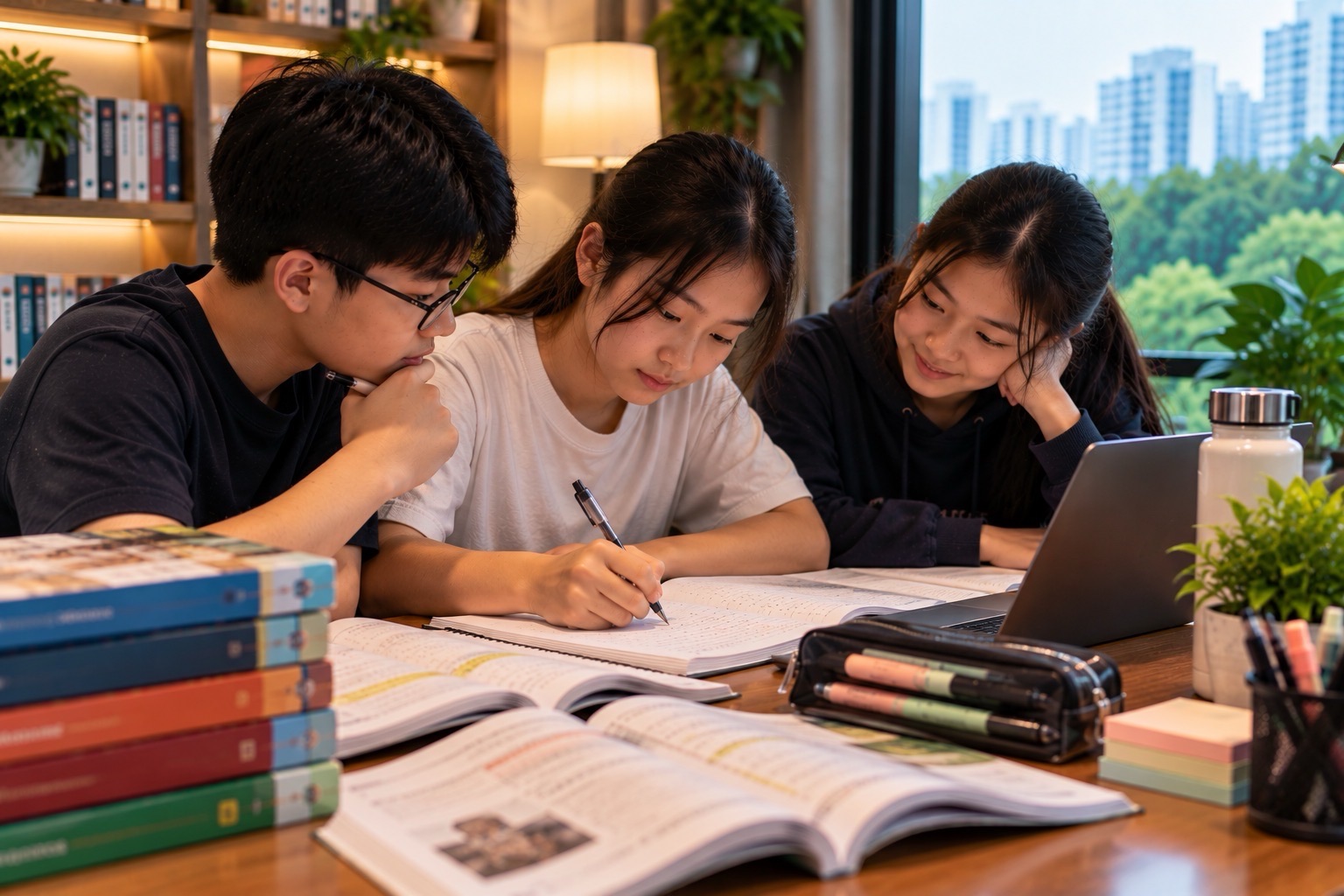
Secondary 4 Science Small Groups Tuition River Valley | Benefits and Consequences. Secondary 4 Science small groups tuition for River Valley families can be valuable when a capable student knows the syllabus but struggles to evaluate unfamiliar evidence or make decisions without a tutor’s hints. A well-matched three-pupil tutorial can deepen scientific reasoning through thoughtful comparison of competing models and independent application.
More tuition may also be unnecessary or counterproductive. A crowded academic schedule can remove time for self-study and rest, while constant guidance can make a teenager dependent on being told the next step. Parents should identify an actual learning objective and confirm the tutor and teaching location. This guide does not verify a River Valley eduKateSG Science class.
At a glance: At a glance: inspect original marked work for repeated higher-order errors; confirm the exact Pure or Combined Science syllabus; ask how extension remains relevant to the assessment; protect independent revision time; and review an unseen problem after four meetings.
- Best learner fit: secure foundations but repeated unfamiliar-application weaknesses
- Tutorial aim: compare models, evaluate evidence and justify conclusions
- Risk: harder worksheets or more hours without clear educational value
- Small-group requirement: all three must reason independently rather than follow a strong speaker
- Practical caution: extra travel and homework can undermine a sustainable week
- Location: River Valley is a guide audience, not confirmation of a local centre
A plateau in results may point to how the student thinks
A learner can remember definitions, solve standard Physics calculations and write familiar Biology explanations yet lose marks on altered scenarios. The problem may be that the student recognises textbook examples instead of selecting scientific principles from unfamiliar data. Adding more broad revision sheets may not address the recurring decision error.
A tutor should inspect several original marked answers and identify a category: incorrect model choice, misread graph, unsupported experimental claim or incomplete causal explanation. This gives the family a specific educational target rather than a vague ambition to reach a higher grade.
A high-performing teenager might need contrasting questions that demand judgment rather than material from a much higher syllabus. The task can be difficult because a known principle must be applied precisely under changed conditions, not because its vocabulary is new or obscure.
Parents should also consider whether school and self-study already address the weakness effectively. A student who can identify errors, use teacher feedback and revise independently may gain little from another weekly class. Tuition is most defensible where a specific difficulty persists despite those resources.
The quality of an inference is more important than its confidence
Strong students sometimes write elaborate explanations containing several plausible scientific facts, then lose marks because the actual evidence supports a narrower conclusion. In Chemistry, an observation may not uniquely identify a gas. In Biology, a result may not establish causation when several conditions change. In Physics, an equation may not fit the system being described.
A tutor can give students competing interpretations of an unfamiliar experiment and ask which assumptions each contains. One pupil proposes a model, another checks the actual data and a third suggests a test that might distinguish the alternatives. The teacher ensures scientific accuracy rather than rewarding rapid confident speech.
A concise explanation is often better than a long speculative one. The student should name the relevant evidence, select a mechanism that fits and avoid unsupported extras. This requires the learner to decide what to leave out, a useful higher-order skill.
After the discussion, every pupil should answer a different question alone. If a student can identify the limit of the evidence without a tutor hint, the intellectual challenge has translated into personal competence.
Extension should deepen understanding within the right syllabus
An impressive tuition programme may advertise advanced topics and unusually difficult worksheets. But national-examination preparation depends on the student’s registered course and the ability to use that knowledge appropriately. Material beyond the syllabus can be enjoyable enrichment, not an automatic requirement for distinction.
A useful extension question might ask the pupil to evaluate a fair-test design, explain a graph with a changed context or compare two plausible scientific models. These tasks require more reasoning while staying anchored in the principles the learner should already know.
Group compatibility matters. Pure Physics, Combined Physics/Chemistry and G2 Science can overlap in some ideas but have different overall demands. A three-person class should differentiate genuinely or recommend better placement. The most advanced worksheet is not necessarily the most educationally useful.
The tutor should explain what an extension task develops and how independent progress will be tested. A precise objective such as choosing the appropriate model in an unfamiliar circuit is more helpful than the vague promise of ‘harder Science’.
What is three-pupil Secondary 4 Science tuition?
Small groups tuition is supplementary teaching for a few learners together. A tutorial is the individual teaching session. The published eduKateSG reference programme describes up to three students with approximately ninety-minute lessons. A smaller group may allow a tutor to hear more of each student’s reasoning, spot a misconception and check a corrected answer. These possibilities are valuable only when the tutor actively uses the time for diagnosis and individual work; a small headcount is not itself proof of effectiveness.
A well-run tutorial moves from the student’s own attempt to a targeted explanation and then to a fresh problem. For example, if a child selects the wrong physical quantity in a circuit, the tutor should ask how the diagram was read rather than immediately demonstrate another calculation. If a Chemistry conclusion overstates an observation, the student should practise distinguishing evidence from inference. The aim is not merely to finish the worksheet, but to make the student’s next decision more accurate.
Three learners can learn by comparing methods and challenging assumptions. One student may notice an axis label, another explain a particle model and a third question whether a conclusion follows from an experiment. However, a quiet learner can also become a spectator. A responsible tutor gives every pupil independent thinking and writing time before and after shared discussion. An answer borrowed from a confident classmate is not evidence of personal mastery.
The independent Education Endowment Foundation research review defines small-group tuition as two to five pupils and reports positive average effects in its broader evidence base. That research is not a direct evaluation of Singapore Secondary 4 Science or eduKateSG. Its average months of learning progress must not be turned into a promised SEC grade, and good teaching depends on curriculum alignment, the tutor’s feedback and the suitability of the learners grouped together.
2026 GCE or 2027 SEC? The syllabus comes before the classroom
The Singapore–Cambridge Secondary Education Certificate (SEC) begins in 2027, replacing the separate GCE N- and O-Level examinations. Subjects are examined at G1, G2 or G3 levels. Those levels refer to actual course requirements, not simply different target grades for one universal worksheet. The student’s registered Science course and examination year should be known before an external tutor recommends an available group.
At G3, Combined Science uses a defined pair of disciplines. A student taking Physics/Chemistry does not have the same subject combination as a learner taking Chemistry/Biology. Separate Pure Physics, Chemistry and Biology have their own syllabuses. G2 Combined Science also has its distinct subject codes and content, and G1 Science is a separate course. A class advertised only as Secondary 4 Science therefore needs more description before parents can judge its suitability.
SEAB publishes the SEC overview, 2027 G1 syllabus list, 2027 G2 list, 2027 G3 list and 2026 GCE O-Level syllabuses. Families should use the school’s exact subject and the appropriate current-year listing. Older questions may still assess overlapping scientific ideas, but the tutor should screen their topic coverage, difficulty and assessment requirements instead of assuming they map perfectly to the new examination.
A syllabus mismatch creates real educational costs. A learner studying the wrong course may spend an evening on irrelevant material or mistakenly conclude they are weak because questions are pitched at a different level. A strong pupil may complete easier unrelated work without gaining any new reasoning skill. A careful placement process asks about subject code, current school topics and an actual marked response before selecting a group.
What the 2027 subject codes mean for class placement
| 2027 Science route | SEAB subject code examples | Tutoring consequence |
|---|---|---|
| G1 Science | K123 | Use the integrated G1 Science syllabus. |
| G2 Combined Science | K223 Physics/Chemistry; K224 Physics/Biology; K225 Chemistry/Biology | Confirm the correct pair and G2 depth. |
| G3 Combined Science | K326 Physics/Chemistry; K327 Physics/Biology; K328 Chemistry/Biology | Plan for the chosen pair, not all three disciplines. |
| G3 Pure Science | K323 Physics; K324 Chemistry; K325 Biology | Use the distinct separate-subject syllabuses. |
| 2026 GCE O-Level Combined Science examples | 5086, 5087, 5088 | Treat earlier exam materials as references to check, not automatic equivalents. |
Parents do not have to memorise every code. They should know their own child’s course and expect the tutor to confirm it. The codes below provide concrete examples of why a single Secondary 4 Science label is too vague for national-examination preparation. The final reference remains the official syllabus applicable to the student.
In a compatible three-student group, a tutor may share a broad scientific skill across several examples while using subject-specific follow-ups. But if the students’ courses have little overlap, identical worksheets cannot provide complete teaching. It may be better to form a different group, arrange a more focused session or use school consultation for a narrow question.
The examination-year difference also matters. An older GCE paper does not become scientifically worthless merely because the certificate changes, but it must be used thoughtfully. A tutor should be able to say why a particular older question remains relevant to the student’s 2027 course and where the syllabus or marking demand differs.
An accurate learning plan is not a race to the hardest possible material. The task needs to be demanding enough to reveal the student’s understanding and sufficiently aligned to the course to be meaningful. Parents should seek clear explanations of subject fit instead of accepting vague promises about covering all Science.
What exactly caused the lost Science mark?
| Category | What the child does | Teaching response |
|---|---|---|
| Knowledge gap | Cannot state or use the required principle. | Rebuild first principles, then retrieve later. |
| Misconception | Uses a true rule under unsuitable conditions. | Compare correct and contrasting contexts. |
| Graph or diagram reading | Misreads units, axes, apparatus or a component. | Translate the representation into words. |
| Incomplete scientific explanation | Names an outcome but omits its mechanism. | Link evidence, principle and consequence. |
| Unsupported inference | Treats a plausible explanation as proved. | Identify controls and sufficient evidence. |
| Execution or timing | Makes numerical, checking or time-allocation mistakes. | Stabilise the method and then time practice. |
A final wrong answer is a symptom, not necessarily a diagnosis. A pupil may know a formula but use it for the wrong part of a circuit. Another may remember osmosis but ignore the conditions in a cell diagram. A third may identify a plausible gas without the experimental evidence required to establish it. These errors all reduce marks, but the next useful lesson is different for each learner.
Ask the student to show the original marked response and narrate the first step. What did the question appear to ask? Which scientific principle was chosen and why? Did the pupil read the axes, labels and units? Where was a conclusion inferred rather than observed? The tutor should listen before supplying the model answer, because once a correct solution is shown it becomes harder to discover the child’s original thinking.
Some mistakes are primarily missing knowledge, some are misconceptions, and others involve representations, mathematical execution or command words. An effective tutor chooses a contrasting question that exposes the difference. When a pupil becomes able to classify their own error as a wrong model rather than merely ‘carelessness’, that insight helps future independent revision.
A diagnostic can also show that the child does not need ongoing tuition. A single school-teacher clarification, short numerical bridge or purposeful self-study schedule may solve the particular problem. External instruction should be recommended because it addresses a demonstrated need, not as an automatic requirement for a national examination.
How a ninety-minute Science tutorial can build independent thinking
A small-group lesson should not merely repeat a school lecture at a quieter table. It can begin with short retrieval of an earlier weak concept, examine one authentic school answer and rebuild the missing model. The tutor then introduces questions that alter the context and checks whether each learner can still select the principle. The final individual attempt matters because students sit examinations without a tutor naming the next formula or scientific process.
An illustrative sequence is ten minutes of retrieval, fifteen minutes of diagnosis, twenty minutes of first-principles explanation, twenty minutes of contrasting applications, fifteen minutes of independent work and ten minutes planning targeted home practice. This is a possible design rather than a guaranteed operational schedule. The actual subject, learner readiness and tutor judgment may require different proportions.
Group discussion can support learning when pupils are appropriately matched. One student may notice a missing axis label, another a wrong particle assumption and the third an experimental control. The tutor should invite each learner to defend reasoning with scientific evidence, then give individual questions with changed details. Merely agreeing with the strongest pupil’s model answer is recognition, not mastery.
The teacher should gradually reduce scaffolding. A hesitant student might initially receive a labelled diagram and a question broken into steps. Later the same principle should be tested with the labels removed and an unfamiliar context. If the pupil still needs a leading prompt, the tutor has useful information: a part of the concept or question-reading routine remains fragile. The next lesson should address that part rather than simply move to another chapter.
Practical Science: investigations, evidence and actual laboratory experience
Scientific inquiry is more than knowing the names of apparatus. Students need to understand what variable is deliberately changed, what response is measured, which relevant conditions are controlled and how a conclusion follows from the data. An investigation can produce a correct observation and still not establish the cause the learner writes. Paper-based tutoring can teach these distinctions using diagrams, tables and experimental descriptions.
A student may respond to any practical limitation by writing ‘human error’. That phrase is often too vague. A useful analysis identifies a particular measurement constraint, uncontrolled condition or procedural weakness supported by the scenario and suggests an improvement that addresses it. Repeating an experiment may help with random variation but does not automatically repair a confounded comparison where several factors change together.
Science writing should also distinguish an observation from a hypothesis or inference. Effervescence is a visible change, whereas identifying a gas may require appropriate evidence. A biological graph can show a plateau without proving every possible cause. Students should be encouraged to give precise, bounded conclusions rather than add extra claims simply because they know related terms.
A tuition room that teaches written practical planning is not automatically a supervised laboratory. Handling apparatus, making real measurements and applying safety procedures require suitable facilities and instruction. Parents should ask what equipment, if any, is actually available, and ensure school practical learning remains part of the child’s preparation. An honest provider describes those limits rather than promising all aspects of practical Science without verifying them.
A four-week evidence check for tuition quality
An early review is useful because families need a way to judge whether extra tuition is improving learning rather than simply increasing activity. Before the first lesson, keep an original marked question and classify two recurring errors. The tutor should name a narrow teaching target, such as identifying the correct component in a circuit or distinguishing a measured observation from an inferred conclusion.
After the second lesson, ask the teenager to explain the corrected principle in their own words and apply it in a slightly changed situation. The third lesson can reduce prompts further and present an unfamiliar question. At the fourth, compare a fresh task of similar demand with the starting example. The important evidence is the student’s own reasoning, not the number of pages completed.
Four weeks is not a guarantee of a grade increase. Some misconceptions are narrow and quickly repaired; others require earlier knowledge and more sustained practice. A change in an overall examination mark depends on many skills beyond the one targeted in tuition. An honest tutor may report that graph reading has improved while long causal explanations remain weak. Such specificity helps the family make the next decision.
If the same error persists, question whether the diagnosis was correct, the group was compatible and the student had enough meaningful practice between lessons. The family may need a different teacher, a slower bridge, more school consultation or a reduced workload. The answer is not automatically to book more of the same sessions. Continued attendance should be justified by observable educational value.
Benefits, disadvantages and alternatives
Three-pupil tuition can allow frequent questioning, close error analysis and constructive peer comparison. Its disadvantages include shared tutor attention, the possibility of an unsuitable group mix, fees, travel and homework. These considerations should be evaluated together. A student who is exhausted or following the wrong subject combination may gain little even from a capable teacher.
One-to-one tuition can provide intense individual pacing for a serious gap but may cost more and offer fewer opportunities to compare peer reasoning. A larger revision class can suit a learner whose foundations are secure and who mainly wants structure or broad timed practice. School teacher consultation is especially useful for focused questions about current classwork or marking expectations.
Independent revision remains important whichever tuition format is selected. The teenager should be able to attempt a question before consulting a solution, explain why a correction works and retrieve the same concept after a delay. If a student already performs these tasks reliably using school feedback, additional tuition may be unnecessary. A responsible provider should be comfortable making that recommendation.
The cost of not taking tuition can also be real when a persistent misconception remains uncorrected. The sensible choice is therefore not automatically ‘more’ or ‘less’ tuition. It is the smallest effective intervention that solves the specific problem without undermining sleep, other national-examination subjects or the student’s ability to study independently.
Home revision that strengthens—not duplicates—the tutorial
After a lesson, the tutor can assign a few varied questions that require the corrected scientific idea to be retrieved without notes. A short error log should record the original mistaken assumption, the accurate principle and a future date to revisit it. Merely copying a model answer into a notebook may make the correction look finished while leaving the original decision habit unchanged.
Parents can ask neutral questions: what does the graph show, which quantity is being calculated, what evidence supports this conclusion and what condition has changed? These prompts invite the teenager to explain a method without being told the answer. If an adult supplies the first formula every time, the child may become dependent on a cue that is absent during examinations.
Study tasks should remain proportionate to the learner’s week. A ninety-minute lesson can demand much more time once travelling, eating and follow-up assignments are counted. Other examined subjects, school work, exercise and sleep also need space. Extra tuition that leaves no time for independent application can defeat its own purpose.
Good tuition should ultimately make itself less necessary. A teenager who can identify errors, select suitable practice, ask focused school questions and correct work alone has developed a skill extending beyond one examination. Parents can reduce tuition as that independence becomes reliable rather than treating weekly attendance as a permanent obligation.
Illustrative ninety-minute teaching sequence
| Stage | Time | What it tests |
|---|---|---|
| Retrieve an old concept | 10 minutes | Delayed recall without notes |
| Diagnose original work | 15 minutes | First wrong scientific decision |
| Rebuild the model | 20 minutes | Causal understanding and correct terminology |
| Apply to a contrasting task | 20 minutes | Transfer to unfamiliar conditions |
| Independent answer | 15 minutes | Every learner works without hints |
| Set the next retrieval target | 10 minutes | Purposeful home practice |
Four-week parent review
| Checkpoint | Evidence | Decision |
|---|---|---|
| Before beginning | Original marked work and error types | Is a concrete problem identified? |
| After two lessons | Own-words explanation and changed example | Is the principle understood? |
| After three lessons | Fresh independent application | Does reasoning transfer? |
| After four lessons | Comparable unseen response and error log | Continue, adjust or stop based on evidence |
The parent enrolment checklist
- Identify the exact Science combination, examination year and G1/G2/G3 level.
- Bring recent school questions with the child’s original working intact.
- Ask whether all three learners have compatible subjects and pace.
- Confirm the tutor can identify the first misconception, not simply provide more worksheets.
- Check whether individual unseen tasks are part of the class.
- Distinguish written experiment analysis from real supervised practical work.
- Verify actual tutor, teaching room, timetable, fee and available place.
- Include total travel and home practice in the weekly time budget.
- Review independent progress after four lessons without grade guarantees.
- Choose school help, individual bridging or no tuition when a group is not suitable.
When a strong learner needs a different kind of practice
A capable Secondary 4 student may know definitions, complete routine calculations and perform well on familiar questions, yet lose marks when the examination combines concepts or presents data in a new form. The issue may be transfer rather than missing content. A tutor should analyse original marked work to identify whether the child chooses an unsuitable model, overlooks a condition or overstates an inference.
More chapter-by-chapter revision may not solve a problem of judgment. A useful extension task can compare two plausible explanations, ask which evidence supports each and require the student to identify what information would distinguish them. This deepens understanding within the relevant syllabus rather than racing into unrelated advanced terminology.
For Physics, the pupil might explain why one equation fits a circuit and another does not. For Chemistry, the task could distinguish reaction evidence from a guessed product. For Biology, a graph might require recognising a plateau and limiting an explanation to the measured conditions. The challenge is selecting a defensible principle, not merely using the most difficult worksheet.
Parents should ask the tutor to name the higher-order error being addressed and what independent response will test it. A statement such as ‘we teach harder Science’ is less informative than a plan to improve data interpretation or justified causal reasoning.
Group discussion should sharpen scientific judgment
Three capable learners may benefit from comparing different models of the same data. One proposes a hypothesis, another checks the graph or experiment, and a third identifies a possible uncontrolled condition. The teacher ensures that every explanation is scientifically accurate and that disagreement is based on evidence rather than confidence or speaking speed.
A quiet pupil may notice a critical detail after careful thought; a fluent pupil may answer first and overlook it. A small group should protect private thinking time before the discussion. Every student writes a first response, listens to the competing interpretations and then completes a changed question individually.
The quality of a Science answer is not determined by its length. An elaborate paragraph with several unsupported claims can be weaker than a concise one containing the relevant condition, mechanism and conclusion. A tutor can teach pupils to identify which sentence actually helps answer the question and which material is speculative or irrelevant.
After the group has considered one experiment, each learner should receive a different unseen data set. If all three can justify a restrained conclusion without tutor prompts, the collaboration has developed personal competence. If only one student can perform alone, the class requires more targeted feedback.
The danger of adding tuition to an already full timetable
River Valley families may be considering supplementary Science even when a child is already conscientious and heavily scheduled. Schoolwork, CCAs, multiple tuition subjects and examination papers can occupy nearly every evening. Although each individual class may appear useful, the combined commitments can remove the quiet time needed for independent reasoning and self-correction.
The marginal benefit of another lesson should be judged against what it replaces. A learner who already analyses errors accurately may gain more from an independent timed paper and adequate sleep than another round of guided explanations. A teenager with a persistent unfamiliar-application weakness might benefit from a carefully targeted group, provided the timetable remains sustainable.
A good tutor gradually reduces hints and gives the student more responsibility for selecting practice. Early sessions may involve a teacher-chosen diagnostic; later the pupil brings an error log and proposes a focus. The aim is for the teenager to use school feedback and syllabus materials confidently without requiring permanent external direction.
Four lessons provide an early review, not a promised improvement in national examination marks. Parents can compare original and changed unfamiliar questions of similar demand, note whether the student needed prompting and consider whether the extra class remains worthwhile. Stronger autonomy may be a reason to reduce tuition.
River Valley is a reader location, not a promised class venue
This guide is intended for families in River Valley, but it does not establish that eduKateSG operates a dedicated Secondary 4 Science classroom or vacant three-pupil group there. The family should request the actual tutor, teaching location, syllabus combination and available timetable directly. A published teaching model elsewhere in Singapore does not prove a group exists in every estate.
Location convenience is useful only after educational fit has been confirmed. A nearby class using the wrong Science subject or level is not a good choice simply because travel is easy. A suitable class further away may have value if it repairs a persistent error, but transport, meals, homework and fatigue should all be included in the decision.
School consultation and self-study should remain real alternatives. A student with one narrow marking question can often use a teacher conversation efficiently. A student who can already analyse unfamiliar evidence may not require another weekly lesson. The smallest effective intervention is preferable to adding classes because they appear prestigious.
The best outcome is the ability to choose scientific models, interpret data and correct errors without help. A small group can support that outcome when it provides accurate teaching and individual feedback, but it should not turn learning into perpetual dependence on the tutor.
Four worked Science corrections for River Valley
Biology graph plateau is ignored
Teaching response: Describe the complete data and explain any relevant limiting factor within the evidence. The learner should then face another previously unseen question that changes the example but keeps the same underlying scientific principle. The tutor can compare that attempt with the original marked work and explain what has become more independent, rather than claim that one corrected answer guarantees an examination grade.
Chemistry observation treated as proof
Teaching response: Separate observed changes from confirmed identification and warranted inference. The learner should then face another previously unseen question that changes the example but keeps the same underlying scientific principle. The tutor can compare that attempt with the original marked work and explain what has become more independent, rather than claim that one corrected answer guarantees an examination grade.
Physics equation used under wrong conditions
Teaching response: Identify the system and quantity before selecting the model. The learner should then face another previously unseen question that changes the example but keeps the same underlying scientific principle. The tutor can compare that attempt with the original marked work and explain what has become more independent, rather than claim that one corrected answer guarantees an examination grade.
Confident pupil supplies every group answer
Teaching response: Require private responses before discussion and individual tasks afterward. The learner should then face another previously unseen question that changes the example but keeps the same underlying scientific principle. The tutor can compare that attempt with the original marked work and explain what has become more independent, rather than claim that one corrected answer guarantees an examination grade.
Frequently asked questions for River Valley families
Does a strong student necessarily need tuition?
No. Extra lessons should address a real objective and not displace effective independent revision.
Does off-syllabus advanced content guarantee distinction?
No. The course requirements and quality of scientific reasoning are more relevant.
Is a River Valley small-group classroom confirmed?
No. Verify the tutor, actual venue, syllabus and vacancy.
What demonstrates useful extension?
Better independent answers to unfamiliar application and evidence-evaluation questions.
Further official and connected reading
- SEAB Singapore–Cambridge SEC overview
- How G3 Physics/Chemistry Science Works
- How G3 Physics/Biology Science Works
- How G3 Chemistry/Biology Science Works
- How G2 SEC Science Combinations Work
- eduKateSG immutable three-pax teaching reference
- eduKateSG tuition and teaching hub
This is an independent reader guide and not an official MOE or SEAB publication. The official syllabus and the student’s registered subject determine examination requirements. An estate name in a guide identifies the intended audience; it does not confirm a physical teaching centre, a tutor or an available group.
The considered choice for River Valley parents
A River Valley family should choose Secondary 4 Science small groups tuition because the teenager has a defined learning need and the available tutor can make independent progress visible. For a child who is behind, rebuild the earliest important idea. For one who is inconsistent, practise retrieving and applying the same principle in varied contexts. For an already capable learner, extend for a specific purpose while protecting self-directed study. The best tuition produces a student who eventually needs less correction.
Arrange a parent–student consultation
Bring a recent original marked Science response and the registered examination year and subject. Contact eduKate Singapore · Ask about a suitable group on WhatsApp. Confirm the real venue and available place before travelling.
eduKateSG | Three-pupil tutorials, evidence-based Science correction and independent learning. Properly taught kids shine a bright light into the future.