
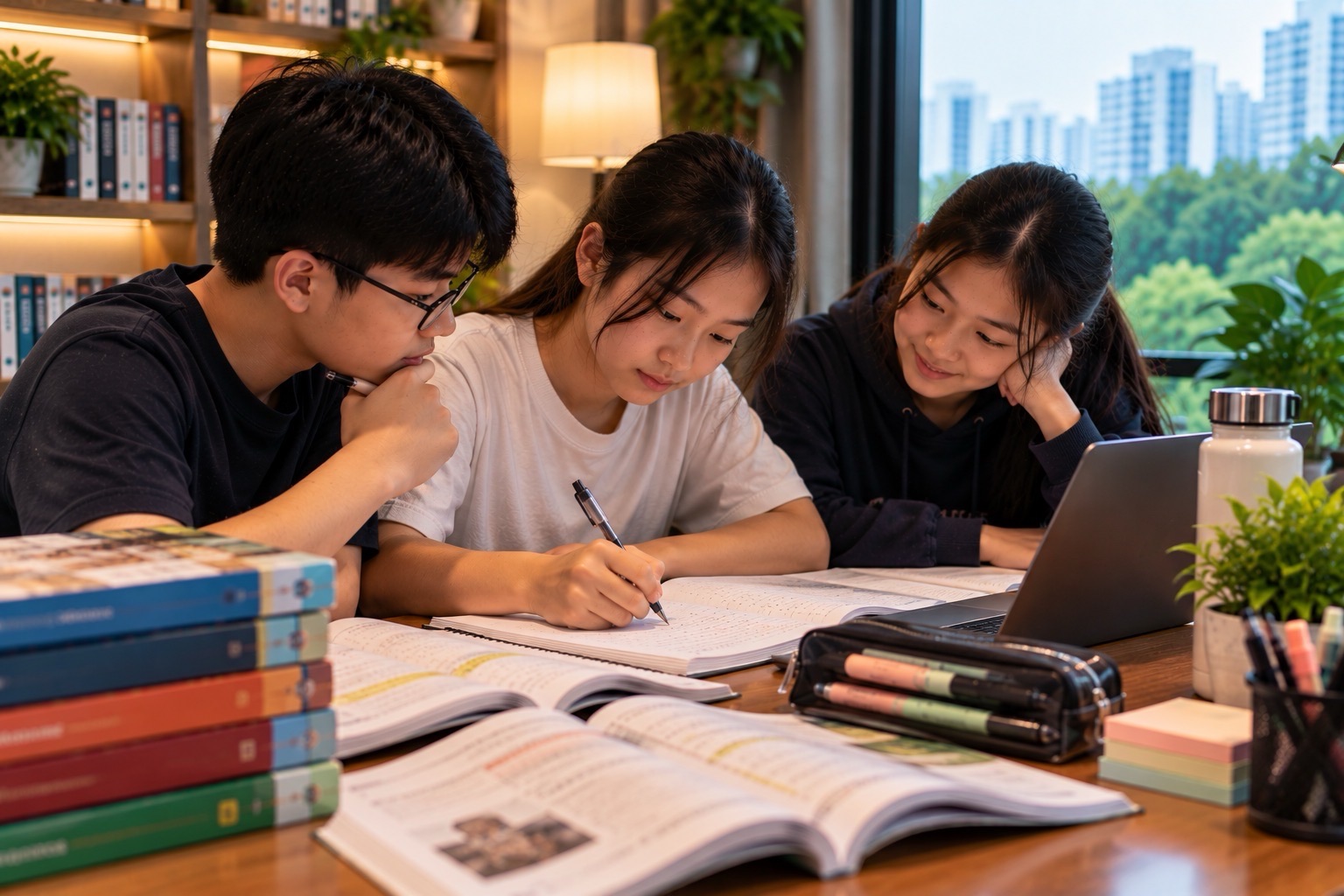
Secondary 4 Science Small Groups Tuition Sembawang | Benefits and Consequences. Secondary 4 Science small groups tuition for Sembawang families should begin with the student’s actual school-registered Science subject, not a generic promise to cover every Secondary 4 topic. For students preparing for the first Singapore–Cambridge Secondary Education Certificate (SEC) in 2027, the difference between G1 Science, G2 Combined Science, G3 Combined Science and separate G3 Pure Sciences matters when choosing a suitable three-pupil tutorial.
The benefits are real only when the group is compatible and a tutor can identify the child’s scientific misconception, correct it and check independent application. The consequences of poor placement include irrelevant worksheets, unnecessary travelling, lost self-study time and discouragement from questions pitched at the wrong level. An article intended for Sembawang readers does not establish that eduKateSG has an available physical classroom there.
Quick parent information: Quick parent decision: identify the exact Science subject and examination year; bring unedited school responses; ask how three learners are matched and differentiated; check that the tutor uses current SEAB syllabuses; confirm the actual venue and timetable; review progress through fresh questions after four sessions.
- The first action is to obtain the registered subject title and syllabus level from school.
- A suitable group has compatible learning needs or demonstrably different individual tasks.
- A key risk is mistaking generic Science revision for relevant SEC examination preparation.
- Independent answers, not completed worksheets, provide evidence that the student learned.
- The full journey, home practice, other subjects and rest belong in the tuition decision.
- Estate naming is information for Sembawang families, not confirmation of a tuition branch.
How to match Secondary 4 Science tuition to the correct SEC course: a guide for Sembawang families
Why the phrase ‘Secondary 4 Science’ is not enough for enrolment
A parent searching for Science tuition may naturally give the teenager’s school year and general subject. Yet that description leaves out the information needed to select a tutorial. The student may study an integrated G1 Science course, a combined G2 pairing, a combined G3 pairing or separate Pure Sciences at G3. These pathways teach overlapping habits of scientific reasoning, but their syllabus content and assessment scope are not interchangeable.
A responsible tutor begins by asking for the student’s own course and examination year. It would be a poor match to place someone studying Physics/Biology into a group dominated by Chemistry work simply because all the pupils are in Secondary 4. Likewise, Pure Physics and the Physics component of Combined Science have differences in depth and question demand. A small group is only beneficial when its actual work addresses the registered subject.
The certificate transition creates a second risk. An older practice paper may contain scientifically useful ideas but use a code and assessment structure belonging to a previous examination. Parents do not have to become syllabus specialists, but they should expect the tutor to explain which old questions are appropriate and which require adaptation. The official current-year document, rather than a large file of unlabeled past questions, should govern preparation.
Sembawang families can make an enquiry clearer by bringing the exact subject title, a photograph of the school assessment header and one original marked response. Ask the proposed tutor how a first lesson would address that subject, not only whether a class has space. A provider who recommends a different group or declines an unsuitable pairing may be giving the family more valuable advice than one who enrols everybody immediately.
Why three pupils need more than an identical worksheet
The attraction of a three-person class is that a tutor may hear each learner explain a thought before it disappears into a written answer. However, three students can still have different misconceptions, levels and interests. One may struggle with fundamental particle behaviour, a second with interpreting graphs, and a third with writing a reasoned conclusion. The same activity may serve as a shared introduction, but it cannot automatically be the complete lesson for all of them.
A better teaching sequence offers a common principle where appropriate and then differentiates. For instance, all three pupils might practise identifying the independent and dependent variables in an investigation. Their next questions can reflect the actual experimental content and demand of their own courses. The tutor should observe which student needs a diagram, who needs a numerical bridge and who is ready to test an unfamiliar inference.
The class can also develop peer reasoning. One pupil proposes a solution, another notices an overlooked condition, and the third asks whether the conclusion is supported. But that dialogue needs supervision. A confident student may speak first and encourage the others to copy, leaving parents with a positive impression of discussion but no evidence of individual understanding. The tutor should collect a private first attempt and a different private final response.
The placement question is therefore not whether three is a low number. It is whether the teacher can give every pupil relevant material, suitable challenge, a respectful environment and enough time to demonstrate an independent method. A matched larger revision class may help a confident learner more than an unsuitable three-pupil group. Conversely, a child missing deep prerequisites may benefit from individual bridging before joining peers.
What a syllabus-matched diagnosis should reveal
A low Science grade can look alarming, but it does not explain why marks were lost. A pupil might know the relevant process but apply it to the wrong diagram. Another might be unable to recall the scientific principle at all. A third might complete a correct calculation with inconsistent units. All three can produce an incorrect final response, but their next effective teaching task is different. A genuine diagnostic must examine the first wrong decision.
The tutor should look at unedited marked work and ask the child to explain how the answer began. Which words in the question seemed important? Which quantity was being calculated? Was the graph axis read correctly? Did the learner describe an observation or jump straight to a conclusion? Once these decisions are visible, the teacher can distinguish an encoding gap from an application or execution problem.
For example, a student may accurately define osmosis but predict the wrong change in a cell because the membrane conditions were ignored. The teacher might ask the pupil to identify the direction of net water movement using an appropriate water-potential explanation. A second diagram with altered surroundings then tests whether the model works in a new context. Rereading the definition alone would not provide that evidence.
Parents should ask for a one-page description of the first priority, why it matters and how a changed question will check the repair. It need not be a complicated report. A statement such as ‘the learner misreads the independent variable on practical graphs’ is actionable. The broad conclusion ‘the learner must revise Science harder’ tells neither the tutor nor the teenager which decision needs to change.
Why practical Science cannot be simplified into generic exam phrases
Practical investigations involve variables, measurements, apparatus, controls and conclusions. A student may memorise that experiments should be fair, but write that every variable must remain unchanged. In a valid comparison the factor under investigation changes, the response is measured, and other relevant conditions are controlled. The precise identities of those variables depend on the experiment, so a tutor should use actual setups rather than phrase banks alone.
A reaction-rate comparison can demonstrate the issue. If two trials differ in concentration and temperature, the observed difference cannot cleanly establish the effect of either factor alone. The tutor can ask what must be controlled to isolate the intended relationship, then have the pupil design a more interpretable comparison. A changed experiment in a different subject tests whether the reasoning has transferred.
The phrase ‘human error’ is another warning sign. It may sound like an evaluation but does not identify which procedure or measurement created uncertainty. A stronger response states a particular plausible limitation supported by the setup and explains how to improve it. Repeating a trial may reduce random variation, but repeating a confounded experiment does not automatically identify a cause.
Families must also distinguish written practical reasoning from hands-on work. A small tutorial room can teach data response and investigation planning without offering a supervised laboratory. Parents should ask whether the proposed class has apparatus and appropriate supervision, or whether practical questions are handled on paper. School laboratory teaching remains essential where required by the official course.
The 2027 SEC transition should guide old-paper selection
Families often hold collections of past GCE questions and may worry that a 2027 candidate can no longer use them. That conclusion would be too broad. Scientific laws, particle models and experiment reasoning do not simply expire when the certificate is renamed. However, examination subject codes and the exact current course matter, and older questions need to be screened for topic coverage and demand.
A tutor can label each selected task by its purpose. Some questions are for concept retrieval, others for unfamiliar application, and others for timed practice closely resembling the current assessment. A question that is useful for understanding a circuit relationship may not be an appropriate full examination simulation if the course or structure differs. This distinction protects a teenager from confusing educational practice with official paper familiarity.
Parents should ask whether the teacher has checked the correct subject-level syllabus and any current specimen papers. The existence of an enormous question bank is not, by itself, a quality signal. A smaller set of well-chosen tasks with careful individual feedback may be more useful than a thousand pages copied from mismatched courses.
The student can also learn to judge relevance. Rather than blindly answering everything in a folder, the teenager can ask which scientific principle is being assessed, whether it belongs to the current course and what learning objective the problem serves. That ability will make home revision more efficient long after a particular tuition programme ends.
Sembawang families must consider a full travel and learning budget
The name Sembawang in this guide identifies the intended reader community. It does not confirm an eduKateSG Science classroom in Sembawang or a vacant place there. Families should verify the real teaching location, current tutor, Science combination, timetable and fee before planning a journey. An estate-specific webpage should not be mistaken for a booking notice.
Secondary 4 students have school lessons, other national-examination subjects, practical programmes, homework and a need for sleep. A ninety-minute tutorial may consume much more time when travelling, eating and additional assignments are considered. The family should decide what the new commitment displaces and whether the proposed learning gain is sufficiently specific to justify it.
A nearby class that is pitched to the wrong subject level may be a poor choice despite convenience. A suitable group elsewhere may justify additional travel if it resolves a persistent misconception, but parents should remain realistic about fatigue. School-teacher consultation or targeted individual help may be better for some questions. An already independent learner may not need external tuition at all.
At the four-lesson checkpoint, ask for a new question from the correct subject and level. Does the teenager now choose an appropriate scientific principle, explain the result and correct mistakes without hints? If so, the class may be earning its place. If not, question the diagnosis, teacher method or group composition instead of assuming more sessions must eventually work.
What a responsible first-month placement review should contain
Week one begins with the actual registered course and a few original answers. The tutor identifies whether the main obstacle is a missing concept, unsuitable application, graph reading, inference or examination execution. The goal should be narrow enough to teach and check, such as choosing the correct physical quantity from a circuit rather than the vague ambition to ‘improve all Science’.
Week two rebuilds the principle and presents contrasting examples. The learner should explain why a familiar approach fails in one setting and works in another. The student then attempts a short retrieval task after a delay rather than simply rereading the tutor’s solution. The point is to make the idea usable from memory.
Week three removes leading hints. The teacher presents a new question and asks the pupil to select the concept independently. If the old error returns, it provides useful information for more precise teaching. The tutor can revisit an earlier prerequisite or change the example rather than blame the pupil for not working hard enough.
Week four compares a similarly demanding unseen problem with the baseline and reviews the weekly burden. Parents should receive specific evidence about what became independent and what remains weak, not a promised SEC grade. If the group is incompatible, changing placement is responsible. If the child now revises effectively with school feedback and self-study, reducing tuition may be an appropriate educational outcome.
Four worked examples of Science misconceptions for Sembawang
G1 Science candidate given a G3 Pure question
Original problem: The wrong syllabus creates an unfair comparison.
Targeted teaching: Match teaching tasks to the registered subject and course level.
Independent evidence: Unseen question at the correct level is solved independently.
Different Combined Science pairs share irrelevant work
Original problem: One student spends time on a discipline they do not offer.
Targeted teaching: Use subject-specific tasks or recommend a compatible group.
Independent evidence: Every pupil produces relevant independent answers.
Chemistry gas identity assumed from bubbles
Original problem: The learner treats effervescence as proof of one product.
Targeted teaching: Separate observation, likely explanation and suitable confirmation.
Independent evidence: Another experiment receives a defensible conclusion.
A class feels helpful but results remain dependent on hints
Original problem: The tutor or strongest pupil selects every first step.
Targeted teaching: Collect private attempts before and after discussion.
Independent evidence: The student chooses an unfamiliar method alone.
Questions Sembawang parents frequently ask
Does Sembawang have a confirmed eduKateSG Secondary 4 Science class?
No. This guide does not verify a physical centre or available class in Sembawang.
Can different G-level Science learners share tuition?
Sometimes for overlapping skills, but actual content, difficulty and independent practice must be appropriately differentiated.
Are old GCE questions invalid for SEC candidates?
Not automatically. Older questions should be checked for overlap with the current course and assessment.
Does the small headcount guarantee a distinction?
No. Teaching quality, student work and many other factors affect examination outcomes.
How should families judge the first four lessons?
Compare independent unseen work at the correct syllabus level and check whether repeated mistakes have reduced.
Can a tutor guarantee rebanding to a higher subject level?
No. School subject-level decisions follow official school processes and policies.
Why school consultation and tuition need not compete
The school teacher knows what the class has studied and can often clarify why a particular response lost marks. A small-group tutor may then help the learner practise that scientific principle in several new contexts. Treating the two sources as complementary avoids duplicating the same explanation while leaving the underlying application problem unresolved. Parents should encourage the student to bring focused questions to school rather than outsource all correction.
A pupil who can retrieve the concept but has a narrow uncertainty about the teacher’s marking may need a short consultation, not another permanent paid class. Conversely, if the same misconception persists in several different questions despite school feedback, a targeted tutorial may supply the additional observation and variation that is missing. The decision should follow the child’s work.
Sembawang families must also consider whether an available class is physically feasible. The neighbourhood label is not a verified teaching room. Confirm the instructor, course and full journey before deciding that an evening commitment will be manageable alongside school, other subjects and rest.
The best intervention ends with a student who knows how to ask a precise question, test the corrected concept in an unfamiliar problem and recognise the boundary of the scientific explanation. This is a lasting learning capability that makes both school and external instruction more effective.
How to discuss a poor group match without blaming the learner
A student who is overwhelmed by another group’s Science questions may not lack effort; the material may belong to a different course or require prerequisites not yet taught. Parents can ask the tutor whether the class can provide an appropriately sequenced bridge. If not, recommending a different group or individual teaching is a responsible response.
At the opposite extreme, a capable learner repeatedly finishing irrelevant easy tasks may be under-challenged despite appearing successful. The family should ask for unfamiliar but syllabus-matched applications that require genuine reasoning rather than increased worksheet volume.
The group should be periodically reassessed, not treated as a permanent placement. School assessments and delayed retrieval can reveal changes in readiness. A student who needed a slower pace at the start may later work independently, while another may reveal a deeper misconception as questions become unfamiliar.
Parents should judge fit through calm, specific evidence rather than peer comparison or prestige. The correct measure is whether the child’s own scientific thinking is becoming more accurate, stable and independent within the registered course.
Singapore examination pathways: what the 2026–2027 transition means for Science
From 2027, Singapore candidates take subjects under the Singapore–Cambridge Secondary Education Certificate (SEC), combining the former separate N- and O-Level examinations under one certification system. The change of certificate does not erase differences between Science syllabuses. Subjects remain examined at approved G1, G2 or G3 levels, and the student’s registered subject and examination year should determine the tutor’s materials. Consult SEAB’s official SEC information before treating an older paper as an exact match.
| Route | Official 2027 subject codes | Educational consequence |
|---|---|---|
| G1 Science | K123 | The G1 Science course has its own scope and assessment requirements. |
| G2 Science (Physics, Chemistry) | K223 | G2 teaching should follow the matching combined pair and level. |
| G2 Science (Physics, Biology) | K224 | Do not substitute Chemistry for the pupil’s registered Biology component. |
| G2 Science (Chemistry, Biology) | K225 | Use the appropriate pair and G2 syllabus demands. |
| G3 Science (Physics, Chemistry) | K326 | Combined G3 course, distinct from separate Pure Science subjects. |
| G3 Science (Physics, Biology) | K327 | Both the Physics and Biology components need suitable practice. |
| G3 Science (Chemistry, Biology) | K328 | The Chemistry and Biology programme is not a generic three-discipline course. |
| G3 Pure Sciences | K323 Physics; K324 Chemistry; K325 Biology | Separate subject content and papers require a deliberate match. |
| 2026 GCE Combined Science | 5086; 5087; 5088 | Older subject codes refer to the previous year’s examination system. |
Official school-candidate lists: 2027 G1 syllabuses, 2027 G2 syllabuses, 2027 G3 syllabuses and 2026 GCE O-Level syllabuses. These codes help parents check placement and question relevance; they are not a substitute for reading the actual syllabus. A student may benefit from an older question when its concept and assessment demand remain appropriate, but old paper codes and updated SEC subject codes should not be presented as identical.
A tutor should therefore ask for the student’s own school subject record before recommending an available place. Similar names can conceal differences in depth, combination and assessment. A pupil given questions from a different course may look weaker than they actually are, while a child completing overly familiar lower-demand tasks may acquire false confidence. Syllabus matching is a basic requirement of responsible teaching rather than a marketing extra.
Why three pupils can be useful without being a guarantee of results
The eduKateSG immutable Clementi three-pupil tutorial reference describes a small teaching format designed around close attention and carefully sequenced support. This structure may allow the tutor to inspect each learner’s diagrams, calculations, oral reasoning and written explanations. Its potential advantage depends on actually using the time for targeted feedback. A class of three can still be ineffective if the syllabus is mismatched, the pace unsuitable or one confident pupil supplies every answer.
The Education Endowment Foundation’s small-group tuition evidence review examines a wider body of research on groups of two to five students. It supports the general value of targeted small-group instruction, but is not a direct evaluation of Singapore Secondary 4 Science or this tuition provider. Its reported average effects should never become a promise of a particular SEC score or grade for an individual pupil. The important implementation questions are the quality of instruction, precise feedback and relevance of the content.
In a good three-person tutorial, the first attempt belongs to each student. The teacher listens to what was thought to be relevant before showing a model answer. Students then compare reasoning, question assumptions and identify why a tempting wrong method fails. Every learner finally completes an unfamiliar task independently. Without that final check, a student may recognise a classmate’s answer but remain unable to generate a response under examination conditions.
How a 90-minute Science tutorial can be organised around real learning
| Illustrative stage | Time | Purpose and evidence |
|---|---|---|
| Retrieve a prior misconception | 10 minutes | See whether the corrected idea remains usable without notes. |
| Examine original marked work | 15 minutes | Locate the first wrong scientific decision. |
| Build the underlying principle | 20 minutes | Connect diagrams, models, evidence and terminology. |
| Use contrasting or altered contexts | 20 minutes | Prevent copying the original example’s surface details. |
| Individual unseen question | 15 minutes | Verify that all three pupils can choose a method without hints. |
| Short error log and next retrieval task | 10 minutes | Give the child a feasible task before the next meeting. |
These times illustrate one educational design and are not confirmation of a particular tutor, current timetable or local classroom. The actual distribution may vary according to school assessments and the group’s needs. The critical feature is a loop of diagnosis, explanation, application, feedback and delayed retrieval. A student who understands a worked answer immediately after the tutor explains it may still need to prove that the same model is accessible next week.
The tutor should progressively reduce prompts. Early in a repair a student may need a labelled diagram or a short explanation broken into stages. Later the labels should be removed and the question context changed, leaving the learner to select the principle. That independence is the reason the tutorial is more than another set of worksheets supervised by an adult.
What practical Science tuition can and cannot replace
Scientific inquiry requires careful observations, identification of independent and dependent variables, controlled comparisons, measurement, safe apparatus handling and justified conclusions. A tuition room can teach paper-based planning and interpretation very effectively. It should not automatically be described as a laboratory with supervised hands-on apparatus work, however. Parents must ask what the proposed programme actually offers and continue the relevant school practical training and safety instruction.
The phrase ‘human error’ is often insufficient for an experimental-evaluation answer. Students should point to an actual plausible limitation supported by the apparatus or procedure and describe an improvement that addresses it. Repeating a trial may improve reliability when there is random variation, but cannot by itself repair an experiment in which more than one relevant condition changed. This is an example of thinking about evidence rather than memorising a generic marking phrase.
Four lessons: an early review, not an examination-grade forecast
| Checkpoint | Evidence worth keeping | What it can establish |
|---|---|---|
| Baseline | Original marked work, named course and error categories. | The teaching has a clearly identified target. |
| Lesson two | A corrected concept explained in the student’s own words. | The learner understands more than a copied sentence. |
| Lesson three | Changed example with reduced assistance. | The model can transfer to an unfamiliar context. |
| Lesson four | Comparable new answer and updated error record. | Whether the group is generating useful independent progress. |
Four weeks is a sensible early checkpoint, but complex gaps can take longer and a final Science grade depends on many skills. Parents should compare tasks of similar demand and record whether hints were needed. A child who now identifies graph axes correctly has made a useful improvement, but that does not guarantee distinction across all subject components. If progress is absent, revisit the diagnosis, tutor fit, group composition and available study time instead of automatically buying more worksheets.
Tuition choices and their educational consequences
| Arrangement | Potential benefit | Possible trade-off |
|---|---|---|
| Three-pupil tutorial | Close feedback and disciplined peer comparison. | Attention still shared; group mismatch can conceal gaps. |
| Individual tutor | Highly flexible pacing for a deep or unusual misconception. | May cost more and lacks group discussion. |
| Larger revision group | Broad coverage, timed practice and a routine for independent learners. | Less opportunity to inspect everyone’s initial reasoning. |
| School-teacher consultation | Direct access to school feedback and the current course. | Limited consultation time; specific questions help. |
| Independent practice | No commute and more responsibility for selecting tasks. | A recurring misconception may remain if feedback is unreliable. |
| Additional weekly class | Can repair a persistent error that ordinary revision has not resolved. | Transport, fees, fatigue and homework may displace other important activities. |
The cost of a tutorial extends beyond the advertised ninety minutes. Include travel, meals, preparation, additional work and the effect on time for other examined subjects and sleep. More tuition is not automatically a better plan, especially when a learner can already diagnose and correct mistakes through school. But doing nothing about a serious recurring misconception can also waste revision effort. Parents should choose the least burdensome intervention with a credible route to independent improvement.
Parent checklist before enrolment
- Confirm examination year, registered Science subject, combination and G1/G2/G3 level.
- Bring original marked answers showing how the student reasoned before correction.
- Ask which misconception the next four lessons are intended to repair.
- Verify the actual tutor’s expertise in the appropriate subject and level.
- Ask how group composition and differences in starting knowledge are managed.
- Require individual unseen tasks before concluding that group discussion produced learning.
- Clarify whether practical preparation is written only or involves actual supervised apparatus.
- Confirm the real classroom, timeslot, fees, policies and available seat.
- Include the journey, homework and remaining independent study in the weekly time budget.
- Review comparable new work after four sessions without accepting a guaranteed-grade claim.
Official syllabuses and linked eduKateSG Science reading
- SEAB — Secondary Education Certificate overview
- SEAB — 2027 G1 subject syllabuses
- SEAB — 2027 G2 subject syllabuses
- SEAB — 2027 G3 subject syllabuses
- SEAB — 2026 GCE O-Level syllabuses
- EEF — Small-group tuition research review
- eduKateSG — G3 Physics/Chemistry Science preparation
- eduKateSG — G3 Physics/Biology Science preparation
- eduKateSG — G3 Chemistry/Biology Science preparation
- eduKateSG — G2 SEC Science combinations
- eduKateSG — Immutable Clementi three-pupil teaching reference
- eduKateSG — Tuition and Teaching Hub
Editorial note: This independent parent guide is not an MOE or SEAB syllabus. Students should follow their school’s registered course and the official examination requirements. A neighbourhood name describes intended readers, not a verified tuition centre, available teacher or current three-pupil Science class.
Should a Sembawang student enrol in small groups Science tuition?
A Sembawang family’s decision should begin with one actual recurring error, a clear teaching plan and independent evidence of improvement. An appropriate three-pupil group may help, but school consultation, individual bridging or purposeful self-revision can be more suitable for some learners. The proposed timetable and journey should leave time for other subjects and rest. Good tuition produces a more capable teenager, not a permanent need to attend extra classes.
Arrange a parent–student consultation
Bring the student’s original marked Science work, examination year and course details. Contact eduKate Singapore · Ask about a matching group via WhatsApp. Confirm actual availability and the venue before travelling.
eduKateSG | Small-group Science tutorials, precise feedback and independent learning. Properly taught kids shine a bright light into the future.