
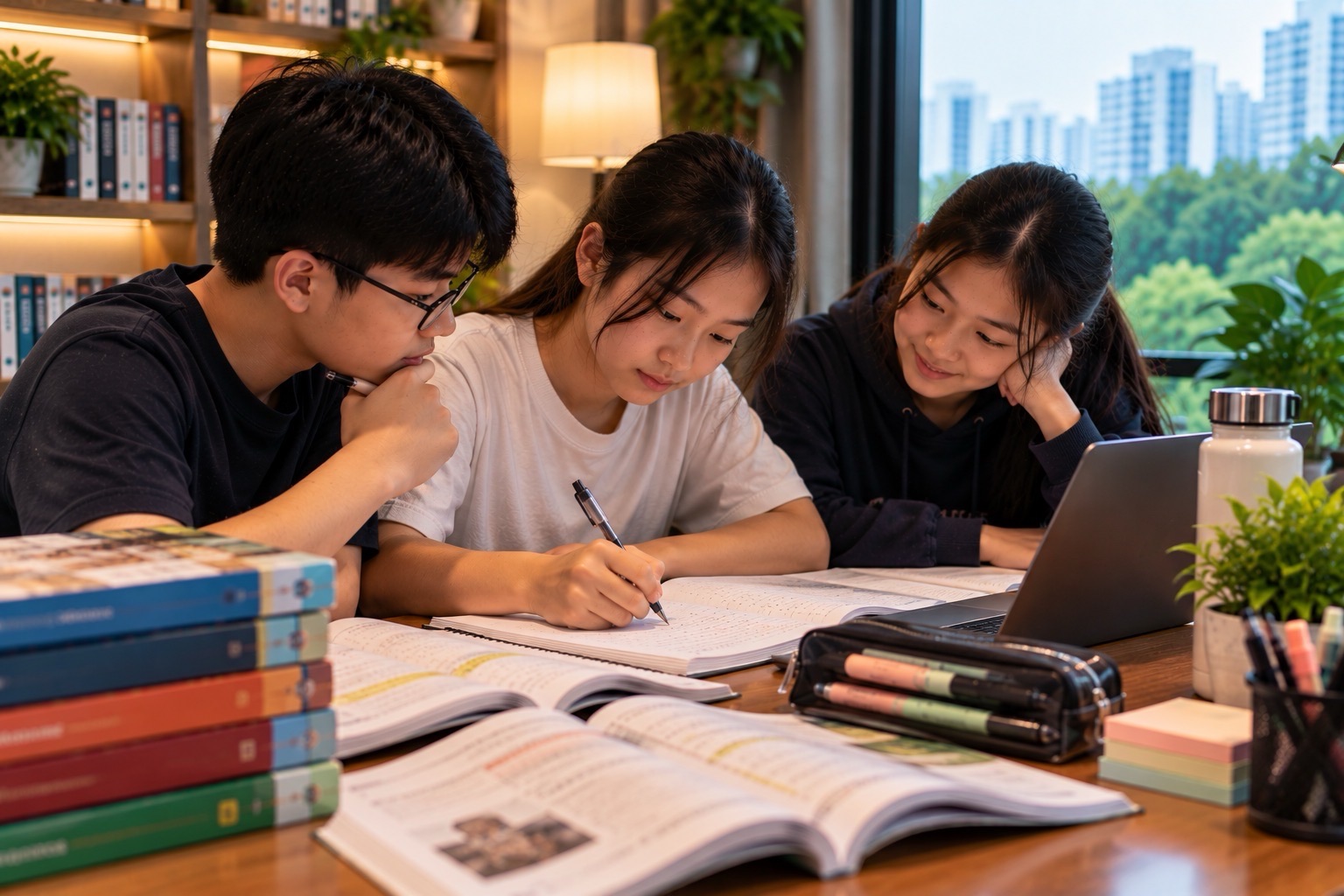
Secondary 4 Science Small Groups Tuition Tengah | Benefits and Consequences. Secondary 4 Science small groups tuition for Tengah families should begin with the student’s exact subject and examination year, particularly as Singapore enters the first SEC examination cohort in 2027. A three-pupil tutorial can offer close feedback on Physics, Chemistry or Biology misconceptions, but only when the group actually teaches the registered G1, G2 or G3 syllabus at an appropriate pace.
The consequence of choosing poorly can be wasted revision time. A class that follows an unrelated Science combination, moves too fast or creates a long commute may be less useful than focused school consultation or independent study. This Tengah guide is written for families in the estate; it does not claim that eduKateSG has opened a physical Tengah Science classroom or has a vacant group there.
Quick parent information: At a glance: confirm the subject code and school programme, inspect a recent marked answer, verify tutor and three-person group composition, check current 2027 SEC syllabus materials, calculate the complete lesson-and-travel commitment and compare independent progress after four sessions.
- First priority: registered Science subject, G-level and examination year.
- Key risk: different SEC Science combinations grouped together without relevant teaching.
- Potential benefit: focused diagnosis and feedback with compatible peers.
- Student outcome: the child chooses scientific models and answers new questions independently.
- Household concern: include the actual commute, meals, homework and rest in the weekly plan.
- Location: a Tengah tuition guide is not confirmation of a local teaching facility.
Choosing the right Science level and support in a developing neighbourhood
The certificate name alone does not tell a family which Science course to choose
The Singapore–Cambridge Secondary Education Certificate (SEC) begins in 2027, combining the former separate national examination qualifications into one certificate that reports subjects at approved G1, G2 and G3 levels. A parent who asks for Secondary 4 Science tuition still needs to specify what the teenager is taking. An integrated G1 Science programme, a G2 Combined Science pair, a G3 Combined Science pair and separate G3 Pure Sciences have different requirements.
A tutor should check the school-registered subject rather than infer it from the child’s year or a previous stream label. Students may take different subjects at different levels under Full Subject-Based Banding, and the actual Science course determines the correct practice. A pupil taking Chemistry/Biology should not be assigned an extensive Physics programme simply because the next available group is called Secondary 4 Science.
Some earlier GCE questions remain useful where the scientific concepts and difficulty overlap with the current syllabus. Nevertheless, a full mock paper should reflect the actual course and assessment structure instead of assuming every old O-Level or N-Level item is an exact substitute. A tutor should be able to explain why a selected question is relevant and where a different course’s material might mislead.
Tengah families can make enrolment decisions easier by bringing the student’s course title, syllabus level and one original marked assessment. A provider who asks for these details and checks what the proposed three-person group offers is demonstrating care. A generic promise to cover all Science regardless of subject or level should not replace evidence of actual teaching fit.
A smaller group can still be academically mismatched
Imagine a three-pupil group containing a G2 Physics/Chemistry learner, a G3 Chemistry/Biology learner and a student studying G3 Pure Physics. They share some important scientific inquiry habits but not a complete syllabus. If everyone receives an identical worksheet, each learner may spend substantial time on content that does not directly prepare their actual paper. The small headcount does not remove the mismatch.
Some shared teaching can be useful. A tutor might begin with the general skill of reading graph axes, identifying controlled variables or separating observations from conclusions. Pupils could then complete appropriate subject-specific applications that differ in content and depth. The teacher must plan these tasks and have enough time to provide meaningful individual feedback; simply giving the fastest student extra pages is not the same as differentiation.
Prior knowledge and pace matter as much as the course code. A student missing foundational Mathematics or particle models may need a slower bridge, while another is ready for unfamiliar examination-style reasoning. A three-person class can accommodate some differences when the tutor actively scaffolds, but not every possible gap. A more compatible group or individual instruction may be necessary when the mismatch is large.
Parents should ask how the tutor forms groups, how much individual work each child completes and what happens when one pupil’s current school topic differs from the others. An honest recommendation not to enrol in a poor match can save time, fees and confidence. The right question is not whether a group of three sounds premium but whether this particular child can learn efficiently in it.
A syllabus-aligned diagnostic should start with the learner’s own answers
An examination result does not reveal why marks were lost. One pupil may be unable to recall a necessary concept; another knows it but chooses the wrong model; a third interprets the graph correctly but writes an incomplete causal explanation. A tutor should examine original marked work rather than prescribe the same revision sequence because all students are in Secondary 4.
For Physics, a wrong calculation could begin with values chosen from the wrong circuit component. The teacher can ask the student to trace the diagram, name the requested quantity and explain which relationship applies. For Chemistry, a student might claim a gas identity from bubbling alone, requiring clearer separation of observation and confirmation. In Biology, a definition of osmosis may be correct while the net movement prediction ignores the actual conditions.
Each error suggests a different corrective activity. Missing recall needs first-principles teaching and delayed retrieval. An application mistake needs contrasting examples. A scientific-writing problem requires a valid causal chain. A timing issue may need short progressively timed questions after the method is accurate. Identifying the first failure prevents the teenager from spending the entire month practising the wrong skill.
At the end of the diagnostic, parents should be able to name a narrow target and an independent test. An example is ‘correctly interpret which quantity belongs to a named circuit branch in a new diagram’. That is measurable. ‘Complete more Science papers’ is a workload goal, not proof that the original misconception will be repaired.
The full commuting decision matters to families in Tengah
A new neighbourhood can make families especially attentive to travel and the availability of suitable education services. But this article does not verify any eduKateSG Tengah teaching centre, Science tutor or vacant three-person class. The family should check the real venue, instructor, subject combination, schedule and price before planning a journey. A geographically targeted guide is not a statement about an existing branch.
The total time cost includes getting to class, a meal, the approximately ninety-minute tutorial and follow-up homework. A Secondary 4 student also needs time for other examined subjects, school practical learning and adequate sleep. The class may be academically effective yet have poor overall value if the teenager has no time left to retrieve or apply what was taught independently.
Convenience is important but comes after curriculum fit. A nearby lesson using the wrong subject pairing may be less useful than an appropriate school consultation. Another family may decide that a longer journey is reasonable because a persistent misconception has not been resolved through ordinary revision. Both choices require an honest calculation of what the new weekly commitment replaces.
Parents should avoid treating the first advertised vacancy as the only option. A student with a narrow doubt can ask a school teacher; someone missing major prerequisites may need a short individual bridge; and a strong independent learner may gain more from home practice. The tutor should explain why the proposed group addresses the actual learning need rather than rely on being the first available class.
Practical Science needs correctly interpreted evidence at every level
Science involves observations, measurements, controlled variables and explanations that are justified by the evidence. These broad habits matter across G1, G2 and G3 even though the specific subject content and assessment demand vary. A pupil should know what was deliberately changed, what outcome was measured and which other factors must be controlled before claiming that one cause produced the result.
An experiment that changes both temperature and concentration cannot by itself isolate the effect of either variable on reaction rate. A plant-growth comparison that alters light and water together raises the same problem in a different discipline. The tutor can use appropriate examples from the pupil’s actual syllabus to teach fair testing, then ask the learner to evaluate another unfamiliar setup independently.
Scientific conclusions also require careful distinction between observation and inference. Bubbles may show that gas is formed, but not automatically its unique identity. A graph may show a trend without establishing its exact cause. A tutor should train students to make accurate claims, explain relevant models and identify what additional evidence would be useful, instead of simply memorising stock practical phrases.
Written tuition can support experimental analysis, but it should not be represented as supervised laboratory work unless suitable facilities and oversight actually exist. The family should ask what the programme provides and maintain school practical experience where required by the official course. Subject-level matching extends to the type and depth of practical questions the teenager is asked to practise.
SEC preparation should not become a race to harder unrelated material
Parents may assume that high-performance tuition must teach topics above the student’s registered course. Enrichment can be interesting, but it is not automatically efficient preparation for a particular national examination. A learner whose current syllabus principles remain unstable may gain more from accurate application of familiar ideas than from additional advanced terminology outside the course.
A useful extension task uses the same scientific model in a new setting. A Physics learner might compare two circuit arrangements; a Chemistry pupil might decide which evidence supports a product identification; a Biology student could evaluate an unfamiliar graph’s plateau. These questions can be demanding because they require model selection and scientific reasoning, not because they introduce content from a different subject level.
The tutor should be able to explain what skill the extension develops and how it will be checked. A child who can justify why one model fits and another does not is demonstrating depth. A pupil who completes an impressive-looking out-of-syllabus worksheet only after being shown the method may have gained little examination-relevant independence.
Parents should ask whether current-year SEAB syllabuses have been consulted and whether the questions match the registered paper. Being ahead of a school lesson can sometimes help, but only when the necessary foundations are secure and the teenager can still complete schoolwork, other subjects and rest. The aim is meaningful progress rather than the fastest possible chapter coverage.
What a four-lesson decision cycle should show
Week one begins with the actual Science subject and original marked work. The tutor identifies the first recurring error and selects a specific target. The teenager should be able to state why that target matters and what a correct response would require. If the group is mismatched, the tutor should acknowledge this before proceeding rather than expecting the pupil to cope with irrelevant material.
Week two rebuilds the model and uses contrasting examples. The child first answers with some appropriate scaffolding, then attempts a similar principle with changed conditions. A short home task can check whether the corrected idea is retained after several days. The amount of practice should be purposeful rather than simply large.
Week three removes hints and presents an unfamiliar question without announcing its topic. The learner selects the relevant scientific principle, interprets the data and writes an answer independently. If the old misconception returns, that information guides the next lesson. The teacher should revisit a missing prerequisite rather than simply assign another full paper.
Week four compares a fresh task of similar demand with the original response, recording scientific accuracy and the number of prompts needed. Parents also review travel, energy and work for other subjects. A narrow improvement is valuable, but it does not guarantee a final SEC grade. The family can continue, change group, seek individual help or return to school-supported self-study according to actual evidence.
The ultimate benefit is independence, not permanent enrolment
A successful Science learner can inspect unfamiliar information, decide which principle applies, explain the outcome and recognise whether the evidence supports a conclusion. Tuition may help build those habits, but a student should not need the tutor to supply the first formula or model every time. A class that constantly gives hints can produce a stack of correct worksheets while leaving the teenager hesitant alone.
An error log can support the transition. At first, the tutor may identify a misconception and assign the relevant retrieval task. Later the teenager records why an answer was wrong, chooses a new problem that would test the correction and checks the result using school feedback. This makes revision more focused and reduces dependence on a weekly session.
Three-person discussions can provide alternative scientific interpretations, provided the tutor keeps them accurate and protects quiet individual thinking. The final unfamiliar response should belong to each learner. If only the strongest student can explain it after discussion, the group still needs a different instructional approach or a change in composition.
Tengah parents can review whether their child now learns effectively through school and independent practice. If so, reducing paid tuition may be sensible. If a genuine misconception persists and the proposed group fits, targeted lessons may be useful. The best outcome is a sustainable, self-correcting teenager rather than an indefinitely expanding timetable.
Four worked Science learning cases for Tengah
G2 Science learner assigned G3 Pure worksheets
Original error: Subject level is treated as interchangeable.
Teaching response: Confirm official registered syllabus and use appropriate independent practice.
Independent check: Fresh G2-level problem is solved without hints.
Mixed Science pairings receive one worksheet
Original error: A pupil spends time on a component not offered.
Teaching response: Separate individual subject tasks or choose a more compatible group.
Independent check: Every pupil completes work relevant to their course.
Graph model chosen from appearance alone
Original error: Axes, units and conditions were not read.
Teaching response: Identify measured quantities and supported pattern before explaining.
Independent check: New data set interpreted correctly at the proper level.
Long travel displaces independent revision
Original error: Tuition increases scheduled time but reduces consolidation.
Teaching response: Calculate total weekly commitment and choose the least burdensome suitable support.
Independent check: Student can retain the correction while maintaining a sustainable week.
Frequently asked questions from Tengah parents
Is eduKateSG operating a confirmed Science classroom in Tengah?
This article does not establish one. Verify the tutor, actual teaching location and available group directly.
Are G1, G2 and G3 Science the same syllabus with different target grades?
No. They have distinct subject syllabuses and assessment requirements, so teaching should match the registered course.
Can different Science combinations share one three-student class?
Only when relevant teaching is deliberately differentiated; a poor match may not be useful.
Are old O-Level questions always unsuitable for 2027 SEC?
No. Overlapping concepts may remain useful, but questions must be checked against the current subject and level.
Can tuition guarantee a move to a different subject level?
No. School subject-level decisions follow the applicable school policies and processes.
What is a useful first-month review?
A comparable unfamiliar problem answered independently, together with the child’s actual weekly time and fatigue.
A Tengah family’s enrolment checklist should begin before the first timeslot
In a growing neighbourhood, parents may compare several travel possibilities and tuition formats. But the first step should remain academic: identify the registered SEC or GCE Science subject, its level and the student’s actual weakness. A timetable slot is not educationally suitable just because it is the most convenient one offered. Subject compatibility and tutor expertise come before distance.
Families should bring a marked school answer and ask the tutor how the first wrong scientific decision will be repaired. A G1 Science learner and a G3 Pure Chemistry learner may share inquiry skills but need different substantive practice. An available group that cannot differentiate appropriately should not be chosen only because it contains three students.
The parent should then verify the real classroom, assigned teacher, current fees, day and vacancy. This article does not establish an eduKateSG teaching room in Tengah. A locality-focused guide is intended to inform families, not to act as a booking notice for an unverified branch.
Finally, calculate the total weekly commitment and identify which independent revision period the lesson would replace. A student with a narrow misconception may benefit from school consultation or short targeted tutoring, while someone already studying effectively may need no extra class. The best support is the least burdensome one that demonstrably develops independent reasoning.
Why SEC course clarity reduces anxiety and wasted practice
The new certificate structure can make parents uncertain about whether older examination papers are still suitable. The correct response is not to abandon every previous question or use all old material unchanged. The tutor should check the official current-year subject syllabus and choose older tasks only when the concepts and demand remain appropriate.
A student should know the purpose of a question. Is it meant to retrieve a principle, compare contrasting examples or simulate the actual examination? A conceptual problem may be educationally useful even when it is not a faithful mock paper. Clear labelling allows the teenager to practise deliberately rather than become confused about assessment expectations.
Students should also avoid interpreting subject levels as judgments of ability. The registered G-level identifies the actual course and its requirements. Teaching at an unsuitable level can create unnecessary discouragement or false confidence. A well-matched small group chooses questions that are demanding but relevant to what the learner is expected to understand.
After four lessons, parents should ask whether a new syllabus-appropriate task can be completed independently and whether the timetable remains sustainable. The tutor may report a narrow gain in scientific reasoning without promising a national examination grade. As the pupil becomes able to plan and correct revision alone, additional tuition may become less necessary.
2026 GCE and 2027 SEC: confirm the Science subject before choosing tuition
From 2027, Singapore’s Singapore–Cambridge Secondary Education Certificate (SEC) replaces the former separate GCE N(T), N(A) and O-Level examinations. Under the SEC, pupils take registered subjects at their G1, G2 or G3 levels. The certificate structure changes, but the actual subject requirements still determine the questions a candidate will face. A parent should therefore show a tuition provider the child’s registered Science subject, level and exam year before asking whether an advertised Secondary 4 group is appropriate.
| 2027 programme | Official SEC code examples | What a tutor must match |
|---|---|---|
| G1 Science | K123 | The distinct integrated G1 Science syllabus, not a presumed shortened G3 Pure Science course. |
| G2 Science (Physics, Chemistry) | K223 | G2 combination and course demands. |
| G2 Science (Physics, Biology) | K224 | Both G2 Physics and Biology components. |
| G2 Science (Chemistry, Biology) | K225 | Chemistry/Biology material at G2 level. |
| G3 Science (Physics, Chemistry) | K326 | The defined G3 combined pairing, not all three sciences. |
| G3 Science (Physics, Biology) | K327 | Physics/Biology at the prescribed G3 level. |
| G3 Science (Chemistry, Biology) | K328 | The registered Chemistry/Biology course. |
| G3 Pure Physics, Chemistry, Biology | K323, K324, K325 | Separate Pure Science syllabuses with their own content and assessment. |
| 2026 O-Level Combined Science examples | 5086, 5087, 5088 | Older examination codes are not the 2027 SEC identifiers. |
These codes are verified from SEAB’s official 2027 G1 syllabus list, 2027 G2 syllabus list and 2027 G3 syllabus list, alongside its SEC overview. For students taking the 2026 GCE examination, refer to the 2026 O-Level syllabuses. Older past-paper questions can still help with concepts that overlap, but should be screened against the current course and level before they are treated as realistic national-examination preparation. Subject matching is not achieved by simply changing the paper code on a worksheet.
A small group can include several learners whose needs overlap, but not every mixed set is educationally suitable. A pupil studying Pure Physics and another taking G2 Chemistry/Biology may share general inquiry habits without sharing most examinable content. If the tutor uses a common graph-reading example, subsequent tasks should be relevant to each student’s course. Where the group cannot deliver enough subject-specific feedback, recommending separate lessons is more responsible than assuming that the small headcount makes every combination compatible.
The actual benefits and limits of a three-pupil tutorial
The immutable eduKateSG Clementi three-pupil reference describes a small-group teaching model with close explanations, carefully sequenced practice and attention to student understanding. The potential advantage of three pupils is that a tutor can inspect more of each learner’s thought process than in a much larger class. However, a smaller headcount is a condition that enables individual feedback, not proof that such feedback is being delivered. A lesson where every student copies one completed model answer can still leave important misconceptions hidden.
The Education Endowment Foundation review of small-group tuition examines research involving groups of two to five learners and reports positive average effects across its evidence base. That research is not a direct trial of eduKateSG or Singapore Secondary 4 Science, and average study findings cannot guarantee any pupil’s SEC grade. The actionable lesson is to use targeted teaching, sound curriculum alignment and high-quality feedback. Parents should evaluate what their own teenager can do independently rather than take group size as a prediction of marks.
Peer learning can be useful when one pupil proposes a scientific model, another checks it against the observed data and the third questions an assumption. The tutor must ensure accuracy and respectful participation. Some teenagers need longer thinking time and may be quiet even when they understand more than a fast speaker. The first response should therefore belong to every individual learner; discussion follows, and then a new problem should be completed alone. Without this sequence, group fluency may be mistaken for personal examination readiness.
A practical 90-minute lesson: from an original error to independent transfer
| Illustrative stage | Minutes | What it should reveal |
|---|---|---|
| Retrieve earlier concepts without notes | 10 | Whether the last correction remains accessible after a delay. |
| Inspect the student’s actual marked answer | 15 | The first incorrect scientific decision. |
| Build the necessary first principle | 20 | An explanation the learner can give in their own words. |
| Practise contrasting contexts | 20 | Whether the scientific model applies to unfamiliar surface details. |
| Complete a new individual response | 15 | Every pupil chooses the method without peer or tutor cues. |
| Record a small follow-up task | 10 | A feasible retrieval plan rather than maximum homework volume. |
This breakdown is an illustration of effective tutorial design, not a claim that the actual tuition provider runs these exact minutes or a particular class is currently available. A group may need to allocate more time to an unstable prerequisite or a current school assessment. The principle should remain: the student is asked to think, the tutor diagnoses a specific error, the relevant model is explained, and a fresh task tests whether it can now be applied alone.
Help should be gradually withdrawn. A new learner may initially need a labelled diagram or a question divided into stages, while a capable pupil may need only the unedited problem. Later examples can remove those prompts and change the context. A child who succeeds only when the tutor announces a formula may still be dependent on guidance. The goal is not to leave students confused, but to ensure that assistance leads to genuinely independent scientific decisions.
A Science error map parents can use during the first consultation
| Visible mistake | Possible underlying issue | Better next step |
|---|---|---|
| A key definition or principle cannot be recalled | Knowledge not secure | Rebuild the idea and test delayed retrieval. |
| A familiar relationship is used in the wrong situation | Conceptual misconception | Compare examples that fit and do not fit the rule. |
| A graph, circuit or diagram is misread | Representation or quantitative reasoning | Identify axes, scale, units and relevant components first. |
| An answer names a result without explaining why | Missing causal explanation | Connect the conditions, relevant scientific model and consequence. |
| An observation is treated as definite identification | Unsupported inference | Separate data, hypotheses, controlled variables and confirming evidence. |
| The method is correct but execution or timing fails | Numerical or examination technique | Teach compact checking and progressively timed work after accuracy. |
Parents should preserve the child’s own original working before showing the marking guide. The same wrong final number may arise because one pupil chose an incorrect physical model while another used the correct model with inconsistent units. Similarly, two weak Chemistry responses may differ: one child lacks essential reaction knowledge, while another knows the facts but makes an inference that the provided experiment cannot establish. A tutor who identifies the exact cause is more likely to choose efficient practice than one who simply assigns a general past-year paper.
Practical Science requires care about evidence and real laboratory experience
Science experiments involve setting up investigations, controlling relevant variables, collecting measurements, observing changes, interpreting results and working safely with apparatus. Some of this reasoning can be taught through written diagrams and data tables in a tuition room. That does not automatically amount to supervised laboratory training. Families should ask whether the actual programme provides suitable equipment and supervision, or whether practical support concentrates on written planning and evaluation, and continue the relevant school practical teaching.
Weak practical answers often contain phrases such as ‘human error’ or ‘repeat the experiment’ regardless of what the question shows. These are not universal improvements. A scientifically useful response identifies a plausible measurement constraint or uncontrolled condition supported by the scenario and explains how the proposed modification would address it. If two conditions changed together, repeating the same comparison many times does not isolate one cause. The learner must understand what the evidence permits and avoid unsupported certainty.
The consequences of tuition: fees, fatigue, independence and alternatives
| Support route | Potential benefit | Possible limitation |
|---|---|---|
| Three-student tutorial | Frequent diagnostic feedback plus useful peer comparison. | Attention remains shared and mismatched groups can be counterproductive. |
| One-to-one lesson | Highly tailored pacing for serious or unusual gaps. | Potentially higher cost and no peer discussion. |
| Larger revision class | Broad structured practice for a self-directed student. | Less opportunity to examine each child’s first wrong step. |
| School consultation | Direct support linked to the school syllabus and marked work. | Time may be limited; focused questions help. |
| Independent revision | No extra travel and more control of the study routine. | A misconception may persist without reliable feedback. |
| Adding an extra class | May repair a problem that existing methods have not resolved. | Travel, cost and homework may displace other useful learning. |
The time cost of a nominal ninety-minute lesson may be substantially longer once transport, meals, waiting and extra assignments are included. A Secondary 4 teenager must still prepare other examined subjects, attend school activities and sleep enough to learn effectively. More tuition can improve results when it targets a genuine gap, yet can be counterproductive when it duplicates working school support or removes independent application time. Families should compare the marginal educational gain against the activities the new class displaces.
There are also costs to not obtaining useful help. An unresolved misconception may be repeated through several full practice papers, wasting time and reducing confidence. The decision is therefore not simply whether tuition is good or bad; it is whether the available intervention is properly matched, reasonably priced in time and fees, and producing better independent learning than the alternatives. A responsible provider should be willing to recommend another format or no extra tuition where that is more appropriate.
The four-lesson evidence checkpoint
| Point | Evidence | Interpretation |
|---|---|---|
| Before the first lesson | Original marked answer plus two error categories. | The tutor has a specific target rather than a grade slogan. |
| After two lessons | New explanation in the student’s own words. | The model is becoming understandable. |
| After three lessons | Unfamiliar application with fewer hints. | The learner can select the idea beyond the worked example. |
| After four lessons | A comparable unseen answer and updated error log. | Continue, adapt, change format or stop based on observed progress. |
Four lessons are an early review interval, not a guarantee of a grade rise. Some mistakes can be repaired quickly, but other gaps depend on earlier foundations or several interacting skills. A student may improve at reading graphs while still struggling with chemical explanations; that partial progress should be described accurately. Do not compare a hard school examination with an easy follow-up worksheet and claim the difference proves a dramatic improvement. The stronger comparison uses new questions of similar demand and records the amount of assistance given.
Ten parent checks before enrolling
- Confirm the student’s registered 2026 GCE or 2027 SEC subject, combination and G1/G2/G3 level.
- Bring genuine marked schoolwork with the student’s original attempt visible.
- Ask the tutor to identify the first mistaken assumption and a suitable correction.
- Check whether the proposed three learners have compatible subjects and starting points.
- Require individual unseen answers rather than only shared worksheet completion.
- Distinguish written experiment analysis from actual supervised laboratory work.
- Verify the real tutor, classroom, day, price, current vacancy and make-up arrangements.
- Include travel, home tasks, other subjects and sleep in the weekly time budget.
- Agree an early review based on comparable independent work without grade promises.
- Consider school-teacher consultation, individual bridging, self-study or no extra tuition if those suit the child better.
Official SEAB sources and connected eduKateSG Science reading
- SEAB — Secondary Education Certificate overview
- SEAB — 2027 G1 syllabuses for school candidates
- SEAB — 2027 G2 syllabuses for school candidates
- SEAB — 2027 G3 syllabuses for school candidates
- SEAB — 2026 GCE O-Level syllabuses
- Education Endowment Foundation — Small-group tuition evidence
- eduKateSG — G3 Physics/Chemistry Science guide
- eduKateSG — G3 Physics/Biology Science guide
- eduKateSG — G3 Chemistry/Biology Science guide
- eduKateSG — G2 Science combinations guide
- eduKateSG — Immutable Clementi three-pupil tutorial teaching reference
- eduKateSG — Tuition and Teaching Hub
Editorial note: This is independent educational information for parents and students, not an official MOE or SEAB syllabus. The child’s registered course and current official examination requirements take precedence. The estate named in the title identifies the intended readership, not a confirmed classroom, tutor or vacant three-person Science group. No responsible provider can guarantee a particular national-examination grade.
A considered Secondary 4 Science tuition decision for Tengah
A Tengah family should choose a three-pupil Science tutorial only where the proposed group matches the actual syllabus and addresses a real learning weakness with measurable independent progress. Some pupils need first-principles rebuilding, others need changed application and retrieval, and some already study effectively through school. A class that fits academically but removes too much time for rest or other subjects may still be the wrong choice. The longer-term objective is a teenager who can learn and correct without permanent dependence on tutoring.
Arrange a parent–student consultation
Bring the student’s exact Science subject, year and original marked response. Contact eduKate Singapore · WhatsApp tuition enquiry. Confirm current programme availability and actual teaching location before travelling.
eduKateSG | Three-pupil tutorials, first-principles Science, targeted feedback and independent learning. Properly taught kids shine a bright light into the future.