
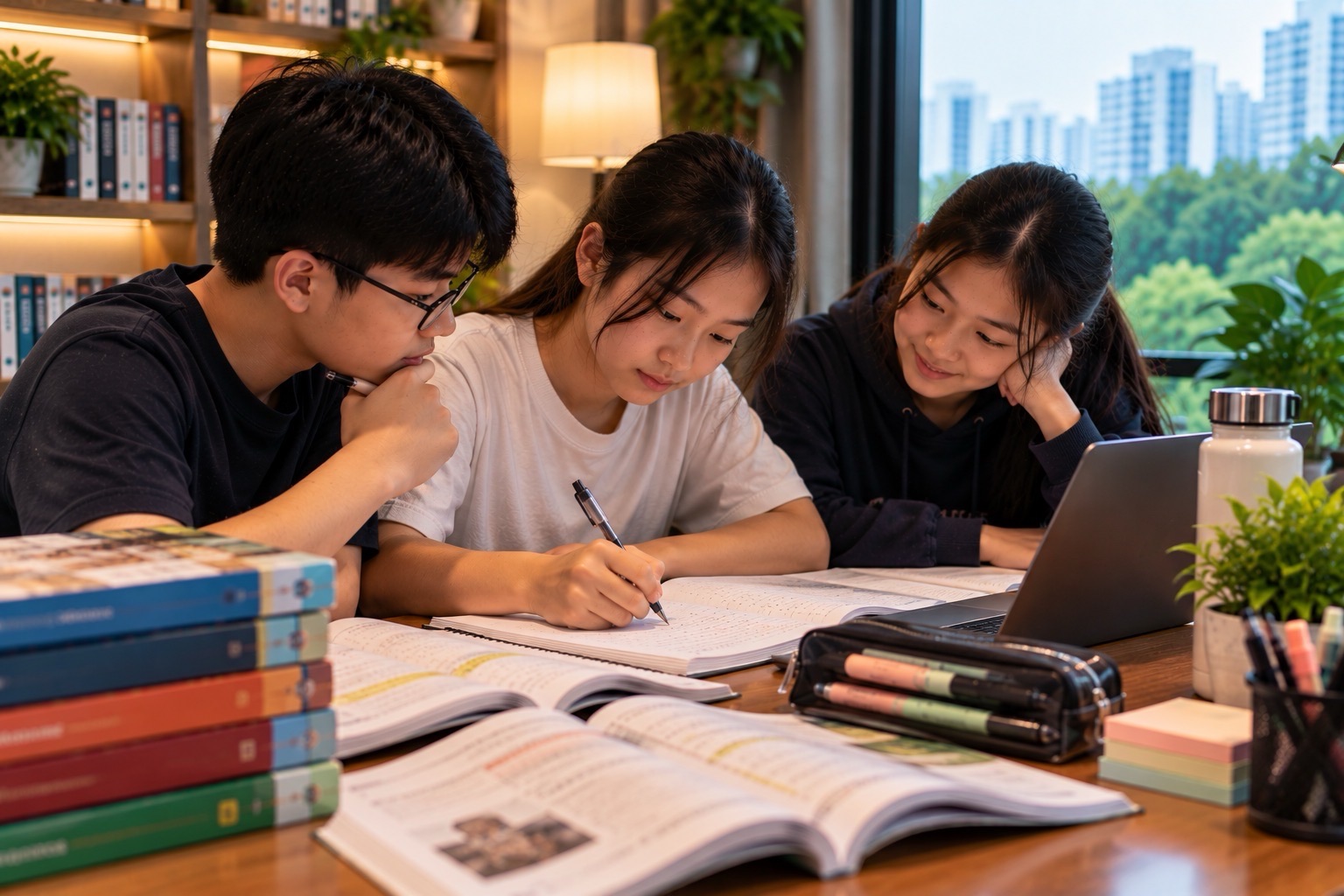
Secondary 4 Science Small Groups Tuition Yio Chu Kang | Benefits and Consequences. Secondary 4 Science small groups tuition for Yio Chu Kang families is worth considering when a repeated misconception resists school teaching and independent revision, and close feedback from a suitably matched tutor would make a real difference. A three-student tutorial can diagnose the specific error, rebuild the scientific principle and test whether the learner now solves unfamiliar questions independently.
But additional tuition can also be counterproductive. Another evening commitment may displace other examined subjects, rest, family time and the independent practice needed to apply corrections. A small group is not automatically suitable for every student. This Yio Chu Kang guide does not confirm a physical eduKateSG Secondary 4 Science classroom or an available group in the area.
At a glance: Quick parent guide: identify the exact Science subject and exam year; show two authentic recurring errors; consider school consultation and self-study first; check the tutor, venue and group compatibility; and agree a four-lesson evidence review with no grade guarantee.
- Primary question: is there a real unresolved learning problem that tutoring can address?
- Potential benefit: three-person feedback on misconceptions and independent solutions.
- Potential consequence: the additional class may consume the student’s best self-study evening.
- Compare alternatives: school teacher consultation, one-to-one bridging, larger revision or no tuition.
- Scientific check: use a fresh problem, not the original corrected worksheet, to test improvement.
- Location: this guide does not establish a Yio Chu Kang centre or vacant seat.
A sustainable Secondary 4 Science plan and when not to add tuition: a parent guide for Yio Chu Kang
When tuition is a sensible intervention rather than a default purchase
Parents naturally worry when Secondary 4 assessments feel important and other families appear to be arranging more classes. But tuition is not a compulsory part of the Singapore education system or a guaranteed route to distinction. Its value comes from solving a problem the student has not been able to resolve effectively through ordinary school teaching, feedback and purposeful revision.
A teenager may repeatedly misunderstand a Physics relationship, misread Chemistry observations or give incomplete Biology explanations. If these mistakes persist despite genuine attempts at correction, a tutor who can observe the original reasoning and explain the first wrong decision may help. The educational benefit is then specific and testable, not a general belief that more hours always produce higher marks.
Another student may already be able to identify mistakes, practise unfamiliar questions and ask school teachers focused questions. For that learner, an additional three-person tutorial may provide little marginal gain. It can even remove time that would have been used for independent exam preparation, sleep or another weaker subject. Parents should consider whether the class is truly needed.
Yio Chu Kang families can begin with a simple evidence check: retain two original errors and ask the teenager to explain how they have tried to fix them. If the errors are becoming less frequent through existing resources, more tuition may be unnecessary. If the same scientific misunderstanding returns, a targeted small group or another suitable intervention may be justified.
The real learning need is not always visible from the Science grade
A single score can conceal several types of weakness. A pupil may have secure concepts but poor time management; another may be fast at calculations but choose incorrect physical models; a third may know definitions yet cannot apply them to unfamiliar data. All three can receive a disappointing grade for different reasons. Giving them the same worksheet pack is unlikely to be the best solution.
The tutor should ask for original marked answers and identify whether mistakes arise from missing knowledge, incorrect applications, graph reading, experimental inference, scientific writing or examination execution. A missing principle needs explanation and retrieval. A wrong model needs contrasting examples. A timing issue can be addressed through progressively timed tasks after the method is sound.
Parents should be cautious of simplistic labels such as lazy or careless. A student who repeatedly selects the voltage for the wrong circuit component has an interpretable error, not necessarily a character flaw. A Chemistry answer identifying a gas from bubbling alone shows a specific unsupported inference. Naming the cause gives the learner an action to practise and a way to judge progress.
A good first tutorial may therefore spend more time listening to the student explain a few questions than demonstrating many completed answers. A small group should permit that attention, but only when every pupil gets individual opportunities to reason. The goal is a diagnosis that changes the next lesson rather than merely confirming that the overall grade was weak.
A first-principles repair should come before paper volume
Suppose a student repeatedly predicts the wrong direction of osmosis in a changed cell diagram. Rewriting the definition ten more times may not help because the missing step is using the actual solution and membrane conditions to predict net movement. A tutor can draw contrasting systems and ask which relevant factor changes. A fresh independent diagram then tests whether the child understands the model.
In Physics, the learner may know a formula but not which component it describes. The teacher should trace the circuit, identify the requested quantity and justify why the relationship applies before allowing numerical substitution. A changed arrangement can then show whether the principle transfers. Timed questions should not be the first treatment for a conceptual mistake.
Chemistry has analogous reasoning errors. A student may identify a specific gas from bubbles without appropriate evidence or treat ionic conductivity as though the presence of ions alone is sufficient in every state. The tutor should connect observations or properties to the relevant particle model and experimental confirmation. An unseen case checks whether the child can adapt.
Once the underlying method is accurate, repetition and timed practice can become useful. The aim is not to avoid worksheets but to use them after the pupil understands what they are practising. A tutor who simply assigns more full papers while the same misconception persists is not making the best use of the student’s scarce revision time.
Small groups have real advantages and real limitations
A group of three may allow more frequent direct questioning than a large class, making it easier for the teacher to see how each child selects a scientific principle. Pupils can also compare methods and learn to challenge unsupported claims respectfully. These are potential advantages, not automatic outcomes of a low student count.
A large difference in prior knowledge can undermine the format. A student with deep missing foundations may need more individual bridging than the group can realistically provide in ninety minutes. Another may already be ready for complex unfamiliar applications and spend much of the session waiting. The tutor should consider pace, actual subject level and confidence when forming groups.
A mixed Science combination can also waste time. A G3 Pure Physics student and a G2 Combined Chemistry/Biology learner have some transferable investigation habits but different substantive content. A tutor should explain how tasks will be differentiated, or advise against combining them when the overlap is insufficient. An honest decision not to enrol can protect the family from unnecessary cost.
Parents should ask whether each learner attempts an unseen question privately after discussion. If one confident student always explains first, quieter pupils may look engaged but leave without practising the most important individual decision. The tutor’s method matters more than the number three printed in an advertisement.
The full weekly time cost can outweigh the advertised lesson benefit
A ninety-minute tuition class rarely costs only ninety minutes. The family must consider transport, meals, waiting, preparation, follow-up homework and fatigue. A teenager with school, CCAs, languages, mathematics and humanities already has a finite number of useful study hours. A class that consumes the only quiet evening for independent revision may not be the best intervention.
The educational cost of fatigue can be subtle. A student may attend more lessons but retain less of the content because sleep and self-practice have been reduced. The teenager may also become dependent on adults assigning every task, leaving little opportunity to diagnose and correct errors alone. Families should view those effects as part of the consequences of tuition, not as separate issues.
An effective tutor can help by setting a small amount of purposeful home practice. Two contrasting problems and a short delayed retrieval check may be more useful than another long paper when one concept has just been repaired. The goal is to make independent revision more accurate and efficient rather than expand the volume of academic activity.
Yio Chu Kang parents should verify the actual teaching site and calculate the full journey before committing. The location in this article identifies its readership, not an available eduKateSG classroom. A class may be academically strong but logistically unsuitable, and parents should be free to choose another arrangement when that is the responsible decision.
When school consultation or independent revision may work better
A student who has one specific uncertainty about a school practical, marking requirement or current classroom topic may benefit from asking the teacher directly. The school is already teaching the registered course and can explain its learning and assessment expectations. Such consultation may solve a narrow problem without a new weekly commitment.
An independent learner can also use carefully selected textbook or examination questions with delayed retrieval and an error log. The key is to attempt the question before reading the solution, record why an original method failed and test the corrected principle in a changed context. A student who can do this reliably may not require supplementary tuition.
Other cases call for more individual support. A pupil with severe foundational gaps may need a slower sequence or a one-to-one tutor before joining a shared group. A student with stable concepts but weak stamina may need timed paper practice rather than another explanatory session. The appropriate method depends on the cause of errors.
A responsible tuition provider should be able to recommend these alternatives. Saying a particular three-person class is not suitable is useful information, especially when subject mismatch or timetable pressure is evident. Parents should prefer grounded educational advice to an automatic claim that every child benefits from more tuition.
A four-lesson decision checkpoint rather than an indefinite commitment
At the beginning, keep two original marked Science responses and identify the repeated errors. The tutor can choose one clear teaching target, such as understanding a circuit component, explaining a biological process under changed conditions or drawing a justified conclusion from an experiment. This establishes a baseline against which the value of tutoring can be evaluated.
After two lessons, ask the child to explain the corrected idea without notes and attempt a changed example. A tutor should check not only whether the answer is correct but why the student selected the approach. Recognition of a model answer during class does not establish that it can be retrieved independently days later.
By the third lesson, students should face an unfamiliar problem with fewer prompts. Errors that return are useful diagnostic evidence and may show that a prerequisite was missed. The fourth lesson can compare a new task of similar demand with the original and review the broader timetable. A narrow gain is meaningful without implying a guaranteed improvement in the final grade.
If the class has repaired the misconception and the student can now revise independently, the family may reduce tuition. If the group is incompatible or the weekly commitment is exhausting, changing course is reasonable. The purpose of extra teaching is to develop capability, not create a permanent recurring purchase.
What independent Scientific thinking should ultimately look like
A confident student should be able to start an unfamiliar Science problem by identifying the information given, the relationship being examined and the scientific principle likely to apply. In Physics, that may mean interpreting a diagram and checking units. In Chemistry, it may mean distinguishing a reaction observation from a confirmed identification. In Biology, it can involve reading the conditions of a process rather than relying on a memorised picture.
The pupil should also be able to explain why an answer is supported and when it is uncertain. An experiment with uncontrolled variables does not prove the same claim as a fair comparison, and a graph’s trend must be read across the measured range. Scientific reasoning includes deciding what not to claim, not merely adding more technical vocabulary.
A tutor can help students reach this standard through clear first-principles explanations, contrasting examples, delayed retrieval and independent assessment. Small-group discussion can contribute when it is disciplined and respectful, but each learner must eventually perform without classmates. That is why the tutorial should regularly end with an unseen task.
Yio Chu Kang families can judge success by what the teenager can do after the tutor leaves: diagnose an error, select relevant practice and use school feedback to improve. When those habits become stable, supplementary lessons may have fulfilled their purpose. Independence is a stronger educational outcome than permanent dependence on a weekly class.
Four worked Science diagnostic examples for Yio Chu Kang
Child still loses marks with more Physics papers
Original error: The underlying circuit misconception is repeatedly practised.
Teaching response: Rebuild the model and use contrasting diagrams before timing.
Independent check: Fresh circuit problem solved without hints.
Chemistry conclusion unsupported by data
Original error: Familiar gas identification is repeated without confirmation.
Teaching response: Separate direct observations and sufficient evidence.
Independent check: New experiment interpreted appropriately.
Biology answer ignores changed conditions
Original error: A definition is quoted but not applied.
Teaching response: Identify relevant membrane or graph conditions and cause.
Independent check: Changed scenario explained independently.
Study week becomes too full
Original error: Tuition displaces sleep and independent retrieval.
Teaching response: Reduce low-value work or select alternative support.
Independent check: The learner remains rested and applies corrections between lessons.
Frequently asked questions for Yio Chu Kang parents
Does this guide confirm an eduKateSG Science centre in Yio Chu Kang?
No. The actual tutor, location, programme and vacancy need direct verification.
Is tuition necessary for every Secondary 4 student?
No. Students who learn effectively through school and independent revision may not need extra classes.
When is one-to-one tuition more suitable?
It can fit large foundational gaps or a learning pace that a three-person group cannot adequately accommodate.
Should a student do full timed papers with unresolved misconceptions?
Targeted first-principles repair should come first; timed work becomes more useful when the method is accurate.
Can a three-person tutor promise a particular SEC grade?
No. Group size and teaching can support progress but cannot guarantee examination outcomes.
What is a sensible reason to stop tuition?
The student consistently solves new problems and corrects errors independently with school and self-study resources.
The choice not to enrol can be an academically responsible choice
Parents may feel that refusing another tuition class means accepting avoidable risk. Yet a student who already retrieves scientific concepts, identifies errors and applies school feedback effectively may gain little from a further weekly commitment. The opportunity cost can be substantial when that lesson removes time for independent papers, sleep or preparation for a weaker subject.
A school consultation may resolve a narrow question about current lessons or marking criteria. A short period of individual bridging may better serve a deep prerequisite gap. A larger revision group can provide structure to a learner who is already capable of independent practice. A three-person tutorial is valuable when the child actually needs the close diagnostic process it can provide.
The family can test the need by selecting two recurring marked errors and asking whether the student can explain and correct them through existing resources. If the errors keep returning despite sincere independent attempts, a targeted tutor may help. If they are already becoming less frequent, adding more teaching may be unnecessary.
Yio Chu Kang readers should also verify the actual teaching venue, tutor and vacancy rather than infer a local branch from a guide title. Practical feasibility matters alongside academic fit. The least burdensome effective intervention is generally a better educational choice than the most expensive or most frequent schedule.
How students can preserve independence while receiving extra help
A tutor may make a student feel successful by supplying the first step for every question. The child then completes the working and gains confidence during the lesson, only to stall when a new examination problem provides no hint. An effective programme should gradually remove these cues and allow the teenager to make a reasonable first attempt before receiving correction.
A short error log can name the point at which the student made an unsupported decision. The next home task should use a changed context and be attempted without the old model answer in sight. Over time, the learner can choose which entries to revisit and ask focused questions at school.
Parents can help by asking what the problem gives, which scientific principle might apply and what evidence supports the response. They should avoid immediately telling the child the correct formula or process. The resulting explanation may be imperfect, but the attempt creates information about what the learner actually understands.
When independent work becomes reliable, the family should review whether recurring tuition still adds value. The educational objective is not that every week is filled with paid lessons; it is that the teenager can plan, reason and correct without continuous adult direction. A good tutor can support that objective even when it means fewer future lessons.
What exactly is small groups Science tuition?
Small groups tuition is supplementary teaching for a small number of students together, rather than a substitute for school. The tutorial is the individual session. The eduKateSG immutable reference describes a three-pupil tuition format with sessions around ninety minutes. The educational idea is simple: a tutor has more opportunities to listen to each pupil, identify a misconception and check a correction than in a large group. The format only succeeds when the teaching uses those opportunities rather than treating the small headcount as a promise of better grades.
A group of three can support learning through respectful comparison of ideas. A student may propose how a Physics diagram should be read, another can test that against the measurements, and a third can explain why an attractive alternative method fails. But the teacher must also protect each learner’s own thinking time. An outspoken pupil can give every answer in a small class while quieter classmates appear to understand, which is why initial and final individual written responses matter.
The independent Education Endowment Foundation review of small-group tuition describes the method as two to five pupils and reports an average positive effect across the studies it reviews. The evidence is not a controlled evaluation of eduKateSG or Singapore Secondary 4 Science, and it cannot justify promising any particular SEC grade. Its more relevant lesson is that curriculum fit, quality of tutoring, accurate diagnosis and targeted feedback shape the result. Parents should ask what the child can do alone after the explanation, not simply how few students sit at the table.
2026 GCE and the first 2027 SEC: do not mix examination routes
In 2027, Singapore introduces the Singapore–Cambridge Secondary Education Certificate, replacing the separate GCE N- and O-Level examinations. Candidates are assessed in subjects offered at G1, G2 or G3 levels. The exact Science subject and examination year therefore matter when selecting practice and grouping pupils. A 2026 GCE Combined Science learner may have a different course code from a 2027 SEC pupil, even where underlying scientific concepts overlap.
| Subject route | Relevant 2027 SEC code examples | Responsible group placement |
|---|---|---|
| G1 Science | K123 | Use the distinct G1 Science syllabus, not a generic reduction of a Pure Science paper. |
| G2 Combined Science | K223 Physics/Chemistry; K224 Physics/Biology; K225 Chemistry/Biology | Confirm the registered pairing and G2 assessment demands. |
| G3 Combined Science | K326 Physics/Chemistry; K327 Physics/Biology; K328 Chemistry/Biology | Prepare the correct two-discipline course. |
| G3 Pure Sciences | K323 Physics; K324 Chemistry; K325 Biology | Check separate Pure subject syllabuses and required depth. |
| 2026 GCE O-Level Combined examples | 5086 Physics/Chemistry; 5087 Physics/Biology; 5088 Chemistry/Biology | Screen older past-paper material rather than assuming identical 2027 codes. |
These subject examples are based on SEAB’s 2027 G1 school-candidate listing, 2027 G2 list and 2027 G3 list; refer also to the SEC overview and 2026 GCE O-Level syllabuses. For a particular student, the school’s registered subject and the official syllabus control what should be examined. A tutor may use older questions to teach overlapping concepts, but should check their level, topic and assessment demand against the present course before presenting them as examination practice.
Parents should not confuse a G-level with a judgment about intelligence or effort. It is the level of the course being offered in the student’s school programme. A tutorial that teaches material outside the registered requirements can make a pupil feel defeated for irrelevant reasons. Likewise, an easier worksheet may allow a strong learner to finish quickly without preparing for the required paper. Good subject matching respects what the child is actually studying and gives appropriately demanding practice.
Diagnose the reason for lost marks before prescribing more worksheets
| Why the answer went wrong | What the original work reveals | A better first teaching step |
|---|---|---|
| Knowledge not secured | Student cannot state a required principle or process. | Explain a model, then check delayed retrieval. |
| Misconception | True rule applied under incorrect conditions. | Contrast cases where the rule does and does not fit. |
| Diagram or graph error | Axes, units, scales, apparatus or quantities misread. | Translate the representation into words before calculating. |
| Weak causal explanation | A result named without an underlying mechanism. | Link question evidence, principle and outcome. |
| Unsupported inference | Observation treated as uniquely proving a cause or identity. | Separate what was measured from hypotheses and conclusions. |
| Exam execution error | Rushed arithmetic, weak timing or irrelevant content. | Stabilise accuracy, then build a compact check and timed fluency. |
The first step of a good diagnostic is to preserve original marked work. After the model answer has been copied, it becomes difficult to see what the teenager originally assumed. A tutor can ask how the student selected an equation, why a reaction product seemed likely or what graph axis was read. The answer reveals whether the problem is a missing concept, an inaccurate application, unclear writing or a numerical slip. Those are different needs and should not all receive the same full-paper practice.
Sometimes there is more than one problem. A student may understand a biological process orally yet struggle to express it in writing, or may be fluent with terminology while misunderstanding its actual mechanism. A short diagram explanation, oral account and unassisted written response help distinguish these situations. The tutor can then teach the most important missing piece before adding time pressure or harder questions.
An illustrative 90-minute, three-pupil Science tutorial
| Stage | Minutes | Purpose |
|---|---|---|
| Retrieve previous misconceptions | 10 | Check if an old principle remains usable without notes. |
| Examine a marked school response | 15 | Identify the first incorrect scientific assumption. |
| Rebuild the relevant idea | 20 | Teach clearly through model, diagram or mechanism. |
| Use contrasting applications | 20 | Test the idea in new surface contexts. |
| Write an unseen independent answer | 15 | Verify that all three pupils can reason alone. |
| Record errors and short home practice | 10 | Plan deliberate retrieval without overwhelming the weekly timetable. |
These are sample timings, not a statement that a local teaching centre is open or follows this exact schedule. A tutor might adjust the proportions in response to a student’s examination needs. What should remain is the instructional sequence: retrieve, diagnose, explain, transfer, verify and revisit. The last independent answer is particularly useful because a learner may follow a teacher’s complete demonstration without being able to choose that method on their own in an examination.
A thoughtful teacher can also reduce scaffolding over time. An insecure pupil might initially need a labelled diagram and a step-by-step explanation. Later the tutor can remove prompts and introduce a fresh question whose relevant topic is not announced. If the teenager makes a wrong first choice, the teacher learns what remains fragile. If the child solves it independently, the tutor can increase challenge or introduce realistic timing. This is more informative than moving through chapters solely because the worksheet pack says so.
Practical Science: the difference between written reasoning and real experiments
Scientific investigations involve variables, observations, measurement, equipment, uncertainty and evidence-based inference. A tutorial room can support written experimental planning and data-response reasoning, even without a full laboratory. But it should not be described as replacing supervised hands-on work unless appropriate facilities and supervision genuinely exist. Students still need the school practical experience and safety instruction required by their Science course.
A common weak practical response says ‘human error’ or ‘repeat more’ regardless of the specific experiment. These phrases are not universal solutions. The learner should identify a limitation supported by the actual procedure, explain how it affects the conclusion and propose an improvement directly addressing it. Repetition may reduce random variation, but cannot by itself make a comparison fair when another important condition changed simultaneously.
Good practical tuition trains students to be precise about uncertainty. A graph may establish a trend without proving its cause. A bubbling reaction may indicate gas formation without uniquely identifying the gas. An experimental comparison may become uninformative because temperature and concentration both changed. A strong scientific answer states the evidence, applies the relevant principle and stops where the information no longer supports certainty.
Benefits, costs and alternatives for a Singapore Secondary 4 learner
| Learning arrangement | Potential benefit | Important cost or limitation |
|---|---|---|
| Three-person tutorial | Frequent individual questioning with compatible peers. | Tutor attention shared; wrong group mix can undermine teaching. |
| One-to-one tuition | Personal pacing and intensive repair of severe gaps. | May be more expensive and lack peer explanation. |
| Larger revision class | Broad structured practice for an already independent pupil. | Usually fewer chances to inspect each learner’s thinking. |
| School-teacher consultation | Connected to current school topics and marked work. | Limited time; pupil should prepare focused questions. |
| Independent retrieval and practice | Flexible and avoids travel and added fees. | Unrecognised misconceptions may persist without feedback. |
| Additional weekly tuition | Targeted help for recurring errors that school support has not resolved. | Can displace other subjects, self-study, meals and sleep. |
A family should treat the weekly timetable as finite. An advertised ninety-minute class may occupy considerably more of the evening once travel, meals, waiting and follow-up assignments are included. If the teenager becomes exhausted, independent practice and consolidation may suffer even when the tutor explains clearly. Parents should ask whether a short targeted intervention, school consultation or home practice would address the same difficulty at lower overall cost.
A four-lesson progress check with no grade promise
| Time | Evidence to keep | What to decide |
|---|---|---|
| Baseline | Original marked question and repeated error categories. | Is there a precise teaching target? |
| After lesson two | Own-words explanation plus a changed task. | Does the learner understand the principle? |
| After lesson three | Unfamiliar task with reduced tutor help. | Can the pupil choose the method independently? |
| After lesson four | Comparable unseen work and updated error log. | Continue, modify, change format or stop based on evidence. |
Four weeks is an early educational checkpoint, not a timetable guaranteeing an A grade. Some narrow weaknesses can improve rapidly, while deep gaps may require longer foundations. Parents should compare tasks of similar difficulty and ask whether the student received hints. A student who now reads graphs correctly may still have weak scientific writing; both facts should be reported honestly rather than collapsed into an exaggerated prediction about examination results.
If no clear progress appears, check the diagnosis, group compatibility, amount of homework and the child’s ability to retrieve corrections between sessions. The right next step may be a slower individual bridge, a different group, consultation with the school teacher or fewer commitments. Simply scheduling another month of the same worksheets is not a reliable response to an unresolved misconception.
Ten questions parents should ask before enrolling
- Which Science combination, G1/G2/G3 level and examination year is the group actually teaching?
- Can the tutor inspect my child’s unedited original work and identify the first mistaken assumption?
- Are the three learners compatible in subject, depth, pace and starting knowledge?
- Does every pupil attempt an unseen task without copying before and after discussion?
- How will experimental evidence, graphs, formulae and scientific explanations be taught?
- Does the programme include supervised laboratory apparatus, or written practical preparation only?
- Who is the real tutor, where is the classroom, and what timetable and seat are available?
- What are the fees, missed-lesson arrangements, travel demands and home-practice expectations?
- What would count as independent progress after four lessons, without promising a grade?
- Could school consultation, one-to-one bridging, larger revision or no tuition be a better option?
Official requirements and connected eduKateSG reading
- SEAB — Singapore–Cambridge Secondary Education Certificate
- SEAB — 2027 G1 syllabuses for school candidates
- SEAB — 2027 G2 syllabuses for school candidates
- SEAB — 2027 G3 syllabuses for school candidates
- SEAB — 2026 GCE O-Level syllabuses
- Education Endowment Foundation — Small-group tuition research
- eduKateSG — G3 Physics/Chemistry Science preparation
- eduKateSG — G3 Physics/Biology Science preparation
- eduKateSG — G3 Chemistry/Biology Science preparation
- eduKateSG — G2 Science combinations preparation
- eduKateSG — Immutable Clementi three-pupil tutorial reference
- eduKateSG — Tuition and Teaching Hub
Editorial note: This is an independent parent guide, not an MOE or SEAB syllabus. The school-registered subject and current official examination materials take priority. Naming a neighbourhood identifies the intended readership, not an independently verified teaching location, instructor or available class there.
The considered Science tuition decision for Yio Chu Kang families
The strongest reason for a Yio Chu Kang family to choose Secondary 4 Science small groups tuition is a clearly observed learning weakness that close, accurate feedback can help repair. The class should match the learner’s actual course, protect enough time for independent practice and demonstrate progress through unfamiliar questions answered without hints. If the available group is mismatched, the weekly commitment is unsustainable or school and self-study already suffice, choosing another support format—or no additional tuition—may be better.
A child who lacks a prerequisite may need first-principles rebuilding. A learner who recognises familiar answers but fails altered questions needs transfer and delayed retrieval. A strong student may need precise extension instead of more content. In each situation the goal should be a teenager who can identify errors, choose scientific models and learn without permanent dependence on a tutor.
Arrange a parent–student consultation
Bring original marked Science responses and the exact subject and examination year. Contact eduKate Singapore · Enquire via WhatsApp. Confirm the venue and current place before making a journey or payment.
eduKateSG | Three-student tutorials, evidence-based Science feedback and independent learning. Properly taught kids shine a bright light into the future.