
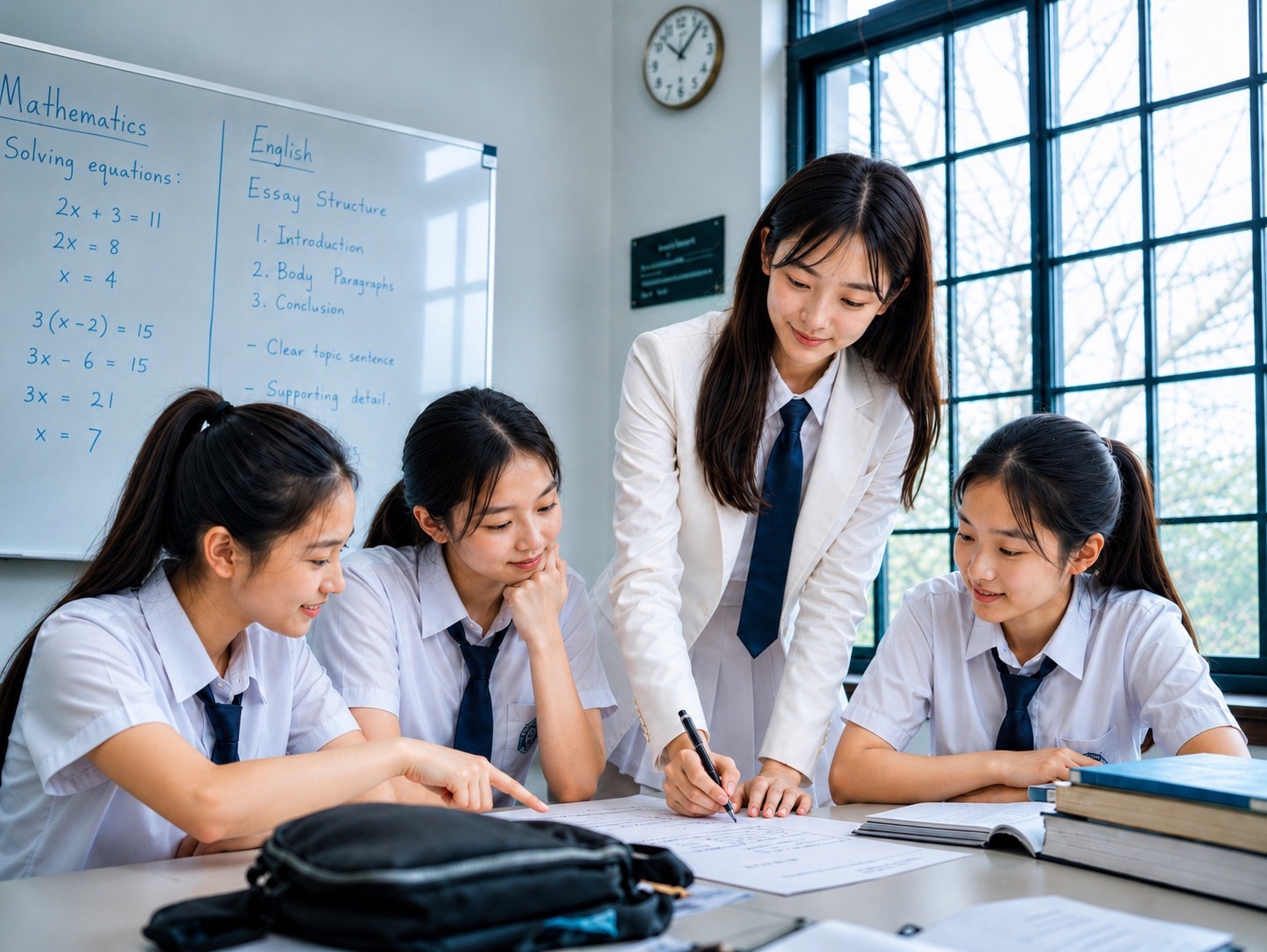
Secondary Mathematics Tuition Punggol | From O-Level to JC, AI, Data and University
Secondary Mathematics prepares students for more than exams. eduKate Punggol helps Sec 1 to Sec 4 students build algebra, graphs, statistics, E-Math, A-Math and exam craft for JC, Polytechnic, AI, data, engineering and university pathways.
Secondary Mathematics is not only for the next test. Algebra, graphs, statistics, geometry, trigonometry, functions and calculus help students prepare for JC, Polytechnic, AI, data, engineering, computing, finance and university pathways. At eduKate Punggol, we teach Mathematics as future-ready thinking.
Punggol Secondary Mathematics Tuition for Future-Ready Students
Summary
Secondary Mathematics is not only for the next test.
It is future training.
Algebra teaches structure.
Graphs teach relationships.
Geometry teaches space.
Statistics teaches uncertainty.
Trigonometry teaches measurement.
Functions teach systems.
Calculus teaches change.
Problem-solving teaches resilience.
Exam craft teaches disciplined performance under pressure.
For students in Punggol, this future-facing view matters even more. Punggol is no longer only a residential estate. With Punggol Digital District and SIT Punggol Campus, the neighbourhood itself is connected to applied learning, industry, technology, innovation and future skills.
That means Secondary Mathematics Tuition in Punggol should not be written only as “help my child pass Math”.
It should be written as:
help my child think better,
help my child keep pathways open,
help my child prepare for JC, Polytechnic or future study,
help my child understand the mathematical language behind AI, data, engineering, economics, computing, finance and research,
and help my child become calmer, stronger and more capable.
At eduKate Punggol, our Secondary Mathematics Tuition helps students build the Mathematics engine from Sec 1 to Sec 4, through G1/G2/G3, E-Math, A-Math, O-Level / SEC preparation and future academic readiness.
Mathematics is not only a school subject.
Properly taught, it becomes a way of seeing the world.
The Question Students Ask: “When Will I Ever Use This?”
At some point, many Secondary students ask the same question.
“When will I ever use this?”
They ask it when algebra feels abstract.
They ask it when graphs become confusing.
They ask it when trigonometry seems far away from daily life.
They ask it when statistics feels like another set of formulas.
They ask it when A-Math becomes difficult.
It is a fair question.
Students want meaning.
They want to know why they are learning.
They want to know whether the effort matters.
The answer should not be shallow.
We should not tell students, “Just study because it is in the exam.”
That may be true, but it is not enough.
A better answer is this:
Mathematics trains the mind to understand structure.
And the future is full of structure.
Data has structure.
Technology has structure.
Engineering has structure.
Finance has structure.
Architecture has structure.
Science has structure.
AI has structure.
Research has structure.
Business decisions have structure.
Even daily problem-solving has structure.
A student may not use every formula directly in adult life.
But the thinking trained by Mathematics continues to matter.
That is why Secondary Mathematics deserves respect.
Secondary Mathematics is a Bridge, Not a Dead End
Students often see Secondary Mathematics as a subject they must survive.
Sec 1 test.
Sec 2 exam.
Sec 3 weighted assessment.
Sec 4 O-Level / SEC paper.
But Secondary Mathematics is more than a sequence of tests.
It is a bridge.
It connects Primary school foundations to future pathways.
For some students, it leads towards Junior College.
For others, Polytechnic.
For others, applied degrees.
For others, business, design, technology, finance, healthcare, computing, engineering, data or research.
Even when the student does not choose a Mathematics-heavy route, the subject trains useful habits.
Careful reading.
Logical working.
Accurate calculation.
Structured reasoning.
Problem decomposition.
Checking.
Correction.
Persistence.
These habits matter everywhere.
At eduKate Punggol, we want students to understand that Secondary Mathematics is not just a hurdle.
It is a bridge.
A student who crosses it properly keeps more doors open.
Why Mathematics Keeps Pathways Open
At 13 or 14, most students do not fully know what they want to do in life.
That is normal.
Some will later choose JC.
Some will choose Polytechnic.
Some will choose business.
Some will choose science.
Some will choose computing.
Some will choose design.
Some will choose engineering.
Some will choose healthcare.
Some will change direction several times.
Because the future is uncertain, students should keep options open where possible.
Mathematics is one of the subjects that keeps options open.
Strong Mathematics helps students enter more demanding academic and technical pathways.
It supports sciences.
It supports economics.
It supports computing.
It supports engineering.
It supports data-related courses.
It supports finance.
It supports many applied fields.
Weak Mathematics does not make a student’s future impossible.
But it can close some doors earlier than necessary.
That is why we take Secondary Mathematics seriously.
Not because every child must become an engineer.
Not because every child must take A-Math.
But because every child deserves the chance to choose with strength, not fear.
At eduKate Punggol, Mathematics Tuition is partly about protection.
Protecting confidence.
Protecting options.
Protecting future readiness.
From Sec 1 Algebra to Future Thinking
Algebra is one of the first major future-thinking tools students meet in Secondary school.
At first, algebra feels like letters replacing numbers.
But algebra is much more than that.
Algebra teaches students to work with unknowns.
This is powerful.
In real life, we often face unknowns.
We do not know the final cost.
We do not know the future trend.
We do not know the exact risk.
We do not know the best decision immediately.
But we can still reason.
We can identify variables.
We can describe relationships.
We can form equations.
We can make assumptions.
We can solve.
This is algebraic thinking.
A student who learns algebra properly is learning how to think when not everything is known yet.
That is a future skill.
At eduKate Punggol, we teach algebra not only as school procedure, but as structured thinking.
The student learns:
What is unknown?
What is given?
What relationship connects them?
What can I transform?
What must remain balanced?
These questions are useful far beyond the classroom.
Graphs: Seeing Relationships
Graphs are another future skill.
A graph is not just a drawing.
It is a visual relationship.
It helps students see change, comparison, trend, speed, growth, decline, pattern and behaviour.
In adult life, graphs appear everywhere.
Business dashboards.
Stock charts.
Scientific data.
Population trends.
Weather reports.
Health information.
Economic indicators.
Engineering measurements.
AI model performance.
Data visualisation.
A student who can read graphs well has an advantage.
They can interpret information.
They can ask whether the scale is misleading.
They can notice trends.
They can compare rates.
They can see whether something is increasing, decreasing or changing unpredictably.
Secondary Mathematics introduces this habit early.
At eduKate Punggol, we help students understand graphs as information, not decoration.
When students learn to read graphs properly, they are learning to read the modern world.
Statistics: Thinking Clearly About Uncertainty
Statistics is one of the most important future-facing parts of Mathematics.
The world is full of uncertainty.
People make decisions using data.
Governments use data.
Companies use data.
Scientists use data.
Doctors use data.
AI systems use data.
Schools use data.
Researchers use data.
But data can be misunderstood.
A student who learns statistics properly begins to understand averages, spread, probability, sampling, interpretation and uncertainty.
This matters because not every number tells the whole story.
An average can hide variation.
A graph can mislead.
A probability can be misunderstood.
A small sample can be unreliable.
A trend can be real or accidental.
Statistical thinking helps students become more careful citizens and future professionals.
At eduKate Punggol, we want students to see statistics as more than examination marks.
It is a way of thinking clearly when the world is uncertain.
And the future will be full of uncertainty.
Geometry and Trigonometry: Understanding Space, Shape and Measurement
Geometry teaches students to reason about space.
Angles.
Lines.
Triangles.
Circles.
Similarity.
Congruency.
Area.
Volume.
Shape.
Trigonometry extends that reasoning into measurement.
Lengths.
Angles.
Heights.
Distances.
Slopes.
Directions.
These ideas matter in architecture, engineering, design, physics, robotics, surveying, navigation, graphics, construction and many applied fields.
Even when students do not use formal trigonometry every day, the spatial thinking remains useful.
They learn to visualise.
They learn to reason from diagrams.
They learn to justify statements.
They learn not to assume from appearances.
This is important.
A diagram may look correct but still require proof.
That habit is valuable beyond Mathematics.
Do not assume.
Check the condition.
Give the reason.
At eduKate Punggol, we teach geometry and trigonometry as structured visual reasoning.
Students learn that seeing is not enough.
They must understand why.
Functions: The Language of Systems
Functions are one of the great ideas in Mathematics.
A function describes how one quantity depends on another.
Input.
Rule.
Output.
This idea appears everywhere.
A business model has inputs and outputs.
A machine has inputs and outputs.
A computer program has inputs and outputs.
An AI model has inputs and outputs.
An economic system has variables that affect one another.
A science experiment studies how one factor affects another.
A student who understands functions begins to understand systems.
This is why functions matter.
In Secondary Mathematics and A-Math, functions may seem abstract.
But they are actually preparing students to think about relationships.
If one quantity changes, what happens to another?
What is the rule?
What is the pattern?
Can we predict?
Can we invert the relationship?
Can we transform the graph?
At eduKate Punggol, we help students see functions as more than notation.
Functions are a way of describing the world.
Calculus: The Mathematics of Change
For students who move into A-Math and later JC Mathematics, calculus becomes important.
Calculus is the Mathematics of change and accumulation.
Differentiation helps describe rates of change.
Integration helps describe accumulation and area.
These ideas are foundational in science, engineering, economics, computing, modelling and many university pathways.
To a Secondary student, calculus may begin as rules.
Differentiate this.
Integrate that.
Find the gradient.
Find the maximum or minimum.
But underneath the rules is a powerful idea.
The world changes.
Objects move.
Populations grow.
Costs vary.
Temperatures shift.
Signals fluctuate.
Systems respond.
Calculus gives students tools to describe those changes.
This is why A-Math is not just a harder version of E-Math.
It opens the door to higher mathematical thinking.
At eduKate Punggol, we help students build the algebra and function foundations needed for calculus to make sense.
Calculus should not be memorised blindly.
It should be understood as the study of change.
Mathematics and Artificial Intelligence
Students hear about artificial intelligence everywhere.
AI can write.
AI can draw.
AI can recognise images.
AI can recommend videos.
AI can analyse data.
AI can support businesses.
AI can change industries.
But behind AI is Mathematics.
Not only simple arithmetic.
AI involves data, probability, statistics, optimisation, linear algebra, functions, algorithms and modelling.
Secondary students do not need to understand all of that immediately.
But they should understand this:
The future is becoming more mathematical.
Students who are comfortable with Mathematics are better prepared to understand the systems shaping the world.
They may not all become AI researchers.
But mathematical confidence helps them participate more intelligently in an AI-driven world.
They can ask better questions.
They can understand data better.
They can learn computing more easily.
They can approach technology with less fear.
At eduKate Punggol, we see Secondary Mathematics as part of future literacy.
The child who learns algebra, graphs, statistics and functions today is building the mental tools for tomorrow’s world.
Mathematics and Data
Data is everywhere.
Students produce data when they use apps.
Companies collect data when customers buy products.
Schools analyse data to understand performance.
Governments use data to plan.
Scientists use data to test ideas.
Businesses use data to decide strategy.
Healthcare uses data to understand risk.
Data without Mathematics is just numbers.
Mathematics helps turn data into meaning.
Students who understand statistics, graphs, averages, probability and modelling become better at interpreting data.
They can ask:
What does this number mean?
What is being measured?
Is the sample large enough?
Is the graph fair?
What is the trend?
What is the uncertainty?
What conclusion is justified?
These are powerful questions.
At eduKate Punggol, we want students to see that Mathematics is not only about finding answers.
It is also about asking better questions.
In a data-heavy future, that matters.
Mathematics and Engineering
Engineering is one of the clearest examples of Mathematics in action.
Engineers use Mathematics to design, test, measure, model and improve systems.
They work with forces, structures, circuits, materials, signals, machines, energy, movement and constraints.
Secondary Mathematics builds the early foundations.
Algebra for relationships.
Graphs for behaviour.
Geometry for space.
Trigonometry for measurement.
Calculus for change.
Statistics for testing.
Problem-solving for design.
Not every student will become an engineer.
But students who may be interested in engineering need strong Mathematics.
Weak foundations can make future technical study much harder.
At eduKate Punggol, we help students understand that today’s Mathematics topics are not isolated chapters.
They are early tools for future fields.
A properly taught child sees the connection.
That connection can create motivation.
Mathematics and Computing
Computing also relies on mathematical thinking.
Programming requires logic.
Algorithms require structure.
Data structures require organisation.
AI requires statistics and models.
Cybersecurity uses number theory and cryptography.
Graphics use geometry and linear algebra.
Simulation uses equations.
Optimisation uses functions.
Secondary Mathematics prepares students indirectly by training structured thought.
A student who learns algebra learns symbolic manipulation.
A student who learns functions learns input-output relationships.
A student who learns logic in geometry learns justification.
A student who learns statistics learns uncertainty.
A student who learns problem-solving learns decomposition.
These are computing habits too.
At eduKate Punggol, we do not claim every Mathematics lesson is coding.
But we do say this:
Good Mathematics makes computing easier to enter.
It trains the mind to handle structure.
And computing is built from structure.
Mathematics and Economics, Finance and Business
Mathematics also supports economics, finance and business.
Students who later study these fields will meet numbers, graphs, models, rates, optimisation, probability, statistics and risk.
Even in ordinary life, mathematical thinking helps.
Budgeting.
Interest rates.
Loans.
Discounts.
Investments.
Inflation.
Business margins.
Data dashboards.
Forecasts.
Decision-making.
A student who is comfortable with Mathematics is less likely to be frightened by numbers.
They can analyse.
They can compare.
They can question.
They can plan.
This matters in adulthood.
At eduKate Punggol, we teach Mathematics as part of practical intelligence.
The child who learns to reason with numbers becomes better prepared for real-world choices.
Mathematics is not only for scientists.
It is for citizens, workers, leaders, entrepreneurs and families.
Punggol’s Future: Why Location Matters
Punggol has changed.
It is not only a housing estate.
It is becoming connected to applied learning, digital industry, innovation and future work through the wider Punggol Digital District and SIT Punggol Campus environment.
This gives Punggol Mathematics Tuition a powerful local story.
The child studying algebra in Punggol is not far from a district built around future skills.
The student learning graphs today may later study data, engineering, computing, design, healthcare technology or applied science.
The neighbourhood itself becomes a reminder:
Education is connected to the world.
This is why eduKate Punggol should speak about Mathematics with optimism.
We are not only preparing students for school tests.
We are preparing them for the systems they will inherit.
A properly taught child becomes more ready for that future.
Punggol is a good place to say this.
Because the future is not abstract here.
It is being built nearby.
From O-Level / SEC to Junior College
For students who move into Junior College, Secondary Mathematics becomes the foundation for higher Mathematics.
Students who take H1, H2, H3 or Further Mathematics later will need strong foundations from Secondary school.
Algebra becomes more demanding.
Functions become more important.
Graphs become more abstract.
Calculus becomes central.
Statistics becomes deeper.
Vectors and modelling may appear.
A weak Secondary Mathematics base can make JC Mathematics feel extremely fast.
This is why upper-secondary preparation matters.
Sec 3 and Sec 4 are not only examination years.
They are also bridge years to post-secondary study.
At eduKate Punggol, we help students understand this connection.
If a student may choose JC Mathematics later, E-Math and A-Math foundations must be treated seriously now.
The future climb is easier when the lower steps are strong.
From Secondary Mathematics to Polytechnic
Not every student chooses JC.
Many students choose Polytechnic pathways.
Mathematics still matters.
Polytechnic courses in engineering, information technology, applied sciences, business analytics, finance, architecture, design technology and other fields may require quantitative confidence.
Students may meet applied Mathematics, statistics, data analysis, programming, modelling, measurement or technical calculations.
A student who dislikes Mathematics may still enter a field where numbers and logic appear.
That is why Secondary Mathematics remains useful.
It builds the student’s ability to handle technical learning.
At eduKate Punggol, we respect different pathways.
JC is not the only route.
Polytechnic is not a lesser route.
Both require students who can think, learn, adapt and solve.
Mathematics helps build that capability.
From Secondary Mathematics to University
University Mathematics appears in many forms.
Some students study Mathematics directly.
Others meet Mathematics inside engineering, computing, business, economics, physics, chemistry, architecture, data science, psychology, life sciences, medicine, social sciences or research methods.
Mathematics may appear as calculus, statistics, linear algebra, optimisation, discrete mathematics, modelling, quantitative methods or data analysis.
The student may not realise in Secondary school how often Mathematics returns.
But it does.
This is why early confidence matters.
A student who leaves Secondary school frightened of Mathematics may avoid future opportunities.
A student who leaves Secondary school with stronger foundations has more confidence to enter quantitative fields.
At eduKate Punggol, we want students to leave Secondary Mathematics not only with a grade, but with readiness.
The grade matters.
But the readiness matters too.
University Research: The Long End of the Mathematics Road
At the highest levels, Mathematics becomes research.
Researchers study pure Mathematics, applied Mathematics, computational Mathematics, statistics, cryptography, modelling, data science, optimisation and many other fields.
Some research is abstract.
Some is applied.
Some supports science and engineering.
Some supports computing and secure communication.
Some supports data and machine learning.
This is the long end of the road that begins with simple school foundations.
A Secondary student solving algebra may not yet see this future.
But the same discipline is beginning.
Understand the structure.
Work carefully.
Check the logic.
Correct the mistake.
Try again.
These habits scale.
They begin in school.
They continue into advanced study.
At eduKateSG, we like this long view.
It reminds us that education is not only about the next worksheet.
It is about building a mind capable of future thought.
Why Students Do Not Need to Know Their Future Yet
Some students may say:
“I do not want to be an engineer.”
“I do not like AI.”
“I am not interested in research.”
“I will not use A-Math.”
That may be true.
But the student does not need to know their whole future now.
A 13-year-old does not need a final career plan.
A 15-year-old may still change direction.
A 17-year-old may discover new interests.
The purpose of Mathematics is not to force every child into one future.
The purpose is to keep thinking strong enough for many futures.
Mathematics builds flexibility.
A student who can handle Mathematics has more choices.
A student who learns how to solve difficult problems becomes more adaptable.
A student who learns how to correct mistakes becomes more resilient.
These qualities help in many paths.
At eduKate Punggol, we teach Mathematics as future capacity.
Not one fixed career.
Capacity.
That is the better word.
Mathematics Builds Character Too
Mathematics is not only cognitive.
It also builds character.
Students learn patience.
They learn accuracy.
They learn humility.
They learn that the first answer may be wrong.
They learn to check.
They learn to redo.
They learn to face difficult problems.
They learn not to give up too quickly.
They learn that effort must be guided by method.
They learn that clarity matters.
These habits are valuable.
A student who learns to correct a Mathematics mistake properly is also learning a life skill.
Do not collapse.
Find the cause.
Repair.
Try again.
This is why eduKateSG’s view of Mathematics is optimistic.
We are not only chasing marks.
We are building stronger learners.
Marks are important.
But the learner behind the marks is more important.
A strong learner can keep growing.
The Future Student Needs More Than Memorisation
The future will not reward only memorisation.
Information is everywhere.
Answers can be searched.
Tools can calculate.
AI can generate.
But students still need judgement.
They need to know whether an answer makes sense.
They need to interpret information.
They need to ask good questions.
They need to detect errors.
They need to reason through uncertainty.
They need to understand systems.
Mathematics trains these abilities.
Not when it is taught as blind procedure.
But when it is taught with meaning, structure and correction.
At eduKate Punggol, we do not want students to memorise without understanding.
We want them to know why.
Why this method?
Why this formula?
Why this graph?
Why this step?
Why this mistake?
Why this correction?
This “why” builds future thinkers.
What Future-Ready Mathematics Tuition Looks Like
Future-ready Mathematics Tuition is not random enrichment.
It begins with the syllabus.
Students still need to do well in school.
They still need examinations.
They still need E-Math and A-Math preparation.
But the teaching should connect the syllabus to deeper thinking.
Future-ready tuition includes:
strong algebra,
clear working,
graph interpretation,
statistical thinking,
geometry reasoning,
trigonometric understanding,
functions,
calculus readiness where appropriate,
mistake analysis,
exam craft,
and confidence.
It also teaches students to ask:
What is the structure?
What is the relationship?
What is the data saying?
What is changing?
What is unknown?
What method fits?
How do I check?
These questions prepare students for more than one paper.
They prepare students for learning itself.
That is the kind of Mathematics Tuition eduKate Punggol should represent.
The 55-65-75-85 Corridor and the Future
The 55-65-75-85 corridor is not only about marks.
It is about future readiness.
A student at 55 needs stability because without stability, the future pathway feels narrow.
A student at 65 needs leak reduction because repeated small losses can become long-term frustration.
A student at 75 needs mixed-topic control because future study rarely presents problems in isolated chapters.
A student at 85 needs distinction craft because high-level pathways require precision, stamina and flexibility.
Each stage builds future capacity.
The falling student learns that recovery is possible.
The stable student learns consistency.
The strong student learns discipline.
The distinction student learns polish.
At eduKate Punggol, we use this corridor to help students move one layer at a time.
Not only towards a better mark.
Towards a stronger self.
E-Math and the Future
E-Math prepares students for broad quantitative literacy.
It teaches students to handle many mathematical situations.
This matters because life is broad too.
Students will meet numbers, graphs, charts, measurements, probabilities, percentages, financial decisions, data and practical problem-solving.
E-Math helps students become less afraid of quantitative information.
This is important even for students who do not choose mathematically intensive pathways.
At eduKate Punggol, we treat E-Math as an important future skill subject.
It builds reliability.
It builds practical reasoning.
It builds examination discipline.
E-Math is not just the “ordinary” Mathematics.
It is the foundation of everyday quantitative confidence.
That is worth building well.
A-Math and the Future
A-Math prepares students for deeper mathematical pathways.
It strengthens algebra, functions, trigonometry, logarithms, differentiation and integration.
These are important foundations for JC Mathematics and many university-related fields.
A-Math also trains symbolic confidence.
The student learns to manipulate complex expressions.
The student learns to follow long methods.
The student learns to see hidden structures.
The student learns to persist through difficulty.
This is useful even beyond the exact topics.
At eduKate Punggol, we treat A-Math as both an academic subject and a thinking gym.
It is demanding.
But properly taught, it can become empowering.
A student who learns to control A-Math often becomes more confident in handling difficult intellectual work.
That confidence matters.
Full SBB and Future Pathways
Full Subject-Based Banding gives students more flexibility to develop according to strengths and readiness.
This makes Mathematics support even more important.
A student’s subject level should not become a fixed identity.
It should be understood as part of a pathway.
A student may need more support now and grow later.
A student may be strong now and need stretch to keep future options open.
A student may need bridging between levels.
A student may need confidence before performance improves.
At eduKate Punggol, we teach the student in front of us.
We do not reduce the child to a label.
We help the student build the mathematical strength needed for the next step.
The future should not be closed too early by weak foundations, fear or poor correction.
With proper support, students can grow.
That is the hopeful side of Full SBB.
Punggol Secondary Mathematics Tuition as a Learning Supply Chain
A good Mathematics result looks simple from the outside.
The mark appears on the paper.
But behind that mark is a supply chain.
Understanding.
Practice.
Correction.
Memory.
Working discipline.
Algebra.
Graphs.
Geometry.
Statistics.
Exam craft.
Confidence.
Teacher judgement.
Parent support.
Student effort.
The visible grade is only the shelf.
The real system is behind it.
At eduKate Punggol, our Secondary Mathematics Tuition is built to strengthen this whole supply chain.
If the child is falling, we find the broken link.
If the child is stable, we strengthen the system.
If the child is strong, we stretch and polish.
This is how Mathematics becomes less random.
The future-ready student is not built by one worksheet.
The student is built by a working system.
What Parents Should Remember
Parents should remember five things.
First, Mathematics is cumulative.
Weak foundations travel.
Second, Mathematics is trainable.
Students can improve when the cause of weakness is found.
Third, Mathematics affects future options.
Strong Mathematics can keep pathways open.
Fourth, Mathematics is not only about exams.
It trains reasoning, structure, accuracy and resilience.
Fifth, tuition should bring clarity.
Good tuition should not create more panic.
It should help the family understand what is happening and what to do next.
At eduKate Punggol, we want parents to feel that the child’s Mathematics journey can be made visible.
Once visible, it can be repaired.
Once repaired, it can grow.
The eduKateSG View: Properly Taught Students Build a Better Future
At eduKateSG, we believe education is part of building a better world.
That may sound large.
But it begins small.
One child learning to think clearly.
One student no longer afraid of algebra.
One teenager learning to correct mistakes.
One learner discovering that difficult things can be understood.
One future adult becoming more capable.
Mathematics is one of the subjects that builds this capability.
It teaches students to reason.
It teaches students to structure.
It teaches students to persist.
It teaches students to solve.
A properly taught student carries that strength forward.
Into JC.
Into Polytechnic.
Into university.
Into work.
Into family decisions.
Into society.
Into the future.
This is why Secondary Mathematics Tuition in Punggol should not be written only as exam rescue.
It is part of a larger educational mission.
Properly taught kids shine a bright light into the future.
Conclusion: Mathematics is a Future Language
Secondary Mathematics is not only for Sec 1, Sec 2, Sec 3 or Sec 4.
It is not only for the next test.
It is not only for O-Level or SEC Mathematics.
It is a future language.
Algebra teaches students to reason with unknowns.
Graphs teach students to see relationships.
Statistics teaches students to handle uncertainty.
Geometry teaches students to reason about space.
Trigonometry teaches students to measure the world.
Functions teach students to understand systems.
Calculus teaches students to understand change.
Exam craft teaches students to perform under pressure.
Together, these skills prepare students for JC, Polytechnic, university, AI, data, engineering, computing, finance, economics, science, research and many other pathways.
At eduKate Punggol, our Secondary Mathematics Tuition helps students build this future language with structure.
We diagnose.
We repair.
We teach.
We correct.
We stretch.
We prepare.
We help students catch up, keep up and move ahead.
The goal is not only better marks.
The goal is a stronger child.
A clearer thinker.
A calmer learner.
A more capable future adult.
That is why Mathematics matters.
That is why Secondary Mathematics Tuition matters.
And that is why, in Punggol, this subject should be taught not with fear, but with purpose.
The future is full of systems.
Mathematics helps students read them.
Want your child’s Mathematics to prepare them for more than the next test?
At eduKate Punggol, we help Secondary students build the algebra, reasoning, exam craft and confidence needed for school, future pathways and the world ahead.
Contact eduKate Punggol to discuss your child’s Secondary Mathematics learning plan.