
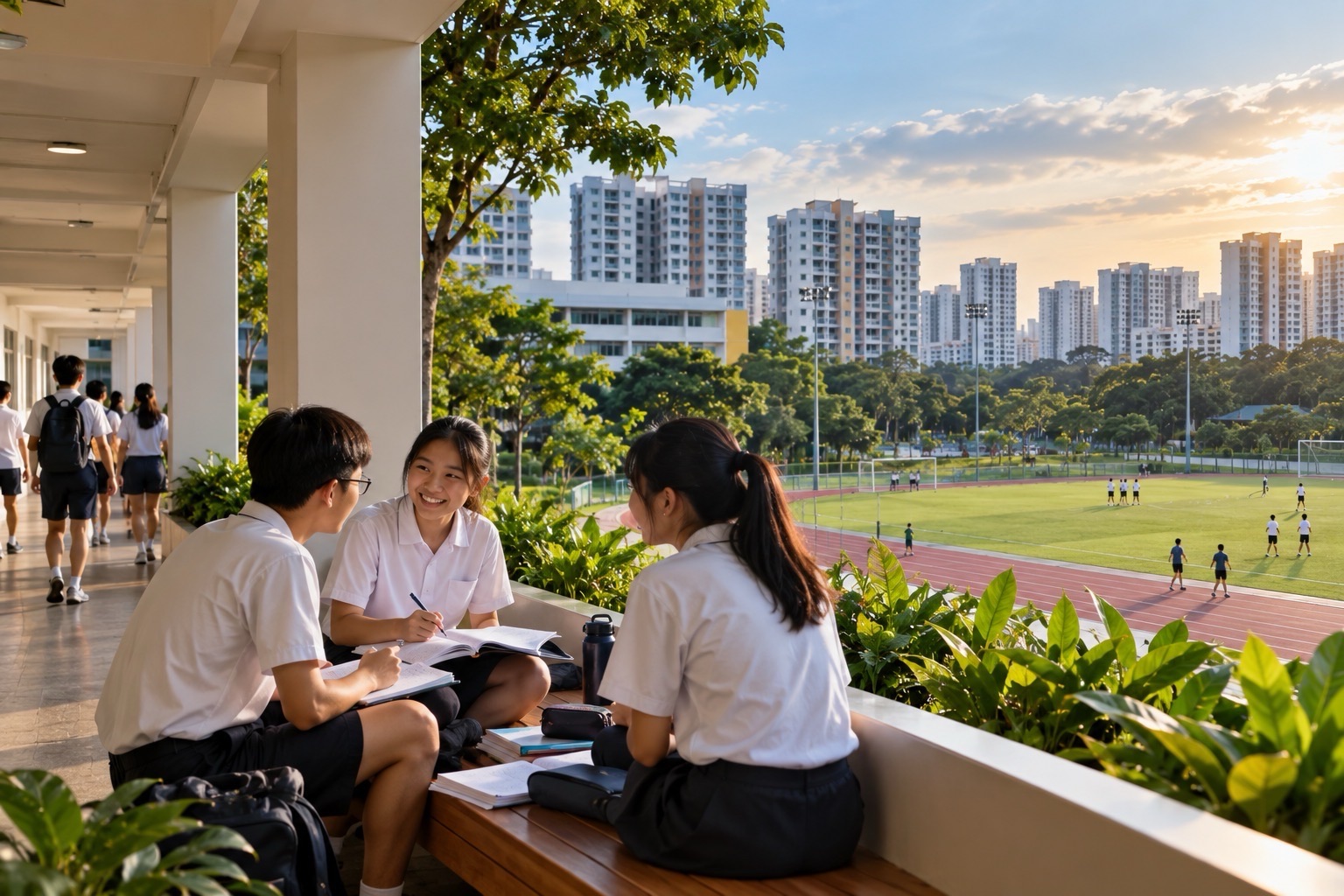
Singapore Education 2027 includes a Direct School Admission (DSA-Sec) application cycle for Primary 6 pupils seeking Secondary 1 places in January 2028. This pathway recognises talents and interests beyond PSLE scores, and helps participating secondary schools select young people they can develop through distinctive programmes.
Did you know? A confirmed DSA-Sec allocation is not a flexible early reservation that parents can abandon because PSLE results turn out better than expected. It normally involves a commitment to the allocated secondary school and the chosen talent area. The quality of the school fit matters far more than collecting an impressive offer letter.
This guide explains the 2027 DSA-Sec planning process, school talent areas, portfolios, trials, interviews, preferences and family decisions. As of 27 October 2026, the exact 2027 application dates for 2028 school entry have not yet been established by the current official notices reviewed. Past 2026 dates are identified clearly as past-cycle examples.
Apply in 2027 for 2028 Secondary 1 entry
A child taking PSLE in 2027 would ordinarily enter Secondary 1 in 2028. If the child hopes to apply through DSA-Sec, the relevant cycle occurs during Primary 6, before the final PSLE result is known.
The child finishing Primary 6 in 2026 is in a different position. That student’s DSA application window ran during 2026 for entry to Secondary 1 in January 2027, and the school preference window has already closed. Such a family should focus on the actual current result, allocation and school reporting instructions.
The first official reference is MOE’s DSA-Sec website. Participating schools publish their own talent areas, criteria and assessment requirements. One school may offer an innovation track; another may focus on sports, languages, visual arts or leadership. No universal list of talent areas applies to every school.
What can the 2026 cycle tell us about 2027?
The 2026 DSA-Sec application window for Secondary 1 entry in 2027 ran from 6 May to 2 June 2026. Published secondary-school notices set out selection activities over subsequent months, followed by the 19–23 October 2026 school preference stage.
For example, Tanjong Katong Secondary’s 2026 DSA notice explained its Malay Language and sports talent areas, assessment process and school preference dates. Junyuan Secondary’s 2026 notice identified its own sports performance tasks and selection timetable.
These examples illustrate the structure, not the confirmed 2027 dates. Families seeking Secondary 1 entry in 2028 should revisit MOE and the relevant schools when the 2027 cycle is announced. Do not invent a fresh May opening or October deadline based solely on last year’s dates.
Who should consider DSA-Sec?
The strongest candidate is not necessarily the pupil with the largest number of competition certificates. A good candidate has genuine interest, appropriate ability or potential, motivation to improve and willingness to participate in the programme over time.
In sports, this might mean consistent training, teamwork, resilience and responsiveness to coaching. In language, it might mean sustained reading, public speaking, writing or the ability to think creatively with words. In STEM, it might involve solving problems, testing prototypes and learning from failed attempts.
Some schools may welcome applicants with potential who do not already hold national awards. Others have specific selection requirements. Families need to read the current criteria for the actual school and talent area rather than accepting general claims about what every school must value.
A child who likes Mathematics may not necessarily enjoy the particular STEM programme a school offers. Another who loves a sport casually may not want regular intensive training. DSA should open up an opportunity that genuinely fits the learner, not become a shortcut to a fashionable school.
How to research schools without chasing reputation
Use MOE SchoolFinder to compare programmes, CCAs, school location and education pathways. Then read each school’s official DSA notice, school website and any offered briefing.
Ask practical questions. Which talent area does the school offer this cycle? Does the child meet the conditions? What are the regular training commitments? Does the school provide subject-level support if the student struggles academically? Is there space to develop other interests?
The school is a real place the student will attend for several years. It has daily lessons, friendships, facilities, CCAs, discipline, homework and a journey from home. Families in Bukit Timah, Punggol, Tampines, Yishun or Jurong may face very different transport costs and travel times even when applying for similar talent areas.
School choice is therefore both an educational and household decision. A good talent programme is not automatically good for a child if the daily commute leaves no time for rest or the child feels no sense of belonging.
Application choices, registration and eligibility
During the 2026 exercise, DSA-Sec applicants generally applied through a central MOE portal using the authorised Singpass process. The system permitted up to three choices, with restrictions on applying twice to the same school for different talent areas. Applicants from non-mainstream schools had a separate route to secure the necessary registration number.
These are prior-cycle administrative details, not a guarantee that the 2027 portal will be identical. Parents should check the 2027 application guide, actual eligibility and the precise limit on choices when the new exercise launches.
An application choice is also different from the later preference ranking that may follow offers. Parents should understand the sequence and not confuse a trial invitation with admission, an offer with final posting, or a waitlist with a guaranteed vacancy.
Keep application acknowledgement records in a secure place. Do not share the child’s candidate identifiers or school notices publicly, and avoid giving Singpass credentials to third-party agents.
Portfolios: what genuine evidence looks like
A portfolio should show the learner’s real work and progress. The strongest evidence often explains what the student tried, what the student contributed, which obstacle appeared and how the work improved.
A child applying to a science or innovation programme might discuss a prototype, a fair test, an unexpected result and a revised design. An applicant interested in leadership may provide concrete examples of helping a group rather than writing generic claims of being a born leader.
A language applicant might explain an original story, speech or reading project. The relevant feature is not the expensive cover or print quality; it is whether the child can explain why the work matters and what has been learned.
Not every talent programme requires the same portfolio. Some use audition, sports trial, aptitude test, interview or school records. Read the school’s official submission rules before paying anyone to manufacture a polished collection of achievements that does not match the required evidence.
A useful home exercise is to ask the child to describe one activity in three parts: “What I attempted”, “What did not work”, and “What I learned or changed”. This prepares a thoughtful explanation without forcing memorised answers.
Auditions, trials and interviews: how to prepare
Selection activities are designed to assess a pupil’s suitability and potential. Preparation should build confidence with the process, not coach the child to imitate a personality that the child does not possess.
For a sports trial, follow appropriate safety guidance, use the specified equipment and prioritise ordinary training, rest and hydration. For a music or performance audition, ask the school for permitted repertoire or instruments. For an academic or innovation activity, practise explaining methods and reflecting on mistakes.
For interviews, help the pupil answer straightforward questions naturally: Why do you enjoy this field? Which difficult experience taught you something? What do you do when someone in a group disagrees with you? What is one challenge you would like to explore further?
An honest answer such as “I have not solved that yet, but I would test it by…” may show more thoughtful learning than an exaggerated claim. Children should understand that an interview is an opportunity for mutual fit, not a verdict on their overall worth.
Plan travel to the actual assessment location and read reporting instructions carefully. A well-prepared child should not be distressed by a preventable late arrival, missing equipment or a misunderstanding of the event’s venue.
Confirmed Offer, Waitlist and Unsuccessful
Under the previous national process, schools could issue outcomes such as Confirmed Offer, Waitlist or Unsuccessful. Each has a distinct meaning. A waitlist place is not a confirmed offer, and an application shortlisted for assessment is not a final allocation.
When the official preference stage arrives, students with relevant offers should make decisions according to their genuine school preference and the applicable commitment terms. A household should not view the ranked choices as a way to hold every possible option open indefinitely.
An allocated DSA-Sec applicant generally commits to that secondary school and does not participate in the ordinary Secondary 1 Posting Exercise. Woodlands Secondary’s DSA guidance explicitly notes the commitment and continued participation in the chosen talent area.
Parents need to review the full current MOE rules before confirming choices. The school’s academic programme, travel, culture and talent development should all feel workable. A better-than-expected PSLE result does not automatically undo the commitment.
Does DSA replace the need to study for PSLE?
No. DSA-Sec students still have to meet the applicable PSLE and school-programme eligibility conditions. A pupil who receives an encouraging talent outcome still benefits from strong reading, writing, mathematical reasoning, Science literacy and steady examination preparation.
A sport-focused child who struggles with English comprehension needs targeted language teaching; buying more sports equipment will not repair the comprehension gap. Equally, withdrawing the child entirely from a loved sport to practise another hundred worksheets may harm motivation.
The sensible balance depends on the child’s needs. Keep a weekly schedule containing subject foundations, talent practice, CCAs and rest. The preparation plan should change when evidence changes.
See our PSLE 2027 guide for the correct examination-year calendar and practical revision approach.
The Full Subject-Based Banding connection
DSA does not remove the need to understand the curriculum the receiving school offers. Under Full Subject-Based Banding, secondary students may study approved subjects at G1, G2 and G3 levels according to readiness and school arrangements.
Posting Group and subject level are not interchangeable. A child needs to be able to cope with the school’s curriculum, and the family should ask about subject options and support rather than assume the DSA talent automatically determines academic placement.
For the 2027 entry cohort, our Secondary 1 transition guide gives additional background. Families applying during 2027 for 2028 entry should reconfirm their own receiving school’s requirements.
Three realistic family scenarios
A Primary 5 student enjoys writing and debate but has no national medal. The family looks at relevant schools’ last published language talent criteria, encourages regular original writing and uses constructive teacher feedback. It waits for the current 2027 listings before applying.
A committed athlete living far from a desired school compares the daily journey, expected training schedule, academic subjects and CCA load. The family talks with the pupil about whether the programme would still be attractive on difficult days, not just at an open house.
A child already received a 2026 DSA offer for January 2027 entry. The parents discover a guide to the next 2027 exercise and think they must reapply. They should instead follow the concluded 2026 application process, actual allocation and receiving school’s 2027 reporting instructions.
These examples are illustrations of sound planning, not promises of admission probability. School places, categories and selection rules can change annually.
How parents can help without taking over
A child should be part of every material decision. Ask whether they genuinely like the school, whether they understand the commitment and what excites or worries them about the programme. Adults can provide resources and perspective, but the child will live the daily experience.
Avoid comparing the pupil’s DSA outcome with friends’ offers. Different schools look for different talents and have different capacities. Rejection does not mean the child’s effort or identity was worthless.
Be cautious of any service promising guaranteed DSA admission. No private coaching company can make an official school’s selection decision. The most valuable support is authentic learning, appropriate preparation and a manageable family routine.
Practical 2027 DSA preparation checklist
- Confirm the student’s Primary 6 year is 2027 and the desired Secondary 1 entry year is 2028.
- Use MOE’s newly published 2027 calendar, not the 2026 application or preference dates.
- Review genuine school talent offerings and programme commitments.
- Collect authentic work, reflections and relevant activities where permitted.
- Check school-specific portfolio, trial, interview and equipment instructions.
- Distinguish application, selection, offer, preference and final allocation.
- Read commitment conditions before making a binding choice.
- Keep PSLE preparation, sleep, travel and friendships in the plan.
- Ask the child whether they truly want the school’s long-term programme.
Frequently asked questions
Are 2027 DSA-Sec dates the same as the 2026 application dates?
Do not assume that. The dates in this article’s historical example are specifically from the 2026 exercise for entry in 2027. Check MOE’s 2027 notice for 2028 admission.
Can a student use DSA to avoid the PSLE?
No. The relevant PSLE requirements still apply. A talent-based offer does not remove national academic eligibility conditions.
Must every applicant have national-level awards?
No universal national-medal rule applies to every school and talent area. Each participating school publishes its own selection criteria, which may include potential and aptitude.
Can a confirmed DSA student switch to normal S1 Posting if PSLE goes well?
A successful DSA-Sec allocation normally creates a commitment to the selected school, and the pupil is not part of the ordinary S1 Posting Exercise. Read the actual offer terms carefully.
How many schools should a family shortlist?
Begin by finding suitable programmes, then use the official limit for the current exercise. The previous 2026 portal permitted up to three application choices, subject to its specific rules.
Official sources and related reading
- MOE — DSA-Sec
- MOE — SchoolFinder
- Tanjong Katong Secondary — 2026 DSA Details
- Junyuan Secondary — DSA Selection Examples
- Woodlands Secondary — DSA Commitment
- SEAB — PSLE
- eduKateSG — Singapore Education 2027 Family Watchlist
- Arrange an eduKate Singapore consultation
The decision that matters most
The best DSA outcome is not merely admission to a school with a famous name. It is a student with a genuine talent entering a school able to nurture that strength while supporting academic foundations, friendships and personal growth.
For the 2027 exercise, verify the current official dates, let the child participate meaningfully in the decision and be certain the family understands the school commitment before accepting it.