
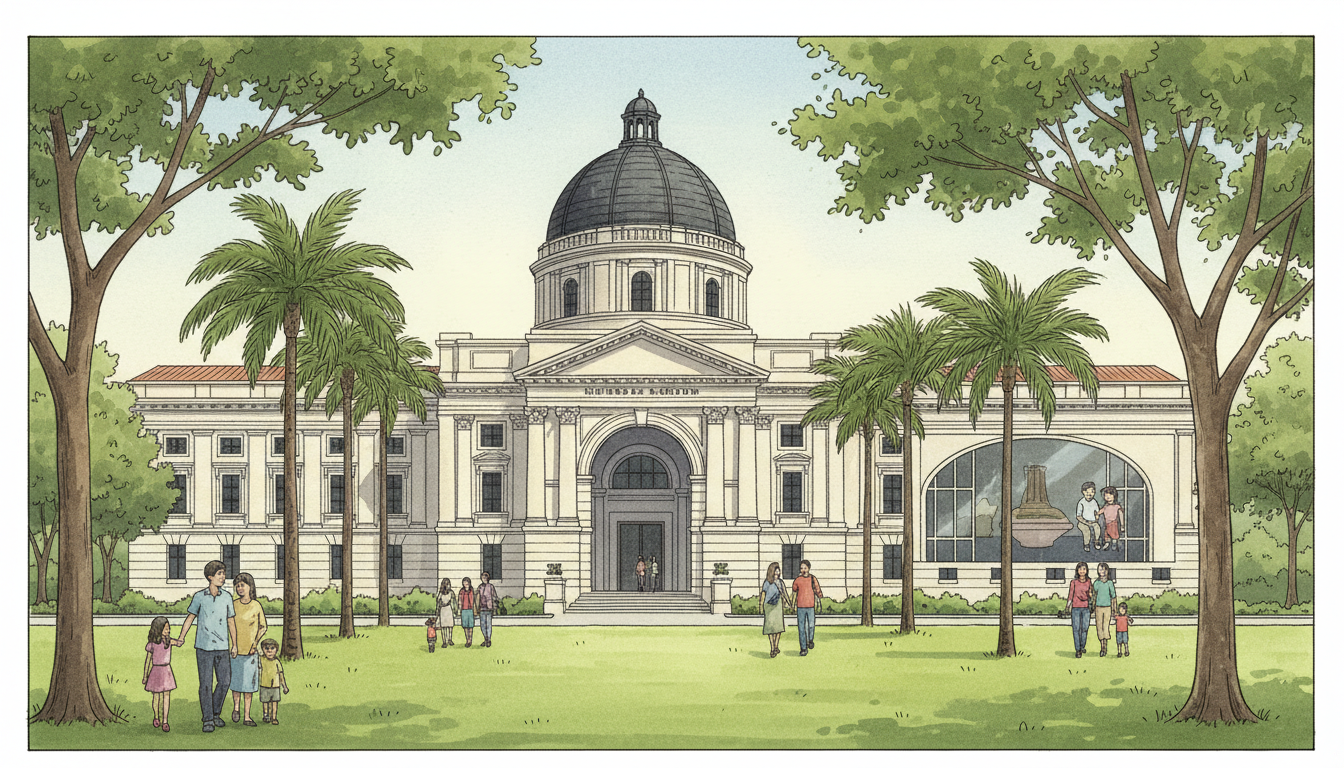
An object displayed at a Singapore museum can have several stories. A label might be written in English, a family might recognise a Malay place name, an older visitor might remember a Chinese or Tamil expression, and an overseas guest might need an explanation of the historical setting. These readings are not all identical, yet they can contribute to public understanding when each is connected to evidence rather than treated as the only possible account.
The National Museum of Singapore describes itself as the country’s oldest museum, opened in 1887, with exhibitions and programmes spanning the island’s long history and cultural heritage. It also provides online resources and has invited public contributions of everyday objects and stories. That makes museums a useful setting for learning how first languages, personal memory and formal historical documentation can work together.
This chapter is a vocabulary lesson, not a general museum visitor guide. It teaches the terms needed to read a caption, distinguish a primary source from a curator’s interpretation, understand an object from a language unfamiliar to the visitor, and explain why a national collection can hold more than one kind of Singaporean life story.
This specialist article is part of the eduKateSG Master Vocabulary Library and connected Vocabulary Articles archive. It is written for students, parents, educators and curious readers. It treats vocabulary as an engine for meaning, precision, evidence, audience awareness and independent expression—not a list of impressive words to memorise. Its teaching sequence applies the diagnosis, concept rebuilding, Fencing Method, retrieval and transfer principles demonstrated across Vocabulary Learning Hub.
The answer first: why this theme is part of Singapore nation building
| Question | Clear answer |
|---|---|
| Main question | How can people with different first languages understand and discuss the same public historical collection? |
| Answer | By linking objects, source information, honest interpretation and accessible explanations, while retaining room for differing personal memories. |
| Institutional example | The National Museum documents Singapore’s history; its online resources include virtual and thematic heritage materials. |
| Time-sensitive caution | The museum’s 2026 gallery upgrades have changing schedules; check the current visitor information before planning an on-site visit. |
| Useful result | 32 vocabulary terms, worked caption corrections, source-literacy scenarios and age-adjustable learning tasks. |
The wider language context must remain exact. Singapore’s Constitution, Article 153A establishes Malay as the national language and Malay, Mandarin, Tamil and English as the four official languages. First language is an individual linguistic biography; home language describes current household use; a school Mother Tongue Language is an educational classification; and a common working language concerns shared practical communication. These categories can overlap but are not synonyms.

Find what you need in this article
- First language, national language and official language
- Timeline and source limits
- Six reasons the theme matters
- The 32-term quick-reference guide
- In-depth vocabulary learning cards
- Eight worked Singapore situations
- Practice from Primary to adult learning
- Self-check and answer guidance
- Frequently asked questions
- Primary sources
- Continue the vocabulary network
First language and public life: name the right category
When a student says ‘my first language is English’, the statement concerns early acquisition, not the Constitution. When someone says ‘I speak Mandarin most at home’, they describe a social context that may change across generations. A child studying Tamil as a school Mother Tongue Language subject is using an educational label that may or may not match early home use. Saying ‘Malay is Singapore’s national language’ is a formal legal statement, and saying ‘English commonly coordinates work and education’ describes an institutional function.
These differences are especially important in public settings. A museum visitor, patient, commuter or pupil may need a certain explanation, yet their surname or presumed ethnicity does not tell you which language they learned first. Accurate support begins by asking about the relevant task and offering an appropriate route to understanding. This is the central link between vocabulary and nation building: institutions can serve a shared civic world without requiring identical private linguistic histories.
| Label | Meaning | Misinterpretation to avoid |
|---|---|---|
| First language | A language acquired early in life, possibly alongside another. | Assuming it from race, surname or accent. |
| Home language | A language or languages used with household members. | Treating it as a fixed single label across a lifetime. |
| School Mother Tongue Language | A curriculum and policy designation for school learning. | Assuming it must be the strongest home language. |
| Official language | A formally recognised public language in Singapore. | Claiming all four official languages are national languages. |
| National language | Malay under Singapore’s Constitution. | Calling English the national language because it is widely used. |
| Working language | A common channel for practical coordination. | Assuming it replaces heritage and family languages. |
The Singapore Department of Statistics cautions that a measure of the language most or second-most frequently spoken at home does not enumerate every language a person knows. Use that as a test of disciplined interpretation. A source that measures household frequency cannot, by itself, prove a person’s reading competence, citizenship or preference in a particular institutional setting.
Timeline: what happened, and what the date does not prove
Every historical claim has a date and scope. A museum reopening plan is not proof of a completed opening; a 2026 event page is not a current invitation for later years; and a historical conflict is not an excuse to stereotype people living now. These entries are deliberately limited to their sources.
| Period | Supported context | What must remain qualified |
|---|---|---|
| 1887 | The National Museum’s institutional history traces its beginnings to 1887. | An institution’s opening year is not the date every modern display was created. |
| 1992 | The National Museum’s historic building was designated a National Monument on 14 February. | Monument designation concerns a building; it is not identical to the museum’s whole collection. |
| 2023–2026 | The museum undertook restoration and upgrading, closing some galleries in phases. | An older exhibition webpage may be outdated on the day of a reader’s visit. |
| 2025–2026 | Temporary and virtual exhibitions offered alternative ways to explore histories during upgrades. | Digital access to a programme is not a promise that all objects are available for reuse. |
| 10 October 2026 (scheduled) | The museum’s upgrading notice listed this as the planned Singapore History Gallery reopening date. | A published plan does not itself prove that reopening occurred; check its current status. |
Six deeper explanations of the nation-building connection
1. A museum object is not its entire historical explanation
A photograph, tool, letter or piece of clothing is a physical or digital trace of a specific context. A curator selects information, constructs a label and decides which questions a visitor can reasonably answer from the source. The object may support a claim about materials, maker or date, while a broader claim about society may require several other records.
Read an exhibition label in layers. Start with the identifiable object, move to its date and provenance, then separate the display’s verified description from the curator’s interpretation. Ask what other sources would be needed if the label claimed to represent the experiences of every Singaporean at that time.
This approach resists the temptation to reduce public history to an attractive but unsupported story. It does not prohibit interpretation; it makes interpretations accountable to the evidence they use.
Meaning check: Explain this idea in two sentences to a younger reader. Make one sentence describe the verified fact or specific example, and the second explain what it does not establish. The best vocabulary work teaches both a useful meaning and its evidence boundary.
2. First languages shape personal connections to a display
A visitor’s family may have called a neighbourhood by an older name in Malay or a Chinese variety. A child may recognise the English translation but not the script printed on an archived document. Another visitor may speak Tamil at home but need support to read older literary forms. These relationships describe actual encounters, not identities that can be inferred from a face or surname.
A good guide can ask which part of a label is unclear and offer a source-based explanation. Some historic terms should be retained in their original form with an accurate gloss. Translation can give access to meaning while preserving a record of the expression used in its period.
An accessible explanation should not silently convert a personal recollection into a documented historical event; both can appear, but they need distinct attribution.
Meaning check: Explain this idea in two sentences to a younger reader. Make one sentence describe the verified fact or specific example, and the second explain what it does not establish. The best vocabulary work teaches both a useful meaning and its evidence boundary.
3. Public collections help construct a shared, plural narrative
Museums choose objects to tell stories about migration, trade, labour, education, family life, conflict and change. A national collection can offer a common reference without pretending that the lives represented are identical. A school group might compare two artefacts from the same decade and find evidence of very different daily routines.
The term representation is useful here: whose history appears, whose voice is quoted and who can find a familiar point of entry? Fair interpretation is not accomplished merely by adding a colourful image. It requires choosing materials responsibly, explaining their origins and acknowledging absences.
Visitors should avoid assuming that one object from a community represents all people belonging to that community.
Meaning check: Explain this idea in two sentences to a younger reader. Make one sentence describe the verified fact or specific example, and the second explain what it does not establish. The best vocabulary work teaches both a useful meaning and its evidence boundary.
4. Caption language can make or break comprehension
A caption that begins with an unfamiliar abbreviation and a technical archaeological period may be precise to a specialist but confusing to a Primary 5 reader. Good museum writing provides an accessible first sentence, the key evidence and optional deeper detail. Terms such as provenance, provenance gap, catalogue and reproduction rights should be explained where they matter.
If the explanation is translated, the curator needs to preserve names, dates, uncertainty and relationships. Transliteration of a name does not necessarily convey its meaning; translation of meaning may not preserve a historical person’s chosen spelling. A useful caption can show both where evidence allows.
The goal is not to use the longest word; it is to help the visitor correctly understand what the exhibit supports.
Meaning check: Explain this idea in two sentences to a younger reader. Make one sentence describe the verified fact or specific example, and the second explain what it does not establish. The best vocabulary work teaches both a useful meaning and its evidence boundary.
5. Gallery access is part of inclusion
The National Museum’s online resources and the Peranakan Museum’s access-visit information show that museum learning may involve digital resources, different guide formats and community visits. Actual access arrangements, language availability, reservations and gallery opening conditions vary by institution and date.
A reader should therefore distinguish a publicly advertised programme from a confirmed service for a particular booking. A museum webpage saying that English and Mandarin tours are offered in certain circumstances does not promise every visitor a tour in every language at every moment.
This distinction is a useful vocabulary test: accessibility is about what people can genuinely use, not merely the presence of several words on a brochure.
Meaning check: Explain this idea in two sentences to a younger reader. Make one sentence describe the verified fact or specific example, and the second explain what it does not establish. The best vocabulary work teaches both a useful meaning and its evidence boundary.
6. National memory requires both respect and historical criticism
Objects and stories can be emotionally meaningful while also open to careful questions. A descendant may share a memory; a curator may explain an artefact’s wider economic setting; a scholar may identify an alternative reading. These accounts need not be flattened into agreement, yet they should be clearly labelled so the public can examine them.
Students learn civic competence when they can identify the limits of a display, ask what remains missing and discuss disagreement without mocking a speaker’s language. National memory becomes more trustworthy when it can accommodate multiple perspectives and correct its factual mistakes.
The practical skill is disciplined curiosity: look closely, attribute carefully, interpret with humility and connect the object to the sources that support the claim.
Meaning check: Explain this idea in two sentences to a younger reader. Make one sentence describe the verified fact or specific example, and the second explain what it does not establish. The best vocabulary work teaches both a useful meaning and its evidence boundary.
32 vocabulary terms: the complete quick-reference table
The list below is a learning tool, not an MOE/SEAB prescribed word list. Use it first for navigation, then work through each explanation to see why a term fits a given Singapore example, where it would be misleading, and how it can transfer to another situation.
| No. | Vocabulary | Concrete Singapore use |
|---|---|---|
| 1 | museum | The National Museum of Singapore presents historical objects and stories. |
| 2 | collection | A museum brings objects from different periods into a collection. |
| 3 | artefact | An old household tool becomes evidence about earlier daily life. |
| 4 | exhibition | Visitors explore a historical exhibition at a Singapore museum. |
| 5 | curator | A curator researches an object before approving a label. |
| 6 | docent | A museum docent leads a discussion for schoolchildren. |
| 7 | provenance | A catalogue records how a donated item reached the museum. |
| 8 | accession number | A museum’s catalogue identifies a specific artefact. |
| 9 | primary source | A dated photograph is used to study a street from an earlier decade. |
| 10 | secondary source | A historian compares several documents about the same era. |
| 11 | interpretation | A curator interprets the use of a historic tool. |
| 12 | caption | A label provides a date, name and context for an item. |
| 13 | historical context | A display connects a schoolbook to its historical education system. |
| 14 | timeline | A class places artefacts in chronological sequence. |
| 15 | chronology | A pupil checks whether one reform preceded another. |
| 16 | oral history | An elder describes moving to an estate during redevelopment. |
| 17 | testimony | An archived interview preserves a resident’s voice. |
| 18 | first language | A visitor learned Malay first and later studied history in English. |
| 19 | home language | Two family members discuss the same exhibition in different languages. |
| 20 | source language | A letter was originally written in a Chinese language variety. |
| 21 | translation | An English explanation accompanies a historical-language source. |
| 22 | transliteration | A place name is shown in Roman letters alongside its original script. |
| 23 | register | A child-friendly panel differs from a specialist catalogue. |
| 24 | annotation | A panel annotates a period-specific expression. |
| 25 | multilingual interpretation | Visitors use available multilingual guides or explanations. |
| 26 | accessibility | An exhibition offers accessible routes and explanatory resources. |
| 27 | representation | A display includes objects representing varied neighbourhood lives. |
| 28 | collective memory | Museum displays prompt family conversations about Singapore history. |
| 29 | historical uncertainty | The museum identifies a disputed maker or date cautiously. |
| 30 | conservation | Conservators protect vulnerable historical documents. |
| 31 | reproduction rights | A visitor asks whether an archive photograph can be published. |
| 32 | public memory | A museum provides a meeting place for stories of different communities. |
The detailed vocabulary lessons: definition, evidence boundary and practice
1. museum
What it means: An institution that collects, cares for, studies and presents material for public learning. To use it precisely, the reader must understand the feature that makes this term different from a nearby expression, not merely learn a dictionary synonym.
Singapore context: The National Museum of Singapore presents historical objects and stories. The example is deliberately bounded to a particular person, setting or documented institution. Do not change a specific statement into ‘all Singaporeans’ or ‘every institution’ without new evidence.
What the word does not prove: A museum’s interpretation is not identical to every person’s recollection. This boundary matters because confident but inaccurate vocabulary can obscure an unfair assumption, a missing source or a mistaken public instruction.
Apply it: Describe the difference between a museum and a shopping display. Explain why this term fits the example and which near synonym would change the meaning. Write a new sentence about a different school or civic situation.
2. collection
What it means: A group of objects or records organised and cared for by an institution. To use it precisely, the reader must understand the feature that makes this term different from a nearby expression, not merely learn a dictionary synonym.
Singapore context: A museum brings objects from different periods into a collection. The example is deliberately bounded to a particular person, setting or documented institution. Do not change a specific statement into ‘all Singaporeans’ or ‘every institution’ without new evidence.
What the word does not prove: Collection membership does not prove every object has the same origin. This boundary matters because confident but inaccurate vocabulary can obscure an unfair assumption, a missing source or a mistaken public instruction.
Apply it: Choose two items and identify their different contexts. Fence the concept: what belongs inside this term’s definition, and what stays outside? Create one accurate statement and one tempting but false one.
3. artefact
What it means: An object made or modified by human activity. To use it precisely, the reader must understand the feature that makes this term different from a nearby expression, not merely learn a dictionary synonym.
Singapore context: An old household tool becomes evidence about earlier daily life. The example is deliberately bounded to a particular person, setting or documented institution. Do not change a specific statement into ‘all Singaporeans’ or ‘every institution’ without new evidence.
What the word does not prove: One artefact rarely proves how every family lived. This boundary matters because confident but inaccurate vocabulary can obscure an unfair assumption, a missing source or a mistaken public instruction.
Apply it: Write a cautious object caption. Say it in ordinary English to a Primary learner, then more formally to a Secondary student. Keep the fact unchanged while improving clarity for each audience.
4. exhibition
What it means: An arranged presentation of selected objects or information. To use it precisely, the reader must understand the feature that makes this term different from a nearby expression, not merely learn a dictionary synonym.
Singapore context: Visitors explore a historical exhibition at a Singapore museum. The example is deliberately bounded to a particular person, setting or documented institution. Do not change a specific statement into ‘all Singaporeans’ or ‘every institution’ without new evidence.
What the word does not prove: An exhibition is a curated selection, not a complete inventory of history. This boundary matters because confident but inaccurate vocabulary can obscure an unfair assumption, a missing source or a mistaken public instruction.
Apply it: Explain what selection leaves out. After reading, cover the term and retrieve it from the meaning without hints. Test it again on a different day with a new audience or institution.
5. curator
What it means: A person responsible for interpreting, selecting or caring for a collection. To use it precisely, the reader must understand the feature that makes this term different from a nearby expression, not merely learn a dictionary synonym.
Singapore context: A curator researches an object before approving a label. The example is deliberately bounded to a particular person, setting or documented institution. Do not change a specific statement into ‘all Singaporeans’ or ‘every institution’ without new evidence.
What the word does not prove: Curator expertise does not remove the need to cite evidence. This boundary matters because confident but inaccurate vocabulary can obscure an unfair assumption, a missing source or a mistaken public instruction.
Apply it: Draft a question to ask a curator. Explain why this term fits the example and which near synonym would change the meaning. Write a new sentence about a different school or civic situation.
6. docent
What it means: A guide or educator helping visitors engage with exhibits. To use it precisely, the reader must understand the feature that makes this term different from a nearby expression, not merely learn a dictionary synonym.
Singapore context: A museum docent leads a discussion for schoolchildren. The example is deliberately bounded to a particular person, setting or documented institution. Do not change a specific statement into ‘all Singaporeans’ or ‘every institution’ without new evidence.
What the word does not prove: A docent’s tour schedule cannot be inferred from a historic listing. This boundary matters because confident but inaccurate vocabulary can obscure an unfair assumption, a missing source or a mistaken public instruction.
Apply it: Write a respectful tour enquiry. Fence the concept: what belongs inside this term’s definition, and what stays outside? Create one accurate statement and one tempting but false one.
7. provenance
What it means: The documented origin and ownership or custody history of an object. To use it precisely, the reader must understand the feature that makes this term different from a nearby expression, not merely learn a dictionary synonym.
Singapore context: A catalogue records how a donated item reached the museum. The example is deliberately bounded to a particular person, setting or documented institution. Do not change a specific statement into ‘all Singaporeans’ or ‘every institution’ without new evidence.
What the word does not prove: A compelling story without documentation is not proof of provenance. This boundary matters because confident but inaccurate vocabulary can obscure an unfair assumption, a missing source or a mistaken public instruction.
Apply it: List three fields that should be recorded. Say it in ordinary English to a Primary learner, then more formally to a Secondary student. Keep the fact unchanged while improving clarity for each audience.
8. accession number
What it means: An identifier assigned to an acquired collection object. To use it precisely, the reader must understand the feature that makes this term different from a nearby expression, not merely learn a dictionary synonym.
Singapore context: A museum’s catalogue identifies a specific artefact. The example is deliberately bounded to a particular person, setting or documented institution. Do not change a specific statement into ‘all Singaporeans’ or ‘every institution’ without new evidence.
What the word does not prove: An accession number is not a person’s identity number. This boundary matters because confident but inaccurate vocabulary can obscure an unfair assumption, a missing source or a mistaken public instruction.
Apply it: Explain why identifiers prevent confusion. After reading, cover the term and retrieve it from the meaning without hints. Test it again on a different day with a new audience or institution.
Retrieval checkpoint for terms 1–8: Without looking at the table, retrieve three terms from this group. For each, explain its meaning, give a different Singapore example, and produce one incorrect statement that you can repair. The target is flexible use, not repeating words in order. Revisit the same distinctions tomorrow and next week.
9. primary source
What it means: Material directly connected with the period or event studied. To use it precisely, the reader must understand the feature that makes this term different from a nearby expression, not merely learn a dictionary synonym.
Singapore context: A dated photograph is used to study a street from an earlier decade. The example is deliberately bounded to a particular person, setting or documented institution. Do not change a specific statement into ‘all Singaporeans’ or ‘every institution’ without new evidence.
What the word does not prove: A primary source can still be incomplete or biased. This boundary matters because confident but inaccurate vocabulary can obscure an unfair assumption, a missing source or a mistaken public instruction.
Apply it: Identify its creator, time and purpose. Explain why this term fits the example and which near synonym would change the meaning. Write a new sentence about a different school or civic situation.
10. secondary source
What it means: A later explanation or analysis based on existing evidence. To use it precisely, the reader must understand the feature that makes this term different from a nearby expression, not merely learn a dictionary synonym.
Singapore context: A historian compares several documents about the same era. The example is deliberately bounded to a particular person, setting or documented institution. Do not change a specific statement into ‘all Singaporeans’ or ‘every institution’ without new evidence.
What the word does not prove: A secondary source should not invent primary evidence. This boundary matters because confident but inaccurate vocabulary can obscure an unfair assumption, a missing source or a mistaken public instruction.
Apply it: Match one claim to its referenced source. Fence the concept: what belongs inside this term’s definition, and what stays outside? Create one accurate statement and one tempting but false one.
11. interpretation
What it means: A reasoned explanation of what evidence may mean. To use it precisely, the reader must understand the feature that makes this term different from a nearby expression, not merely learn a dictionary synonym.
Singapore context: A curator interprets the use of a historic tool. The example is deliberately bounded to a particular person, setting or documented institution. Do not change a specific statement into ‘all Singaporeans’ or ‘every institution’ without new evidence.
What the word does not prove: Interpretation and verified description should be distinguished. This boundary matters because confident but inaccurate vocabulary can obscure an unfair assumption, a missing source or a mistaken public instruction.
Apply it: Label one factual detail and one inference. Say it in ordinary English to a Primary learner, then more formally to a Secondary student. Keep the fact unchanged while improving clarity for each audience.
12. caption
What it means: Short explanatory text placed beside an image or object. To use it precisely, the reader must understand the feature that makes this term different from a nearby expression, not merely learn a dictionary synonym.
Singapore context: A label provides a date, name and context for an item. The example is deliberately bounded to a particular person, setting or documented institution. Do not change a specific statement into ‘all Singaporeans’ or ‘every institution’ without new evidence.
What the word does not prove: A caption without context may give a false impression. This boundary matters because confident but inaccurate vocabulary can obscure an unfair assumption, a missing source or a mistaken public instruction.
Apply it: Write an audience-appropriate caption. After reading, cover the term and retrieve it from the meaning without hints. Test it again on a different day with a new audience or institution.
13. historical context
What it means: The surrounding conditions of a past event or object. To use it precisely, the reader must understand the feature that makes this term different from a nearby expression, not merely learn a dictionary synonym.
Singapore context: A display connects a schoolbook to its historical education system. The example is deliberately bounded to a particular person, setting or documented institution. Do not change a specific statement into ‘all Singaporeans’ or ‘every institution’ without new evidence.
What the word does not prove: Present-day assumptions may not fit the past. This boundary matters because confident but inaccurate vocabulary can obscure an unfair assumption, a missing source or a mistaken public instruction.
Apply it: Ask what else was happening at the time. Explain why this term fits the example and which near synonym would change the meaning. Write a new sentence about a different school or civic situation.
14. timeline
What it means: An ordered representation of dates and events. To use it precisely, the reader must understand the feature that makes this term different from a nearby expression, not merely learn a dictionary synonym.
Singapore context: A class places artefacts in chronological sequence. The example is deliberately bounded to a particular person, setting or documented institution. Do not change a specific statement into ‘all Singaporeans’ or ‘every institution’ without new evidence.
What the word does not prove: A timeline does not automatically explain causes. This boundary matters because confident but inaccurate vocabulary can obscure an unfair assumption, a missing source or a mistaken public instruction.
Apply it: Separate date and explanation. Fence the concept: what belongs inside this term’s definition, and what stays outside? Create one accurate statement and one tempting but false one.
15. chronology
What it means: The time order of events. To use it precisely, the reader must understand the feature that makes this term different from a nearby expression, not merely learn a dictionary synonym.
Singapore context: A pupil checks whether one reform preceded another. The example is deliberately bounded to a particular person, setting or documented institution. Do not change a specific statement into ‘all Singaporeans’ or ‘every institution’ without new evidence.
What the word does not prove: Coincidence in timing is not proof of causation. This boundary matters because confident but inaccurate vocabulary can obscure an unfair assumption, a missing source or a mistaken public instruction.
Apply it: Write two events in verified order. Say it in ordinary English to a Primary learner, then more formally to a Secondary student. Keep the fact unchanged while improving clarity for each audience.
16. oral history
What it means: A recorded account of remembered experiences. To use it precisely, the reader must understand the feature that makes this term different from a nearby expression, not merely learn a dictionary synonym.
Singapore context: An elder describes moving to an estate during redevelopment. The example is deliberately bounded to a particular person, setting or documented institution. Do not change a specific statement into ‘all Singaporeans’ or ‘every institution’ without new evidence.
What the word does not prove: Memory should be attributed and checked against other evidence. This boundary matters because confident but inaccurate vocabulary can obscure an unfair assumption, a missing source or a mistaken public instruction.
Apply it: Create a permission and source note. After reading, cover the term and retrieve it from the meaning without hints. Test it again on a different day with a new audience or institution.
Retrieval checkpoint for terms 9–16: Without looking at the table, retrieve three terms from this group. For each, explain its meaning, give a different Singapore example, and produce one incorrect statement that you can repair. The target is flexible use, not repeating words in order. Revisit the same distinctions tomorrow and next week.
17. testimony
What it means: A person’s account of what they experienced or know. To use it precisely, the reader must understand the feature that makes this term different from a nearby expression, not merely learn a dictionary synonym.
Singapore context: An archived interview preserves a resident’s voice. The example is deliberately bounded to a particular person, setting or documented institution. Do not change a specific statement into ‘all Singaporeans’ or ‘every institution’ without new evidence.
What the word does not prove: Testimony is not automatically representative of a population. This boundary matters because confident but inaccurate vocabulary can obscure an unfair assumption, a missing source or a mistaken public instruction.
Apply it: Use ‘this speaker recalls’ accurately. Explain why this term fits the example and which near synonym would change the meaning. Write a new sentence about a different school or civic situation.
18. first language
What it means: A language acquired first or among the earliest in childhood. To use it precisely, the reader must understand the feature that makes this term different from a nearby expression, not merely learn a dictionary synonym.
Singapore context: A visitor learned Malay first and later studied history in English. The example is deliberately bounded to a particular person, setting or documented institution. Do not change a specific statement into ‘all Singaporeans’ or ‘every institution’ without new evidence.
What the word does not prove: Cannot be inferred from an artefact or ethnicity. This boundary matters because confident but inaccurate vocabulary can obscure an unfair assumption, a missing source or a mistaken public instruction.
Apply it: Draft a voluntary, respectful question. Fence the concept: what belongs inside this term’s definition, and what stays outside? Create one accurate statement and one tempting but false one.
19. home language
What it means: A language used with family or household members. To use it precisely, the reader must understand the feature that makes this term different from a nearby expression, not merely learn a dictionary synonym.
Singapore context: Two family members discuss the same exhibition in different languages. The example is deliberately bounded to a particular person, setting or documented institution. Do not change a specific statement into ‘all Singaporeans’ or ‘every institution’ without new evidence.
What the word does not prove: One home may use several languages. This boundary matters because confident but inaccurate vocabulary can obscure an unfair assumption, a missing source or a mistaken public instruction.
Apply it: Describe a fictional multilingual visit. Say it in ordinary English to a Primary learner, then more formally to a Secondary student. Keep the fact unchanged while improving clarity for each audience.
20. source language
What it means: The language of material before translation. To use it precisely, the reader must understand the feature that makes this term different from a nearby expression, not merely learn a dictionary synonym.
Singapore context: A letter was originally written in a Chinese language variety. The example is deliberately bounded to a particular person, setting or documented institution. Do not change a specific statement into ‘all Singaporeans’ or ‘every institution’ without new evidence.
What the word does not prove: The language of a current display label may differ from the source. This boundary matters because confident but inaccurate vocabulary can obscure an unfair assumption, a missing source or a mistaken public instruction.
Apply it: Write an accurate bilingual source note. After reading, cover the term and retrieve it from the meaning without hints. Test it again on a different day with a new audience or institution.
21. translation
What it means: Expressing the meaning of content in another language. To use it precisely, the reader must understand the feature that makes this term different from a nearby expression, not merely learn a dictionary synonym.
Singapore context: An English explanation accompanies a historical-language source. The example is deliberately bounded to a particular person, setting or documented institution. Do not change a specific statement into ‘all Singaporeans’ or ‘every institution’ without new evidence.
What the word does not prove: A summary can lose qualifiers and is not always a translation. This boundary matters because confident but inaccurate vocabulary can obscure an unfair assumption, a missing source or a mistaken public instruction.
Apply it: Preserve a proper name and an uncertain date. Explain why this term fits the example and which near synonym would change the meaning. Write a new sentence about a different school or civic situation.
22. transliteration
What it means: Representing words from one writing system using another. To use it precisely, the reader must understand the feature that makes this term different from a nearby expression, not merely learn a dictionary synonym.
Singapore context: A place name is shown in Roman letters alongside its original script. The example is deliberately bounded to a particular person, setting or documented institution. Do not change a specific statement into ‘all Singaporeans’ or ‘every institution’ without new evidence.
What the word does not prove: Transliteration is not a definition of the name. This boundary matters because confident but inaccurate vocabulary can obscure an unfair assumption, a missing source or a mistaken public instruction.
Apply it: Contrast sound and meaning. Fence the concept: what belongs inside this term’s definition, and what stays outside? Create one accurate statement and one tempting but false one.
23. register
What it means: The style appropriate to the audience and context. To use it precisely, the reader must understand the feature that makes this term different from a nearby expression, not merely learn a dictionary synonym.
Singapore context: A child-friendly panel differs from a specialist catalogue. The example is deliberately bounded to a particular person, setting or documented institution. Do not change a specific statement into ‘all Singaporeans’ or ‘every institution’ without new evidence.
What the word does not prove: Simple language must not distort evidence. This boundary matters because confident but inaccurate vocabulary can obscure an unfair assumption, a missing source or a mistaken public instruction.
Apply it: Rewrite jargon without deleting a condition. Say it in ordinary English to a Primary learner, then more formally to a Secondary student. Keep the fact unchanged while improving clarity for each audience.
24. annotation
What it means: A note adding explanation to a source or text. To use it precisely, the reader must understand the feature that makes this term different from a nearby expression, not merely learn a dictionary synonym.
Singapore context: A panel annotates a period-specific expression. The example is deliberately bounded to a particular person, setting or documented institution. Do not change a specific statement into ‘all Singaporeans’ or ‘every institution’ without new evidence.
What the word does not prove: Annotation must be distinguishable from the original source. This boundary matters because confident but inaccurate vocabulary can obscure an unfair assumption, a missing source or a mistaken public instruction.
Apply it: Add an explanatory note. After reading, cover the term and retrieve it from the meaning without hints. Test it again on a different day with a new audience or institution.
Retrieval checkpoint for terms 17–24: Without looking at the table, retrieve three terms from this group. For each, explain its meaning, give a different Singapore example, and produce one incorrect statement that you can repair. The target is flexible use, not repeating words in order. Revisit the same distinctions tomorrow and next week.
25. multilingual interpretation
What it means: Helping visitors engage with material across languages. To use it precisely, the reader must understand the feature that makes this term different from a nearby expression, not merely learn a dictionary synonym.
Singapore context: Visitors use available multilingual guides or explanations. The example is deliberately bounded to a particular person, setting or documented institution. Do not change a specific statement into ‘all Singaporeans’ or ‘every institution’ without new evidence.
What the word does not prove: Availability differs by museum, programme and date. This boundary matters because confident but inaccurate vocabulary can obscure an unfair assumption, a missing source or a mistaken public instruction.
Apply it: Check current tour language options. Explain why this term fits the example and which near synonym would change the meaning. Write a new sentence about a different school or civic situation.
26. accessibility
What it means: Removing barriers to meaningful use of information or facilities. To use it precisely, the reader must understand the feature that makes this term different from a nearby expression, not merely learn a dictionary synonym.
Singapore context: An exhibition offers accessible routes and explanatory resources. The example is deliberately bounded to a particular person, setting or documented institution. Do not change a specific statement into ‘all Singaporeans’ or ‘every institution’ without new evidence.
What the word does not prove: Multiple languages alone do not guarantee every access need. This boundary matters because confident but inaccurate vocabulary can obscure an unfair assumption, a missing source or a mistaken public instruction.
Apply it: Identify language and mobility barriers. Fence the concept: what belongs inside this term’s definition, and what stays outside? Create one accurate statement and one tempting but false one.
27. representation
What it means: Whose experiences and voices are made visible. To use it precisely, the reader must understand the feature that makes this term different from a nearby expression, not merely learn a dictionary synonym.
Singapore context: A display includes objects representing varied neighbourhood lives. The example is deliberately bounded to a particular person, setting or documented institution. Do not change a specific statement into ‘all Singaporeans’ or ‘every institution’ without new evidence.
What the word does not prove: One object cannot represent every member of a group. This boundary matters because confident but inaccurate vocabulary can obscure an unfair assumption, a missing source or a mistaken public instruction.
Apply it: Ask whose account is missing. Say it in ordinary English to a Primary learner, then more formally to a Secondary student. Keep the fact unchanged while improving clarity for each audience.
28. collective memory
What it means: Ways a society shares and reshapes recollections of the past. To use it precisely, the reader must understand the feature that makes this term different from a nearby expression, not merely learn a dictionary synonym.
Singapore context: Museum displays prompt family conversations about Singapore history. The example is deliberately bounded to a particular person, setting or documented institution. Do not change a specific statement into ‘all Singaporeans’ or ‘every institution’ without new evidence.
What the word does not prove: Collective memory does not mean identical recollections. This boundary matters because confident but inaccurate vocabulary can obscure an unfair assumption, a missing source or a mistaken public instruction.
Apply it: Compare two remembered experiences. After reading, cover the term and retrieve it from the meaning without hints. Test it again on a different day with a new audience or institution.
29. historical uncertainty
What it means: A limit on what surviving evidence can establish. To use it precisely, the reader must understand the feature that makes this term different from a nearby expression, not merely learn a dictionary synonym.
Singapore context: The museum identifies a disputed maker or date cautiously. The example is deliberately bounded to a particular person, setting or documented institution. Do not change a specific statement into ‘all Singaporeans’ or ‘every institution’ without new evidence.
What the word does not prove: Uncertainty should not be covered with confident storytelling. This boundary matters because confident but inaccurate vocabulary can obscure an unfair assumption, a missing source or a mistaken public instruction.
Apply it: Write ‘likely’ or ‘unknown’ where appropriate. Explain why this term fits the example and which near synonym would change the meaning. Write a new sentence about a different school or civic situation.
30. conservation
What it means: Care that helps objects or material survive. To use it precisely, the reader must understand the feature that makes this term different from a nearby expression, not merely learn a dictionary synonym.
Singapore context: Conservators protect vulnerable historical documents. The example is deliberately bounded to a particular person, setting or documented institution. Do not change a specific statement into ‘all Singaporeans’ or ‘every institution’ without new evidence.
What the word does not prove: Conservation does not prove an object’s story is complete. This boundary matters because confident but inaccurate vocabulary can obscure an unfair assumption, a missing source or a mistaken public instruction.
Apply it: Describe one reason care and evidence differ. Fence the concept: what belongs inside this term’s definition, and what stays outside? Create one accurate statement and one tempting but false one.
31. reproduction rights
What it means: Permissions and restrictions connected with copying material. To use it precisely, the reader must understand the feature that makes this term different from a nearby expression, not merely learn a dictionary synonym.
Singapore context: A visitor asks whether an archive photograph can be published. The example is deliberately bounded to a particular person, setting or documented institution. Do not change a specific statement into ‘all Singaporeans’ or ‘every institution’ without new evidence.
What the word does not prove: Visible online content is not necessarily free to reproduce. This boundary matters because confident but inaccurate vocabulary can obscure an unfair assumption, a missing source or a mistaken public instruction.
Apply it: Write a responsible reuse request. Say it in ordinary English to a Primary learner, then more formally to a Secondary student. Keep the fact unchanged while improving clarity for each audience.
32. public memory
What it means: Shared ways a society encounters and interprets history. To use it precisely, the reader must understand the feature that makes this term different from a nearby expression, not merely learn a dictionary synonym.
Singapore context: A museum provides a meeting place for stories of different communities. The example is deliberately bounded to a particular person, setting or documented institution. Do not change a specific statement into ‘all Singaporeans’ or ‘every institution’ without new evidence.
What the word does not prove: Public history should not erase individual testimony. This boundary matters because confident but inaccurate vocabulary can obscure an unfair assumption, a missing source or a mistaken public instruction.
Apply it: Write a plural, evidence-based conclusion. After reading, cover the term and retrieve it from the meaning without hints. Test it again on a different day with a new audience or institution.
Retrieval checkpoint for terms 25–32: Without looking at the table, retrieve three terms from this group. For each, explain its meaning, give a different Singapore example, and produce one incorrect statement that you can repair. The target is flexible use, not repeating words in order. Revisit the same distinctions tomorrow and next week.
Eight worked Singapore scenarios: diagnose the misunderstanding
The scenarios below are created for teaching; they are not transcripts of real patients, pupils, museum visitors or transport passengers. Institutional facts remain attributed to the public sources later in this guide. Each case shows the initial wording, the precise failure, a repaired explanation and a new task for independent transfer.
Scenario 1: One object becomes a universal story
Setting: A student views a 1950s household object.
Where meaning breaks down: The report says every Singapore family owned one.
Better wording: ‘This object documents one practice; wider records would be needed to describe population use.’
Why the repair works: An artefact is a source, not a representative survey. Identify whether the original error was a wrong category, missing qualifier, unsupported inference, unclear audience, poor tone, omitted condition, or unverified historical claim.
Independent transfer: Add a qualifier and one source question. Then adapt your explanation for a visitor with a different language background without adding information that the source does not support.
Scenario 2: The gallery caption and family name disagree
Setting: A visitor knows a neighbourhood by a family-language name.
Where meaning breaks down: The guide says the visitor’s memory must be wrong because the panel uses a different name.
Better wording: ‘The panel gives an official or selected label; let us verify other historic names and periods.’
Why the repair works: Public labels and vernacular language histories may differ. Identify whether the original error was a wrong category, missing qualifier, unsupported inference, unclear audience, poor tone, omitted condition, or unverified historical claim.
Independent transfer: Create a two-name catalogue note. Then adapt your explanation for a visitor with a different language background without adding information that the source does not support.
Scenario 3: An exhibition page is mistaken for a current schedule
Setting: A school reads a 2025 special-exhibition page during October 2026.
Where meaning breaks down: Teachers promise that an exhibition is still on display after its listed closing date.
Better wording: ‘Confirm the current museum programme and gallery status before planning a visit.’
Why the repair works: An archival page is not evidence of a live event. Identify whether the original error was a wrong category, missing qualifier, unsupported inference, unclear audience, poor tone, omitted condition, or unverified historical claim.
Independent transfer: Separate past and current exhibitions. Then adapt your explanation for a visitor with a different language background without adding information that the source does not support.
Scenario 4: A child recognises the script but not the sentence
Setting: A learner recognises Tamil letters on a displayed item.
Where meaning breaks down: An adult assumes the child can fully translate the artefact.
Better wording: ‘Script recognition and comprehension are different skills; seek an accurate explanation.’
Why the repair works: Reading ability has several components. Identify whether the original error was a wrong category, missing qualifier, unsupported inference, unclear audience, poor tone, omitted condition, or unverified historical claim.
Independent transfer: Design a respectful comprehension check. Then adapt your explanation for a visitor with a different language background without adding information that the source does not support.
Scenario 5: An uncertain date becomes certain
Setting: A label says an item may date from the early twentieth century.
Where meaning breaks down: A website states an exact manufacturing day.
Better wording: ‘Retain the uncertainty unless an authenticated source gives a precise date.’
Why the repair works: Confidence must match the evidence. Identify whether the original error was a wrong category, missing qualifier, unsupported inference, unclear audience, poor tone, omitted condition, or unverified historical claim.
Independent transfer: Rewrite the date phrase. Then adapt your explanation for a visitor with a different language background without adding information that the source does not support.
Scenario 6: A translated label hides the original voice
Setting: An archive excerpt appears in English beside an original-language document.
Where meaning breaks down: A student presents the translation as the exact original wording.
Better wording: ‘Identify the source language, the translation and any explanatory annotation separately.’
Why the repair works: The source’s linguistic form is part of its history. Identify whether the original error was a wrong category, missing qualifier, unsupported inference, unclear audience, poor tone, omitted condition, or unverified historical claim.
Independent transfer: Label all three elements. Then adapt your explanation for a visitor with a different language background without adding information that the source does not support.
Scenario 7: Museum photography becomes commercial content
Setting: A blogger copies an exhibition photo from a website.
Where meaning breaks down: They assume an accessible image is automatically licensed for commercial reuse.
Better wording: ‘Check copyright and image-reuse permission; cite the institution and object appropriately.’
Why the repair works: Public access is not the same as reproduction rights. Identify whether the original error was a wrong category, missing qualifier, unsupported inference, unclear audience, poor tone, omitted condition, or unverified historical claim.
Independent transfer: Draft a rights enquiry. Then adapt your explanation for a visitor with a different language background without adding information that the source does not support.
Scenario 8: A pupil disagrees with a family recollection
Setting: An older resident remembers a place differently from a textbook.
Where meaning breaks down: The pupil dismisses the person without asking what they witnessed.
Better wording: ‘Record the personal perspective, then compare dates, maps and other records.’
Why the repair works: Respect for testimony and evidence checking can coexist. Identify whether the original error was a wrong category, missing qualifier, unsupported inference, unclear audience, poor tone, omitted condition, or unverified historical claim.
Independent transfer: Write a careful two-source comparison. Then adapt your explanation for a visitor with a different language background without adding information that the source does not support.
Teach this vocabulary from the first weak link, not from a bigger list
Diagnose: recognition, meaning, accuracy or retrieval?
Begin with a short scenario and ask the learner to explain it without seeing the glossary. If they know the concept but cannot name it, work on word retrieval. If they can repeat the term but not explain it, rebuild the concept with contrasting examples. If they apply it to one rehearsed example only, teach transfer. If the problem lies in uncertainty about a law or date, teach source checking before polishing the prose.
Repair: contrast a correct example with a near miss
Use one accurate sentence, one overgeneralisation and one sentence with the wrong audience. Mark the exact word or condition that needs changing. In Singapore language topics, particularly watch for confusion among first language, school Mother Tongue Language, national language and official language. In institutions, watch for phrases that turn ‘may be available’ into ‘guaranteed’. A correction should teach why the boundary exists, not merely supply the final answer.
Model: from supported explanation to independence
A tutor can first think aloud while comparing the evidence with the word choice, then invite the student to complete a sentence stem. Remove that stem after one or two successful examples. Ask the student to explain the same idea to a younger reader, a parent and an unfamiliar adult. If the factual conclusion changes when the register changes, the meaning is not yet secure.
Retrieve and interleave: check durability after a delay
Return to the selected terms after one day, several days and a week. Mix terms from the current article with earlier Singapore Vocabulary chapters so the learner must choose rather than anticipate the next definition. Keep a four-column error log: term, attempted sentence, specific problem and independently corrected sentence. A smaller set mastered deeply is more useful than forty unchecked new words.
Transfer: move the skill to a genuinely new place
A pupil who learns verification in a museum caption should notice it in a transport advisory; a learner who understands consent in healthcare communication should recognise the need for permission in an oral-history interview. Some parts transfer easily, but the new institution also creates new rules. The mature vocabulary user asks what is similar, what is different and which new source must be checked.
A four-week practice route for Primary, Secondary and adult readers
| Phase | Work | Evidence of success |
|---|---|---|
| Week 1 — Meaning | Learn terms 1–8, compare first/home/national/official language and practise two clear explanations. | Can distinguish categories without relying on the page. |
| Week 2 — Evidence | Learn terms 9–16, read one official source and diagnose two worked scenarios. | Can identify which claim the source establishes and which it does not. |
| Week 3 — Expression | Learn terms 17–24, prepare a short passage and adapt it to two audiences. | Keeps meaning accurate when register changes. |
| Week 4 — Transfer | Learn terms 25–32, retrieve a mixed sample without cues and solve a fresh scenario. | Can choose and justify at least six terms independently. |
Primary learners: choose four or five terms per sitting and use pictures or short oral explanations before independent sentences. Secondary learners: build a one-paragraph claim-evidence-explanation answer with a clear non-example. JC and adults: audit source scope, uncertainty and possible consequences of wording. The same exact concept should be taught at a level suited to the reader, without equating language fluency with intelligence or moral worth.
Self-check: twelve questions with answer guidance
- 1. What is Singapore’s national language?
- 2. What are Singapore’s four official languages?
- 3. Why is a first language different from a school Mother Tongue Language?
- 4. Can you infer someone’s preferred language from their ethnicity?
- 5. What does an evidence boundary do?
- 6. Why must a dated event page be labelled with its year?
- 7. How do factual description and interpretation differ?
- 8. When is a translation or explanation insufficient?
- 9. Why does asking for clarification improve public communication?
- 10. Does a shared public institution require identical home languages?
- 11. What is the difference between recognising and mastering vocabulary?
- 12. What makes a responsible nation-building vocabulary paragraph?
Answers and how to diagnose errors
1. Malay. A stronger answer also supplies one original example and a limitation. If the student can only repeat this sentence, require a changed audience or an unfamiliar situation before treating the word as mastered.
2. Malay, Mandarin, Tamil and English. A stronger answer also supplies one original example and a limitation. If the student can only repeat this sentence, require a changed audience or an unfamiliar situation before treating the word as mastered.
3. One describes early individual acquisition; the other is also a curriculum designation. A stronger answer also supplies one original example and a limitation. If the student can only repeat this sentence, require a changed audience or an unfamiliar situation before treating the word as mastered.
4. No; ask the person where it is relevant. A stronger answer also supplies one original example and a limitation. If the student can only repeat this sentence, require a changed audience or an unfamiliar situation before treating the word as mastered.
5. It keeps a claim from asserting more than its source supports. A stronger answer also supplies one original example and a limitation. If the student can only repeat this sentence, require a changed audience or an unfamiliar situation before treating the word as mastered.
6. It may describe a completed programme rather than present availability. A stronger answer also supplies one original example and a limitation. If the student can only repeat this sentence, require a changed audience or an unfamiliar situation before treating the word as mastered.
7. Description identifies what the evidence records; interpretation explains what it may mean. A stronger answer also supplies one original example and a limitation. If the student can only repeat this sentence, require a changed audience or an unfamiliar situation before treating the word as mastered.
8. When it omits or changes essential scope, conditions or meaning. A stronger answer also supplies one original example and a limitation. If the student can only repeat this sentence, require a changed audience or an unfamiliar situation before treating the word as mastered.
9. It exposes misunderstanding before the wrong action follows. A stronger answer also supplies one original example and a limitation. If the student can only repeat this sentence, require a changed audience or an unfamiliar situation before treating the word as mastered.
10. No; accessible information enables different people to participate. A stronger answer also supplies one original example and a limitation. If the student can only repeat this sentence, require a changed audience or an unfamiliar situation before treating the word as mastered.
11. Mastery includes independent recall and accurate use in another context. A stronger answer also supplies one original example and a limitation. If the student can only repeat this sentence, require a changed audience or an unfamiliar situation before treating the word as mastered.
12. It uses exact terms, reliable evidence, an inclusive example, an appropriate qualifier and an actionable insight. A stronger answer also supplies one original example and a limitation. If the student can only repeat this sentence, require a changed audience or an unfamiliar situation before treating the word as mastered.
Use a ten-point rubric: two marks each for accurate meaning, fitting Singapore context, correct use of evidence or qualification, suitable audience register, and independent transfer. A low score in meaning calls for concept rebuilding; a low score in evidence calls for source work; and a low score in transfer calls for new scenarios. Do not prescribe more vocabulary before identifying which step is unstable.
Frequently asked questions
1. Are museum captions always primary sources?
No. Many captions are modern explanatory writing about primary objects; separate the source from the interpretation. The general learning principle is to distinguish official facts from individual experiences and to check the relevant institution directly when the question involves current services, access, dates or safety. A broad cultural description is not a licence to stereotype an individual.
2. Can one artefact prove how all Singaporeans lived?
No. General claims require a broader body of evidence. The general learning principle is to distinguish official facts from individual experiences and to check the relevant institution directly when the question involves current services, access, dates or safety. A broad cultural description is not a licence to stereotype an individual.
3. What language are all museum tours conducted in?
There is no single answer for all sites. Check the particular institution’s current tour languages, accessibility and booking rules. The general learning principle is to distinguish official facts from individual experiences and to check the relevant institution directly when the question involves current services, access, dates or safety. A broad cultural description is not a licence to stereotype an individual.
4. What is the difference between translation and transliteration?
Translation conveys meaning in another language; transliteration represents the written or spoken form in another script. The general learning principle is to distinguish official facts from individual experiences and to check the relevant institution directly when the question involves current services, access, dates or safety. A broad cultural description is not a licence to stereotype an individual.
5. Is the National Museum of Singapore an old institution?
Yes. Its institutional history dates its opening to 1887. The general learning principle is to distinguish official facts from individual experiences and to check the relevant institution directly when the question involves current services, access, dates or safety. A broad cultural description is not a licence to stereotype an individual.
6. Was the Singapore History Gallery scheduled to reopen in 2026?
Yes. The upgrading notice listed 10 October 2026 as the planned reopening; readers should check current information for actual access. The general learning principle is to distinguish official facts from individual experiences and to check the relevant institution directly when the question involves current services, access, dates or safety. A broad cultural description is not a licence to stereotype an individual.
7. Is a family memory valid historical evidence?
It is useful testimony of an individual’s experience but may need independent verification for broader claims. The general learning principle is to distinguish official facts from individual experiences and to check the relevant institution directly when the question involves current services, access, dates or safety. A broad cultural description is not a licence to stereotype an individual.
8. Can I republish an image found on a museum website?
Not automatically. Check copyright and specific permissions first. The general learning principle is to distinguish official facts from individual experiences and to check the relevant institution directly when the question involves current services, access, dates or safety. A broad cultural description is not a licence to stereotype an individual.
9. Why is first language relevant to museum learning?
Language shapes how a person can read, recognise and interpret historic voices while sharing the same public collection. The general learning principle is to distinguish official facts from individual experiences and to check the relevant institution directly when the question involves current services, access, dates or safety. A broad cultural description is not a licence to stereotype an individual.
10. What should I do after learning the terms?
Write a caption based on an object, cite the evidence, explain a term and state one uncertainty. The general learning principle is to distinguish official facts from individual experiences and to check the relevant institution directly when the question involves current services, access, dates or safety. A broad cultural description is not a licence to stereotype an individual.
Sources and fact-check boundaries
Sources below are government, heritage, health or transport institutions as appropriate. The fictional examples illustrate language decisions; they are not clinical instructions, real-time journey information, gallery reservation confirmations or reports of named people. Documented facts and inferred learning explanations are kept separate, and time-sensitive arrangements should be confirmed from the live authority when used.
- National Museum: mission, long history and public role
- National Museum: Online exhibitions and resources
- National Museum: Gallery upgrading and dated reopening plan
- National Museum: Public collection contributions
- Peranakan Museum: language and access arrangements for group visits
- Singapore Constitution, Article 153A
Connect this vocabulary lesson to its specialised owner and series
The wider Master Vocabulary network organises vocabulary acquisition from meaning to accurate independent use. The Vocabulary Learning Hub guides progression, while the links below extend the exact Singapore nation-building topic without pretending that this vocabulary page replaces official policy, professional advice or comprehensive visitor guides.
- Master Vocabulary Hub
- Vocabulary Articles archive
- Vocabulary Learning Hub
- Singapore Vocabulary: Oral History and Shared National Memory
- Singapore Vocabulary: Street Names and Language Memory
- National Museum Vocabulary and Historical Learning
Four new Singapore Vocabulary nation-building chapters
- Singapore Vocabulary | Museums, First Languages and Shared Public Memory
- Singapore Vocabulary | Healthcare, First Languages and Communication with Dignity
- Singapore Vocabulary | MRT Wayfinding, First Languages and an Accessible City
- Singapore Vocabulary | Racial Harmony Day, First Languages and Mutual Respect
Previous Singapore first-language and nation-building learning
- English as a common working language
- Malay and national language
- Mandarin and family memory
- Tamil and equal civic voice
- National Pledge and shared identity
- Home languages and bilingual schools
- Street names and living linguistic memory
- Translation and public-service trust
- National Service and teamwork
- Hawker centres and everyday belonging
- Public libraries and shared reading
- Language festivals and exchange
- Singlish and everyday identity
- Oral history and national memory
- Community clubs and trust
- National Day songs and shared civic memory
Editorial accuracy: Prepared with the named authoritative sources as of 23 October 2026. Specific programme schedules, services, laws and operating conditions may change. No person’s first language, identity or citizenship is inferred from appearance, accent, surname, attire or the activities in which they participate.