
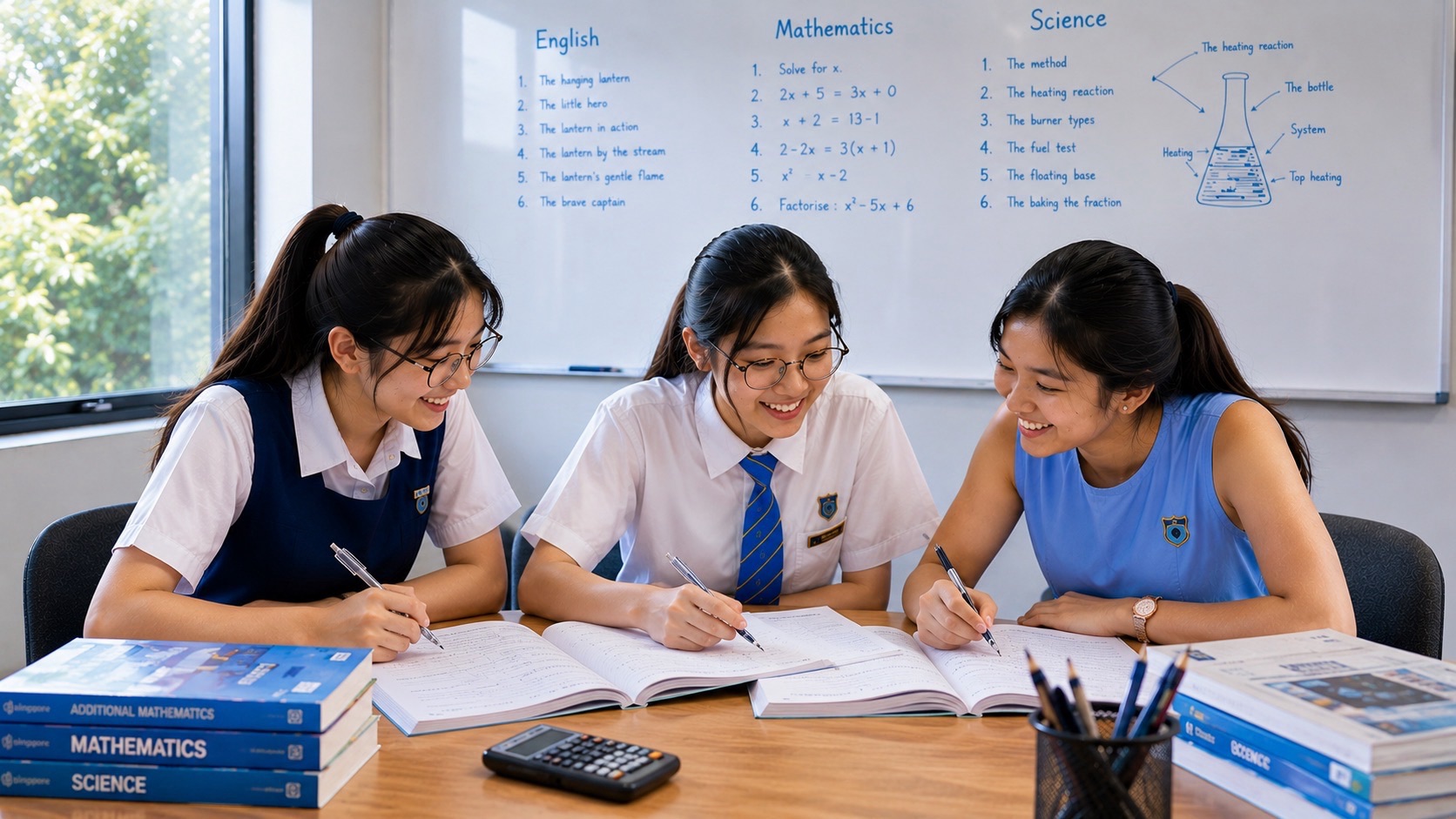
Surviving tuition in MacPherson is not about teaching a child to tolerate a permanently crowded week.
It is about building a week that remains usable.
MacPherson sits at a useful intersection of the Circle and Downtown Lines. For families in the area, this makes many schools, enrichment routes and tuition locations accessible. It also creates a familiar Singapore problem: because movement is possible, the timetable can keep expanding.
A student can move from school to CCA, from CCA to tuition, from tuition to dinner, and from dinner to homework without ever having a true reset.
That may look productive.
It may actually be a fragile system operating without margin.
At eduKateSG, our premium 3-pax small-group tutorials are designed around a different principle. Tuition should reduce confusion, repair weak foundations, improve accuracy and make schoolwork easier to manage. It should not simply add more volume to the student’s day.
For MacPherson families, surviving tuition begins by asking a simple question:
Is the lesson making the rest of the week better?
MacPherson Is Connected, So the Real Risk Is Over-Scheduling
MacPherson’s transport connections make it easy to think in terms of reach.
A parent can reasonably consider lessons in several parts of Singapore.
That is useful.
But a good transport map can hide the true cost of movement.
A student does not experience a journey as a line on a map.
The student experiences:
- walking;
- waiting;
- transfers;
- heat or rain;
- carrying a school bag;
- hunger;
- mental fatigue;
- uncertainty over timing; and
- whatever schoolwork remains after the lesson.
This matters because tuition takes place inside the student’s whole day.
A ninety-minute class may occupy three hours once travel and meals are included.
That can still be a strong decision.
But only when the teaching return justifies the full cost.
The First Question Is Not “How Much Tuition?”
The first question is:
What problem are we trying to solve?
A student may need tuition because:
- a core foundation is weak;
- school pace is too fast;
- the student understands in class but forgets later;
- mistakes repeat;
- examination technique is poor;
- written answers are imprecise;
- homework takes far too long;
- the student needs more challenge; or
- confidence has dropped after repeated poor results.
These are different problems.
They should not receive the same solution.
A student who needs repair may require slower, more diagnostic teaching.
A strong student may need deeper applications rather than more repetition.
A student who is overloaded may not need another class at all.
The purpose of tuition must be visible.
Surviving Tuition Means Managing Total Load
Students do not experience school, tuition and homework as separate systems.
It all arrives inside one brain and one week.
A realistic weekly load includes:
- school hours;
- CCA;
- school consultations;
- project work;
- travel;
- meals;
- tuition;
- tuition continuation work;
- school homework;
- revision;
- family commitments; and
- sleep.
Each item may be reasonable alone.
The problem appears when too many reasonable things are stacked together.
That is how students end up finishing homework near midnight while adults wonder why motivation is falling.
The issue may not be motivation.
The system may simply be too full.
The Hidden Cost of Switching
MacPherson students often move between different settings during the day.
School.
Train.
Bus.
Mall.
Home.
Tuition.
Library.
Each movement requires a switch.
The student has to stop one task, move, reorient and begin another.
This switching cost is small each time.
Across a week, it becomes significant.
That is why a simple routine can be so powerful.
A stable routine answers questions before they consume attention.
Where do I go?
What do I bring?
When do I eat?
What happens after class?
When will I finish the continuation work?
Predictability protects cognitive energy.
Tuition Should Give Time Back
Good tuition is not only about what happens during the lesson.
It is about what becomes easier afterwards.
A student may spend ninety minutes learning one difficult Mathematics concept.
If that understanding reduces three hours of confused homework later, the tuition has created time.
A student may spend one lesson repairing English comprehension habits.
If future school papers become easier to analyse, the tuition has created time.
A student may learn how to organise Science explanations clearly.
If fewer corrections are needed later, the tuition has created time.
This is the best measure of efficiency.
The lesson should reduce future friction.
Why 3-Pax Small-Group Tuition Can Be Sustainable
A class of three creates enough space for the tutor to see how the student thinks.
That matters because the final answer is only the surface.
A Mathematics error may come from:
- weak number sense;
- poor algebra;
- a sign error;
- misreading;
- the wrong method;
- weak checking; or
- panic under time pressure.
An English weakness may come from:
- poor vocabulary;
- weak sentence control;
- shallow planning;
- poor comprehension;
- unclear argument; or
- insufficient evidence.
A Science response may fail because:
- the concept is wrong;
- the keyword is missing;
- the explanation is incomplete; or
- the student does not connect cause and effect.
The faster the true failure point is identified, the less random practice is needed.
That is one of the main reasons small-group tuition can reduce workload instead of increasing it.
A 90-Minute Lesson Should Have a Clear Shape
A useful tuition lesson should feel complete.
Retrieve
Bring earlier knowledge back without immediate support.
Diagnose
Check recent schoolwork and identify repeating problems.
Teach
Explain the core idea clearly.
Practise
Apply the idea with guidance.
Transfer
Use the learning in a less familiar question.
Correct
Identify why errors occurred.
Continue
Leave with a focused next step.
The lesson should not end with a vague sense that “more work” is required.
The student should know exactly what has improved and what remains to be done.
Tuition Homework Must Be Small Enough to Be Done Properly
One of the easiest ways to break a student’s week is to give too much continuation work.
Tuition homework should not exist merely because tuition took place.
It should have a job.
The work may be used to:
- retrieve a method after a delay;
- stabilise one weak skill;
- correct a repeated error;
- practise a short timed section;
- prepare for the next school topic;
- revise one earlier chapter; or
- prove independent understanding.
The quantity should match the objective.
A student who needs ten good questions does not benefit from fifty.
Focused work is often more rigorous because every question has a reason.
Primary Students Need Protection From Adult Timetables
Primary students often follow the schedules adults create for them.
They may not know how to say that the week is too full.
Overload may appear as:
- irritability;
- slow homework;
- careless mistakes;
- forgetfulness;
- resistance to starting;
- tears over simple tasks;
- reduced reading;
- constant tiredness; or
- dependence on adults.
These signs do not automatically mean tuition should stop.
They mean the system should be examined.
Is the child sleeping enough?
Are several classes duplicating one another?
Is travel consuming too much of the afternoon?
Is every weekend booked?
Is there still space for play, conversation and curiosity?
Primary tuition should strengthen childhood learning.
It should not consume childhood.
Secondary Students Need to Become More Independent
Secondary students face a different challenge.
The workload becomes fragmented.
Different teachers set different tasks.
CCA becomes more demanding.
Assessments cluster.
The student is expected to manage more independently.
Tuition should therefore build self-management.
A Secondary student should gradually be able to answer:
- What is due this week?
- Which subject needs attention first?
- What should I bring to tuition?
- Which mistake keeps repeating?
- When is the next test?
- Which evening is overloaded?
- What work can I move earlier?
This is not administrative trivia.
It is part of academic performance.
MacPherson to Bukit Timah: Route Simplicity Still Needs Time
For families travelling from MacPherson toward eduKateSG’s Bukit Timah location near Sixth Avenue MRT, the Downtown Line offers a direct rail connection toward Sixth Avenue.
That makes the route simple.
Simple does not mean free.
The student still spends time walking, waiting, travelling and returning.
The journey should therefore be evaluated inside the full school day.
A direct line can make a longer journey more predictable.
That predictability helps.
But a lesson should still be placed on a day with enough margin for the student to arrive mentally available.
Meals Matter More Than They Look
A student who arrives hungry learns differently.
A student who eats too late may sleep too late.
A student who rushes through dinner every tuition day starts to associate the class with stress.
Meals are therefore part of the learning system.
Families should decide in advance:
when the student will eat;
what is realistic;
whether a snack is enough before class;
and whether the main meal should happen before or after.
A small amount of planning prevents repeated chaos.
Choose the Tuition Day by Energy, Not Only Availability
The earliest available slot is not always the best slot.
A good tuition day may have:
- normal school dismissal;
- no heavy CCA;
- enough travel margin;
- a meal window;
- no major deadline the next morning; and
- enough recovery afterwards.
A less convenient clock time on a better day may produce more learning than a perfect time on an overloaded day.
The student’s energy pattern matters.
Examination Periods Need a Different Mode
When examinations approach, the student’s priorities change.
Tuition should change with them.
Useful examination work may include:
- mixed-topic retrieval;
- timed sections;
- paper analysis;
- repeated-error repair;
- question selection;
- answer planning;
- checking routines;
- formula recall;
- vocabulary precision; and
- confidence under time pressure.
The aim is not to produce the largest revision pile.
The aim is to convert knowledge into reliable performance.
Do Not React to a Bad Result With Random Volume
A poor test score is information.
Before increasing tuition, ask where the marks were lost.
Was the content unknown?
Was the student too slow?
Were the mistakes careless?
Was the question misread?
Was the method wrong?
Was the answer incomplete?
Did the student panic?
Different failures require different repairs.
A good tutor helps turn the paper into a diagnosis.
That is far more useful than simply assigning another stack of worksheets.
Warning Signs That the Tuition System Is Breaking
Review the system if several of these appear repeatedly:
- sleep is consistently too late;
- the student is always rushing;
- school homework is displaced;
- tuition work accumulates;
- meals become irregular;
- repeated mistakes remain unchanged;
- the student cannot explain what was learned;
- weekends become catch-up marathons;
- marks stay unstable despite more hours; or
- the student has no recovery space.
The answer may be less tuition.
It may also be better tuition.
It may be a different day.
It may be less duplicated homework.
It may be one intensive repair period followed by maintenance.
Diagnosis comes first.
Signs That Tuition Is Working
A healthy tuition system produces more than marks.
Parents may notice that the student:
- starts work with less resistance;
- completes routine homework faster;
- remembers older topics;
- asks better questions;
- makes fewer repeated errors;
- checks work more automatically;
- becomes more independent;
- prepares earlier for tests; and
- recovers more calmly after a poor result.
These operating improvements matter because they reduce future load.
The student becomes easier to teach because the student is becoming better at learning.
What Parents Can Do
Parents do not need to become subject tutors.
A more valuable role is to protect the architecture.
That means:
- keeping the weekly timetable visible;
- preventing avoidable over-stacking;
- monitoring sleep;
- planning meals and travel;
- sharing assessment dates;
- bringing recent schoolwork to consultations;
- asking what problem tuition is currently solving; and
- reviewing whether the arrangement still makes sense.
This keeps the parent at the correct level.
What Students Can Do
Students can reduce tuition stress through simple habits.
Bring the correct materials.
Mark difficult school questions.
Keep an error list.
Know the next assessment date.
Complete corrections before the next lesson.
Tell the tutor when school load changes.
Do not hide confusion.
Ask early.
These habits reduce mental clutter.
They also build independence.
Class Details at eduKateSG
Format: Premium 3-pax small-group tutorials
Duration: About 1.5 hours weekly
Teaching may include:
- first-principles explanation;
- foundation diagnosis;
- guided practice;
- independent application;
- retrieval;
- interleaving;
- error analysis;
- school-assessment alignment; and
- carefully paced pre-teaching.
Materials may include:
- lesson notes;
- selected practice;
- mixed revision;
- assessment-style questions;
- diagnostic checks;
- correction work; and
- focused continuation tasks.
The aim is to make every lesson useful enough to justify the time it occupies.
What to Bring to a Tuition Consultation
Bring evidence.
Useful materials include:
- recent test papers;
- marked homework;
- teacher comments;
- school worksheets;
- current topic sequences;
- repeated difficult questions;
- upcoming assessment dates; and
- the weekly timetable.
The academic evidence shows what needs repair.
The timetable shows how the repair can fit.
Both matter.
Frequently Asked Questions
Is MacPherson convenient for tuition travel?
Its Circle and Downtown Line connections make many routes practical. Families should still calculate the full door-to-door journey.
Is direct MRT travel always easy for students?
It reduces transfer complexity, but the total day still matters. A direct journey after a late CCA can still be tiring.
Should tuition be reduced if a student is tired?
Not automatically. First identify whether the problem is lesson quality, timing, travel, homework volume, sleep or the number of commitments.
Is more homework from tuition better?
Only when it creates more learning. Focused continuation work is often more valuable than large quantities of routine practice.
What if the child needs help in several subjects?
Prioritise the biggest academic bottlenecks first. Solving two important problems properly may be better than spreading the week across many weakly targeted classes.
Can travel time be used for rest?
Yes. Rest can be the best use of travel when the student needs recovery.
What should happen after a bad test?
Analyse the paper, identify the dominant failure pattern, repair it and test again.
What is the long-term goal of tuition?
The student should become more capable, more independent and less dependent on emergency rescue.
Surviving Tuition in MacPherson Means Building Margin
MacPherson makes movement easy.
The challenge is not to confuse movement with progress.
A strong tuition system gives every lesson a reason.
It protects meals.
It counts travel honestly.
It uses small-group teaching to reduce wasted practice.
It gives continuation work that can actually be completed.
It protects sleep.
And it leaves enough margin for the student to remain curious, alert and capable.
The student should not become better at surviving an overloaded week.
The week should become better designed.
That is when tuition becomes sustainable.
And that is when survival becomes control.