
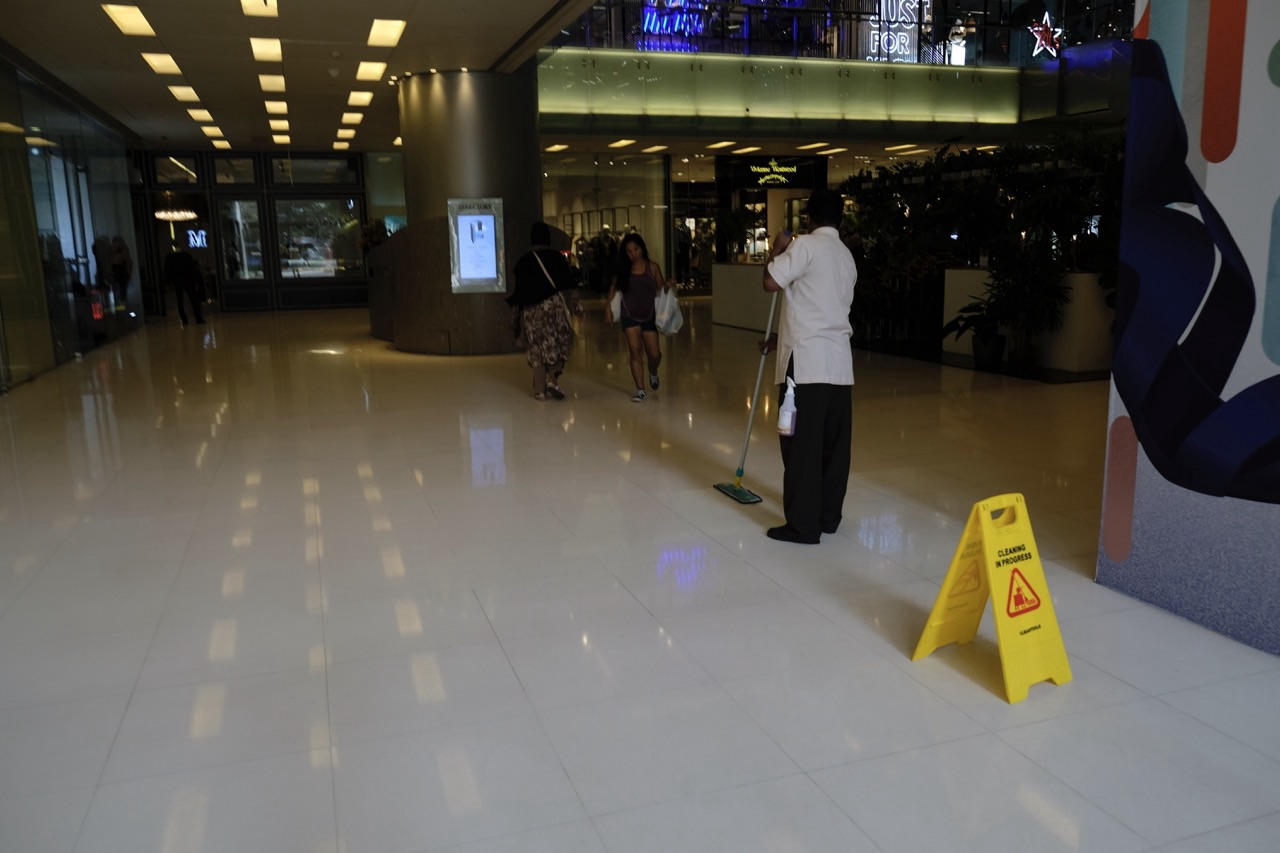
A cleaning company earns trust when the agreed spaces are genuinely clean, workers are protected and paid lawfully, and the client can verify what was done. A completed shift roster, a photo of a polished floor or a low tender price cannot prove that hygiene needs were met across a building or that staff had the training and time required to do the work.
This article follows BrightSquare Facilities Care, a completely fictional Singapore cleaning contractor engaged to maintain the common areas of a condominium. Its client complains about recurring wet floors near an entrance on rainy days, even though the digital task schedule is fully green. Meanwhile, a new contract bid assumes one employee can cover two distant buildings with no realistic transition time. The company must distinguish performed tasks from actual conditions, review safety, staffing, pay and management evidence, and keep residents informed without making unsupported hygiene guarantees.
The Gold Standard master hub explains excellence through accountable systems. Cleaning Services discusses individual cleaning outcomes; Property Management Companies examines the building owner’s duties; and Waste Management Companies addresses collection and disposal. This article focuses on the cleaning company that prices, licenses, staffs, supervises and verifies responsible service.
Find the cleaning-company decision you need
Follow a fictional condominium cleaning contractor from NEA licensing and worker training to honest site reporting, staff safety, fair pay and verified resident outcomes.
Chapter index
Licence, job categories and fair employment · Chapters 1–7
- Define exactly which cleaning business is being offered
- Know when the NEA Cleaning Business Licence is mandatory
- Choose the correct licence class and renewal plan
- Budget the actual licensing and corporate capacity requirements
- Use licence training requirements as an operating capability
- Distinguish future training changes from requirements already in force
- Pay cleaners according to the correct Progressive Wage Model category
Safe sites, truthful checklists and proper materials · Chapters 8–12
Supervision, privacy and responsible contractor handover · Chapters 13–16
Client accountability, finances and actual cleanliness · Chapters 17–20
1. Define exactly which cleaning business is being offered
Cleaning operations can cover office premises, food courts, condominium common areas, public places, hospitals or special industrial tasks. The actual activities, hazards, equipment and regulator requirements differ. A company should not use one generic brochure to imply it is qualified to carry out every specialised form of cleaning.
BrightSquare is engaged for a condominium’s common areas, not private domestic bedrooms or medical-grade specialist procedures. Its offer identifies ordinary cleaning, access arrangements, timing, the client’s responsibilities and tasks needing separate qualified vendors. When a client asks for work outside the contract, management should assess it rather than instruct staff to improvise.
Back to chapter index · Next chapter
2. Know when the NEA Cleaning Business Licence is mandatory
Singapore businesses offering general cleaning services at premises or public places normally require a Cleaning Business Licence under the Environmental Public Health Act. Certain excluded cleaning work—such as solely domestic-premises cleaning, façade cleaning or swimming-pool cleaning—can fall outside this general licensing regime. Companies must check the actual scope.
NEA’s Cleaning Business Licence guidance explains the distinction. A contractor cleaning condominium common property, like BrightSquare, should not claim it is merely a domestic cleaner to avoid the applicable licence. Businesses subcontracting their cleaning work to licensed companies also generally need their own cleaning business licence under the defined regime.
Back to chapter index · Next chapter
3. Choose the correct licence class and renewal plan
Singapore’s enhanced licensing framework, introduced on 1 January 2024, provides Class 1, Class 2 and Class 3 Cleaning Business Licences. These are not merely marketing ranks: eligibility, competency requirements and permitted renewals differ. A business that starts with Class 3 cannot assume that class will renew forever.
NEA states that Class 3 is for eligible new cleaning businesses and is non-renewable; before or upon expiry the firm must move to Class 2 or Class 1 if it continues. The classes each have a two-year duration under the current scheme, with qualifying and operational requirements. BrightSquare should document its actual class, expiry and ability to meet the next class rather than promise customers that licensing remains indefinitely unchanged.
Back to chapter index · Next chapter
4. Budget the actual licensing and corporate capacity requirements
A company must have the organisational competence and financial capacity appropriate to the licence sought. From 1 April 2026, NEA raised the Cleaning Business Licence application fee to S$180. Other conditions include specified paid-up capital for Class 1 and Class 2, while Class 3 has different entry arrangements.
NEA’s current licensing FAQ explains the fee change and framework. BrightSquare does not treat payment of S$180 as sufficient by itself; approval remains subject to licence requirements and supporting evidence. Directors should plan training, capital and renewal before signing multiyear cleaning contracts.
Back to chapter index · Next chapter
5. Use licence training requirements as an operating capability
Workers may need training in general cleaning, specific job tasks and workplace safety suited to their assigned work. A firm that hires new staff faster than it can train them risks inconsistent outcomes and workplace injury. The requirements differ by licence class and employee circumstances.
NEA’s enhanced training guidance sets the current baseline as one WSH and one Core module for Class 2 and Class 3, with an additional Core module for Class 1, subject to stated application details and exceptions. BrightSquare keeps real training records by role and does not send an unprepared worker to operate unfamiliar equipment purely because the team is short-staffed.
Back to chapter index · Next chapter
6. Distinguish future training changes from requirements already in force
Regulatory and training schemes evolve. Businesses should prepare for announced future changes without advertising them as rules that already apply. Employees deserve accurate guidance about which course they need now and what extra training may be required in later years.
NEA states that an additional mandatory Baseline Core Module will take effect on 1 July 2029 for covered cleaning roles, with level depending on duties. At this article’s 2026 date, that future requirement is not yet an additional current mandate. BrightSquare may plan upskilling early while meeting all the training already required for its actual licence class.
Back to chapter index · Next chapter
7. Pay cleaners according to the correct Progressive Wage Model category
Singapore’s cleaning-sector Progressive Wage Model covers relevant cleaning employees who are citizens or permanent residents, with duties for licensed cleaning businesses and relevant in-house employers. Different categories apply to office/commercial, food and beverage and conservancy work, along with job ranks and part-time arrangements.
MOM’s current cleaning PWM page sets the basic monthly minimum for a full-time outsourced Group 1 General Cleaner in the defined 35–44-hour category at S$2,080 from 1 July 2026 to 30 June 2027. Other roles have different rates and eligible employees may qualify for a PWM Bonus of at least two weeks’ basic wage each year. BrightSquare should identify each employee’s actual category and conditions instead of treating one wage table entry as universal.
Back to chapter index · Next chapter
8. Protect workers’ safety as part of the commercial contract
Cleaning can involve wet floors, lifting, equipment, chemicals, access work and repetitive tasks. Workers need suitable training, actual risk controls and time to perform duties safely. The company must not bid for a service at a price that assumes people can avoid essential precautions.
BrightSquare’s recurring wet-floor problem includes risks to cleaners as well as visitors. The company asks qualified personnel to assess conditions and its own arrangements rather than invent a technique in a sales article. MOM’s WSH Risk Management guidance supports systematic identification and control of hazards. Staff must be able to raise a risky condition without being penalised for slowing a schedule.
Back to chapter index · Next chapter
9. Make site induction specific to each building
A cleaner assigned to a condominium, medical clinic or food court may face different surfaces, access restrictions and operating times. The company needs information about the actual site and legitimate client expectations. An employee’s general cleaning certificate cannot replace a useful handover to the premises being serviced.
BrightSquare’s site supervisor checks which areas are included, what work cannot occur during peak resident movement and who can authorise changes. The managing agent explains the access and incident contacts. A roster proving that a worker arrived is not evidence that the person understood the specific duties, materials or operational constraints.
Back to chapter index · Next chapter
10. Define what each checklist item means to the client
Cleaning checklists can show whether a task was acknowledged but not necessarily whether the intended result was achieved. A checkbox may represent arrival, cleaning performed, a visual inspection or verified acceptance. Companies should define these stages so staff and clients are not misled by an all-green dashboard.
BrightSquare’s floor-cleaning app shows completed tasks despite repeated complaints. Management compares the work history with observations at times when residents actually use the area. A good report distinguishes a crew visit from a professionally appropriate finding that the space meets the agreed condition. Unresolved recurring problems should remain visible until reviewed.
Back to chapter index · Next chapter
11. Match equipment and supplies to the premises
Cleaning machinery, detergents and tools need to be suitable for particular surfaces and tasks. Inappropriate products can damage flooring or create new risks. A company’s purchasing system must not allow a lower-cost substitution without competent consideration of the actual work.
BrightSquare’s supplier proposes a different product for its existing floor-care contract. The company reviews compatibility, worker safety, client specifications and the relevant product information. It does not simply ask employees to use more of the substitute to achieve the same appearance. The Chemical Companies guide explains why supplier descriptions and safety data matter beyond a product’s name.
Back to chapter index · Next chapter
12. Avoid making unsubstantiated disinfection guarantees
Cleanliness, disinfection, sterilisation and infection-control performance are not interchangeable promises. Different environments may require specified competent methods and validated systems. A general cleaning company cannot claim all spaces are ‘hospital sterile’ merely because an employee used a marketed disinfectant.
BrightSquare describes which tasks its contract actually covers and routes infection-control decisions beyond its competence to appropriate specialists and the client’s governing requirements. The firm should not publish a ‘99.9999% germ-free’ guarantee without defensible evidence for the actual premises, conditions and scope. Truthful service descriptions prevent customers from mistaking appearance for a health assurance.
Back to chapter index · Next chapter
13. Keep subcontractors and temporary workers inside company accountability
Cleaning companies may use subcontractors or manpower suppliers to meet peaks. Singapore’s licensing rules can cover firms subcontracting general cleaning or supplying cleaning manpower, and the main contractor still needs to manage its actual contractual obligations.
BrightSquare assesses the legal status, competence, training and supervision arrangements for each relevant supplier. It keeps clear records of who attended and what was done. An outsourced worker should not be asked to complete a specialised task without the right instructions and lawful protections. A contractor’s separate invoice cannot be used to make responsibility invisible when residents report repeat failures.
Back to chapter index · Next chapter
14. Give supervisors time to inspect the real service
Supervision matters because a route may appear complete while surfaces remain unsuitable, bins were missed or a building changed its use. Supervisors should have realistic capacity to review work, coach staff and investigate repeated issues rather than only collect timesheets.
BrightSquare reviews how its supervisors evaluate resident complaints and actual building conditions. A valid concern leads to evidence gathering, task adjustment and appropriate follow-up, not reflexive blame of the cleaner who worked the last shift. The company should distinguish employee competence from a schedule or resource problem imposed by management.
Back to chapter index · Next chapter
15. Make cleaning and waste responsibilities meet at a verified handover
Cleaning can involve litter collection, replacing liners or moving waste to a designated collection point, while lawful waste transport and downstream treatment may belong to another licensed company. The contract needs to identify when responsibility changes hands and what record proves the transfer.
BrightSquare confirms which waste tasks are within scope and who operates the actual disposal or collection system. Waste Management Companies addresses lawful custody and recovery. A room with empty bins does not prove material was recycled; the company should avoid claims that go beyond the part of the chain it can verify.
Back to chapter index · Next chapter
16. Protect resident and workplace privacy
Cleaners may encounter offices, residential common spaces, unattended belongings and other private information. Staff need clear boundaries, access permissions and a route to report an unexpected issue. Cleaning a site does not give a company unrestricted rights to photograph personal documents or enter excluded rooms.
BrightSquare trains employees to respect access rules and to handle legitimate incident reporting without unnecessary data collection. PDPC organisational guidance helps with personal data responsibilities when applicable. A cleaning company’s audit photographs should show the relevant task, not sensitive client records captured incidentally. A lawful cleaning appointment should not become a privacy incident.
Back to chapter index · Next chapter
17. Handle complaints through verifiable re-inspection
Building managers and residents may complain about slippery floors, persistent odours, missed areas or damaged surfaces. These issues need categorisation and meaningful inspection, not a universal voucher or scripted apology. The company should record what it was asked to fix and whether the actual situation changed.
BrightSquare’s repeated wet-floor case should be evaluated using suitable, competent site investigation. Management may find that the agreed task frequency, weather exposure or equipment choice requires revision. Any technical determination belongs to qualified people. Closing the support ticket is only appropriate when the company has recorded the relevant outcome and communicated what remains outside its scope.
Back to chapter index · Next chapter
18. Reconcile invoices to delivered and accepted scope
Clients may pay for scheduled hours, occupied area, defined tasks or result-based arrangements. Each has a different evidence requirement. A cleaning company should know whether missed visits, changed premises or accepted variations alter the invoice and who is authorised to approve such changes.
BrightSquare’s monthly invoice should connect to actual contracted service and the documented treatment of exceptions. It should not bill for an unstaffed shift as though fully delivered or silently add charges after a routine complaint. The Property Management Companies guide explains the MCST-side contract verification. Accurate commercial records make fair cooperation possible.
Back to chapter index · Next chapter
19. Measure verified clean areas rather than only shifts completed
Cleaning productivity may be tracked through tasks scheduled, tasks attempted, verified acceptance and exceptions requiring follow-up. A high number of check-ins cannot tell whether the space was usable. Both the client’s inspection process and the company’s own review should use understandable definitions.
Fictional arithmetic: of 100 site tasks due in a period, 92 are accepted on first review, five require rework and three are inaccessible under the approved scope. Initial verified acceptance is 92%, while 97 tasks have received work or rework action if the five were subsequently accepted. The three inaccessible areas should not silently count as completed; their actual outcome needs documented agreement.
Back to chapter index · Next chapter
20. The gold standard is clean results achieved by a sustainable workforce
BrightSquare’s all-green schedule masked recurring concerns and a staffing plan that ignored travel and handover time. It reviews its real site responsibilities, supervisor workload, working conditions, wage and training duties, then changes the task and verification design before bidding for another estate.
A gold-standard cleaning company holds the right licence, trains and pays workers correctly, uses safe and suitable methods, supports supervisors and delivers the agreed condition without overclaiming hygiene outcomes. It can tell clients what happened, what failed and how the next clean will improve. Dependability comes from people and evidence—not a checklist completed from memory.
Worked cleaning report: attendance is not acceptance
This is an invented service-management example, not a scientifically validated hygiene score or a cleaning-industry legal standard.
| Task state | Illustrative count | What the client can infer |
|---|---|---|
| Site tasks scheduled | 100 | Defined work within a period |
| Accepted on initial check | 92 | 92% first-review acceptance |
| Tasks requiring correction | 5 | Need actual rework and verification |
| Inaccessible under the authorised plan | 3 | Unresolved access, not quietly completed |
| Potentially verified after successful rework | 97 | Not 100 without agreed resolution of three remaining tasks |
Cleaning company and facilities-client checklist
- Does the actual work require an NEA Cleaning Business Licence, and is the correct Class 1/2/3 licence in force?
- If Class 3, has the company planned for the transition because that class cannot simply be renewed?
- Have cleaners received the training applicable to the current licence class and role?
- Are future 1 July 2029 Baseline Core Module requirements correctly distinguished from today’s obligations?
- Is the correct July 2026 Cleaning PWM wage and bonus paid where mandatory?
- Are workers able to report unsafe sites and unsuitable cleaning products?
- Does the company distinguish an attended task from verified accepted cleanliness?
- Can the client identify lawful waste and specialised cleaning handovers?
- Are privacy, subcontracting and invoices handled within the actual contract and law?
- Can supervisors and customers see what remains open after a complaint?
NEA, MOM and connected eduKate guidance
- NEA: Cleaning Business Licence — classes, exclusions, eligibility and scope
- NEA: Cleaning Business Licence FAQ — 2026 fee and licence changes
- NEA: Enhanced Training Requirements — current modules and future 2029 additional training
- MOM: Cleaning Sector Progressive Wage Model — wage and bonus schedules effective July 2026
- MOM: WSH Risk Management — worker hazard controls
- eduKate: Cleaning Services — individual service quality and handover
- eduKate: Property Management Companies — buyer-side maintenance and contracts
- eduKate: Waste Management Companies — waste custody and recovery
This educational company-management article is not a cleaning chemistry procedure, risk assessment for any particular site, germ-removal certification or confirmation of a real company’s licence. BrightSquare and the task figures are fictional. Actual cleaning, worker-safety and legal duties need to be determined for the precise business, location and activity.