
A timber’s last dated ring can be exact while its felling date remains a range. The missing information often lies at the outside of the wood: how much sapwood survives, whether the heartwood–sapwood boundary is identified, and whether the original growing edge remains.
This guide shows how those observations become conditional date bounds. It works through an invented two-timber comparison, tests a change in the assumed sapwood population, and separates a felling estimate from a construction date. All dates and sapwood ranges in the exercises are fictional teaching assumptions.
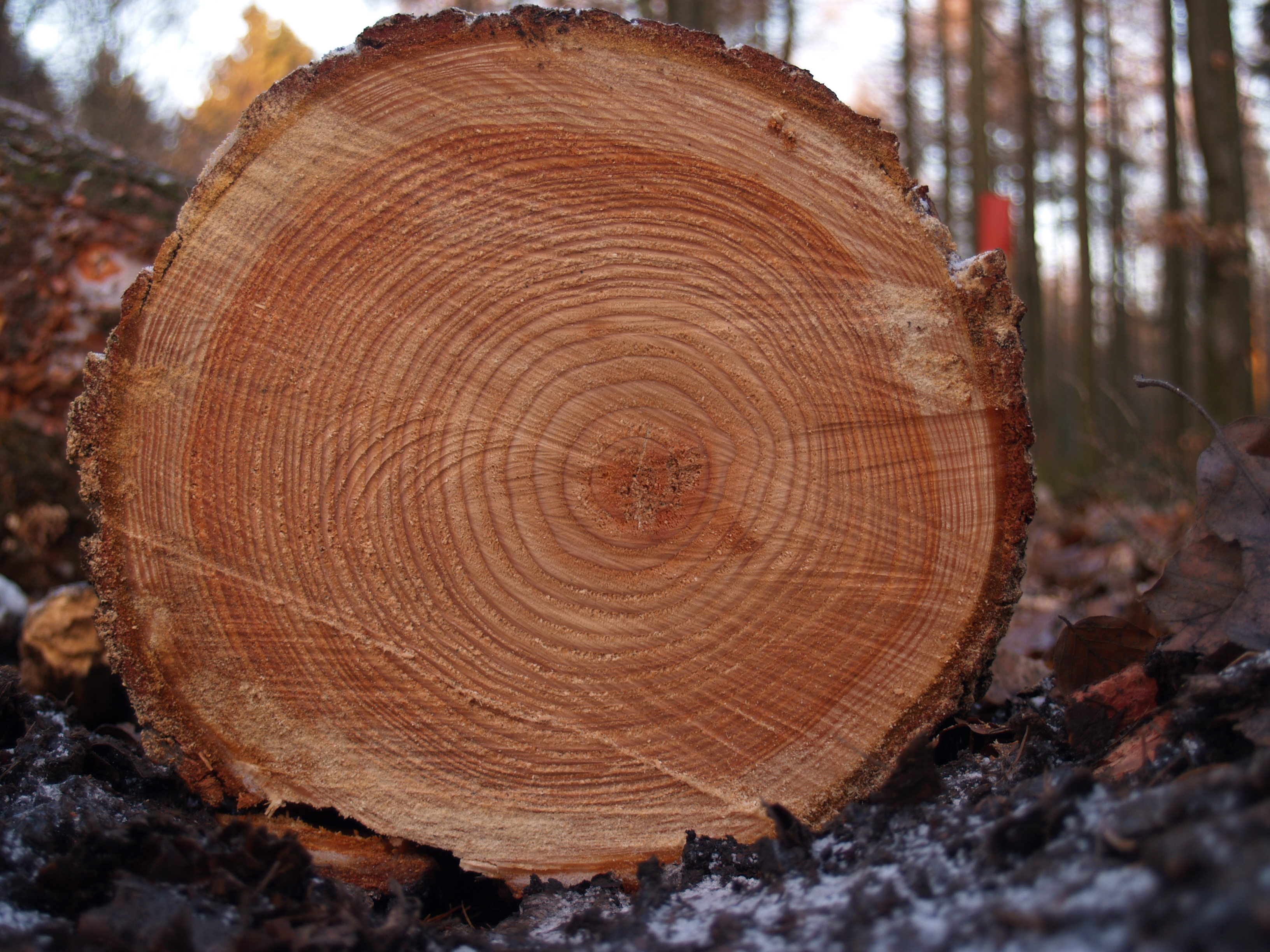
Featured image: tree-trunk cross-section photographed by Arnoldius, CC BY-SA 2.5, unmodified. It illustrates growth rings; it is not a dated specimen from these exercises.

eduKateSG · The Gold Standard of Dendrochronology
Choose your reading route
Identify the preserved edge · Chapters 1–2. Build the quantities before using a formula.
Build and challenge a date range · Chapters 3–5. Follow original examples, assumptions and changed conditions.
Audit the historical claim · Chapters 6–8. Test transfer, answer common questions and follow connected reading.
Full chapter index · Practice and evidence checks · Return to Dendrochronology
Chapter index
Identify the preserved edge · Chapters 1–2
Build and challenge a date range · Chapters 3–5
Audit the historical claim · Chapters 6–8
CHAPTER 1 OF 8 · Identify the preserved edge
1. Identify which edge the sample preserves
Start at the outside, because the question is when growth ended. A crossdated ring sequence assigns calendar years to preserved growth. It does not restore tissue removed by shaping, weathering or decay.
The heartwood–sapwood boundary separates inner heartwood from outer sapwood where that distinction can be reliably recognised. Sapwood forms the outer band of wood involved in transport in the living tree. The number of sapwood rings varies; it is not one universal constant.
The original outer growth edge, sometimes described as bark edge or waney edge in a timber report, can provide much stronger evidence about the last growth than an arbitrary cut face. Identification must be anatomical and contextual, not simply an assumption that the last visible line is the last ring the tree formed.
Keep pith and outer edge separate. Missing the centre affects a tree-age estimate. Missing the outside affects the interval between the latest preserved ring and the end of growth. A specimen can preserve one and lack the other.
The Historic England dendrochronology guidelines distinguish complete sapwood, incomplete sapwood and heartwood-only results. Their examples also show why a regional sapwood estimate must be justified for the timber being studied.
CHAPTER 2 OF 8 · Identify the preserved edge
2. Write the dates and ring counts as different quantities
Use a precise counting convention. Let H be the calendar year of the last heartwood ring immediately before the first sapwood ring. Let s be the number of consecutive preserved sapwood rings after H. Then the last preserved ring has year L = H + s, assuming the sequence is correctly crossdated and continuous.
Let S be the total number of sapwood rings originally present through the final growth ring. Under this convention, the final growth-ring year is H + S. The number of missing outer sapwood rings is S − s.
These relationships are bookkeeping, not an empirical sapwood model. They become a date estimate only after a suitable model supplies plausible values for S.
For the exercises, suppose an applicable reference population is represented by an invented range of 18–32 total sapwood rings. We treat that range as an allowed set within the exercise. It is not a published range for any species or region, and no confidence percentage is assigned to it.
Keep the season convention visible
The arithmetic identifies the final growth-ring year. Real felling reports may refine or qualify this using the state of the outer ring and local growth season. A completed ring can be followed by a dormant period spanning calendar years. Do not infer an exact cutting day, month or civil-calendar year from the arithmetic alone.
The worked ranges below are therefore simplified annual felling estimates under an assumed annual reporting convention, conditional on felling following the final recorded growth without an unrecognised dead-standing interval.
CHAPTER 3 OF 8 · Build and challenge a date range
3. Calculate a range without counting preserved sapwood twice
Timber A has H = 1590 and six preserved sapwood rings. Its latest preserved ring is therefore L = 1596. The outer growth edge is missing.
Under the exercise’s total-sapwood range S = 18–32, the missing sapwood count is 18 − 6 to 32 − 6, or 12–26 rings. Add that missing interval to the last preserved year:
1596 + 12 = 1608; 1596 + 26 = 1622.
The conditional range is 1608–1622. The same result follows directly from H + S: 1590 + 18 through 1590 + 32.
| Quantity for Timber A | Value | Role |
|---|---|---|
| Last heartwood ring H | 1590 | Starting year before the sapwood sequence |
| Preserved sapwood count s | 6 | Observed surviving outer rings |
| Latest preserved year L | 1596 | H + s |
| Assumed total sapwood count S | 18–32 | External model input for the exercise |
| Missing sapwood count S − s | 12–26 | Unobserved outer interval |
| Conditional final-ring range | 1608–1622 | L + missing rings, or H + total rings |
A common mistake is adding all 18–32 rings to L = 1596. That gives 1614–1628 and counts the six preserved sapwood rings twice. To avoid it, label every count “total,” “preserved” or “missing” before adding it to a date.
The two-route check is useful beyond tree rings. If two equivalent accounts disagree, look for an interval that has been omitted or included twice.
CHAPTER 4 OF 8 · Build and challenge a date range
4. Change the boundary evidence and the conclusion changes
Now consider Timber C, whose last preserved heartwood ring is dated 1590. The heartwood–sapwood boundary is not identified. Additional outer heartwood may be missing as well as all the sapwood.
It would be unjustified to assign C the same upper date as Timber A. In the teaching model, at least 18 sapwood rings would follow the eventual boundary, so a lower bound of 1608 follows if the minimum applies. But an unknown number of additional heartwood rings could push the final date much later. The calculation supplies no finite upper bound.
This is a conditional terminus post quem: a lower chronological limit under stated assumptions. It is not a narrow date range with its upper end left off for convenience.
The preserved count can constrain the model
Suppose Timber D preserves 25 sapwood rings and examination establishes that at least one further annual ring has been removed. The exercise’s allowed total of 18–32 must be narrowed to 26–32. Values below 26 contradict the observed preservation condition.
If the same sample instead preserves 35 sapwood rings, the assumed range of 18–32 is incompatible with the observations. Do not force the data into the range. Check anatomy, counts, provenance and the applicability of the model.
A population range is not a guarantee
Real sapwood models may describe distributions rather than hard limits. Their interpretation depends on the species, source population, tree characteristics and statistical method. An observed value beyond a reported interval need not be biologically impossible. The hard-bound exercises here are deliberately simpler than that statistical problem.
CHAPTER 5 OF 8 · Build and challenge a date range
5. Combine timbers only after justifying a shared event
Timber B has H = 1598 and four preserved sapwood rings. Under the same invented total-sapwood range, its conditional final-ring range is 1616–1630. Timber A’s range is 1608–1622.
If independent contextual evidence supports the hypothesis that A and B were felled in the same year, that common year must lie in the overlap: 1616–1622.
| Sample | Individual conditional range | Consequence under a shared-year hypothesis |
|---|---|---|
| A | 1608–1622 | Common year must not be later than 1622 |
| B | 1616–1630 | Common year must not be earlier than 1616 |
| A and B together | 1616–1622 | Intersection, conditional on the shared-year hypothesis |
Being in the same roof is not enough to establish the shared-year hypothesis. Repairs, storage, reuse and timber obtained in separate episodes can place differently aged wood in one structure. Joinery, building phases, records and other dated timbers help assess the relationship.
If a third timber’s conditional range were 1640–1652, the three intervals would have no common year. That is a signal to revisit the assumptions. It does not prove which timber is wrong. The shared event, the sapwood model, the anatomical assessment or the calendar assignment may need investigation.
Do not average incompatible ranges to manufacture agreement. Nor should two individual 95% intervals be intersected and casually labelled a new 95% interval. Probability coverage and dependence require a statistical model; the simple set operation does not supply one.
CHAPTER 6 OF 8 · Audit the historical claim
6. Audit the historical claim and test a changed context
A useful report separates observations, calendar assignments, model inputs and historical interpretation. The Archaeology Data Service guide to dendrochronological data and metadata identifies the importance of species, sapwood counts, bark information and dates for interpretation.
For Timber A, preserve the raw series and crossdating evidence; record H = 1590 and six observed sapwood rings; explain the status of the outer edge; identify the source and applicability of any real sapwood model; then report the resulting conditional range. Record unmeasured but recognised rings separately so that measuring difficulties do not silently remove calendar years.
Transfer one: a different source population
Suppose independent provenance evidence makes a different invented model appropriate: S = 24–46. Keeping A’s measured wood unchanged gives a new range of 1614–1636. The sample did not acquire new rings. The inference changed because the assumed population changed.
If provenance remains unresolved, do not select the model that best fits a preferred building date. Report the alternative scenarios and the evidence needed to distinguish them. This exercise uses hypothetical populations; real estimates require specialist justification.
Transfer two: a dated repair
A document places a repair in 1660, while A’s conditional felling estimate remains 1608–1622. Does that contradiction invalidate the rings? Not necessarily. The timber could have been stored or reused, or could belong to an earlier phase retained during the repair. Investigate its role rather than equating growth and installation.
Transfer three: missing pith
A core misses the pith but preserves a securely dated original outer growth edge. Does missing the pith automatically destroy the final-ring date? No. It limits the age-from-centre estimate, while the outer-edge evidence can still support the final-growth interpretation. The missing part must be connected to the particular question.
CHAPTER 7 OF 8 · Audit the historical claim
7. Questions about sapwood and felling dates
Can a perfectly crossdated sequence still yield only a lower bound?
Yes. Calendar assignment and outer-ring preservation are different sources of information. Excellent dating of surviving heartwood does not reveal how much outer material was removed.
Does six preserved sapwood rings mean six missing years?
No. Six is the observed count. Missing rings are estimated from an appropriate total-sapwood model minus the preserved count, with preservation constraints applied.
Can one country’s sapwood range be copied to imported timber?
Not automatically. The relevant population concerns the tree’s origin and characteristics, which may differ from the location where the timber was found or used.
Does a felling estimate date construction?
It constrains a timber’s history. Construction requires contextual evidence linking that timber to a building episode and accounting for possible storage, repair and reuse.
Is the photograph enough to identify all these boundaries?
No. It illustrates rings, but this guide makes no anatomical or calendar claim about that photographed tree. Professional assessment needs suitable material, records and expertise.
Should students take new cores to practise?
The calculations can be practised with supplied records and photographs. Sampling historical objects or living trees requires appropriate expertise and permission; it is unnecessary for these paper exercises.
CHAPTER 8 OF 8 · Audit the historical claim
8. Continue from dated wood to a defensible history
Establish the chronology
- The Gold Standard of Dendrochronology connects ring formation, crossdating and interpretation.
- Teaching Dendrochronology provides the fuller crossdating and classroom evidence route.
- Tree rings and past-climate evidence distinguishes calendar evidence from environmental interpretation.
Interpret the object and its context
- The Gold Standard of Dendrology develops tree biology and identification.
- The Gold Standard of Archaeology connects material evidence with historical claims.
- Teaching Radiocarbon Dating offers a different dating method whose ranges and contexts must also be interpreted carefully.
Practise the transferable distinction
The Gold Standard of Education develops learning that survives a change of context. How X Works connects this subject to the wider explanatory library.
Historic England’s guidelines, the Archaeology Data Service documentation and the image’s source and licence were checked on 22 October 2026. They support the preservation, reporting and attribution distinctions. All dates, sapwood bounds and timber comparisons in this article are invented teaching cases. A real felling estimate must identify its applicable empirical model and uncertainty.