
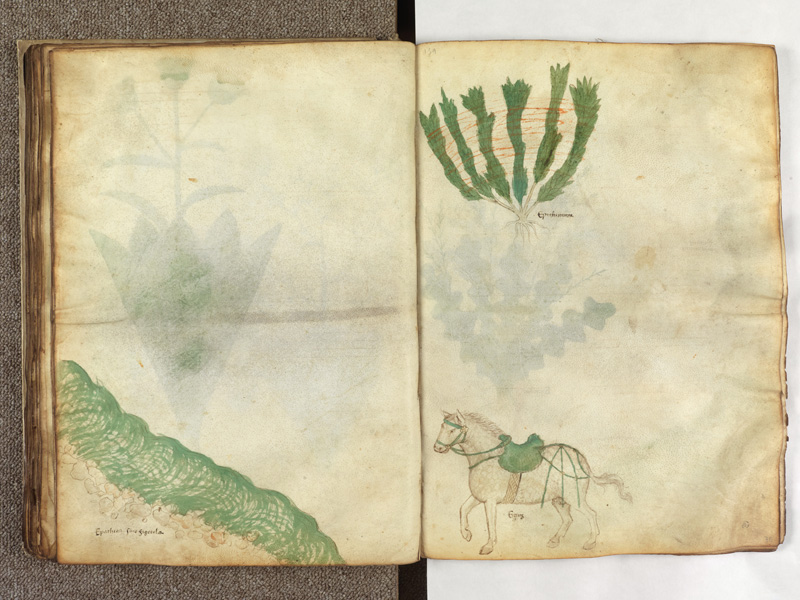
A manuscript book is a physical structure, not only a sequence of words on a screen. Folios, bifolia, gatherings, page layout, materials, marginal marks, bindings and provenance all help reconstruct how a manuscript was made and used. The Gold Standard of Teaching Manuscript Studies joins these forms of evidence without pretending a digitised image preserves everything about the original.
Our central classroom case is two nested paper bifolia, producing four leaves and eight writing sides. When the inner bifolium is removed, the model loses two leaves and four sides. The construction is invented and uses ordinary modern paper; it is not a reconstruction of the featured historical botanical manuscript. Students learn to reason about missing and added leaves before attempting to interpret real collation records.
The Schoenberg Institute’s manuscript course, VisColl’s structure visualisations and detailed British Library manuscript descriptions provide scholarly context. This article continues the eduKate Gold Standard of explicit methods, worked examples, independent reasoning and responsible material care.
Find the manuscript question
Read from the physical book to a transparent collation reconstruction, or jump to the material evidence your students need to understand.
Chapter index
Read the object and its units · Chapters 1–4
Reconstruct pages, hands and histories · Chapters 5–10
- Read quire structure without imposing one ideal pattern
- Distinguish foliation from pagination and later numbering
- Use ruling, pricking and page layout as production evidence
- Recognise multiple hands without claiming identities
- Teach decoration and marginalia as layers of use
- Investigate binding without proposing repairs
Provenance and missing structure · Chapters 11–12
Digital access, cultures and transfer · Chapters 13–16
1. Begin by looking at the book, not just the text
A student opens a digital facsimile of a historic manuscript and reads the caption as though the screen were simply an old edition of a modern paperback. The page has writing, perhaps an illustration, and a number in a corner. A Manuscript Studies teacher asks another question: how was this book made, which leaves belong together, how were they written and assembled, what changed in later centuries, and which of those physical relationships does the digital screen hide?
Our fictional classroom manuscript is a tiny gathering made from two folded sheets nested together. We will use paper surrogates to investigate its structure, not handle an actual historic manuscript. The teaching target differs from Paleography, which focuses on reading historic handwriting. Manuscript Studies includes codicology—the physical structure of manuscript books—as well as textual, artistic, historical and provenance questions. The strongest lesson helps students connect physical evidence to the histories of production, use and preservation.
Back to chapter index · Next chapter
2. Distinguish manuscript, codex, leaf and page
A manuscript can refer broadly to writing made by hand, including records that are not bound books. A codex is a book form built from leaves, which may be gathered into sections. A leaf has two sides; a page refers to one side. These terms sound elementary but matter enormously when learners describe missing material or navigate archival references.
Build one folded paper bifolium and ask students to count: it contains two leaves, or four writing surfaces. If a catalogue gives ‘f. 3v’, that identifies the verso of the third leaf under the stated foliation, not a general ‘page three’. Teach common abbreviations such as f. for folio and r/v for recto and verso, while acknowledging that numbering, directionality and manuscript traditions vary. A learner who keeps those units distinct can follow a real catalogue without losing their place.
Back to chapter index · Next chapter
3. Compare paper and parchment without guessing from colour
Historical books may be made from parchment, paper or other substrates, and a manuscript can combine multiple materials. The yellowish tone of a photograph cannot by itself establish that a leaf is parchment. Parchment manufacture, paper fibres and subsequent storage can affect surface appearance, but lighting and digitisation alter what we see. A teacher should use accurately catalogued institutional images to explain material categories rather than invite confident guesses from a screen.
Students record what they can observe and what the catalogue documents. For a real example, the British Library record for Harley MS 1706 identifies it as a parchment codex and gives detailed structural information. That attribution comes from the cataloguing record, not an inference students should claim to make from a thumbnail. The standard is source-aware material description with properly bounded physical conclusions.
Back to chapter index · Next chapter
4. Teach bifolia through folding and nesting
A bifolium is a sheet folded to produce two conjugate leaves. When nested, bifolia can form a gathering or quire. In our invented model, two bifolia nested together yield four leaves and eight writing sides. The outer bifolium provides leaves one and four; the inner one provides leaves two and three. This relationship is not obvious when a digitised manuscript displays pages one after another without showing the fold.
Have students assemble an inert modern-paper model and mark conjugate pairs in a colour-coded drawing. When they remove the inner bifolium, the model loses two leaves and four writing sides, even though one outer bifolium still holds the structure together. Ask which surviving leaves were physically connected before the loss. This is a powerful codicological insight: a gap in a book may be inferred partly from physical construction, not only from what a sentence says.
Back to chapter index · Next chapter
5. Read quire structure without imposing one ideal pattern
Manuscript books can contain gatherings of different numbers of leaves, with added, cancelled or displaced sheets. The physical history may involve initial construction, use, repair and rebinding. A modern catalogue may express this in a collation formula that records surviving and missing leaves. Yet a neatly drawn diagram should not be mistaken for a photograph of every binding or a claim that all medieval manuscripts share the same format.
The VisColl collation project explains how models and diagrams help visualise quire and leaf structure beyond ordinary page-turning interfaces. Its work explicitly accounts for leaf status such as original, missing, added or replaced. Teach students to label assumptions in their own models. If the evidence does not show whether a leaf was lost or deliberately omitted, the correct description may remain tentative.
Back to chapter index · Next chapter
6. Distinguish foliation from pagination and later numbering
Foliation numbers leaves, while pagination numbers pages. Historic manuscript foliation might be original, later handwritten or modern institutional numbering; these schemes can coexist and even disagree. If a book was rebound or had leaves inserted, a surviving sequence may contain gaps, duplications or corrections. Students should not assume that an apparent number written in the margin is the date of manufacture or the original folio identifier.
Use a fictional sequence where an older pencil numbering omits a leaf and a later archivist supplies corrected foliation. Students make two columns and document which scheme they use when citing evidence. A precise reference like ‘folio 4 verso under the current catalogue numbering’ is preferable to ‘page four’ if the latter points to something else. Citation clarity is part of scholarly care: another researcher must know exactly which surface supports a reading.
Back to chapter index · Next chapter
7. Use ruling, pricking and page layout as production evidence
Manuscript makers often prepared writing surfaces with ruling and sometimes pricking to guide lines and columns. Text spaces, margins and decorative areas were planned in different ways according to period, place, function and resources. Visible ruled lines can help reveal how the page was organised, but their presence does not prove a particular author or date in isolation.
Teach a diagram exercise showing a writing space divided into two columns, with margins and illustrative guide marks. Pupils compare a closely packed account-book page with a manuscript designed for display reading. Ask why each layout suits its practical purpose. The British Library’s Harley MS 1706 catalogue includes ruling, column and line information, demonstrating that page structure belongs in a serious object description rather than being dismissed as decoration.
Back to chapter index · Next chapter
8. Recognise multiple hands without claiming identities
A manuscript may involve more than one scribe, or one scribe may write at different speeds or with different instruments. Differences in letter forms, ink, spacing and layout can suggest separate writing hands, but identifying the historical people behind them requires stronger evidence. Do not turn every visible variation into a new named writer.
Provide two properly attributed manuscript images or an invented pair of letterform samples. Ask students to describe which features differ and whether the variation is systematic. Then explain the distinction between saying ‘two distinguishable hands appear’ and ‘the second hand belongs to a particular person’. The first may be supported by comparative writing features; the second may require an ownership note, signature or external records. Manuscript Studies benefits from Paleography while remaining a broader material investigation.
Back to chapter index · Next chapter
9. Teach decoration and marginalia as layers of use
Initials, rubrication, diagrams, annotations and drawings may belong to the original production campaign or have been added later. A marginal note can reflect how a subsequent reader used the book, not what its first scribe intended. An illustration may organise scientific, religious or practical knowledge but requires cultural and historical context to interpret fairly.
Use an approved image of a manuscript page with botanical illustration as a visual case. Ask what can be seen: an image, text, layout and any later marks that may be documented. Do not infer that every illustrated plant was used in a certain medicine simply because it resembles a modern species. The object may contain layered intellectual histories. Students should distinguish what the manuscript says, how it is represented and which later interpretations are proposed by scholars.
Back to chapter index · Next chapter
10. Investigate binding without proposing repairs
A manuscript’s cover, spine, sewing and endpapers may reveal multiple construction and conservation episodes. Rebinding can preserve a volume while changing the evidence of its original assembly. A later cover should not automatically be called fraudulent or removed to make the book look more ancient. The meaning and material risks require professional assessment.
Ask students to work from a catalogue and photographs rather than dismantling an original. They can identify which components belong to the page block and which may be later additions, marking uncertainty. The Schoenberg Institute’s Manuscript Skills course introduces students to safe research in special collections. The classroom should not teach physical reconstruction through destructive handling. A paper model is enough to understand the relevant geometry.
Back to chapter index · Next chapter
11. Explain colophons, ownership marks and provenance
A colophon may record a scribe, completion circumstance or other statement, depending on the tradition. Ownership inscriptions, seals, library labels and bindings can provide clues to a manuscript’s movement. Yet a name written inside a book is not automatically proof that the writer composed its whole text or owned it continuously. Provenance requires attention to how and when marks were added and to external evidence.
Use an invented source sequence: a book contains a written name dated to one period, a later institutional stamp, and a modern catalogue reference. Students should describe each separately and avoid inventing an uninterrupted ownership chain through the years between marks. The Schoenberg Institute describes a database used to trace manuscript provenance. A responsible learner understands that a provenance hypothesis must remain revisable when new documentation appears.
Back to chapter index · Next chapter
12. Teach missing leaves as a structural inference
If a gathering originally held two nested bifolia, removal of the inner one leaves its outer pair intact but removes two consecutive leaves in reading order. This is a precise statement about the model’s conjugate leaves. It does not establish why the removal happened. The missing bifolium could have been lost, removed or replaced under circumstances requiring further evidence.
Ask students to draw the quire before and after loss and then inspect which text surfaces would no longer exist. If a real manuscript has a textual break at the same location, that may support the reconstruction, but handwriting continuity and binding evidence should also be considered. The teacher should reward the student who distinguishes an observed gap from an explanation of its cause. Physical reconstruction gains scholarly value when its assumptions are visible.
Back to chapter index · Next chapter
13. Use digital manuscript images while recording what they hide
Digitised manuscripts are commonly viewed through images of single leaves or facing pages. VisColl’s explanation notes that digital page-turners often lack cues about book thickness, folding, physical attachments or image capture methods. A modern viewing interface may pair images taken at separate times, creating an appearance of one opening without reproducing all its physical relationships.
Teach students to switch mentally between the folio sequence, quire model and manuscript object description. A sharp scan can support reading text, but it may not reveal watermarks, sewing, erased writing, surface texture or later repairs. The teacher should ask what kind of evidence would require special imaging or professional inspection. A digital facsimile is an extremely useful research tool without being a complete substitute for the object.
Back to chapter index · Next chapter
14. Compare manuscripts across cultural traditions with care
Manuscript traditions across Europe, Asia, Africa and other regions use varied writing supports, formats, scripts and bindings. Some works are codices; others take the form of scrolls, palm-leaf bundles or concertina structures. A teaching sequence focused on the European folded-bifolium codex should not be presented as the universal construction system for world manuscripts.
Students can compare source-verified institutional descriptions of two different formats and identify how physical structure changes the reading and preservation experience. Avoid reducing a culture to an exotic book shape or guessing material based on appearance. The Schoenberg Institute’s description of Digital Scriptorium explicitly discusses access to pre-modern manuscripts from many cultures. Respectful comparison starts with the particular object, catalogue and provenance.
Back to chapter index · Next chapter
15. Make conservation, permission and access part of the lesson
Fragile manuscripts can be vulnerable to light, handling, humidity, physical strain and repeated consultation. Digitisation may reduce handling while introducing new questions about rights, cultural sensitivity and access. The institution controls how originals are requested, whether photography is permitted and which supports or staff are required. A school assignment does not override those conditions.
Build a classroom access plan using a repository’s published catalogue and digital images. If a page is unavailable or the catalogue lists consultation restrictions, students should record that fact and seek approved alternatives. They should not assume that an item shown online is free of reproduction restrictions or that handling a historic book is harmless. Manuscript Studies teaches appreciation through protection as well as examination.
Back to chapter index · Next chapter
16. Prove transfer with a new manuscript assembly
The final task changes the model: a fictional manuscript gathering includes two nested bifolia plus an added single leaf inserted before the final original leaf. Students must distinguish original conjugate leaves from the later addition, calculate the new number of leaves and explain how foliation might record the change. Starting from four original leaves, the added singleton gives five surviving leaves and ten writing sides, provided no other loss is assumed.
The learner should draw the structure, identify the additional leaf and explain which conclusions can be reached from the model alone. They must not claim a specific historic date or purpose for the addition without evidence. Teachers can assess whether students understand leaf versus page, conjugate structure, collation and provenance. The gold standard of teaching Manuscript Studies is a learner who reads the physical book as evidence while staying honest about what its construction does and does not prove.
Worked codicology model: count conjugate leaves
All labels refer to an invented paper classroom gathering, not an actual manuscript shown in the featured image. One bifolium consists of a sheet folded into two leaves. Two nested bifolia therefore create four leaves and eight surfaces. Their conjugate pairs are identifiable from the paper model.
| Stage | Leaves present | Writing sides | Physical relationship |
|---|---|---|---|
| Outer bifolium alone | 2 | 4 | Two leaves connected by a fold |
| Add one inner bifolium | 4 | 8 | Conjugate leaves in reading order: 1 + 4, 2 + 3 |
| Remove inner bifolium | 2 survive | 4 survive | Original leaves 2 and 3 missing; outer 1 + 4 remain |
| Insert an additional singleton | 5 if added to intact four-leaf model | 10 | Added leaf has no original conjugate mate in that quire |
Interpretation: The physical relation tells us what was connected, not why a piece is gone or when a singleton was added. Those events require other evidence—sewing, text continuity, material analysis and historical documentation. The class should be able to draw the gathering before and after its hypothetical alteration.
Four practical lessons on manuscript structure
- Lesson 1 — Identify: distinguish manuscripts, codices, folios, pages, recto and verso using teacher-made paper surrogates.
- Lesson 2 — Build: fold and nest two modern-paper bifolia; label conjugate pairs and map reading order.
- Lesson 3 — Investigate: remove or insert an invented leaf; compare collation, writing continuity and source uncertainty.
- Lesson 4 — Transfer: interpret a new quire diagram and a real catalogue entry without conflating the physical object with its digital facsimile.
Frequently asked questions
Is a manuscript the same thing as a bound codex?
No. A manuscript is handwritten material; a codex is a particular book structure. Handwritten sources may also have other formats.
How many pages does one bifolium produce?
When folded into two leaves, one bifolium offers four writing sides. Multiple nested bifolia create a gathering.
Does a missing leaf prove censorship or deliberate removal?
No. The loss may have multiple causes. An explanation requires evidence beyond the mere absence of a leaf.
Can a scanned page replace all physical manuscript evidence?
No. Scans help with text and imagery but may not show material properties, folds, sewing, thickness or other physical relationships.
What is the difference between Paleography and Codicology?
Paleography focuses on the reading and analysis of handwriting; codicology examines the material construction and structure of manuscript books.
Professional manuscript research and collation references
- Schoenberg Institute: Manuscript Skills Course
- Schoenberg Institute: Research Projects and VisColl
- VisColl: Understanding the Collation of Manuscripts
- British Library: Harley MS 1706 Physical Description
- British Library: Royal MS 1 D V — Collation and Script
- 2026 Scholarly Study: Modelling the Middle Ages with VisColl
Related eduKate learning paths
- Teaching Paleography | Handwriting and Transcription
- Teaching Archival Studies | Records and Provenance
- Teaching Conservation Science | Materials and Risk
- Medieval Medical Manuscripts of Padua | From Book to Patient
- Teaching Digital Humanities | Context and Computational Methods
- The Gold Standard master hub
The gold standard of teaching Manuscript Studies is the ability to reason from a book’s physical structure without guessing its history, to connect text with materials and provenance, and to use digital tools without losing sight of the original object and the uncertainty that surrounds it.