
Uranium-Series Dating, especially uranium-thorium dating of cave calcite, can constrain the ages of archaeological deposits and cave art. **It measures mineral formation, not automatically the age of a nearby human activity.** The important questions are which carbonate layer formed when, whether its isotope system behaved appropriately, and what stratigraphic relationship links it to the archaeological event.
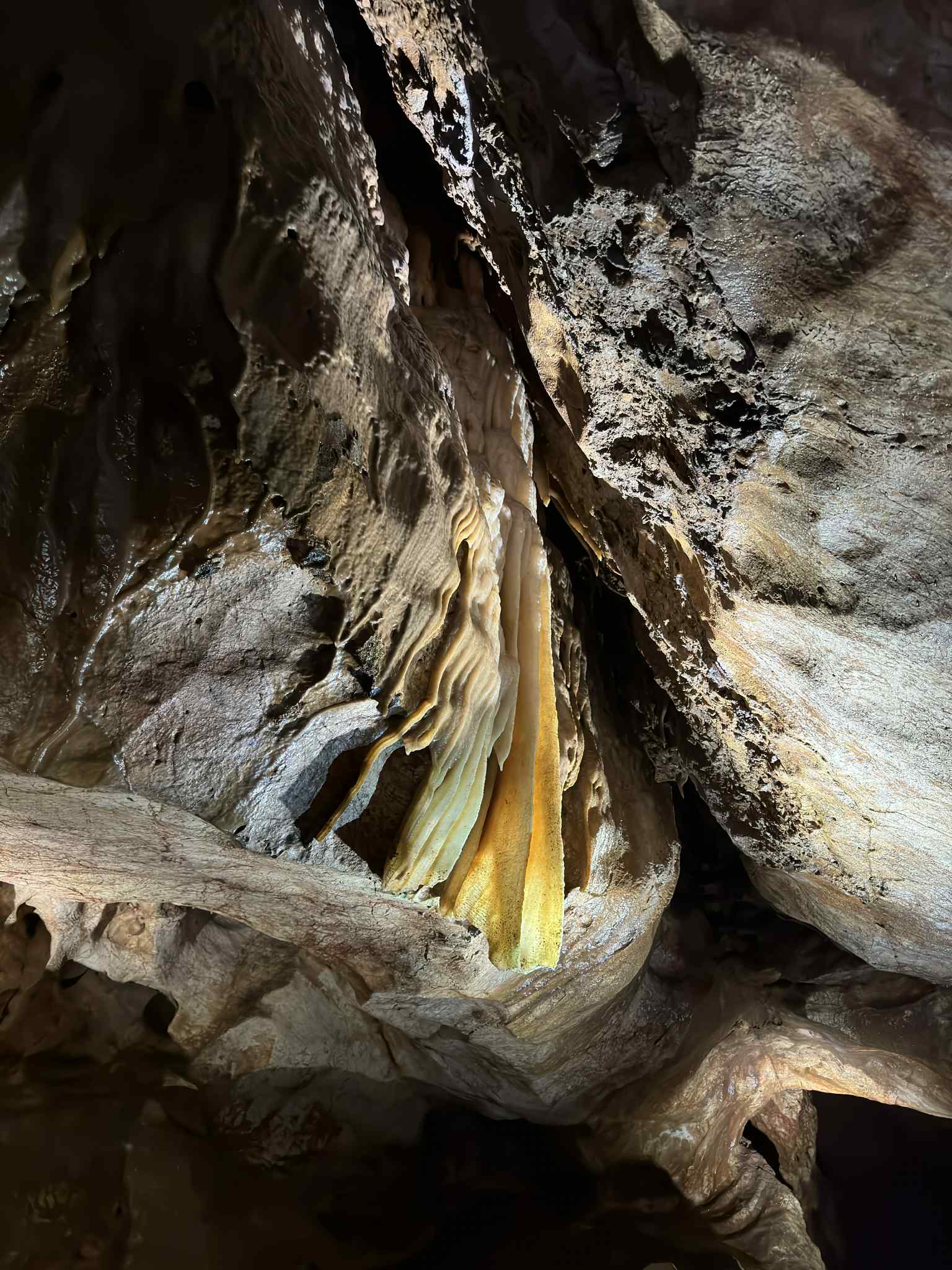
Our fictitious Limestone Gallery has an archaeological level between an older 120 ± 5 ka lower calcite crust and a younger 90 ± 4 ka upper flowstone. These are invented ages with no formally specified confidence intervals. The image is a real carbonate cave formation at Gadime Cave, Kosovo, not the hypothetical sampled cave.
The Historic England U-Th guide, Smithsonian Human Origins Program and eduKate Gold Standard master hub provide the research and teaching context.


1. Which event does a calcite age actually describe?
The fictional Limestone Gallery has a human occupation deposit bounded by older and younger cave flowstones. A U-Th analysis of suitable carbonate can concern when that mineral formed, not automatically when people made tools or occupied the cave. A formation date may be used to bracket human activity only when field relationships are securely documented. The Historic England U-Th guide explains this indirect role.
Give students a three-column source sheet listing artefact deposition, lower calcite precipitation and upper calcite precipitation. They should not assign the same date to all events. Our site and dates are invented and have no connection to the real Gadime Cave featured image. The first essential competency is knowing exactly what material was measured and what that permits historians to say.
Back to chapter index · Next chapter
2. How uranium and thorium form a usable clock
Uranium-238, uranium-234 and thorium-230 belong to a radioactive decay chain. In calcium carbonate formed from suitable water, uranium may be incorporated more readily than largely insoluble thorium. After mineral formation, decay processes generate and remove different radioactive daughters. Their relative activities can support a formation age under a justified isotope and system model. This differs from ordinary carbon-14 dating and from uranium-lead dating of ancient minerals.
The Smithsonian Human Origins Program explains the U-234 to Th-230 dating pathway. Students should draw a simple chain and identify which material must remain a sufficiently closed system after precipitation. No one isotope percentage is a calendar date. A confident explanation describes the mechanism and the needed initial-conditions model without pretending a classroom diagram replaces laboratory analysis.
Back to chapter index · Next chapter
3. Why starting composition matters
The simplified U-Th model assumes a suitable initial relationship between uranium and thorium in precipitating carbonate. Thorium is often excluded from clean water-derived calcite compared with dissolved uranium, but sediments can contribute initial detrital thorium. A muddy calcite lamina may therefore violate a simple no-initial-thorium assumption, and analytical corrections are not guaranteed to restore complete chronological reliability.
Students compare a fictional clean flowstone sample with a second containing visible silt. They write what additional isotope and mineral measurements would help specialists evaluate detrital contamination. The useful answer distinguishes the parent-daughter ratio now observed from what the system may have contained at formation. Historic England describes correction using detrital assumptions and its potential uncertainty.
Back to chapter index · Next chapter
4. Half-lives and the practical useful age range
Uranium-234 and thorium-230 have different half-lives, with Th-230 near 75,000 years and U-234 near 245,000 years. As the decay chain approaches radioactive equilibrium, changes in activity ratios offer diminishing chronological discrimination. That makes the method useful for many Pleistocene cave deposits but not an unlimited clock for every geological specimen.
The Historic England dating guidance describes a practical older range around 500 ka for many carbonate U-Th applications, dependent on material conditions and measurement. Have students examine a fictional activity-ratio curve whose increase gradually flattens. Why would two older layers near equilibrium be harder to distinguish? The response should connect isotope production and decay with measurement sensitivity, not count visible stalagmite bands as annual years.
Back to chapter index · Next chapter
5. Identify potentially dateable cave carbonate
Stalagmites, stalactites, flowstones, tufa and travertine can include carbonate precipitates suitable for uranium-series dating under certain conditions. An object that looks like white limestone is not necessarily an intact growth layer or a chemically well-behaved sample. Site geometry, uranium concentration, grain fabric and preservation influence suitability.
The real featured photograph is of carbonate formations in Gadime Cave, Kosovo, credited to Mozaikuks, not a dated isotope specimen. Students should describe what the photograph shows without assigning a mineral age. In a fictional section, they select an intact overlying and an underlying flowstone rather than an arbitrary cave wall. A good research plan asks which formation episode constrains the actual archaeological event before requesting invasive analysis.
Back to chapter index · Next chapter
6. Preserve stratigraphy and growth direction
A flowstone may grow in phases, be eroded, fracture, or be redeposited. A mineral fragment recovered loose in sediment could have formed long before its final deposition. Its measured formation age therefore does not necessarily date the deposit. An intact layer sealing an archaeological surface offers a different relationship from a broken stalagmite mixed into fill.
Give pupils a section diagram with two in-situ crusts and one loose fragment. They identify which materials could plausibly bracket occupation and which lack a secure depositional connection. The Historic England Pin Hole case study describes scattered U-Th ages among calcites incorporated in older excavated layers, showing why source formation and context should never be assumed identical.
Back to chapter index · Next chapter
7. Use overlying calcite to set a minimum age
An overlying calcite film that formed after a painted surface or archaeological deposit can provide a lower age bound for the earlier activity, given undisturbed relationships. If the film formed nominally 90,000 years ago, the covered surface must be older than that mineral, not necessarily exactly that age. This is often described as a minimum age of the covered event.
Students should label the overlying fictional F2 layer as 90 ± 4 ka, with the ± value only illustrative. Ask them to write ‘occupation predates the overlying calcite’ rather than claim ‘occupation occurred at 90 ka’. A real Spanish cave-art uranium-series study used films overlying motifs to establish minimum ages. The relation between pigment and mineral, not the presence of a number in a journal, is the historical mechanism.
Back to chapter index · Next chapter
8. Use underlying calcite to set a maximum age
An occupation deposited above a securely formed earlier calcite surface must generally be younger than that surface under the stated undisturbed sequence. An underlying flowstone dated nominally 120 ka can thus provide an older or maximum bound on later activity. This is logically the converse of overlying calcite. The two mineral ages can bracket occupation without measuring it directly.
In our fictional Limestone Gallery, F1 underlies the tools and has an illustrative 120 ± 5 ka age. A learner should state that the occupation postdates F1 and predates F2 above. Neither number is a direct age of the tools. Ask pupils to draw a time axis with older time on one side and younger time on the other; switching between numerical years before present and ordinary year counts often reverses the verbal comparison.
Back to chapter index · Next chapter
9. Distinguish an approximate bracket from a formal statistical interval
Our fictional F1 and F2 ages suggest an occupation nominally between about 120 and 90 ka under the idealised stratigraphic model. Their ± terms have no specified confidence level in the example and therefore cannot produce a formal 95% interval by casual addition or subtraction. Geological uncertainties may also be shared or systematic, and the model can fail if carbonate was reworked.
Give learners two candidate museum captions: one says the artefacts ‘were made exactly 105,000 years ago’; the other says they ‘occur between intact, nominally dated carbonate horizons’. The second is evidentially safer. A qualified numerical statement requires a specified uncertainty model and verified field associations. Confidence should come from methods and data, not the number of decimal places in a spreadsheet.
Back to chapter index · Next chapter
10. Identify detrital thorium contamination
Detrital sediment can supply initial thorium-230 not generated by decay after carbonate formation. Thorium-232 may help assess the contribution and some professional corrections use assumptions about initial ratios. A corrected age may carry much larger uncertainties; heavily contaminated material may be unsuitable. A very clean-looking mineral is not an independent guarantee of uncontaminated isotope chemistry.
Ask students to interpret two invented reports, one with low detrital indicator and another requiring a large correction. They should not automatically select the first if its stratigraphic relationship is poor, or force the second into an age model when its correction dominates uncertainty. Historic England’s guide also describes multi-sample isochron approaches that may help but can greatly enlarge uncertainty. The aim is a transparent quality decision.
Back to chapter index · Next chapter
11. Open-system isotope movement can bias ages
A carbonate dated by a uranium-series model must have preserved a sufficiently appropriate closed-system isotope history. Leaching or later addition of uranium or thorium can change measured ratios and produce apparent ages older or younger than mineral formation. Growth layers may look intact to an excavator while microscopic or chemical processes have altered isotopic composition.
Provide a fictional stalagmite with lower growth dated 110 ka and an upper growth phase reported at 135 ka, contrary to the simple expected sequence. Students should investigate growth orientation, contamination, analytical association and open-system behaviour. They should not reorder the measured values invisibly to satisfy a textbook diagram. Dating disagreement is a scientifically meaningful quality warning and may prevent a confident U-Th chronology.
Back to chapter index · Next chapter
12. Differentiate mineral age, growth hiatus and cave activity
Cave calcite may stop growing during dry conditions and resume later. A stalagmite could have several growth segments separated by hiatuses that do not record a continuous chronology. A dated lower segment and upper segment need not mean carbonate grew uniformly between them; a gap can represent centuries or millennia with no mineral formation.
Ask pupils to examine a fictional banded stalagmite with a visible dissolution surface. They propose where a specialist might investigate the separate growth phases and how a hiatus changes a simple age-depth model. A consistent set of dated mineral positions can inform cave environmental history, but should not be converted automatically into an uninterrupted record of human visits. Geological deposition and social events remain separate.
Back to chapter index · Next chapter
13. Use the real Pin Hole study to see indirect dating
At Pin Hole, Creswell Crags, Derbyshire, calcite samples collected during earlier archaeological excavations were later studied using U-Th techniques. The Historic England report discusses several ages ranging through the Late Pleistocene, reflecting carbonate pieces that formed before becoming incorporated into the archaeological deposits. The youngest relevant mineral age provided a useful maximum-age constraint rather than a direct age of the fauna or tools.
Students compare the Pin Hole formation history to our neat fictional bracket. Why can a loose older mineral in a mixed deposit provide a different constraint from an intact overlying flowstone? Their response should specify the archaeological association in each case. A famous site’s date should never be transplanted to another cave because the two contain similar calcite. Source-specific interpretation is the goal.
Back to chapter index · Next chapter
14. Use films over cave paintings without dating pigment directly
U-Th analysis may date calcite films that formed before or after prehistoric cave art, yielding older or younger constraints on the act of painting. An overlying film can provide a minimum age for the painting; an underlying coating may provide an older bound. These are not direct pigment ages. Open-system concerns and sampling relationships must still be scrutinised, particularly on irreplaceable cultural heritage.
The 2012 Spanish cave-art study reported minimum ages for selected motifs using overlying calcite. Ask pupils why the result need not identify which population created a painting without separate cultural and archaeological evidence. Sampling cave art is a highly specialised conservation and ethics decision, not a school activity. Teaching the principle through diagrams avoids damage while conveying the chronological logic.
Back to chapter index · Next chapter
15. Corroborate U-Th with other chronological evidence
Radiocarbon, OSL, stratigraphy, palaeontology and other evidence may test or refine cave chronology, but different methods often date different material events. Charcoal carbon can predate deposition, OSL grains can record sediment burial, and U-Th calcite records mineral formation. Agreement requires source associations that connect the measured events to the research question.
Give students a fictional occupation layer, short-lived charred material and overlying flowstone. They should label what each laboratory would measure and where the results might provide complementary bounds. The Historic England Pleistocene dating review recommends stratigraphic consistency and independent checks. A strong learner does not average unrelated ages to create an artificial occupation year.
Back to chapter index · Next chapter
16. Archive source details and transfer to an unfamiliar cave
A trustworthy U-series report records carbonate type, exact sampled lamina and orientation, excavation context, isotope measurements, detrital correction, open-system concerns, dated growth phase, age uncertainty and archaeological association. Without those details, a final date is hard to interpret or reassess. Real sampling may damage protected cave formations and requires appropriate specialist permission.
The final fictional packet includes one intact upper crust, one contaminated lower crust and one loose stalagmite piece of unknown source. Students select which can reasonably bound an occupation, identify when further analytical review is needed, and explain how they would present the limits to a museum visitor. The gold standard is an evidence-led cave chronology that preserves ambiguity rather than inventing an exact age.
Worked F1/F2 dating logic: carbonate bounds, not direct artefact dates
| Fictional source | Position | Invented nominal age | Interpretation |
|---|---|---|---|
| Upper F2 | Intact cap above occupation | 90 ± 4 ka | Activity predates this carbonate |
| Occupation | Between intact F1 and F2 | Not directly dated by U-Th | After formation of F1, before F2 |
| Lower F1 | Intact lower crust | 120 ± 5 ka | Activity postdates this carbonate |
| Loose F3 | Detached fragment within fill | 140 ka (toy) | No direct formation-deposition equivalence |
The nominal bracket is approximately **between 90 and 120 thousand years ago**, but not a formally calculated confidence interval. An overlying flowstone supplies a minimum age for earlier activity; an underlying intact layer supplies a maximum age. A loose fragment can have formed long before it entered a deposit.
Case A — a date inversion after a growth hiatus
An imaginary stalagmite has an upper layer appearing older than the layer immediately below it. This could reflect open-system uranium migration, detrital correction issues, sampling problems, reuse or a misread growth sequence. Students should investigate the material and method instead of silently rearranging numbers into a desired older-to-younger order.
Give two independently documented dates and a photo showing a possible hiatus. Ask what further isotopic or microscopic checks would clarify chronology and when the dating conclusion should remain unresolved. This trains pupils to treat an unexpected result as potentially informative evidence rather than a failed worksheet.
Case B — the mixed cave deposit contains old calcite
A fictional excavation layer includes a 140-ka loose carbonate fragment among much younger-looking artefacts. Students might assign the entire layer the mineral’s age, but the fragment could have fallen or washed in after forming elsewhere. Its original formation and final deposition are separate events.
Ask learners which context record would link the fragment securely to a dating boundary. If none exists, the measured mineral age can inform possible sediment history without directly fixing the occupation date. This is similar in reasoning, not numbers, to the real Pin Hole study.
Case C — a calcite film over a painting
An imagined red motif is overlain by a small carbonate coating dated under a stipulated reliable U-Th model. Because the coating grew after the painting, it can provide a minimum age of the motif, not the exact day or century the image was painted. Students should preserve both chronological logic and heritage ethics.
Ask how a dated substrate under the motif would provide a different constraint. They should explain what evidence would establish that the film genuinely formed above rather than within a reworked material and why sampling protected art is a professional conservation decision.
Case D — an age corrected for detritus becomes broad
A made-up carbonate sample contains a large detrital fraction. A correction can be attempted, but uncertainty in the initial thorium component may overwhelm the precision of the measured isotope activities. A narrow uncorrected numerical age is not necessarily more accurate than a broad corrected result.
Students compare a clear mineral age with an uncertain corrected one and decide which can be used as a firm stratigraphic bound. The correct answer depends on error and association, not on which value matches a desired archaeological period.
Case E — two independent clocks date different things
A fictional charred seed from an occupation is measured by radiocarbon, while upper flowstone is studied with U-Th. The results could be compatible even though the dates differ, because one concerns source carbon and the other calcite precipitation. Students should not average them.
Build a context chart separating the dates and model assumptions, then ask how secure association and relative order could narrow a valid occupation interval. A high-quality answer explains the physical event each clock recorded and acknowledges all remaining uncertainty.
Case F — a museum caption that avoids invented certainty
One candidate caption reads ‘These tools date from exactly 105,000 years ago’. Another states that the imaginary tool-bearing deposit lies between intact carbonate horizons with nominal formation ages near 120 and 90 ka, pending geological and isotope-quality checks. The second tells the reader both what is known and how it is known.
Ask students to explain why precise-looking ages can be rhetorically persuasive but scientifically weak when the event association is incomplete. Effective public archaeology translates rigorous dating evidence without hiding source limitations.
Four-lesson curriculum
- Lesson 1: understand U-Th decay, calcium carbonate precipitation and the difference from other isotope clocks.
- Lesson 2: use a cave section to distinguish underlying, overlying and reworked carbonate.
- Lesson 3: compare detrital correction, open-system uncertainty and independent archaeological dates.
- Lesson 4: solve a new cave-art or cave-deposit packet and present bounded chronological conclusions.
Extended age-bracketing laboratory: four sample cards with different assumptions
The fictional Limestone Gallery provides four sample cards. Lower F1 records a calcite growth layer that appears to lie beneath the occupation; upper F2 seems to seal the artefacts; loose F3 has no original growth position; and F4 comes from a muddy coating within an intrusive crack. Students should not give these four numbers equal chronological weight. The lower and upper intact layers can bracket occupation if the archaeological sequence is secure. F3 could be much older than final deposition, while F4 may be affected by detrital contamination or later mineral growth. Ask which of the cards contributes to a minimum age, which to a maximum age and which needs further source work before any event association is defensible.
Add the fictitious isotope laboratory result for F4: a nominal date that appears between F1 and F2 but is accompanied by a warning that detrital correction adds substantial uncertainty. A teacher should not reward inclusion simply because the number happens to fit the expected interval. Nor should an apparently contradictory result be discarded without analysis. The pupils’ task is to explain where the material came from, what isotopic system was measured, which corrections were applied and whether the date can genuinely constrain the archaeological target. This is a realistic training exercise in distinguishing numerical consistency from independent evidence.
A formal research audit for carbonate dating claims
| Step | What a reliable analysis documents | Common source error |
|---|---|---|
| Event | Carbonate formation versus archaeological activity | Claims the tool was directly dated |
| Material | Mineral growth fabric, site and precise sampled position | Treats loose fragments as intact flowstone |
| Isotopes | U/Th activity ratios, contamination and correction method | Assumes every calcite begins thorium-free |
| System behaviour | Open-system concerns and growth-age order | Forces reversed dates into desired order |
| Chronology | Age estimates, uncertainty, relative bounds and associations | Invents an exact occupation year |
At the end, each learner writes a short archaeological conclusion under two conditions. First assume that F1 and F2 are fully intact and their analytical ages are justified. The correct statement provides an approximate bound on the intervening occupation, not a direct date. Second introduce a new field observation showing that F2 was disturbed during a later collapse. Pupils must revise their conclusion because the evidence linking upper mineral formation to occupation is no longer as secure. The isotope age itself may remain a legitimate measurement of carbonate precipitation, but the particular archaeological bound may weaken. The difference between measurement quality and historical relevance is the distinctive intellectual lesson of Uranium-Series Dating.
Frequently asked questions
Does U-Th directly date a stone tool?
In common cave-carbonate applications, no. It dates the mineral and can constrain related archaeology.
What does an overlying calcite date establish?
A minimum age for an earlier covered event under reliable stratigraphic association.
What about an underlying calcite layer?
It may provide a maximum age for later deposition or activity.
Can uranium move after calcite formation?
Yes. Open-system behaviour can bias apparent ages and must be investigated.
Should pupils sample historic cave deposits?
No. Specialist permissions, conservation and qualified analysis are required.
U-Th professional research and connected eduKate guides
- Historic England: U-Th Pleistocene Dating
- Historic England: Pin Hole Cave Dating Case
- Smithsonian Human Origins: Dating Methods
- Pike and Colleagues: Cave Art U-Series Research
- Gadime Cave Photograph (CC0)
- Teaching Radiocarbon Dating
- Teaching OSL Dating
- Teaching Tephrochronology
- Teaching Archaeology
- The Gold Standard master hub
The gold standard of teaching Uranium-Series Dating is a student who can interpret carbonate formation ages, recognise their mineral and isotopic limitations, and use stratigraphic constraints to say only what the archaeological context supports.