
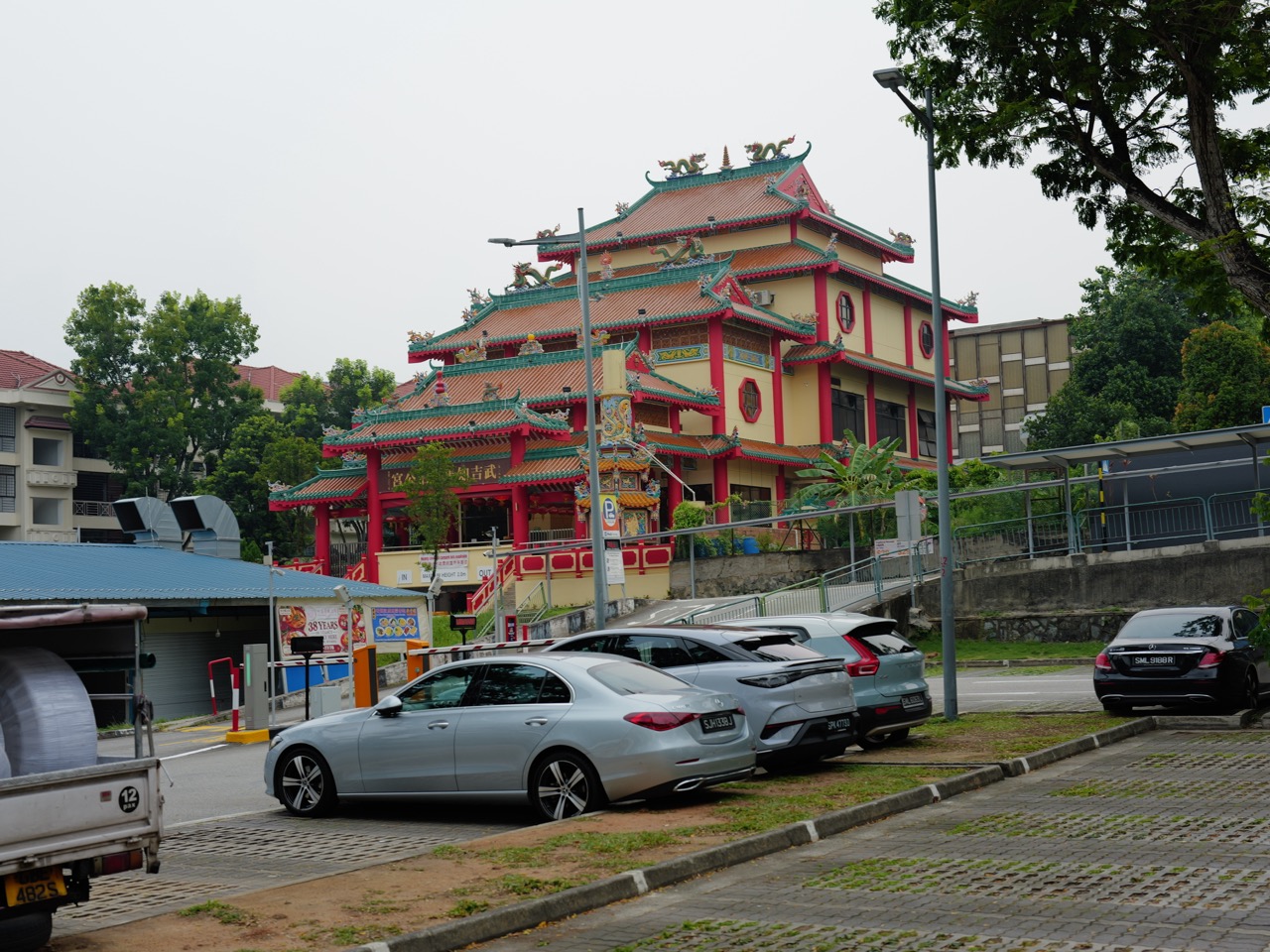
Where is Bukit Timah Tua Pek Kong Temple, and may visitors go inside? Bukit Timah Tua Pek Kong Temple (武吉知马大伯公宫, also catalogued as 武吉知马七英里大伯公宫) is at 10 Jalan Seh Chuan, Singapore 598416, close to the Beauty World shopping and food area. The temple is a living Taoist Chinese place of worship, not a ticketed heritage museum. Current public business listings give 7am–5pm daily and telephone 6468 0589, but the temple does not publish a clearly maintained official visitor timetable, so call before arranging a special trip or assuming the main worship space will admit sightseeing visitors. Anyone entering must follow the temple’s own directions and place worshippers first.
This guide answers searches for Bukit Timah Tua Pek Kong Temple opening hours, 10 Jalan Seh Chuan directions, temple near Beauty World MRT, Bukit Timah Chinese temple history, Seven Mile Tua Pek Kong, Taoist shrine architecture, Tua Pek Kong meaning, temple photography etiquette, nearby heritage walks and respectful cultural visits. The official-style society records confirm that the temple organisation registered as a society on 24 December 1978 and as a charity on 17 July 1985. Those dates establish organisational records; they do not prove the exact original date a shrine was first established on this land. Architectural information from the 2014 exterior-lighting project documents its layered roof forms and modern improvements without treating a lighting completion date as the temple’s founding date.
A thoughtful local stop: arrive from Beauty World MRT, walk to Jalan Seh Chuan, observe the temple exterior from an appropriate public area and ask permission at the entrance before proceeding inside or photographing any religious activity. If the temple is busy with worship, visit another day or keep the visit to a quiet respectful exterior look. You can combine this stop with the separate Bukit Timah Interim Market & Food Centre at 2A Jalan Seh Chuan, or nearby Beauty World food and shopping, but a sacred space is not merely a background for a food crawl. No public admission price or formal guided-tour schedule has been independently confirmed for 2026; visitors should not infer that the temple sells tickets or guarantees tours.
Quick answer: temple facts to check
| Question | Best-supported information | Visitor consequence |
| Name | Bukit Timah Tua Pek Kong Temple | May also appear as 7th Mile Tua Pek Kong |
| Address | 10 Jalan Seh Chuan, Singapore 598416 | Do not confuse with 2A Jalan Seh Chuan market |
| Nearest transport reference | Beauty World MRT (Downtown Line) | Check pedestrian street route |
| Published directory hours | Daily around 7am–5pm | Not a guaranteed temple-issued visitor timetable |
| Telephone | 6468 0589 | Confirm entry, festivals and access |
| Type | Taoist Chinese place of worship | Respect ritual practices and participants |
| Society registration | 24 December 1978 | Not necessarily the founding year |
| Charity registration | 17 July 1985 | Community and philanthropic activities |
| Architectural lighting | 2014 project; 2015 design award | Not proof of new 2026 opening |
| Visitor fee or tour | No confirmed public visitor programme | Do not invent admission or reservations |
| Nearby food stop | Interim market at 2A Jalan Seh Chuan | Separate institution and address |
Contents: a respectful heritage visit
- Correct street address and nearby MRT
- What Tua Pek Kong means and religious context
- Registration and cultural history without speculation
- What the architecture and roofline reveal
- Rules for arriving, dress, photography and worship
- Festivals, noise, candles and donations
- Nearby food, MRT and a short cultural walk
- How to learn more from reliable sources
- FAQs and verified reference links
1. First, use the exact Jalan Seh Chuan address
The relevant location is 10 Jalan Seh Chuan, Singapore 598416. Multiple independent listings and a researcher-maintained Singapore Chinese temple dataset match this address.
The number matters: the active Bukit Timah Interim Market & Food Centre occupies 2A Jalan Seh Chuan, a different place on the same street. Typing only ‘Jalan Seh Chuan’ is not precise enough for a visitor with little time.
2. Beauty World MRT is the appropriate rail landmark
The temple lies in the Upper Bukit Timah neighbourhood near Beauty World MRT, served by the Downtown Line. Visitors can follow public streets towards Jalan Seh Chuan.
Choose an official crossing and an accessible pedestrian approach if needed. A nearby MRT is not a claim that the temple entrance is within the paid station area or a shopping mall.
3. Why the 7th Mile name appears in records
A specialist catalogue of Singapore Chinese temples records the fuller Chinese name 武吉知马七英里大伯公宫, referring to Bukit Timah’s seventh-mile landmark.
Road-mile names preserve an older way of describing neighbourhood locations. Today’s visitor should still navigate by the actual street address rather than searching for a physical seven-mile stone.
4. The temple is active, not a preserved empty monument
The temple is a working religious institution. The meaning of the space is shaped by worship, community duties and personal prayers rather than by a museum timetable.
Tourists and curious neighbours are guests. A quiet respectful visit is appropriate only where the temple permits it, and worshippers’ needs take precedence over photography.
5. What does Tua Pek Kong mean?
Tua Pek Kong is often translated as ‘Grand Uncle’ or a venerable elder and is associated with an earth or local protective deity in Chinese religious practice across Southeast Asia.
Different temples and communities may express the deity’s history and worship in their own ways. A simple public label should not erase local ritual or interpretative differences.
6. Taoist traditions are diverse
Singapore’s Chinese temple landscape includes Taoist, Buddhist and syncretic practices. The Bukit Timah organisation is publicly classified under Taoism in its society and charity information.
Do not equate every Chinese-looking temple with a Buddhist monastery, and do not assume that neighbouring Buddhist sites have the same customs.
7. Why visitors should avoid ritual assumptions
A devotee may bring offerings, light incense or follow a sequence of prayer. Those actions have meaning within the person’s tradition, and they should not be reproduced casually as a staged tourist performance.
If you are uncertain about an altar, ritual or item, ask a temple representative politely. Observation and respect are valid ways to learn.
8. What can an exterior visitor appreciate?
From a permitted public position, notice layered roof planes, roof-edge curves, colours, decorative motifs and the relationship between the building and the modern Upper Bukit Timah street.
A facade can reveal how heritage forms coexist with nearby shops, roads and community facilities. Look carefully without blocking the entrance or nearby traffic.
9. The 2014 lighting project documents the architecture
Lighting consultancy Light Collab identifies a 2014 temple exterior-lighting project at the same address, led with an architect from SPORE_Studio. The project specifically highlights illuminated tiered roof forms.
This is valuable evidence about a documented design phase, but not an excuse to claim the temple itself was founded in 2014 or completely rebuilt in 2026.
10. A 2015 award recognised exterior illumination
The project’s credits report an Illumination Awards Award of Merit in 2015 for exterior lighting design.
Lighting design can make traditional forms legible within a busy modern street. An award for illumination is not the same as a heritage-monument designation for the whole building.
11. What is special about a layered roof?
Traditional Chinese temple roof forms can emphasise thresholds, hierarchy and ornament. The Bukit Timah project’s lighting deliberately draws attention to tiered roof silhouettes.
You do not need specialist architecture vocabulary to notice the forms. Compare how the roof reads in daylight with its silhouette seen from a safe public area in the evening.
12. Lighting does not guarantee nighttime admission
A building designed to be visible after sunset may have interior visitor hours that end much earlier. Business directories currently report closing at about 5pm.
Do not travel at night expecting unlocked doors simply because exterior lighting photographs look impressive. Check directly before planning evening access.
13. A 1978 registration is not a founding myth
Society records give 24 December 1978 as a registration date. A charity listing gives 17 July 1985 as a separate milestone.
These records show the organisation’s formal status. Without well-supported archival evidence, the date of an original village shrine or earliest act of worship should remain unstated.
14. Charity registration reflects community activity
Public charity directories describe religious activity along with financial assistance, bursaries and charitable purposes. These listings help explain why an active temple may also have an important neighbourhood function.
Do not assume a visitor can obtain financial aid on the spot or that every cultural event is open to all. Programmes have their own eligibility and organiser arrangements.
15. A temple can be a cultural landmark without an entry ticket
Places of worship often contribute to the visible history of a street through architecture and repeated community use, whether or not they operate formal sightseeing programmes.
The fact that you can admire an exterior from a public pavement does not create a right to enter private prayer or administrative areas.
16. Published hours need to be checked with the actual temple
Business directories currently report 7am–5pm daily. However, these are third-party business listings rather than a guaranteed temple-maintained 2026 visitor calendar.
Telephone 6468 0589 before travelling for a scheduled group visit, before assuming holiday access, or if mobility support is needed.
17. No confirmed visitor-ticket system
No reliable official source used for this guide establishes a paid entry ticket, fixed tourist tour, booking page or hourly admission programme for the temple.
Avoid buying an unrelated third-party attraction ticket marketed around the area. Visitors should ask the temple directly if any organised cultural introduction exists.
18. The temple is not a general-purpose photography studio
The exterior may make a beautiful local photograph, but close-up photography of worshippers, altars or rituals can be intrusive. Some areas may prohibit pictures entirely.
Ask before photographing indoors and follow signs or a representative’s directions. Do not use flash without permission or pose in ways that obstruct devotional use.
19. Respecting a worshipper’s privacy
Someone visiting a place of worship may be praying about personal difficulties or carrying out family obligations. That is not an invitation to capture their face or activities for social media.
Compose wide architectural photographs from public positions where allowed, and move aside when people need to enter. Consent matters more than getting a dramatic image.
20. Choose modest, unobtrusive clothing
Appropriate clothing for a religious setting is usually modest and practical, but individual houses of worship can have specific requirements.
Check entrance notices. Do not apply another temple’s rule about shoes, headwear or ritual behaviour automatically to this one without confirmation.
21. Whether to remove footwear depends on onsite instructions
Some sacred buildings require shoes to be removed in designated worship areas, while others have different arrangements. The specific requirement for this temple has not been verified through an official visitor page.
Look for posted signs and follow staff guidance. Never remove footwear into a busy walkway or block a doorway.
22. Do not touch offerings, prayer objects or displayed items
Offerings, incense holders, tablets and other items may be sacred or belong to a devotee. A curious visitor should not handle them simply because they are within reach.
For children, explain that the space belongs to a community’s living traditions. Observing without touching can be the most respectful and meaningful approach.
23. Incense has meaning and safety considerations
Incense may form part of temple worship. Smoke, embers and the placement of offerings are managed according to community practice and safety needs.
Avoid standing close to active burners with loose clothing, keep children supervised and do not light or move incense without guidance.
24. Festivals can alter access and crowding
Lunar-calendar observances and religious celebrations may bring more devotees to a temple. The specific Bukit Timah temple’s 2026 festival schedule has not been independently verified.
Do not publish invented ceremony dates or promise performances. Check directly with the temple if you hope to observe an appropriate public occasion.
25. A festival crowd is not the same as a tourist event
Devotional gatherings exist for participants’ religious purposes. Some observances may welcome guests while others may prioritise members and worshippers.
If a visit coincides with a busy service, ask whether it is appropriate to remain. A quieter day may be better for respectful architectural appreciation.
26. Donations are not an admission fee
A religious organisation may accept voluntary contributions, but that is not proof of a mandatory visitor-ticket price. Donations and prayer offerings can have different purposes.
Never imply that purchasing incense or handing over money is required to sightsee unless the temple explicitly says so.
27. Children can learn what a living heritage place is
A short visit can help a child understand the difference between a museum, community meeting place and active temple. Look at the entrance, roofline and other non-sensitive visible details.
Explain beforehand that voices should remain low and objects should not be handled. A respectful observation may be enough without going indoors.
28. Help teenagers distinguish facts from stories
Students can compare the 1978 society registration, 1985 charity registration and 2014 architecture-lighting project. Each has a date but describes a different kind of event.
A good historical account labels its evidence. ‘Registered in 1978’ is supported; ‘founded in 1978’ is not established solely by that record.
29. Why a religious building matters to urban history
A busy commercial district can retain smaller community institutions that preserve customs and neighbour relationships across redevelopment.
A temple’s importance cannot be measured only by its visitor numbers. People may value it for worship, support and continuity.
30. The street name Jalan Seh Chuan is part of local geography
Jalan Seh Chuan lies among Beauty World shops, markets and places of worship. Its unusual mix of religious and commercial activity gives the street its distinct local character.
Walk on public pavements and choose marked crossings. A heritage visit should never require entering a carpark or a private compound without permission.
31. Where is the interim market relative to the temple?
The operating Bukit Timah Interim Market & Food Centre is at 2A Jalan Seh Chuan, while Tua Pek Kong Temple is at 10 Jalan Seh Chuan.
They are nearby but distinct, and their purposes differ. A market lunch can be a separate stop after a respectful temple visit.
32. What about the old Bukit Timah Market?
The original Bukit Timah Market at Upper Bukit Timah Road closed for redevelopment in 2024. The interim market is the active replacement, and the old-site reopening remains tentative around 2029.
A temple visit should not be directed to the closed former market address by copying an outdated map or review.
33. Nearby food can make a flexible outing
Beauty World Food Centre on Level 4 of Beauty World Centre and the interim market are separate meal destinations near the MRT. You can select one based on your preferred stall and its current hours.
Plan food around the group’s appetite, not as though the temple operates a café or provides visitor meals.
34. A 30-minute cultural stop
A short visit might include finding the temple, observing its architecture from the street, speaking politely to an authorised representative if appropriate and leaving when worship activity requires space.
This is a suggested quiet stop, not a promise of a formal 30-minute temple tour or unrestricted access to prayer rooms.
35. A longer neighbourhood history walk
Combine the temple’s exterior with a look at the nearby market streets and the historical street names in Beauty World. Each place illustrates a different form of urban continuity.
Do not merge the histories into one invented story. Temple society records, market relocation and street-name origins should be checked against their own sources.
36. Consider an early-day visit
If the 7am–5pm business-directory window remains current, daylight is the more practical time for a respectful exterior visit. Morning visits may also be easier before markets or roads become especially busy.
The chosen hour should follow the temple’s own current wishes. Never treat an informal business listing as proof that a door will always be unlocked.
37. Street accessibility must be checked
The surrounding streets have normal Singapore urban infrastructure, but no reliable public source establishes step-free access to every interior part of this specific temple.
Visitors with mobility needs should call ahead about entrances, thresholds, assistance and drop-off. A public pavement being accessible does not establish that all prayer areas are.
38. What if the gates are closed?
Respect the closure. An online guide may have been indexed before a schedule change, a maintenance operation or a private event.
You can view appropriate exterior architecture from public space without climbing gates or entering another property. If necessary, reschedule.
39. A quiet visit does not require ritual participation
Non-devotees may prefer to observe and learn respectfully. There is no general reason to imitate unfamiliar prayers, incense handling or donation practices for a photograph.
If invited to take part, ask what is appropriate and decline politely if you would rather observe. Religious respect includes honest participation choices.
40. Cultural terminology should stay precise
Tua Pek Kong is a deity name, Bukit Timah is the neighbourhood identifier, and Jalan Seh Chuan is the street address. The temple’s registration lists Taoism as its sector classification.
Do not refer to every nearby Chinese Buddhist monastery as the Tua Pek Kong Temple, and avoid conflating distinct traditions.
41. What can a photograph prove?
A recent exterior photo can show the building’s roof shape or that a gate is visible. It cannot prove an indoor visiting policy, the duration of a ceremony or the date the original temple was founded.
Pair photographs with the better-supported society and architectural records. That is the difference between visual observation and a historical claim.
42. Why a tourist description should be restrained
The temple may be meaningful to generations of local residents, but promoting it as a ‘hidden Instagram spot’ can invite insensitive behaviour. People use the space for religious reasons.
A better guide helps visitors find the correct location, understand its cultural role and decide whether a quiet visit is appropriate.
43. Photography at night requires extra care
The 2014 lighting project makes the roof forms visible after dark, but outdoor photography must not obstruct roads, doorways or residences.
Do not extrapolate an architectural feature into nighttime access. The third-party business hours end around 5pm, and any after-hours observation should remain in lawful public space.
44. Where can the history be researched further?
Use Singapore’s official society and charity registers for organisational status, heritage publications for broader Chinese religious practice and primary architectural credits for the documented lighting work.
Avoid repeating unverified founding dates or stories taken from an unattributed short social-media caption. Distinguish local oral accounts from archival records.
45. A meaningful takeaway from the visit
A place of worship is a reminder that neighbourhood heritage includes ongoing beliefs and community networks, not only preserved colonial buildings or old train stations.
The most respectful visitor leaves knowing the correct name, address and social function of the place—and without disturbing the people who came to worship.
Frequently asked questions: Bukit Timah Tua Pek Kong Temple
What is the address of Bukit Timah Tua Pek Kong Temple?
10 Jalan Seh Chuan, Singapore 598416.
How do I get there by MRT?
Beauty World MRT on the Downtown Line is the nearby station. Follow public streets to Jalan Seh Chuan using a current map.
What time does the temple open?
Third-party business directories list around 7am–5pm daily. The temple does not publish a verified official visitor timetable, so confirm directly.
What is the temple’s phone number?
6468 0589, according to public business directories.
Is the temple a tourist attraction?
It is primarily a living place of worship. Any sightseeing visit is subject to temple rules and worship activity.
Can tourists enter?
Ask the temple directly about its current visitor policy, access and any restricted areas. Public architecture is not proof of unrestricted indoor admission.
Is there an entry ticket?
No independently verified official visitor-ticket price or booking system is published in the sources used for this guide.
Is photography allowed?
Ask onsite, particularly for indoor religious spaces and worshippers. Exterior public-street photography should not obstruct anyone.
Can children visit?
If the temple permits visitors, children should be closely supervised and taught to respect rituals and objects.
What does Tua Pek Kong mean?
A venerable elder or protective deity, often associated with earth and place in Chinese Southeast Asian religious traditions.
Is the temple Taoist or Buddhist?
Its formal charity classification lists Taoism. Nearby religious institutions may belong to different traditions.
What is the Chinese name?
Records include 武吉知马七英里大伯公宫, referring to the Bukit Timah seventh-mile Tua Pek Kong temple.
When was the temple founded?
The exact founding of the original shrine is not established by the verified material cited here. The society registered on 24 December 1978.
When was it registered as a charity?
Public records give 17 July 1985.
Was it rebuilt in 2014?
A documented exterior lighting design was completed in 2014. That does not establish that the entire temple was newly founded or rebuilt then.
What was the 2015 award?
An Award of Merit for exterior lighting design, as listed by project designers Light Collab.
Is the temple open after sunset?
Do not assume so. Exterior architectural lighting is not proof of access after the roughly 5pm directory closing time.
What is special about its roof?
The design documentation highlights tiered temple roof forms and their night illumination.
Do visitors need to remove shoes?
Follow the temple’s own posted footwear instructions; the specific interior requirement has not been verified here.
Should I wear modest clothing?
Yes, choose respectful clothing and follow any onsite guidelines for entering a sacred space.
Can I use flash photography?
Only with explicit permission; avoid intrusive light during worship and follow any no-photography signs.
Can I touch temple objects?
Not without permission. Offerings and ritual objects may be sacred or belong to worshippers.
Can I light incense as a tourist?
Ask temple staff about the meaning and correct procedure rather than participating merely for a photograph.
Are there festival performances?
No verified 2026 festival programme is published for this temple in the sources checked; ask the organiser directly.
Is it the same place as the interim market?
No. The temple is at 10 Jalan Seh Chuan and the interim market at 2A Jalan Seh Chuan.
Is it near Beauty World Centre?
It is in the same general Beauty World neighbourhood, but not inside Beauty World Centre.
Is there a carpark?
A photograph shows a nearby parking area, but legal public spaces and charges should be checked onsite; availability is not guaranteed.
Is the temple wheelchair accessible?
No verified full step-free-access details are available in the cited public sources. Contact it for individual needs.
Do I need a guided tour?
There is no confirmed regular tourist-guided-tour schedule. A quiet independent visit, where permitted, may be more appropriate.
Can a large group just arrive?
Ask the temple in advance, particularly if you need to enter worship areas or bring a class.
Does a society registration date prove its founding?
No. Registration records legal status at a particular time, not necessarily the first establishment of worship at a site.
Where can I verify the building history?
Use the society register and Light Collab’s credited 2014 architecture-lighting project as separate sources.
Can I visit after a Beauty World hawker meal?
Yes as a neighbourhood itinerary where the temple permits visitors, while respecting worshippers and the temple’s actual schedule.
What if the temple is closed when I arrive?
Respect the closure, do not enter restricted areas and contact the temple for another time.
Is Tua Pek Kong a single temple across Singapore?
No. Several distinct temples honour Tua Pek Kong. This guide refers specifically to 10 Jalan Seh Chuan in Bukit Timah.
Related Bukit Timah cultural and food outings
- Nearby Bukit Timah Interim Market at 2A Jalan Seh Chuan
- Beauty World Food Centre rooftop hawker guide
- Bukit Timah hidden heritage and quiet local streets
- Bukit Timah historic sites and WWII heritage
- Beauty World shopping and neighbourhood services
- Low-cost cultural and family outings
Temple registration, architecture and visitor references
Editorial verification: 22 October 2026. Third-party opening times are explicitly qualified because a temple-published visitor timetable was not located. We make no unsupported claim about the temple’s earliest founding, rituals, guided tours or admission price.
- Singapore society registration profile — exact address, 1978 and 1985 status
- Light Collab — architectural lighting, 2014 project and 2015 award
- Local business listing — temple phone number and 7am–5pm directory hours
- Waze — temple location and third-party operating hours
- Chinese temple research dataset — formal Chinese place name and postal address
- Singapore Tourism Board — examples of respectful visitor etiquette at Chinese temples
- NEA — nearby market relocation and redevelopment dates