
Things to do in Singapore | Tanjong Pagar Road. Walk one of Chinatown’s most important conserved commercial streets, see the Former Jing Hwa Cinema, study long rows of protected shophouses, compare pre-war architecture with modern towers around Guoco Tower, and use the road to understand how entertainment, retail, migration, transport and conservation have shared the same urban spine for more than a century.
Tanjong Pagar Road is a street of transitions.
At one end, it brushes Chinatown.
At the other, it reaches the modern CBD and Tanjong Pagar MRT.
Along the way, conserved shophouses, old cinema history, food businesses, hotels and towers create a long urban timeline.
- Walk the conserved shophouse stretch.
- See the Former Jing Hwa Cinema at 1 Tanjong Pagar Road.
- Compare residential-front and commercial-front shophouses.
- Walk toward Guoco Tower and Tanjong Pagar MRT.
- Connect into Craig Road, Tras Street and Duxton.
- Use the road to see how an old commercial spine remains active beside a much denser CBD.
- Return after dark to compare historic architecture with the modern office skyline.
Read: Things to do in Singapore | Tanjong Pagar
Read: Things to do in Singapore | Tras Street
Read: Things to do in Singapore | Craig Road
Start With the Big Idea: Tanjong Pagar Road Is the Main Street of a Conserved District
URA identifies Tanjong Pagar as one of Chinatown’s four historic conservation precincts.
The area is bounded partly by Tanjong Pagar Road itself and contains mostly two- and three-storey Early, Transitional and Late shophouses.
The road therefore functions as both a working urban street and a spine through one of Singapore’s earliest large-scale conservation districts.
Official district reference: URA | Chinatown – Tanjong Pagar Conservation Area
Visit the Former Jing Hwa Cinema
At 1 Tanjong Pagar Road stands the Former Jing Hwa Cinema.
URA records that the cinema was built in 1958 and was one of Chinatown’s three famous cinemas together with the Majestic and Oriental.
It became associated with first dates, holiday treats and popular entertainment.
The building’s history adds a twentieth-century leisure layer to a street often read only through nineteenth-century shophouses.
Official conservation reference: URA | 1 Tanjong Pagar Road – Former Jing Hwa Cinema
Use the Cinema to Understand Mass Entertainment
Cinema changed how urban residents spent leisure time.
A film theatre could gather hundreds of people for the same experience at once.
That created demand for surrounding food, transport and meeting places.
The cinema therefore belonged to a wider entertainment ecosystem rather than operating as an isolated building.
Study the Modern Style
URA notes that the Former Jing Hwa Cinema was designed by local architect Wong Foo Nam in the Modern style.
It was the first cinema in Singapore to include a basement carpark and extensive floor-to-ceiling windows.
Those features reflect a different urban era from the shophouses around it.
Cars were becoming more important.
Modern architecture favoured large glazing and simpler forms.
One building therefore marks a technological and stylistic shift inside the historic district.
Walk the Conserved Shophouse Rows
URA individually records many conserved buildings along Tanjong Pagar Road, including 24, 26, 51, 88, 94 and 106.
The value comes from their concentration.
Walk slowly enough to notice how repeated plot widths and rooflines create a coherent street even when decoration changes from building to building.
Official example: URA | 24 Tanjong Pagar Road
Look for Residential Fronts
URA’s conservation rules identify protected residential fronts in parts of the district.
These use timber casement windows flanking a double-leaf timber door.
The detail matters because a street now dominated by restaurants and offices still carries evidence that people once lived directly behind those façades.
Modern use and historic form do not always match.
That mismatch is part of adaptive reuse.
Compare 24, 26 and 51 Tanjong Pagar Road
Use several recorded conserved buildings as anchor points.
Compare window proportions, parapets, decorative mouldings and how the ground floor meets the five-foot way.
The aim is not to memorise addresses.
It is to train the eye to distinguish variations inside the shophouse type.
Official example: URA | 26 Tanjong Pagar Road
Official example: URA | 51 Tanjong Pagar Road
Walk Toward Guoco Tower
Near Tanjong Pagar MRT, the urban scale changes dramatically.
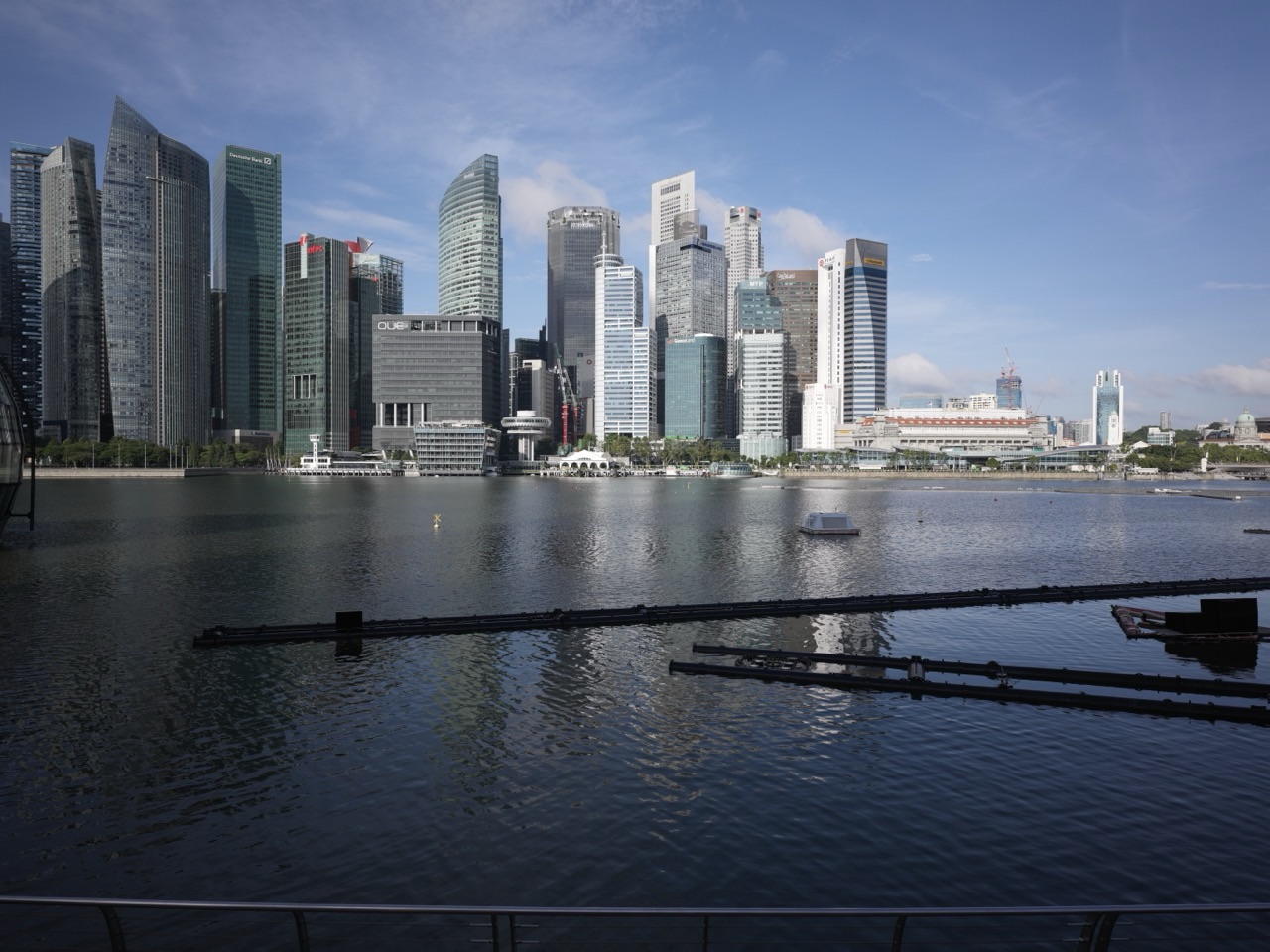
Guoco Tower and surrounding high-rise developments create one of the strongest low-rise-versus-high-rise contrasts in central Singapore.
That contrast illustrates a key planning strategy.
Historic districts can remain relatively low-rise when major density is concentrated at nearby transport nodes.
The old street survives beside the new vertical city.
Use Tanjong Pagar MRT to Understand Transit-Oriented Density
The East–West Line station anchors one of Singapore’s major CBD employment and residential nodes.
High-capacity transit makes taller, denser development more practical because large numbers of people can arrive without every trip depending on cars.
Transport capacity and building density therefore reinforce one another.
Walk Into Tras Street
Tras Street provides a quieter parallel conservation street with strong residential-front examples and the historical origin of Hong San See.
Walking between the two streets shows how several conserved micro-environments can exist inside one larger district.
Continue nearby: Things to do in Singapore | Tras Street
Walk Into Craig Road and Duxton
Craig Road continues the residential-front conservation story while Duxton introduces public housing and linear park space.
The route shows Tanjong Pagar evolving block by block rather than changing at one single boundary.
Continue nearby: Things to do in Singapore | Craig Road
Continue nearby: Things to do in Singapore | Duxton
A Simple Tanjong Pagar Road Half-Day Plan
- Morning: begin at Maxwell or Chinatown side of Tanjong Pagar Road.
- Cinema stop: see the Former Jing Hwa Cinema.
- Architecture stop: follow the conserved shophouse row.
- Food stop: choose a current café, hawker or restaurant.
- Density stop: continue toward Guoco Tower and Tanjong Pagar MRT.
- Extension: loop back through Tras Street, Craig Road or Duxton.
Tanjong Pagar Road Through the eduKate Ecosystem
Things to do in Singapore | Tanjong Pagar
Things to do in Singapore | Tras Street
Things to do in Singapore | Craig Road
Things to do in Singapore | Duxton
Frequently Asked Questions
Is Tanjong Pagar Road conserved?
Large stretches lie within the Chinatown–Tanjong Pagar Conservation Area and contain many individually recorded conserved shophouses.
What was Jing Hwa Cinema?
It was a 1958 Modern-style cinema at 1 Tanjong Pagar Road and one of Chinatown’s three famous cinemas.
Why are there skyscrapers beside low shophouses?
Singapore preserves selected historic streets while allowing much greater density at nearby CBD and MRT sites, creating a deliberate contrast in scale.
Is Tanjong Pagar Road good for children?
Yes for an architecture and city-history walk, especially when combined with Maxwell, Duxton or Craig Road.
What is the main learning idea?
Urban continuity. Tanjong Pagar Road shows how one commercial street can absorb new transport, entertainment and high-rise development while a substantial historic shophouse fabric survives.
Official References and Conservation Sources
URA | Chinatown – Tanjong Pagar Conservation Area
Things to do in Singapore | Tanjong Pagar Road
Tanjong Pagar Road is one long argument that old and new do not have to occupy separate cities.
A 1950s cinema sits inside a nineteenth-century shophouse district.
Modern towers rise beside both.
The MRT runs below.
The road remains active because each generation added another layer instead of requiring the previous one to disappear completely.