
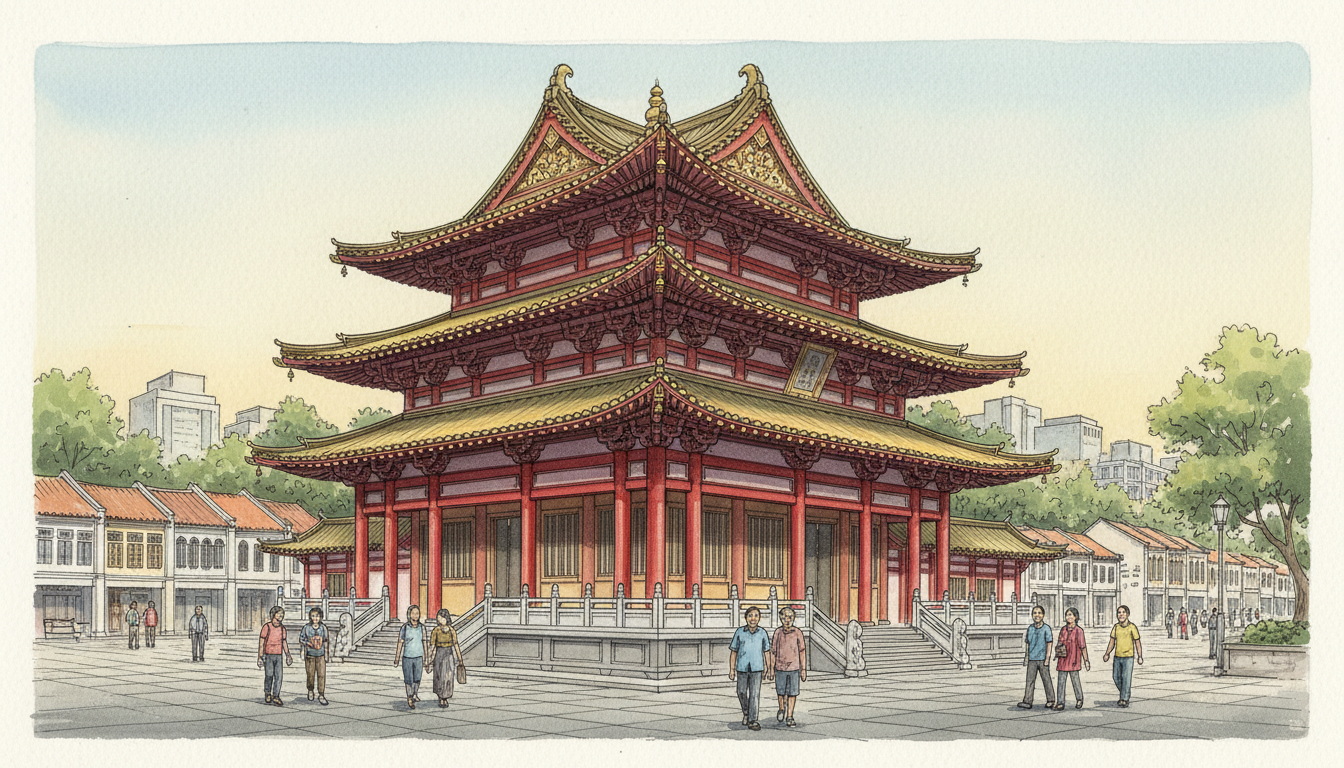
Things to do near Chinatown MRT: take Exit A to Pagoda Street, admire the conserved shophouses, walk to Sri Mariamman Temple and the Buddha Tooth Relic Temple, choose a meal at Chinatown Complex or a nearby hawker centre, and spend time learning how people lived and worked in older Singapore. Chinatown station (NE4/DT19) is an interchange on the North East and Downtown Lines. A rewarding heritage walk can be free; museum entry, food and shopping are separate choices.
For a comfortable two-hour first visit, follow this sequence: Chinatown MRT Exit A → Pagoda Street → Sri Mariamman Temple exterior → South Bridge Road → Buddha Tooth Relic Temple and the surrounding streets → food or a rest stop at Chinatown Complex. If you want a paid museum visit, reserve time for Chinatown Heritage Centre on Pagoda Street rather than trying to fit in every temple and market. Check dates carefully: the Heritage Centre lists a full maintenance closure on 10 November 2026, and NEA lists the Chinatown Complex market at Block 335 Smith Street for cleaning on 16–17 November 2026.
Quick answers before you leave:
- Station: Chinatown NE4 / DT19, interchange; Exit A for Pagoda Street and the historic shopping lanes.
- Best free walk: Pagoda Street, historic shophouses, South Bridge Road and public views of religious landmarks.
- Best cultural stops: Sri Mariamman Temple and Buddha Tooth Relic Temple; respect worship, dress rules and photography guidance.
- Best affordable meal plan: compare available stalls at Chinatown Complex or other nearby hawker centres; food prices and hours vary.
- Paid learning stop: Chinatown Heritage Centre at 48 Pagoda Street, generally 10am–8pm, last entry 7.15pm, with maintenance notices.
- Important dates: Heritage Centre closed 10 Nov 2026; Chinatown Complex scheduled for cleaning 16–17 Nov 2026.
- Family time: 45–60 minutes for a compact walk, around two hours for stops and food, longer if visiting a museum.
- Alternative station: Maxwell MRT can be more convenient for some destinations at the southern end of Chinatown.
Pick the right Chinatown experience rather than walking everywhere
Chinatown is compact when viewed on a Singapore map, but the walk feels different when you are navigating market crowds, road crossings, religious spaces and lanes full of people stopping for photographs. The mistake is to treat every attraction as a five-minute add-on. Two places may be close in distance but require different opening hours, queues and visitor etiquette.
Start with the reason for your visit. Some families want a free walk and a simple lunch. Visitors from overseas may want to understand cultural and religious history. Older relatives may prefer a few well-chosen landmarks and a seated meal. A child interested in how people lived decades ago may get more from the Chinatown Heritage Centre than from looking at souvenirs for an hour.
| Your priority | Start here | What to leave out |
|---|---|---|
| Free street heritage | Pagoda Street and South Bridge Road | Ticketed museum unless planned |
| Food and market life | Chinatown Complex and nearby lanes | Long temple detours during lunch peak |
| Religious architecture | Sri Mariamman, Buddha Tooth Relic Temple | Entering worship spaces without permission |
| History of working families | Chinatown Heritage Centre | Assuming exhibits are free or walk-in |
| Young children or seniors | Two landmarks and a rest stop | Whole-day sightseeing checklist |
If you have only 45 minutes, complete one coherent mini-walk. If you have three hours, add a guided or self-directed museum experience. There is no value in “finishing” Chinatown when you no longer have the energy to understand what you are looking at.
How to begin at Chinatown MRT Exit A
Chinatown MRT serves both the North East and Downtown Lines, with the station code NE4/DT19. For a first-time heritage visit, Exit A is a logical starting point because it leads towards Pagoda Street, Chinatown Heritage Centre and the connected shophouse streets. When travelling from another line, read the station signs before leaving the concourse; there is no prize for choosing the first escalator you see.
The exit opens into a popular visitor environment. Pause clear of the entrance and check the planned direction before walking. If your group includes children, choose an easily recognisable meeting point, and do not stop in the middle of the station ramp for a family photograph. It is a working transport space with passengers entering and leaving throughout the day.
For one simple loop, follow Pagoda Street towards South Bridge Road. From there you can continue towards the temple district and choose whether to head for a food centre, return to the station or explore another lane. Maps may display all these locations as very close together, but allow for crossings, crowds and stops. A ten-minute estimate for an unhurried adult may be much longer with a stroller or grandparents.
Chinatown is not the same as one MRT exit. Chinatown Point and People’s Park serve different errands, while Maxwell MRT on the Thomson–East Coast Line can be useful for the southern end of South Bridge Road. If you intend to visit only Buddha Tooth Relic Temple, check which station is nearer to your particular starting location. Use eduKate’s Chinatown MRT station guide for additional exit details.
Pagoda Street: shophouses, shopping and the first history question
Pagoda Street immediately introduces the visitor to a particular kind of Singapore streetscape. Conserved shophouses provide the background to shops, food, services and tourist trade. Look up at the upper floors instead of focusing entirely on souvenir displays. Windows, shutters, rooflines, colours and covered walkway arrangements can tell you about urban design and the way narrow plots are used.
A shophouse often brought commercial and domestic life close together. The exact activities differed from building to building, but the arrangement can help a child imagine how people might have worked downstairs and lived or rented rooms in the same structure. The Chinatown Heritage Centre explores this history through reconstructed living spaces. Its interpretation can help you separate a general impression from the documented experience of particular residents.
Do not assume every object sold in a present-day tourist shop is traditional or handmade, or that every operator has occupied a unit for generations. Chinatown has changed repeatedly. The present street is both a heritage setting and a living commercial environment. Its appeal comes partly from that overlap, but a good guide does not confuse a contemporary retail display with an untouched historical record.
For families, an easy question is: “What do you see on the second floor that you would miss if you only looked at the shops?” For older students, ask why a conserved façade and a modern business might coexist. Think about what conservation protects and what it does not. Then keep moving: a ten-minute observation can be enough for a younger child, even if the adults are tempted to photograph every doorway.
Chinatown Heritage Centre: the paid stop that needs a plan
Chinatown Heritage Centre is at 48 Pagoda Street, near Exit A. It operates in restored shophouses and uses reconstructed 1950s interiors to tell stories of migrants and households, including the way rooms, kitchens and working spaces were used. It is an excellent choice if the family’s main question is not simply “What does Chinatown look like?” but “How did ordinary people live here?”
The centre’s official visitor information lists 10am–8pm daily, with last entry at 7.15pm and timed entry capacity. Admission is ticketed; children below three years old have free entry, and other prices depend on category. A significant upcoming closure is Tuesday, 10 November 2026. It also lists a partial closure on 4 December 2026, from 11.30am to 4pm. Check the notice close to your actual date rather than using an old opening-hours graphic.
It is tempting to put the museum, three temples, a food centre and several shopping lanes in one hour because they are geographically close. That schedule misunderstands why you visit a museum. The objects and recreated rooms deserve time. Let a child choose one display and explain what it suggests about living conditions. A short, focused museum visit can be more meaningful than a long, rushed one.
Photographs in the galleries are subject to the centre’s rules, including restrictions on tripods, selfie sticks and flash; food and drinks are not allowed in gallery areas. Some guided experiences require separate arrangements. See Chinatown Heritage Centre: official opening, booking and access notices before paying or promising a date-specific activity.
Sri Mariamman Temple: appreciate an active place of worship
At 244 South Bridge Road, Sri Mariamman Temple is a major Chinatown landmark and Singapore’s oldest Hindu temple. Its richly decorated entrance tower is a clear example of how a single historic neighbourhood can hold several distinct cultural and religious traditions. Visitors often see the tower while walking from Pagoda Street to South Bridge Road.
Respect comes before photography. The temple is an active place of worship. Appropriate dress, footwear arrangements, opening periods and restrictions on entering certain areas may apply. Listen to staff or posted instructions. If you cannot enter, appreciating its exterior from a lawful public vantage point is still a meaningful visit. Do not treat worshippers as scenery for social media and avoid speaking loudly during religious activities.
For children, start with what can be seen: patterns, figures, colours and architectural forms. Ask why a sacred building might use a visual language different from shops around it. Older students can ask how immigrant communities established religious institutions and why a temple in a predominantly Chinese-named district challenges simplistic ideas of one neighbourhood belonging to one culture.
Do not invent the meaning of an image simply because you recognise a shape. Read an authoritative explanation or ask an appropriate guide if available. People may have different levels of knowledge about their religious traditions; the visitor’s role is to learn respectfully, not interrupt a prayer or debate a belief. A multicultural heritage walk works when curiosity is paired with courtesy.
The Singapore Tourism Board’s official tourism information and the temple’s own current visitor guidance are useful checks. When time is limited, plan to view the exterior rather than assume a fixed interior visit will be available on demand.
Buddha Tooth Relic Temple: an accessible cultural anchor, not a theme park
The Buddha Tooth Relic Temple and Museum at 288 South Bridge Road is another major landmark. Singapore Tourism Board describes it as a Tang-inspired Buddhist temple containing religious displays and museum spaces. Its published visitor information lists free general admission and temple hours of 7am–5pm, with a separate museum period generally from 9am to 5pm. This is not a guarantee that every interior area will be accessible regardless of ceremonies or operational changes.
The building’s architecture can be admired from public areas, but it is also used for worship. Dress respectfully and follow restrictions on photography, silence and food. STB’s visitor guidance specifically advises against bare backs, off-shoulder clothing, shorts or miniskirts; do not bring non-vegetarian food or pets into the temple. When a space is closed, use the available public route or exterior rather than trying to find an unofficial entrance.
This temple provides a different sort of history lesson from Pagoda Street. The building itself is comparatively modern, yet its design and contents draw on older traditions. That distinction is worth making explicit. A modern heritage or religious building is not necessarily an old structure. It can express long-standing cultural ideas through more recent architecture.
Ask a child whether the age of a building is the same as the age of the tradition it represents. They may initially assume that an elaborate temple must be centuries old. By separating construction history from religious history, they practise the habit of making precise claims. The result is a better understanding of cultural continuity and change.
Check the Singapore Tourism Board visitor listing for the official overview and etiquette. Maxwell MRT can be a convenient alternative approach if this is your main destination.
Where to eat: Chinatown Complex versus other food stops
Many people come to Chinatown for hawker food. Chinatown Complex Market and Food Centre at Block 335 Smith Street is a well-known choice, but a food guide should not promise that every stall is open, that a dish costs one fixed amount or that a queue will take a predictable number of minutes. Individual operators set their own hours and menus, and cleaning schedules can close the facility entirely.
The National Environment Agency’s hawker-centre maintenance schedule lists the Smith Street Block 335 Chinatown Complex Market for cleaning on 16 and 17 November 2026. If you are planning lunch on those days, do not build your itinerary around eating inside the centre. Choose a verified alternative and check the live notices. The cleaning schedule is a stronger source than an influencer video published before the closure was announced.
Nearby options include food in the wider Chinatown Point and People’s Park precincts, as well as hawker choices around the Maxwell area, depending on where you want to end the walk. Do not confuse the Chinatown Complex market with Maxwell Food Centre: they are separate locations and will not necessarily share their cleaning dates or operating hours.
If you are travelling with young children, find a seat or agree on a meeting point before splitting up to queue. Wash or sanitise hands as appropriate, and pay attention to heat, dietary needs and hygiene. For food allergies, ask individual vendors directly; do not infer ingredient or religious certification simply from a stall’s location in Chinatown.
For an affordable day, set a simple meal budget before you arrive. One chosen meal and a cool drink can be more satisfying than trying to taste every highly recommended dish. Food prices may change, so this guide intentionally avoids a made-up “best ten dishes under S$X” ranking.
A cultural walk should connect the communities, not flatten them
Chinatown’s name highlights the importance of Chinese immigrant communities, but the neighbourhood also contains Hindu and Muslim heritage, with different places of worship standing close to one another. This is a useful lesson about how Singapore’s urban districts developed. Historical labels are sometimes convenient, but they can hide the variety of communities who worked, lived, traded or worshipped nearby.
Walk along South Bridge Road and observe the differences among the religious buildings and shophouses. The point is not to rank them by beauty or age. Ask what function each building serves and why particular visiting rules make sense. A museum is designed to interpret collections; a temple or mosque is a living religious institution. That difference affects how one should behave inside.
A young child might ask why some visitors remove their shoes and others do not. Explain that rules reflect the needs and traditions of the particular site, and that respectful visitors follow them. Avoid stereotyping whole communities by assuming everyone from one background does the same things. If uncertain about a practice, say so and look for an authoritative explanation.
Older students can investigate how a port city attracted people from different places. Chinatown’s former working and residential patterns show how language, trade and housing overlapped. One way to think about the street is as a living record of movement: people moved into the area, created businesses and institutions, and adapted as Singapore changed.
The best lesson is humility. A two-hour tour gives a useful introduction, not exhaustive knowledge of any culture. Ask one good question and leave room for more learning on another visit.
Three walking plans: 45 minutes, two hours and half a day
Forty-five minutes: a compact exterior heritage loop
Leave Chinatown MRT Exit A, look closely at Pagoda Street’s shophouse façades, continue to view Sri Mariamman Temple from a permitted public area and return through a convenient lane. Skip museums and avoid attempting a long market meal. This route is best for a short stopover or a family with limited walking tolerance.
Two hours: landmarks, food and one meaningful question
Start at Exit A, walk along Pagoda Street, see Sri Mariamman Temple, continue toward Buddha Tooth Relic Temple and take a meal or rest near Chinatown Complex, assuming the food centre is open on your chosen date. Choose one history question to discuss on the way. If temple access is restricted, enjoy the exterior and keep the schedule flexible.
Half a day: heritage centre plus a slower street walk
Make Chinatown Heritage Centre the anchor, ideally with a ticket or confirmed admission slot. Allow time to consider one or two of its reconstructed living spaces and then connect what you learned with the shophouses outside. Add one temple stop and a meal rather than trying to visit every religious building and food destination.
Rainy-day adaptation
Use the paid heritage centre if the ticket and operating conditions suit your group, or choose a nearby shopping or dining venue as a temporary shelter. Do not assume temple interiors are general-purpose rain shelters. Religious institutions have their own visitor arrangements. If there is lightning nearby, avoid lingering outdoors along exposed streets merely to finish a route.
These itineraries are deliberately modular. Weather, walking speed, ceremony schedules and queues are real constraints. You may remove a stop without sacrificing the purpose of the day.
Free, paid and uncertain costs
The phrase “free things to do near Chinatown MRT” attracts families who want an affordable outing. The public heritage-street walk generally does not require a ticket. You can appreciate conserved façades and certain religious-site exteriors from accessible public spaces without purchasing a souvenir or paying for a tour. However, some interiors have admission rules, guided programmes may charge, food is purchased separately and the Chinatown Heritage Centre is ticketed.
Use three spending bands rather than a single unrealistic fixed budget. A free-first outing focuses on public streets and exterior architecture, with transport and any meals as the principal expenses. A low-spend outing adds hawker food or refreshments. A museum-led outing includes a deliberate Heritage Centre ticket and gives that experience enough time to justify the cost.
When travelling with children, make the spending rule clear before you reach rows of souvenir shops. If everyone understands that today is for learning and a meal rather than buying toys, decisions become easier. There is nothing wrong with shopping when it is intentional. The problem is when the family expected a free day and accidentally spends the budget for next week’s outing.
Entry and concession arrangements depend on venue, age, residency and programme. Check current terms directly. Do not claim that because one temple offers general free admission, every nearby museum, attraction or exhibition is also free. Likewise, a temporary event discount does not change the default fee for the rest of the year.
A useful family goal is to finish the day able to explain one thing about Chinatown’s past, not to show how many receipts you collected.
Accessibility, street safety and visitor etiquette
Chinatown is busy and can be challenging for some visitors even when the map looks compact. Pavements may narrow around shop displays, visitors stop for photographs, food queues form near entrances and crossings interrupt a walk. A person with a stroller, wheelchair or limited mobility may need a more deliberate route than an adult tourist walking alone.
Check station lifts and the step-free path to your chosen destination before travelling. Older shophouses and religious buildings can have thresholds or internal areas that are not suitable for every mobility need. Contact the venue if you require a particular entrance or facility rather than assuming all conservation buildings have the same access arrangements.
Keep children close at roads and in crowds. Agree on a meeting point if someone steps away to shop or buy food. Do not stop immediately outside an MRT escalator, and never block a temple doorway to take a photograph. Respect prayer activities and signs requesting that shoes be removed or photography stopped.
Chinatown can become hot during the day. Carry water and take short rests. If heavy rain arrives, use a suitable sheltered public or commercial venue and reconsider the outdoor route. During lightning, avoid exposed areas. A heritage outing should be safe and comfortable; completing the exact itinerary is not worth risking wellbeing.
For seniors or young children, two stops and one seated break may be ideal. A visitor’s dignity matters more than the number of attractions named in the article. If a route becomes tiring, finishing early is a thoughtful decision.
How children can learn from Chinatown without an extra worksheet
Learning does not have to feel like another school assessment. Chinatown offers a collection of real objects, buildings, foods and stories that children can use to practise observation and explanation. The best approach is to choose one precise question appropriate to the child’s age and let the experience answer it gradually.
Preschool and Primary 1–2: notice and name
Ask the child to name a roof shape, a window, a colour or a sign. Then ask, “What makes you think that?” It may be enough for a child to say that a building looks different because its roof has colourful figures. Give them the vocabulary needed to describe the observation but do not force a memorised definition.
Primary 3–6: compare two kinds of spaces
Compare a present-day shop with the recreated shophouse home described by the Heritage Centre. Where might people have prepared food, slept or worked in the past? What would you need to know before deciding that life was better or worse? This encourages children to distinguish evidence from assumptions.
Secondary students: ask whose stories are preserved
Look at a public heritage marker and ask who produced it, which period it describes and what evidence it uses. How does a neighbourhood tell the story of merchants, workers, worshippers and families at once? Why might some experiences be easier to document than others? A thoughtful student can begin to understand historical interpretation without expecting one display to tell the whole truth of a district.
Family read-back
At lunch or on the train home, each person explains one surprising fact and one question they still have. Do not grade the answer. The purpose is to help children connect words, experience and evidence in their own voice. A two-minute conversation can make a short outing more memorable than a page full of copied notes.
Did you know? Five useful Chinatown distinctions
The district’s name is not its entire cultural story. A Hindu temple and Buddhist temple are part of the familiar Chinatown route, while other religious institutions and community histories extend through neighbouring streets. Visitors gain more when they notice that variety.
The Heritage Centre is housed in shophouses but is a ticketed museum. The street outside is generally free to walk. That does not make a timed museum admission free.
The Temple at 288 South Bridge Road is a modern structure expressing older traditions. The architecture can represent ideas from a much longer history without the current building itself being centuries old.
A hawker centre and a market can close for cleaning. The November 2026 NEA schedule is a concrete example of why travel information must be checked near the visit date.
“Near Chinatown MRT” depends on your destination. Pagoda Street aligns with Exit A, but a visitor going mainly to Maxwell Food Centre may find a different rail arrival more convenient. A neighbourhood name does not replace accurate journey planning.
Frequently asked questions
What is free near Chinatown MRT?
Public street walks, shophouse observation and many religious building exteriors can be enjoyed without a ticket. Entry rules for particular buildings, museums or programmes vary, so check each venue.
Which exit goes to Pagoda Street?
Chinatown MRT Exit A is the main heritage-street choice, as identified by the Chinatown Heritage Centre’s official visitor directions.
Is Chinatown Heritage Centre free?
It is generally ticketed. Children below three enter free under its published rules, while other admission prices differ by category. Entry can be subject to capacity.
Is the Heritage Centre open on 10 November 2026?
No. The operator lists a full maintenance closure for that date. It also lists a partial closure on 4 December 2026.
Will Chinatown Complex be open for food on 16 and 17 November 2026?
NEA lists the Block 335 Smith Street market and food centre for cleaning on those dates. Check the latest notice and choose another meal stop if needed.
Can I enter Sri Mariamman Temple?
Interior visitor arrangements depend on current religious activities, opening periods, dress and onsite directions. Exterior viewing from permitted public spaces is a suitable alternative when access is restricted.
Is Buddha Tooth Relic Temple free?
Singapore Tourism Board lists free general admission, subject to visitor etiquette and actual availability of different spaces. Special activities may be separate.
How long should I spend in Chinatown?
A compact exterior walk can fit around an hour; two hours is more comfortable for several landmarks and food. Add more time for a museum visit or slower family pace.
Is Chinatown MRT the closest station to all the temples?
No. The ideal starting station depends on the landmark and your previous journey. Maxwell MRT is another practical approach for the southern Chinatown area.
Is the route suitable for older parents or a stroller?
It can be adapted, but crowds, crossings and some building thresholds require care. Choose a shorter step-free route and confirm individual venue access where needed.
Where should we eat on a budget?
Chinatown Complex or other nearby hawker and food options may be suitable when open. Compare current menus, seating and dietary requirements rather than relying on a universal outdated “best price”.
What if it rains?
Use appropriate indoor stops or shorten the outing. Religious spaces are not general-purpose shelters; respect the venue’s own access rules.
Official sources, updates and further reading
Information checked 6 November 2026. Read current operator notices for ticketing, worship arrangements and cleaning dates before a time-specific visit. The route is intended to support real decisions, not create a list of attractions that cannot be completed comfortably.
- Chinatown Heritage Centre — opening hours, admission, closures
- National Environment Agency — market and food centre cleaning schedule
- Singapore Tourism Board — Buddha Tooth Relic Temple
- Singapore Tourism Board — Chinatown neighbourhood
- National Heritage Board Roots — heritage research and trails
- eduKate — Chinatown MRT station guide
- eduKate — free Bugis and Kampong Gelam heritage walk
- eduKate — another short heritage-neighbourhood idea
Chinatown becomes easier to appreciate when you stop trying to “see everything”. Choose one street, one cultural landmark and one comfortable place to rest. Bring home a question, not merely a photograph. That is a practical and enjoyable beginning to understanding Singapore’s neighbourhood history.