
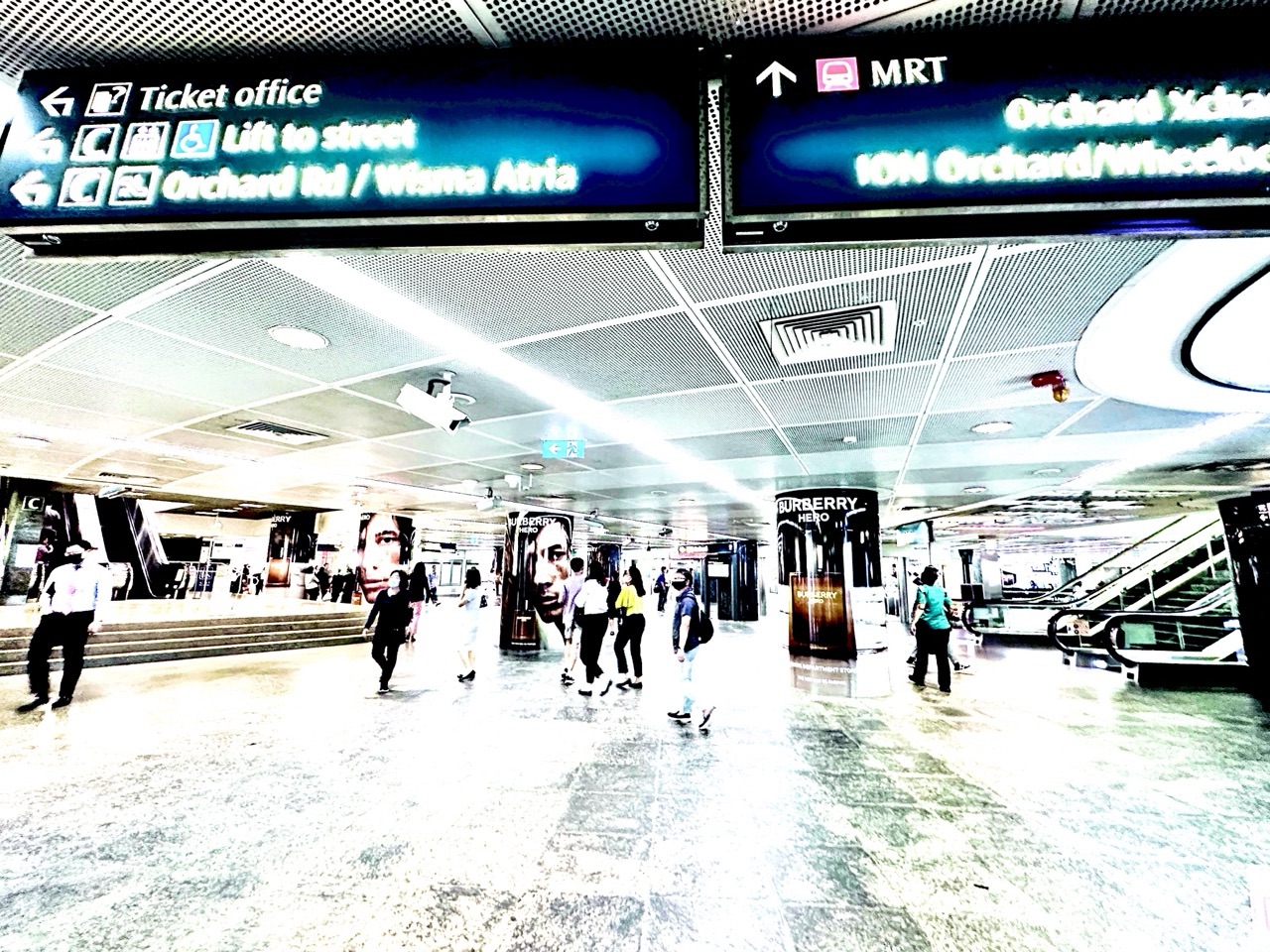
Things to do near Orchard MRT without paying for shopping or attractions: explore the architecture around ION Orchard and TANGS, follow a self-guided part of the National Heritage Board’s Orchard Heritage Trail, study the history of Ngee Ann City and the former Singapore Chinese Girls’ School, and make Emerald Hill an optional longer walk towards Somerset. Orchard MRT (NS22/TE14) connects the North–South and Thomson–East Coast Lines. The famous shopping district is also a place to discover older schools, communities, homes, religious buildings and design decisions that still shape Singapore.
For a manageable free-first visit, start at Orchard MRT → ION Orchard → TANGS and its distinctive architecture → Shaw House/Scotts Road views → a choice of Ngee Ann City or another heritage marker. A longer trip can continue south towards The Heeren, the former Singapore Chinese Girls’ School site and Emerald Hill. The National Heritage Board’s Orchard Road’s Historical Gems is a published 2.2-kilometre self-guided route; it takes around 40 minutes for brisk walking alone, so families should budget longer for crossings, stops and photographs.
Quick visitor answers:
- Best first stop: ION Orchard, directly connected to Orchard MRT, for orientation and weather protection.
- Best no-shopping theme: architecture and local history rather than buying things.
- Official heritage walk: National Heritage Board’s eight-point Orchard Road’s Historical Gems trail, approximately 2.2 km.
- Best short option: ION Orchard, TANGS/Tang Plaza and an exterior architecture observation nearby.
- Best longer option: southwards toward Ngee Ann City, The Heeren, former school site and Emerald Hill, with Somerset as a useful later rail exit.
- Budget: looking at streets and building exteriors is generally free; meals, retail, tickets and special viewing experiences may cost extra.
- Accessibility: do not confuse step-free mall connections with every side-street or heritage venue being step-free.
Why Orchard Road has more to offer than a shopping list
Orchard Road is famous for its malls, but a visitor can learn a surprising amount without entering a single retail queue. Buildings are evidence of decisions made by different generations: who could afford land, what businesses flourished, which communities needed schools or places of worship, and how transport changed the street. The shops are part of the present. The older layers explain how the present came about.
That distinction changes the way you plan a day. Instead of asking how many malls you can visit, choose one question: Why does Tang Plaza look so different from the towers around it? What was on the site of Ngee Ann City before the mall? Why did a girls’ school matter in the development of modern Singapore? Why does Emerald Hill feel different from the main shopping corridor? Each question leads to a real place and a better walk.
The official Orchard Road’s Historical Gems trail is particularly helpful because it names eight historical points and provides an estimated 2.2-kilometre route. The distance is manageable for many adults but should not become an obligation for every family. Choose a three-stop version if someone is tired or the weather is poor.
For first-time tourists, this is a way to understand Singapore beyond polished retail interiors. For Singapore families, it is a chance to discover familiar buildings with fresh eyes. For students, it offers primary-source questions that can be pursued after the visit, using public heritage information rather than invented anecdotes.
Get oriented at Orchard MRT before choosing a direction
Orchard MRT is NS22/TE14. It is an interchange between the North–South and Thomson–East Coast Lines. The connected underground routes make ION Orchard a convenient starting point and a reliable meeting area. Follow current MRT exit and mall signage to reach the right side of Orchard Road; there are multiple underground passages, entrances and busy crossings.
The most important navigation rule is to know whether your next stop is north or south. ION Orchard, TANGS, Shaw House, Wheelock Place and the nearby Scotts Road cluster form the station-side area. Ngee Ann City, Paragon and The Heeren sit farther down Orchard Road, with Emerald Hill closer to the Somerset direction. Do not claim Emerald Hill is immediately beside Orchard MRT simply because both are labelled “Orchard” on a tourist map.
If you are coming with a stroller, find the lift route from the interchange and the shopping-mall access information. If you have luggage, select the shortest comfortable itinerary rather than carrying bags down busy shopping pavements for a long historical route. Use crossings with signals and resist shortcuts across traffic. The best route is the one your group can complete safely, not necessarily the straightest line drawn on a map.
eduKate already maintains an extensive Orchard MRT station guide that explains nearby destinations and station access. This article focuses on free heritage and architecture rather than repeating its general directory. The LTA rail network guide is the appropriate source for current railway information.
The official route: eight historical gems, not eight shopping stops
The National Heritage Board’s Orchard Road’s Historical Gems identifies eight sites: the Royal Thai Embassy, Tang Plaza, Goodwood Park Hotel, Ngee Ann City, the former Mandarin Orchard Hotel, The Heeren, the former Singapore Chinese Girls’ School and Emerald Hill. These sites were chosen to tell different stories about land, people, housing, leisure, institutions and commerce. They are not all museums, and they do not all invite casual public entry.
This distinction matters when a visitor sees “free heritage trail” online. The free activity is largely walking and appreciating the exterior environment or authorised public spaces. The trail does not entitle walkers to wander through a diplomatic mission, hotel guest facilities, school premises or private homes. Read markers from publicly accessible areas, respect boundaries and verify any interior visitor arrangement separately.
National Heritage Board gives a 2.2 km route and an estimated 40 minutes on foot, but that is the basic travel estimate. A family stopping to read heritage interpretation, buy water and cross at traffic lights may need one to two hours or more. Heat, busy pavements, individual mobility and weekend crowds can all change the pace substantially.
Use the official trail page and its available map or booklet to confirm each location before setting out. The route is a useful framework, not an exam to be finished. A shorter three-stop day is still a successful exploration when visitors come away with one grounded insight about the district.
Stop 1: ION Orchard — read the design of a modern transport gateway
ION Orchard is a striking introduction to what a modern, transit-connected shopping centre does. The building meets Orchard MRT underground, gathers multiple levels of stores and helps thousands of visitors disperse towards streets and other buildings. Even if you do not buy anything, its entrances, escalators, signs and exterior façade offer an introduction to how architecture manages movement.
Start with a practical observation: find a sign that takes you to Orchard Road, a sign that takes you to the train and a sign that takes you to an essential service such as a toilet or lift. Are the symbols consistent? Would someone who does not speak English understand enough to navigate? How does a building help visitors make a decision quickly? These are design questions rather than merely shopping questions.
The exterior façade and surrounding public views are useful for photography, but do not block a doorway or moving staircase to get a picture. Some rooftop or special viewing experiences have separate conditions, booking requirements or access rules, so do not promise an unrestricted free skyline observation from a particular level. The most dependable free experience is looking carefully at the building and public streets.
For younger children, ask them to describe the difference between a subway station sign and an advertisement. For teenagers, ask why a transit-linked retail building needs multiple forms of wayfinding and how those signs might be improved. The most enjoyable walk usually begins with something familiar that the visitor learns to see differently.
Stop 2: Tang Plaza — architecture and the history of TANGS
Walk towards Tang Plaza and observe its distinctive roofline and façade. The architecture is a useful visual contrast to the glass-heavy commercial towers around it. National Heritage Board includes Tang Plaza in the historical gems route. Its broader history is associated with the expansion of Orchard Road as a retail district and with the entrepreneurial story of C. K. Tang.
The current building stands in a landscape where streets, retail businesses and land use have changed repeatedly. The aim of a heritage walk is not to pretend the present-day shopfront is an untouched image of the past. Instead, ask how a modern retailer can use architecture to present continuity with cultural traditions while operating in a contemporary district.
Visitors can appreciate the exterior from publicly accessible pavement areas. The retail interior may have its own opening hours and commercial rules. There is no requirement to buy anything to discuss the architecture, and no guarantee that every part of a complex is open to the general public at every hour. Use current signs, respect business entrances and keep the walking corridor free for others.
A useful question for upper-primary children is: “Which feature makes this building recognisable from across the road?” Ask them to name a shape or pattern and explain why it stands out. Secondary students can explore the different purposes of architectural ornament, branding and cultural reference. Those are not identical ideas, even when one building uses all three.
Stop 3: Goodwood Park Hotel and the Scotts Road context
Goodwood Park Hotel appears on the official heritage route because the Orchard and Scotts Road area was once home to a different pattern of residences and social institutions. The building’s castle-like appearance is distinctive in a neighbourhood dominated by newer commercial forms. The heritage trail notes the earlier history of clubs where residents gathered to eat, drink, dance and socialise.
It is tempting to rush over simply for a photograph. Ask first whether your group has the time and mobility to make the detour. A pedestrian at Orchard MRT may have to negotiate street crossings and walk farther than they expected. The hotel is a working commercial property: public views should not be confused with unrestricted entry to private event or guest spaces.
This stop is more rewarding if you compare the building’s appearance with Tang Plaza. Why does one suggest a European castle or clubhouse and another use a very different roof expression? What stories about status, taste and identity might their architects have intended to communicate? These are questions, not facts to declare without evidence. Use heritage interpretation to check any theory rather than presenting a child’s first impression as certainty.
For older relatives or a group with limited time, it is completely reasonable to leave this stop out. An official trail can be adapted. The goal is not to see every building at all costs; it is to understand that the district contains layers of Singapore history that the shopping-centre signs do not immediately reveal.
Stop 4: Ngee Ann City — a mall built over an older story
Continue south along Orchard Road when the group is ready for a longer walk. Ngee Ann City is familiar to many visitors as a large shopping complex, but the National Heritage Board notes that the site was formerly part of Tai Shan Ting, a Teochew cemetery. This is a good example of why a place’s current appearance can conceal several earlier uses.
For children, the concept is simple: buildings and spaces change, while evidence and records help us understand what stood there before. The present shopping centre does not automatically tell us the story of the former cemetery. You need historical sources to connect the two. That is why local heritage agencies, archival maps and interpretive accounts are more trustworthy than a viral caption that gives no source.
There is no need to visit luxury shops to appreciate the site’s history. Observe the exterior, the pedestrian connections and the flow of people. Notice how the complex relates to other malls, the adjacent roads and public space. Ask whether the district would be as convenient without the MRT or the continuous network of pedestrian routes.
When discussing former cemeteries or religious sites, use respectful language. These places mattered to real families and communities. They should not be reduced to a spooky anecdote for entertainment. A careful explanation of how land use and community needs changed is more interesting and more responsible than sensationalising the past.
Stop 5: The Heeren — how businesses and buildings change
The Heeren is another historical-gems waypoint farther down Orchard Road. The heritage trail notes an earlier mixed-use building at the Cairnhill Road junction, linked to businessman Chee Swee Cheng in 1931. This is an opportunity to explore the concept of adaptive city development: a single address can support different activities over different decades while its surroundings change.
A useful discussion begins with the phrase “same place, different purpose”. Ask a child to imagine what a busy corner must support: delivery access, people on foot, buses or cars, retail entrances, shelter and readable signs. Then ask what changes as the area’s economy shifts. A local business district is not frozen at the moment a building opens.
Do not rely on a remembered shop directory to decide what is available inside The Heeren on a particular day. Tenants and operating arrangements are changeable. Use the exterior as the main heritage reference; if someone needs a washroom, refreshment or an indoor break, consult current building signage rather than treating an old online article as an up-to-the-minute mall directory.
For teenagers, this is a useful place to distinguish an architectural fact from an economic interpretation. You can establish that a building once stood here through a heritage record. To claim why a particular business closed or moved, however, requires separate evidence. Good historical thinking should make visitors more curious and more careful about what they believe.
Stop 6: The former Singapore Chinese Girls’ School — why education belongs on a city trail
Orchard Road’s history includes the former site of Singapore Chinese Girls’ School. National Heritage Board records the school as founded in 1899 by Dr Lim Boon Keng, Song Ong Siang and Khoo Seok Wan to provide Chinese girls with modern education. That is a much more significant fact than merely saying that an old school building once occupied an expensive part of town.
The stop connects a city walk to changes in education, access and expectations. In the late nineteenth century, educational opportunities were not distributed in the same way as they are now. The founders’ decision to support girls’ modern education represents a deliberate social effort. A child’s immediate question might be, “Why did people have to create a special school for girls?” That question opens a useful conversation about opportunity and the changes communities made over time.
Stay within public viewing areas and use historical markers or maps. Do not assume a former school site is open for tours simply because the history is public. If there is no marker immediately visible, consult the heritage map rather than wandering into private property. The official route explains why this point matters; a completed public exterior observation is enough for a family outing.
This stop can be particularly meaningful for a student. Ask them to imagine how their present school day would differ if certain subjects or schooling opportunities were unavailable to them. Then return to the actual historical record. The best conversations connect empathy with evidence rather than telling children what they must feel.
Stop 7: Emerald Hill — shophouses, quiet streets and a different sense of space
Emerald Hill lies farther south in the Orchard–Somerset area and should be treated as a meaningful extension rather than an immediate Orchard MRT exit. The character of the street changes as you move away from Orchard Road’s large commercial structures towards a shophouse and residential environment. Its distinctive façade details make it popular with photographers, but it is also a place where people live and work.
Look carefully at the rhythm of windows, covered entrances, colours, decorative features and the way buildings meet the street. What is different about the scale of the buildings here compared with ION Orchard or Ngee Ann City? How does a smaller street change walking speed, noise and the number of people gathering at one entrance? Do not treat every design element as merely “old-fashioned”. Each may have practical, social or aesthetic reasons.
Be a considerate visitor. Photograph building exteriors from public areas, avoid looking into homes, do not lean on private gates and keep narrow passages clear. A heritage street is not a film set. If your group is tired or carrying luggage, choose Somerset MRT for a convenient onward rail route where appropriate, after checking the live map and the direction you need to travel.
For children, Emerald Hill is an excellent final contrast: modern tower, retail landmark, historic institution and smaller streetscape. Ask them to choose one difference they can explain. Ending with a clear observation can make a shorter walk more memorable than taking photographs at every façade without understanding why they matter.
What does ‘free things to do’ really mean on Orchard Road?
Looking at public streets and exterior heritage sites normally does not require an attraction ticket. The official self-guided heritage route gives you a structure for that experience. Nevertheless, “free walk” is not the same as “free everything”. Public transport, food, beverages, personal purchases, hotel services, cinema seats and special experiences each have their own costs.
Families can decide on a simple budget rule before leaving the station. One option is a free-first plan: bring water, explore three public sites and buy no extra entertainment. A second option is a low-spend plan with one meal or drink. A third is an experience plan with one pre-selected paid activity and the rest of the walk kept free. The important word is “pre-selected”; it is easy to drift from an inexpensive heritage outing into spending at every shop.
Window-shopping may be enjoyable, but the story of a historic district should not depend on buying merchandise. Children may learn more from reading an interpretive panel and asking a question than from purchasing a souvenir. If a special gallery or rooftop observation is advertised, check its current admission arrangement rather than assuming access is included just because the surrounding mall is open.
Travel costs depend on where you start and the fare medium you use. For up-to-date fares, consult official fare information or your transport app. Do not build a supposedly authoritative family budget around a made-up universal rail fare; the same outing can cost different amounts for different travellers.
Three Orchard walking plans: 30 minutes, 90 minutes and half a day
30–45 minutes: architecture without an exhausting walk
Start at Orchard MRT, look at ION Orchard’s public areas and exterior, walk towards Tang Plaza and identify the contrast in roof forms. Add a view of nearby Scotts Road if convenient, then return to the station. This is the best option if you are travelling with a senior, a small child, luggage or limited time. You will not cover the full heritage trail, but you can still understand that the district contains different generations of architecture.
90 minutes: a small history walk
Begin at the station, observe Tang Plaza, select a comfortable southern section towards Ngee Ann City and read the official trail context for the sites you pass. Stop for shelter or water as required. This route is more about learning why buildings exist than counting the number of shops passed. If crossing traffic or heat reduces your available time, finish at the nearest sensible rail station rather than reversing the entire walk.
Two to three hours: historical gems with pause points
Use NHB’s route map to plan the eight official points, adding sufficient time for images, reading and conversations. Not every site is accessible inside, so plan exterior viewing as the default. The route may take much longer than the official 40-minute walking estimate once you include stop time. A slow day is not an inferior day; it lets people actually notice the district.
History and food version
Choose three sites rather than eight, then stop for a meal in the Orchard–Somerset corridor. Pick based on the group’s dietary needs and current availability, not a restaurant mentioned in a three-year-old blog post. If the main aim is a meal, see the heritage walk as a short complement, not an exercise you must finish before anyone can eat.
Heat, rain, comfort and step-free access
Orchard Road has indoor connections and large malls, but the official heritage route includes outdoor street-level walking. In Singapore’s tropical climate, this difference matters. A person might enjoy moving around inside a shopping centre but struggle with heat, crowding and crossings outdoors. Plan the day around a mixture of sheltered intervals and outdoor observations, especially when travelling with children or older relatives.
Check the sky before starting a long section, and do not stay outdoors in nearby lightning just to complete a photo itinerary. In heavy rain, change the plan: use the mall as a safe shelter and resume only if conditions improve. Remember that covered walkways do not protect from all wind-driven rain and that the entrances to older side streets may become slippery.
For wheelchairs and strollers, verify lifts, kerbs and the route through the specific buildings you plan to use. Even when the nearest MRT interchange has step-free arrangements, some heritage side streets and private premises can have uneven thresholds or narrower passages. The easiest “accessible Orchard” itinerary may therefore be a shorter route across confirmed level connections rather than the entire official historic circuit.
Bring water and comfortable footwear. Allow more time for traffic lights and crowds, and choose a meaningful meeting point before anyone separates. When the route is busy, avoid posing for photographs in front of shop doors or blocking people coming out of the MRT. A useful public guide should help visitors enjoy the area while making it easier for everyone else to move through it.
How to turn the walk into genuine learning without worksheets
eduKate’s interest in this route is not limited to conventional tuition. A child who understands how to ask a precise question about a familiar street is already learning. The Orchard heritage sites connect geography, history, Mathematics, language, design and civic behaviour to an environment the child can explore with their family.
Ages 5–8: describe one visible difference
Choose one modern building and one older-looking architectural feature. Ask for one word to describe each and one reason. “Tall” and “decorated” are fine beginnings. Then offer a vocabulary word such as “façade”, “landmark” or “entrance” only when it helps the child express what they have seen. Do not ask them to memorise an entire list before lunch.
Ages 9–12: compare past and present
Explain that Ngee Ann City stands at the site of a former cemetery or that a girls’ school was founded in 1899. Ask the child to distinguish a factual statement from a question. “This was the site of Tai Shan Ting” is an evidence-based historical claim. “Why did land use change?” is a question that requires further information. This distinction is fundamental to responsible research.
Teenagers: examine planning trade-offs
Discuss how an urban district balances heritage, commerce, residents and transport access. Who benefits from wide, busy retail corridors? What tensions might exist between tourist photography and private residential life on Emerald Hill? Which claims about a property can be supported by public heritage sources, and which are mere assumptions about the people who live there?
After the outing: a two-minute explanation
Ask each person to name one place, one surprising fact and one question they want to investigate. Families do not need a formal presentation or a graded activity. The goal is for children to connect observations with words and explanations. A small amount of thoughtful reflection can make a free day out more valuable than a rushed collection of attractions.
Avoid common mistakes in Orchard MRT travel guides
Mistake 1: Calling every stop a few minutes from the MRT. The name Orchard covers a long commercial belt. Emerald Hill and other southern sites are closer to the Somerset area than to Orchard station’s fare gates. Describe the route as a walking extension rather than an immediate exit attraction.
Mistake 2: Treating the trail as access permission. NHB includes a diplomatic mission, a hotel and former institutional sites. The history of a building may be public, but its interior access may be restricted. Appreciation from public areas is enough. Never encourage visitors to enter private property because a guide calls a location “must-see”.
Mistake 3: Presenting the 40-minute heritage estimate as a family sightseeing promise. That estimate is for the walking portion. Children, traffic lights, mobility needs, hot weather and stops for discussion all add time. Plan for the least hurried member of the group.
Mistake 4: Assuming the former library@orchard is open because of an old reopening prediction. The library had a renovation closure and public guidance changed. If a library visit is essential to your day, verify its actual operating status directly with NLB rather than assuming a projected date means it is welcoming visitors today.
Mistake 5: Confusing a shopping trip with a heritage experience. Both can be worthwhile. Decide which purpose matters before you leave the station and build a schedule that suits that purpose. A focused walk often feels more satisfying than an unplanned loop through many similar malls.
Did you know? Four Orchard facts worth checking
Orchard Road’s history extends beyond retail. NHB describes historical landmarks connected with communities that lived and worked in the area before the shopping district took its present form. The street name alone does not explain all the histories hidden beneath today’s façades.
Ngee Ann City’s site had a different earlier use. The heritage agency connects it to Tai Shan Ting, the former Teochew cemetery. This shows how the meaning of a single site can change substantially across generations.
The former Singapore Chinese Girls’ School connects Orchard Road to educational change. The school was founded in 1899 to provide Chinese girls with modern education. That is an excellent reason for a student to stop and understand the site, even if they do not shop at all.
Official heritage walks are designed to be adaptable. NHB provides different Orchard routes: Historical Gems (2.2km), Communities and Cemeteries (3.6km), and From Orchard to Garden (4.7km). Choosing the shorter route is not missing the point; it is matching the walk to a purpose and to the people actually attending.
Frequently asked questions about free things to do near Orchard MRT
What can I do near Orchard MRT for free?
Observe public architecture around ION Orchard and Tang Plaza, follow sections of the NHB Orchard Heritage Trail and walk through publicly accessible street areas. Food, paid exhibits, shopping and private services remain separate expenses.
Is there a historical walking trail along Orchard Road?
Yes. NHB lists Orchard Road’s Historical Gems as a 2.2-kilometre self-guided route with eight historical waypoints. Read its map before starting and allow extra time for stops.
Does the trail include Emerald Hill?
Yes. Emerald Hill is on the historical gems route, but it is a longer walk towards the Somerset end rather than an attraction at Orchard MRT’s immediate exits.
Do I have to enter a hotel or embassy?
No. The trail includes stories tied to active properties. See them from permitted public viewpoints and do not assume unrestricted interior access.
Can I bring younger children?
Yes. Choose a two- or three-stop version with indoor breaks, water and comfortable footwear instead of the full distance.
What should we do if it rains?
Shorten the outdoor route and use a suitable mall or other verified indoor public space for shelter. Do not stay exposed to lightning to finish the itinerary.
Is the walk wheelchair-accessible?
Some station and mall connections are step-free, but the full heritage route includes outdoor pavements and older premises with variable access. Check each chosen segment and choose a shorter accessible version if necessary.
Which MRT station is better for Emerald Hill?
Somerset is often a more convenient rail end-point for this southern part of the Orchard shopping belt. Check the current map for the exact entrance you intend to use.
Where can I learn more about the heritage sites?
Use NHB Roots trail descriptions and downloadable maps. They provide source-backed context for historical places without requiring you to buy a guided tour.
Can I make a photography walk without shopping?
Yes. Photograph building exteriors and streets from permitted public spaces, respect residents and staff, and avoid blocking paths, shopfronts and entrances.
Sources, sensible further reading and your next trip
Reviewed 6 November 2026. Historical facts have been drawn from NHB’s official route descriptions. Operating hours, tenancy, station diversions, paid experiences and public access can change. Verify these through the relevant operator before a time-sensitive trip.
- NHB Roots — Orchard Road’s Historical Gems (2.2 km)
- NHB Roots — Communities and Cemeteries trail (3.6 km)
- NHB Roots — From Orchard to Garden (4.7 km)
- Land Transport Authority — rail network
- ION Orchard — visitor and mall information
- eduKate — Orchard MRT station guide
- eduKate — Orchard Road rainy-day alternative
- eduKate — Orchard stroller and wheelchair accessibility guide
The best reason to return to Orchard Road is not a new sale. It might be a new question about a familiar building, a different section of the heritage trail or a conversation about how the city has changed. Choose one manageable route now and leave the next chapter for another visit.