
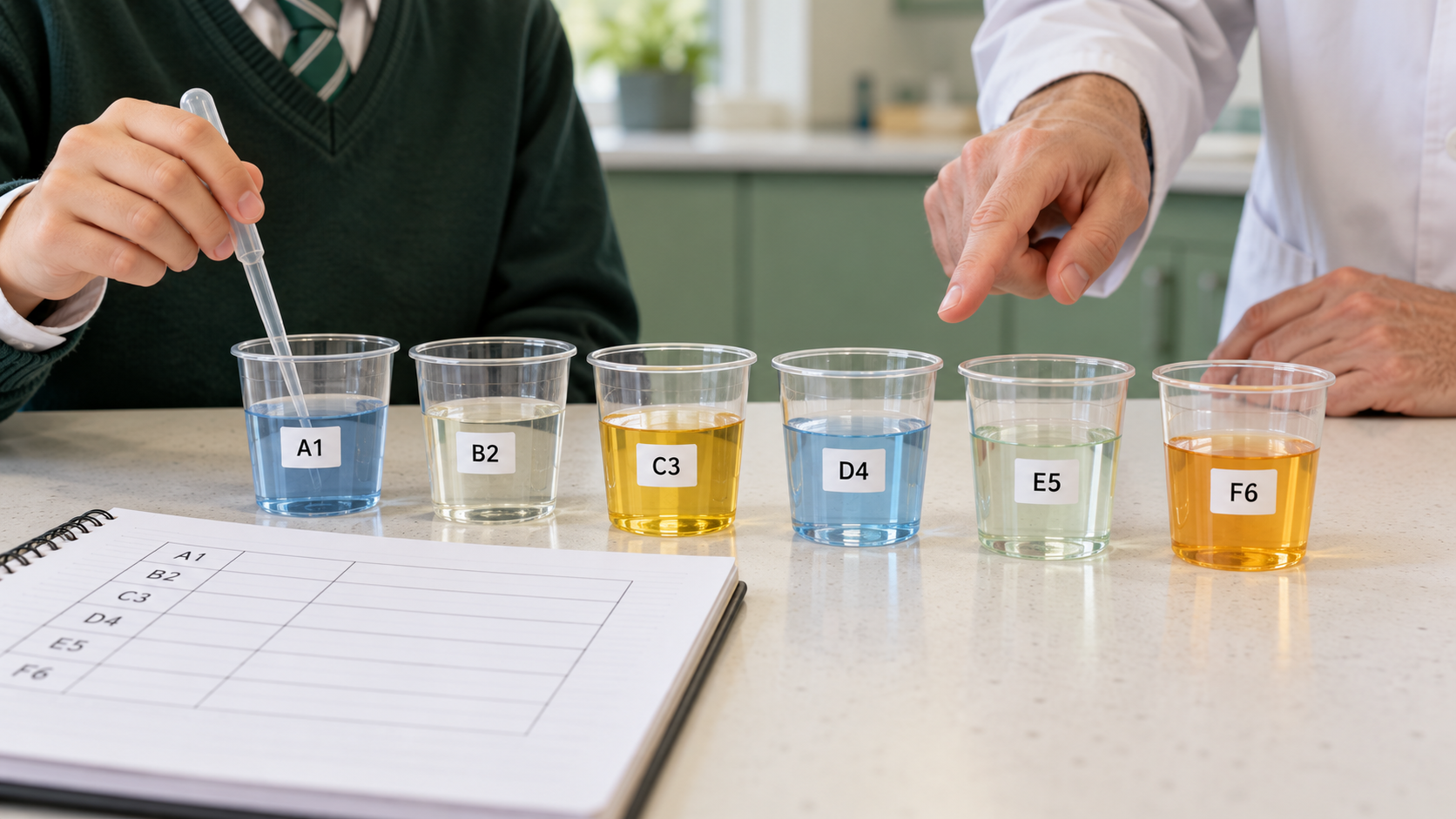
Toa Payoh Primary 3 students can understand the diversity of living things by learning how scientists compare observable characteristics, decide whether something is living or non-living, and classify organisms into appropriate broad groups. A strong answer does not simply memorise an animal’s name. It explains the relevant characteristic, shows how it is observed and avoids concluding that two organisms belong to the same group just because they look alike in one photograph.
Singapore’s MOE Primary Science Syllabus, implemented from the 2023 Primary 3 cohort, covers diversity of living and non-living things, plants, animals, fungi and bacteria. The syllabus emphasises characteristics such as growth, response and reproduction and groups including flowering and non-flowering plants, six broad animal groups, fungi and bacteria. It does not require recall of specific organism names and their detailed characteristics as a separate memorisation exercise. This guide uses safe hypothetical examples and an accessible learning sequence.
- Differentiate living organisms from non-living objects using several characteristics
- Remember that movement by itself does not prove something is living
- Observe growth, response, reproduction and basic survival needs
- Recognise flowering and non-flowering plant groups
- Compare mammals, birds, fish, reptiles, amphibians and insects
- Know that fungi and bacteria are living things but are not simply plants
- Use observable similarities and differences to make classifications
- Distinguish an organism from a material or manufactured object
- Read picture evidence cautiously; one photo may not show a complete life cycle
- Respect wildlife, plants and habitats while making observations
- Verify unfamiliar organisms with suitable reliable references
- Explain the reason for a grouping rather than copying a memorised label
Definition lock: classification uses meaningful observable characteristics
In this guide, living and non-living classification considers growth, response, reproduction and survival requirements together. Broad groups help organise biodiversity, but one image or behaviour may be insufficient. This is a Primary 3 educational guide, and the species mentioned are illustrative examples rather than asserted observations in Toa Payoh.
Part One: living things, evidence and broad animal groups
Diversity means that living things vary in meaningful ways
The word diversity refers to the variety of living and non-living things around us. A plant, an insect and a mushroom can appear very different yet each may be part of a living system. A stone, bicycle and glass bottle are non-living objects, even though they may move or change appearance under particular conditions.
Science classification helps us organise these observations. Instead of treating every new organism as an unrelated mystery, we ask what features it shares with known groups and which features distinguish it. The aim is understanding relationships and characteristics, not winning a contest to list the largest number of names.
Begin by showing pupils two or three authorised pictures and asking what can be observed directly. A pupil may describe number of limbs, visible leaves, body covering or apparent shape. Then ask which features would need more evidence before being used for classification.
Some living things cannot be seen well with the unaided eye, while a large non-living machine can move dramatically. Size and movement alone therefore do not establish biological life.
A good lesson ends with a clear classification reason. The learner should identify the relevant evidence and recognise when a picture lacks enough information for certainty.
Living things share important characteristics, but examples vary
The MOE Primary 3 syllabus asks students to describe living things as needing resources such as water, food and air, and as growing, responding and reproducing. At an introductory level, these traits distinguish living organisms from most non-living objects when considered together.
A seed may appear still for a long time, yet a viable seed can develop under suitable conditions. An adult animal may not be actively reproducing at the instant of observation, but reproduction remains part of its kind’s life cycle. A snapshot does not need to display every life process at once.
Students sometimes apply a checklist too mechanically. They may say a person who is asleep is non-living because they cannot observe movement, or a toy is living because it walks when powered. Both answers confuse one visible event with the broader biological characteristics.
Ask whether the observed entity is part of a living organism’s life cycle or simply an object moved by an external power source. The distinction can require more context than one photograph provides.
Use the features as mutually reinforcing clues, not as a requirement that every organism visibly demonstrate every characteristic during a short classroom exercise.
Movement alone is not proof of life
A bus moves but is not a living organism. A plant can remain rooted in one position while growing, responding to the environment and reproducing. Students who equate locomotion with life may misclassify both.
Movement can arise from wheels, wind, water or human action. If a leaf falls from a tree, the visible motion of the leaf is not the same as showing that the leaf itself is a separate organism moving by its own biological processes.
Some living organisms also show microscopic or slow responses that are not obvious in a short observation. Growth in plants may take days to notice, which is why photographs taken at different times can be useful evidence when properly documented.
Ask what caused the motion, whether the entity carries out other life processes and whether the question provides enough information to decide. A toy insect controlled remotely should not be classified as living because it looks or moves like an insect.
Teach pupils to give at least one valid reason beyond motion. This makes classification a scientific judgement instead of an appearance-based guess.
Growth is different from an object becoming larger
Living organisms can grow through biological development. A child becoming taller and a seedling developing leaves are familiar examples. Yet a non-living balloon can increase in size when inflated, so a change in dimensions alone does not demonstrate biological growth.
Ask what process caused the change. The balloon expands because gas is added or conditions change; a plant grows through cellular processes using resources and energy in appropriate conditions. The outward result may look similar but the mechanism is different.
Some objects such as crystals can also become larger under suitable physical conditions. Their growth in ordinary language does not make them living organisms. Scientific terms often require more precision than everyday descriptions.
A student should use evidence about life processes rather than say ‘it became bigger, therefore alive’. When context is missing, state what additional information would help.
This reasoning transfers to experiments. Observation identifies a measured change, while scientific explanation identifies a supported mechanism.
Response to surroundings is more than a reflexive movement
Living things can respond to changes in their environment. A plant may grow toward a source of light over time, while an animal may move away from an unsuitable stimulus. These are examples of biological response rather than arbitrary motion.
A door may open when an automatic sensor detects someone, yet the door and mechanism are manufactured systems rather than living organisms. Responding to input is therefore not the only characteristic used for classification.
Students should examine how the response relates to the living system and what other life processes the entity has. Avoid concluding that a machine is alive because it uses sensors or artificial intelligence.
Some biological responses are slower than the period of observation. A student should not infer that a plant cannot respond simply because a single photograph shows it unchanged.
Ask the pupil to distinguish the observed stimulus, the resulting change and the classification conclusion. The quality of reasoning matters more than how dramatic the response appears.
Reproduction links one generation to another
Reproduction is a process through which organisms produce new individuals of their kind. A flowering plant may produce seeds through suitable reproductive processes, while different animals may develop offspring in different ways.
One individual organism does not need to be reproducing at every moment to count as living. A young animal or an older organism can still be recognised as part of a living group because the broader life cycle and other characteristics provide evidence.
Some students imagine reproduction means a single animal physically turns back into an egg. Instead, an adult can produce offspring, and the new individual begins its own development. A life-cycle diagram is circular across generations, not backward ageing.
At Primary 3, detailed processes belong to the relevant later syllabus stage. The immediate purpose is recognising reproduction as a characteristic and explaining the continuity of living kinds.
A clear example can show an adult, offspring and subsequent growth without demanding advanced reproductive terminology.
Classify with more than one observable feature
Classification sorts items into groups using chosen characteristics. When identifying a broad animal group, useful features may include body covering, number of legs, wings or aspects of development as taught by the school.
One feature may not be enough. Flying does not establish that an animal is a bird because some insects and mammals can fly. Similarly, living in water does not mean every aquatic animal is a fish.
Ask the pupil to compare the proposed organism against a group’s relevant defining features rather than the most obvious action in one picture.
A classification rule should be consistent. If two objects are placed in different groups, the student should be able to explain which meaningful characteristic led to the separation.
Discuss what the photograph cannot show. An unfamiliar animal’s reproduction or internal structure may require a reliable text source, so a good answer need not pretend that every feature is immediately visible.
Plants include flowering and non-flowering groups
The MOE Primary 3 diversity syllabus identifies flowering and non-flowering plants as broad groups. A flowering plant produces flowers during suitable parts of its life cycle, while non-flowering plants reproduce through other structures or processes depending on the group.
Students should not conclude that a plant without a visible flower today is necessarily a non-flowering plant. It may simply not be in its flowering stage. Classification depends on biological characteristics, not what appears in one photograph.
Leaves, stems and roots can provide useful clues, but different plants have varied structures and growth forms. The school lesson should remain focused on broadly useful observable characteristics.
Some pupils think that all green living things are plants. Fungi and certain microorganisms illustrate why colour or immobility is not a complete definition of plant life.
A thoughtful observation names what is visible, considers the organism’s known group and acknowledges when additional information is needed for an accurate classification.
Mammals have identifying biological characteristics
Mammals are a broad group of animals that includes familiar pets and many wild animals. Mammalian features include milk production for young, while body covering and reproductive characteristics vary among the group’s members.
A pupil may assume every mammal has four legs or gives birth to live young in exactly the same way. The biological group has exceptions, so one oversimplified external feature should not be treated as an absolute test.
Bats are mammals even though they fly, showing why flight is not a definition of birds. Whales are mammals even though they live in water, showing why habitat alone is unreliable.
For Primary 3 work, use the broad grouping and observable similarities the school expects without forcing the child to memorise detailed facts about many named species.
The key is a reasoned classification that remains valid when the animal’s movement, location or size is unusual.
Birds are not simply all flying animals
Birds have feathers as a defining characteristic and generally have beaks and wings, though their flight abilities vary. Some birds fly strongly, while others spend much of their lives on land or in water.
A flying butterfly should not be labelled a bird merely because it has wings. An animal’s body structure and broader characteristics matter more than one shared behaviour.
Likewise, a flightless bird remains a bird. The absence of flying in one species does not erase the biological group to which it belongs.
Students can compare appropriate photographs of a bird and an insect, identifying visible features and explaining why both having wings is insufficient to place them in the same broad group.
A reliable classification does not depend on whether the animal is large, colourful or commonly seen near homes. It uses relevant distinguishing traits.
Fish and aquatic habitat are different ideas
Fish are a broad animal group commonly associated with aquatic life and relevant body structures, including gills in the familiar school examples. However, not every animal found in water belongs to the fish group.
A dolphin may swim and look superficially fish-like, yet it is a mammal. A turtle may spend substantial time in water but is classified with reptiles. The habitat alone does not determine the answer.
Ask what the pupil sees and which group characteristics they know from a reliable school source. If a photograph does not reveal sufficient features, additional information may be necessary.
Do not overburden a Primary 3 lesson with advanced exceptions or scientific taxonomy. The purpose is to avoid the simple error of grouping every swimming animal together.
A good explanation identifies the appropriate broad category and rejects habitat as the sole classification rule.
Part Two: life groups, careful classification and safe inquiry
Reptiles have characteristics beyond living on land
Reptiles form a broad animal group that includes many snakes, lizards and turtles. Their body covering and reproductive features can help with classification, but students should avoid assuming all reptiles live exclusively on dry land.
A turtle might swim regularly yet remain a reptile; a fish does not become a reptile because it occasionally appears near a rock. Habitat and one brief action are not enough to identify the biological group.
Ask the pupil to compare a reptile with a bird or amphibian through several relevant characteristics from a reliable school chart. One photograph may show skin or body covering more clearly than reproduction.
Some reptiles are unfamiliar to young children. The official syllabus explicitly avoids requiring the memorisation of particular organism names and detailed characteristics as an independent task, so focus on meaningful group features.
A strong answer explains why the proposed group fits and recognises that varied species can share an underlying classification.
Amphibians have life histories that matter
Amphibians include frogs and other organisms that often have life stages or adaptations associated with water and land. Their development can differ markedly from the adult form in familiar examples.
A child might classify a frog as a fish because its tadpole stage is aquatic. The mature animal and its biological development provide more information than the appearance of a single early stage.
Ask whether the question concerns a tadpole, an adult frog or the whole species. Distinguishing life stage from biological group prevents the error of treating one organism as belonging to unrelated groups as it develops.
Do not assume all amphibian species follow precisely the same visible life cycle. Use teacher-approved examples and keep detailed taxonomy outside the initial Primary 3 learning requirement.
The useful connection is between classification and life cycles: an organism’s group remains meaningful across development even when its body looks very different at different stages.
Insects have a body plan distinct from birds and spiders
Insects are a broad animal group typically described through three main body sections and six legs in the adult form. Many have wings, but not every insect flies or has visible wings.
A spider has eight legs and does not belong to the insect group, even though both may be small and encountered in gardens. Size is not the deciding characteristic.
A caterpillar is a larval stage of a butterfly or moth; its shape and movement differ from the adult insect. A pupil should not assume that an immature organism must display every adult feature in an obvious way.
Use a clear diagram of an appropriate adult insect and compare it with a spider. Ask the student which observable features distinguish the groups, then discuss how life stages affect appearances.
Good classification uses several relevant characteristics and context. The learner should not judge an unfamiliar animal solely from its ability to crawl or fly.
Fungi are living things, not automatically plants
The Primary 3 syllabus identifies fungi, including mould, mushrooms and yeast, as broad living organisms. Fungi do not simply function as small green plants; they have their own biological characteristics and ways of obtaining nutrients.
Students sometimes classify a mushroom as a non-living object because it remains in one place, or as a plant because it appears to grow from soil. Both conclusions rely too heavily on location or motion.
Explain that fungi are living organisms and that growth and reproduction can occur even when these processes are not directly visible in one photograph.
Do not encourage children to touch, taste, collect or cultivate unknown mushrooms or mould. Some can be hazardous. Printed images and school-approved materials are sufficient for Primary 3 classification.
The goal is recognition of the broad group and respectful scientific observation, not a home experiment involving unidentified organisms.
Bacteria show why size cannot define life
Bacteria are very small organisms that are usually not visible individually to the naked eye. Their existence illustrates why the inability to see obvious movement or organs does not imply that something is non-living.
A student may assume all bacteria are dangerous because news stories often focus on infections. In reality, bacteria occupy varied environments and may have different roles, some beneficial and others potentially harmful.
Classification at this level involves recognising bacteria as a broad group, not memorising extensive species names, microbial anatomy or medical treatments.
Do not ask children to culture bacteria from household surfaces or food. Such experiments can create health risks and are unnecessary for learning the official diversity outcome.
A useful lesson distinguishes observation from knowledge gained through scientific instruments. An illustration can teach about the group without pretending that one microscopic picture reveals every organism’s behaviour.
Classification depends on the question and chosen criteria
The same collection of objects can be grouped in different valid ways depending on the purpose. Animals may be grouped by broad biological class in a Science lesson, while a separate survey could group them by habitat or size.
These classifications answer different questions. A habitat grouping does not replace taxonomy; it simply highlights a different feature. The pupil should always know which criterion was requested.
For a fictional set of bird, bat and butterfly pictures, grouping by flight ability might place all three together, while biological groups separate them. The two groupings can both describe properties without claiming the organisms are closely related.
Ask the learner to label the criterion above the table before sorting. If the chosen feature changes halfway through, the grouping becomes inconsistent.
This skill transfers beyond living things. Materials, shapes and numerical datasets all require explicit criteria when a student claims that several items belong together.
A photograph can conceal important characteristics
An organism photographed from a distance may not display the features needed for confident identification. A small animal seen swimming could belong to several groups, and a plant without visible flowers may still be a flowering species.
Teach pupils to describe observable evidence first. They can say that an animal has wings or that a leaf has a particular outline without inventing unseen reproductive features.
Then ask what additional information would help: a clearer view, a reliable description of development or a reference from an appropriate educational source.
Do not treat the absence of a visible feature as proof that the feature does not exist. The camera angle, life stage and image quality can hide it.
An answer that recognises uncertainty can be more scientifically accurate than a confident but unsupported label. The official task may provide enough information to decide; the student should use what it supplies.
Care for living things is part of Science learning
The MOE syllabus includes care and responsibility toward living things among the values associated with the diversity topic. Respectful observation means avoiding unnecessary harm and disturbance while trying to understand an organism.
Toa Payoh greenery can inspire questions, but children should not pick public flowers, handle unknown fungi or collect wildlife to complete a worksheet. Use public spaces according to the relevant rules and adult supervision.
A photograph of an unfamiliar organism is an invitation to verify, not a reason to invent the species’ name or disturb its habitat. Official nature education resources can provide additional context where needed.
Do not assume that a harmless-looking insect, fungus or plant can be safely eaten or handled. Classification does not certify safety for human contact.
Scientific curiosity and care are compatible. A student can learn to identify broad groups through books, diagrams and suitable observation without treating living organisms as disposable classroom materials.
From Primary 3 classification to later biological systems
Primary 3 classification creates a foundation for later topics involving life cycles, plant systems, human systems and interactions in the environment. Recognising groups helps pupils understand why different organisms have different structures and functions.
A life-cycle diagram builds on the idea that an organism develops and reproduces; a food web builds on knowing which organisms play particular roles in a described ecosystem.
However, learning that a frog belongs to the amphibians does not automatically explain every feeding relationship or reproductive feature. Later topics introduce additional mechanisms and evidence.
Parents should resist adding an entire advanced Biology textbook to a child who is still uncertain about living and non-living characteristics. The next useful step is an accurate explanation of the current concept.
Knowledge grows through connected, appropriate stages. A stable classification foundation supports inquiry without requiring premature memorisation of unrelated facts.
A six-week classification learning sequence
Week one explores living and non-living characteristics through carefully selected pictures. Week two compares movement, growth and response with examples that reveal why a single feature can mislead.
Week three introduces flowering and non-flowering plants, and week four develops broad animal groups using relevant observable features rather than memorised species catalogues.
Week five distinguishes fungi and bacteria from the familiar plant and animal categories. Week six mixes unfamiliar images and asks pupils to justify a grouping and state what additional evidence might be necessary.
Each practice session can be short and age-appropriate. A learner should first explain a meaningful reason before being asked to recognise less familiar names or classify ambiguous photographs.
Progress is demonstrated when the child uses relevant characteristics consistently and remains careful about what cannot be decided from the supplied information.
Frequently asked questions for Toa Payoh parents
Is everything that moves living? No. Machines and moving objects can move without carrying out biological life processes; some living organisms remain in one place.
Is a mushroom a plant? No. Mushrooms belong to the fungi group, which the Primary 3 syllabus identifies separately.
Does every animal in water belong to the fish group? No. Many mammals, reptiles and other organisms use aquatic habitats. A biological classification needs relevant features.
Are all bacteria harmful? No. Bacteria have diverse roles, and pupils should avoid both unsafe handling and blanket claims about the entire group.
Must Primary 3 pupils memorise hundreds of organism names? No. MOE’s syllabus note says recall of names of particular living things and their individual characteristics is not required for the specified outcome.
What shows mastery? The learner identifies relevant life characteristics, selects a consistent classification criterion and justifies a broad grouping from suitable evidence.
Your next step: classify with a reason
Show your child three unfamiliar, reliable pictures of living or non-living things. Ask for observable characteristics, a proposed broad grouping and an explanation of why a competing grouping would be unsuitable. When the photograph cannot support certainty, identify what information is missing. Accuracy and curiosity matter more than recalling an unusual species name.
Official sources and related eduKateSG learning
MOE — Primary Science Syllabus 2023, Diversity of Living and Non-Living Things
Fengshan Primary School — Primary 3 Science Topic Overview
National Parks Board — Biodiversity and Nature Education
National Library Board — Books and Learning
eduKateSG — Primary Science Life Cycles and Germination
eduKateSG — Primary 6 Science Food Chains and Ecosystems
eduKateSG — Primary Science Inquiry and Safe Observations
eduKateSG — Secondary 1 Mathematics Tutor Clementi | Small Groups Tutorials
Arrange a parent–student consultation
eduKateSG provides premium three-student small-group academic tutorials by appointment at 8 Fourth Avenue, Singapore 268674, near Sixth Avenue MRT. Families from Toa Payoh can bring a school Science classification task and identify a precise learning gap. Check subject suitability, session availability and the actual journey before arranging tuition.
Properly taught kids shine a bright light into the future.