
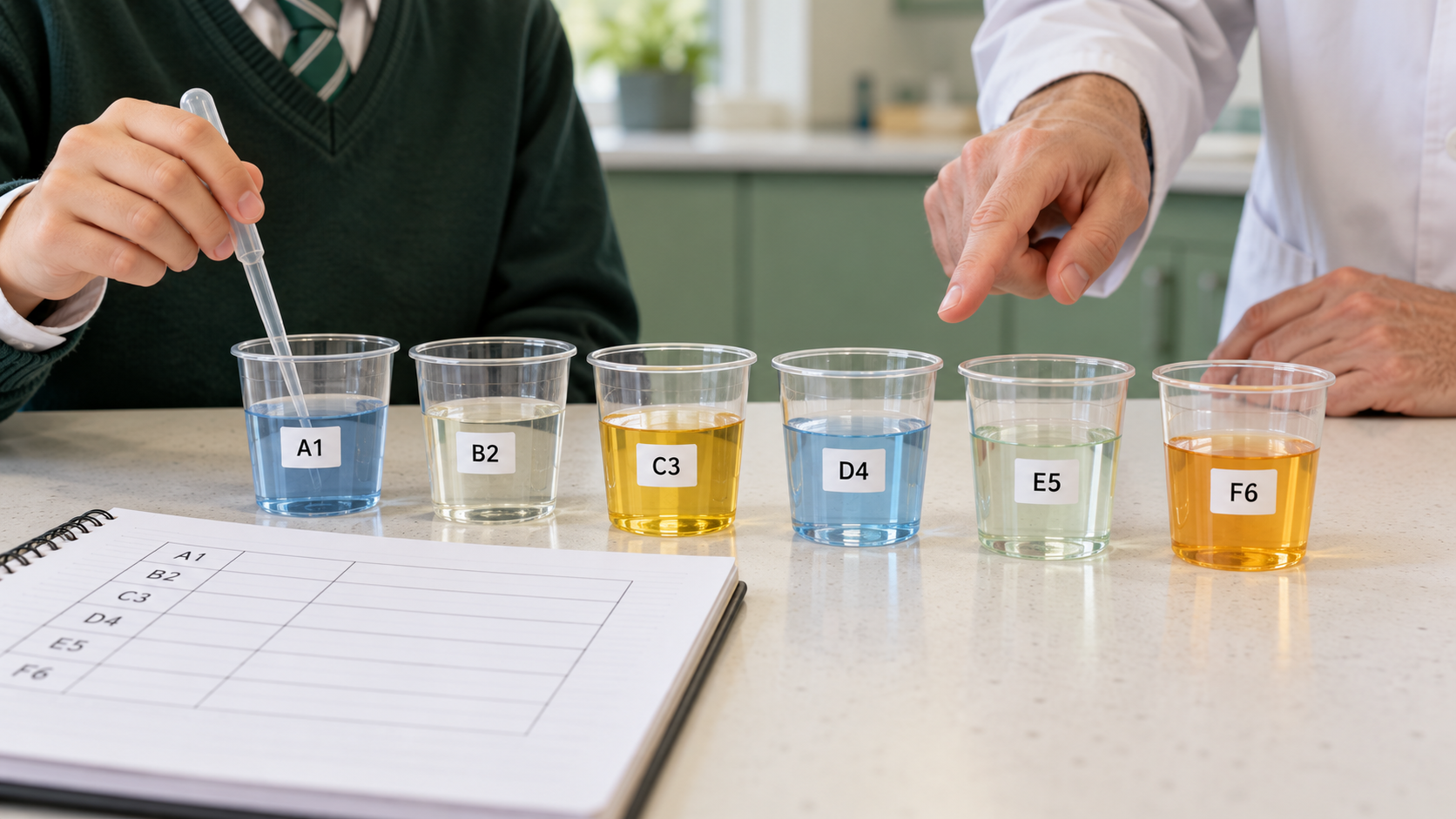
Toa Payoh students entering Secondary Science can learn practical laboratory skills by understanding instructions, recognising hazards, using approved instruments under teacher supervision, recording measurements accurately and explaining what an observation supports. School laboratory work is not simply an opportunity to carry out exciting experiments. It is a disciplined way to gather evidence while protecting students, teachers and the environment.
The correct first priority is safety: students must follow their school’s procedures, authorised supervision and instructions for equipment and substances. Singapore’s lower-secondary Science syllabuses include laboratory measurements, scientific investigation and the importance of safe practice, with content varying by subject level and school. This guide explains how to prepare, reason and report without teaching unsupervised operation of burners, chemicals, electricity or other hazardous apparatus. It complements, rather than replaces, practical instruction by qualified teachers.
- Know and follow the school’s laboratory rules before touching apparatus
- Read teacher instructions, apparatus labels and hazard warnings
- Wear required protective equipment exactly as instructed
- Do not improvise chemicals, heat sources or electrical circuits at home
- Report unknown substances, spills, damage or unsafe conditions immediately
- Distinguish direct observations from inferred explanations
- Select appropriate instruments and record units consistently
- Understand variables, fair comparison and sources of uncertainty
- Use readable tables and graphs with dates, labels and scales
- Treat anomalous results honestly rather than changing records
- Connect each conclusion to actual evidence and its limitations
- Ask the teacher when uncertain; safe inquiry includes knowing when to stop
Definition lock: safe, teacher-supervised laboratory work
In this guide, practical laboratory skills means careful preparation, observation, measurement, recording and explanation in approved school investigations. It does not authorise hazardous experiments at home or provide operational instructions for heat sources, chemicals, electrical apparatus or unknown materials. School-specific safety directions and trained teachers govern all actual laboratory activity.
Part One: safety, measurement and fair investigation
What a school laboratory is for
A laboratory provides controlled learning opportunities that are difficult to reproduce safely or reliably in ordinary surroundings. Students encounter scientific apparatus, measurement techniques, experimental designs and evidence that can strengthen their understanding of classroom concepts. The purpose is not to create a spectacular reaction but to investigate a defined question responsibly.
Secondary Science builds on Primary scientific thinking but introduces more specialised equipment, formal records and subject-level demands. The exact experiments depend on the school and the student’s course. An appealing internet demonstration is not evidence that a particular class will perform that activity.
Ask the child to describe the question before the practical begins. What will be observed or measured, what concepts are relevant and how will the results help answer it? These are learning questions to discuss with the teacher, not permission to change the assigned procedure.
Safety is part of scientific competence. A student who knows a formula but ignores restrictions, mislabels samples or conceals a spill is not demonstrating reliable practice. Careful procedures protect people and make data more trustworthy.
Families can reinforce habits of reading, recording and reasoning at home using paper examples and approved materials. They should not attempt to recreate school laboratory experiments with household substitutes, especially where heat, chemicals or electrical equipment are involved.
The teacher’s instructions govern the activity
Laboratory safety rules are not optional suggestions that a pupil may replace with methods from a video or remembered experiment. The school’s trained staff know the facilities, approved apparatus, hazards and safety arrangements. Students must follow their specific directions before, during and after practical work.
Teach an instruction-reading routine without handling apparatus: identify the purpose, permitted steps, warnings, necessary protective equipment, and the point where the teacher must check work. If any part is unclear, ask before proceeding.
A child may believe that performing a step faster demonstrates mastery. In a lab, speed can reduce accuracy and increase risk. The right pace is the one that allows careful setup, correct observation and safe supervision according to the teacher’s instructions.
Parents should never coach students to ignore school rules because a home method seems simpler. Laboratory procedures may account for hazards invisible in a short worksheet or photograph. A different-looking technique can require training and authorisation not shown on the page.
The transferable skill is procedural responsibility. The student learns to recognise when instructions are incomplete, seek clarification and respect boundaries instead of improvising when unsure.
Hazard symbols require attention and understanding
Laboratory labels can communicate risks such as flammability, corrosiveness, irritation or environmental harm. Students should learn to recognise symbols appropriate to their syllabus and follow the meaning taught by their school. A symbol is an instruction to treat a material carefully, not a puzzle to solve by touching it.
Ask the child what information a label provides: substance identity, risk and relevant instructions. Do not assume two similarly coloured liquids are interchangeable. An unlabelled container should be treated as unknown and reported to the responsible teacher.
Different symbols refer to different kinds of hazards. A material that may harm the environment is not necessarily safe for skin contact, and one that is not flammable can still present other risks. Students need the whole set of instructions, not one remembered icon.
A school laboratory may include equipment or materials outside the child’s current syllabus. The pupil should not handle those merely to learn what they do. Curiosity is valuable, but the authorised practical activity defines what is appropriate.
At home, the best practice is reading example safety labels in approved educational material and explaining why the correct response is to follow the teacher’s guidance. Do not turn hazard recognition into a family experiment with household chemicals.
Protective equipment is determined by the task
Laboratory protective equipment may include eye protection or other items specified by the teacher. The student should use exactly what the school requires and understand why ordinary clothing or casual habits may be inappropriate for particular work. General advice cannot replace the school’s risk assessment.
Teach children to check whether the required equipment is present and correctly used before an authorised activity begins. If protective equipment does not fit or is damaged, alert the teacher rather than trying to adjust hazardous work around the problem.
Some pupils assume that wearing protective equipment makes every procedure safe. It does not. Correct supervision, suitable apparatus, safe technique and awareness of surroundings remain necessary. A pair of goggles is not permission to handle unknown substances.
Do not borrow or substitute household protective items for school laboratory requirements without approval. An improvised glove or eyewear may offer inadequate protection and create false confidence.
The wider lesson is that safety controls work together. A responsible student respects the activity’s purpose, the instructor’s directions and the limits of available equipment before any measurement is attempted.
Know when to stop and inform a teacher
A laboratory problem can arise when apparatus breaks, an unidentified material is noticed or a procedure seems different from its instructions. A student’s correct response is to stop the relevant activity safely and inform the responsible teacher promptly, rather than conceal the issue or improvise a repair.
The child should know the school’s reporting and emergency directions before laboratory work. These differ by facility and should be taught by authorised staff. A general online article cannot instruct someone how to respond to every spill, exposure or equipment fault.
Avoid blaming classmates without understanding what happened. Clear reporting identifies the observation, location and immediate concern so that trained adults can act. Honest reporting helps protect the entire group.
Do not encourage pupils to clean up unknown chemicals or repair electrical equipment themselves. Handling an unsafe condition can create additional risk. The teacher will decide how the situation should be managed under the school’s procedures.
A valuable character lesson follows: admitting uncertainty or a mistake promptly is responsible behaviour. Science education should make it easier for students to tell the truth about what occurred, not train them to hide problems to avoid looking careless.
Observation is different from explanation
An observation is something directly detected or measured, while an explanation interprets why it occurred. A child may write that the temperature increased by three degrees in a hypothetical dataset; claiming which process caused it requires relevant concepts and evidence.
During practical instruction, students should record what they actually see or measure using permitted methods. The teacher may then guide them to connect the observation with scientific ideas. Keeping the two stages separate prevents guesses from being presented as results.
Use a paper exercise with a fictional table. One trial gives a value of ten units and another twelve. Ask what can be stated directly, then what additional information is needed to explain the difference. A larger reading alone does not identify every possible cause.
A common error is writing an expected outcome instead of the result observed. Pupils may think their notebook should match the textbook exactly. Explain that honest records are essential; unexplained differences should prompt verification, not invention.
The transfer is important beyond Science. A student who can distinguish evidence from inference is better equipped to interpret charts, news claims, historical sources and instructions in other subjects.
Read measurements with quantities and units
Different physical quantities require different instruments and units. Length, mass, time, temperature and volume describe different aspects of a situation. A reading of twelve is incomplete without knowing whether it means centimetres, grams or seconds.
Begin with a worksheet showing suitable instrument images and labelled scales. Ask the pupil which physical quantity each instrument is designed to measure. In a real lab, the teacher determines which equipment may be used and demonstrates the correct technique.
Students should record values with sensible precision. Writing many decimal places does not create accuracy when the instrument cannot resolve them. A measured value and an estimate also need to be distinguished.
A typical error is confusing the unit indicated by a scale with one assumed from an earlier question. Another is reading from the wrong reference mark. Teach the student to inspect the scale and write the unit before interpreting the result.
Check what the answer should mean. A mass reading does not become a volume merely because both involve a container. Accurate measurement begins with selecting the correct quantity, instrument and method.
Fair tests ask what changes and what stays comparable
A fair investigation tries to compare conditions in a way that isolates a relevant factor. Students should recognise what is deliberately changed, what outcome is measured and which other factors need to remain comparable. This is a reasoning task even when the procedure is provided by the teacher.
Imagine a fictional experiment in which two trials differ in temperature but also use different materials and amounts. If the outcomes differ, the student cannot confidently attribute the difference to temperature alone. The design includes confounding factors.
On paper, ask the learner to identify what would need to be controlled to make the comparison clearer. The purpose is to evaluate the logic of a proposed design, not to instruct a child to carry out a potentially hazardous experiment at home.
Some real investigations cannot control every external factor perfectly. Students should be able to identify those limitations and explain how they affect confidence in the conclusion. Careful language is better than claiming certainty the data cannot support.
The transferable skill is to design comparisons that answer the stated question. A well-drawn table cannot rescue a procedure in which several important factors change without explanation.
Variables need plain-language meaning before jargon
Students may be able to recite independent, dependent and controlled variable while misunderstanding the relationship. Start with ordinary descriptions: what is changed intentionally, what is measured as the outcome and what needs to be kept similar.
Use fictional cases so the child can focus on logic. A student compares the time different objects take to travel a fixed model distance. What might be deliberately changed, and which measurements would have to be recorded? The details should come from a safe school-provided task or hypothetical data.
Then introduce subject vocabulary at the appropriate syllabus level. The terms are useful because they allow concise communication, but they are not a substitute for explaining the comparison.
A common mistake is calling every number an independent variable. Some numbers are fixed conditions, calculated values or labels. Ask the learner to describe what actually changes between trials rather than guess from the location of a table column.
Once the roles are clear, invite a reasoned prediction. The prediction should connect a possible change to a concept, but it must remain separate from observations collected later.
Data tables must be interpretable by another reader
A table is a record of observations and measurements. The headings should identify each variable and its unit, while the rows should show which values belong together. A visually tidy grid that lacks context is not reliable evidence.
Before a practical, students can inspect the teacher’s approved recording format and check what information is expected. In school, follow the specified table rather than inventing columns that conflict with the procedure.
For a fictional dataset, label trial numbers clearly and show repeated measurements where appropriate. Do not put units inconsistently into only some cells or silently combine results from different conditions.
A useful test is whether another student could read the table several days later and explain which measurement came from which trial. If not, the record needs better labels, not more decorative formatting.
Honest data include unexpected readings. Pupils should not erase or change a result to produce the smooth trend they believe the teacher wants. A discrepancy may deserve checking and explanation, but the original observation should be handled according to the school’s recording rules.
Part Two: reliable data, graphs and conclusions
Graphs represent data, not imagined trends
A graph can make a relationship easier to see when data are recorded accurately. The title, axes, units and chosen scale should communicate what was measured. A colourful graph with missing labels may look complete while leaving the reader unable to interpret it.
Begin with a fictional table so learners can practise graphing without equipment. Decide which variable belongs on each axis and whether the relationship is best shown using a line or another appropriate format. The type of graph should follow the question.
Do not draw a smooth curve simply because the textbook illustration looks smooth. Actual measurements may contain variation, and a graph should represent the values honestly according to the assigned conventions.
Ask the child to describe the pattern before explaining it. Increasing, decreasing or approximately constant are descriptive observations. A statement about why a trend occurs requires a relevant scientific idea and supporting conditions.
A good graph should help another reader answer the original inquiry question, not merely occupy space in a report. If a table communicates a very small dataset more clearly, a graph may not add value.
Accuracy, precision and measurement uncertainty
A measured number is not always an exact statement about nature. Instruments have limits, readings can vary and observers may make mistakes. Students need age-appropriate ways to understand why recorded measurements contain uncertainty without treating every result as unreliable.
Accuracy concerns closeness to an appropriate reference or true value where it can be established. Precision concerns the closeness of repeated readings to one another. The ideas are related but not identical. A set of consistent readings can still be systematically wrong.
Teach this through drawings or teacher-approved sample data. A repeated set of measurements clustered together illustrates precision; a set closer to a verified reference illustrates accuracy. Avoid inventing laboratory results and then claiming they were personally measured.
Ask whether a reported number contains more digits than the instrument can justify. An answer written with many decimal places may look scientific while overstating the available evidence. Suitable units and precision must match the actual measurement.
The practical outcome is careful language. A student should be able to describe what was measured, how reliable the reading appears and what limits the conclusion. Honest uncertainty is part of sound scientific reasoning.
Anomalies should be recorded and investigated honestly
An anomaly is an observation that differs notably from an expected or general pattern. It might arise from measurement difficulty, a genuine phenomenon or another uncontrolled factor. The pupil should not automatically discard it merely because it makes the graph look untidy.
Start by confirming that the data were recorded correctly. Perhaps a unit, label or copied digit is wrong. Any change to the original record should follow the teacher’s procedures and be transparent. The aim is to preserve evidence rather than produce a preferred answer.
Where the difference persists, ask which conditions may have changed. Could the apparatus, timing or method have varied? A student should discuss possibilities as hypotheses, not claim a cause that has not been tested.
A class may be instructed to repeat a measurement, but that decision belongs to the supervising teacher. Learners should not repeat a hazardous procedure independently because a result looks unusual.
The written conclusion should distinguish the overall trend from the anomaly and explain any limitations. Reporting an unexpected result thoughtfully is stronger scientific practice than concealing it.
Repeated measurements and fair interpretation
Repeated observations can help reveal variation and improve confidence when a procedure allows them. However, taking more readings is useful only when the method remains suitable and consistent. Repetition cannot rescue a badly designed comparison in which several important factors change together.
Teach the purpose through an invented dataset. Suppose three readings of a fictional quantity differ slightly. The child can calculate a mean where appropriate and discuss whether one reading is very different. The exercise should not pretend that invented values came from a school experiment.
The number of repetitions, method of summary and treatment of anomalies depend on the task. Students should follow teacher guidance instead of imposing a single statistical rule on every activity. Not all measurements should be averaged uncritically.
If the instrument has a known limitation, repeated readings may not eliminate a consistent bias. Encourage learners to distinguish random variation from a possible systematic issue at the level they can understand.
Transfer the habit to everyday reasoning. One observation is often weaker evidence of a general trend than a well-designed set of observations, but the quality of the design matters at least as much as the number of entries.
Conclusions must return to the actual question
A conclusion is not a restatement of every number in the table. It should answer the investigation’s question and connect the answer to the relevant evidence. The strength of the claim must fit the strength of the data.
Ask the student to begin with what the comparison found. Then point to the readings that support it and explain the relationship using the appropriate scientific concept. An unsupported technical term does not turn a guess into a valid conclusion.
Distinguish an observation from a causal explanation. A fictional dataset might show that two quantities increase together, but that pattern alone does not establish that one causes the other. The design and background knowledge matter.
Encourage a limitation sentence. Perhaps only a small number of trials were available or conditions could not all be controlled. The purpose is not to excuse poor work, but to help the reader understand what can and cannot be claimed.
Finish by proposing a sensible next question or improvement within safe school procedures. Scientific inquiry develops when the learner knows what remains uncertain and how an authorised investigation could clarify it.
Part Three: teamwork, preparation and reporting
Work safely and fairly with classmates
Practical Science often involves sharing roles, observations and apparatus. Collaboration helps when each student understands the task and follows authorised instructions. One confident member should not conduct every meaningful step while others wait without learning.
Clarify responsibilities through the teacher’s directions. A learner may help record observations, explain a table or review a diagram, provided the roles fit the approved procedure. Teamwork never authorises unsupervised use of equipment.
If group members disagree about a reading, return to the recorded evidence and consult the teacher. The group should not vote for whichever result seems most like the textbook answer. Honest discussion improves the report.
A pupil who notices unsafe conditions should alert the responsible teacher rather than attempt a risky intervention. Protecting classmates and respecting one’s limits are part of responsible group work.
After the activity, each student should be able to explain the main investigation independently. Sharing tasks should deepen understanding, not conceal who actually learned the scientific concept.
Prepare through reading, not unsafe rehearsal
Pre-laboratory preparation can include reading the assigned question, reviewing relevant concepts and understanding teacher-provided diagrams. Students should know the purpose of the investigation and which instructions they need to clarify before entering the laboratory.
A safe home exercise is to identify the proposed measurement, units and observation table from a worksheet. The learner can explain the reasoning without touching apparatus. This often reveals a misunderstanding before the classroom activity begins.
Families should not reproduce school chemical, electrical or heating procedures using household substitutes. School laboratories have trained supervision, approved apparatus and safety systems that an ordinary home may not provide.
If an unfamiliar symbol or technique appears in the instructions, write a question for the teacher. A reference book can help explain vocabulary, but it cannot replace the school’s specific operating and safety directions.
Preparation succeeds when the child enters with a clearer intellectual purpose and knows when to ask for help, not when they have performed a dangerous procedure privately in advance.
Write a report that separates method and evidence
A laboratory report should allow another person to understand the question, authorised method, results and explanation. The school’s required structure takes priority. Clear scientific writing need not be ornate, but it should contain traceable information and accurate terminology.
Method describes what was done under school supervision. Results describe observations or measurements. Discussion connects those results to a scientific idea while acknowledging limitations. Mixing the sections can lead to an expected outcome being presented as if it were directly measured.
Use labelled tables and suitable graphs with units. Do not attach a photograph of a classmate or school equipment without permission. Pictures must add relevant evidence, not simply decorate the report.
In the discussion, ask what each observation supports. A copied definition does not automatically explain a measured pattern. The writer should connect the data to the mechanism relevant to the investigation.
Check the conclusion for unsupported certainty. When several explanations remain possible, state the limit rather than inventing a causal claim. Scientific accuracy includes knowing what has not been established.
An eight-week practical reasoning plan
Weeks one and two focus on safe laboratory expectations, hazard awareness and understanding when to ask a teacher for help. Use approved diagrams and school instructions. Do not handle hazardous apparatus or materials at home simply to rehearse an experiment.
Weeks three and four practise quantities, units, scale readings and the logic of variables with hypothetical data. The pupil should explain what is changed, what is measured and what needs to remain comparable before attempting any calculation.
Weeks five and six use clear data tables and graphs. Ask the learner to identify patterns without inventing causes. Distinguish what a reading directly shows from what a scientific concept helps explain.
Week seven considers unexpected readings and measurement uncertainty. Week eight produces a short paper-based practical report, identifying the question, intended observations, supporting evidence and limitations. The programme develops reasoning; real experiments must follow the school’s supervised procedures.
Frequently asked questions about school laboratory skills
Can a student practise a laboratory experiment at home? Hazardous school practicals should not be recreated at home. A parent can support preparation through safe reading and data-analysis exercises, while qualified teachers supervise actual school procedures.
What if a measured result differs from the textbook? Record observations honestly, verify the method with the teacher and discuss possible limitations. Do not conceal a reading or repeat an unsafe procedure privately to make the result look right.
Does every G1, G2 and G3 student have identical Science practical requirements? Not necessarily. Follow the child’s actual subject level, syllabus and school expectations. Learning activities and assessment requirements can differ.
What demonstrates improvement? The student can interpret approved instructions, report risks, record observations and units accurately, and explain a cautious conclusion that fits the evidence.
Your next step
Take an actual school Science worksheet and ask your child to explain the investigation’s question, safety warnings, quantities and intended results table. Then examine a teacher-reviewed report and distinguish what was observed from what was inferred. Keep all practical equipment use within authorised supervision.
Official references and related reading
MOE — Lower Secondary G1 Science Syllabus and Laboratory Procedures
MOE — Holistic Development and Learning
eduKateSG — Primary Science Inquiry in Toa Payoh
eduKateSG — Geography Fieldwork in Toa Payoh
eduKateSG — Secondary 1 Mathematics Tutor Clementi | Small Groups Tutorials
Arrange a parent–student consultation
eduKateSG offers premium three-student small-group tutorials at 8 Fourth Avenue, Singapore 268674, near Sixth Avenue MRT, by appointment. Toa Payoh families can bring a school Science explanation or report to discuss learning needs. All hands-on laboratory activities remain subject to school supervision.
Properly taught kids shine a bright light into the future.