
What are the best places to visit when touring Hiddensee? Start with the Dornbusch Lighthouse above the northern hills, explore Kloster’s Gerhart Hauptmann House and island museums, discover quiet Grieben, then move south through Vitte, the dunes and national park heath, the Baltic beaches and Neuendorf’s fishing village. The final stop is not an invitation to enter a restricted nature reserve: the southern Gellen should be appreciated only from permitted approaches. These ten experiences give a practical route through a German island whose appeal lies in its car-free character, history and coastal landscapes.
Hiddensee is a narrow Baltic Sea island off the west coast of Rügen in northeastern Germany. Ordinary private cars are not allowed on the island, and most holidaymakers use passenger ferries, walking and bicycles. To reach it, choose a ferry from Schaprode on Rügen or a seasonal mainland departure and pay careful attention to whether the boat lands at Neuendorf, Vitte or Kloster. The three ports serve different parts of the island. A relaxed first visit can be a full day concentrated around one or two villages; two or three days make it much easier to enjoy both ends without rushing.
21 October 2026 ferry and visitor note: FRS Reederei Hiddensee has an autumn Schaprode timetable valid through 22 October, with another timetable beginning 23 October. Changes and cancellations remain possible. Do not copy a departure time from a travel blog or assume every boat calls at all three ports. Check the operator’s current Schaprode sailing schedule immediately before booking and again before travelling. Museums, lighthouse interiors and seasonal cafés require their own checks. Core national park areas are protected even when a footpath looks visible on a map.


Quick answer: choose Hiddensee by your interests
- First visit: Arrive at Kloster, explore the village and choose a comfortable approach towards Dornbusch.
- Literature: Gerhart-Hauptmann-Haus and the island museum in Kloster.
- Families: A museum or Nationalparkhaus visit, a short permitted beach walk and an easy meal in Vitte.
- Nature: Walk authorised paths through the Dünenheide and observe the national park without entering core zones.
- Fishing heritage: Neuendorf and an unhurried village walk.
- Longer stays: Use separate northern, central and southern days, checking which port serves each.
- Mobility: Investigate the actual route and step-free facilities rather than assuming a car-free island is also entirely accessible.
All ten Hiddensee places at a glance
- 1. Dornbusch Lighthouse and the Northern Hiddensee Hills — North of Kloster, on the Dornbusch uplands.
- 2. Kloster Village and Gerhart Hauptmann House — Kloster, the island’s northern cultural centre.
- 3. Hiddensee Heimatmuseum: Island Life, Sea Rescue and Local History — Kloster, in a former maritime rescue-station building.
- 4. Hiddensee Island Church and the Historic Kloster Setting — Kloster, close to the village museum and cultural sights.
- 5. Grieben: The Northern Village and Rural Island Paths — North of Kloster, below the Dornbusch heights.
- 6. Vitte Village, its Harbour and the Blaue Scheune — Middle Hiddensee, principal village and busy passenger-ferry stop.
- 7. Nationalparkhaus Hiddensee and the Dünenheide Heath — Between Vitte and Neuendorf, in the central island landscape.
- 8. Hiddensee’s West Coast Beaches and Baltic Sea Walks — The long Baltic-facing western shore, using permitted access points.
- 9. Neuendorf Fishing Village and the Southern Beach — Southern Hiddensee, one of the three ferry-access villages.
- 10. Gellen Peninsula and the Southern Lowlands—View without Entering Closed Zones — South of Neuendorf, towards Hiddensee’s protected southern end.
The order starts in the north and gradually moves south. It is designed to help you navigate the island, but it does not mean that all ten attractions should be attempted in one day. A car-free destination rewards selective itineraries. Choose your port, check your walking distances and allow time to see what makes each community distinctive.
1. Dornbusch Lighthouse and the Northern Hiddensee Hills
Where: North of Kloster, on the Dornbusch uplands. Best for: Maritime navigation, Baltic panoramas and careful hill walking.
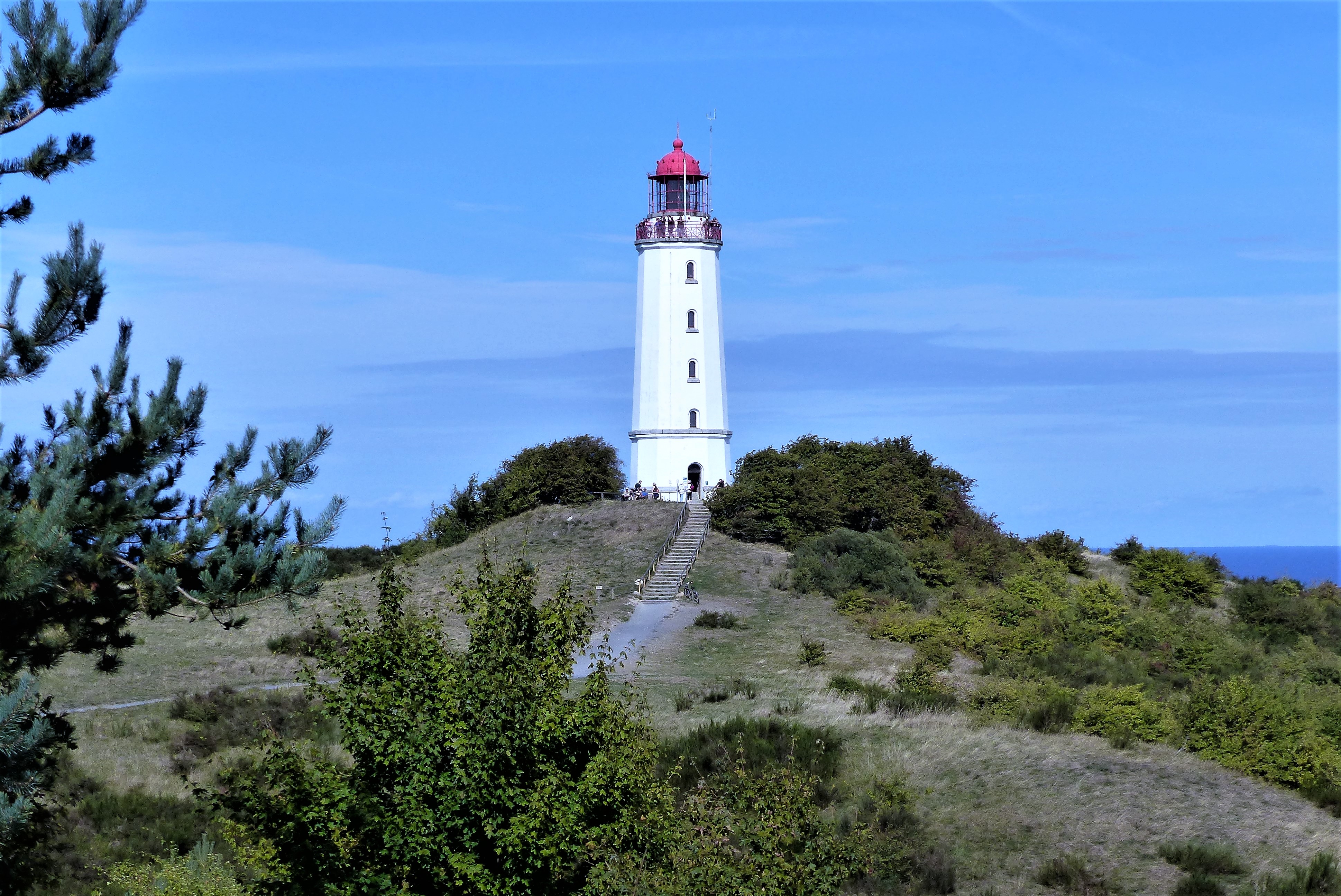
The Dornbusch Lighthouse is Hiddensee’s clearest landmark, a tall white tower with a red lantern above the island’s northern high ground. It dates from the late nineteenth century and helps connect the scenery to a practical story: vessels in the Baltic needed dependable navigational information near coastlines, channels and shallows. On a clear day, the upland views explain why this position was chosen. Far below you can see how the narrow island has a sea-facing coast and a sheltered, intricate Bodden side. The lighthouse is also a useful first lesson in how Hiddensee differs from other North German seaside destinations. Its northern landscape is not simply a low strip of beach, and reaching the tower calls for walking through a sensitive, sometimes windy environment.
The attraction is the whole approach, not only the possibility of climbing the tower. Start from Kloster and follow an authorised walking route towards the Dornbusch hills. Allow time to turn back or pause when the climb becomes tiring. At the summit, notice how the building commands the surrounding land and what that says about maritime technology. A tower interior may be open in a designated season, but stairs, weather rules and operational decisions can limit entry. You can have a rewarding visit without climbing a single tower step. The scenery is particularly dramatic when clouds cross the Baltic, yet that drama also makes it important to keep back from steep coastal edges.
Check the current lighthouse opening arrangements before telling children or other travellers they will be able to ascend. A public path to the outside of a landmark does not guarantee access inside. Wear stable shoes; grass and steps can become slippery in rain, frost or strong winds. Do not cut across grazing land, protected vegetation or unstable cliffs to imitate a photograph. The northern heights form part of a landscape that demands more careful walking than a town promenade. People with mobility limitations should contact the relevant visitor office about suitable viewpoints rather than assuming the historic lighthouse can be reached or climbed without steps. During storms, the safer choice is to enjoy the area’s cultural venues in Kloster.
Standing below the lighthouse, ask what makes its height useful. A beam can be seen over long distances, but only where topography, visibility and the sea horizon permit. Weather such as fog may undermine what seems like a perfect line of sight on a sunny day. The island’s narrow shape and nearby waters invite a simple geography exercise: identify the open Baltic to the west and the sheltered lagoon-like Bodden waters toward Rügen. You can discuss the change from visual light signals to more sophisticated navigation systems without assuming modern technology makes lighthouses entirely irrelevant. A good viewpoint provides questions as well as photographs.
Route suggestion: Give Kloster and Dornbusch a substantial northern half-day. Do not force a long southern hike into the same short afternoon.
Return to all ten places · Next Hiddensee place
2. Kloster Village and Gerhart Hauptmann House
Where: Kloster, the island’s northern cultural centre. Best for: Literature, architecture and the artist history of Hiddensee.
Kloster is Hiddensee’s most important cultural village, combining everyday island life with a legacy of artists and writers who came for the island’s light and relative seclusion. The best-known literary museum is the Gerhart-Hauptmann-Haus, associated with the playwright and 1912 Nobel Prize in Literature laureate. The house gives visitors a much more precise understanding of Hiddensee’s cultural reputation than a vague claim that famous creative people ‘once came here’. It preserves an environment connected to the writer’s daily routine and offers displays about literary modernism and island visitors. Kloster itself deserves a gentle walk: its harbour, village scale and proximity to the northern hills show that this is a community, not simply a historic novelist’s summer backdrop.
The museum’s interpretation includes the historic summer house and a later extension linked by a corridor in which Hauptmann liked to work. Such architectural details are more revealing than a general list of famous guests. Examine how living space, working space and landscape were related. A writer choosing an island home was still dependent on boats, supplies, weather and the work of neighbours. Beyond the museum, take time for a local meal or a short stroll towards the harbour. If you arrive in Kloster by ferry, the village is a practical start point for museum visits, the church and later a hill walk towards the lighthouse.
The official Hiddensee municipal page lists specific opening windows for the Gerhart-Hauptmann-Haus in 2026, with shorter schedules in the shoulder seasons and changes reserved. Do not assume a house museum is open every afternoon because the village itself is accessible. Check tickets, guided-tour times, language provision and the suitability of its historic layout for visitors with reduced mobility. The house is a museum, not an invitation to enter adjacent private dwellings or gardens. Walk slowly in a village whose narrow lanes serve residents and deliveries. If your party has limited time, choose either a thorough literary visit or the full lighthouse outing rather than rushing both.
A writer’s home invites a deceptively simple question: how can a place influence creative work? Landscape is not a mechanical cause of a poem or drama, but a setting can affect routine, observation, privacy and social connections. Compare a preserved room with a modern exhibition label. Which objects are historical originals, and which interpretations have been added for readers? Ask how an archive can document a writer’s life without pretending to reveal every inner thought. This attention to evidence belongs to good history and good literature alike, and it is what makes the visit more worthwhile than simply checking a famous name off a list.
Route suggestion: Pair with Hiddensee Heimatmuseum and the island church if open, or use the village as your base for the Dornbusch path.
Return to all ten places · Next Hiddensee place
3. Hiddensee Heimatmuseum: Island Life, Sea Rescue and Local History
Where: Kloster, in a former maritime rescue-station building. Best for: Local history, family learning and rainy-day culture.
The Heimatmuseum Hiddensee is among the best places to understand the island from the perspective of its residents. It occupies an old sea-rescue-station building dating from 1888, and the museum itself began operating in 1954. That setting is appropriate: maritime rescue, fishing, ferry transport and coastal risk have long mattered here. The museum’s exhibits discuss local life, village history, ships, the history of the monastery, island holidaymakers and culture. It works as an especially valuable companion to the literary museum because it broadens the story beyond well-known visitors and places the island’s families and everyday systems back at the centre.
Expect a series of displays rather than a giant national museum. That smaller scale can be its strength. Objects and photographs help visitors imagine how households managed food, work and connection with the mainland when crossings were more limited and the weather had a greater immediate impact. Family visitors can use the interpretation to discuss the role of sea-rescue volunteers and why a maritime community needs more than picturesque boats. The museum also interprets seasonal living and summer houses, helping distinguish the island’s year-round community from the influx of visitors. Some of the exhibition material is available in English as well as German, according to the museum.
The official museum website publishes different schedules for April–October and the colder months; it also offers guided visits, with some requiring a minimum number of participants. Consult the site for your date rather than relying on a general statement that the museum is ‘open daily’. The former rescue-station architecture may not have the same accessibility as a contemporary museum, so check entrance arrangements. Allow time to look carefully, perhaps one to two hours depending on interest, and do not assume every seasonal temporary display will be present in another month. If a strong coastal wind makes an outdoor itinerary unpleasant, this is one of the most useful alternatives.
What does a rescue station tell us about a place? It suggests people depended on vessels and that sea travel carried risk. This leads to questions about technology, volunteer institutions and the cost of keeping island settlements connected. A photograph of an old ferry can be compared with the current passenger service, but a museum object does not tell the whole transport history by itself. Read labels, ask whether an item was donated by a family and consider how local memory differs from national history. Children may discover that the daily problem of transporting bread, medicine or school materials can be just as interesting as the story of a famous author.
Route suggestion: Make this a compact cultural visit in Kloster, with Gerhart Hauptmann House or a weather-suitable village walk.
Return to all ten places · Next Hiddensee place
4. Hiddensee Island Church and the Historic Kloster Setting
Where: Kloster, close to the village museum and cultural sights. Best for: Religious heritage, architecture and respectful cultural observation.
Hiddensee’s island church is a modest landmark whose significance comes from continuity rather than sheer size. The building’s early history is associated with the medieval monastery community and the church has survived as a place of worship through major changes in island life. The very name Kloster means monastery, so the location offers an invitation to think about how a religious foundation influenced settlement, land and community identity. Today the church is not simply an unused monument preserved for tourists. It remains a setting for services and important personal occasions, which should guide how visitors approach the building.
Take time to observe the church’s exterior, its setting in Kloster and its relationship with nearby village streets. If the church is open outside ceremonies, you may be able to look at its interior and decorative features. Distinguish what is original from later alterations instead of assuming every part is medieval simply because the building has old roots. Religious heritage may appeal to architecture lovers, historians and readers interested in how communities preserved their institutions on a relatively isolated island. Even a short respectful exterior stop can provide context for the local museum’s discussion of the monastery and village.
Do not enter during a private wedding, funeral or another restricted event. If a worship service is taking place, respect the expectations of the parish and avoid intrusive sightseeing. Opening hours can change, so verify them at the local information office or parish. Keep voices low and ask before taking close-up photographs of worshippers. The site is near other Kloster attractions, making it easy to include without extra transport. However, that convenience does not erase the fact that this is a functioning community space rather than an attraction whose sole purpose is to serve a holiday itinerary.
Ask why a small island would build and maintain a church despite limited transport and resources. The answer may involve spiritual life, education, community gatherings and links with authorities on the mainland. The site’s medieval history also provides an opportunity to discuss how a place name can preserve an old institution long after the institution itself has changed. Compare the use of a church today with what a local museum tells you about its past. A respectful visitor learns to recognise that living heritage has present-day users whose needs matter.
Route suggestion: Visit quietly while exploring Kloster, between the island museum and literary house. Keep the route flexible around parish activities.
Return to all ten places · Next Hiddensee place
5. Grieben: The Northern Village and Rural Island Paths
Where: North of Kloster, below the Dornbusch heights. Best for: Village scale, historic farm houses and quiet northern walking.
Grieben is one of the island’s oldest small settlements and a rewarding alternative to the better-known museum and lighthouse stops. Its homes, gardens and rural lanes present Hiddensee on a domestic scale. Here the pleasure is not a large admission-gate attraction, but the experience of seeing a village shaped by the sea, limited space, the movement of visitors and the labour of residents. The ferry operator’s destination guide describes Grieben as the oldest and northernmost of Hiddensee’s villages, with documentary mention reaching back to the thirteenth century. Its quiet character is worth acknowledging without romanticising the practical difficulties of year-round island living.
Take a respectful walk through public paths, notice the relationship between homes and the surrounding hills, and appreciate how building scale and landscaping differ from a mainland town. A small village may offer fewer cafés and services than Vitte, so it is best visited as part of an existing northern route. The appeal is to slow down enough to see small details: a hedge protecting a garden from wind, the direction a lane takes, or the way the settlement sits between open country and maritime access. Those observations give substance to the word ‘village’.
Grieben is not a museum village in which every house is open to inspection. Respect gardens, fences, working areas and the privacy of inhabitants. Avoid close photographs of residents without consent. The footpaths can be exposed, and the distances between settlements are more noticeable on a car-free island. Take water, allow daylight for the return to Kloster or your ferry port, and check how much walking your group can comfortably manage. If travelling with children, do not promise an attraction or playground that the village does not actually provide. A peaceful walk is the experience.
Grieben encourages comparison between the tourism economy and everyday community needs. What services does a family living on a car-free island require—groceries, medicine, repairs, refuse collection and emergency care? How are they supplied without private cars? A village visit is a reminder that ‘quiet’ is not the absence of infrastructure. It is supported by transport arrangements and local work that may be less visible than a famous lighthouse. Encourage children to identify one practical detail of island life that a travel photograph would usually leave out.
Route suggestion: Link Grieben with Kloster and the Dornbusch area; do not turn it into a separate multi-hour cross-island drive, since private cars are not permitted.
Return to all ten places · Next Hiddensee place
6. Vitte Village, its Harbour and the Blaue Scheune
Where: Middle Hiddensee, principal village and busy passenger-ferry stop. Best for: Everyday island life, village art and practical orientation.
Vitte is Hiddensee’s largest settlement and a natural place to start for visitors arriving by ferry. It contains much of the island’s practical visitor infrastructure, including tourism services, accommodation, shops and connections to walking and cycling routes. A harbour walk makes the car-free character of the island immediately visible: passengers, baggage trolleys, bicycles and authorised service vehicles all have to be managed differently from traffic in a typical coastal resort. In the village, the Blaue Scheune or Blue Barn is an instantly recognisable landmark associated with the island’s artistic history. The attraction of Vitte lies in the combination of a living community and creative traditions rather than in a single grand monument.
Spend your first hour looking around the harbour and village before setting off for a long coastal outing. Check where ferries arrive and depart, where bicycles may be hired or taken aboard and where public paths lead towards the beaches. If the Blue Barn or an associated exhibition is open, use it to explore how artists interacted with the island’s everyday environment. Do not assume every historic artist-related house is publicly accessible. Vitte offers a good chance to eat, rest and understand the island’s pace before tackling the northern hills or the quieter southern path.
At the quay, obey ferry staff instructions and do not stand in moving vehicle or luggage areas to photograph the boat. FRS Reederei Hiddensee’s 2026 timetable distinguishes voyages to Vitte, Kloster and Neuendorf, meaning your arrival port and your intended walking route must match. Some sailings include multiple island stops, and bicycle accommodation is limited on certain vessels. Check the current schedule and bring appropriate payment methods for local services rather than assuming everything operates like a mainland railway station. If you are visiting in autumn, confirm when cafés and galleries close, as the summer visitor schedule may not apply.
A working ferry port is one of the best places to understand how a car-free island functions. Deliveries, visitor transport, maintenance and emergency services still require coordination. Look for evidence of how the system solves practical problems without permitting ordinary private-car use. The village’s artistic history adds another dimension: residents and artists may see the same street differently. One sees the route to work; another sees a subject for a painting. A careful travel account recognises both viewpoints and does not treat the community solely as scenery.
Route suggestion: Use Vitte as an orientation hub, then choose a west-coast beach walk or the Nationalparkhaus and dune-heath route.
Return to all ten places · Next Hiddensee place
7. Nationalparkhaus Hiddensee and the Dünenheide Heath
Where: Between Vitte and Neuendorf, in the central island landscape. Best for: National park interpretation, dunes and coastal ecology.
Hiddensee lies within the Western Pomerania Lagoon Area National Park—Nationalpark Vorpommersche Boddenlandschaft—and the Nationalparkhaus Hiddensee is a useful place to begin understanding that designation. The island is not just a beach resort. Its coastal dunes, heathland, lagoons, saltmarshes and bird habitats form part of a protected ecological network extending to the wider Baltic and Bodden landscapes. The Dünenheide between Vitte and Neuendorf is especially distinctive: open heath vegetation, sandy ground and a shifting relationship between exposure and shelter make it unlike the grassy northern hills. A good visit connects the beauty of the landscape with the work of managing habitat and visitor pressure.
Look for the Nationalparkhaus’s interpretation before choosing a trail. Exhibition information can help distinguish which plants and birds may be observed in different seasons and why routes are marked. Along an authorised path through the heath, notice changes in vegetation, dune shape and the way wind affects low shrubs. The area rewards patient observation rather than searching for one famous photo point. Some species are hard to see or seasonal, and an empty-looking stretch of ground can still support vulnerable organisms. There is no need to step off a path to find a plant or insect.
National park rules are more important than a suggested itinerary. Stay on designated paths and follow signs for core protection zones, bird nesting areas and restricted shorelines. Dogs may need to be leashed under park regulations, and drones can disturb wildlife or be restricted. Dry heath and vegetation can be vulnerable to fire, so do not light fires or discard cigarette ends. The terrain may include sand, roots and uneven surfaces; choose trail length for your actual party. Check the Nationalparkhaus visitor hours because an exhibition centre may be closed even when paths remain accessible. In windy or wet weather, shorten the visit instead of assuming the route is an indoor-style attraction.
Ask why people sometimes protect a landscape by allowing limited access rather than forbidding every visitor. Interpretation centres help explain the compromise: public knowledge can support conservation when visitors remain on approved routes and avoid disturbing habitats. Compare the Dünenheide with the rocky northern hills or the southern Gellen lowlands. Each needs different ecological management. This visit is a useful reminder that sustainable tourism means understanding the living systems that make a destination attractive, not simply promising that every famous viewpoint will be available at any time.
Route suggestion: Pair with Vitte and a short stretch of the west-facing beach, or use the Vitte–Neuendorf walking route when conditions and time allow.
Return to all ten places · Next Hiddensee place
8. Hiddensee’s West Coast Beaches and Baltic Sea Walks
Where: The long Baltic-facing western shore, using permitted access points. Best for: Relaxed sea views, quiet walks and family time.
For many visitors, the simplest pleasure of Hiddensee is walking along its Baltic-facing beach. The island’s long, slender form creates a coastline where sea, sky, sand and light dominate the view. Unlike a busy mainland road resort, the shoreline can feel tranquil without the constant presence of private vehicles. A beach visit can also be an excellent contrast to the literary museums and lighthouse. You do not need a ticket or a complicated plan to watch the weather move across the sea. The appeal depends on the particular stretch and season rather than on a claim that one beach is objectively better than every other.
Choose a public beach access near the part of the island where you are already walking. A short shoreline break after Vitte or Kloster can feel more satisfying than walking many kilometres purely to reach a point marked on a map. Look at differences between soft sand, grasses on dunes and the landward landscape. A summer picnic can be lovely, while a cool October day may call for a bracing walk followed by a warm drink in a village. Families can build sand structures without collecting protected plants or disturbing habitat. For swimmers, current local bathing information and conditions matter far more than a photograph of calm water.
Do not assume lifeguard coverage, warm water or easy access on every section. Strong wind, waves, currents and cold water can create hazards even when the beach looks inviting. Dunes and protective vegetation should not be crossed outside designated paths. Some stretches belong to a national park with additional restrictions, so follow signs rather than treating the entire coastline as equally accessible. Take rubbish away, supervise children near the water, and avoid walking right beneath unstable northern cliffs. In winter and shoulder seasons, factor in daylight and weather changes before setting off for a long beach hike.
A beach gives visitors a practical geography lesson. Sand grains, dune grasses, wave direction and seasonal erosion all tell stories about the movement of material along the shore. Compare the western coast with the sheltered Bodden side visible from ferries or routes through the island. What difference does exposure to the open Baltic make? You may not be able to prove every process from one afternoon, but you can observe the coastline carefully and read official explanations later. Most importantly, a gentle beach day teaches that resting and noticing can be valuable forms of travel.
Route suggestion: Add a manageable stretch to Vitte, Kloster or Neuendorf, rather than trying to walk the entire island in one day.
Return to all ten places · Next Hiddensee place
9. Neuendorf Fishing Village and the Southern Beach
Where: Southern Hiddensee, one of the three ferry-access villages. Best for: Traditional fishing, local architecture and a less hurried pace.
Neuendorf is Hiddensee’s southern village and an appealing place for travellers who want to see more than the lighthouse-and-Kloster circuit. Traditional fishing houses and low thatched-roof buildings help give the settlement its distinctive appearance. The village grew around work that depended on maritime resources, and its connections with the open Baltic and sheltered waters were practical necessities long before modern tourism. It is not a reconstructed theme park. Its character survives in a community that still needs ordinary services, resident privacy and careful visitor behaviour. A walk here balances the island’s northern literary history with its long association with fishing families.
Arriving by ferry directly at Neuendorf is an option on services that call there; otherwise, travel on foot or by a suitable cycling route from Vitte. Take time to explore public village lanes, look at the modest building forms and enjoy the nearby beach without trespassing. Some local heritage displays may interpret fishing techniques and village history when open. Avoid making a promise about entering a particular fishing hut unless the operator or museum confirms access. The pleasure is in the relationship between an old settlement, a modern ferry stop and a quiet stretch of coast, rather than in a list of expensive activities.
Check that your outbound and return voyages actually stop at Neuendorf; some ferries call at Vitte and Kloster instead. A short crossing to one port does not mean your return boat will depart from the same place at the same time. If you plan to walk northwards after exploring the village, calculate distance, rest stops and daylight for your party. Village houses may be privately owned, so photograph carefully and do not enter gardens. The southern shore can be exposed, and a less-used section of beach should not be assumed to have rescue or café services. Support open local businesses without expecting resort-style convenience year-round.
Neuendorf encourages the practical question ‘How do people live on a fishing island?’ Boats are only part of the answer. Families needed homes, equipment storage, food preservation, transport to markets and knowledge of weather. Today tourism and other services coexist with fishing traditions, bringing opportunities and pressures. Think about what a resident needs when holidaymakers depart: school access, healthcare, winter transport and maintenance. By recognising those systems, travellers gain a richer understanding than the idea of an isolated picturesque village.
Route suggestion: A good destination for a southern half-day; pair with the permitted approaches to the Gellen landscape and the Dünenheide, but do not enter protected core areas.
Return to all ten places · Next Hiddensee place
10. Gellen Peninsula and the Southern Lowlands—View without Entering Closed Zones
Where: South of Neuendorf, towards Hiddensee’s protected southern end. Best for: Bird habitat, changing shorelines and responsible long-distance views.
The Gellen is Hiddensee’s long, low southern peninsula, a different world from the hills and lighthouse at Dornbusch. Sand, shallow coastal water, dunes and saltmarshes form a landscape closely connected to the national park and bird migration. It is tempting to call the peninsula a hiking attraction because maps show it extending dramatically into the sea. That is misleading without an important warning: significant parts of the southern Gellen are strictly protected, and access can be prohibited. The correct visitor experience is to appreciate the scenery from permitted public paths and viewpoints near Neuendorf and to learn why the protected core exists.
Start by reading the current National Park guidance and signs before considering any southern route. The area’s main attraction is its ecological meaning: birds rely on undisturbed feeding and resting places in a coastal network that spans the Baltic and other migratory routes. If an approved viewpoint allows you to see the lowlands, take binoculars and observe at a distance. The shifting coastline and exposed horizon make for compelling natural scenery without needing to stand on the extreme tip. Do not assume the southern lighthouse or structures visible on maps can be reached as an ordinary leisure walk. A legal viewpoint is a more respectful destination than a trespass.
The national park’s core zones are not optional detours. Do not cross barriers, walk around ‘no entry’ signs at low tide, enter breeding grounds, fly drones over sensitive sites or ask a guide to violate access rules. Consult visitor information for exactly where public access currently ends. Children should understand that a protected area may be worth studying precisely because people do not enter it. Some paths near the southern coast can be sandy, wet or unsheltered; bring wind protection and avoid a long excursion in deteriorating weather. In the absence of a clearly authorised route, enjoy Neuendorf and its public beach instead.
Gellen provides a rare opportunity to explain why the top ten places in a travel guide need not all be entered. The peninsula is part of an ecological system that depends on quiet spaces. If migratory birds cannot feed and rest safely, the effects can extend far beyond Hiddensee. Compare this with the visitor-friendly Dornbusch lighthouse route: different places require different access choices. Consider the difference between a protected area having scientific and scenic significance and it being a tourist attraction open for unrestricted exploration. Choosing not to enter can be the most informed travel decision of the day.
Route suggestion: Treat as a nature-interpretation destination from allowed locations near Neuendorf, never as a promise of walking to the far southern tip.
A practical one-day Hiddensee itinerary
For a first day trip, choose one main section rather than trying to reach both the extreme north and south. From Schaprode, take an early suitable service to Kloster if available on your date. Explore Kloster’s church or a confirmed museum, have lunch, and then walk an authorised path towards the Dornbusch lighthouse according to your fitness and the weather. Return to Kloster or a nearby port that is served by your actual booked sailing. That gives a coherent island experience of literature, history and dramatic coast without putting the return boat at risk.
A second one-day option centres on Vitte. Arrive at the harbour, learn about the car-free village, visit the Nationalparkhaus if open and explore a short marked Dünenheide or beach route. This works particularly well for families and for travellers who do not want to tackle the northern hills. The departure arrangements matter: confirm whether the final ferry leaves Vitte or another port and how long you need to reach it on foot. Do not assume a local taxi will operate like a mainland private car; authorised island transport is limited and must be planned.
The southern option is a quieter Neuendorf visit, with the village and permitted coastal viewpoints as the main focus. A day trip does not give permission to walk into Gellen’s core protection area, regardless of whether a map shows a path. Choose a sensible turnaround time. It is entirely possible to have a memorable Hiddensee visit with one harbour, one museum or nature walk, and a good meal. The island’s charm is partly that the itinerary does not have to be complicated to feel complete.
Two days or three days on Hiddensee
A two-day plan lets the island unfold from north to centre. Use the first day for Kloster, the Gerhart Hauptmann museum, the Heimatmuseum and a weather-suitable lighthouse outing. On the second day, work through Vitte, Nationalparkhaus and the Dünenheide, with a beach break. For travellers staying near Neuendorf, reverse the route and make the southern village your starting point. Reserve time between attractions: sandy or uneven footpaths, a longer museum exhibition and food stops all add time that is not obvious from a map.
With three days, add a separate southern day around Neuendorf and authorised views towards Gellen. You can also make a quiet stop in Grieben as part of your northern itinerary, or simply repeat a favourite coastal walk in different light. Book a suitable guesthouse if you prefer not to depend on the same-day return. Accommodation in small island settlements can be seasonal and sells out during popular periods; check the provider and cancellation terms. Three days are not necessary to ‘finish’ Hiddensee, but they allow you to experience its slower pace rather than racing to cover every named viewpoint.
Whether your holiday lasts one day or a week, group attractions by place. Kloster’s cultural museums belong together, Vitte connects naturally with the Nationalparkhaus and central coast, and Neuendorf forms the southern cluster. The long walk between these areas is part of the journey, not an invisible transport link. Do not copy a route map intended for fit cyclists as an effortless family stroller itinerary. The best plan gives you time to stop and asks honestly how much walking each visitor will enjoy.
How the ferry works: Schaprode, Stralsund and the three island ports
Hiddensee’s main regular connection comes from Schaprode on Rügen, operated by FRS Reederei Hiddensee. The island ports of Neuendorf, Vitte and Kloster are not interchangeable: a boat may call at one, two or all three depending on the timetable and the vessel. A service arriving at Kloster could be ideal for the lighthouse, while Vitte is often more convenient for the Nationalparkhaus and central beaches. Neuendorf serves the south. Travellers coming from other parts of Germany should first choose how they will reach a ferry departure port, since the island itself does not admit ordinary private cars.
There are also services on certain routes and seasons from Stralsund, Breege and other coastal locations. Check whether a timetable is a regular public service, a seasonal excursion or a limited-date sailing. The journey from Stralsund can take substantially longer than the Schaprode crossing, with intermediate calls and different stops. The operator’s information should be treated as authoritative for departure port, bicycle space, pets, luggage and cancellation rules. If you intend to bring a bicycle, check whether it is permitted and whether space is guaranteed on that particular service. Limited decks cannot accommodate unlimited bicycles simply because the island is car-free.
For October 2026 specifically, the Schaprode timetable changes after 22 October, with a published set of sailings beginning 23 October and further low-season changes in November. A departure that exists today may not run on the date you have in mind. Avoid printing permanent ticket prices or telling readers a ferry ‘always leaves’ at a particular clock time. Recheck current operator changes, wind warnings and any port restrictions before beginning the road journey. Leave an appropriate margin for the final return boat because there may be few late departures outside the busiest season.
The short boat ride is part of the island experience. Watch how the routes move through waters between Rügen and Hiddensee and how the terminals serve residents, goods, visitors and emergency needs. On arrival, keep clear of ferry unloading areas and respect staff instructions. Avoid dragging heavy luggage into a long unplanned walking route. If you need accommodation transfer or adapted mobility assistance, contact the provider before departure. The car-free policy is attractive partly because it changes the transport system, but those changes require preparation for people who cannot comfortably carry bags or walk a long distance.
Is Hiddensee really car-free? How to get around
Hiddensee is often described as a car-free island, and that is a useful shorthand for visitors: holidaymakers do not normally bring private passenger cars onto it. However, the word should not be interpreted to mean that all motor vehicles are completely absent under every circumstance. Authorised service, emergency and other regulated vehicles may operate for essential tasks. Visitors generally travel on foot, by bicycle or through appropriate island transport arrangements. That difference matters to accurate writing, particularly when describing accessibility or promising that a village will have no vehicles whatsoever.
Walking is perhaps the best way to experience the island because you notice the transitions between sea, heath, village and protected shore. But distances require consideration. A stroll through Vitte is easy for many people; a route from Neuendorf all the way towards the northern lighthouse is a more substantial excursion. Bikes can help when riders are comfortable with the paths, weather and regulations. Some sections are sandy, uneven or shared with pedestrians, and certain protected routes may restrict cycling. Stay on legal cycling paths, ride considerately through villages and park bicycles where they do not obstruct doorways.
If someone in your party needs adapted transport, do not assume that finding a taxi on arrival will be as easy as in a city. Ask the accommodation, tourist office or ferry operator about actual available options. An island with limited cars can be a peaceful place but not automatically a step-free or wheelchair-accessible one. Historic buildings, coastal pebbles and sandy trails may create barriers. This is one area where an accurate advance question can protect a visitor from disappointment more effectively than a generic claim that the island is ‘perfect for everyone’.
National park and wildlife: why some places are deliberately closed
Hiddensee is part of Nationalpark Vorpommersche Boddenlandschaft, Germany’s Western Pomerania Lagoon Area National Park. The wider landscape encompasses outer Baltic shores, dunes, sheltered Bodden waters and significant habitats for birds. Migration and breeding require areas where human disturbance is minimised. This is why park authorities designate areas with different protection levels and why signs may restrict entry even when a coastline looks open on a map. The southern Gellen is especially important in this context; it is not a place to treat every track as a visitor route.
The conservation rules do not make nature inaccessible. They direct people towards appropriate public pathways, visitor centres, lookouts and seasonal programmes. A guided tour can help people understand birds and habitats without disrupting them. The Nationalparkhaus in Vitte is a particularly helpful starting point for families because it makes complex ecological questions accessible. Binoculars and a little patience often lead to better wildlife encounters than walking closer. Some birds may be absent at the time of your visit, and a spectacular sighting should never be promised merely because photographs from another year show it.
Do not use drones in sensitive areas without verified permission, allow dogs to chase wildlife, disturb resting flocks or cut through dunes to reach the shore. If you find a barrier, accept it. The long-term value of a protected coastline depends on visitors respecting what they cannot directly see, including nesting sites and fragile plant communities. This also makes for a more sophisticated travel story. An island should not be reduced to places that tourists can enter; some of its most important places are essential because they are left undisturbed.
Best time to visit, food choices and responsible holiday planning
Late spring and summer bring long daylight, a wide selection of seasonal visitor services and pleasant opportunities for beaches and longer walks, although the island can be busy and popular accommodation may need advance booking. Autumn may offer quieter paths and changing coastal light; it also brings fewer café openings, shorter museum hours and more variable ferry conditions. Winter can be beautiful but requires closer attention to daylight and shelter. There is no universally best time without knowing whether you prefer swimming, birdwatching, literature, photography or quiet walking.
Hiddensee is not a place where every village has a supermarket and restaurant serving late into the evening. Check meal times for the specific village where you will be staying and be prepared for some seasonal closures. Local seafood and traditional dishes may appeal to travellers interested in the region’s fishing history, but menus, opening times and prices change. If you are cycling or walking between villages, carry drinking water and a sensible snack, especially outside summer. Do not rely on an unverified café from an old online listing to support a long excursion with small children.
A responsible visit helps local businesses without imposing unnecessary pressure on small communities. Respect residents’ privacy, keep paths clear and follow local rules for beaches and cycling. Arrive at cultural museums prepared to learn rather than photograph every corner. Do not take sand, plants or protected natural materials as souvenirs. And remember that an attractive holiday photograph may show a public path in perfect weather that would be uncomfortable or unsafe on the day of your own visit. Current information and a flexible plan are much more useful than a rigid top-ten checklist.
Families, mobility and children on Hiddensee
Families can enjoy Hiddensee by selecting three simple types of experience: one village, one nature or beach outing, and one short cultural visit. A walk through Vitte followed by the Nationalparkhaus and a suitable beach can be a comfortable day if everyone is able to manage the distance. Kloster with a shorter lighthouse approach works well for older children who enjoy landscapes and history. A heavy programme involving several hours of museums and a long north-south walk may tire younger children and prevent them from appreciating the island at all.
Historic house museums often include stairs or narrow passages, while the lighthouse has its own access limitations. Sandy paths, unstable pebbles and steep hills should not be casually described as accessible. Ask the tourist office or venue staff about suitable routes for strollers, wheelchairs and travellers with limited mobility. Some people will have a better experience with a short harbour stroll and a viewpoint than with a challenging hike; both choices can be a complete and meaningful holiday. It is sensible to prioritise comfort, safety and actual interests rather than the number of famous places visited.
Discuss conservation rules positively with children. A closed Gellen core area is not a disappointment but a chance to learn why birds need peace. A museum building that is not open today does not make the island less interesting; you can focus on a permitted nature walk. A lighthouse you cannot climb can still explain navigation from outside. Travel teaches flexibility and observation, and a family that makes one good decision about the weather or wildlife will often remember that experience long after it forgets how many stops appeared on the day’s checklist.
What Hiddensee teaches about islands, literature and geography
Try a straightforward approach during the trip: observe one feature, suggest a reason for it, and check the explanation. At Dornbusch, notice the lighthouse high above the surrounding shore and ask why the site is useful for navigation. At Kloster, examine the relationship between a writer’s preserved home and the place that shaped his routine. At Vitte, watch how a ferry unloads without private cars waiting at an ordinary road dock. In the Dünenheide, notice how plants tolerate sandy, exposed conditions and ask what the national park is protecting. These small questions connect history, science and everyday life without turning a holiday into a lesson plan.
The island also teaches a more subtle distinction between cultural image and reality. Artists, writers and photographers have celebrated Hiddensee as secluded and peaceful, yet real residents need deliveries, emergency services, waste management and reliable transport. ‘Car-free’ describes a policy that creates a particular visitor experience but also requires operational systems. A village associated with a famous writer remains a community with other histories. The landscapes familiar from beautiful photographs can be subject to erosion, seasonal wildlife restrictions and strong winds. Good travel writing respects both the image and the facts behind it.
For readers interested in words and communication, ask how a description changes depending on the purpose. A museum label explains an object; a ferry timetable gives actionable times; a nature reserve sign instructs visitors to protect a habitat; a poem may evoke an atmosphere. Confusing these purposes leads to mistakes, such as relying on a literary impression for practical safety or treating an old schedule as permanent. Learning to distinguish reliable, current operational information from timeless background is one of the most valuable skills a thoughtful traveller can bring home.
Useful English–Chinese island vocabulary
- island — 岛屿 — dǎoyǔ
- lighthouse — 灯塔 — dēngtǎ
- ferry — 渡轮 — dùlún
- harbour — 港口 — gǎngkǒu
- sand dune — 沙丘 — shāqiū
- heathland — 石楠荒原 — shínán huāngyuán
- national park — 国家公园 — guójiā gōngyuán
- nature conservation — 自然保护 — zìrán bǎohù
- fishing village — 渔村 — yúcūn
- author — 作家 — zuòjiā
- museum — 博物馆 — bówùguǎn
- coast — 海岸 — hǎi’àn
- bird migration — 鸟类迁徙 — niǎolèi qiānxǐ
- weather forecast — 天气预报 — tiānqì yùbào
Use these terms when they help describe a real place. Say ‘lighthouse’ at Dornbusch, ‘ferry’ when choosing your port, and ‘conservation’ when discussing why the Gellen’s protected sections are closed. The purpose is not to memorise an entire translation table on holiday. One clearly understood word anchored to an authentic observation is more valuable than a long vocabulary test unrelated to what a learner has experienced.
Frequently asked questions about Hiddensee
Where is Hiddensee?
Hiddensee is a long, narrow Baltic Sea island off the west coast of Rügen in Mecklenburg–Western Pomerania, Germany. Visitors generally reach it by passenger ferry, especially from Schaprode on Rügen, with certain seasonal services from other ports. It is not the same place as Rügen or the islands around Denmark.
Is Hiddensee completely car-free?
Ordinary visitors do not bring private passenger cars onto the island. Authorised essential, service and emergency vehicles may still operate under local rules, so ‘car-free’ is a shorthand for an island transport policy rather than a claim that no motor vehicle can ever be seen.
What are the best attractions for a first visit?
The Dornbusch Lighthouse and Kloster’s cultural museums make a strong northern itinerary. Vitte, its harbour and the Nationalparkhaus are practical for a central-island day, while Neuendorf offers fishing-village heritage and southern scenery. Choose according to your ferry landing port and walking ability.
How many days do I need?
One full day can be very rewarding when focused on one or two neighbouring locations. Two or three days allow unhurried northern, central and southern experiences without rushing. There is no requirement to visit all ten places on one trip.
Which ferry should I take?
FRS Reederei Hiddensee operates regular services from Schaprode. Check whether your specific sailing stops at Neuendorf, Vitte or Kloster, and use the operator’s timetable for your date. Other routes such as Stralsund may be seasonal or take substantially longer.
Do ferry times change in October 2026?
Yes. The Schaprode operator shows one autumn timetable through 22 October 2026 and another beginning on 23 October, followed by low-season changes in November. Actual sailings may change due to weather or operations, so verify the live schedule just before travelling.
Can I bring a bicycle?
Some boats carry bicycles, sometimes with limited places or reservation requirements. Check your particular service and the island’s approved cycling routes before booking. Hiddensee has sandy or restricted paths that are not suitable for riding everywhere.
Can I climb Dornbusch Lighthouse?
Climbing depends on opening schedules, weather, capacity, and the suitability of the staircase for the visitor. Do not assume the tower is open year-round. The legal exterior approach and nearby viewpoints remain worthwhile options when a climb is not possible.
Can tourists walk to the tip of the Gellen peninsula?
Do not assume so. The southern peninsula contains national park core protection zones with restricted or prohibited access. Follow current national park signs and approved routes; view the landscape from permitted positions near Neuendorf rather than trespassing to the far tip.
What is Gerhart Hauptmann House?
It is a literary museum in Kloster associated with the German playwright Gerhart Hauptmann, winner of the Nobel Prize in Literature in 1912. The museum interprets his life and the island’s literary culture through preserved rooms and exhibitions. Check its current opening hours.
Is Hiddensee suitable for families?
Yes, if you choose manageable walks and realistic attractions. Vitte, the Nationalparkhaus, beach walks and a short museum visit can suit many families. More exposed headlands, historic staircases and long sandy paths need closer assessment for young children or visitors with limited mobility.
Are there restaurants and shops all year?
Some services are seasonal and the range is smaller in winter. Check the specific village’s opening times, particularly if you are planning a long walk or a late ferry return. Carry appropriate water, snacks and clothing.
What is the easiest mistake to avoid?
Planning as if the whole island is accessible by car or as if every ferry reaches every port. Match the route to the ferry landing point, choose manageable walking sections, respect the national park and leave a generous margin before the last return boat.
Official sources and connected eduKate travel guides
The operator and primary visitor information below should be consulted for current sailings, nature regulations and seasonal opening. Site details and background checked in October 2026. Weather, access and services can change more quickly than historical facts; the article does not make permanent promises about current tickets, opening hours or wildlife sightings.
- FRS Reederei Hiddensee — Schaprode ferry timetable, October and winter 2026
- FRS Reederei Hiddensee — official operator and service updates
- FRS Reederei Hiddensee — Kloster, Vitte, Grieben and Neuendorf
- FRS Reederei Hiddensee — authorised island hiking suggestions
- Mecklenburg–Western Pomerania tourism — Hiddensee
- Seebad Hiddensee — Gerhart Hauptmann House 2026 visitor hours
- Gerhart Hauptmann House — official museum interpretation
- Hiddensee Heimatmuseum — island history, opening and family visits
- Western Pomerania Lagoon Area National Park — protection and visitor information
- National Park — approved Hiddensee cycle routes
- Hiddensee regional tourism — Vitte and its local attractions
- eduKate — Top 10 Places to Visit When Touring Rügen Island
- eduKate — Top 10 Places to Visit When Touring Germany
- eduKate — Top 10 Places to Visit When Touring Bornholm
- eduKate — Top 10 Places to Visit When Touring Fårö Island
- eduKate — World Travel & Luxury Hub
Photo attribution: Dornbusch Lighthouse on Hiddensee, taken 16 September 2018 by Horst J. Meuter, Wikimedia Commons source, CC BY-SA 4.0 license, image unmodified. The photograph does not establish current access conditions.
Hiddensee is memorable precisely because it refuses to fit into a hurried driving tour. The northern lighthouse asks you to climb and look out; Kloster’s museums invite you to read and remember; Vitte shows the ingenuity of a car-free community; the heath asks you to observe gently; and protected southern areas teach the value of leaving space for wildlife. Plan the ferry carefully, respect residents and conservation rules, then let the island’s slower rhythm become part of the visit.