
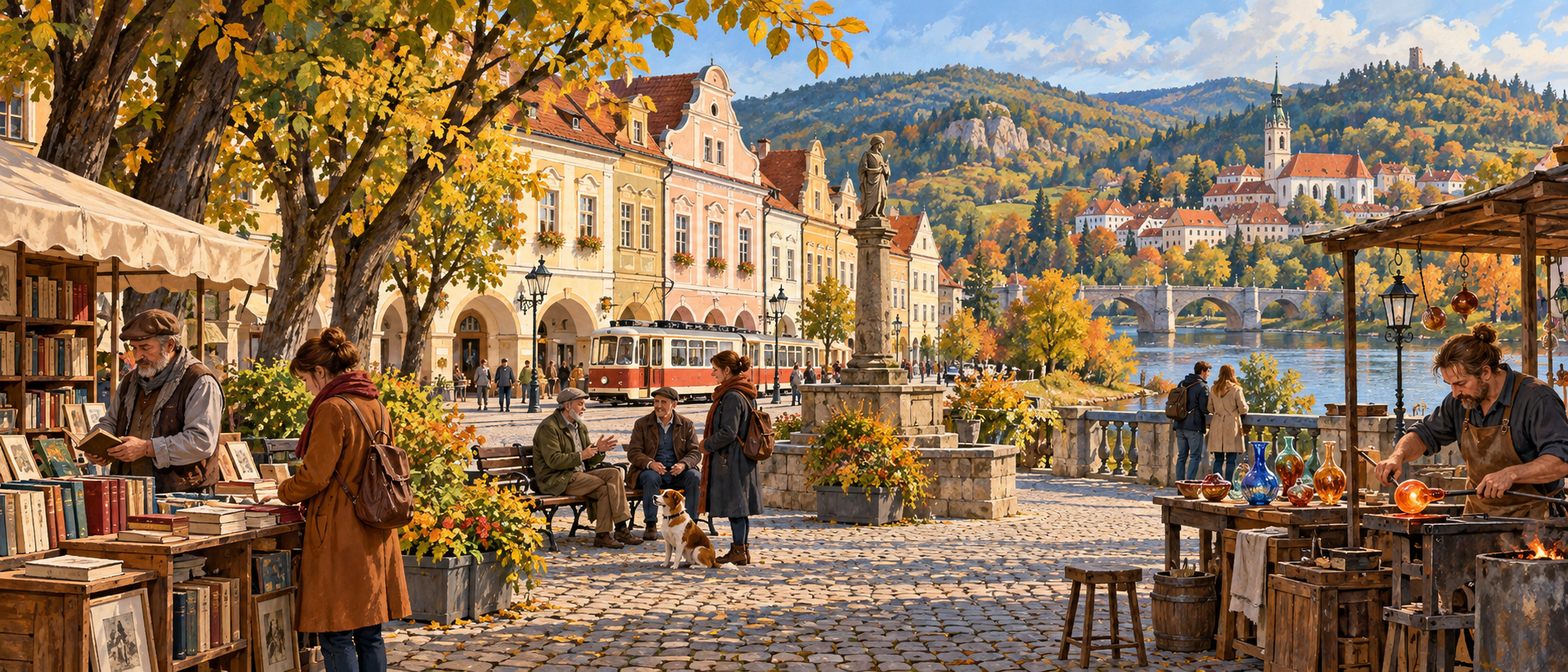
Czechia rewards travellers who look a little beyond Prague’s astonishing skyline. The best things to do when visiting and touring Czechia include exploring Prague Castle and Charles Bridge, walking Český Krumlov’s riverside streets, reading Kutná Hora’s mining history, discovering Brno’s modernist architecture and seeing why the Moravian Karst and South Bohemian landscapes deserve their own days. What makes the Czech Republic so enjoyable is not the number of castles on a checklist; it is the way cities, countryside and ordinary café life tell different parts of the same story.
This Czechia travel guide offers ten meaningful attractions and experiences, practical first-time Czech Republic itinerary ideas, UNESCO heritage, public transport tips and a sensible approach to seasons. Whether you want a Prague and Český Krumlov route, day trips from Prague, Czech spa towns, medieval towns or nature hikes, choose experiences by region. A memorable journey has enough room for one excellent museum, a long lunch and the surprise of an unfamiliar street.
Travel details reviewed 9 October 2026: Czechia belongs to the Schengen area, uses the Czech koruna rather than the euro, and applies nationality-specific passport and visa conditions. EU Entry/Exit System biometric registration may apply to short-stay visitors at external Schengen borders. Seasonal castle openings, cave tours and national park trails must be verified before making connections. Entry, opening, transport, security and weather conditions must be reconfirmed for the exact journey.
eduKateSG · A WORLD WORTH UNDERSTANDING
Choose your Czechia story
A bridge at sunrise, an ancient silver town, a modernist villa and an evening in Moravia.
Czechia at a glance
Prague sits in Bohemia, the western historical region of Czechia. Many famous stops fall within day-trip distance, but ‘near’ does not mean every historic town can be enjoyed between breakfast and dinner. South Bohemia rewards an overnight stay around Český Krumlov; Karlovy Vary belongs to a western spa-town chapter; Brno and the Moravian wine and karst landscapes form an eastern one.
The rail network makes journeys between major cities practical, and buses fill useful gaps. For visitors travelling with children or large bags, the relevant question is not how many stops appear on a train map but how far the accommodation is from the station and how much walking the old town demands. Cobblestones and castle steps require realistic footwear and pacing.
Czechia is an especially rewarding place to notice different styles of architecture: Gothic, Baroque, Renaissance, Art Nouveau and twentieth-century Functionalism coexist with living neighbourhoods. UNESCO recognises numerous Czech cultural sites, but the best travel day often balances one celebrated landmark with a local market, park, café or small museum.
- Good first visit: Prague for three or four days plus one coherent side trip, such as Kutná Hora.
- South Bohemian extension: Český Krumlov and a relaxed river-and-castle day, rather than a rushed two-hour stop.
- Moravia: Brno, the Moravian Karst and the Lednice–Valtice landscape can shape a separate multi-day route.
- Transport and money: Trains are useful between cities; Czech koruna is the everyday currency.
Safety, entry and respect for place
Check Schengen eligibility for your passport and calculate your permitted stay across all Schengen countries, not only Czechia. For visitors using the common 90-days-in-180-days allowance, previous time in Austria, Germany, Poland or other Schengen states is relevant. Border registration under the EU Entry/Exit System may include a photograph and fingerprints and can lengthen arrival queues.
Tourist-heavy areas invite normal big-city precautions. Keep belongings secure on trams, around crowded squares and at stations, use legitimate transport providers and confirm prices before agreeing to optional services. Historic paving becomes slippery in rain or ice, while stairs in towers, caves and castles may be difficult for some travellers.
Nature has its own conditions. Sandstone parks can close trails after weather damage or conservation work; caves require a guided-entry slot; mountainous areas may retain cold or snow when city weather feels pleasant. A safe trip adjusts the day’s plan rather than treating an old photograph as proof of accessibility.
1. Read Prague Castle as a working timeline, not a single building
Prague Castle appears above the Vltava like one immense monument, but the complex is better understood as a collection of political, religious and architectural layers. St Vitus Cathedral, courtyards, palaces and smaller streets each represent a different purpose and historical period. Give the castle enough time for a chosen route instead of trying to cross every courtyard while watching a departure clock.
Begin by looking across the city from the hill: the river, bridges and dense old quarters make the geography visible. When you enter an interior, pay attention to how people used the space and how it was changed over centuries. A guide who can distinguish Gothic stone from later rebuilding makes the experience much richer.
The castle remains an active ceremonial and institutional setting. Security checks, restricted areas and opening times may change with events. Visitors should follow official guidance for ticketed interiors and respect places of worship rather than treating the entire site as an unrestricted backdrop for photographs.
Make it meaningful: Select one castle circuit and one unhurried panorama, with time to understand architectural change.
Practical check: Review the Prague Castle official opening calendar, security procedures, ticket packages and accessibility.
Contents · Previous section · Next section
2. Walk Charles Bridge and Prague’s Old Town at two different hours
Charles Bridge changes character dramatically with the hour. Early light reveals stonework and river views, while the busiest periods bring the energy of performers and visitors. Cross once slowly, noticing the towers, statues and how the bridge connects different historic neighbourhoods. The structure is a place of movement as well as a photograph.
Continue into Old Town with one question in mind: how did trade, religion and city government shape the squares and lanes? Look beyond the Astronomical Clock to building facades, courtyards and the everyday businesses that keep the centre active. A compact walk can become a useful introduction to medieval urban design.
Prague’s popularity also brings crowding. Choose a convenient meeting point if travelling with family, watch your belongings and consider whether a tower climb is suitable for everyone. A calmer side street and an ordinary coffee can reveal more than an extra queue.
Make it meaningful: Spend one slow morning connecting the bridge with Old Town history, then revisit a different river viewpoint later.
Practical check: Confirm any tower admissions, public events, weather and safe walking conditions near the river.
Contents · Previous section · Next section
3. Understand the Jewish Quarter through institutions and memory
Prague’s Jewish Quarter is essential to understanding the city, but it deserves an approach guided by history and respect. Synagogues, the old cemetery and related collections speak to centuries of religious, communal and intellectual life. Many are managed as significant memorial and museum spaces rather than everyday sightseeing interiors.
Choose a museum ticket or guided interpretation that explains what the different sites represent. Read the lives behind inscriptions and objects; do not photograph memorial spaces as if they were theatrical sets. The value of the visit comes from understanding community continuity, persecution, recovery and the people who preserve these stories.
Religious observances can determine closure days and access rules. Different locations may have separate entry requirements and photography restrictions. Plan carefully, particularly around Jewish holidays, and give the visit enough emotional space instead of stacking it between unrelated attractions.
Make it meaningful: Use the Jewish Museum’s current visitor guidance and let history, not the camera, set the pace.
Practical check: Verify holiday closures, permitted photography, ticket locations and respectful conduct.
Contents · Previous section · Next section
4. Spend an evening in Český Krumlov beyond the day-trip rush
Český Krumlov’s historic centre bends around the Vltava and sits beneath a monumental castle complex. UNESCO recognises the exceptional preservation of this urban landscape, but the town becomes more interesting when you notice how river, slope and architecture shape the routes people actually walk.
Rather than arrive, climb the tower, photograph the famous bend and leave, give the streets time to change. A late afternoon walk can reveal smaller workshops, residential lanes and the town’s relationship to the water. The castle gardens and any ticketed interiors deserve a separate decision based on real opening conditions.
South Bohemia is not an extra neighbourhood of Prague. Travel times and seasonal services make an overnight stay attractive for people who value less hurried observation. Respect the residents: the narrow streets and courtyards are not a theme park designed solely for tour buses.
Make it meaningful: Plan a long town walk and one well-chosen castle or cultural visit, preferably with an unhurried evening.
Practical check: Check castle tours, garden access, local transport and flood or weather conditions along the river.
Contents · Previous section · Next section
5. Discover Kutná Hora through the wealth and cost of silver
Kutná Hora emerged as a major medieval silver-mining centre, and its World Heritage townscape records that economic power. The cathedral of St Barbara and historic streets convey ambitions that reached far beyond the small town’s present size. Their architecture makes more sense when you remember the miners, merchants and officials who supported it.
Mining history is particularly valuable because it connects a glittering monument with working lives. If you visit an authorised mining-related museum or underground exhibit, ask how ore was extracted, who laboured there and what technologies changed production. The story is about commerce and society, not just a photogenic vaulted ceiling.
The Sedlec Ossuary is well known, but human remains must be treated with dignity. Observe official conduct and photography rules, and do not reduce the space to a macabre selfie. A day in Kutná Hora can balance solemn history with the beauty of the surviving town.
Make it meaningful: Pair St Barbara’s Cathedral with one serious mining or historic-town interpretation, allowing respect at memorial sites.
Practical check: Confirm real opening times, underground-tour suitability, photography limits and the station-to-centre transfer.
Contents · Previous section · Next section
6. Explore Karlovy Vary as a spa town with working traditions
Karlovy Vary has a distinctive urban rhythm built around mineral springs, colonnades, historic hotels and wooded hills. It belongs to UNESCO’s Great Spa Towns of Europe transnational World Heritage property, alongside other European spa cities. The nomination recognises not just handsome facades but the social and medical culture that developed around therapeutic waters.
Walk along the colonnades and ask why the buildings provide sheltered routes between springs. Public promenading was part of the spa experience, but the city is also a contemporary community with museums, film culture and local businesses. A hillside viewpoint can help you read how the town fits into its valley.
Do not treat mineral-water consumption or thermal therapies as universally suitable for medical conditions. A visit can be enjoyed through architecture, history and ordinary leisure without consuming a particular spring water. Ask professionals about any treatment claims rather than trusting a travel brochure.
Make it meaningful: Choose one promenade and cultural stop, enjoying the valley architecture at a measured pace.
Practical check: Verify current spring and spa access; seek medical advice before using therapeutic facilities.
Contents · Previous section · Next section
7. Discover Brno through Villa Tugendhat and contemporary life
Brno, the largest city of Moravia, offers a rewarding change of pace from Prague. Its student life, cafés, markets and museums feel contemporary, while the UNESCO-listed Villa Tugendhat brings an extraordinary chapter in twentieth-century Functionalist architecture. The villa was designed by Ludwig Mies van der Rohe, and its spaces invite discussion about light, materials and how modern living was imagined.
An architectural visit is best when you know something about the design before entering. Ask how materials, windows and the surrounding landscape relate to one another. Then contrast the villa with Brno’s older historic core and the ways present-day residents use public space.
Villa Tugendhat tours can require advance reservations and some areas have conservation restrictions. Brno deserves more than one train-stop afternoon: make room for a meal, a market and the city’s own identity rather than describing it simply as a cheaper Prague.
Make it meaningful: Reserve a legitimate guided villa visit and give the remaining day to Brno’s everyday urban culture.
Practical check: Book from the official Villa Tugendhat site; confirm tour language, access and any limited interiors.
Contents · Previous section · Next section
8. Walk Lednice–Valtice as a deliberately shaped landscape
The Lednice–Valtice Cultural Landscape is UNESCO-listed for its remarkable large-scale composition of parks, avenues, water features and architecture. It was shaped across generations, connecting palaces and garden structures to a broader designed countryside. It rewards travellers who enjoy noticing how human planning changes the view from one path to the next.
Choose a manageable walk or cycle section. A lake, tree avenue or distant folly can be understood as part of a designed sequence rather than simply a scenic stop. The area also connects to South Moravian wine-growing traditions and communities whose agricultural work continues today.
This is an ideal destination to slow down. Do not plan to visit every building and field in a single afternoon, particularly when interior opening schedules and seasonal transport differ. A good local guide can explain the landscape without turning it into an exhausting catalogue of aristocratic names.
Make it meaningful: Choose a palace or garden focus and one gentle landscape route, adding local food or farming context.
Practical check: Confirm seasonal chateau tours, bicycle or walking routes, heat and public-transport connections.
Contents · Previous section · Next section
9. Explore the Moravian Karst and Macocha as a science lesson
The Moravian Karst north of Brno is a striking world of limestone terrain, caves and underground water. The Macocha Abyss and the managed cave systems reveal how water can shape rock over immense periods. The Czech tourist authority highlights the region among the country’s most important protected landscapes.
Choose one official cave tour rather than assuming every opening in the ground is an invitation. Guided routes may include stairs, boat segments, confined sections and cool temperatures. A well-designed visit lets you notice stalactites, rock surfaces and the role of groundwater without damaging delicate formations.
Karst landscapes are fragile. Touching a cave feature, leaving a designated route or entering an unmarked shaft is not adventurous conservation tourism. A short, carefully guided experience is much more valuable than trying to recreate an explorer’s photograph.
Make it meaningful: Reserve an accessible cave tour and use official interpretation to understand limestone and water.
Practical check: Verify timed cave tickets, route level, temperature, current cave closures and transport from Brno.
Contents · Previous section · Next section
10. See Bohemian Switzerland’s sandstone and recovering forests
Bohemian Switzerland National Park is known for sandstone towers, gorges and woodland landscapes that look radically different from Prague’s towers. Walks can reveal how geology and water shape ravines and ridges, while the forest’s history includes recovery after major wildfires. That ecological story is worth learning rather than ignoring damaged areas because they look less picturesque.
The national tourism organisation reported new cross-border trail opportunities planned for 2026 between Hřensko and Schmilka. Routes and openings must nevertheless be checked through current park and trail managers. The existence of a marked international path does not make every gully or damaged forest safe to enter.
Choose a route appropriate for current weather and the group’s ability. Some walks involve steep stairs, exposed viewpoints and slippery rock. Carry water, leave extra time and be ready to select a lower-effort nature experience if a section is closed.
Make it meaningful: Pick one verified sandstone trail and ask what wildfire recovery reveals about the landscape.
Practical check: Check national park notices, post-fire restrictions, ferry or transport access and safe trail surfaces.
Contents · Previous section · Next section
Choose a coherent route, not a national sprint
Five to seven days: Prague with one historical excursion
Give Prague three or four days for the castle, Old Town and Jewish heritage, then choose Kutná Hora as a meaningful day or Český Krumlov as a relaxed overnight. Both in the same short trip may be possible but can reduce the time to appreciate either.
Eight to ten days: Prague, South Bohemia and the west
Begin in Prague, continue to Český Krumlov for at least one night and choose Karlovy Vary as another distinct chapter. Allow actual train or bus transfer times, museum schedules and a free evening rather than trying to add every UNESCO town.
Four to seven days: Brno and South Moravia
Use Brno for Villa Tugendhat and urban life, then add a managed Moravian Karst visit and the Lednice–Valtice landscape. This route pairs architecture, geology and agriculture without the pressure of crossing the country.
A nature-focused northern Bohemia journey
If sandstone landscapes are the purpose, build around Bohemian Switzerland and relevant rail or road hubs. Verify restrictions and conditions; save a second national park for another trip if weather reduces safe hiking time.
Planning details worth getting right
Confirm nationality-specific Schengen conditions before buying travel. Czechia’s visa-free arrangements for eligible short visits use the same rolling-period calculation as other Schengen countries, and the Entry/Exit System may require biometric registration at external borders. A UK government summary is not automatically your country’s consular rule.
Trains are useful between Prague, Brno and other major cities, but an old-town accommodation may involve a tram, a walk or steep paving. Confirm the exact station, rolling-stock accessibility and whether the ticket is valid for a specified train. Distinguish local Czech koruna prices from any card machine’s offered foreign-currency conversion.
Many castles, gardens, caves and specialist museums reduce or alter opening in winter and on Mondays. Put ticketed highlights on confirmed days first, then use cafés, galleries and walks as pleasant flexible alternatives. Never reserve an exhausting chain of connections simply because a route planner shows the minimal possible transfer.
- Calculate Schengen days and confirm visa or permit rules for your passport.
- Use Czech koruna pricing and check payment options before arriving.
- Book high-demand palace, villa and cave tours through official venues.
- Check seasonal castle and garden openings, especially outside summer.
- Allow cobblestone, hill and stair access time in historic centres.
- Follow signed paths in sandstone and protected karst landscapes.
- Make railway plans using the correct station, transport type and ticket conditions.
- Let a Czech food or museum afternoon replace a weather-disrupted outdoor plan.
Twelve useful English–中文 travel words
These are reading aids for English–Chinese visitors. Local languages, pronunciations and customary permissions matter independently, so ask a qualified local guide or professional where the conversation has consequences.
| English | 中文 | Helpful use |
|---|---|---|
| castle | 城堡 | Confirm which interiors are open. |
| old town | 古城 | Walking may involve cobblestones. |
| railway station | 火车站 | Check the exact arrival station. |
| tram | 有轨电车 | Useful in Prague and Brno. |
| UNESCO heritage | 世界遗产 | Respect living urban spaces. |
| cave | 洞穴 | Use authorised guides and tickets. |
| river | 河流 | Understand town geography. |
| spa town | 温泉疗养城 | Learn about architectural heritage. |
| museum | 博物馆 | Check holiday closures. |
| reservation | 预订 | Some tours require timed booking. |
| walking trail | 徒步步道 | Follow current park notices. |
| Czech koruna | 捷克克朗 | Local currency, not the euro. |
A small travel notebook for a bigger understanding
Make three sketches: the Vltava bending around a city, a garden view framed by deliberate planting, and an underground stream reshaping limestone. They may look unrelated, but each teaches how people and natural processes build a place over time. Czechia becomes more memorable when the traveller understands the reason a view looks the way it does.
Keep an unfinished list as well as a completed one. A garden you chose not to rush, a museum you will return to and a town where you decided to stay an extra night are signs of good judgment, not failures to complete the itinerary.
Frequently asked questions
Is Czechia the same country as the Czech Republic?
Yes. Czechia is the country’s short-form name; Czech Republic remains a widely used formal name.
What is the best first-time Czechia itinerary?
Prague for three to four days plus Kutná Hora or an overnight in Český Krumlov is a strong introduction. Brno and Moravia suit a separate return trip.
Does Czechia use the euro?
No. The national currency is the Czech koruna (CZK). Card acceptance is widespread in many visitor settings, but verify payment methods and currency charges.
Do I need a Schengen visa?
That depends on nationality, purpose, stay length and prior Schengen days. Use the relevant consulate and EU border guidance, not generic travel-blog promises.
Can I hike every route in Bohemian Switzerland?
No. Current trail conditions, weather, conservation and post-fire restrictions can close or reroute paths. Consult the national park before travelling.
Official sources and onward travel reading
These institutions provide authoritative background and current advisory entry points. An official source does not promise that a particular exhibition, trail or booking is open on your date; verify again before acting.
- VisitCzechia — official tourism portal
- VisitCzechia — 2026 travel developments and protected landscapes
- VisitCzechia — UNESCO properties and places
- UNESCO — Czechia World Heritage List
- UK FCDO — Czechia entry and Schengen rules
- Prague Castle — official visitor details
- Jewish Museum in Prague — visitor information
- Villa Tugendhat — official venue
- Bohemian Switzerland National Park — official portal
Continue alphabetically: Cyprus ← Czechia → Democratic Republic of the Congo. Return to the World Country Directory, browse the City Experiences Directory, or continue through the World Travel Hub.