
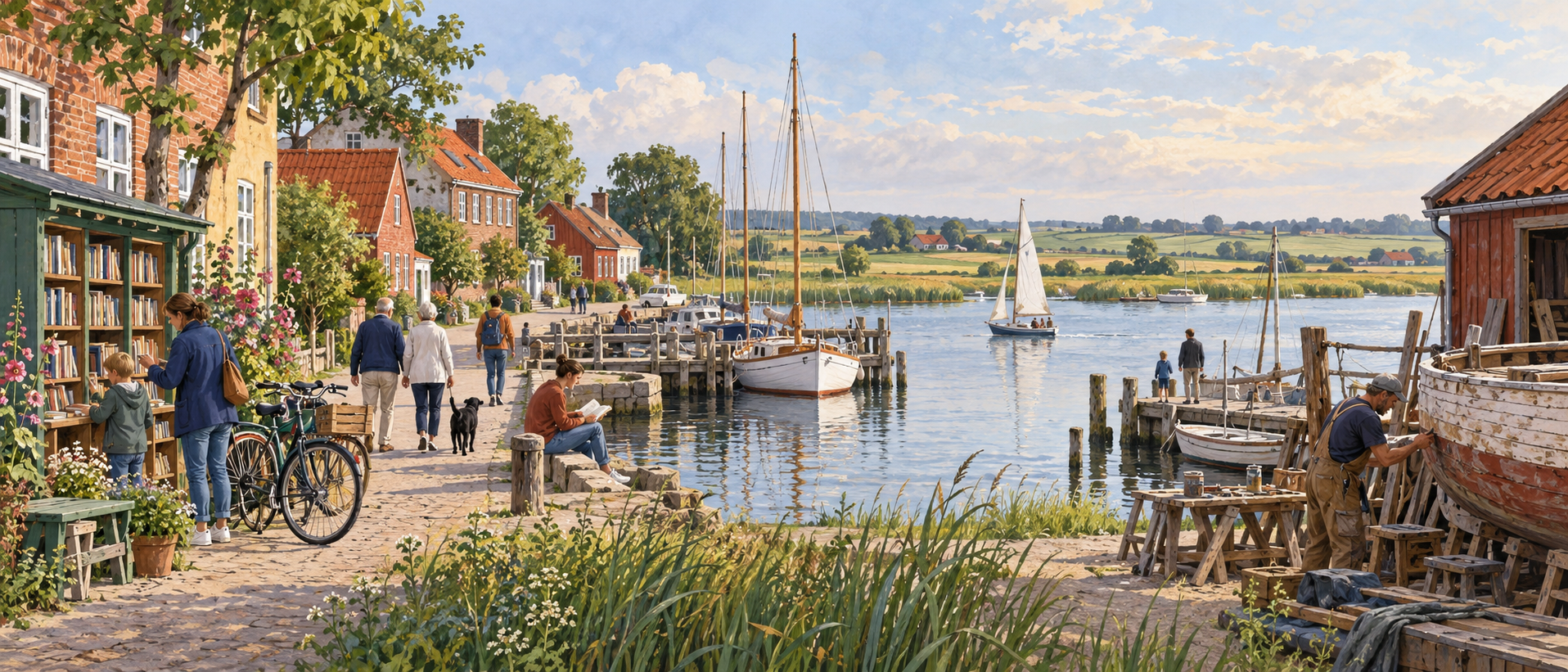
Denmark feels particularly good when you stop asking how many landmarks you can squeeze into a day. The best things to do when visiting and touring Denmark begin with Copenhagen’s waterfront, bicycles, royal architecture and design, but stretch to Viking ships at Roskilde, castles at Helsingør, the white chalk cliffs of Møn, Odense’s storytelling and Aarhus’s art and urban life. Farther into Jutland, Viking monuments, North Sea tides and fossil-rich cliffs remind visitors that Danish history was always shaped by land and water.
This Denmark travel guide helps first-time visitors choose from ten experiences, make realistic Copenhagen and Denmark itinerary plans, understand the UNESCO World Heritage landscape and handle the details of cycling, rail travel, islands, ferries and Schengen entry. If you are looking for Copenhagen things to do, family-friendly Danish attractions, Viking heritage, Aarhus museums or the newly recognised Møns Klint and Western Limfjord geology, start with a coherent region. A happy holiday here is not necessarily a busy one.
Travel information checked 9 October 2026: Denmark uses the Danish krone and belongs to the Schengen area. Eligible visitors must count time across the Schengen area under applicable 90-in-180 rules; the EU Entry/Exit System may involve biometric registration. The Faroe Islands and Greenland, although parts of the Kingdom of Denmark, are outside the EU and Schengen and require their own travel planning. Weather, ferries and coastal cliffs demand seasonal checks. Conditions, entry rules, attraction access and schedules may change; verify them for your actual dates.
eduKateSG · A WORLD WORTH UNDERSTANDING
Denmark: find your best kind of journey
Harbour life, design, Viking histories, fossils and tides: one very enjoyable country with several distinct chapters.
Denmark at a glance
Most first-time visitors arrive in Copenhagen on Zealand, where canals, museums and public transport can occupy several rewarding days. Roskilde and Kronborg Castle make meaningful history-based extensions in the wider region; Møns Klint is a separate nature excursion requiring a careful look at road and bus options. Jutland, meanwhile, contains Aarhus, Jelling, Ribe, North Sea landscapes and fascinating fossil deposits.
The country is well linked by trains and roads across the main islands and peninsula, though travel time and cost depend on your chosen tickets. Walking and cycling are central to many visitor experiences, but the cycling infrastructure works precisely because people follow traffic rules rather than weaving across bike lanes for photographs.
Denmark’s UNESCO story has recently gained two geological chapters. Møns Klint was inscribed in 2025, and The Bony Fish Fossils of the Western Limfjord – Evolution and Climate Adaptation in the Earliest Eocene was inscribed in 2026. They complement Viking ring fortresses, cathedrals and castles, revealing that the landscapes underfoot can be as important as the monuments above them.
- First four days: Explore Copenhagen carefully, including a design or history museum and a leisurely harbour walk.
- History extensions: Roskilde Cathedral and Viking ships, Kronborg Castle or Jelling’s royal Viking monuments.
- Nature chapter: Møns Klint on Zealand’s wider southern route; the Wadden Sea or Western Limfjord in Jutland.
- Currency and entry: Danish krone; Schengen passport rules and EES apply to eligible travellers.
Entry, safety and respectful visiting
The UK FCDO’s Denmark entry guidance, updated in August 2026, confirms Schengen arrangements and warns that introducing the EU Entry/Exit System can lengthen border processing. Passport-specific rules vary, so Singapore and other non-UK readers should confirm their own consular eligibility rather than assume British visa exemptions apply. For qualifying short stays, previous Schengen days count towards the common allowance.
Copenhagen’s cycle lanes are functional transport routes, not extensions of the sidewalk for stopping to take pictures. Follow signs, use designated crossings and look carefully before stepping into a bike lane. Danish weather can change from pleasant sunshine to cold wind or rain; layered clothing and a safe transport alternative make outdoor days happier.
Coastal cliffs and the North Sea need caution even in a country with excellent visitor infrastructure. Erosion constantly changes Møns Klint, and high tides make Wadden Sea access hazardous without expert timing. Do not approach unstable chalk edges, wander far onto tidal flats independently or assume a boat will operate in poor weather. Faroe and Greenland expeditions belong to separate expert-planned journeys, not a casual mainland Denmark add-on.
1. Experience Copenhagen’s harbour as an everyday urban landscape
Start with Copenhagen’s relationship to water. Nyhavn’s painted buildings and historic harbour setting are instantly recognisable, but the more interesting story is how the city has changed its waterfront from working port infrastructure into public space. Choose a leisurely walk that also includes a quieter canal or harbour stretch, so the day is not reduced to one crowded photograph.
Notice how pedestrians, bicycles, boats and cafés coexist. Public spaces work because residents move through them with habits and expectations of their own. Follow the cycling rules and do not step backward into a bike lane while taking a picture. A local walking tour can reveal why a bridge, warehouse or converted industrial building matters.
The most rewarding waterfront hour might be a simple one: a bakery purchase, a view across the water and time to observe the city. If taking a canal boat, verify the legitimate operator and weather rather than assuming every route runs year-round.
Make it worthwhile: Plan a harbour walk connecting one famous view to a quieter local waterway, adding an authorised canal tour if desired.
Check before going: Check boat availability, weather, bike traffic and the difference between public paths and private waterfront property.
2. Discover Copenhagen through design, royal spaces and daily life
Denmark’s reputation for design becomes far more interesting when you look beyond expensive chairs. Museums, public buildings, street furniture and homewares show how materials, craftsmanship and everyday needs interact. A design museum can turn the seemingly ordinary act of sitting, lighting a room or using a bicycle into a small lesson about aesthetics and function.
Pair that with a royal or civic setting, perhaps the Amalienborg area, where ceremonial architecture and active institutions share a city. Understand the purpose of a palace square rather than expecting its occupants or guards to perform for visitors. The history of monarchy, public life and urban design is richer when approached with respect for the people who work there.
If you travel with children, choose one museum or historical interior rather than three in a row. End with a neighbourhood meal or a park. Copenhagen is at its best when curiosity fits comfortably into the pace of living.
Make it worthwhile: Choose one design-focused museum and one appropriate civic or royal-area walk, leaving time for a relaxed meal.
Check before going: Confirm museum admissions, royal event restrictions, temporary closures and accessibility.
3. See Viking ships and a royal cathedral in Roskilde
Roskilde is one of Denmark’s most rewarding excursions because it combines two very different forms of evidence. The Viking Ship Museum explains maritime technology, travel and the people who built and used vessels; Roskilde Cathedral, listed by UNESCO, records another long chapter of religious and royal history. Together they make the past both practical and monumental.
A reconstructed boat is not merely an exhibit to photograph. Ask how craftspeople knew what to rebuild, which materials were used and how the vessels responded to wind and water. A cathedral reveals a different kind of skill: brick construction, memorial architecture and generations of changing ceremonial practice.
Leave enough time for both sites without turning them into rushed checklist items. Some museum demonstrations or sailing activities are seasonal, while religious services may affect cathedral access. Roskilde also has its own town life worth enjoying after the major heritage stops.
Make it worthwhile: Spend a full historical day on ships, craftsmanship and the cathedral rather than a short photo stop.
Check before going: Verify museum activities, cathedral hours and train connections from Copenhagen.
4. Visit Kronborg Castle as a lesson in the Baltic straits
Kronborg Castle at Helsingør has literary fame because of Shakespeare’s Hamlet, but its geographical position is the first story to understand. It stands near the narrow waters separating Denmark and Sweden, where control of shipping routes mattered greatly. UNESCO recognises the fortified Renaissance complex as an outstanding historic monument.
Walk its public rooms and exterior spaces with a sense of the maritime landscape beyond. Ask how a castle could project power over passing ships and why both military engineering and ceremonial architecture mattered. The literary association is enjoyable, but it becomes stronger when placed within real political and economic history.
An afternoon here can be combined with Helsingør’s harbour or cultural setting, if the weather and transport work. Cross-strait views are enticing, but an additional trip into Sweden requires separate scheduling and the appropriate documents.
Make it worthwhile: Choose an official castle route and observe how its location controls the surrounding waterway.
Check before going: Verify current castle tours, event closures, opening days and rail or ferry arrangements.
5. Walk Møns Klint with an appreciation of moving geology
On the island of Møn, tall white chalk cliffs rise above a turquoise-looking Baltic shore. Their appeal is immediate, but UNESCO’s 2025 World Heritage inscription identifies something deeper: powerful glaciers pushed and deformed ancient chalk layers, leaving a landscape that reveals how ice, rock and erosion shape one another.
The GeoCenter and approved trails can make those processes visible. Look at chalk, flint, beech forest and the changing cliff line rather than treating the view solely as a dramatic background. Fossils and delicate habitats are part of the site’s conservation story, and some sections may be inaccessible after storms or erosion.
The cliff edge and beach approaches demand respect. Slippery steps, falling material, steep gradients and changing sea conditions make independent shortcuts unwise. Møns Klint is a fine nature day when you select a suitable route, but it is not a quick stroll from central Copenhagen without a realistic transport plan.
Make it worthwhile: Learn the glacial history through official interpretation and follow one currently open, manageable viewpoint route.
Check before going: Consult local nature-manager notices, erosion hazards, tide and wave conditions, stairs and seasonal access.
6. Meet Odense through Hans Christian Andersen and a living city
Odense is closely associated with Hans Christian Andersen, whose fairy tales remain known across the world. A museum or guided literary route offers an opportunity to ask how stories travel across languages and centuries. That is more engaging than merely standing beside a statue of an author whose books you may already know.
Explore the relationship between Andersen’s biography, local history and modern exhibitions. Some versions of a story feel different when read aloud or translated; a family visit can turn that into a playful learning activity. The city itself has contemporary neighbourhoods, cafés and public life that deserve attention beyond literary landmarks.
Odense sits on Funen and can fit a route between Copenhagen and Jutland if the timing works. Plan a real visit rather than a frantic station-stop photograph. A quieter afternoon in a museum or garden may be exactly what a longer Denmark itinerary needs.
Make it worthwhile: Choose an Andersen interpretation experience and connect it with a relaxed town walk or reading moment.
Check before going: Confirm museum bookings, exhibition languages, seasonal schedules and the correct rail stop.
7. Spend a thoughtful day with Aarhus’s art and Old Town
Aarhus, in eastern Jutland, is a university city with a distinct mix of old and contemporary spaces. ARoS Aarhus Art Museum makes a compelling introduction to modern visual culture, while Den Gamle By presents urban history through preserved buildings and interpretation. Seeing both lets a traveller ask how people in different periods imagined daily life.
Visit Denmark announced a James Turrell Skyspace installation, The Dome, for 2026 at ARoS, a reminder that museum programmes change. Check the museum’s current admission and opening arrangements rather than assuming a press announcement guarantees access on your chosen day. Give at least one artwork time to work on you instead of racing for an iconic photo.
Then move to an older street scene or harbour area and consider how Aarhus continues to change. Its appeal lies in the conversation between culture, students, industry and the sea. Staying overnight can feel more rewarding than a long same-day round trip from Copenhagen.
Make it worthwhile: Pair a contemporary art experience with one urban-history setting, leaving space for the city’s own pace.
Check before going: Verify ARoS exhibition and ticket information, Den Gamle By hours and intercity train travel.
8. Follow Viking history from Jelling to the ring fortresses
Jelling’s mounds, rune stones and church are UNESCO-listed landmarks associated with early Danish royal history. They make an excellent starting point for asking how written language, public monuments and political change were represented in the Viking Age. A good interpretation experience focuses on what the stones say, who commissioned them and how historians work with incomplete evidence.
Denmark’s five Viking-Age Ring Fortresses entered the World Heritage List in 2023. Their geometric plans and construction are fascinating evidence of organisation and technological knowledge. The component sites are spread across the country, so they are best considered as linked history chapters, not one all-inclusive afternoon excursion.
Select Jelling or a suitable ring fortress with a museum and opening timetable that fits your route. Respect archaeological boundaries and avoid walking over fragile features simply to capture a more symmetrical aerial image. The history becomes more exciting when the surrounding landscape is included.
Make it worthwhile: Choose one Viking heritage site for a full interpretation and compare its map with the other fortress locations.
Check before going: Check actual site access, interpretation centre hours, museum exhibits and transport across Jutland.
9. Discover the Western Limfjord’s newly recognised fossil world
In July 2026, UNESCO inscribed The Bony Fish Fossils of the Western Limfjord, a Danish natural World Heritage property associated with fossil-rich deposits from the earliest Eocene. Its scientific importance rests on exceptional evidence of fish evolution and environmental adaptation after a period of profound global climatic change.
The dramatic layered slopes and coastal exposures around the western Limfjord invite questions about what the sea looked like millions of years ago. Microscopic organisms, sediment and volcanic ash helped preserve a geological record that scientists can still interpret. A good geoheritage day begins with a museum or authorised guide rather than trying to collect fossils anywhere you please.
Cliff and shoreline access must respect conservation, private land and erosion hazards. Fossil collecting is subject to local rules and should never damage protected exposures. The place teaches a powerful lesson: a landscape does not have to be mountainous to contain a story of planetary significance.
Make it worthwhile: Study the 2026 UNESCO inscription and seek a managed museum or geoheritage interpretation visit.
Check before going: Confirm permitted paths, fossil-collection rules, tidal conditions and access to relevant sites in the Limfjord.
10. Let Ribe and the Wadden Sea teach you about tides and settlement
Ribe is one of Denmark’s historic towns, with old streets and a relationship to marsh and coastal landscapes that gives Jutland a different character from Copenhagen. It can form a rewarding heritage morning before a carefully managed Wadden Sea experience, provided you allow enough time to understand the enormous tidal environment.
UNESCO recognises the Wadden Sea across Denmark, Germany and the Netherlands as an exceptional coastal ecosystem. Its mudflats, channels and migratory birds depend on constantly moving water and sediment. A guided walk or appropriate nature tour can reveal how people and animals respond to tides, but the landscape is not a place for improvising a hike to the horizon.
Choose a licensed local nature interpreter who understands tide timing. Wear practical clothing, keep your distance from wildlife and ask about areas closed for breeding or conservation. Ribe and the sea make an especially fine reminder that a landscape’s most important feature can also be its greatest hazard.
Make it worthwhile: Combine one historic-town walk with an authorised tidal-landscape experience and learn to read the water.
Check before going: Do not enter tidal flats without appropriate local expertise; confirm flood timing, weather and nature restrictions.
Routes designed for real days
Four to six days in Copenhagen and eastern Zealand
Stay based in Copenhagen, choose relaxed city days and add Roskilde or Kronborg as a distinct history excursion. A dedicated Møns Klint nature day needs more deliberate ground travel and should only be added if your available days allow.
Seven to ten days from Copenhagen to Funen and Aarhus
Explore Copenhagen, continue through Odense for Andersen and city life, then spend several nights in Aarhus. This route mixes design, literature and modern art without asking for a new hotel every night. Jelling can be a carefully timed extension if rail or road conditions suit.
A Jutland heritage-and-landscape holiday
Focus on Aarhus, Jelling, the Western Limfjord fossils, Ribe and Wadden Sea ecology across several days. Choose a geographically sensible base or two. The limiting factor is not enthusiasm but opening days, travel times and coastal weather.
Islands and the far north as separate future journeys
Bornholm, Skagen, the Faroe Islands and Greenland offer entirely different regional experiences. Bornholm ferry or flight links, Skagen’s northern geography and the Faroe/Greenland visa and climate considerations merit their own plans; don’t imply they are day trips from central Copenhagen.
Practical choices before bookings
The Danish krone (DKK) remains the currency, and EU or Schengen membership does not mean euro usage. Contactless payment is common in many areas, but check the legitimacy of operators and card fees. Trains, buses and urban transport use different ticket systems and may have bicycle restrictions at busy times.
Denmark is part of Schengen, so nationality-specific visa and rolling stay rules matter; the FCDO notes that the EU Entry/Exit System is being implemented at external borders. The Faroe Islands and Greenland have separate administrative arrangements: a passport or visa that covers mainland Denmark should not be presumed to settle those journeys. Check with Danish or local authorities as appropriate.
Plan outdoor days around weather rather than around social-media images. Cliffs and fossil sites require terrain awareness, Wadden Sea mudflats require tide expertise and island boats are vulnerable to wind. Museum, café and design experiences make excellent alternatives when conditions do not allow an outdoor plan.
- Confirm your nationality’s Schengen entry rules and any prior Schengen days.
- Allow extra processing time for EES checks when travelling through external borders.
- Use Danish krone and check train, bus and bicycle-ticket conditions.
- Reserve popular museum or attraction admissions through official venues.
- Stay on safe established routes around chalk cliffs and fossil deposits.
- Use professional tide interpretation for Wadden Sea trips.
- Treat the Faroe Islands and Greenland as distinct destination planning exercises.
- Choose one or two regions for a short visit instead of crossing the whole kingdom.
Twelve useful English–中文 travel words
These English–Chinese reading aids make preparation easier. They do not replace local languages, official notices, permissions or a professional guide where necessary.
| English | 中文 | Think about |
|---|---|---|
| harbour | 港口 | Working waterways connect city life. |
| bicycle lane | 自行车道 | Look before crossing. |
| royal castle | 皇家城堡 | Respect active institutional spaces. |
| Viking ship | 维京船 | Learn about craftsmanship and travel. |
| cathedral | 大教堂 | Check worship and access rules. |
| chalk cliffs | 白垩峭壁 | Watch erosion and cliff edges. |
| fossils | 化石 | Respect collection and access rules. |
| tidal flats | 潮滩 | Use a qualified guide. |
| design museum | 设计博物馆 | Explore everyday materials and function. |
| train ticket | 火车票 | Confirm route and bicycle policy. |
| Danish krone | 丹麦克朗 | Local currency. |
| Schengen area | 申根区 | Shared entry-day rules may apply. |
A travel notebook that tells a better story
Choose a recurring question for the country: ‘How does Denmark make space for daily life?’ Look for the answer in Copenhagen’s bicycle lanes, Roskilde’s shipbuilding, Aarhus’s public art and a carefully organised tidal walk near Ribe. Urban design, archaeology and conservation may seem like different subjects, but all involve choices about how people use shared space.
Keep a record of the moments that required restraint. Maybe you stayed away from an unstable chalk edge, allowed a museum room more time or chose a short walk rather than a risky mudflat crossing. Good travel memories are made by judgment as well as curiosity.
Questions worth answering
How many days are best for Denmark?
Four or five days works for Copenhagen and one nearby excursion. A week to ten days lets you add Funen or eastern Jutland without constantly changing hotels.
Does Denmark use the euro?
No. The official currency is the Danish krone, even though Denmark is in the European Union.
What is new in Denmark’s UNESCO heritage in 2026?
The Bony Fish Fossils of the Western Limfjord property was inscribed on the World Heritage List in 2026; Møns Klint joined in 2025.
Can I visit Møns Klint as a simple central Copenhagen walk?
No. It is a separate destination on Møn that needs transport planning, a suitable trail and current erosion-safety checks.
Are Greenland and the Faroe Islands included in mainland Denmark’s Schengen arrangements?
No. They are distinct jurisdictions within the Kingdom of Denmark and are outside the EU and Schengen area; consult their own entry requirements before travelling.
Original sources and further reading
The linked tourism, heritage and government sources provide essential background, not a guarantee of live opening times or suitability. Check all access, security and health details again immediately before acting.
- VisitDenmark — official travel guide
- VisitDenmark — Denmark UNESCO heritage places
- VisitDenmark — new experiences in 2026
- UNESCO — Denmark World Heritage properties including 2026 Western Limfjord
- UNESCO — Møns Klint (2025 inscription)
- UK FCDO — Denmark 2026 travel advice
- UK FCDO — Denmark entry, EES and Greenland/Faroe details
- VisitDenmark — Viking heritage and ring fortresses
Continue alphabetically: Democratic Republic of the Congo ← Denmark → Djibouti. Return to the World Country Directory or continue through the World Travel Hub.
For city-level research, browse the World City Experiences Directory and World City Travel Essentials.